
Cracked Hill
Geological museum and educational center that becomes part of incredible land

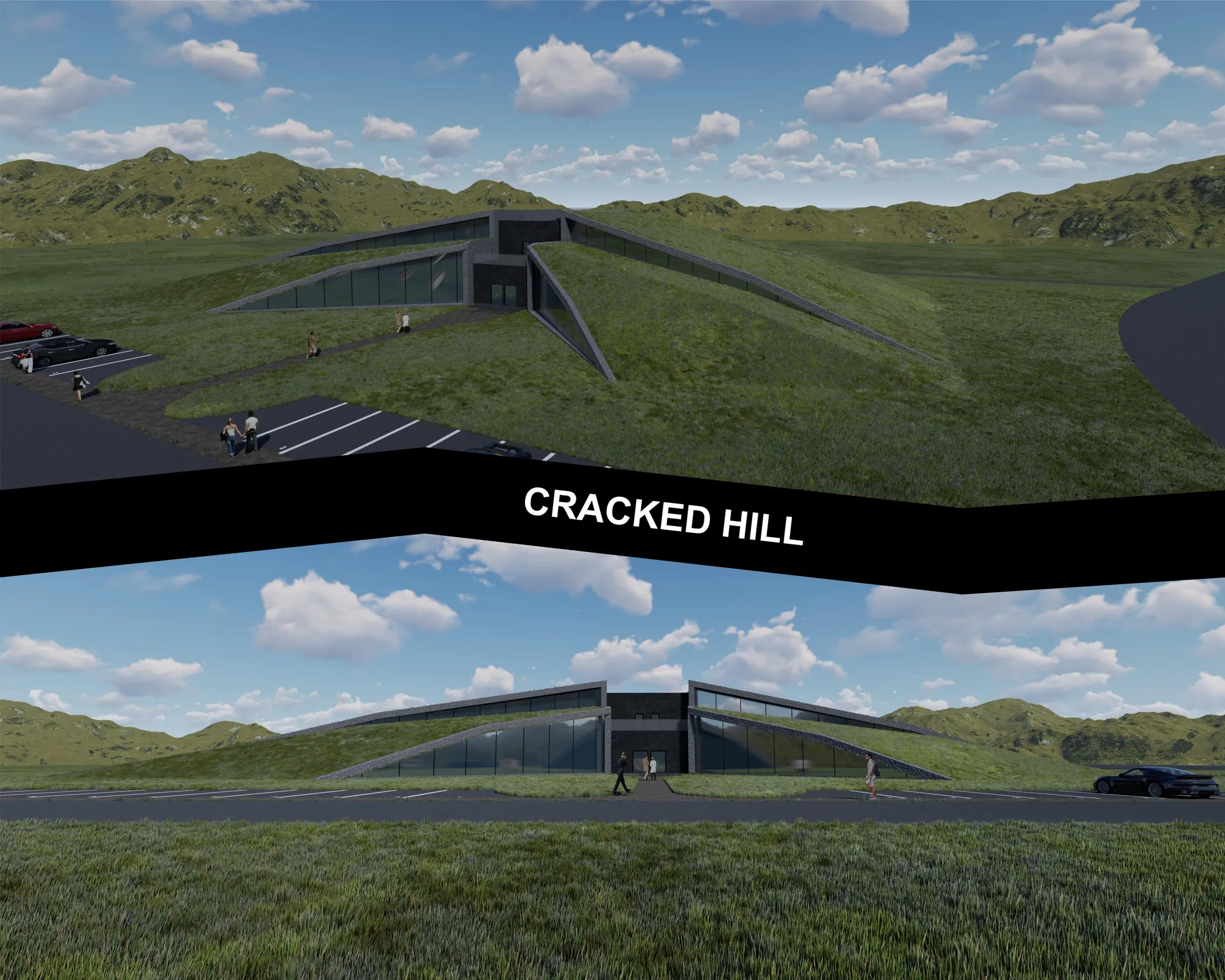
Cracked hill is a building project that attempts to meet the challenge of the location in which it is to be situated. The context of the surroundings, that is, the beautiful landscape of the national park Þingvellir in this place, uncontaminated by any conspicuous buildings, actually forces us to develop a concept of a building for a geological museum and educational center that would blend in with the surroundings as effectively as possible, without hindering the enjoyment of the local views by the people who are there, who undoubtedly mostly come there precisely in order to commune with nature. In order to meet the assumption of blending the building into the surroundings as effectively as possible, I decided to use a block which in its form resembles the organic shape of a hill. As you can see, one of the characteristic features of this location are the hills to which the view extends from virtually every side. However, the organic form of the building in this case is not enough to achieve a satisfactory effect, so I decided to use green roofs to cover the building of the geological museum and education center (by the way, green roofs are one of the most characteristic features of Icelandic architecture). The combination of the organic form of the hill and green roofs ultimately resulted in the building blending in with the local landscape, but my work on the building did not end there. I also wanted - since it was to be a geological museum - to emphasize the fact that it is located in Iceland in the Þingvellir National Park. The park lies in a rift valley that marks the ridge of the Mid-Atlantic Ridge and the boundary between the North American and Eurasian tectonic plates. I wanted to show this somehow through the forme of the building. I thought that a good effect would be given by cutting the body of the hill into two parts and placing a cuboidal form between them. this procedure makes the building resemble a cracked hill, which can be considered some form of allusion to the local location. The whole form is complemented by glazing in the form of curtain walls placed in the cut places of the solid, which adds even more dynamism to the body of the building.
As for the program included in the building design, it meets all the essential requirements of the competition. Learning and recreation constitute 50 percent of the program, all rooms are located on the first floor with the exception of part of the exhibition hall, which, due to the pronounced slope of the building, had to be partially located on the lowered first floor; moreover, part of the exhibition hall has been placed near the lobby to allow visitors to interact with the exhibits from the very entrance. The cafe is located immediately at the main entrance, while the auditorium has been placed close to the lobby so as to allow more people to leave the building as quickly as possible. Learning/workshop areas are located near the exhibit hall, in the same circulation path as Washrooms/Toilets. Research occupies 30 percent of the facility, with rooms located on two floors, the first floor and the first floor. There is a separate entrance for this area - on the south side - plus its users have a separate parking lot. Laboratories are located on the first floor and on the first floor similarly to researchers offices, guest rooms are located on the first floor besides. As for Services, it occupies 20 percent of the program, as stipulated in the regulations. Entrance Lobby was placed on the north side, Washrooms/Toilets near the lobby(in the same place on the first floor), similarly to Administration office and Curator's office, Utility was located in the lowering of the first floor on the west side. The building on the side of the main entrance door, so among other things for visitors, is connected to the surrounding tourist parking lot by a wide sidewalk.
The materials of which the geology museum and learning center building is composed from the outside are primarily intended to correspond as well as possible with the location there. I chose green roofs to cover most of the building. The walls, in part, are glazed and in part finished with stone slabs. The interior has been kept in darker subdued colors also through the use of stone slabs. As for the construction, it is mixed, mostly consisting of reinforced concrete walls, with reinforced concrete columns used where necessary. Partition walls will be erected from ceramic elements.

Popular Articles
Popular articles from the community


AL-JANNAH: Sustainable Architecture and Permaculture for Afghan Widows
AL-JANNAH uses sustainable architecture and permaculture to create resilient oasis of housing, learning, work and renewal for Afghan widows.

Conexión: Biophilic Design Reimagines High-Rise Living in Hong Kong
Conexión reimagines high-rise living in Hong Kong through biophilic design, green facades, shared spaces, daylight, water and nature within.

The Earth Pod: 3D Printed Homes for Resilient Refugee Communities
The Earth Pod reimagines refugee housing through 3D printed homes made from clay, combining resilience, self-sufficiency, and rapid shelter.

The Ocean Hive: Sustainable Architecture for a Self-Sufficient Civilization at Sea
The Ocean Hive imagines sustainable architecture at sea, where modular habitats, algae, wave power and ocean waste sustain a growing colony.
Similar Reads
You might also enjoy these articles

The Rhythm of Seasons
A Farmers' Market Connecting Nature and the City

More Than a Building-Designing a Living System
More Than a Building-Designing a Living System
Base Beyond
DESERT COMPOUND ARID: TOURISM OF ABSENCE AND ABUNDANCE

Explore Geological Heritage Competitions
Discover active competitions in this discipline




Challenge to reimagine the Iron Throne


Photograph architecture without architects


Illustrate the lost glory of Angkor Wat - Render Challenge


Design challenge to reuse E-waste
Comments (0)
Please login or sign up to add comments
No comments yet. Be the first to comment!