

ASWA Wraps a Triangular Mixed-Use Building in Glowing Fiberglass Along the Chaophraya River
A craft beer bar, restaurant, and office stack up inside a translucent wedge on a tight triangular site in Nonthaburi, Thailand.


Wedged between a river-crossing bridge and a public park in Nonthaburi, Thailand, the Craft Estate is the kind of building that refuses to be background. ASWA (Architectural Studio of Work - Aholic) took a triangular site of roughly 1,270 square meters and squeezed out a 1,400-square-meter mixed-use structure that rises from 12 to 17 meters, its sharpest point aimed squarely at the Chaophraya River. The trapezoidal plan is not a formal flourish; it is the maximum buildable volume the site allows, given setbacks and zoning. Every angle earns its keep.
What makes the project worth studying is the deliberate split personality of its program and its skin. The building is perceptually cut into two halves: a four-story restaurant zone containing a coffee stand, craft beer bar, semi-outdoor and indoor dining, and a stepped rooftop hangout, and a three-story office block with working areas, meeting rooms, and a managing director's suite on the opposite side. Holding the two halves together, visually at least, is a facade strategy that pairs precast concrete with white translucent fiberglass roof tiles, producing a building that reads as solid concrete by day and as a glowing lantern by night.
A Facade That Filters and Radiates
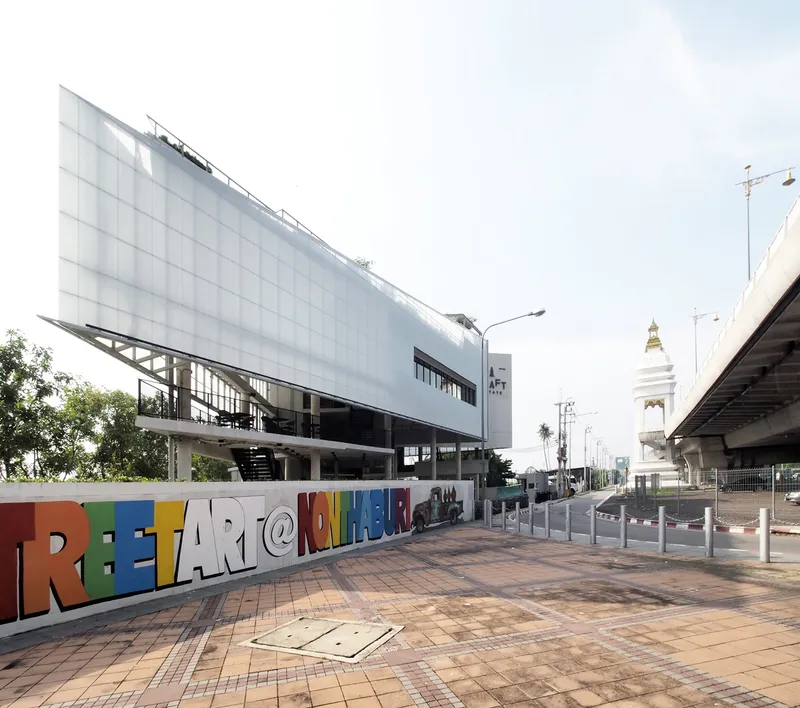
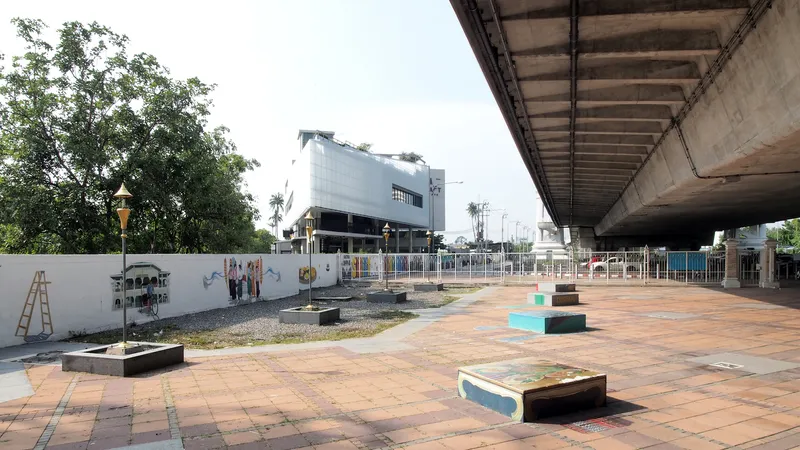
From the street, the Craft Estate presents a gridded screen of translucent fiberglass panels set above a ground floor colonnade of exposed concrete columns. The material choice is pragmatic for Thailand's tropical climate: the fiberglass diffuses harsh sunlight into a soft, even wash of daylight that reaches deep into the floor plates without the heat gain of clear glazing. It also introduces a deliberate blurriness to the interior experience, softening the boundary between inside and outside.
At street level, the building sits beside a highway overpass, and the brick-paved plaza that extends beneath it acts as a buffer zone, connecting the Craft Estate to its urban surroundings through painted planters and shade rather than a hard property line. The screened facade reads as an extension of this in-between condition: neither sealed wall nor open storefront, but something porous.
Infrastructure as Neighbor
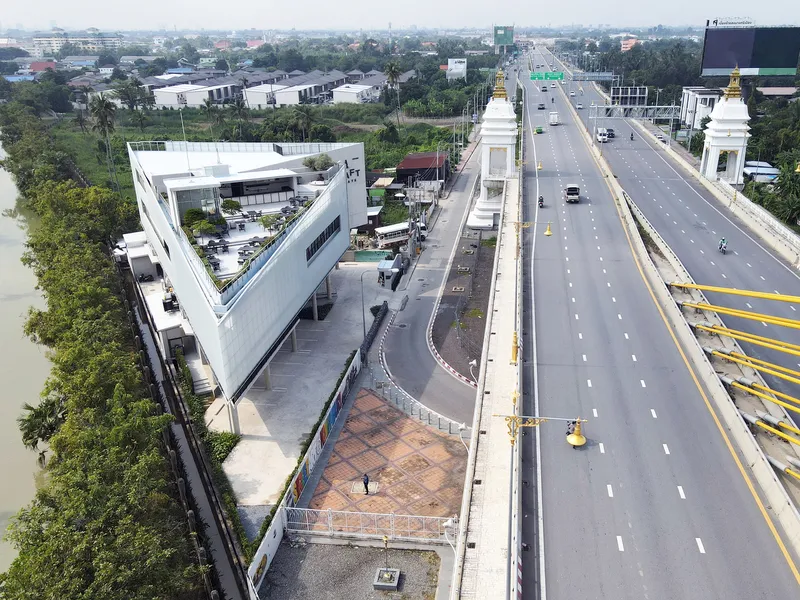
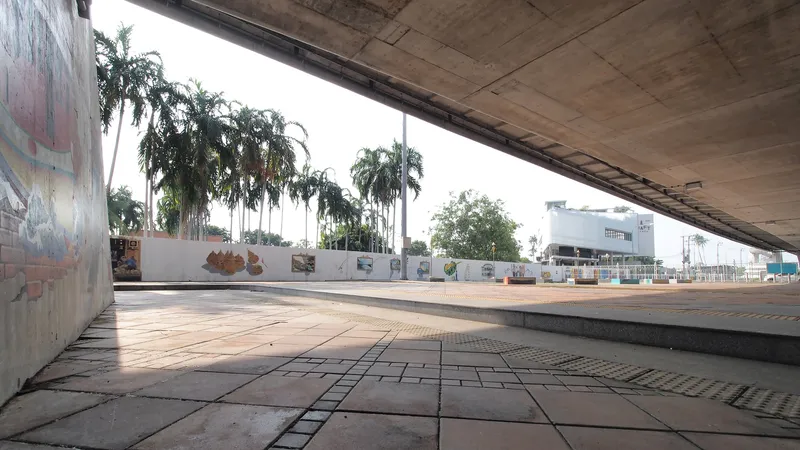
The aerial view is revealing. The Craft Estate sits right alongside a wide highway, flanked by ornamental gateway pylons that signal the bridge crossing. Most architects would treat this proximity as a problem to mitigate. ASWA instead leans into it, orienting the building's public face toward the road and river rather than turning its back. The covered plaza at ground level, with its exposed concrete ceiling and patterned pavement beneath palm trees, creates a sheltered threshold that borrows the drama of passing traffic without being consumed by it.
Siting a restaurant and bar next to a highway overpass is a gamble, but the logic tracks: this is a location with high visibility, easy access, and a river view that most quiet side streets cannot offer. The building's height, ramping from 12 to 17 meters, ensures that upper-level diners clear the noise line and gain the panorama.
The Double-Height Dining Core
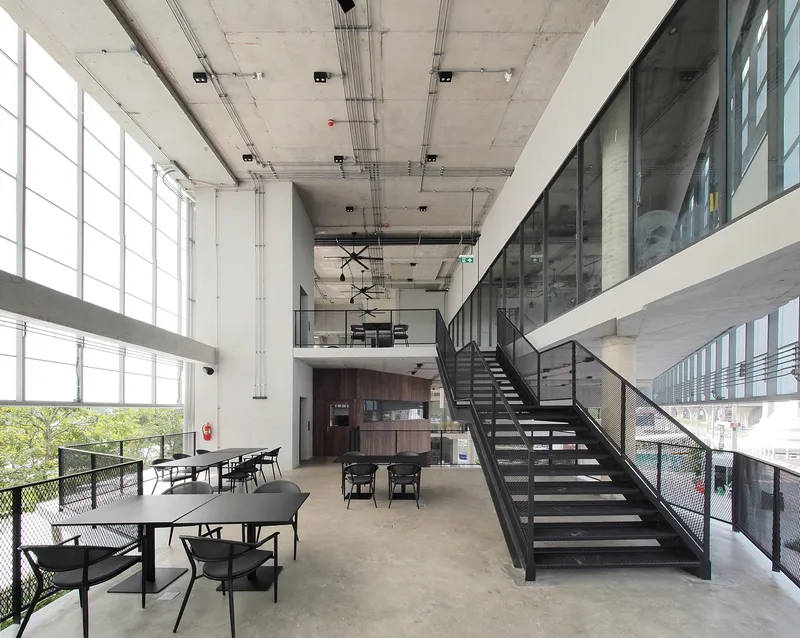
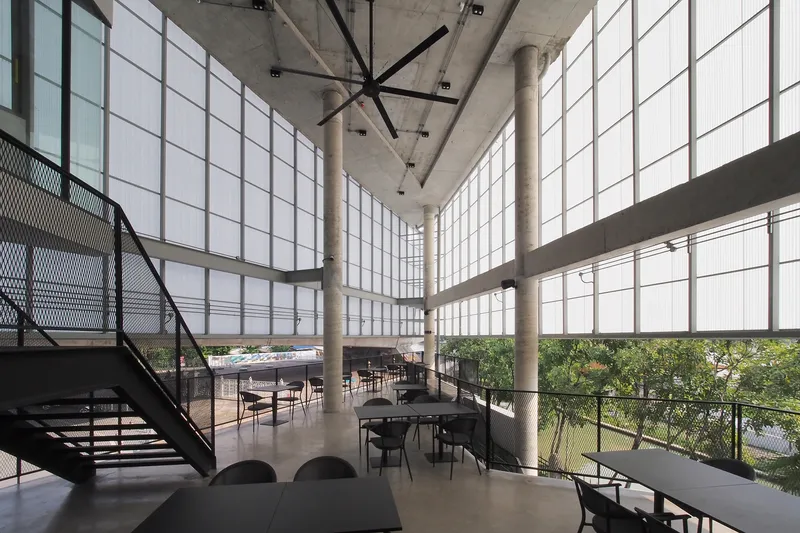
Inside, the restaurant half of the building is organized around a generous double-height volume. An open-tread metal staircase connects levels while preserving sightlines through the space, and a gridded window wall repeats the rhythm of the exterior screen at a more intimate scale. The exposed concrete ceiling is left raw, a move that keeps the material palette honest and reduces the visual fussiness that can plague hospitality interiors.
The atrium-like space looking onto courtyard greenery gives the four-story restaurant section its vertical legibility. You understand you are in a tall, continuous volume rather than a stack of isolated floors. Ceiling-mounted fans are visible, a concession to the humid climate that doubles as a textural element against the rough concrete soffit. The staircase is steel, open-tread, industrial in tone but light enough not to block the filtered daylight streaming through the fiberglass panels.
Mezzanine and Filtered Light
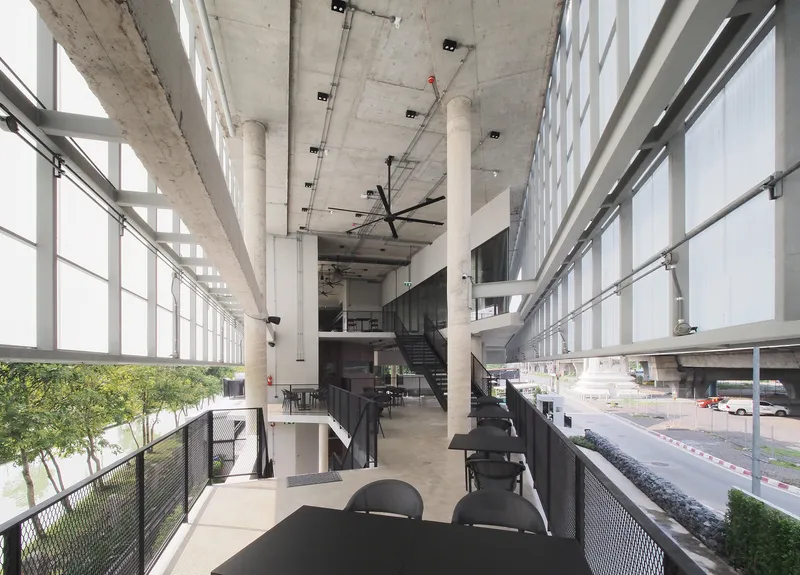
The mezzanine level demonstrates how the translucent wall panels perform in practice. Daylight enters as a diffuse glow, soft enough to eliminate glare on work surfaces or dining tables but bright enough to make the space feel open well into the afternoon. Concrete columns march through the plan at regular intervals, establishing a structural grid that both the restaurant and office zones share. This shared grid is the connective tissue between the building's two programs, allowing them to read as one volume from the outside even when they function independently inside.
The ceiling fans, exposed ducts, and raw concrete are consistent across the mezzanine, reinforcing a material language that is more brewery than boardroom. For a building that houses both craft beer and corporate offices, this industrial register makes sense: it sets a tone that neither function has to fight against.
Why This Project Matters
Craft Estate is a lesson in reading a difficult site as an opportunity rather than a constraint. The triangular plot, the highway adjacency, the bridge: all of these could have produced a defensive, inward-looking building. Instead, ASWA turned the site geometry into the building's defining formal move and used a single, economical material strategy to unify a complex program under one roof. The fiberglass-and-concrete palette does double duty, performing climatically during the day and scenographically at night, when the translucent skin transforms the structure into a riverside beacon.
More broadly, the project argues that mixed-use buildings do not need to segregate their programs behind separate entrances and distinct architectural identities. Here, a craft beer bar and a managing director's office share the same structural grid, the same material vocabulary, and the same relationship to the river. The result is a building that feels cohesive rather than compromised, a genuine community anchor for a stretch of Nonthaburi riverfront that could easily have been overshadowed by the infrastructure around it.
Craft Estate Restaurant and Offices by ASWA (Architectural Studio of Work - Aholic). Nonthaburi, Thailand. 1,400 square meters. Photography by Phuttipan Aswakool.
About the Studio
Share Your Own Work on uni.xyz
If projects like this are the kind of work you want to make, uni.xyz is a place to publish your own, find collaborators, and enter design competitions.


Popular Articles
Popular articles from the community


Singing Woman: An Opera House That Performs Before the Curtain Rises
Ovidiu Cristian Pavel's conceptual opera house translates Estonia's choral identity into a sculpted waterfront landmark facing the Baltic Sea.

Opera on the Sea: Driftwood Logic Shapes a Timber Opera House on Estonia's Coast
Trevor Orgill's opera house translates the entangled drift of floating timber into a civic building where wood, water, and music converge.


David Ortega Stacks a Two-Story Mexico City Penthouse Around a Steel Stair and a Pergola-Shaded Roof Terrace
In Colonia Roma, a 300 m² penthouse uses oak joinery, a planted steel stair and a slatted roof pergola to make a new-build apartment feel like a house.

Aquadapt: An Underwater Habitat That Rewrites Its Rooms by the Hour
Curved modules ring the seabed while one shell shifts from breakfast room to cinema, farm and football pitch as residents' needs change.

Similar Reads
You might also enjoy these articles


Hodi-Mandai Geram
Project Function: Preservation and revitalization of the Intangible heritage and socio-spatial identity of the Hodi by Housing, Cultural Memory Center, Sacred Grove, landscape, local tourism economy


Olio Towers: A Mid-Rise for Performers That Fuses Housing, Rehearsal, and Stage
Located blocks from Houston's Theater District, this modular tower stacks living units around a central performance atrium.

Oasis: Modular Green Housing Carved into Dhaka's Urban Fabric
A shortlisted Plugin Housing entry reclaims unauthorized settlements in Dhaka with stepped concrete volumes, green roofs, and ventilation-driven design.

Black Hole: A Floating Megastructure for the Post-Physical Era
Emiliano Mazzarotto envisions a spherical, self-scaling arena where e-sports, digital hotels, and holographic stadiums replace traditional public space.

Explore Office Building Competitions
Discover active competitions in this discipline

Challenge to reimagine the Iron Throne

Photograph architecture without architects

Illustrate the lost glory of Angkor Wat - Render Challenge

Design challenge to reuse E-waste
Comments (0)
Please login or sign up to add comments
No comments yet. Be the first to comment!