
ONO Inserts a Micro-Village of Sleeping Nooks and Steel Volumes into a San Francisco Warehouse
At Crane Cove, adaptive reuse meets communal invention as an industrial shell becomes a shared living experiment on the waterfront.


Adaptive reuse has become a dependable genre in contemporary architecture, but most projects in the category follow a familiar script: strip the interior, expose the trusses, install polished concrete, lease to a tech firm. Obata Noblin Office (ONO) does something considerably stranger at Crane Cove Warehouse in San Francisco. Inside a cavernous industrial shell, the firm builds what amounts to a small village: freestanding steel volumes, quilted sleeping alcoves with color-changing light, oriented strand board partitions on wheels, and a screening room shaped like a geode. The project reads less like a renovation and more like a cabinet of spatial curiosities dropped inside an old shed.
What makes the project genuinely interesting is its refusal to treat the warehouse as a neutral container waiting for conventional programming. Instead, the existing structure becomes an atmosphere, a climate, a context in itself. The new insertions are deliberately foreign objects: grey steel boxes punched with porthole windows, salmon-colored stairs, yellow ladders that recall ship rigging. Every element signals that it arrived after the fact, that it is a guest inside the host. The result is a layered reading of time and use that most adaptive reuse projects flatten out in the name of seamlessness.
A Steel Box with a Porthole
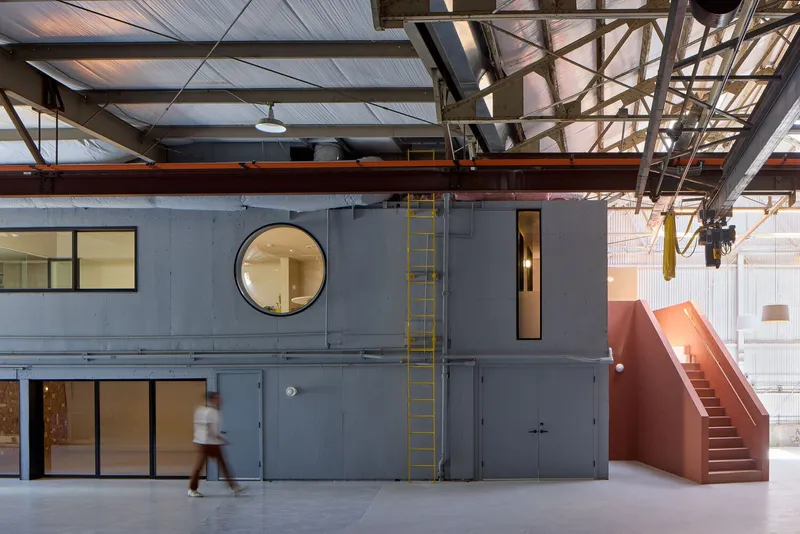
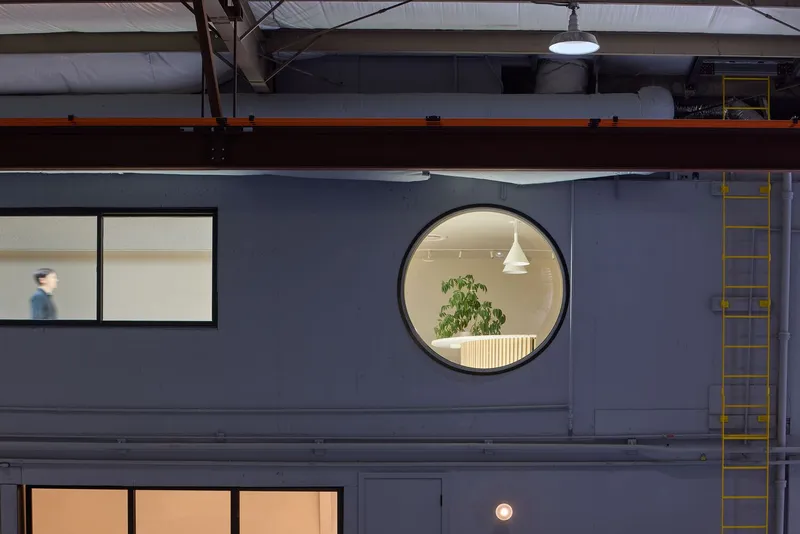
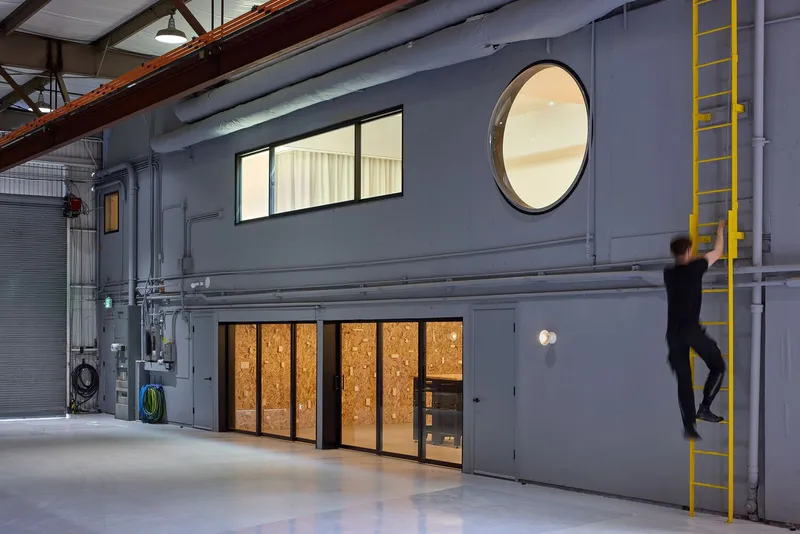
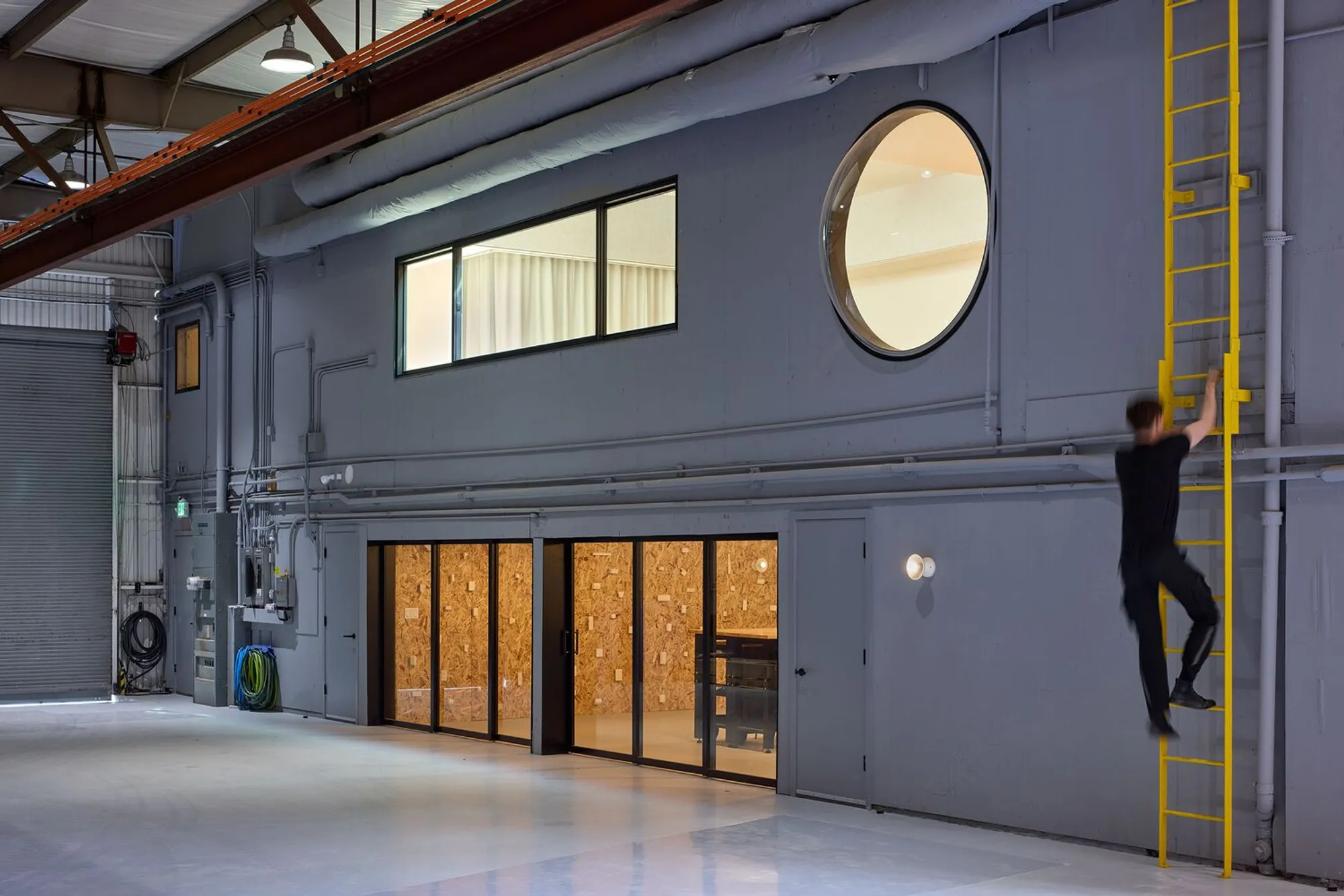
The signature move at Crane Cove is a grey steel volume inserted beneath the warehouse's existing timber trusses. Its circular window, somewhere between a ship's porthole and an observatory lens, frames views back into the larger hall. A yellow ladder bolted to its side provides access to a mezzanine level, giving the object a playful, almost set-design quality. At dusk, interior light spills through the openings and the volume becomes a lantern inside the darker shell.
The proportions are crucial. The box is large enough to feel inhabitable but small enough to remain legible as an object within the warehouse volume. You can walk around it. You can look through it. It does not try to fill the space. That restraint keeps the original industrial character alive while giving residents a genuinely distinct threshold between the communal hall and their private quarters.
Sleeping Alcoves as Immersive Pods
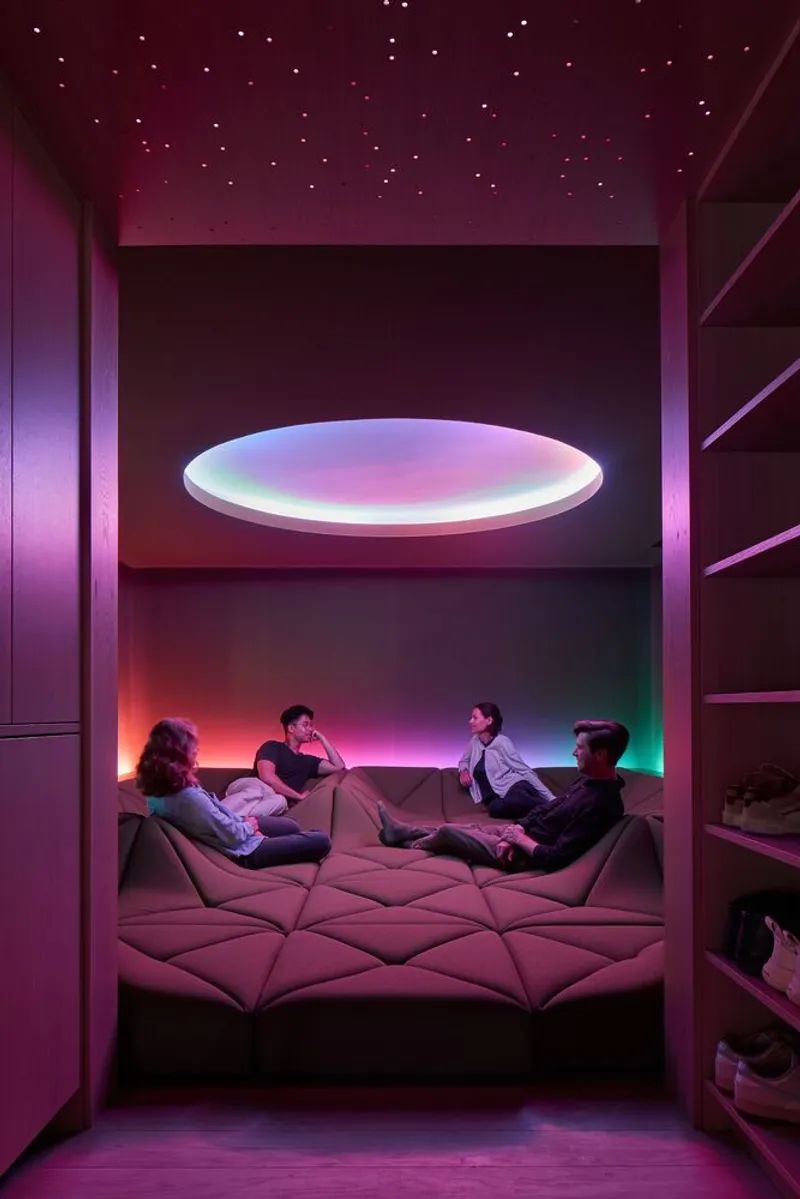
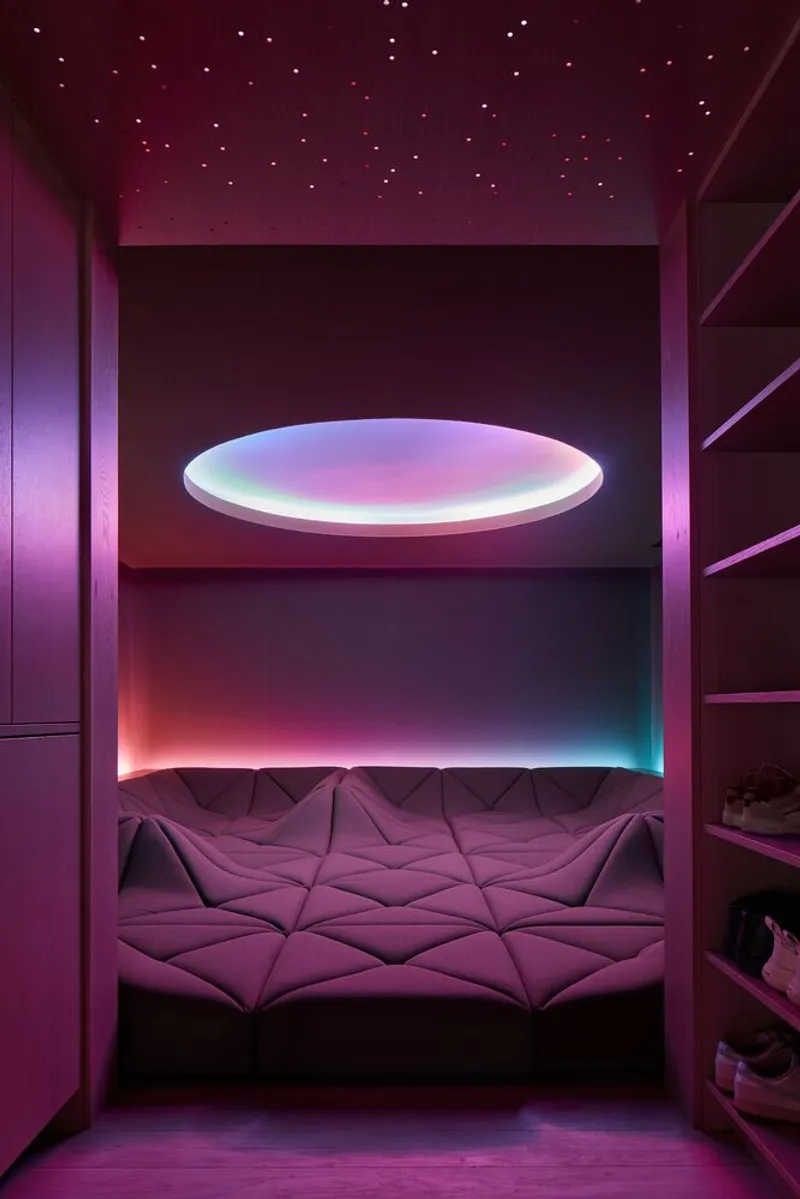
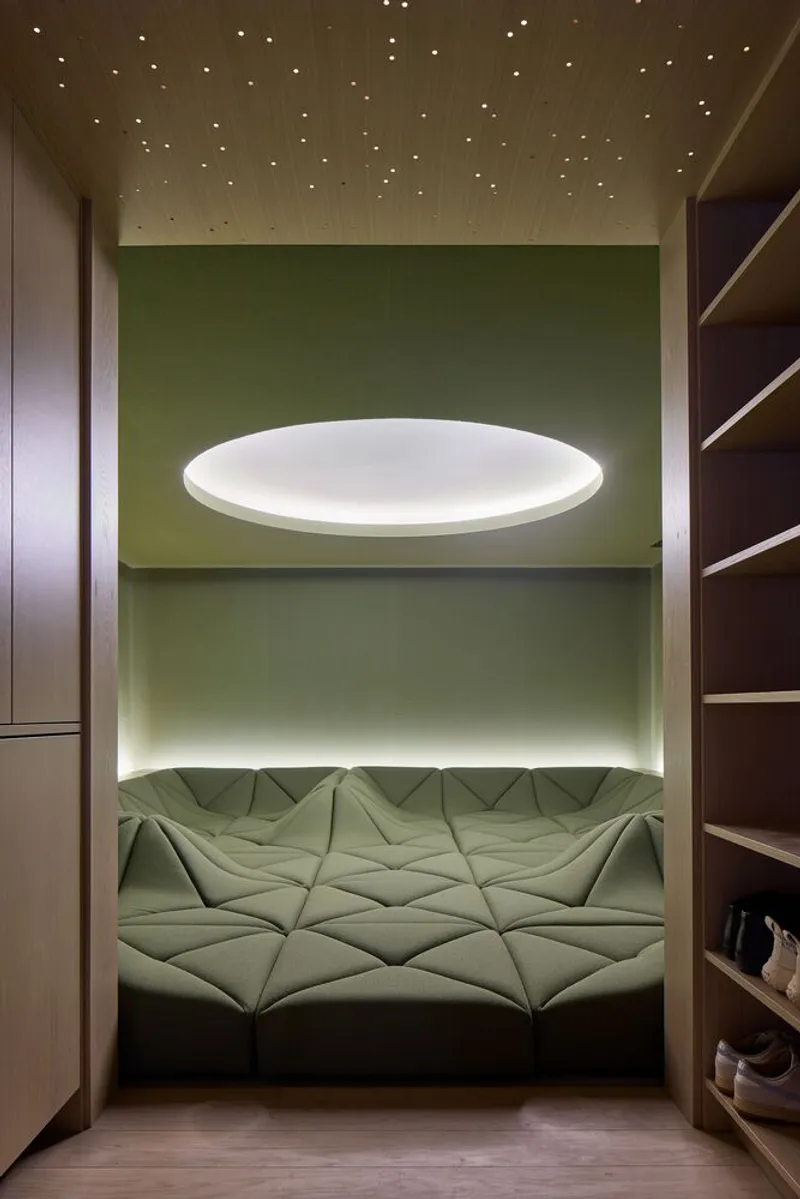
The sleeping nooks are perhaps the project's most provocative gesture. These alcoves are compact, quilted in fabric, and ringed with LED perimeter lighting that cycles through pink, blue, and green. They feel closer to a James Turrell installation than to a bedroom. Four people can recline in a single pod, suggesting that the architects conceived of sleep itself as a communal activity, or at least one not requiring the rigid privacy conventions of traditional housing.
A floating circular luminaire overhead reinforces the sense of enclosure without a door. The alcoves manage to feel womb-like without being claustrophobic, largely because the perforated ceilings and open entries maintain a visual connection to the surrounding space. It is a design strategy rooted in hospitality innovation, Japanese capsule hotels, and the growing co-living movement, but executed with a material warmth that those precedents often lack.
The Screening Room and the Daybed
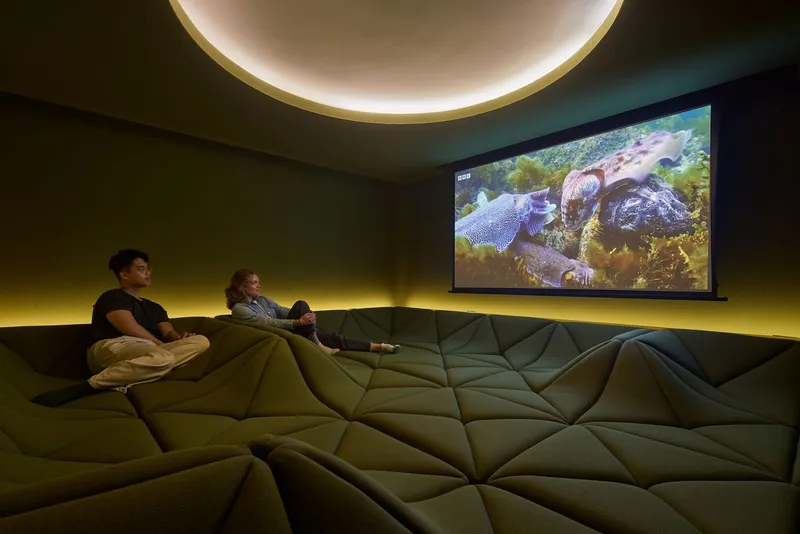
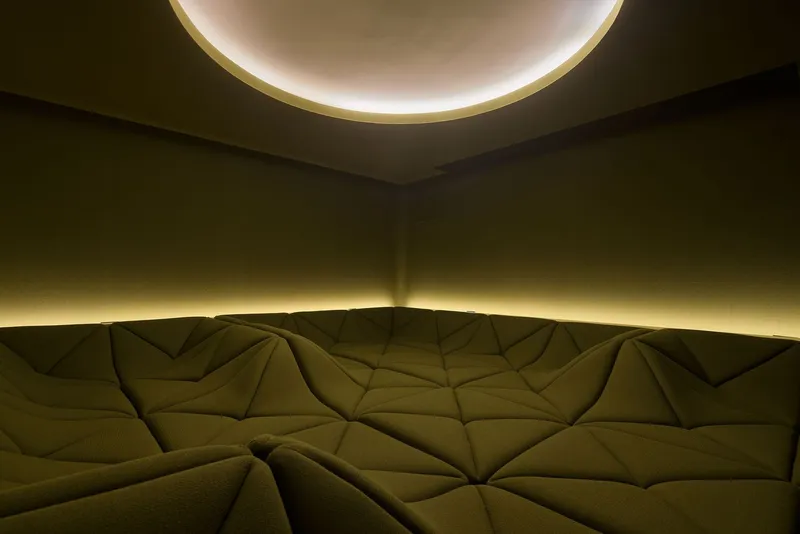
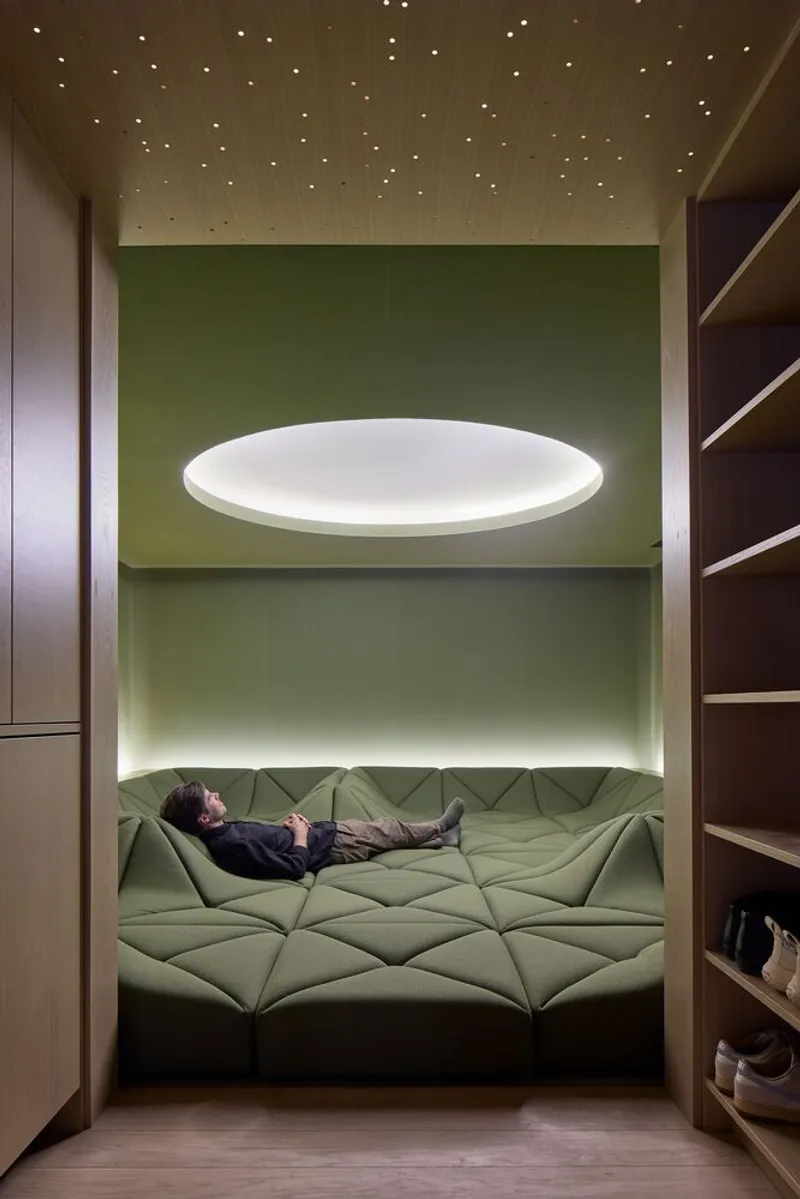
A faceted upholstered platform turns one room into a small screening theater, its geometry folding bodies into a relaxed collective viewing posture. The circular ceiling cove above echoes the porthole motif found elsewhere, tying the cinematic alcove back to the warehouse's nautical vocabulary. It is a social space designed for a specific activity, not a generic "flexible" room, and that specificity gives it real character.
Nearby, a sage green quilted daybed occupies a recessed alcove beneath a perforated ceiling. The combination of soft upholstery and precise architectural framing recurs throughout the project. ONO treats comfort not as an afterthought applied through furniture but as a condition built into the architecture itself. Walls become seats. Ceilings become light sources. The line between fixture and finish dissolves.
Communal Living Spaces
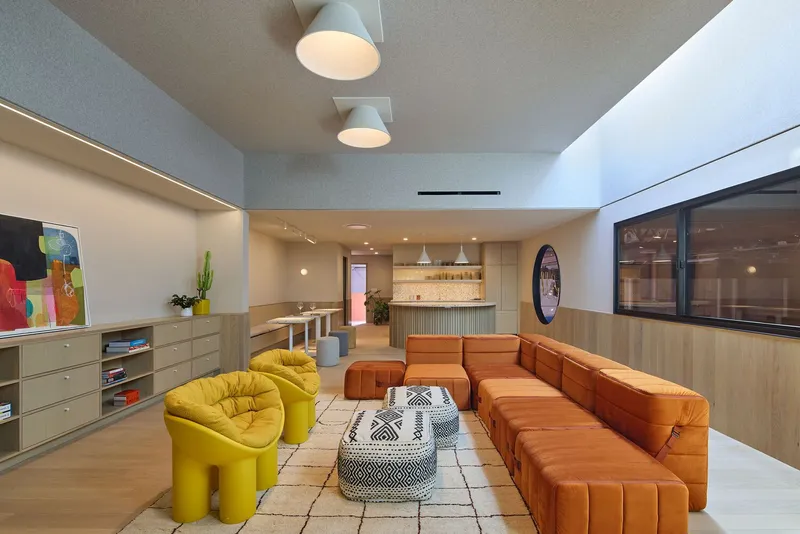
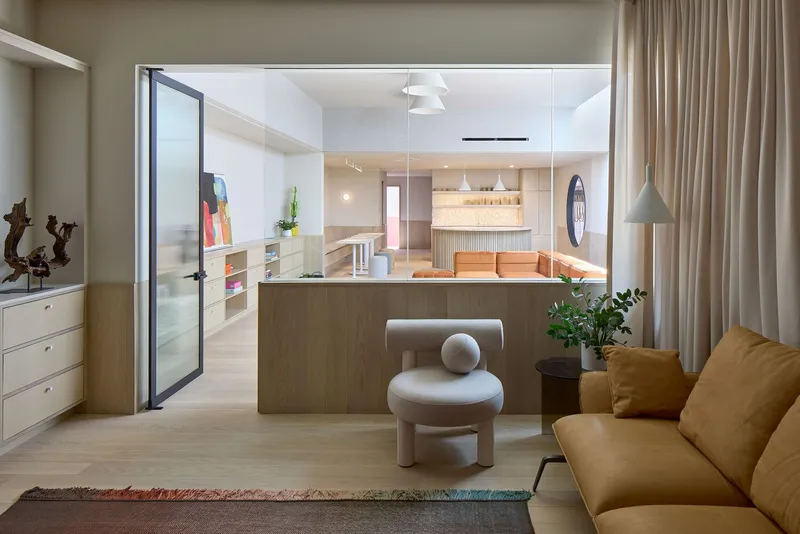
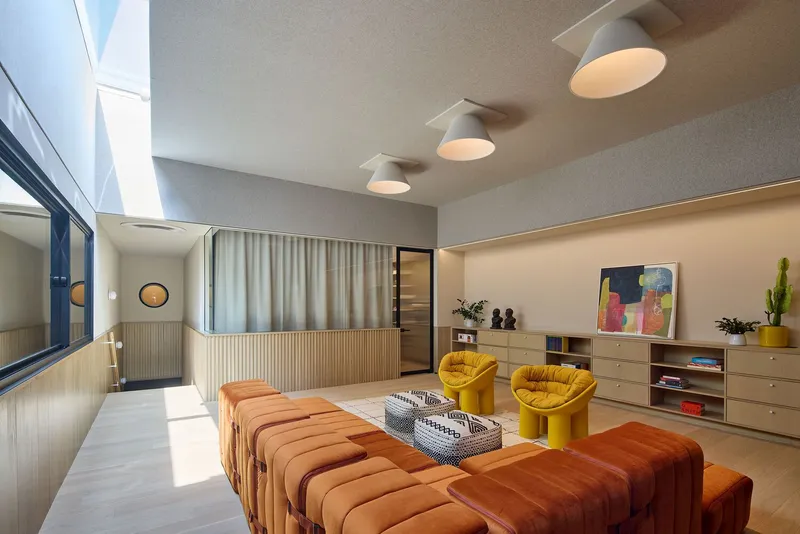
The shared lounge deploys a palette of orange modular seating and yellow sculptural chairs beneath a blue-grey ceiling, an unapologetically saturated composition that recalls mid-century Scandinavian social housing more than Silicon Valley co-living. The furniture here does real work: it defines zones, suggests groupings, and gives residents permission to sprawl in a way that conventional sofas pushed against walls never do.
Elsewhere, living rooms open through glazed partitions toward kitchens and dining areas, maintaining sightlines across the plan while providing acoustic separation. Three domed pendant lights hang above fluted wood paneling, and full-height sheer curtains filter light from overhead skylights. The materials are warm but deliberate: fluted timber, terrazzo, translucent ribbed glass. Nothing is raw for the sake of rawness.
Kitchens, Dining, and Material Detail
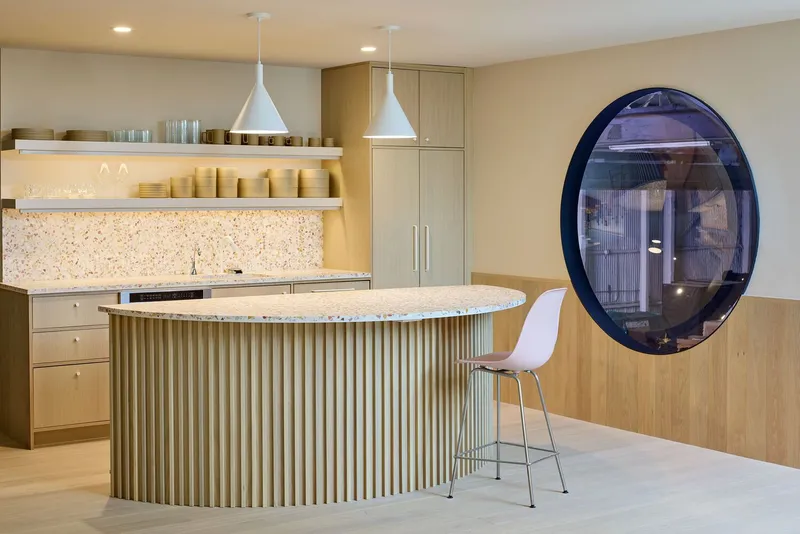
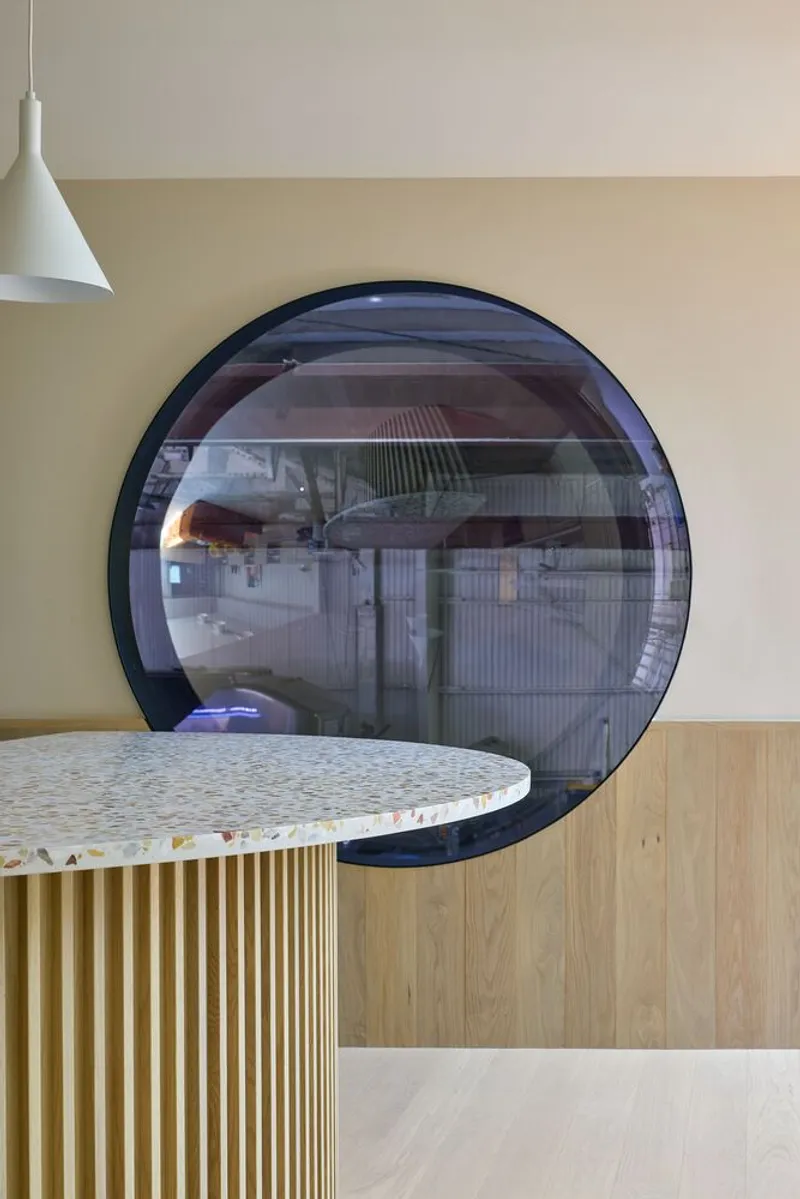
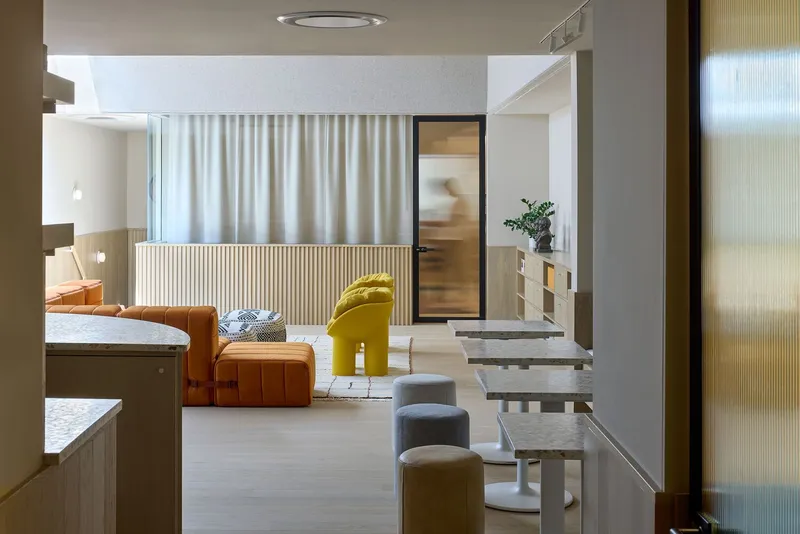
The kitchen islands feature vertical fluted wood siding and terrazzo backsplashes, paired with oval porthole windows set into timber walls. A dining area with a terrazzo-topped fluted base looks out through a large circular window onto a courtyard. The porthole motif, used so emphatically on the steel volumes, reappears here at a domestic scale, binding the project's industrial and residential identities together.
Translucent ribbed glass partitions separate zones while preserving light transfer, a smart technique for a deep-plan warehouse where natural light is a limited resource. The partitions introduce a soft, milky glow that contrasts with the harder surfaces of steel and concrete found elsewhere. It is a subtle move that prevents the interior from feeling like a single relentless material expression.
Flexible Partitions and the OSB Strategy
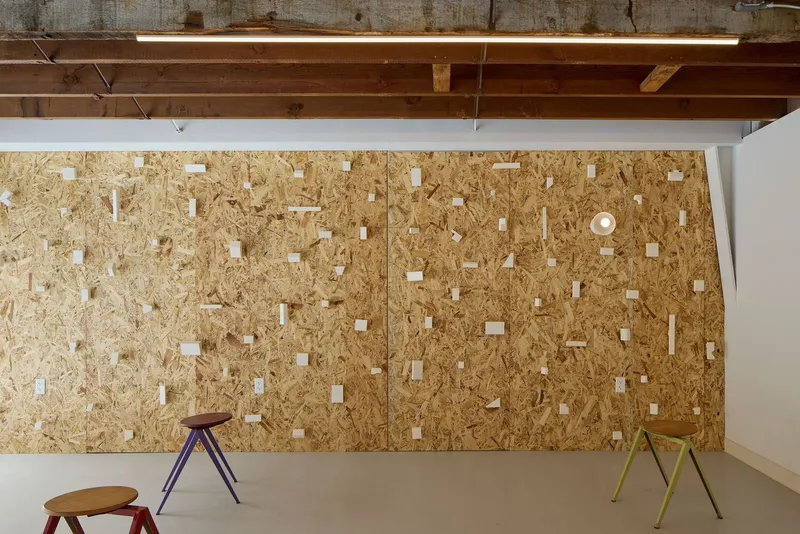
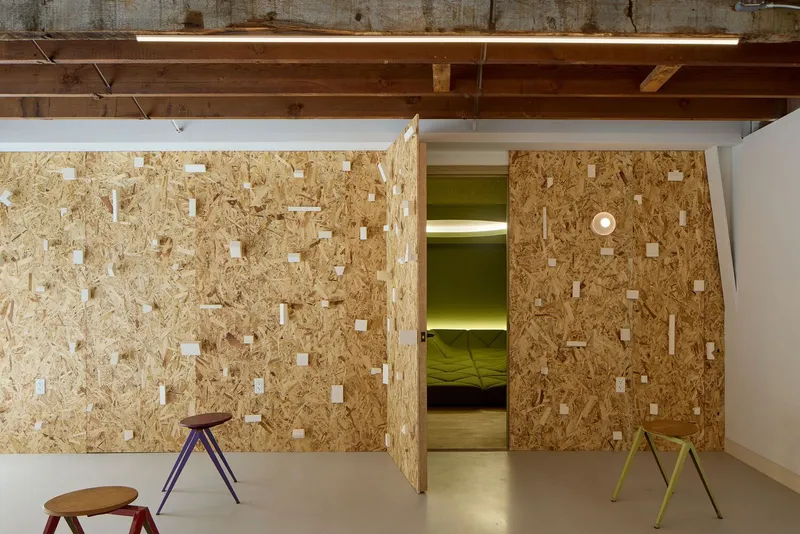
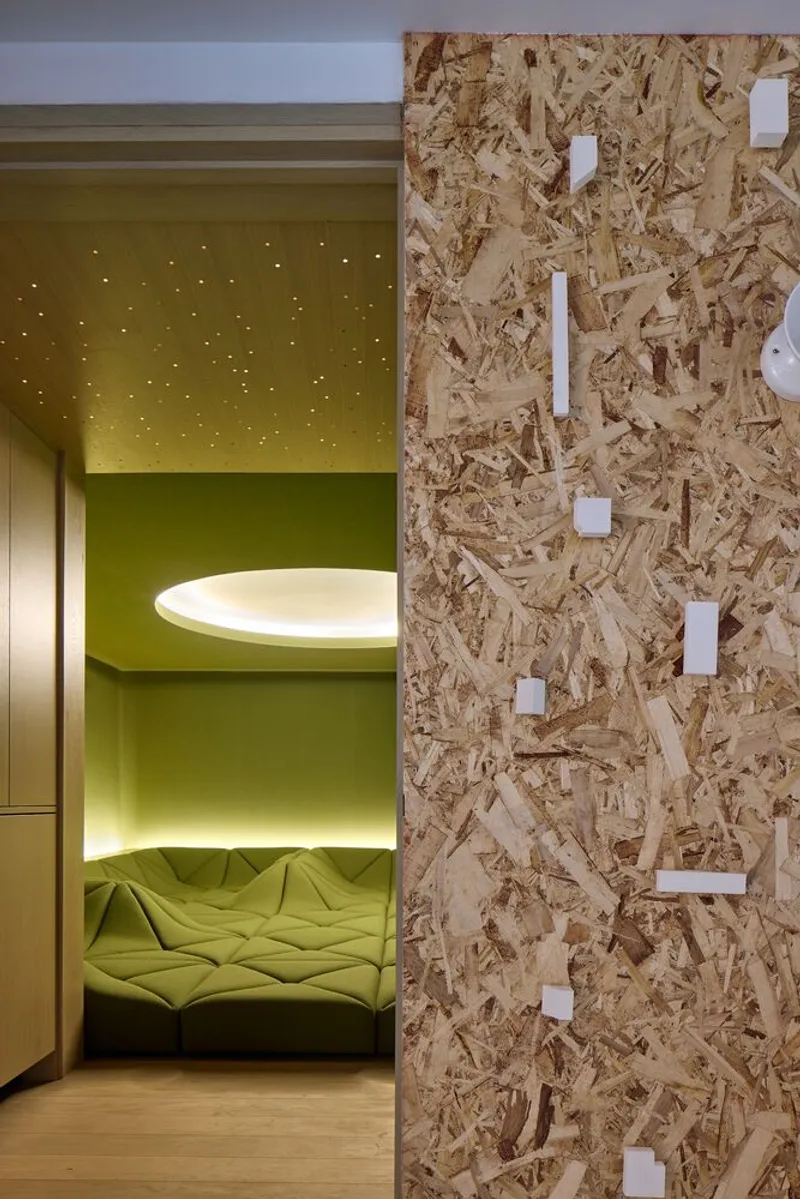
Oriented strand board (OSB) is often a cost-driven choice that architects dress up with post-rationalized sustainability claims. At Crane Cove, ONO leans into the material's chippy, rough texture as a frank expression of impermanence. Walls made of OSB panels sit on wheels, allowing the layout to be reconfigured. White wooden mounting blocks scattered across the surface suggest a pegboard logic: hang what you need, move on.
The movable walls acknowledge that communal living programs change faster than architecture can respond through conventional construction. Rather than building fixed rooms that will be demolished and rebuilt within a few years, the project embeds adaptability at the system level. It is pragmatic, not precious, and it gives residents a degree of spatial agency that most co-living projects, with their Instagram-ready finishes, would never risk.
Bathrooms and Private Moments
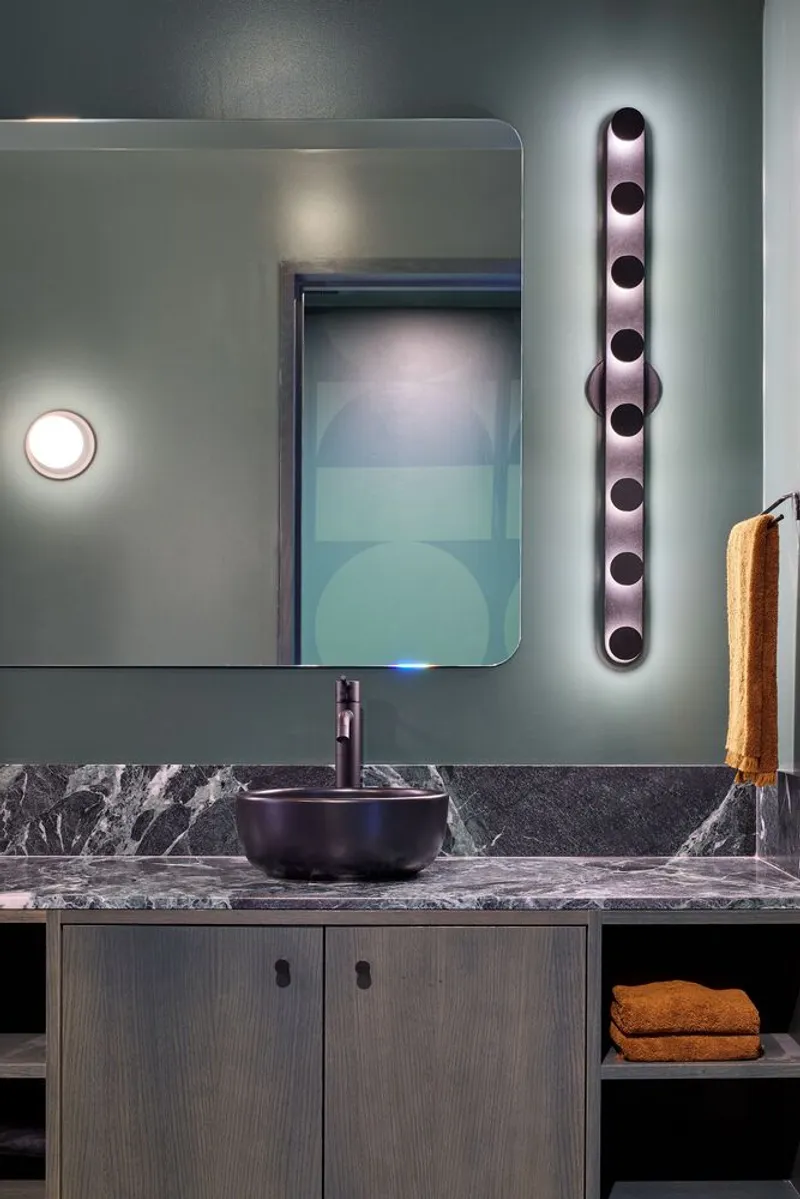
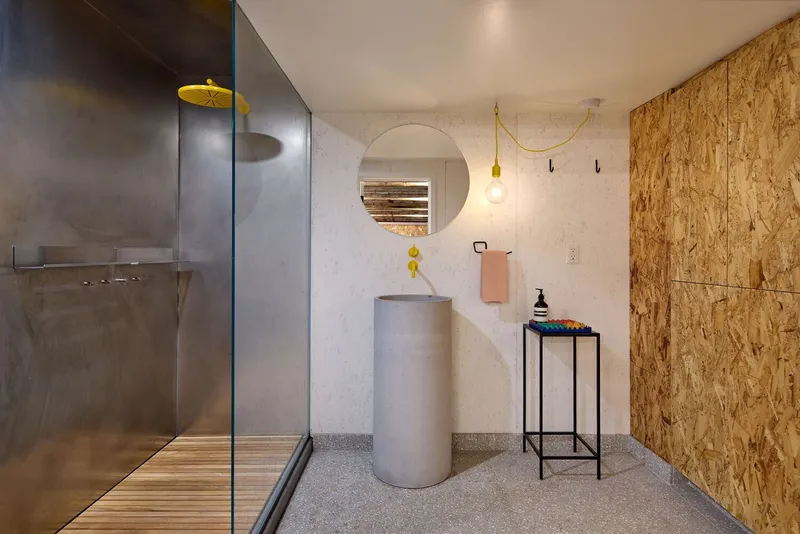
Even the bathrooms carry the project's material logic forward. A dark stone counter with a vessel sink and backlit mirror offers a moment of hotel-grade refinement, while a neighboring bathroom uses a cylindrical concrete sink and an OSB wall to stay within the warehouse's rougher register. The two approaches coexist without contradiction, suggesting that the project accommodates different expectations of comfort rather than enforcing a single standard.
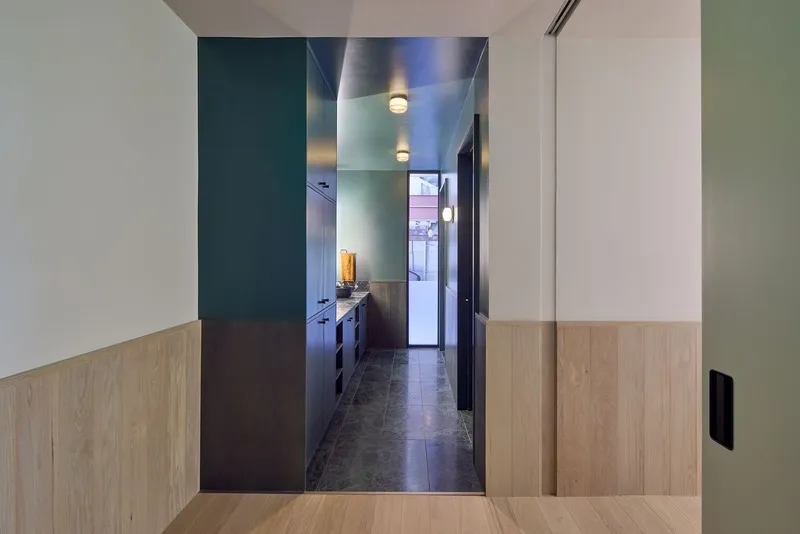
A corridor view through a sliding door into a galley kitchen with dark cabinetry reinforces the compressed, efficient spatial planning. These are not generous rooms. They are tuned to specific functions and stripped of excess volume. The result is that the communal spaces feel genuinely expansive by contrast, a calculated hierarchy that makes sharing space more attractive than retreating to private quarters.
Stairs, Nooks, and Threshold Moments
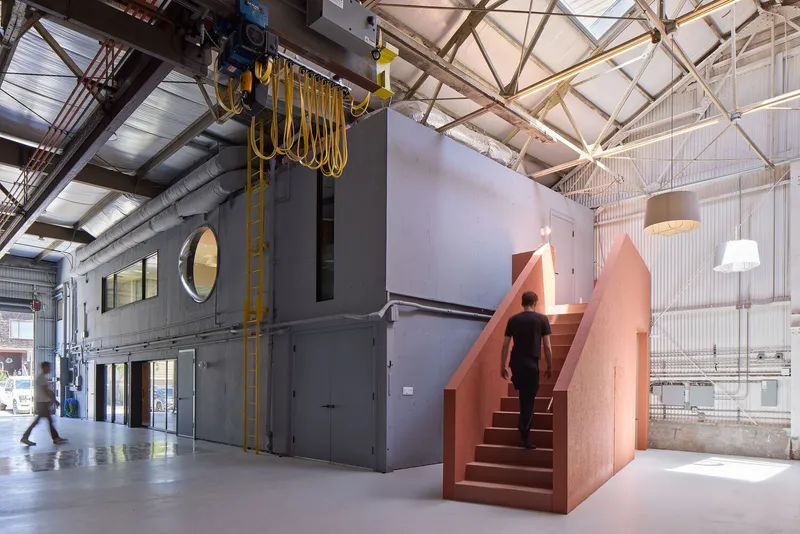
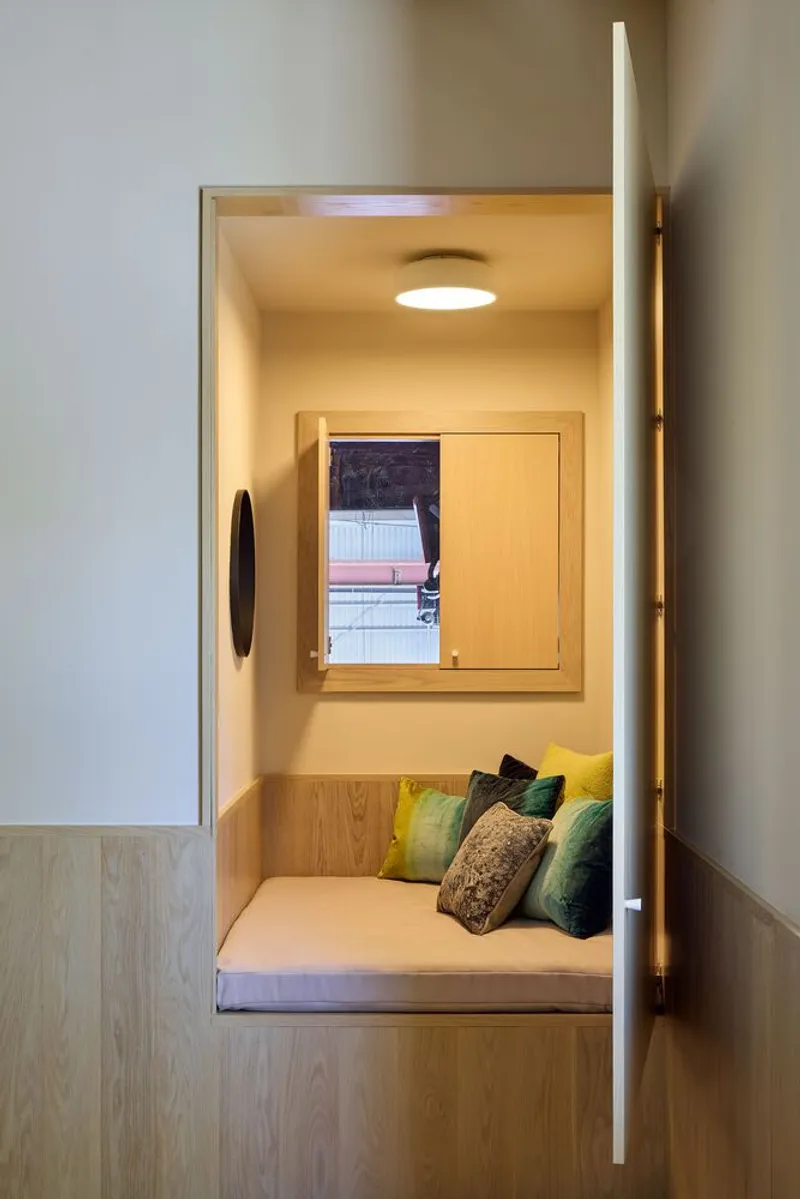
A salmon-colored steel stair rises beneath a corrugated metal ceiling, its warm tone catching the eye against the cooler industrial backdrop. Hanging pendant lights mark the path upward, turning circulation into an event rather than a chore. Elsewhere, a light wood reading nook with a built-in bench and a square window framing an exterior view provides a genuinely intimate retreat. These threshold moments, the in-between spaces that are neither fully private nor fully communal, are where the project's social design becomes most legible.
Plans and Drawings
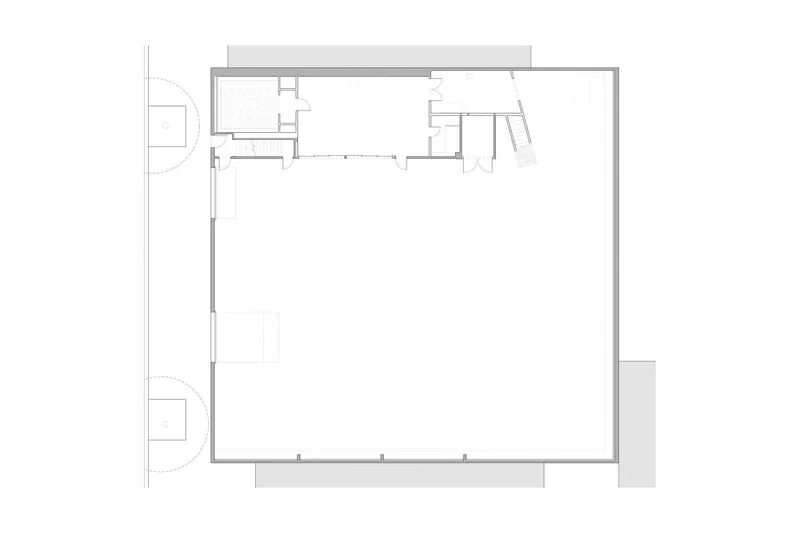
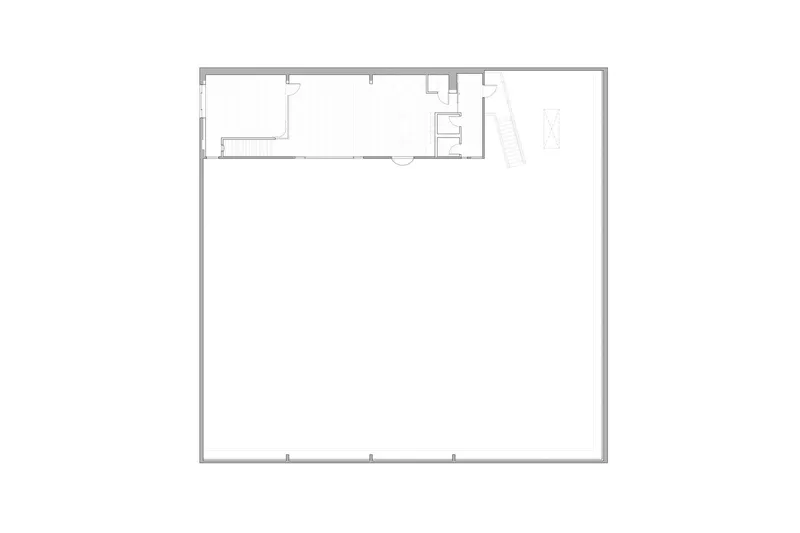
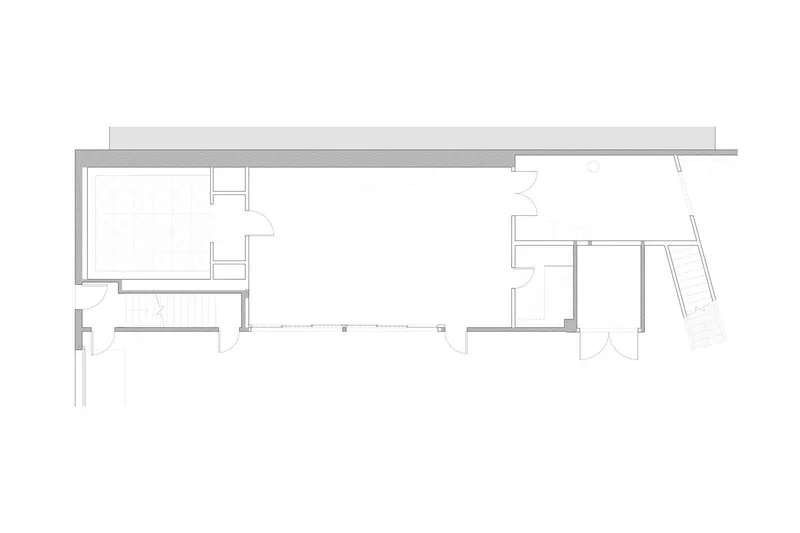
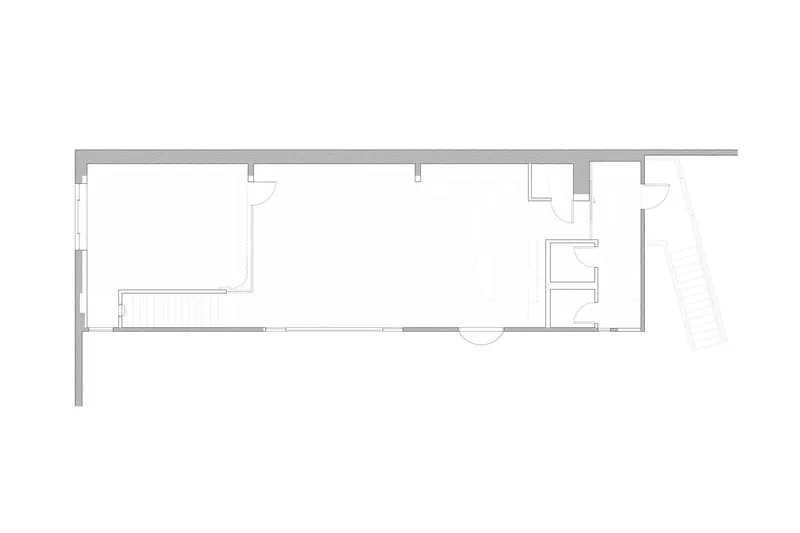
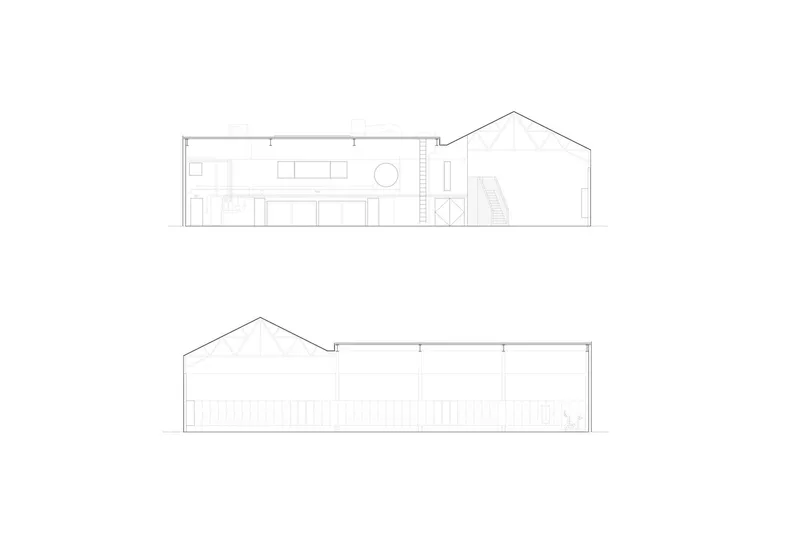
The floor plans reveal the project's organizational strategy: service rooms, bathrooms, and kitchens are consolidated along edges and corners, freeing the center of each volume for open communal use. Two connected volumes with an angled outdoor deck create a courtyard condition, bringing light and air into what would otherwise be a sealed industrial box. The section drawings show how the flat-roofed insertions sit beneath the gabled warehouse structure, maintaining a clear gap between old and new that preserves the original spatial drama.
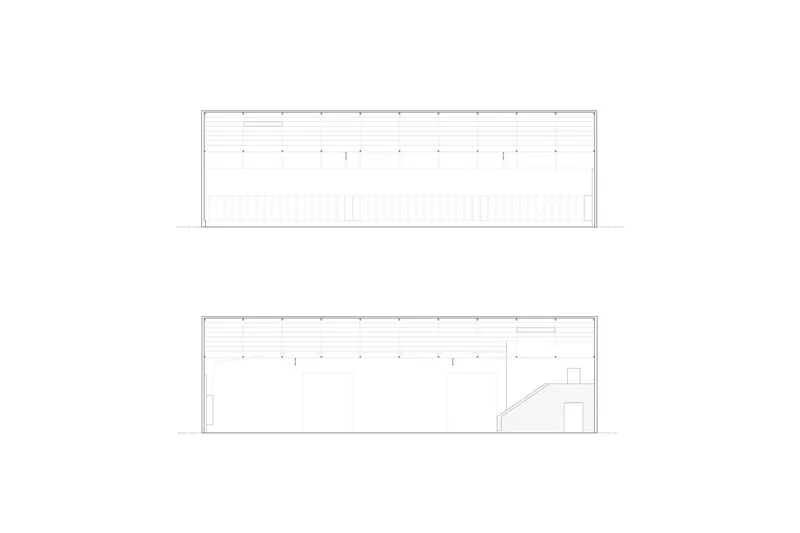
Elevation drawings confirm a restrained exterior: horizontal cladding and rooftop louvres maintain the industrial character of the neighborhood while signaling a carefully managed transformation. The architecture does not shout from the street. It saves its energy for the interior, where the real invention happens.
Why This Project Matters
Crane Cove Warehouse matters because it treats adaptive reuse as a design problem rather than a branding exercise. Too many warehouse conversions rely on the existing character of the shell to do all the heavy lifting while filling the interior with generic contemporary finishes. ONO reverses that equation: the shell remains largely untouched, and the new insertions carry the full weight of architectural invention. The porthole windows, quilted sleeping pods, movable OSB partitions, and color-washed alcoves create a micro-world inside the macro-shell, each element calibrated to a specific social or sensory purpose.
The project also represents a more honest version of communal living than the polished co-living brands that have proliferated in recent years. By using frankly inexpensive materials alongside carefully detailed moments of refinement, ONO avoids the false homogeneity of those models. The result is a space that feels genuinely lived-in, not curated for a leasing brochure. If the future of urban housing involves more sharing and less square footage per person, this is a credible proposal for what that future might actually look and feel like.
Crane Cove Warehouse: Adaptive Reuse by Obata Noblin Office (ONO), San Francisco, California. Photography by Bruce Damonte.
About the Studio
Share Your Own Work on uni.xyz
If projects like this are the kind of work you want to make, uni.xyz is a place to publish your own, find collaborators, and enter design competitions.




Popular Articles
Popular articles from the community


AL-JANNAH: Sustainable Architecture and Permaculture for Afghan Widows
AL-JANNAH uses sustainable architecture and permaculture to create resilient oasis of housing, learning, work and renewal for Afghan widows.

Riyadh For All: Intergenerational Urban Design for Active Aging in Rabat
Riyadh For All reimagines urban design in Rabat with intergenerational co-living, adaptive courtyards, and Moroccan cultural exchange today.

Hill & Cross Opera: Sculptural Opera House Architecture Shaped by Tallinn’s Landscape and Identity
Hill & Cross Opera reimagines opera house architecture in Tallinn through its sculptural hill, civic plaza, glass wave and a luminous cross.

Co-life: Sustainable Architecture for Age-Friendly Community Living
Co-life reimagines sustainable architecture for seniors through courtyards, rammed earth, shared gardens, and spaces designed for belonging.


Similar Reads
You might also enjoy these articles


Hodi-Mandai Geram
Project Function: Preservation and revitalization of the Intangible heritage and socio-spatial identity of the Hodi by Housing, Cultural Memory Center, Sacred Grove, landscape, local tourism economy


Olio Towers: A Mid-Rise for Performers That Fuses Housing, Rehearsal, and Stage
Located blocks from Houston's Theater District, this modular tower stacks living units around a central performance atrium.

Oasis: Modular Green Housing Carved into Dhaka's Urban Fabric
A shortlisted Plugin Housing entry reclaims unauthorized settlements in Dhaka with stepped concrete volumes, green roofs, and ventilation-driven design.

Black Hole: A Floating Megastructure for the Post-Physical Era
Emiliano Mazzarotto envisions a spherical, self-scaling arena where e-sports, digital hotels, and holographic stadiums replace traditional public space.


Explore Architecture Competitions
Discover active competitions in this discipline



Challenge to reimagine the Iron Throne


Photograph architecture without architects


Illustrate the lost glory of Angkor Wat - Render Challenge


Design challenge to reuse E-waste
Comments (0)
Please login or sign up to add comments
No comments yet. Be the first to comment!