
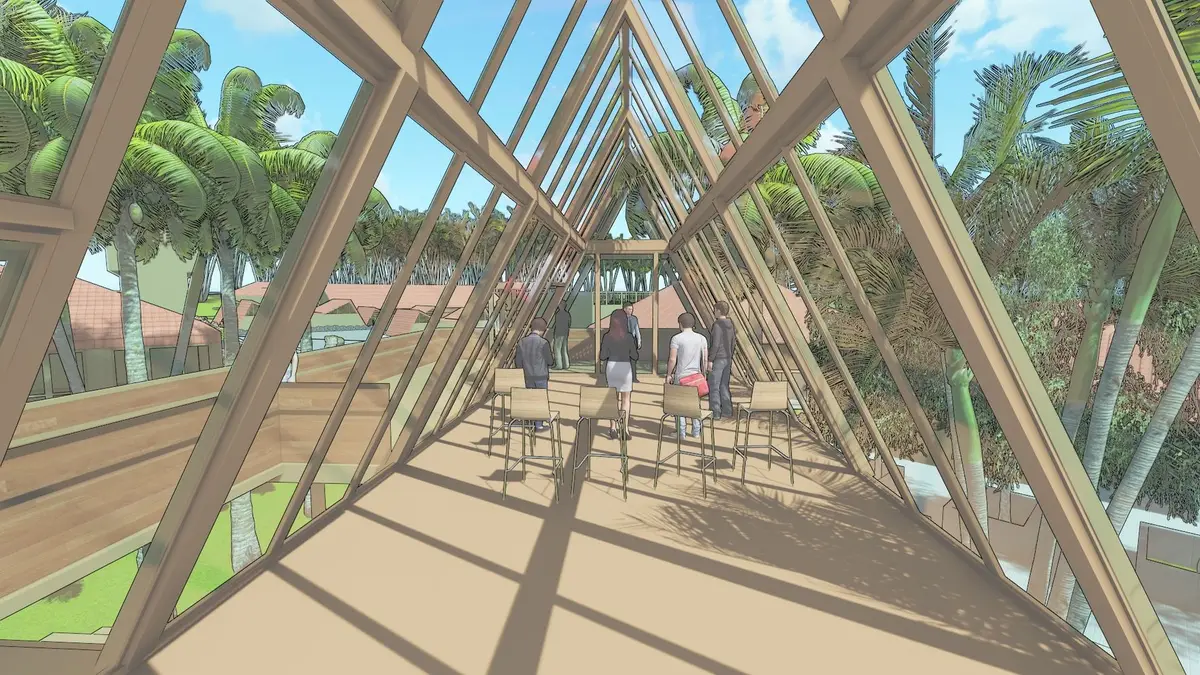
Creative Incubator: Vernacular Architecture as a Framework for Collaboration in Varkala
A shortlisted cultural campus in Kerala weaves hexagonal libraries, open-air theatres, and modular studios into Varkala's coastal terrain.


What happens when you design a building not around a programme, but around the friction between disciplines? The Creative Incubator in Varkala, Kerala, starts from a deceptively simple premise: that architects, writers, musicians, and visual artists produce better work when their spaces overlap. The result is a campus of interconnected blocks, each tuned to a specific creative practice, yet stitched together through courtyards, shaded corridors, and open-air theatres that refuse to let any one discipline exist in isolation. It is cultural infrastructure in the fullest sense, a physical machine for cross-pollination set into the sloped terrain of one of Kerala's most distinctive coastal towns.
Designed by Sonali Bordia, the project was shortlisted in UnIATA '22. The site sits near the National Centre for Performing Arts in Varkala, Thiruvananthapuram, a town known equally for its cliffside spirituality and its growing cultural tourism. Bordia's design draws heavily on Kerala's vernacular architectural language, sloped roofs, timber framing, courtyard planning, while proposing a hybrid typology that bridges the gap between artistic residency, public institution, and community gathering ground.
A Courtyard Complex Built on Adjacency
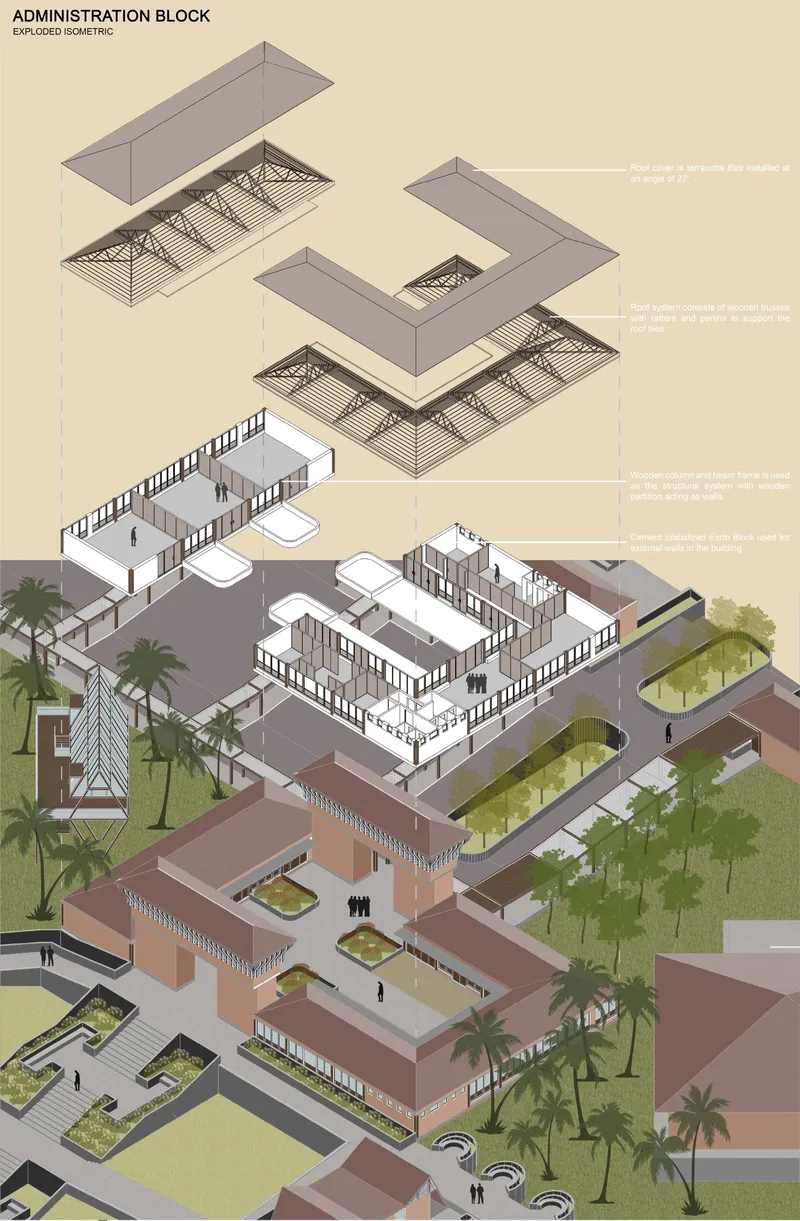
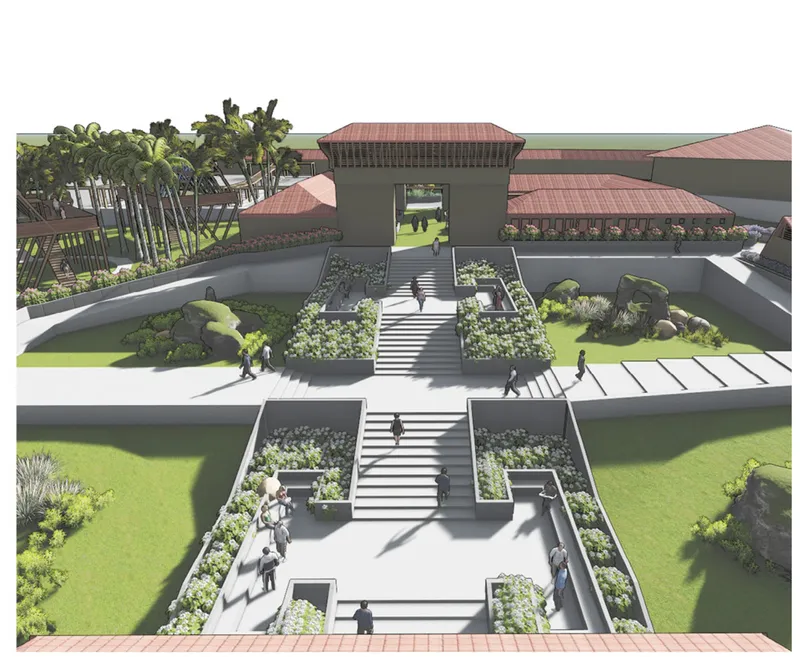
The campus is organized around a principle of adjacency-based spatial planning. Related disciplines, Performing Arts, Visual Arts, Literature, Library, Administration, and Auditorium, are positioned so that their edges and circulation paths overlap, generating the kind of unscripted encounters that rigid zoning eliminates. The exploded isometric reveals how structural layers build up above a courtyard complex: timber roof assemblies float over palm-shaded gathering spaces, while the courtyard itself operates as the social spine of the entire plan. Terraced gardens with planted beds and a central staircase mediate the natural slope of the site, turning topography into a processional sequence rather than an obstacle.
Mobility through the campus is deliberately ambiguous. Corridors blur the boundary between public and private; an open-air amphitheatre sits adjacent to studio blocks, so a rehearsal can spill into a shared courtyard. The gateway structure visible at the top of the terraced gardens marks an entry point but also frames views back down toward the planted landscape, establishing the campus as something experienced in both directions.
The Hexagonal Library as Campus Heart
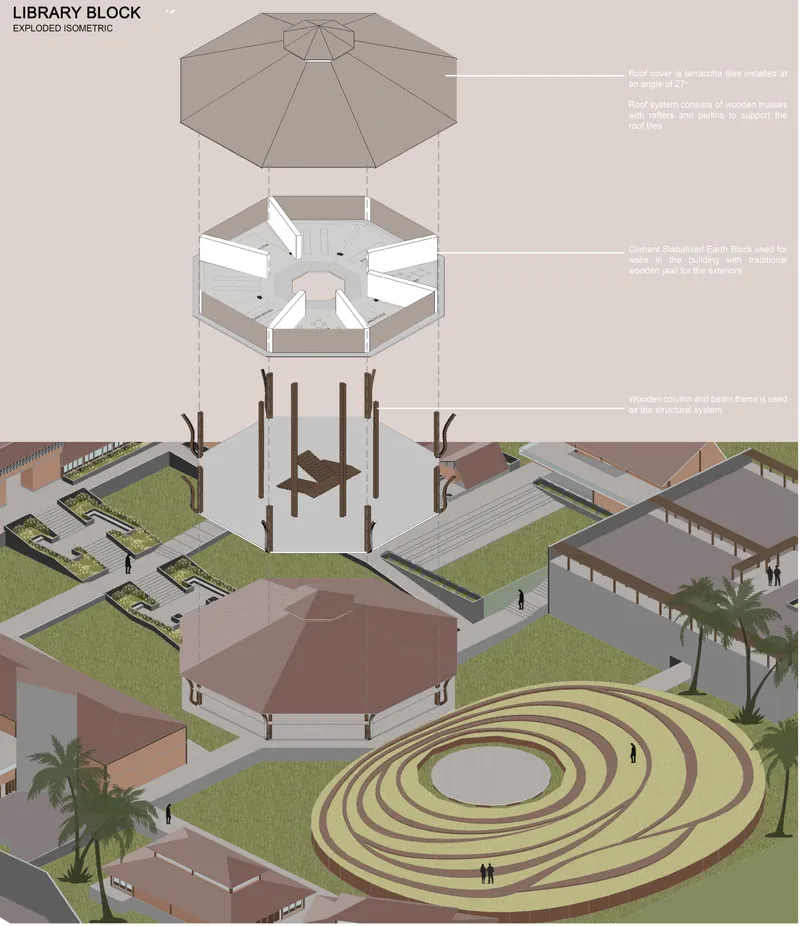
At the centre of the scheme sits the Library Block, a hexagonal (or more precisely octagonal, as the isometric reveals) timber structure that overlooks an open-air theatre and acts as the visual landmark of the campus. The circular patterned courtyard at its base reinforces its role as a focal point, a place you orient yourself toward and then move outward from. Bordia frames it as a collaborative arena as much as a reading room, and the geometry supports that reading: the octagonal plan distributes sightlines evenly, offering no dominant axis and no hierarchy of position.
The structure embodies Kerala's traditional architectural language through sloped roofs and wooden framing, but scaled up to an institutional register. Surrounding buildings defer to its height and form, reinforcing the idea that knowledge and shared culture are the gravitational centre of any creative ecosystem. It is a bold move for a campus that otherwise distributes its functions laterally across the terrain.
Modular Studios and the Literature Arts Block
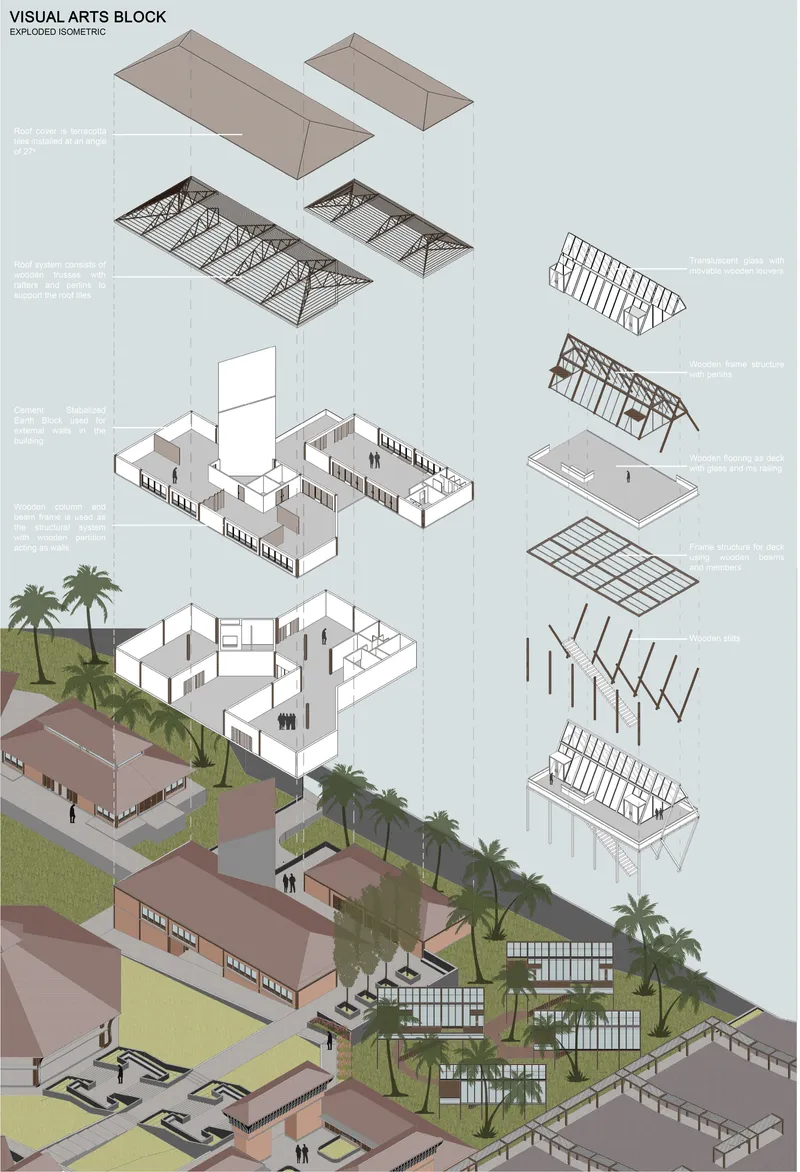
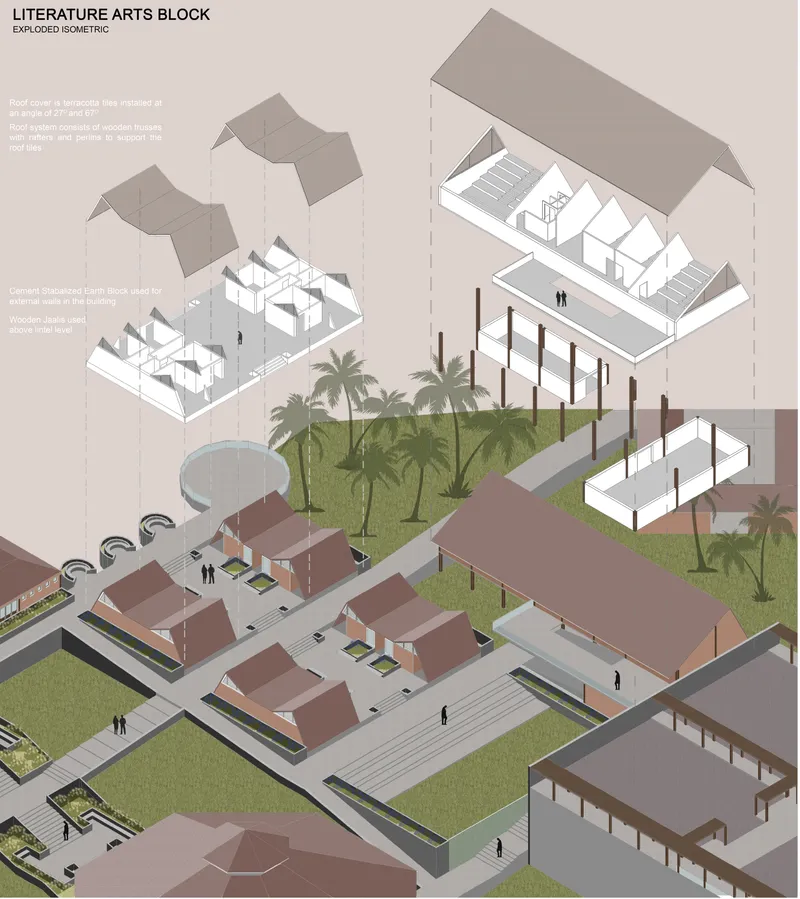
The Literature Arts Block comprises a series of modular studios and lecture halls designed for writers, poets, and printmakers. Its spatial hierarchy is legible in the isometric: individual studios cluster around communal courtyards, creating a rhythm of solitude and sociability. The roof trusses, exposed in the exploded drawing, reveal the structural honesty of the design. These are not decorative gestures toward tradition; the timber trusses do real work, spanning the studios while allowing generous ceiling heights that keep the interiors cool through stack ventilation.
A palm-lined campus with paved plaza connects this block to the larger network. The paving pattern, visible in the isometric, organizes foot traffic while defining zones for informal gathering, exhibition, and passage. The Performing and Visual Arts Blocks nearby accommodate rehearsal, exhibition, and performance spaces, blending art and architecture into a continuous narrative. What holds the entire campus together is not a single architectural gesture but a consistent material and spatial vocabulary: timber columns, sloped roofs, shaded walkways, and courtyards that breathe.
Vernacular Strategies for Climate and Context
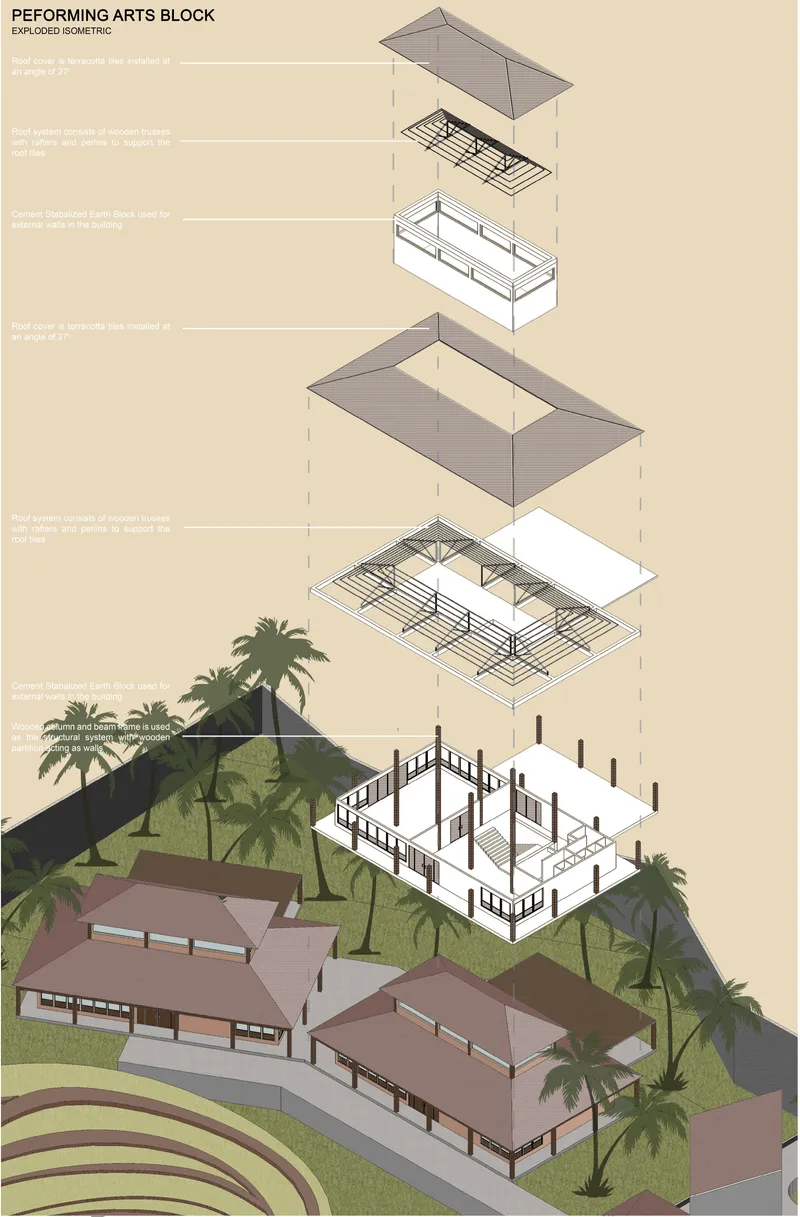
The final isometric drawing isolates a single building's roof and truss structure above a white volume with timber columns and surrounding palms. It is a clear statement of method: every design decision here is simultaneously climatic and cultural. The sloped roofs shed Kerala's monsoon rains efficiently while creating deep overhangs that shade the corridors below. Timber columns lift the building visually and structurally, allowing air to move through the ground plane. Bordia's grid analysis of the site informed orientation choices that mitigate solar heat gain, and the surrounding vegetation is treated as an active design element rather than decoration.
The campus integrates natural land contours, water bodies, and cultural pathways into what Bordia describes as an inclusive creative landscape. The vernacular references are specific rather than nostalgic: shaded corridors drawn from Kerala's traditional residential architecture, courtyards scaled to institutional use, and material choices that prioritize passive thermal comfort. The result is a campus that feels rooted in Varkala's identity while proposing something genuinely new for the town's cultural future.
Why This Project Matters
The Creative Incubator tackles a problem that architecture rarely addresses well: how to design for the unpredictable social dynamics of creative work. Most cultural buildings either over-determine their programmes (a theatre is a theatre, a studio is a studio) or dissolve into vague "flexible space" that accommodates everything and inspires nothing. Bordia's approach is more precise. Each block has a clear identity and spatial logic, but the campus as a whole is designed so that the spaces between buildings, the courtyards, corridors, and amphitheatres, carry as much programmatic weight as the buildings themselves.
For Varkala, a town whose identity is increasingly shaped by tourism, the proposal offers an alternative trajectory: cultural production, not just consumption. The incubator imagines a network where citizens, professionals, and visitors interact on equal terms, anchored by an architecture that draws its authority from Kerala's own building traditions. As a shortlisted entry in UnIATA '22, the project demonstrates that vernacular intelligence and contemporary programming are not competing interests but complementary forces. It is a convincing argument that the most effective creative spaces are the ones that give their occupants structure and surprise in equal measure.
View the Full Project
About the Designers
Designer: Sonali Bordia
Enter a Design Competition on uni.xyz
uni.xyz runs architecture and design competitions year-round that reward proposals with spatial conviction and real site intelligence.
Project credits: Creative Incubator by Sonali Bordia UnIATA ‘22 (uni.xyz).


Popular Articles
Popular articles from the community


ETEH Reworks the Shared Spaces of São Domingos School in Brazil Around Timber, Color and Hanging Plants
At São Domingos School in Brazil, 436 m² of hall, refectory and library are recast with timber joinery, a yellow and blue code and trailing greenery.

Cube Design Draws an Ecological Corridor Between Two Shenzhen Hills with the Nankai Building
Beside Shenzhen's container docks, the Nankai Building pairs stacked balconies with a climbing green screen to connect two hillsides across its height.


Opera on the Sea: Driftwood Logic Shapes a Timber Opera House on Estonia's Coast
Trevor Orgill's opera house translates the entangled drift of floating timber into a civic building where wood, water, and music converge.

David Ortega Stacks a Two-Story Mexico City Penthouse Around a Steel Stair and a Pergola-Shaded Roof Terrace
In Colonia Roma, a 300 m² penthouse uses oak joinery, a planted steel stair and a slatted roof pergola to make a new-build apartment feel like a house.

Similar Reads
You might also enjoy these articles

Aquadapt: An Underwater Habitat That Rewrites Its Rooms by the Hour
Curved modules ring the seabed while one shell shifts from breakfast room to cinema, farm and football pitch as residents' needs change.

Play: Fragments of Their World: Remembered Architecture Rebuilt as a Modular Playground for Refugee Camps
Tom Gardner abstracts domes, arches and towers from the homelands of displaced families into a kit of child-scaled play parts for camp settlements.
REBIRTH: A Circular Settlement Where Afghan Widows and Their Children Rebuild Life Together
A shortlisted Resile entry turns the circle into a protective ring of timber and brick, gathering homes, classrooms and gardens around a shared landscape.
The Main Dream: A Recycled Plastic Kit That Lets Refugee Children Build Their Own Playground
Thirty-centimetre interlocking cubes that connect on three axes turn play into construction, letting children author the spaces they occupy.

Explore Cultural Hub Competitions
Discover active competitions in this discipline

Challenge to reimagine the Iron Throne

Photograph architecture without architects

Illustrate the lost glory of Angkor Wat - Render Challenge

Design challenge to reuse E-waste
Comments (0)
Please login or sign up to add comments
No comments yet. Be the first to comment!