
Creative Studio Unravel Revives a 1930s Bukchon Hanok as an Intimate Guesthouse in Seoul
An 80-year-old Korean traditional house in Jongno-gu gets a careful renovation that preserves its blue roof tiles, gobang glass, and courtyard rituals.


Bukchon Hanok Village is one of Seoul's last continuous fields of traditional Korean houses, a dense lattice of timber frames, courtyard gardens, and clay-tiled roofs wedged between two palaces. Most of the hanoks here date to the 1930s, when housing management firms collectively standardized the neighborhood's residential fabric to accommodate a rapidly modernizing city. The Nostalgia Bluejae House, renovated by Creative Studio Unravel and completed in 2020, sits at the entrance of 31 Gahoe-dong, roughly 80 years old and carrying the particular distinction of being the only hanok in the area roofed with the same blue tiles once reserved for the Blue House, South Korea's presidential residence.
What makes this 135 m² project worth studying is not the gesture of preservation itself, which has become a familiar narrative in Bukchon, but the specificity of what was preserved and the restraint of what was added. Creative Studio Unravel treated the house's materiality as a kind of archaeological record: gobang glass panels with their bumpy, irregular surfaces from integrated 1930s-era techniques; hand-shaved wood ceiling panels, each cut with a slightly different pattern; blue roof tiles that link a modest dwelling to the symbolism of state power. The renovation converts the hanok into an overnight accommodation, a programmatic shift that actually reinforces the domestic rhythms the building was designed around. You sleep here, eat here, bathe here, sit in the courtyard here. The architecture does not need to perform for a new use; it simply needs to endure.
Courtyard as Organizing Principle
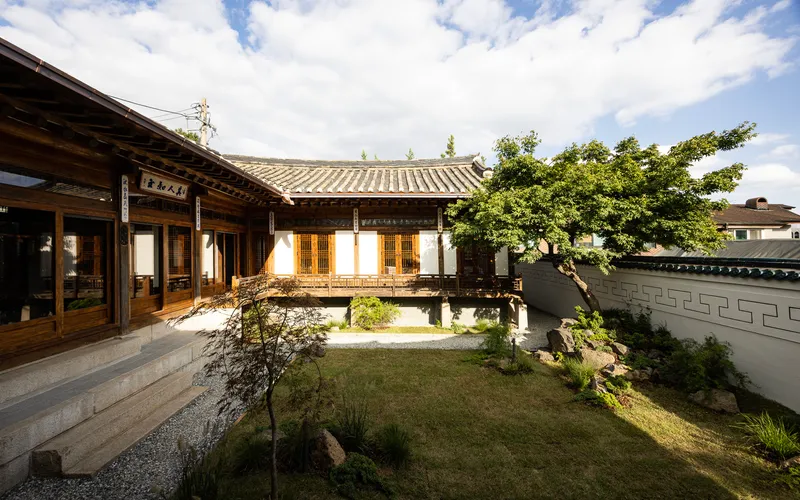
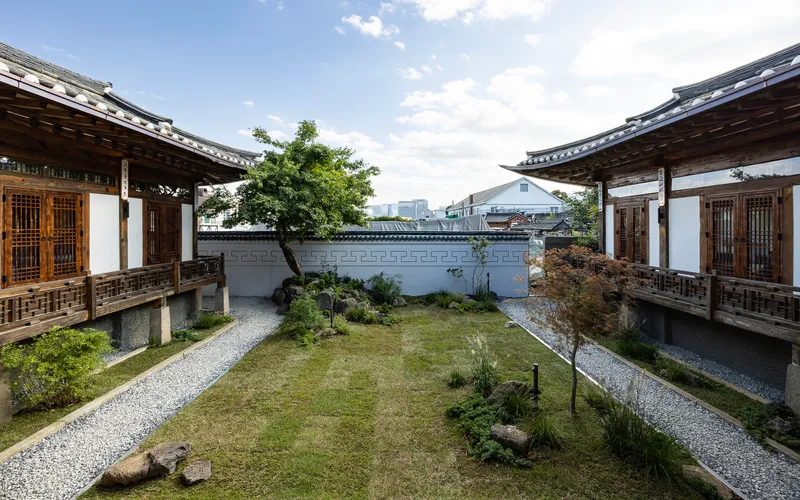
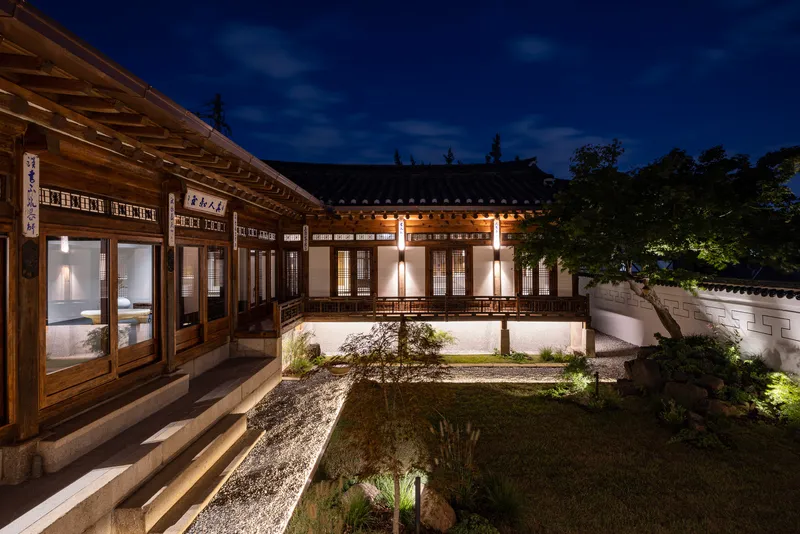
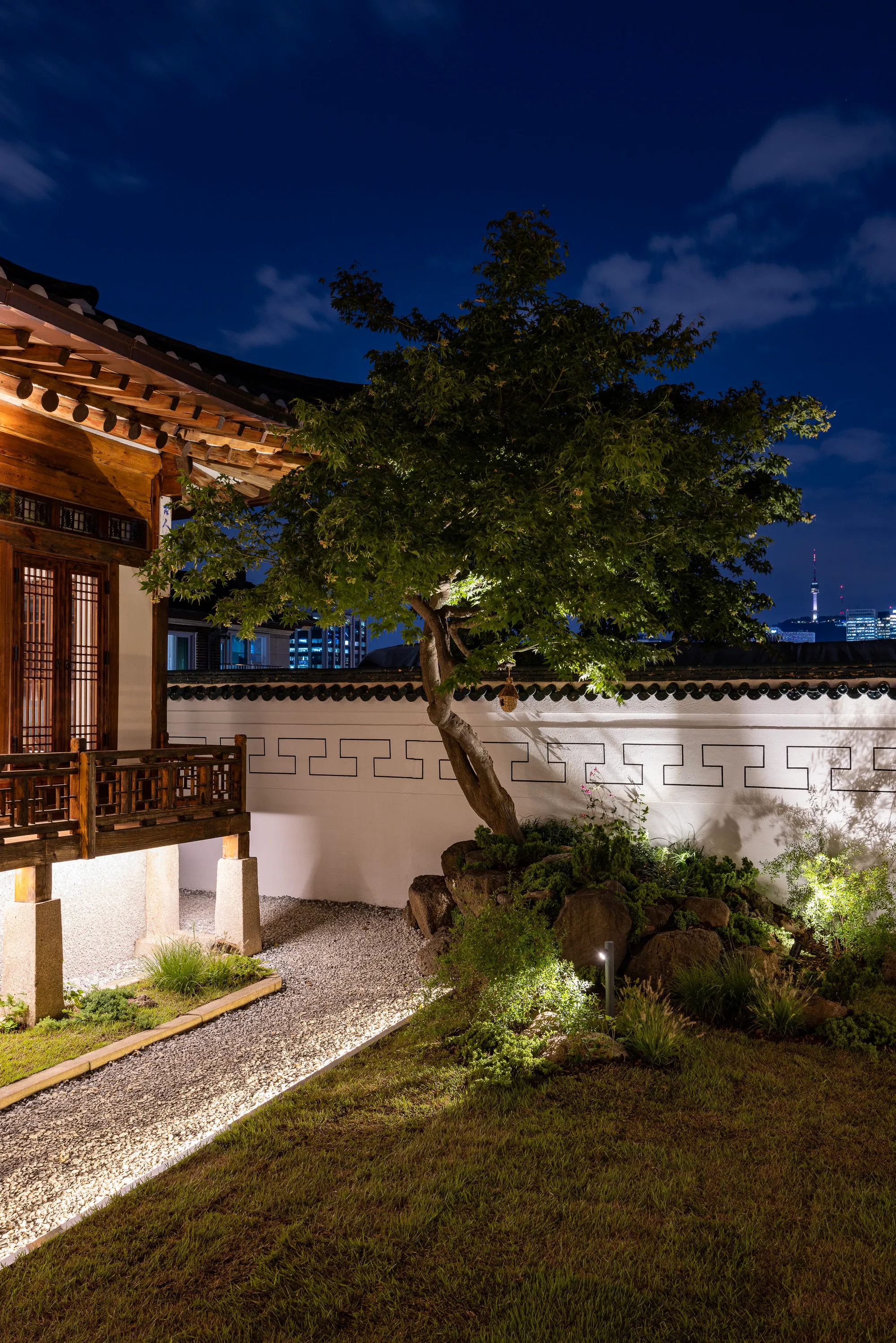
The central courtyard is not a leftover void between buildings. It is the spatial engine of the entire house, organizing circulation, light, ventilation, and sightlines. Two timber-framed pavilions face each other across a garden of gravel paths, rock plantings, and a mature pine tree that extends beyond the roofline. The plan follows a logic common to Bukchon hanoks of the 1930s: rooms wrap around a shared open-air center, each one oriented inward rather than toward the street.
Creative Studio Unravel kept this courtyard essentially intact, treating it as the element that makes the house legible. At dusk, when the timber eaves are lit from below, the courtyard reads as a kind of domestic stage, framed on all sides by deep overhangs and latticed screens. By night, the blue tiles disappear into darkness and the pavilions glow against a deep sky, a quality the photographers clearly understood.
Lattice, Light, and the Logic of the Screen
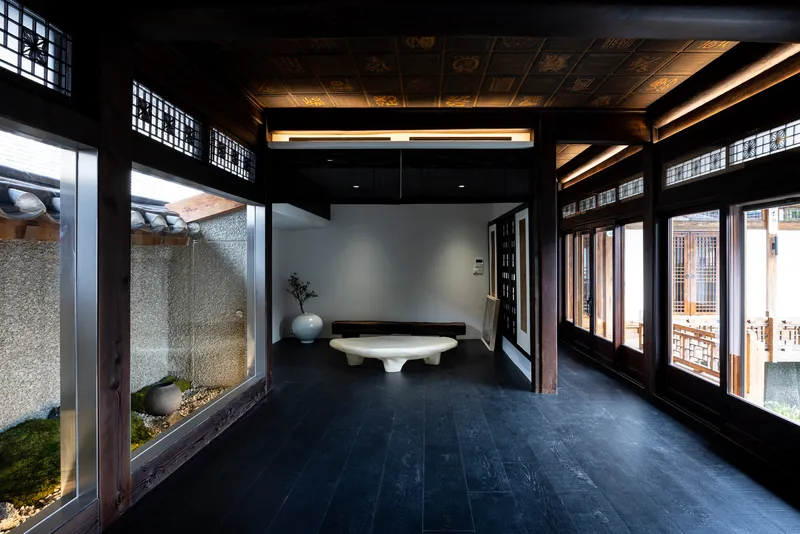
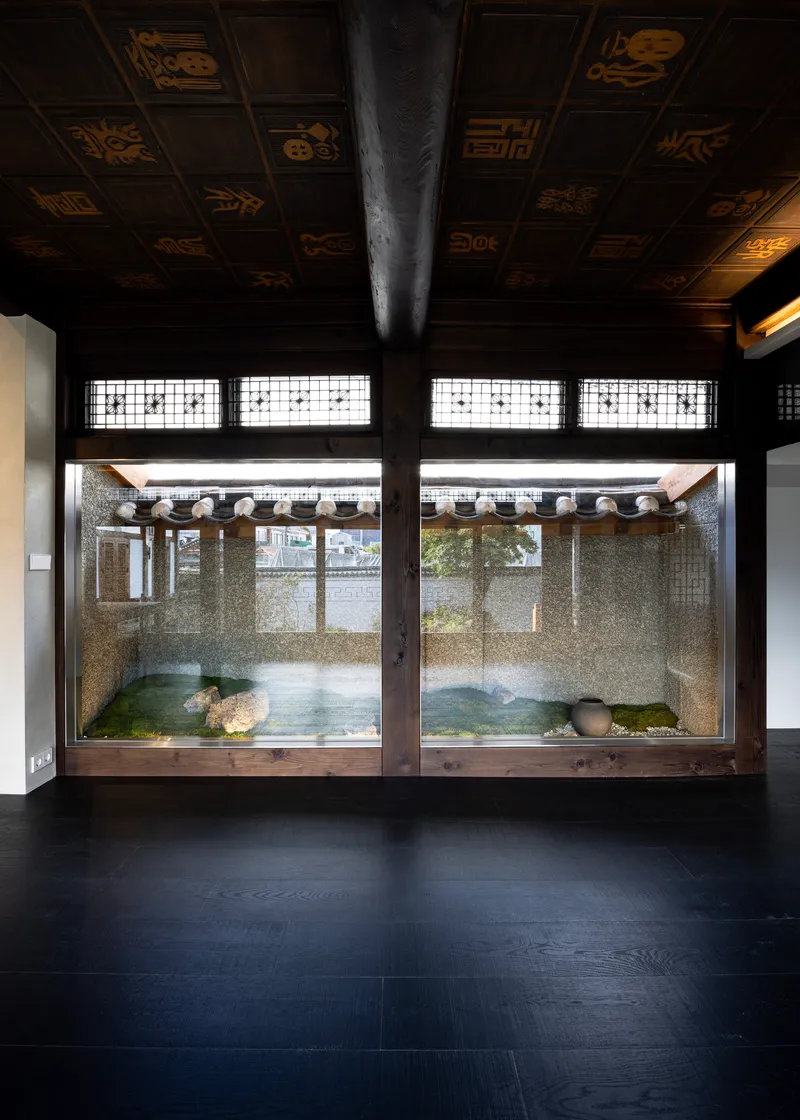
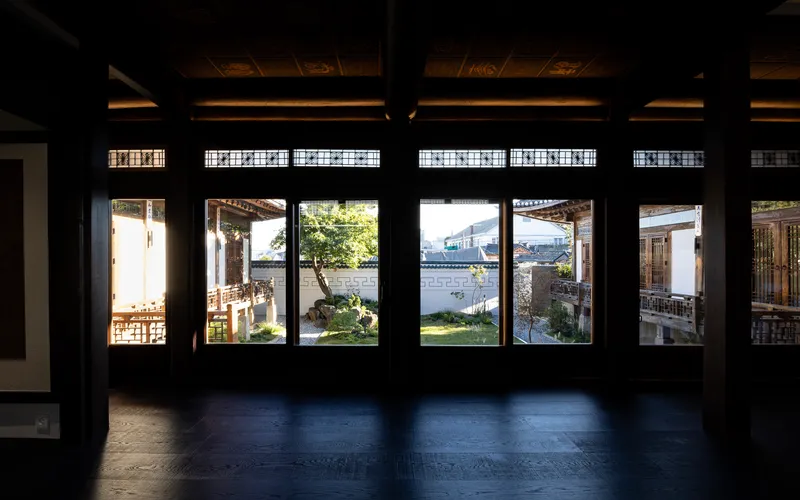
The latticed windows and transom panels do an enormous amount of architectural work here. They filter daylight into soft, diffused washes across dark timber floors. They provide privacy without closing off views to the courtyard. They establish a visual rhythm, a repeating pattern of wood and void, that ties every room to every other room. In a 135 m² house, this kind of material consistency is critical: it makes a compact plan feel deliberate rather than cramped.
Several interior views show how the lattice operates differently depending on the time of day and the direction of light. Morning sun through a bedroom screen creates sharp geometric shadows on platform beds. Afternoon light through a corridor transom produces a warm, amber haze. The gobang glass, with its irregular bumps and refractions, adds another layer of texture to these filtered views, a material that modern float glass could never replicate.
Timber Structure as Ornament
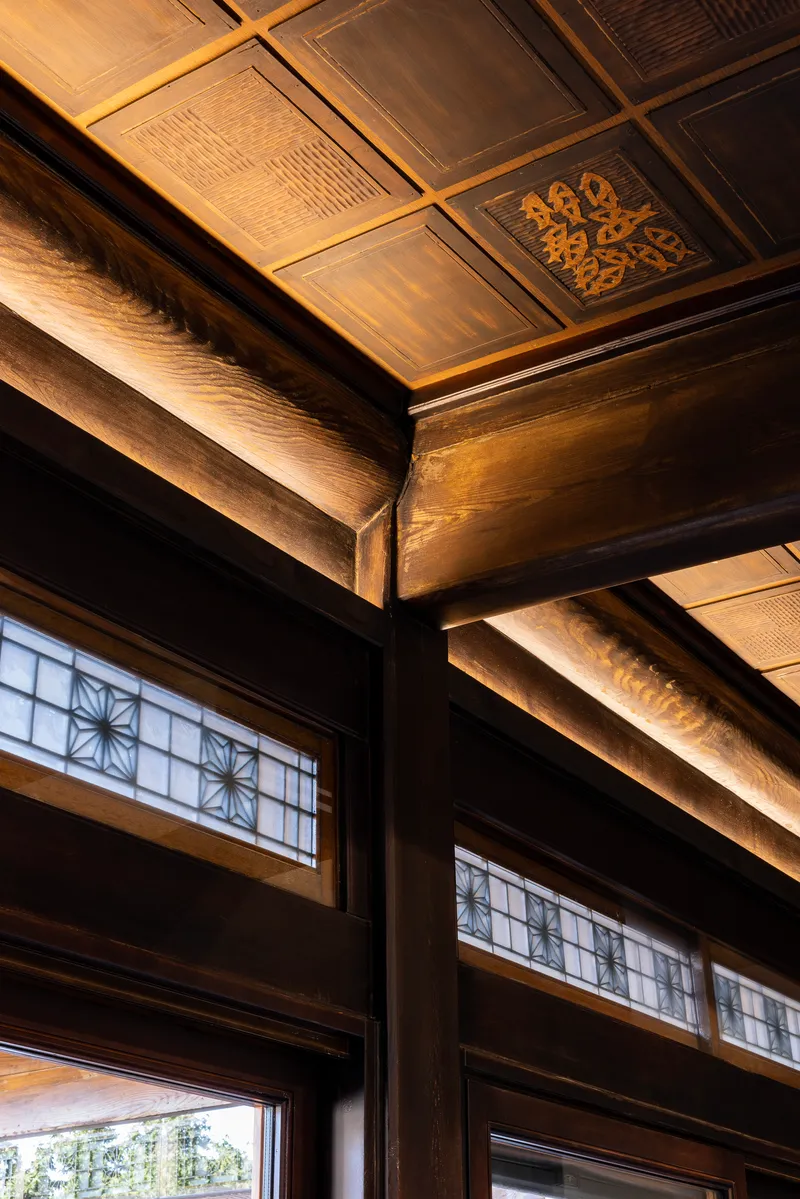

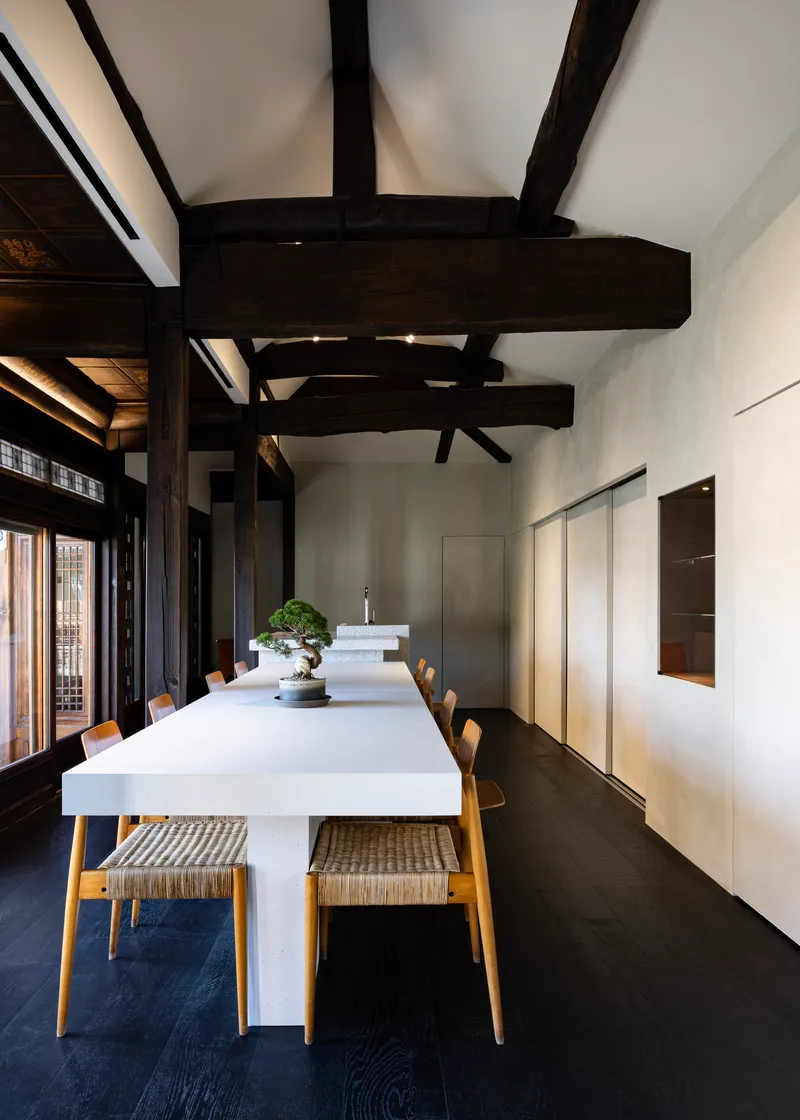
The exposed timber structure, dark-stained beams, coffered ceilings, and hand-shaved panels, serves as both the building's skeleton and its primary decorative language. The dining room is a clear example: a white table and light wooden chairs sit beneath a heavy coffered ceiling, the contrast between the furniture's simplicity and the ceiling's complexity creating a tension that keeps the room from feeling like a museum.
Looking up at the ceiling panels, you can see the individuality of each hand-shaved piece, slight variations in grain direction, depth of cut, and surface texture. These are not mass-produced elements. They are records of labor, and the renovation's decision to leave them visible rather than concealing them behind new finishes is the project's most important editorial choice.
Living Rooms for Staying the Night
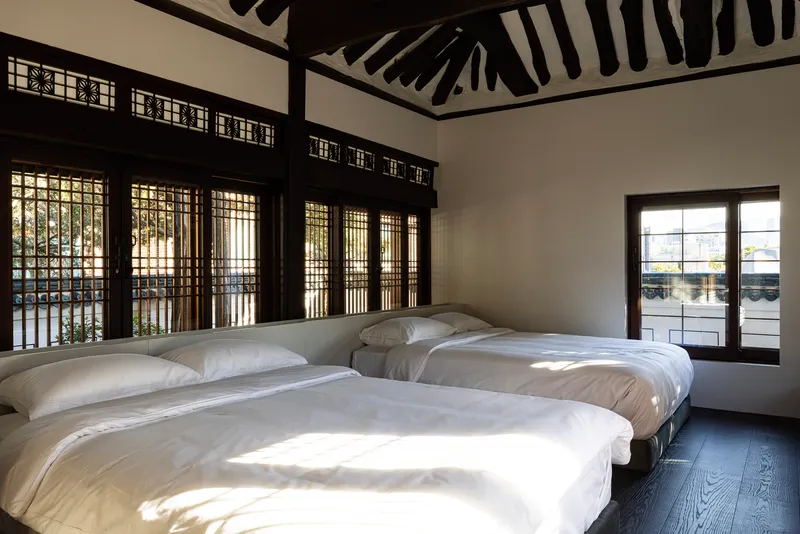
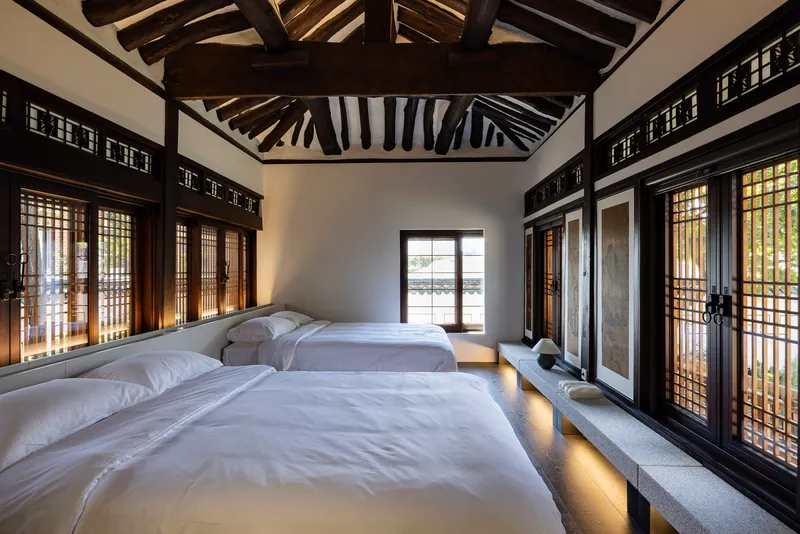

The bedrooms are designed around low platform beds, a nod to the traditional Korean ondol floor-sleeping culture, positioned close to latticed screens so that guests wake to filtered daylight. The rooms are spare: a scroll painting, a timber truss overhead, a panel of lattice that can slide open to reveal the courtyard. There is no television, no minibar cabinet, no attempt to approximate a hotel room. The accommodation program succeeds because it asks guests to inhabit the house on the house's own terms.
At dusk, the twin-bed room with its exposed roof trusses takes on a particularly compelling quality. The warm interior light glows against the darkening sky visible through the lattice, collapsing the boundary between inside and outside into a single gradient. It is a reminder that the hanok was designed for a climate with dramatic seasonal swings, and that its spatial strategies, the deep eaves, the operable screens, the thermal mass of the floor, still function.
Modern Insertions, Carefully Calibrated
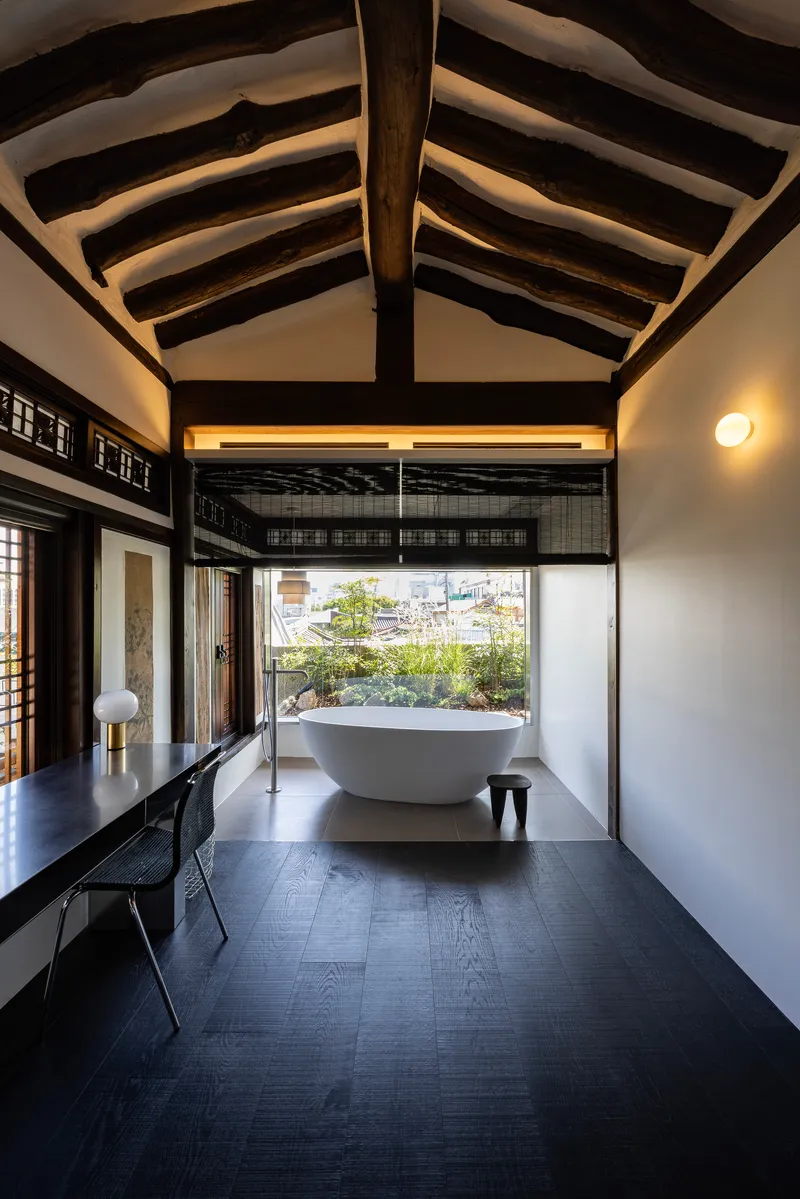
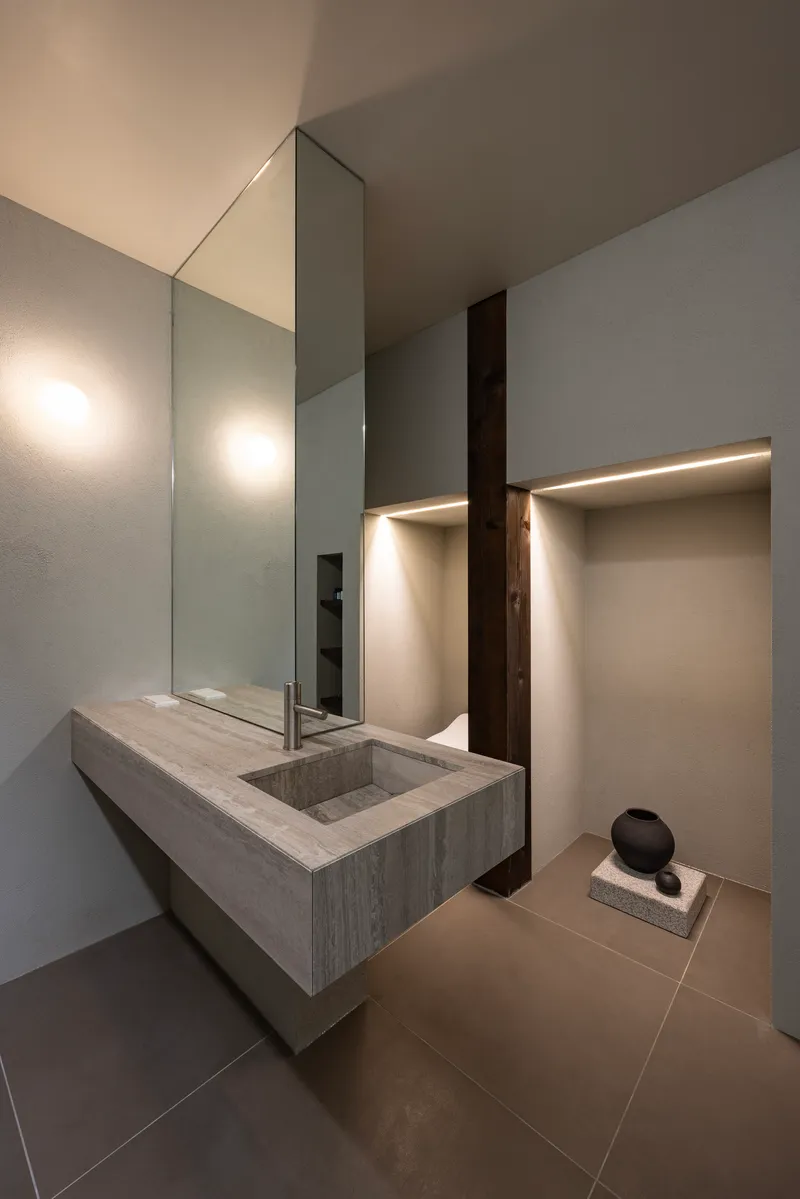
The clearest evidence of new work appears in the bathroom and kitchen. A freestanding bathtub sits beneath exposed timber rafters with a direct view to the planted courtyard, a frankly luxurious move that the original 1930s house would never have included. The washroom uses a poured concrete vanity, recessed lighting, and a wall-mounted mirror, materials and details drawn from contemporary minimalism rather than historical precedent.
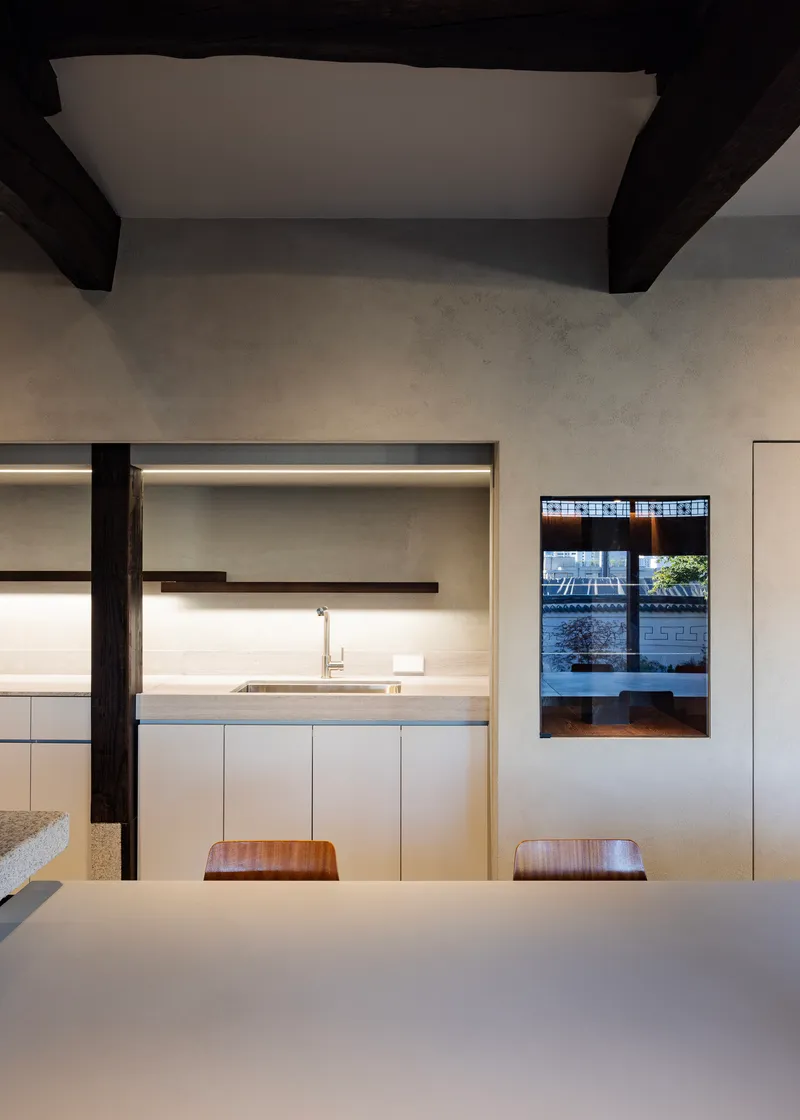
The kitchen is similarly restrained: white cabinetry and backlit shelving tucked beneath the existing timber beams and plaster ceiling. These insertions work because they occupy the functional gaps in the original plan without competing with its material character. Glass and metal, the same categories of modern convenience that 1930s builders introduced into Bukchon hanoks, reappear here in updated form. The principle has not changed in 80 years; only the fixtures have.
Threshold and Veranda
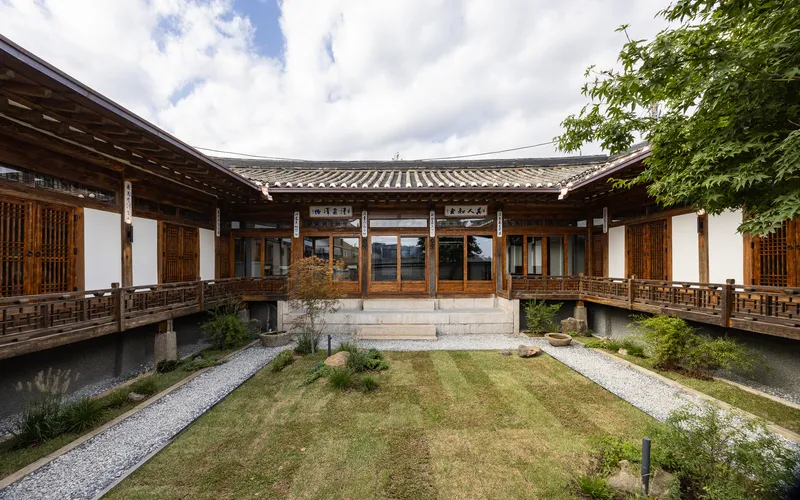
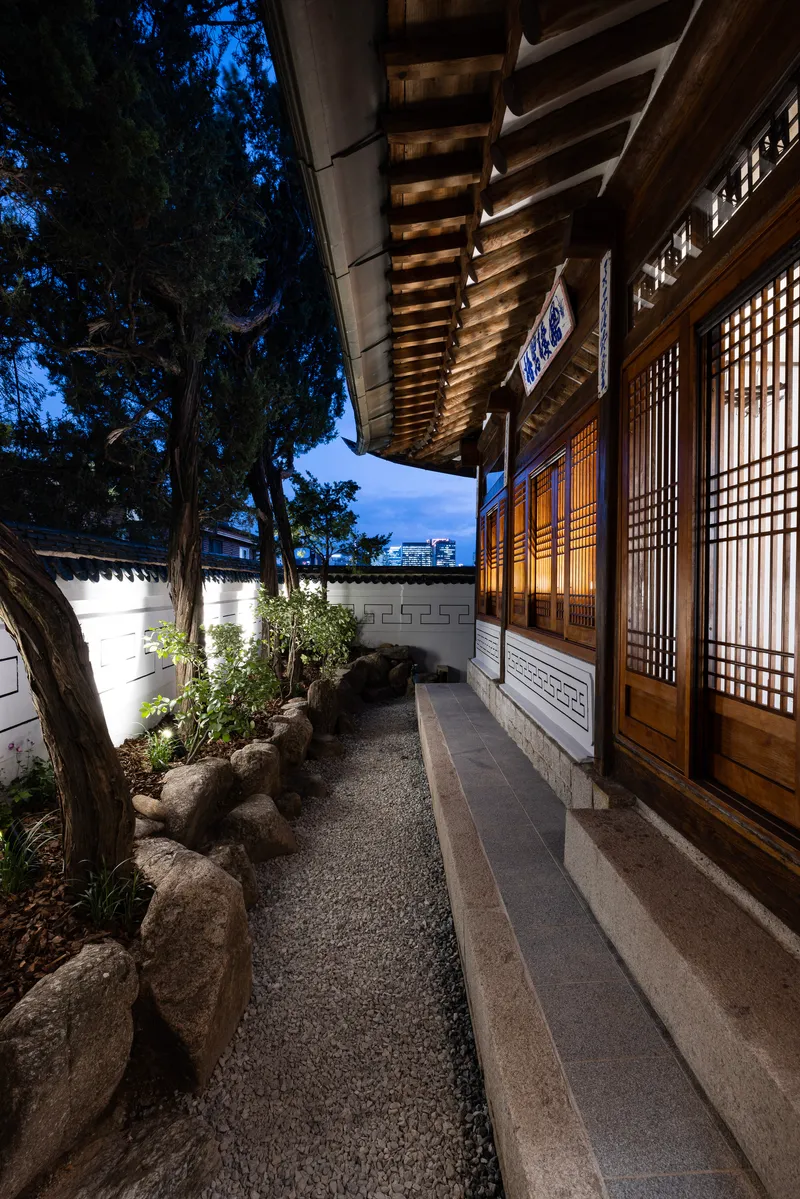
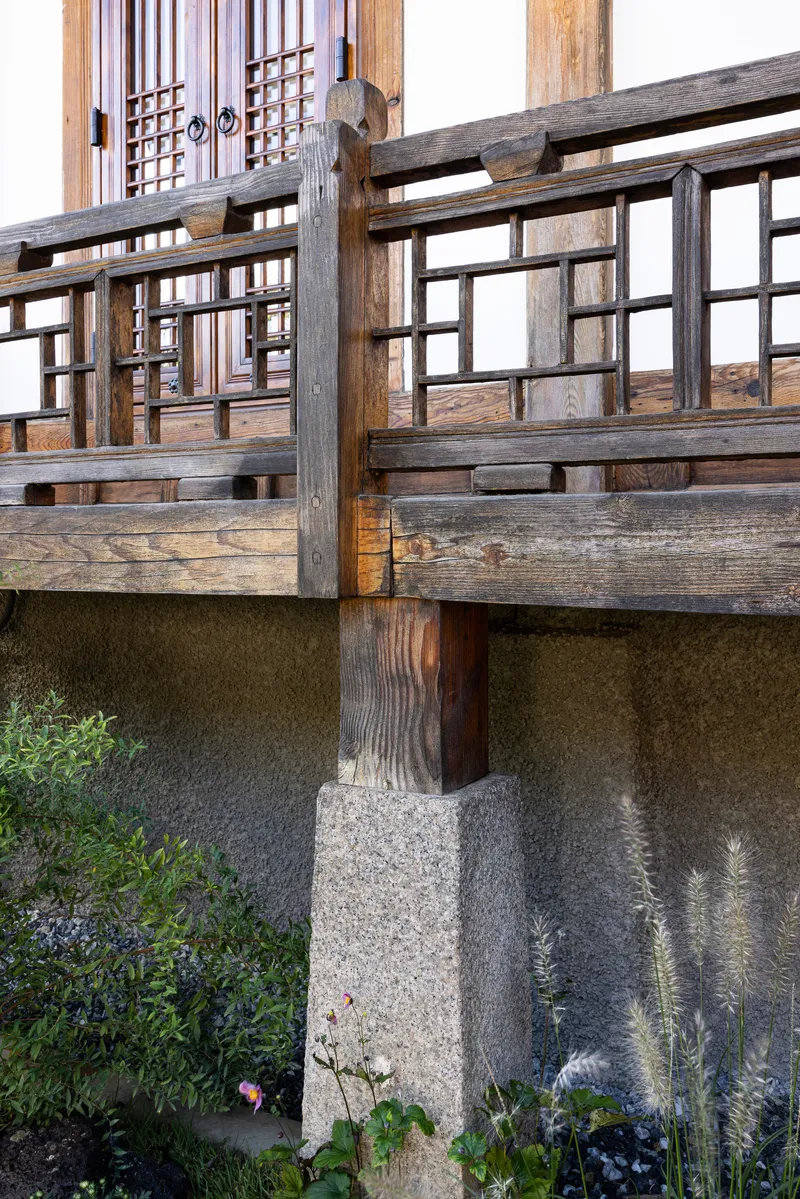
The elevated timber verandas that ring the courtyard serve as the house's transitional zone, neither fully inside nor fully outside. These covered platforms, raised on stone plinths and shaded by deep roof overhangs, are where the architecture mediates between the private interior and the shared garden. Lattice screens along the veranda edge can be opened or closed, turning the threshold into a room or a passage depending on the season and the hour.
At twilight, with the screens partially open and the gravel garden illuminated by low light, the veranda becomes the most atmospheric space in the house. A stone balustrade beside a planted bed of grasses and shrubs marks the edge where architecture meets landscape, a boundary that the pine tree, extending its branches well above the roofline, cheerfully ignores.
Interior Details and Atmosphere


Several rooms feature framed scroll paintings and calligraphy hung against timber lattice, a curatorial decision that reinforces the house's identity as a cultural artifact rather than merely a building. The dark wooden flooring, polished to a low sheen, reflects the lattice patterns overhead, doubling the geometry of the screens in a way that makes small rooms feel deeper than they are.
Views through dark timber-framed openings toward the courtyard compress foreground and background into layered compositions of wood, glass, gravel, and tile. The architects understood that in a hanok, framing matters as much as material. Every doorway is a picture plane, every window a deliberate edit of the landscape beyond.
Why This Project Matters
The Nostalgia Bluejae House matters because it demonstrates that heritage renovation does not require either frozen-in-amber reverence or aggressive modernization. Creative Studio Unravel found a third path: identifying the elements that give the house its cultural and material specificity, the blue roof tiles, the gobang glass, the hand-shaved ceiling panels, the courtyard plan, and then protecting those elements while inserting new amenities in the gaps. The result is a building that functions comfortably as overnight accommodation without pretending to be anything other than an 80-year-old hanok.
More broadly, the project raises useful questions about what collective standardization actually produced in 1930s Seoul. These Bukchon hanoks were not aristocratic commissions; they were developer housing, built in series by management firms adapting traditional forms to modern urban pressures. That makes them a fascinating hybrid, vernacular in their spatial logic but industrial in their production. Preserving one of these houses, and making it available for visitors to spend a night in, turns a building type into a legible argument about how Korean domestic architecture absorbed modernity. The blue tiles on the roof are a poetic accident, linking a modest dwelling to the highest seat of national power, but the real story is in the wood, the glass, and the courtyard that holds them all together.
Nostalgia Bluejae House by Creative Studio Unravel. Located in Jongno-gu, Seoul, South Korea. 135 m². Completed in 2020. Photography by Sunghoon Han.
About the Studio
Share Your Own Work on uni.xyz
If projects like this are the kind of work you want to make, uni.xyz is a place to publish your own, find collaborators, and enter design competitions.




Popular Articles
Popular articles from the community


Conexión: Biophilic Design Reimagines High-Rise Living in Hong Kong
Conexión reimagines high-rise living in Hong Kong through biophilic design, green facades, shared spaces, daylight, water and nature within.

The Ocean Hive: Sustainable Architecture for a Self-Sufficient Civilization at Sea
The Ocean Hive imagines sustainable architecture at sea, where modular habitats, algae, wave power and ocean waste sustain a growing colony.

Co-life: Sustainable Architecture for Age-Friendly Community Living
Co-life reimagines sustainable architecture for seniors through courtyards, rammed earth, shared gardens, and spaces designed for belonging.

Co-Life: Senior Housing Design That Reconnects Older Adults With the City
Co-Life reimagines senior housing design through healing gardens, shared streets, workshops, and a sustainable community across generations.


Similar Reads
You might also enjoy these articles

Bao Huynh Watercolor Atelier: A Serene Art Retreat in Hội An
Bao Huynh Watercolor Atelier in Hội An blends multifunctional art spaces, sustainable design, local materials, and family-friendly living in a serene environment.

Atelier Macri Concept Store Interior Design by CASE-REAL
Atelier Macri store features a "ko" counter, walnut wood details, cork displays, blending retail, gallery, and seamless customer experiences.

Manuel Vargas Izquierdo Stadium and High-Performance Sports Center: Architectural Excellence in Jalpa de Méndez
The Manuel Vargas Izquierdo Stadium blends sustainable design, inclusive sports facilities, and cultural-inspired architecture, revitalizing Jalpa de Méndez’s public spaces.

KAKR Buluh Awar Hall: Revitalizing Community and Ecology Through Bamboo Architecture
Community built bamboo hall revitalizes Buluh Awar village, empowering youth, restoring ecology, celebrating vernacular craftsmanship through sustainable architecture and culture.




Comments (0)
Please login or sign up to add comments
No comments yet. Be the first to comment!