
CREM Paragon x KIND Wraps a University Mosque in a Woven Brick Drum on the Edge of a Lake
Al-Iqtishad Mushola brings a spiraling basketweave facade and planted terraces to the University of Indonesia's economics campus.


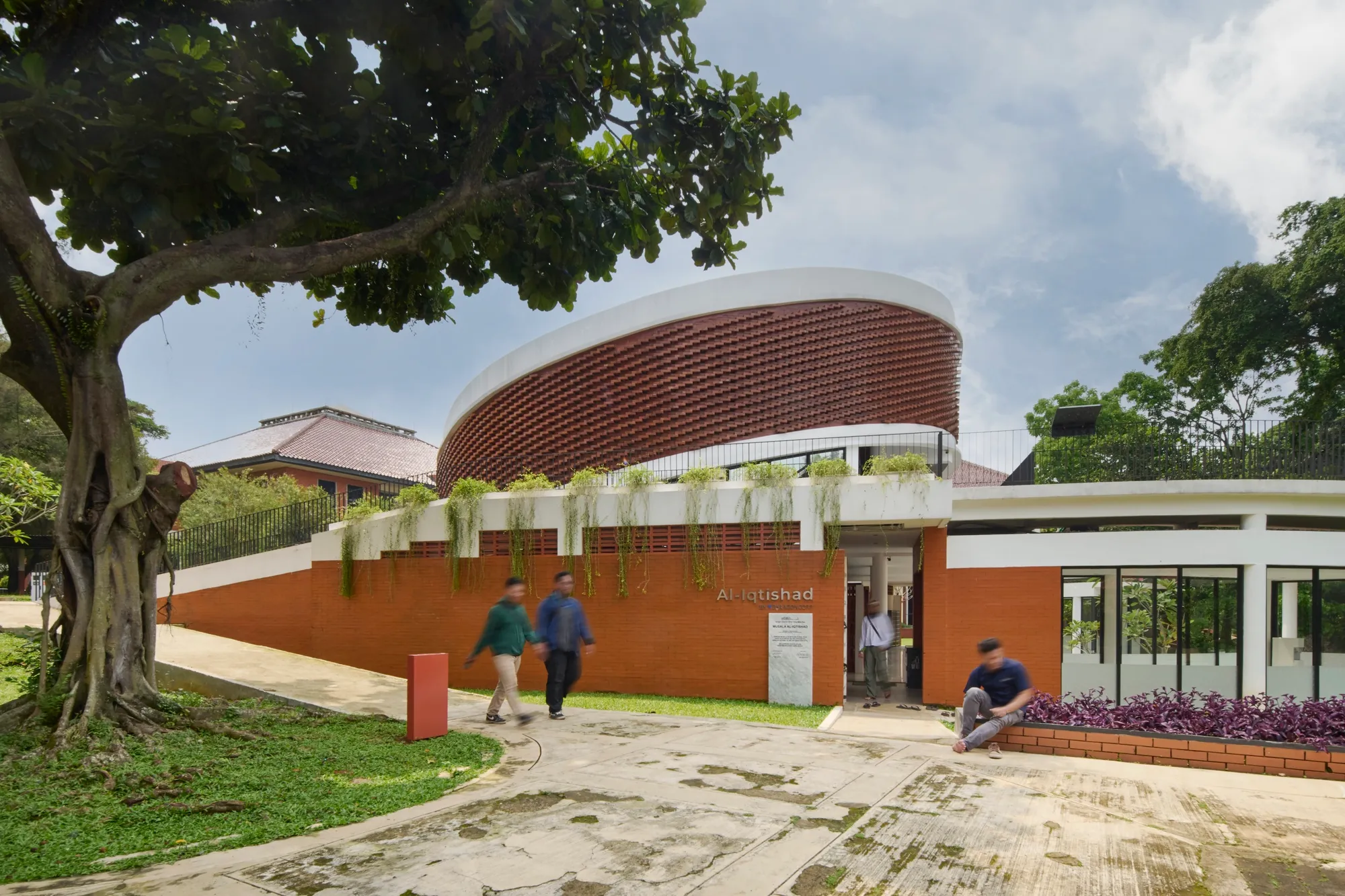
Most campus prayer halls are afterthoughts, tucked into leftover rooms or shoehorned between parking structures. Al-Iqtishad Mushola, designed by CREM Paragon x KIND for the Faculty of Economics and Business at the University of Indonesia, refuses that fate entirely. Sitting on the southeastern edge of the campus near a lakeshore, the 434-square-meter worship space announces itself through a cylindrical brick volume whose woven facade reads as both textile and tectonic artifact. It is a small building with an outsize presence, and the decision to give a mushola this level of architectural ambition says something meaningful about how the campus values communal spiritual life.
What makes the project genuinely interesting is the way it negotiates between a singular, almost monumental gesture and a sequence of intimate, layered outdoor spaces. The circular drum anchors the composition, but the real spatial richness unfolds in the terraces, walkways, and planted courtyards that cascade down toward the water. The building is not just a place to pray; it is a place to linger, to circulate, to watch the light shift through perforated brick. That duality, between the civic and the contemplative, is where this project finds its footing.
A Cylinder Among Diamonds
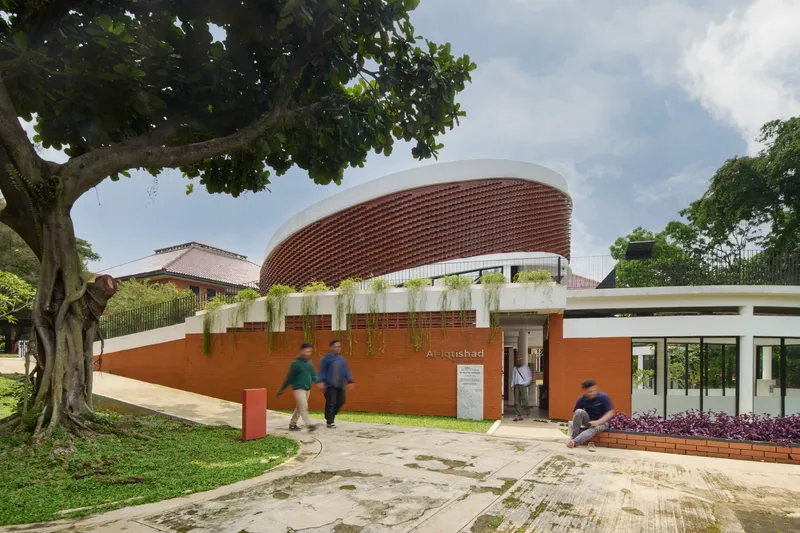
The Faculty of Economics and Business campus is organized around diamond-shaped departmental buildings, a geometry that Al-Iqtishad's circular plan deliberately resists. The cylindrical volume doesn't try to blend in. It establishes its own formal logic, reading as a counterpoint to the angular context rather than a continuation of it. From the street approach, the terracotta brickwork and the basketweave pattern create a warm, almost haptic surface that draws pedestrians in. It is a building you want to touch.
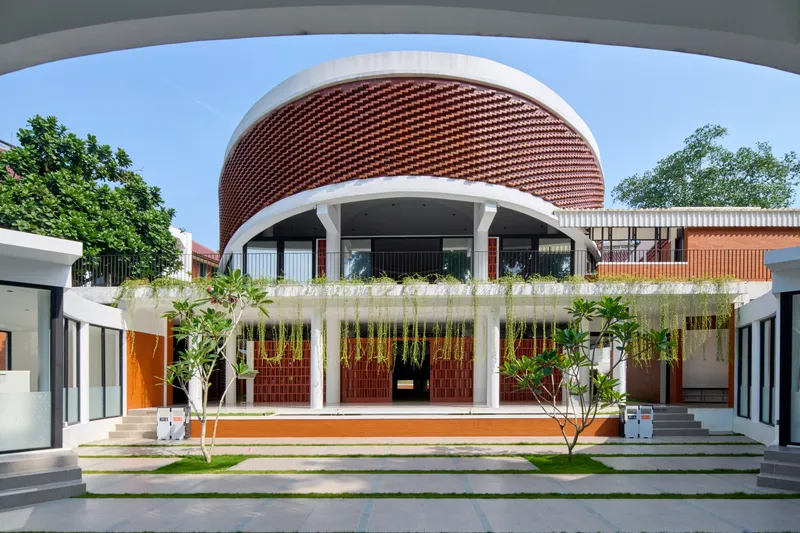
The courtyard side reveals the drum sitting above a planted terrace, framed by hanging greenery and columned walkways. This is where the building's personality shifts from solid and grounded to open and permeable, a transition that happens not through a single threshold but through a gradient of enclosure.
Terraces, Walkways, and the Space Between
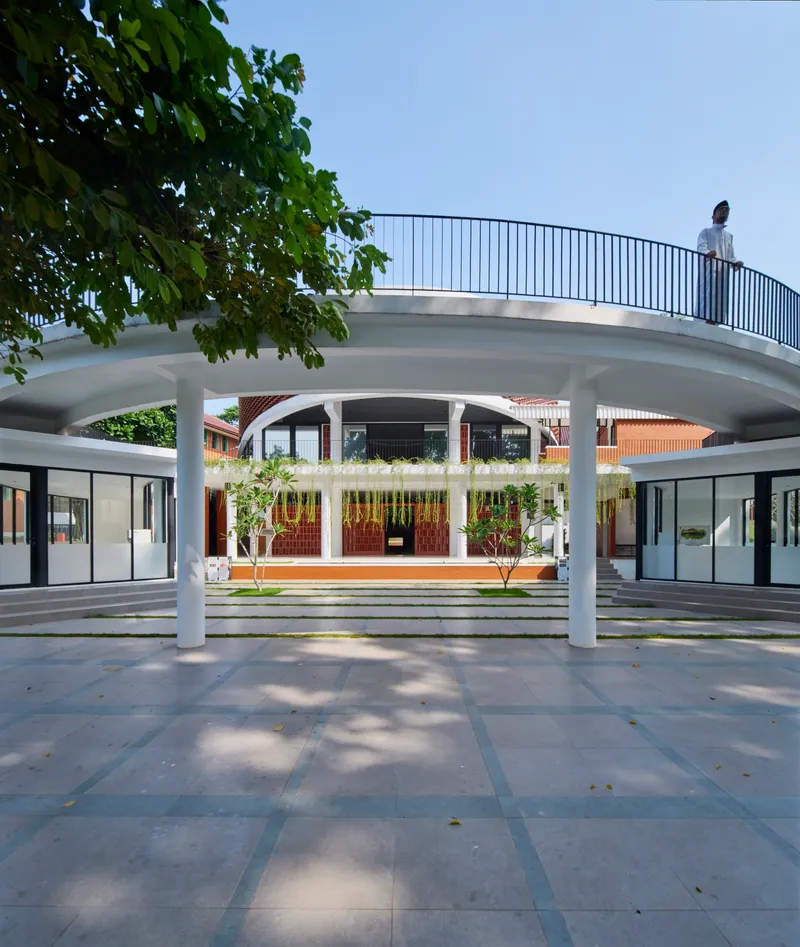
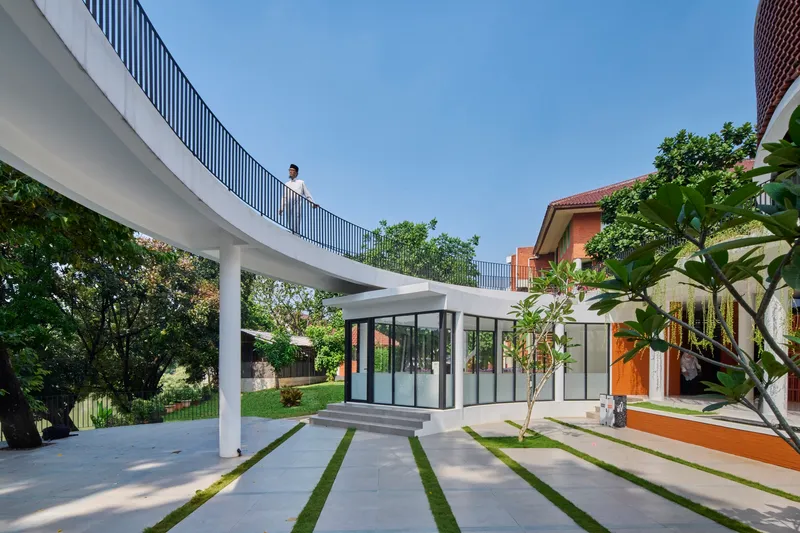
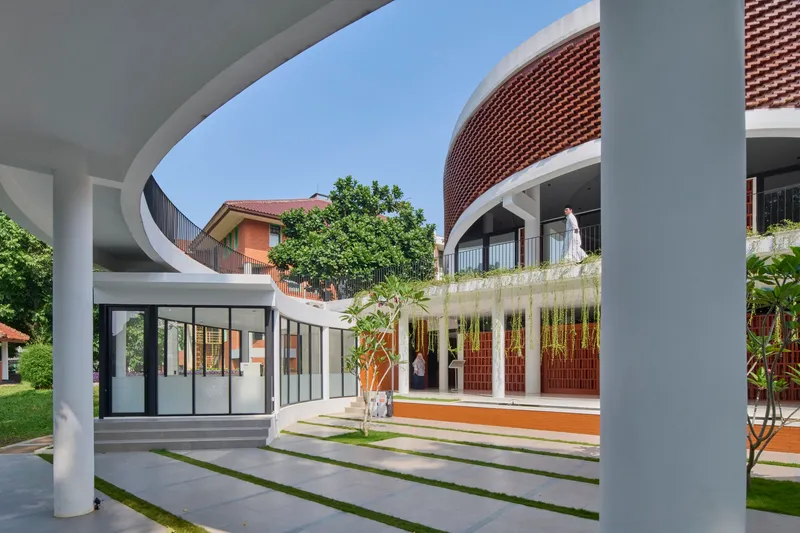
The outdoor circulation spaces deserve as much attention as the prayer hall itself. Curved elevated walkways, supported by slender white columns, wrap around the building and offer views down to grass-jointed paving and a glazed pavilion below. These are not corridors. They are social spaces in their own right, designed to slow people down and give them a reason to pause. The cantilevered terrace, where a figure stands above the planted ground plane, shows the architects working at a scale that feels almost domestic, despite the building's institutional role.
Framing is used deliberately throughout. White columns create rhythmic openings that turn adjacent courtyards into composed views, with grass strips reinforcing the directionality. The interplay between solid brick above and open colonnade below gives the project a sectional richness that many buildings three times its size fail to achieve.
The Basketweave Facade Up Close
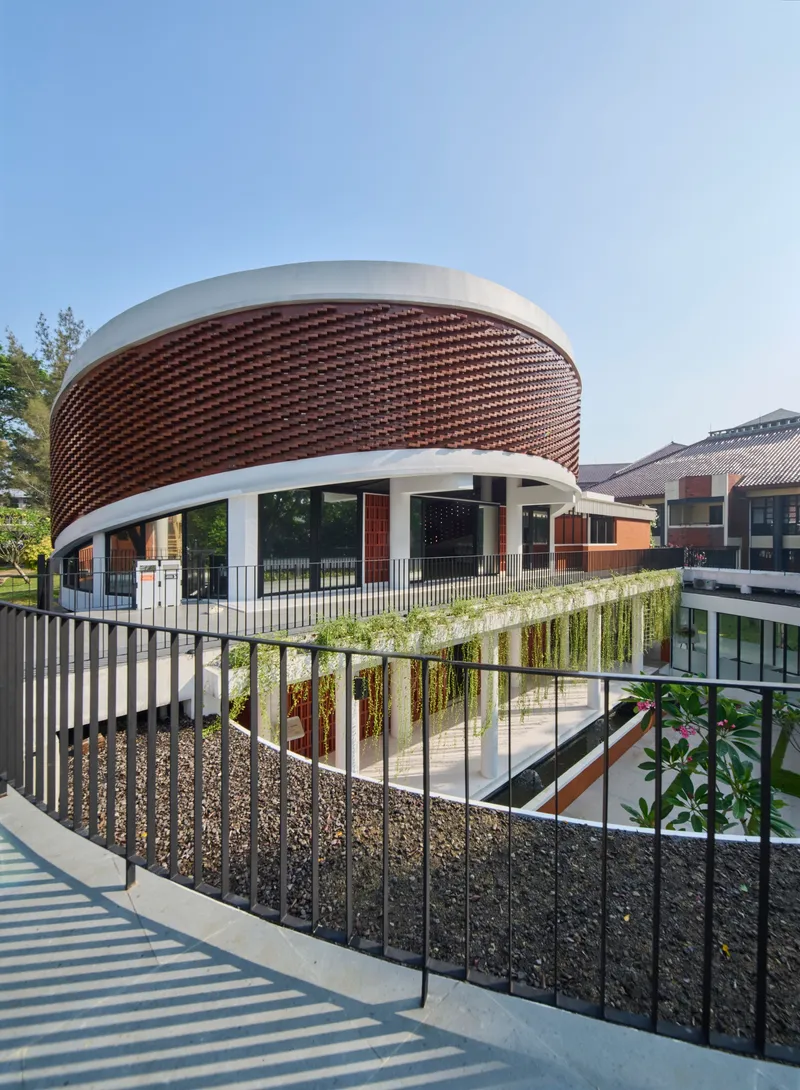
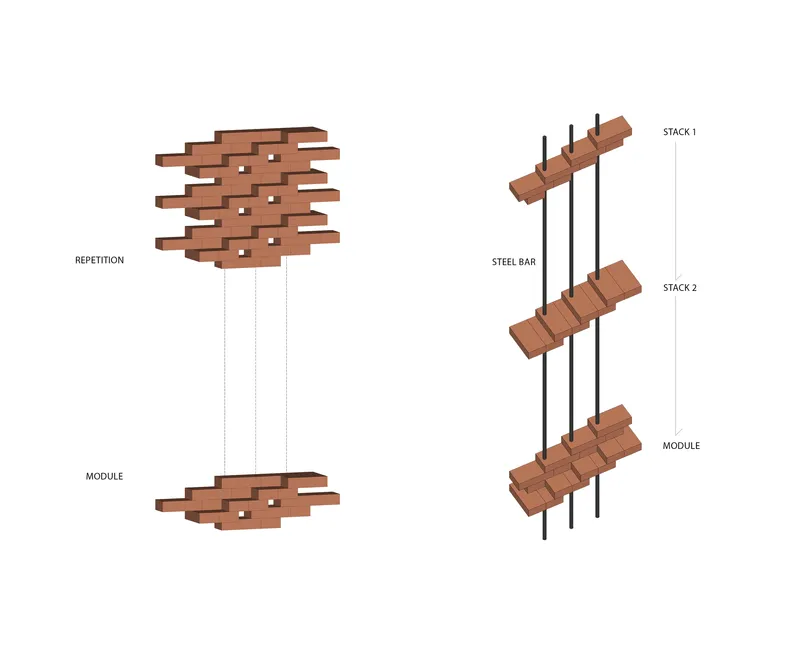
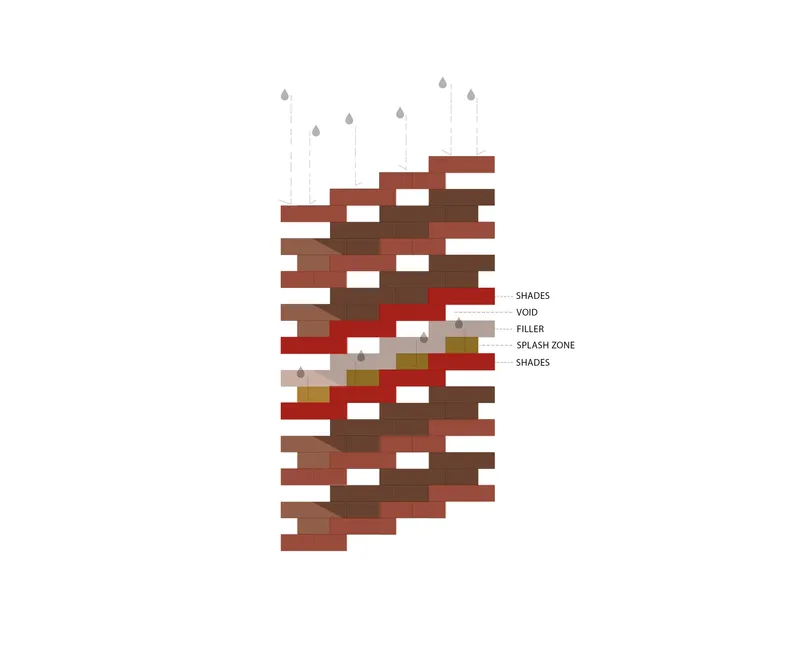
The defining move here is the brick screen that wraps the cylindrical volume. The construction detail is straightforward but effective: individual brick modules are stacked in a staggered pattern and threaded onto vertical steel bars. The result is a woven surface with controlled voids that modulate light, ventilation, and visual privacy. It is a tectonic system that performs environmentally while reading as ornament.
The elevation diagram breaks the facade into color-coded zones: shaded areas, voids, solid filler, and splash zones where water may contact the surface. This kind of analysis reveals a project that treats material performance as a design driver rather than an afterthought. The woven pattern is not decorative. It is an environmental response calibrated to the Indonesian climate, where managing solar gain and airflow is fundamental.
Descending Toward the Water
The site section tells a story the photographs only hint at. The building's multiple levels terrace down toward the nearby lakeshore, embedding the mushola into the topography rather than sitting atop it. This move ties the building to the larger campus landscape and creates a procession from the public street edge, through the planted terraces, down to the water. For a worship space, that directional quality matters. Arrival is not instantaneous; it is staged, giving visitors time to transition mentally from the activity of campus life to the quiet of prayer.
Plans and Drawings
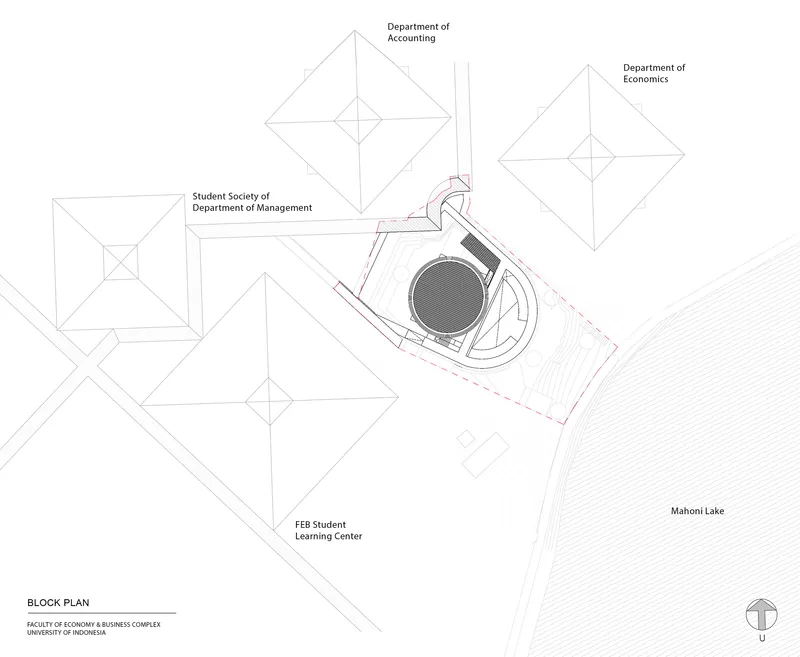
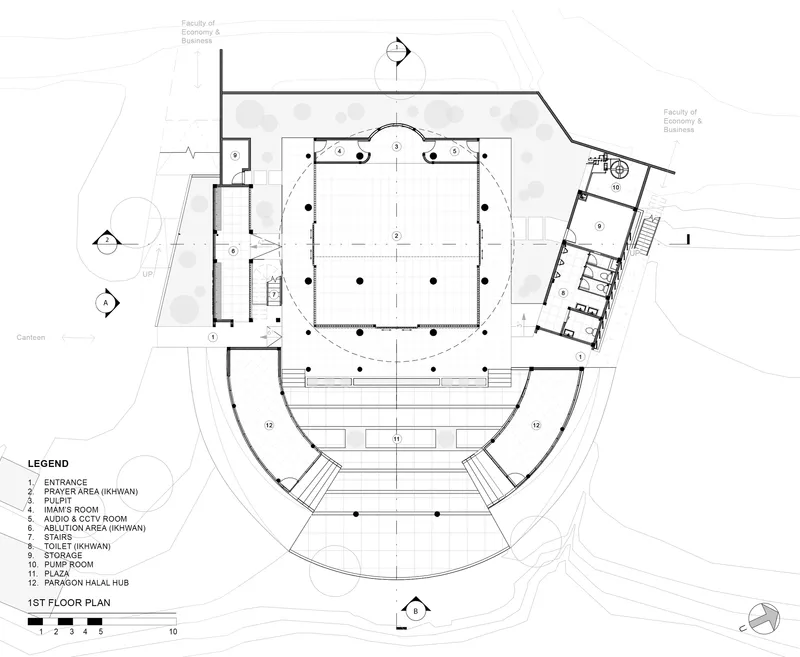
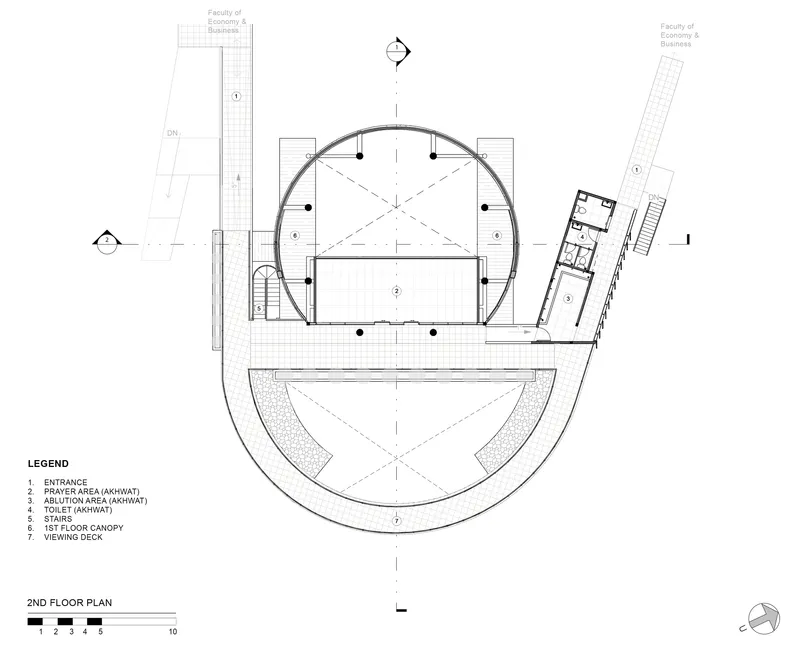
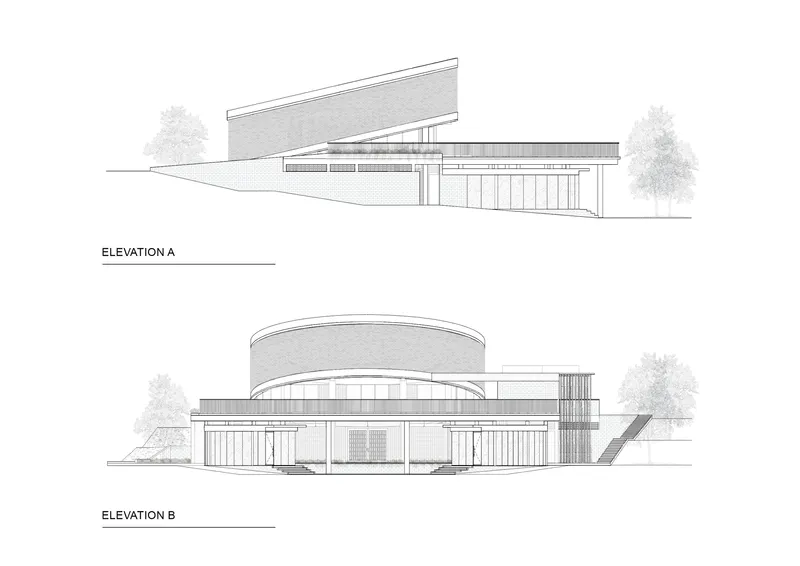
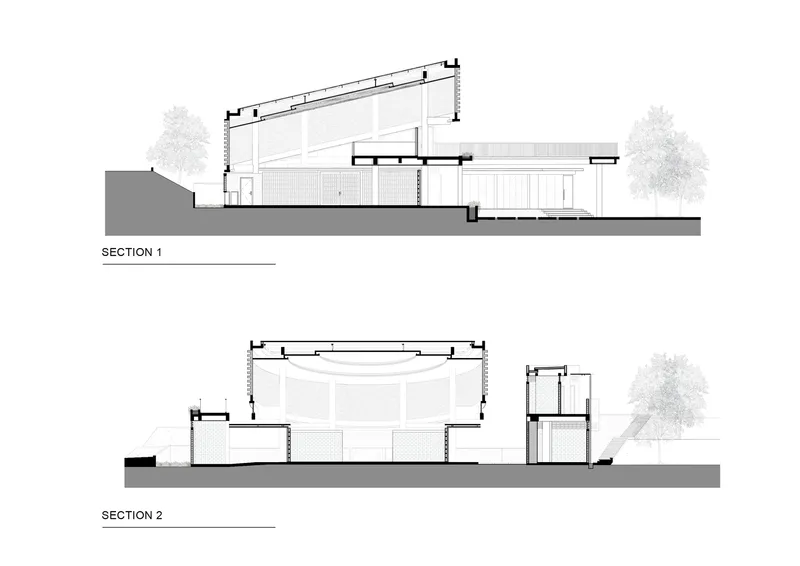
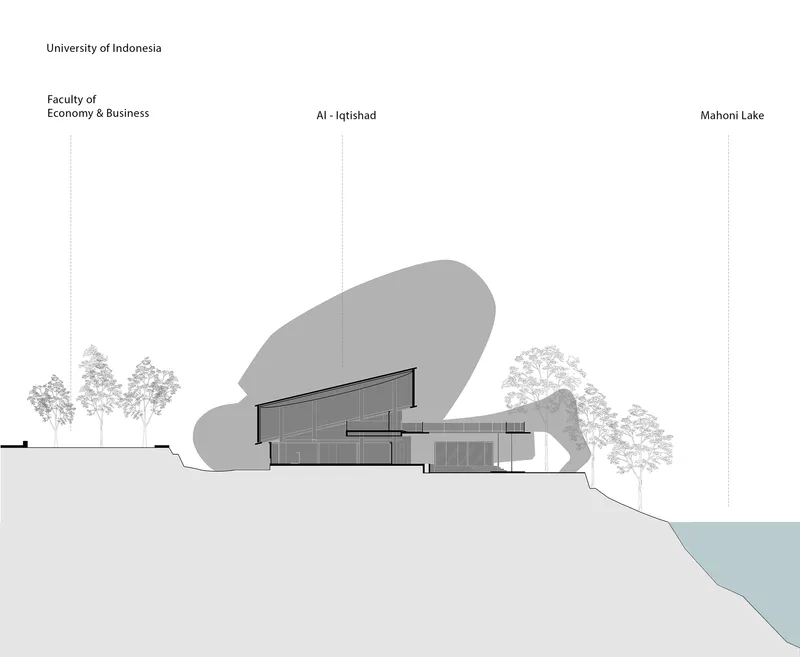
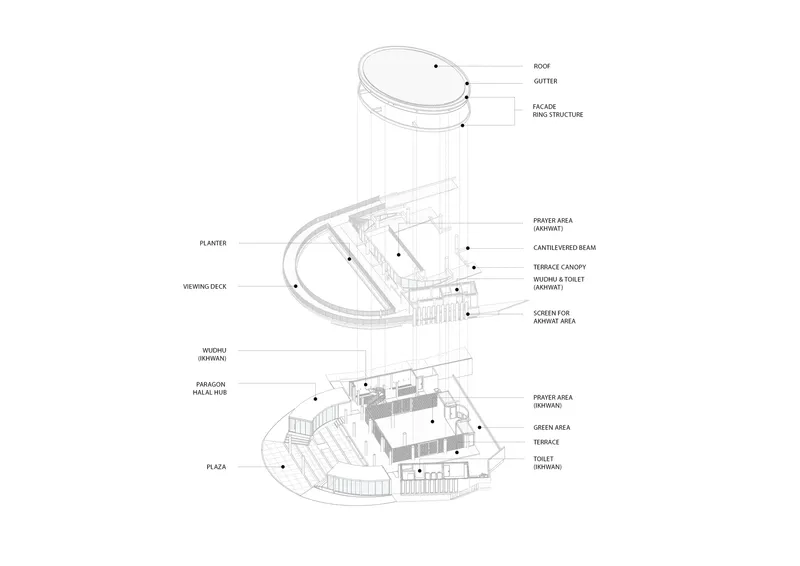
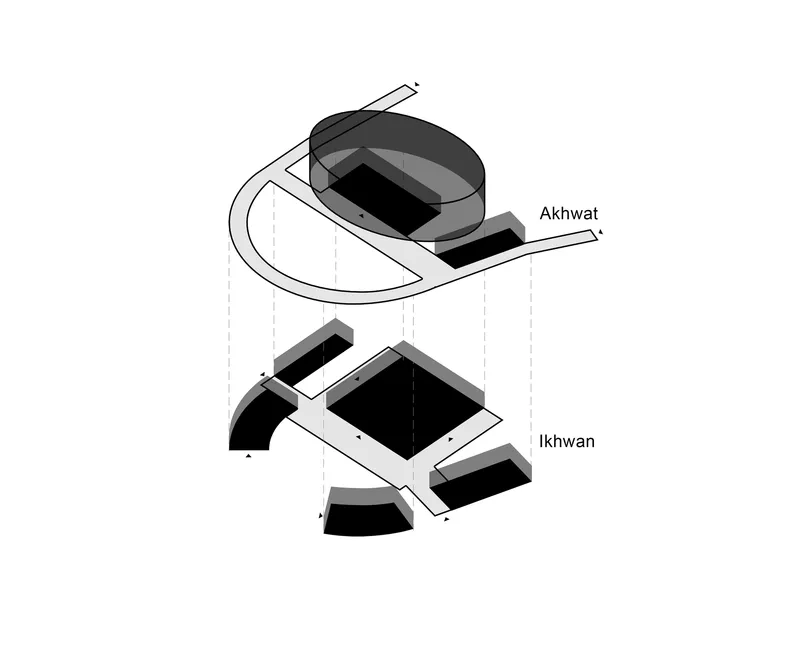
The block plan confirms the formal strategy: a circle dropped into a field of diamonds, positioned at the campus edge near the lake. The first floor plan shows the circular prayer hall at the core, surrounded by ancillary spaces and curved steps that mediate between the drum and the rectangular volumes below. At the second floor, a semicircular prayer area opens onto a viewing deck, reinforcing the idea that this building is as much about looking outward as turning inward.
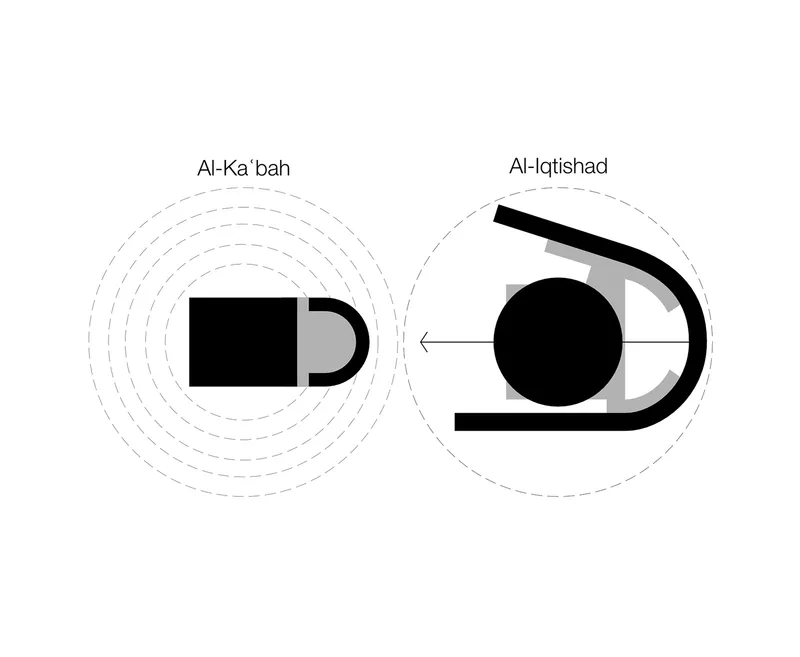
The sections are particularly revealing. An angled roof caps the composition, hovering above the curved dome volume, while the lower levels open laterally through colonnades. The exploded axonometric labels each component clearly: roof, viewing deck, terrace canopy, prayer areas. The diagram comparing two circular configurations, solid versus void, shows the architects testing how mass and opening could be distributed across the plan. These drawings document a rigorous design process, not just a finished object.
Why This Project Matters
Al-Iqtishad Mushola matters because it refuses to treat campus worship as a secondary program. By giving the mushola a legible, iconic form and surrounding it with generous public space, CREM Paragon x KIND have created a building that serves as both a spiritual anchor and a social node for the faculty. The woven brick drum is memorable, but it is the terraced landscape and layered circulation that make this a genuinely usable piece of campus infrastructure.
The project also offers a compelling model for how to work with brick in a tropical climate. The threaded-bar construction system is replicable. The environmental logic of the perforated screen is legible in the drawings. And the decision to embrace a circular geometry amid orthogonal neighbors demonstrates that campus architecture does not need to default to conformity to achieve coherence. Sometimes the strongest contribution is the one that insists on being different.
Al-Iqtishad Mushola, designed by CREM Paragon x KIND, Kecamatan Beji, Indonesia. 434 m². Completed 2025. Photography by Nilai Asia, Sofian Johan, and Adjie Negara.
About the Studio
Share Your Own Work on uni.xyz
If projects like this are the kind of work you want to make, uni.xyz is a place to publish your own, find collaborators, and enter design competitions.




Popular Articles
Popular articles from the community


Hill & Cross Opera: Sculptural Opera House Architecture Shaped by Tallinn’s Landscape and Identity
Hill & Cross Opera reimagines opera house architecture in Tallinn through its sculptural hill, civic plaza, glass wave and a luminous cross.

The Musturak Paradise: Senior Living Architecture for a Connected Future in Temara, Morocco
The Musturak Paradise reimagines senior living architecture in Temara via private homes, social spaces, culture, community, and shared care.

Co-Life: Senior Housing Design That Reconnects Older Adults With the City
Co-Life reimagines senior housing design through healing gardens, shared streets, workshops, and a sustainable community across generations.

The Ocean Hive: Sustainable Architecture for a Self-Sufficient Civilization at Sea
The Ocean Hive imagines sustainable architecture at sea, where modular habitats, algae, wave power and ocean waste sustain a growing colony.


Similar Reads
You might also enjoy these articles

Bao Huynh Watercolor Atelier: A Serene Art Retreat in Hội An
Bao Huynh Watercolor Atelier in Hội An blends multifunctional art spaces, sustainable design, local materials, and family-friendly living in a serene environment.

Atelier Macri Concept Store Interior Design by CASE-REAL
Atelier Macri store features a "ko" counter, walnut wood details, cork displays, blending retail, gallery, and seamless customer experiences.

Manuel Vargas Izquierdo Stadium and High-Performance Sports Center: Architectural Excellence in Jalpa de Méndez
The Manuel Vargas Izquierdo Stadium blends sustainable design, inclusive sports facilities, and cultural-inspired architecture, revitalizing Jalpa de Méndez’s public spaces.

KAKR Buluh Awar Hall: Revitalizing Community and Ecology Through Bamboo Architecture
Community built bamboo hall revitalizes Buluh Awar village, empowering youth, restoring ecology, celebrating vernacular craftsmanship through sustainable architecture and culture.


Explore Educational Building Competitions
Discover active competitions in this discipline



Design Challenge - Contemporary interpretation of a religious complex


Challenge to design public laboratory
Comments (0)
Please login or sign up to add comments
No comments yet. Be the first to comment!