
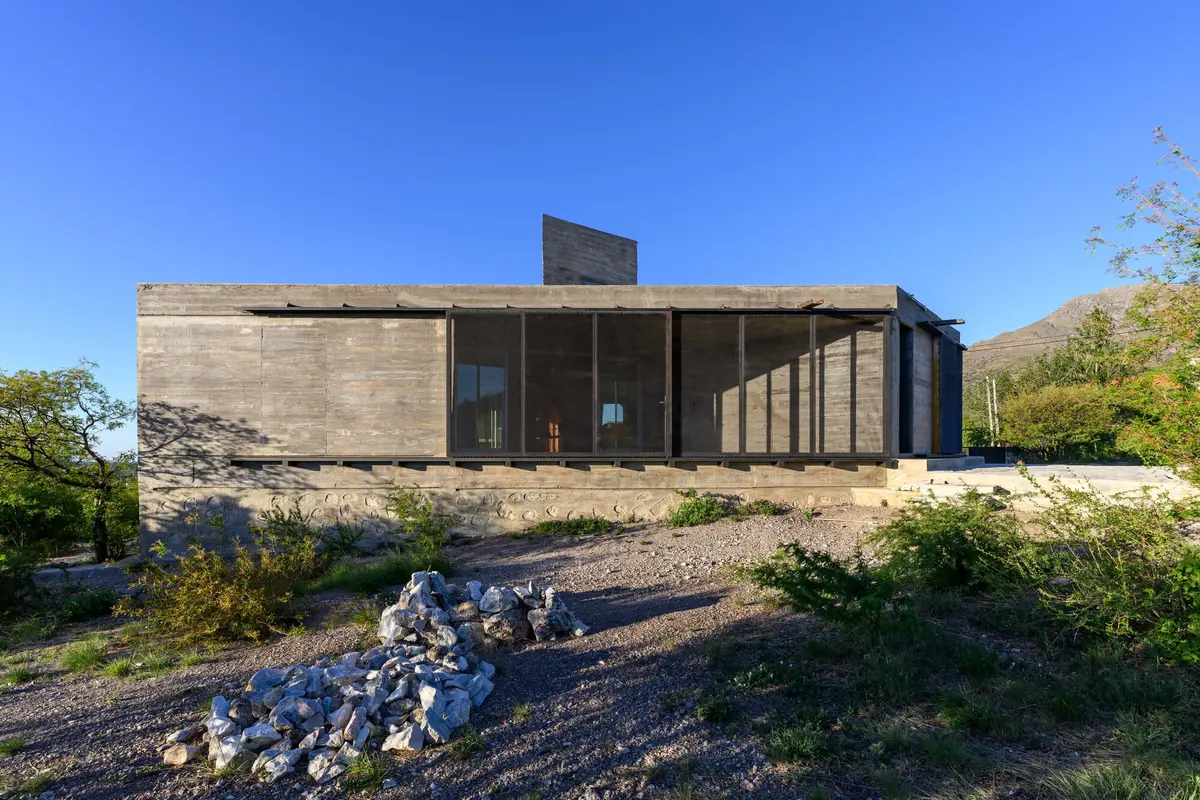
Cristian Nanzer Triangulates a Concrete House Around Three Distant Peaks in Córdoba
At the edge of a protected reserve in Capilla del Monte, Casa Cosmos locks its geometry to the surrounding mountain landscape.


A house that takes its bearings from three landforms rather than a street grid is a rare thing. Cristian Nanzer's Casa Cosmos, perched at the foothills of the Punilla Valley in Capilla del Monte, Argentina, does exactly that: its plan radiates outward from a single point on the plot toward Las Gemelas to the south, Mount Uritorco to the northeast, and El Cajón Dam to the west. The resulting geometry is not a rectangle loosened by a few angled walls. It is a genuine triangulated matrix, a centrifugal arrangement in which every room faces one of those three horizons.
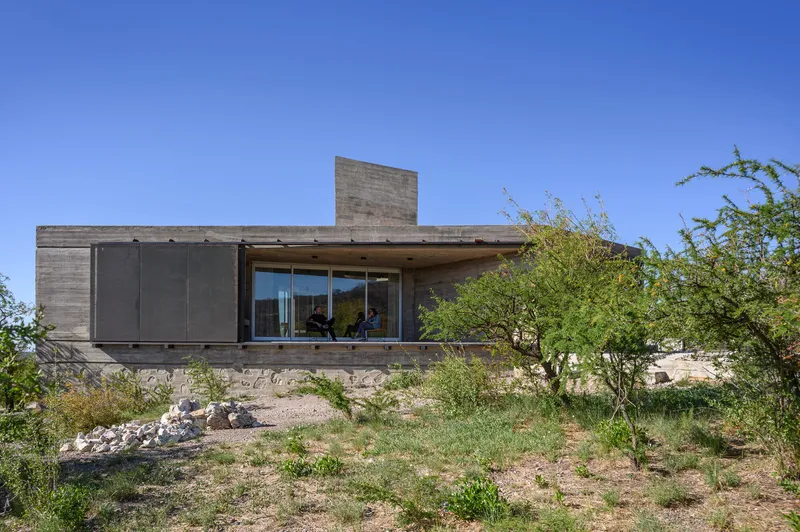
The name was given by the owner upon first seeing the house standing on the land, and you can understand the impulse. With its board-formed concrete walls, rammed stone plinth, and expanded metal shutters, the 355 square meter volume looks as though it was quarried from the site itself, then torqued to receive light from above and across three orientations at once. It sits at the edge of a protected natural reserve, dense with red quebrachos, black algarrobos, chañares, and aromitos. That adjacency imposes discipline: you earn the views by building tight and low, and Nanzer responds by absorbing the slope into a stone base that elevates the main floor just enough to clear the canopy line.
A Plinth That Absorbs the Hill
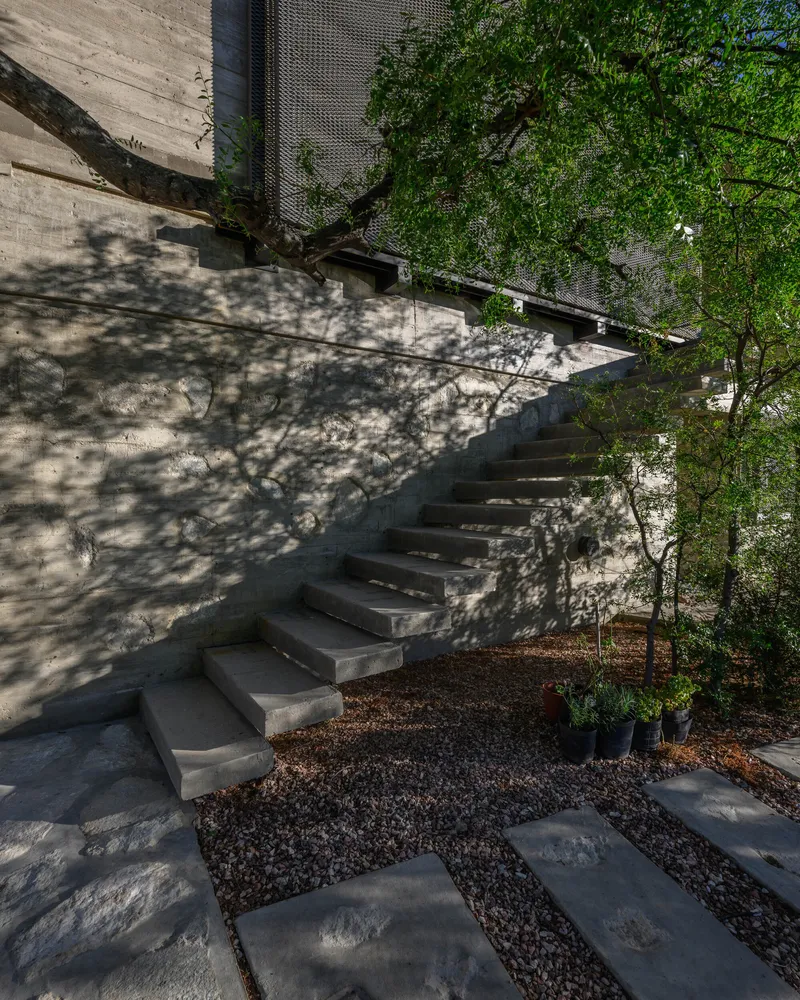
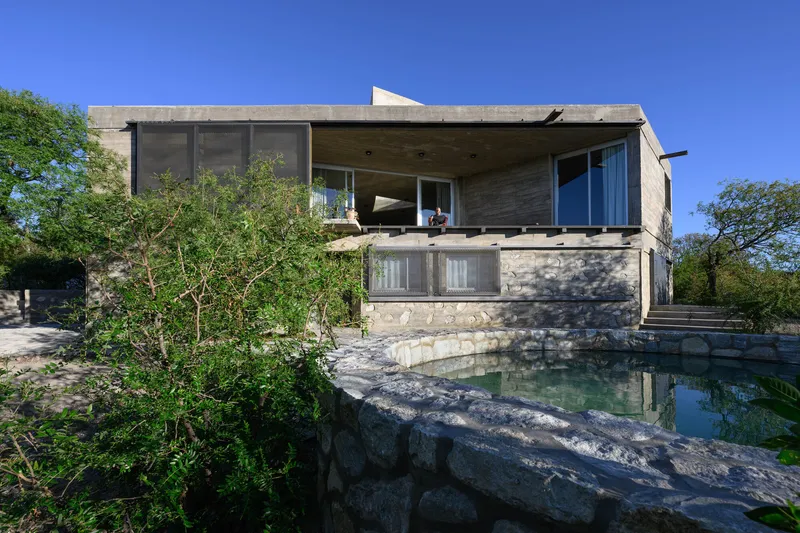
The site drops from east to west with a steep descent toward woodland on the southern edge. Rather than leveling the ground, Nanzer uses 40 cm thick rammed stone walls to retain the earth and establish a new datum for the main floor. The plinth is more than structure: it houses an independent residential unit, technical areas, and storage, turning what would otherwise be a retaining wall into occupied space. From the approach, the concrete staircase rising through dappled shadows reads as a deliberate threshold, separating the domestic interior from the slope's wilder terrain.
The stone construction carries a blunt, geological quality. Its aridity mirrors the surrounding semi-arid landscape, and the material choice keeps local building traditions visible rather than smoothing them away behind render. You see the labor in the wall.
Board-Formed Concrete and the Art of Imprint
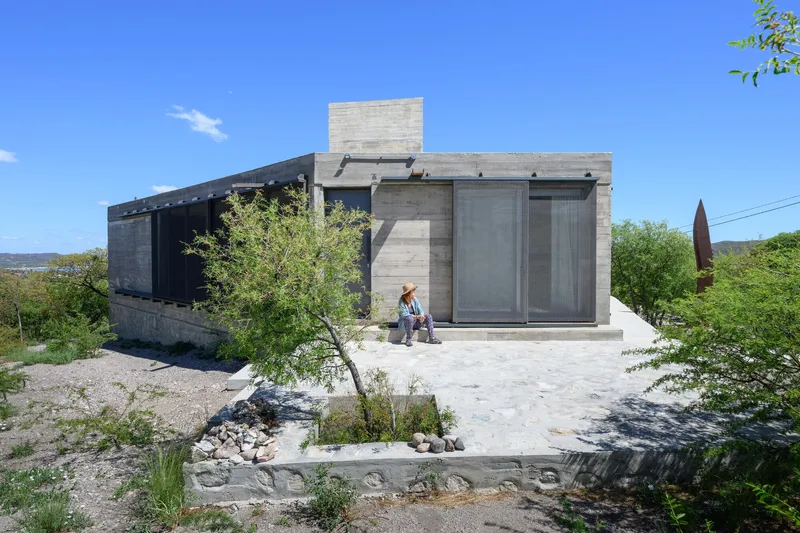
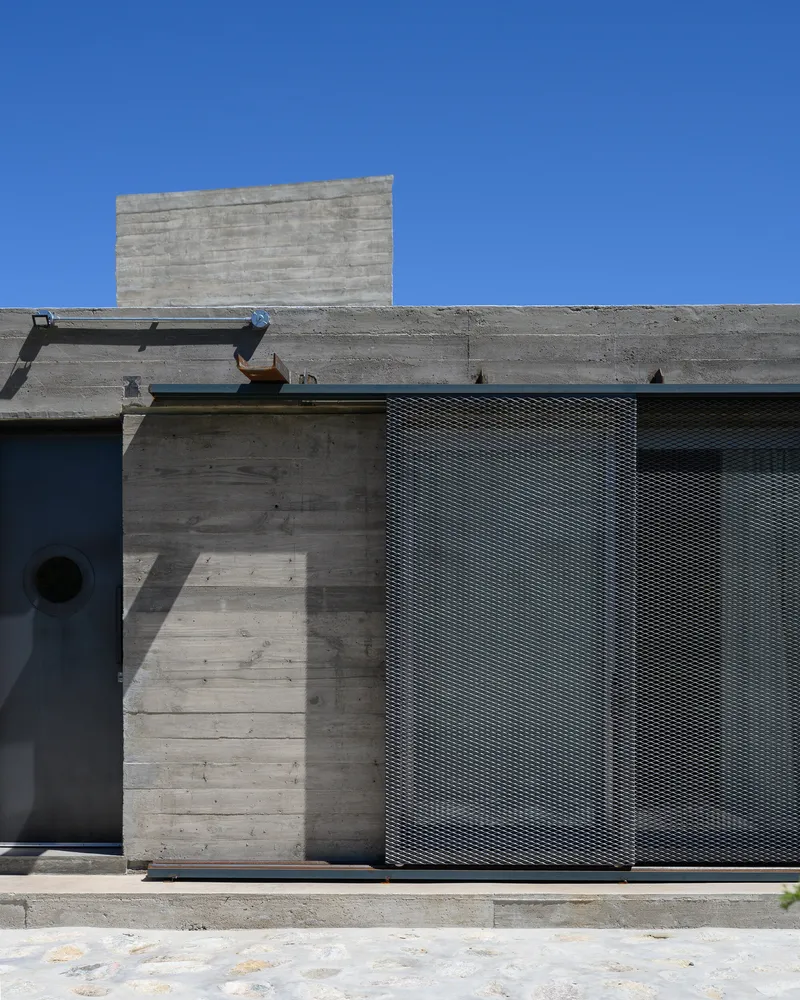
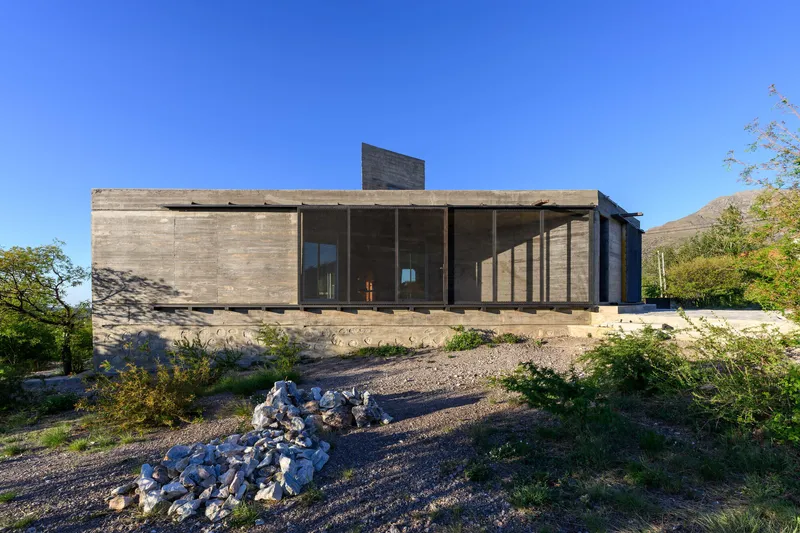
Above the stone base, the main floor is built entirely in board-formed exposed concrete. The formwork grain is legible on every surface, ceiling included, rendering the construction process explicit. Nanzer treats this not as a stylistic signature but as a way of making the building's own history readable. The expanded metal sliding shutters sit proud of the concrete face, adding a secondary layer that can be drawn closed to filter the intense Córdoba sun into a fine grain of light and shadow.
Where the shutters are open, the house projects a monolithic profile. Where they are closed, the facades soften into something more provisional, almost textile. That duality keeps the exterior from feeling static across the day, a practical and atmospheric move in a climate where sun angles shift dramatically between seasons.
A Triangular Void at the Core
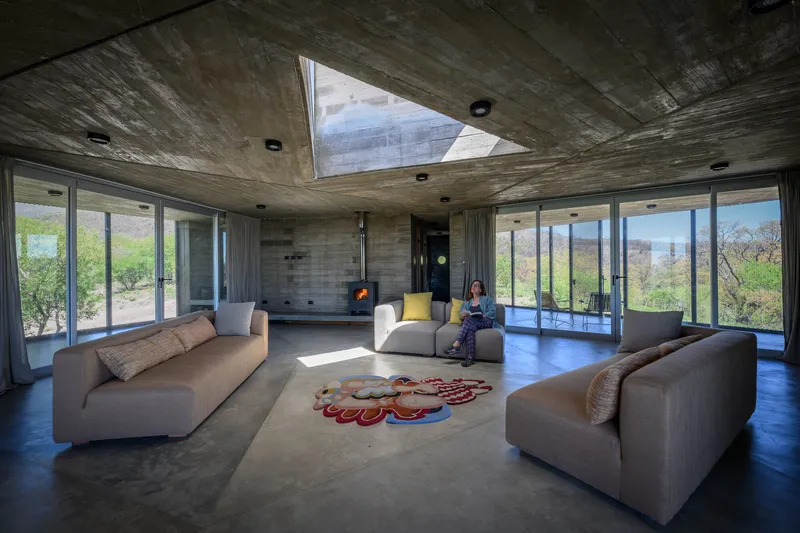
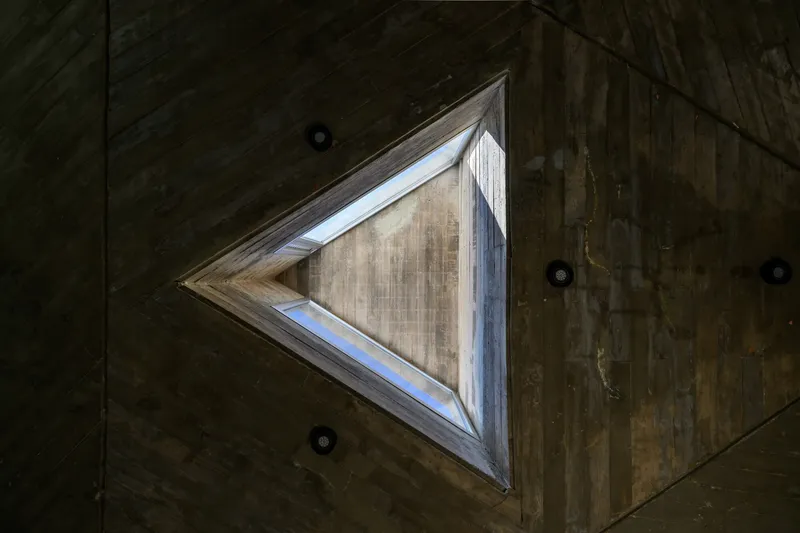
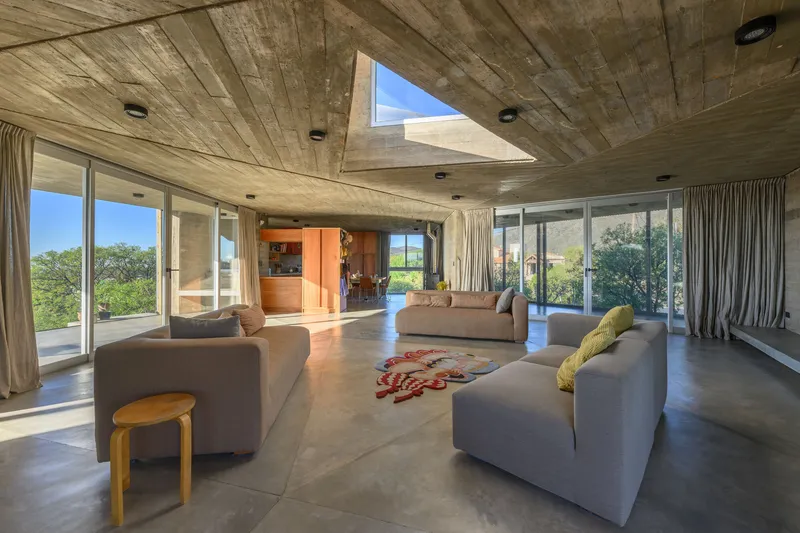
The central social space is crowned by a triangular skylight that follows the plan's organizing logic. Rooms radiate outward from this void, each oriented toward one of the three landscape focal points. The skylight drives a column of zenithal light into the deepest part of the floor plate, turning the ceiling into a framing device rather than a cap. Recessed fixtures line the concrete reveals, but during daylight hours the artificial light is redundant.
Sitting in the living room, you read the triangulated geometry overhead without needing to consult the plan. The ceiling slopes and folds according to the same angular discipline that governs the exterior, collapsing the distinction between structural logic and spatial experience. It is one of the project's clearest achievements: a complex geometry that feels intuitive once you are inside it.
Deep Galleries and the Landscape Beyond
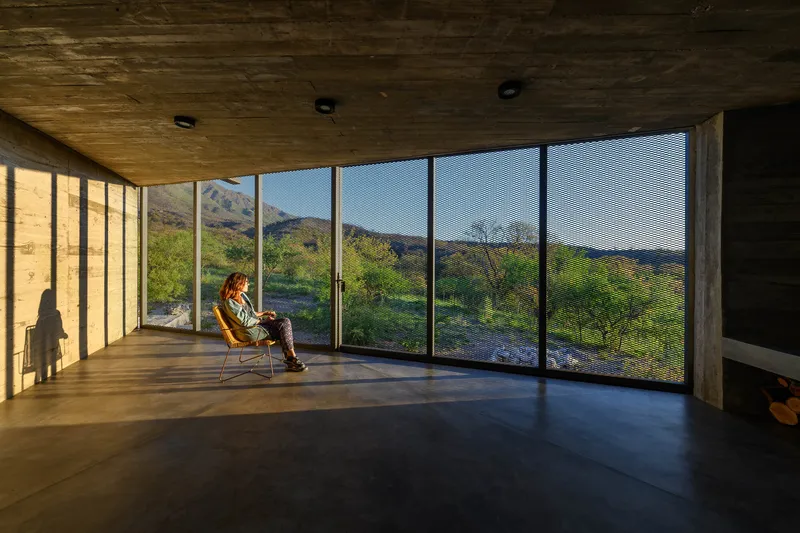
Three deep galleries carve into the polyhedral volume, creating shaded exterior rooms that extend the living spaces outward without exposing them to direct sun. These are not decorative loggias; they are the primary mechanism for passive comfort in a region where summer heat arrives early and stays long. The floor-to-ceiling glazing behind each gallery frames a specific peak or dam, turning the panorama into three discrete compositions rather than one continuous sweep.
The reflecting pool at the base of one gallery doubles the sky and softens the thermal mass of the concrete. Its circular form, visible in the plan, is the one curve in a project otherwise governed by straight lines, and it reads as a deliberate counterpoint, a moment where the strict geometry relaxes to hold water.
Climate as Form-Giver
Thermal insulation is integrated within the wall assembly of the exterior enclosures, reinforcing hygrothermal performance without adding a visible cladding layer. The expanded metal shutters adjust luminosity and airflow simultaneously, acting as both privacy screen and ventilation regulator. Taken together with the deep galleries and the massive concrete ceilings, the house achieves a high degree of passive environmental control. The design does not rely on one heroic gesture; it layers several modest ones.
The decision to orient three faces toward three distant landmarks is itself a climate strategy. Each orientation receives a different solar exposure, allowing the shutters on one face to be fully open while those on another are drawn tight. The house breathes unevenly across its perimeter, responding to sun and wind in real time.
Plans and Drawings
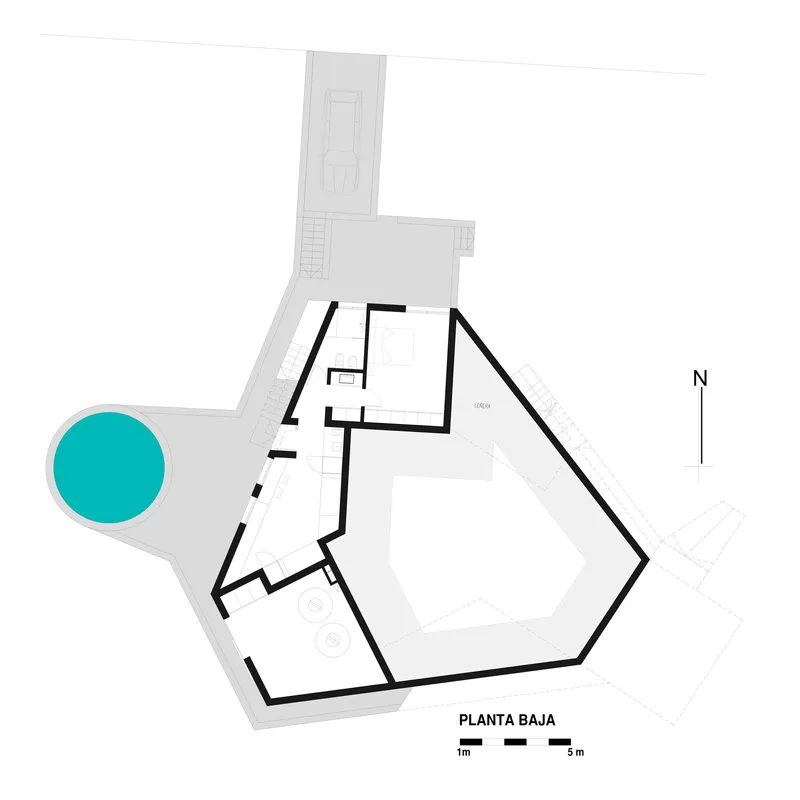
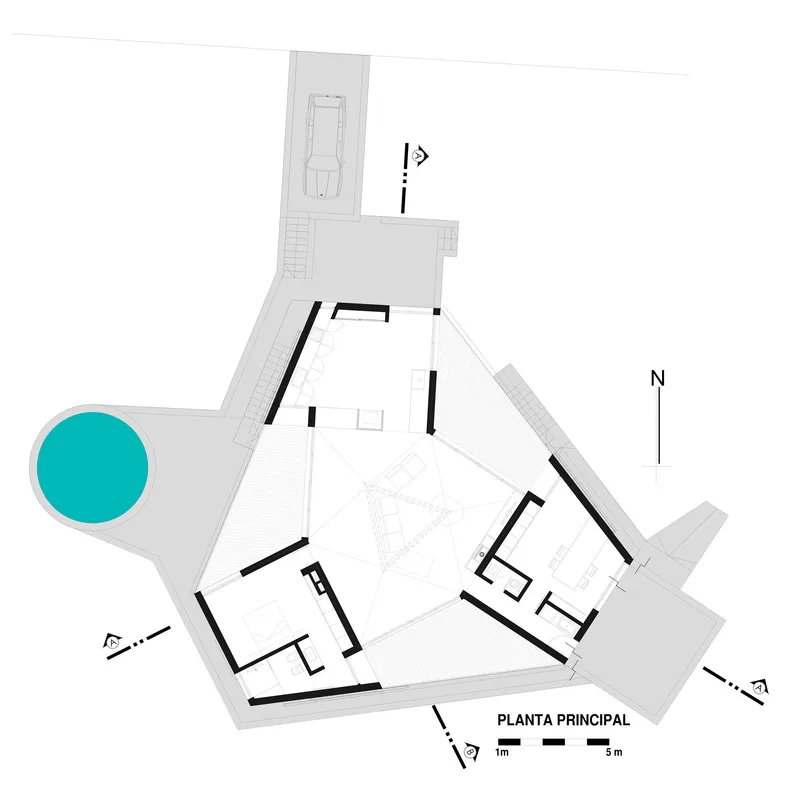
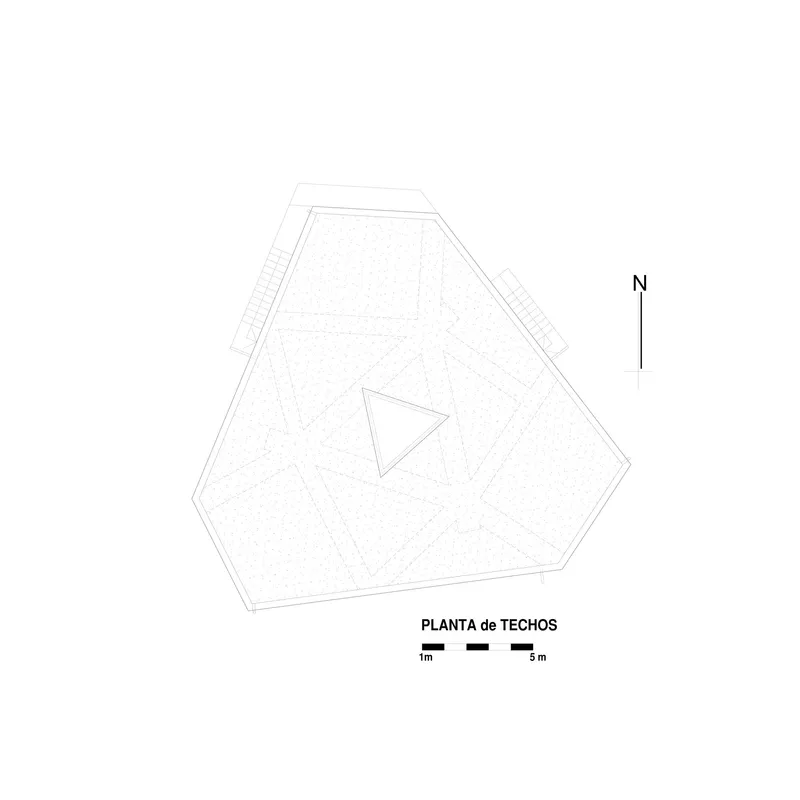
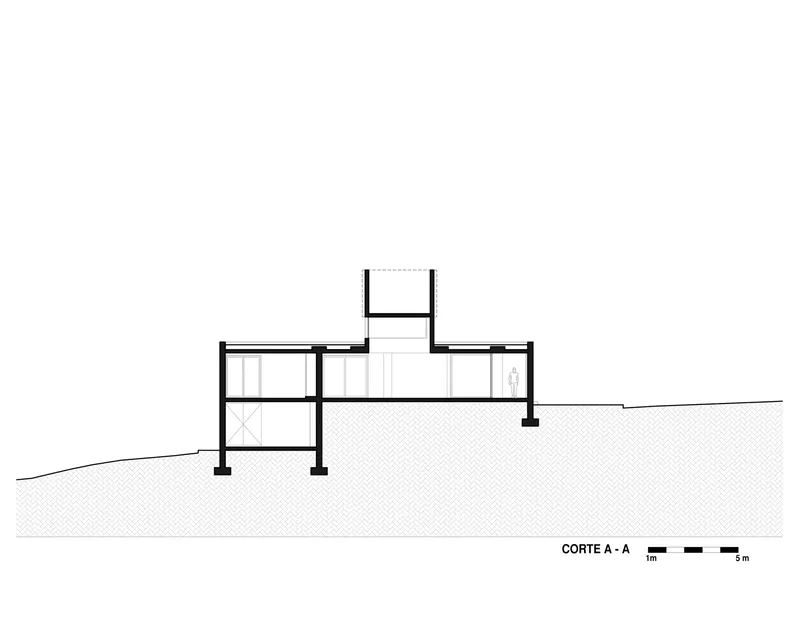
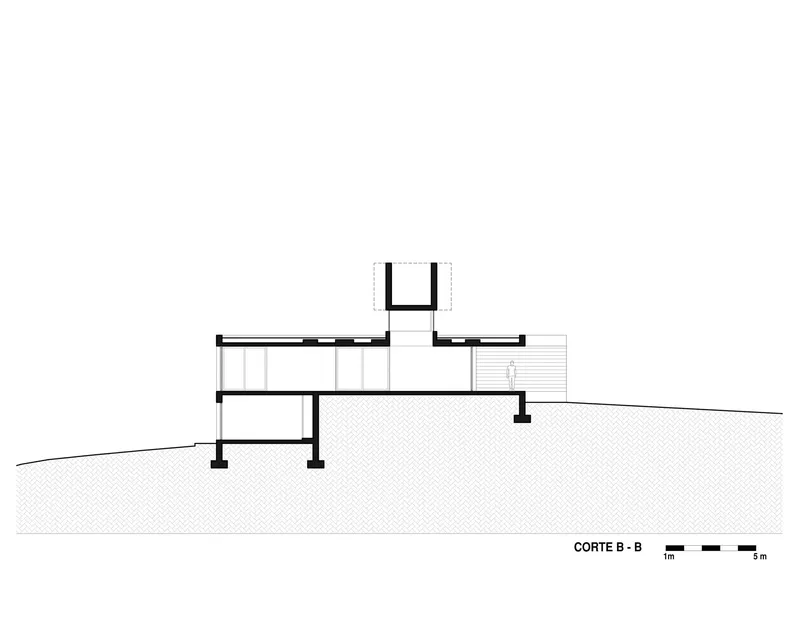
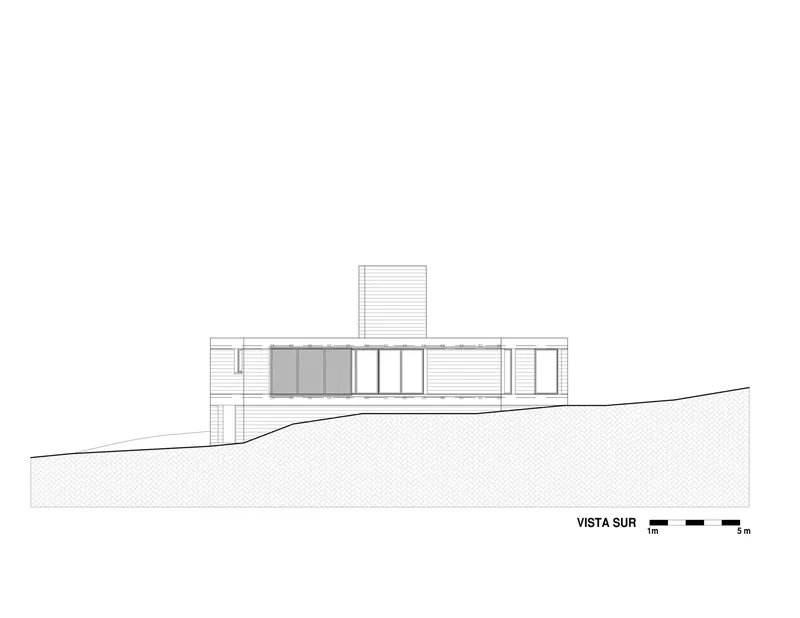
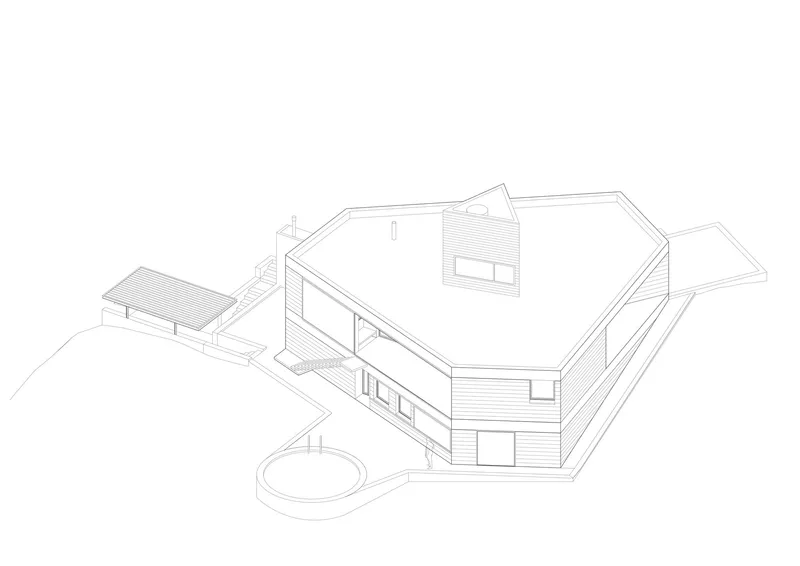
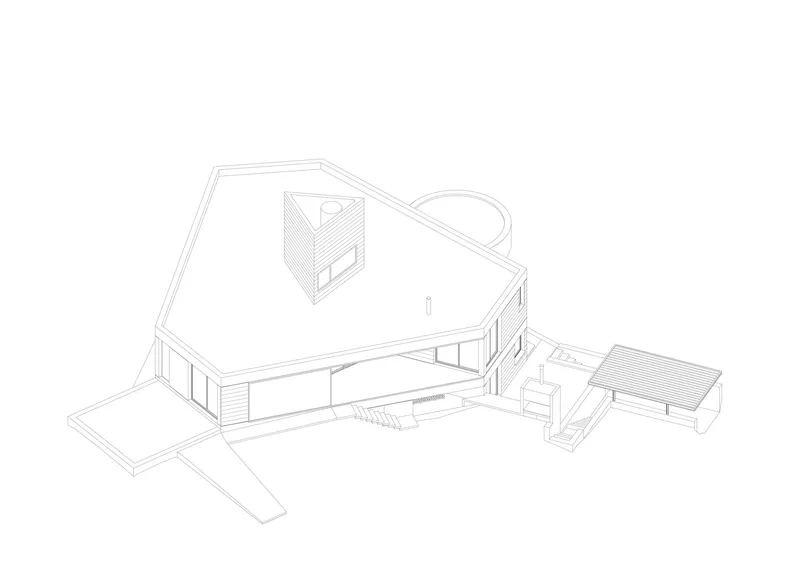
The ground floor plan reveals the centrifugal organization most clearly: rooms wrap around a central courtyard with the circular pool offset to the west. The upper floor plan shows how the triangular void cuts through the center, governing corridor widths and room proportions. In section, the split-level condition becomes legible, with the plinth stepping down the slope and the main floor floating above on its stone base. The axonometrics are particularly useful here, pulling apart the pentagonal envelope to show how the covered pavilion, the main volume, and the staircase relate to one another as discrete but interlocked pieces.
The roof plan confirms what the sections suggest: the pentagonal form is not a plan conceit but a truly three-dimensional figure, with each facet tilted to a different pitch. The south elevation drawing, with its horizontal timber cladding and central glazed openings, offers the most resolved facade composition, revealing how the tower element punctuates the long horizontal line.
Why This Project Matters
Houses that derive their geometry from landscape features rather than lot lines tend to be either excessively romantic or excessively diagrammatic. Casa Cosmos avoids both traps. Its triangulated plan is legible in experience, not just on paper, and the material palette of rammed stone, board-formed concrete, and expanded metal ties the abstract geometry back to the physical realities of site and construction. Nanzer demonstrates that a complex form can emerge from a clear set of rules without becoming arbitrary.
The project also offers a convincing model for building at the edge of protected land. By absorbing the slope into an occupied plinth and concentrating the footprint into a single compact volume, the house minimizes its impact on the adjacent reserve while maximizing its engagement with the broader landscape. The three views are not consumed as spectacle; they are built into the spatial logic of everyday domestic life, a permanent orientation toward something beyond the property line.
Cosmos House by Cristian Nanzer, Capilla del Monte, Córdoba, Argentina. 355 m², completed 2024. Photography by Gonzalo Viramonte.
About the Studio
Share Your Own Work on uni.xyz
If projects like this are the kind of work you want to make, uni.xyz is a place to publish your own, find collaborators, and enter design competitions.


Popular Articles
Popular articles from the community


Lunar Spiral: Space Architecture Shaped by the Mathematics of the Universe
Lunar Spiral reimagines space architecture through Fibonacci geometry, lunar regolith, levitating habitats, and self-sustaining Moon living.

ALGAL REALM: A Bio-Integrated Lunar Habitat Design for Life Beyond Earth
ALGAL REALM reimagines lunar habitat design with algae-powered life support, 3D-printed regolith, and vertical living for a lunar future.

Conexión: Biophilic Design Reimagines High-Rise Living in Hong Kong
Conexión reimagines high-rise living in Hong Kong through biophilic design, green facades, shared spaces, daylight, water and nature within.

Little Red Riding Hood: Architectural Design as a Journey Through Fear, Light, and Storytelling
Little Red Riding Hood reimagines the fairy tale through architectural design shaped by fear, light, scale, memory, uncertainty, and choice.

Similar Reads
You might also enjoy these articles

Bao Huynh Watercolor Atelier: A Serene Art Retreat in Hội An
Bao Huynh Watercolor Atelier in Hội An blends multifunctional art spaces, sustainable design, local materials, and family-friendly living in a serene environment.

Atelier Macri Concept Store Interior Design by CASE-REAL
Atelier Macri store features a "ko" counter, walnut wood details, cork displays, blending retail, gallery, and seamless customer experiences.

Manuel Vargas Izquierdo Stadium and High-Performance Sports Center: Architectural Excellence in Jalpa de Méndez
The Manuel Vargas Izquierdo Stadium blends sustainable design, inclusive sports facilities, and cultural-inspired architecture, revitalizing Jalpa de Méndez’s public spaces.

KAKR Buluh Awar Hall: Revitalizing Community and Ecology Through Bamboo Architecture
Community built bamboo hall revitalizes Buluh Awar village, empowering youth, restoring ecology, celebrating vernacular craftsmanship through sustainable architecture and culture.


Comments (0)
Please login or sign up to add comments
No comments yet. Be the first to comment!