

Cruit Island House by Pasparakis Friel: A Masterful Coastal House Design in Ireland
Cruit Island House redefines coastal house design in Ireland by blending family legacy, rugged landscape, and contemporary architectural restraint.


A Home Sculpted by the Elements
Perched atop a granite cliff on the eastern edge of Cruit Island, Cruit Island House by Pasparakis Friel is a poetic response to place, family legacy, and the rugged natural beauty of Ireland’s coast. Shaped by four generations of memories and envisioned as a sanctuary for future gatherings, the project embodies a contemporary yet grounded expression of coastal house design in Ireland.

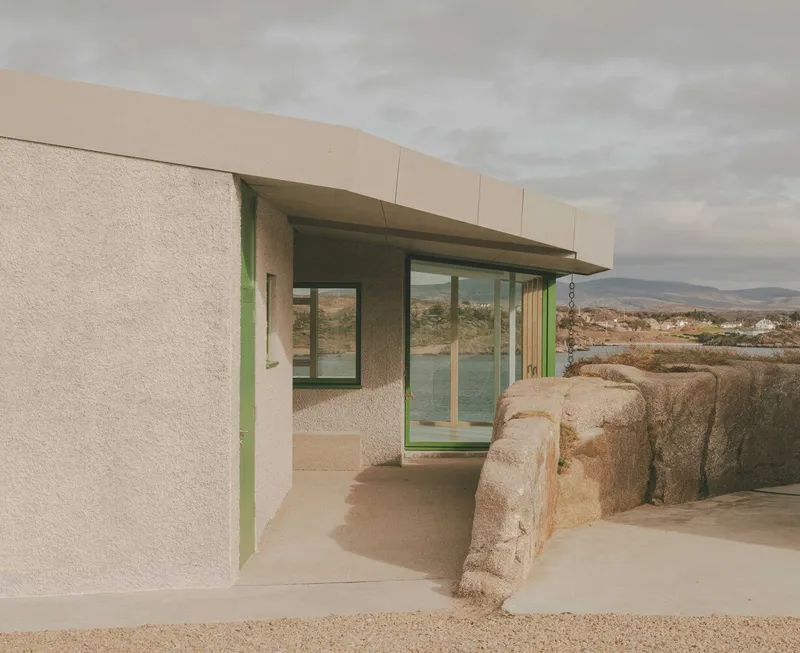
The island is defined by its dramatic geology—rocky knolls, sweeping Atlantic winds, and secluded inlets. With the Atlantic Ocean to the west and a tranquil bay to the east, every direction leads to the sea. In this context, the house emerges not as an interruption but as a continuation of the landscape, integrating seamlessly into the wild, wind-worn terrain.


Nestled Between Granite Outcrops
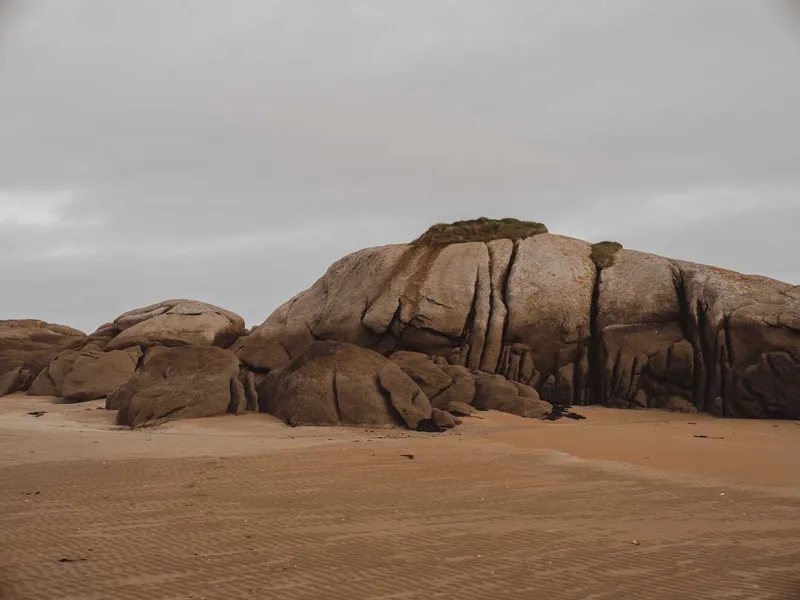
The house tucks itself between two significant granite formations. On one side, a large, towering outcrop forms a natural wall, framing bedroom views with textured rock and glimmering sea. On the other side, a low, linear stone ridge gently leads toward the house’s entrance, creating a natural approach to the sheltered bay and private beach below.
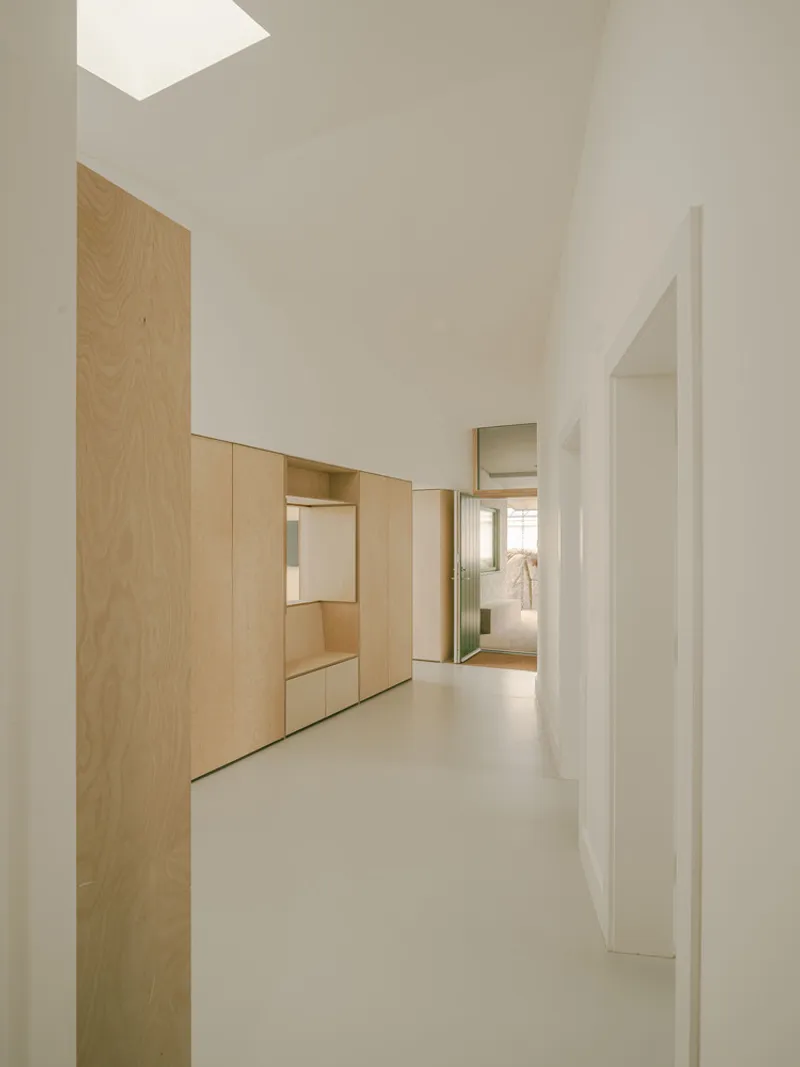

Between these formations, the architecture creates intimate outdoor zones—external rooms where rock, shadow, and sky form a setting for contemplation or play. These voids blur the line between indoors and out, making the architecture feel porous, open, and rooted in its environment.

Architecture as Landscape Extension
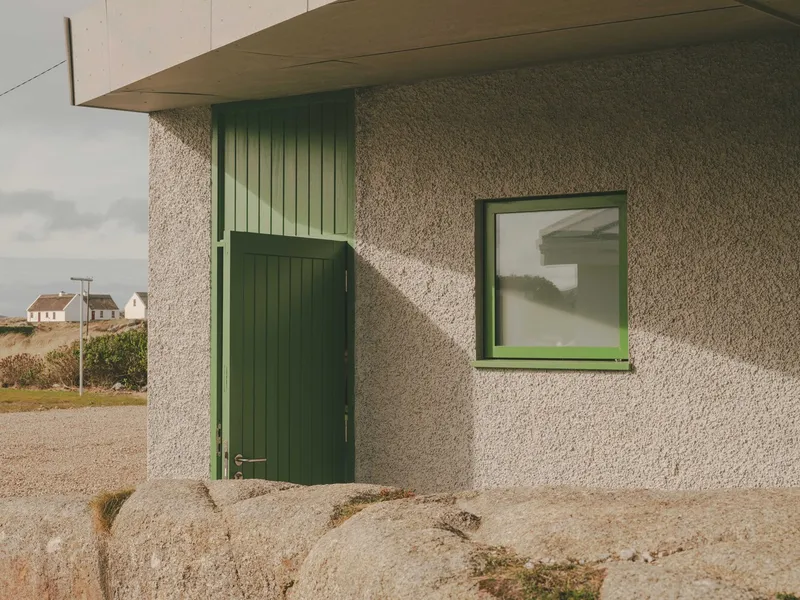
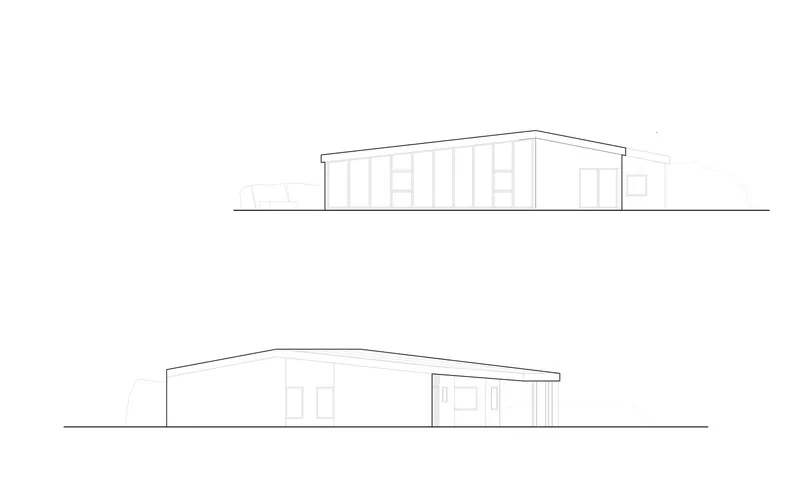
Pasparakis Friel has conceived the house as an extension of the geological formations. Roof planes mirror the topography, echoing the island’s layered rock strata. The material palette reinforces this approach: roughcast rendered walls, corrugated fibre cement roofs, and stone-like massing all dissolve the house into its natural setting.

Muted tones dominate—weathered greys, stone whites, and mossy greens. Window and door frames painted a grassy green nod to native vegetation like Marram grass and chasmophytes, blending the architectural details into the landscape’s hues and textures.


Contrasts of Exposure and Protection
Facing the road to the west, the house presents a solid, closed façade—a defensive, rock-like wall that evokes protection and privacy. A deep architectural recess, like a fissure in stone, adds shadow and intrigue, referencing the eroded crevices found in the surrounding rocks.
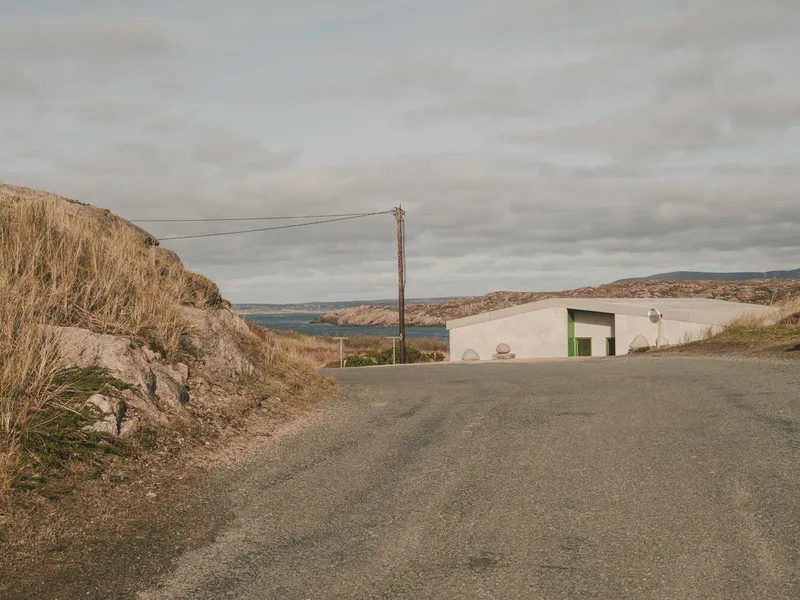
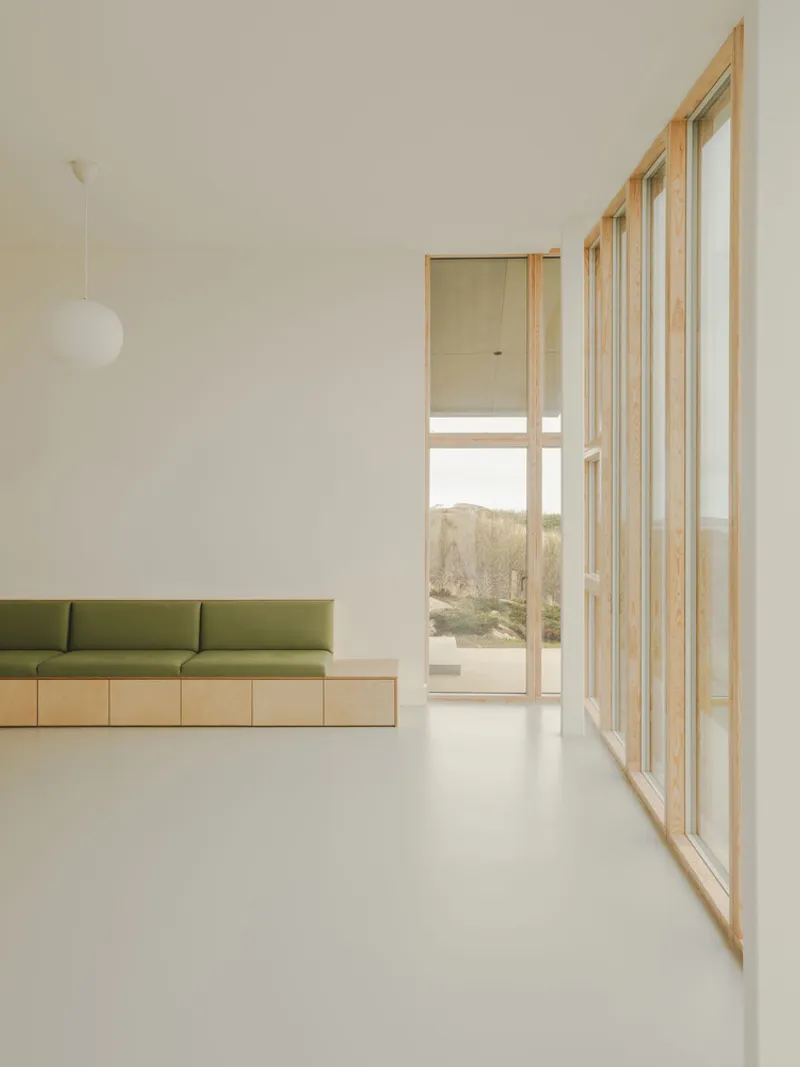
In contrast, the eastern elevation opens entirely to the bay with a light, transparent façade. This glazed expanse invites the shifting Irish light into the interiors while offering panoramic views of the sea. The experience inside oscillates between enclosure and exposure, between the elemental and the domestic.

A Social Heart for Generations
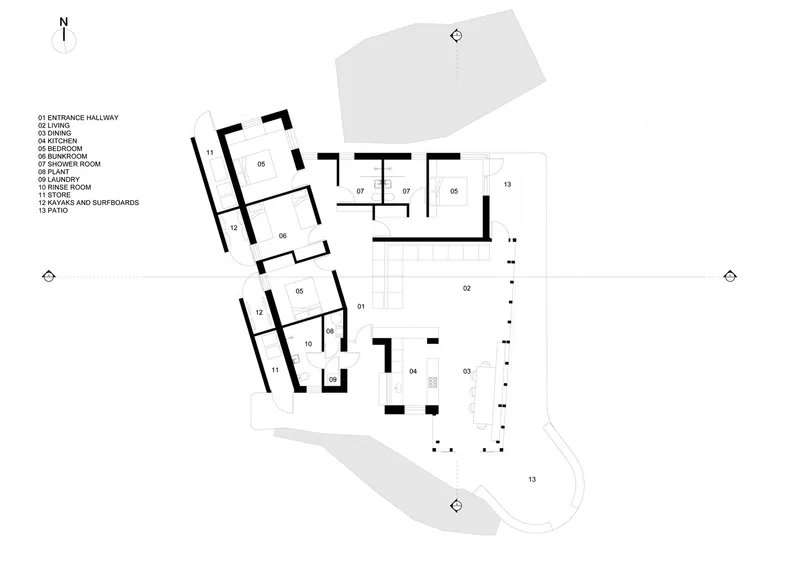
At the center of the plan lies the open living area—the heart of the house. It is designed to be robust, warm, and accommodating for large family gatherings, especially after days spent on the nearby beach. Bedrooms are arranged around this core, providing retreat without isolation.
The design prioritizes hardwearing materials suitable for sandy feet, damp coats, and sea air. Yet it does so without sacrificing aesthetic clarity. Timber interiors, polished concrete floors, and clean lines ensure a calm and enduring spatial quality. This balance of utility and softness defines the project’s success as a contemporary coastal house design.

Enduring, Layered, and Local
More than just a holiday retreat, Cruit Island House is a home that respects time—both geological and generational. Its siting, materials, and planning are deeply attuned to the island’s identity. It doesn’t impose itself on the landscape but listens to it, grows from it, and weathers with it.

Pasparakis Friel’s approach reflects a deep understanding of how architecture can serve as a vessel for memory, place, and ongoing family life. In the canon of coastal house design in Ireland, this home stands out not just for its restraint and beauty, but for its quiet resilience.
All photographs are works of Peter Molloy


Popular Articles
Popular articles from the community


Juan García Correa, John González and Claudia Rueda Sink a Circular Amphitheater into a Manizales Engineering Building
On the La Nubia campus in Manizales, Colombia, the S1 Building folds labs and offices into a hillside of ramped lawns that double as a campus route.

U.GA Architects Wraps an Oval Rooftop Pool in Curved Board-Formed Concrete on Busan's Jeollidan-gil
In Busan's Jeonpo-dong, a 454 m² mixed-use block stacks a neighborhood facility, guest rooms and an oval rooftop pool inside spiraling concrete walls.

LT2A and OPEN Architectes Thread a Brick and Glass High School Through a Wooded Belgian Campus
In Braine-l'Alleud, a 3,000 m² wing for Collège Cardinal Mercier pairs pale brick with a glazed colonnade, deferring to a small chapel and a dense wood.

David Ortega Stacks a Two-Story Mexico City Penthouse Around a Steel Stair and a Pergola-Shaded Roof Terrace
In Colonia Roma, a 300 m² penthouse uses oak joinery, a planted steel stair and a slatted roof pergola to make a new-build apartment feel like a house.

Similar Reads
You might also enjoy these articles

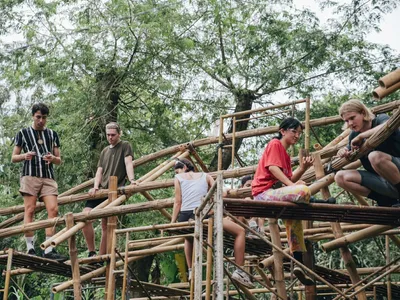
Bamboo Housing Challenge 2026: Design Affordable, Sustainable Homes Using Bamboo
An international design competition by Bamboo U and IBUKU inviting architects and designers to reimagine affordable housing using bamboo — with the winning design built full-scale in Bali.

Computational Design & Education: Beegraphy Design Awards Introduces 7th Category (Featuring Jiyun's Innovative Approach)
Dive into Beegraphy’s 7th Design Awards category, where computational design meets education to create immersive, interactive learning tools, inspired by Jiyun’s work.

From Parametric Lighting to Urban Furniture: Join the 2nd Workshop in Beegraphy’s Computational Design Series
Dive into Cutting-Edge Design Techniques and Practical Applications with Industry Experts

Last Call: Unleash Your Architectural Genius in SHAK's Kindergarten Design Competition
Urgent call for architects to join SHAK's kindergarten design competition before the looming deadline

Explore Architecture Competitions
Discover active competitions in this discipline

Challenge to reimagine the Iron Throne

Photograph architecture without architects

Illustrate the lost glory of Angkor Wat - Render Challenge

Design challenge to reuse E-waste
Comments (0)
Please login or sign up to add comments
No comments yet. Be the first to comment!