

Pandolfini Architects Wraps a Cremorne Office Tower in Cathedral-Like Aluminium Fins
A seven-storey workplace in Melbourne's industrial Cremorne district channels heritage signage and bush-hammered concrete into a compact vertical landmark.


Cremorne sits at an odd intersection of Melbourne's urban history. Old red-brick warehouses shoulder up against workers' cottages, and both now share the street with glass-fronted tech offices. Into this compressed, layered fabric, Pandolfini Architects has slotted a seven-storey tower on Cubitt Street that manages to be both assertive and deeply literate about its context. The building houses a ground-floor fashion showroom, six levels of office space, and a rooftop terrace, all stacked on a site wedged between a row of tiny cottages and a humble warehouse.
What makes the project worth studying is not its height or its program but its material argument. The tower reads as three distinct registers: a bush-hammered concrete portal at the base, a band of hand-fabricated curved aluminium fins across the middle storeys, and a cleaner concrete volume at the top. Each register does specific environmental and cultural work. The fins reference the suburb's iconic neon signage, from the Skipping Girl Vinegar sign to the Nylex clock, translating flat graphic nostalgia into three-dimensional screening. The concrete base borrows its rough texture from the industrial buildings that once defined the neighbourhood. None of this is applied decoration; every element doubles as climate strategy or spatial device.
A Ground Plane Built on Weight and Craft
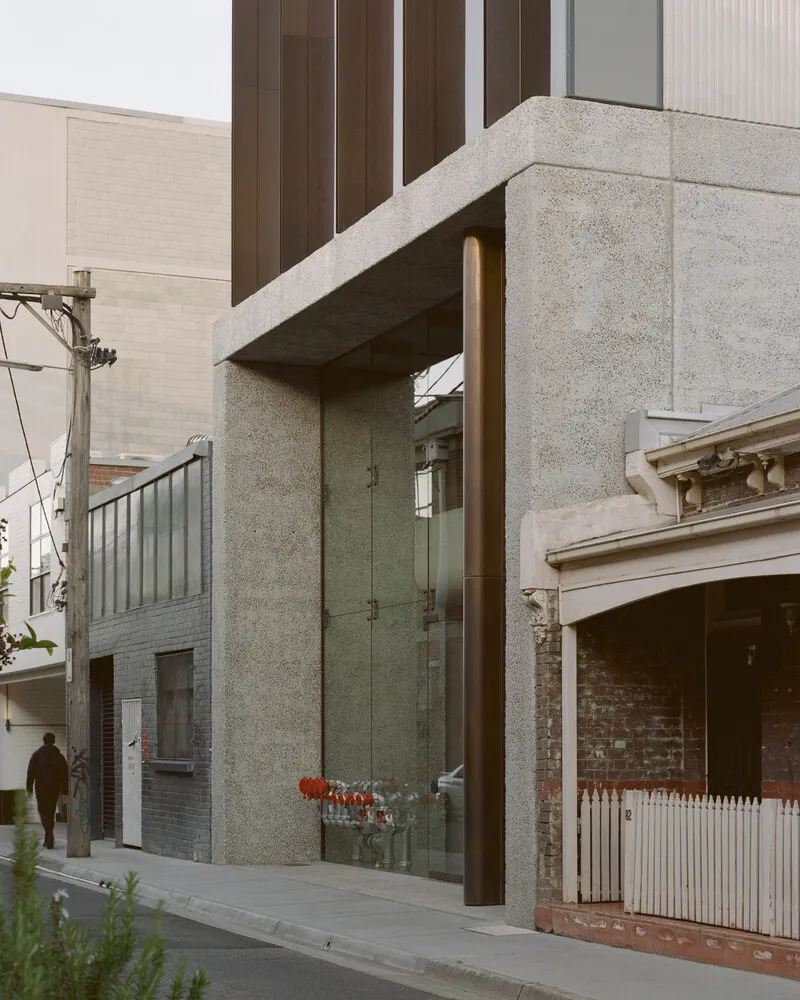
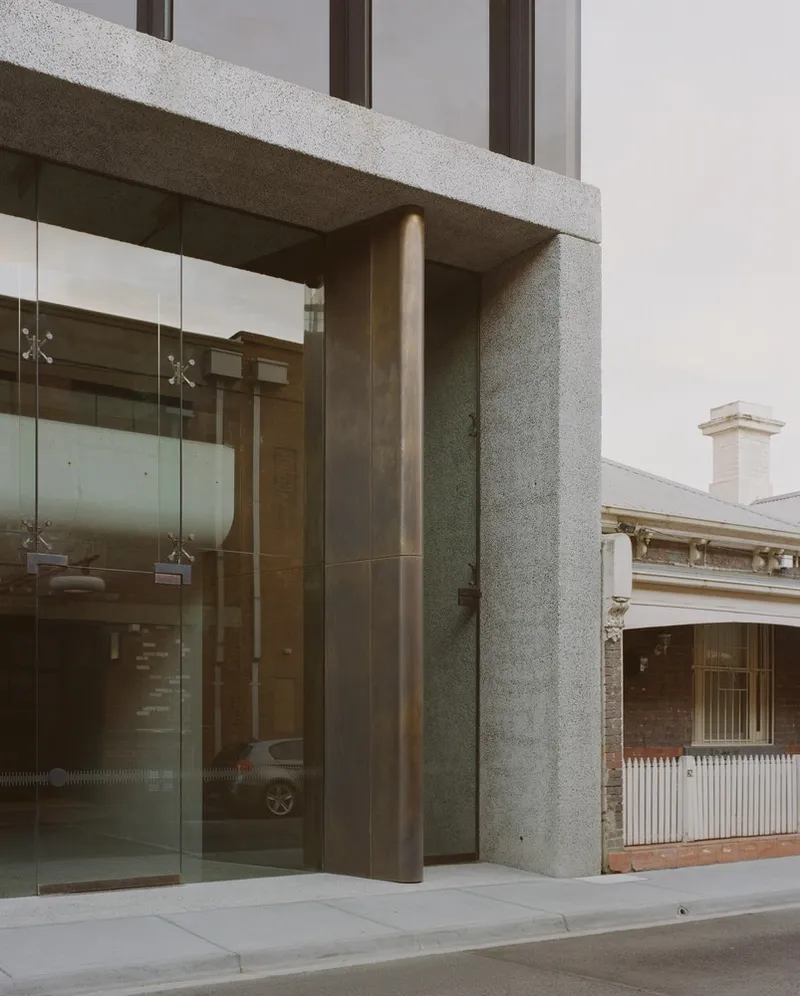
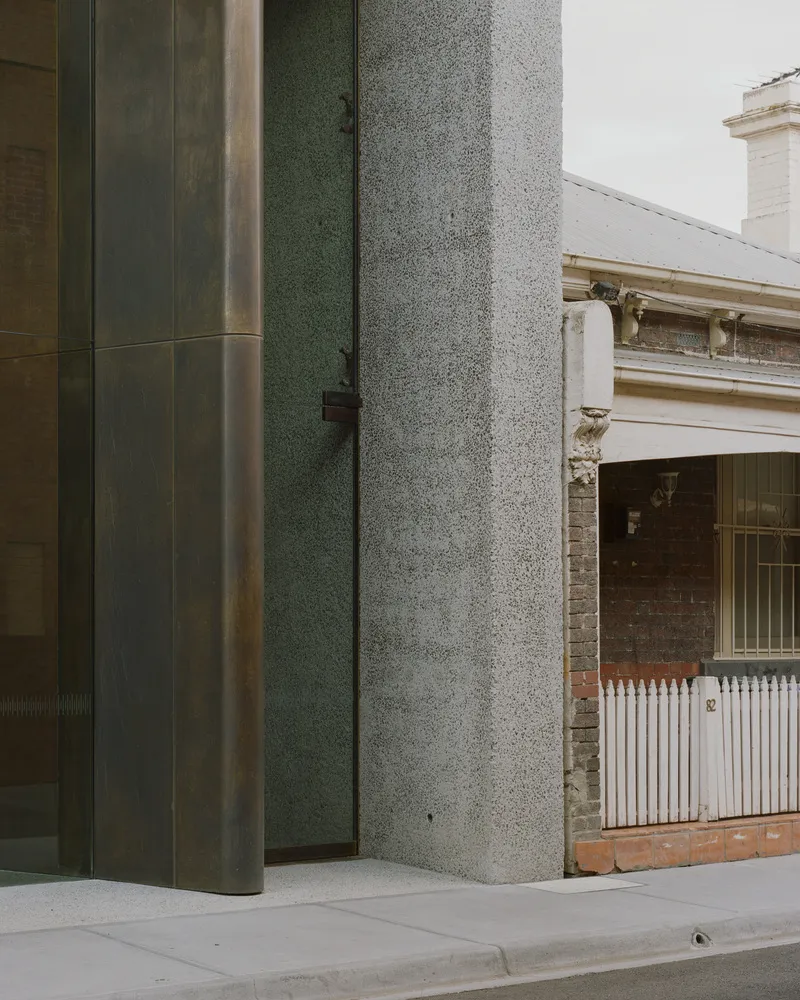
The ground level sets the tone with deliberate heaviness. Concrete columns, bush-hammered to expose aggregate, support the cantilevered volume above. A hand-finished brass blade runs vertically alongside the entry, introducing a jewel-like material against the raw mineral surface. Terrazzo flooring extends from the interior through the portal and into the threshold, blurring the line between public footpath and private foyer. The effect is generous for a building on such a tight site: the double-height entry reads as a civic gesture rather than a corporate lobby.
Look closely at the junction between terrazzo column and bronze cladding, and you see how carefully the detailing has been resolved. These are materials that demand precision because they show every misalignment. The fact that they meet cleanly, with a shadow gap rather than a trim piece, suggests a builder (Principle Constructions) that understood the architects' ambitions.
The Aluminium Fin Screen: Signage as Architecture
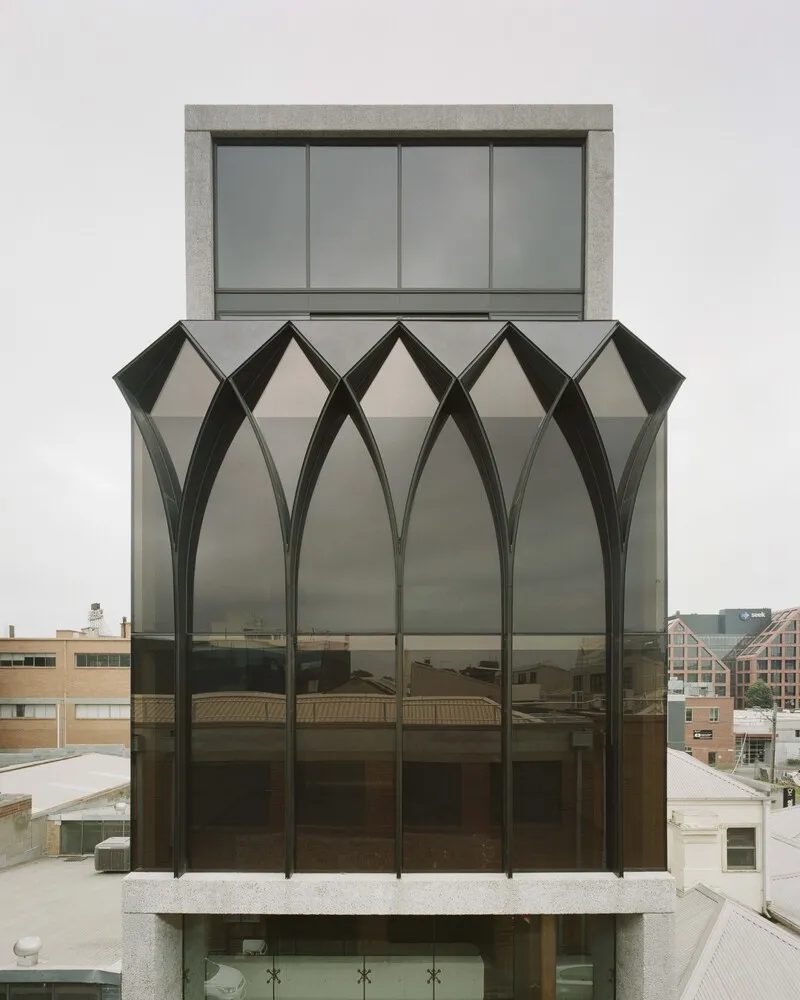
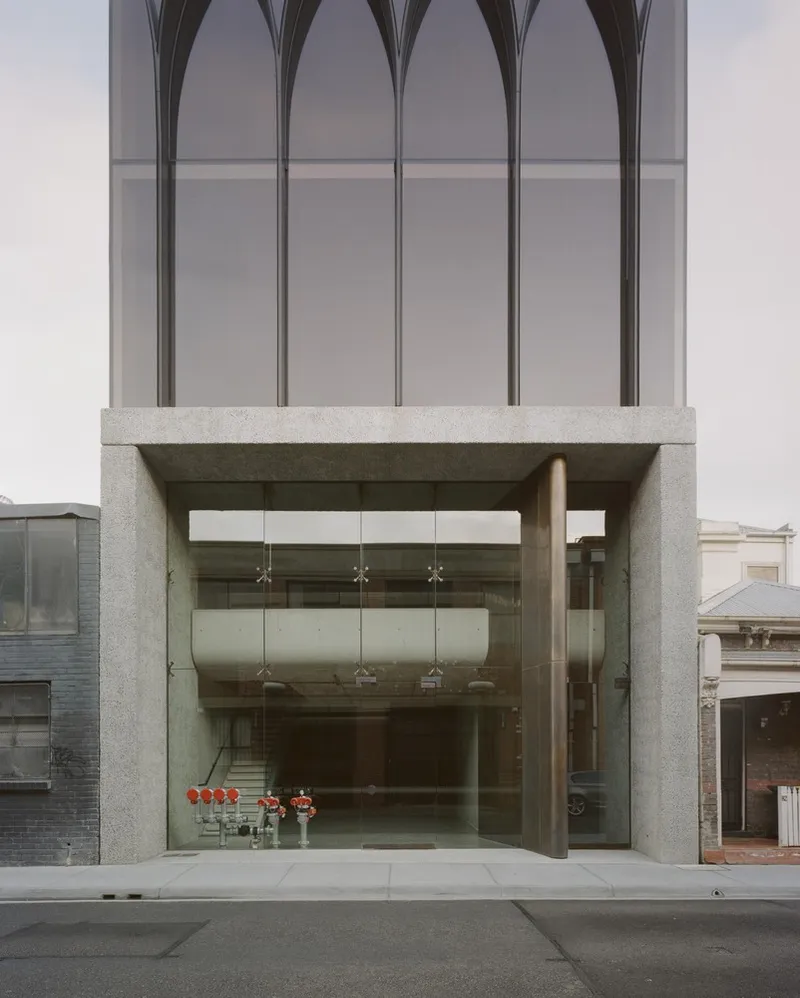
The most visually arresting move is the cathedral-like framework of curved aluminium fins that overlays the glazed facade. These are not off-the-shelf extrusions. They were hand-fabricated into arched profiles that recall Gothic tracery, and their curvature modulates the view from inside while providing solar shading and privacy for the lower storeys. From the street, the fins create a moiré effect as you walk past, shifting between transparency and opacity depending on your angle.
The reference to Melbourne's heritage signage is the conceptual spine of this element. Cremorne's neon landmarks were large-scale graphic objects mounted on industrial buildings, pieces of communication infrastructure that became beloved urban icons. The aluminium fins operate in the same register: they are structural ornament that gives the building a recognizable silhouette in a neighbourhood of competing scales. The arched forms also create a pleasing visual rhythm against the flat-topped warehouse next door, establishing a dialogue rather than a confrontation.
Interior Materiality: Concrete, Timber, and Light
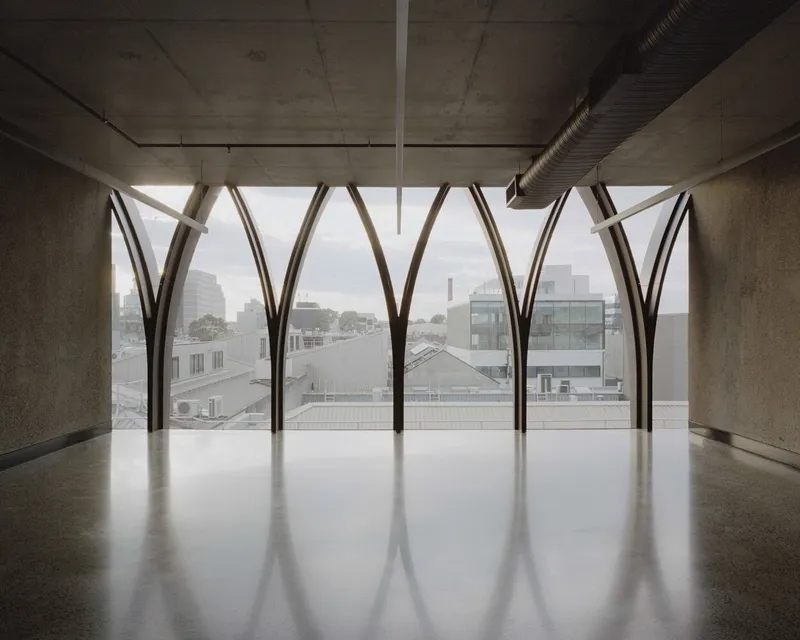
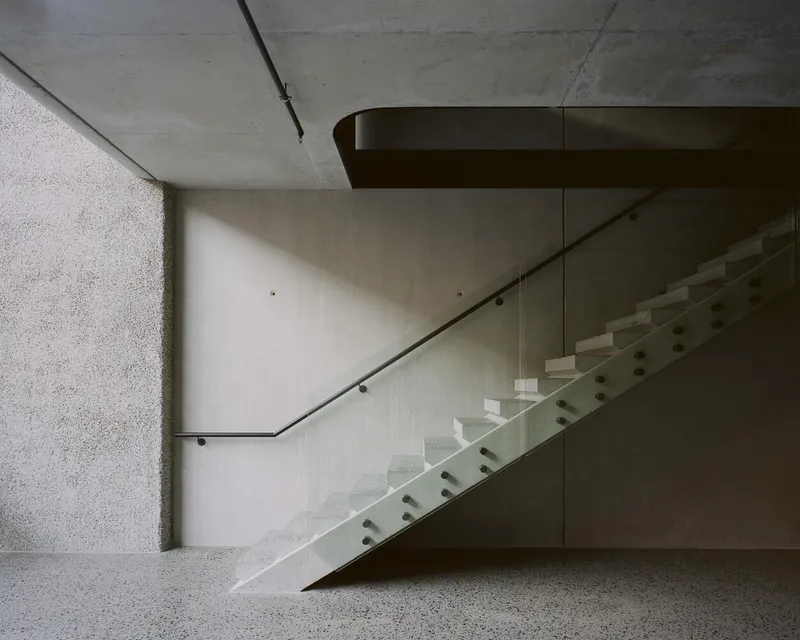
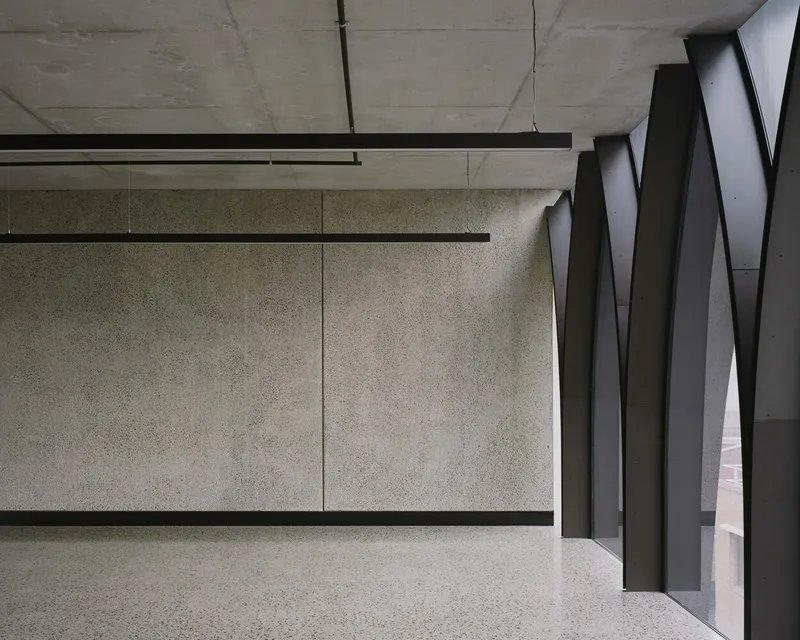
Inside, the palette stays disciplined. Polished concrete floors run throughout, their reflective surface amplifying the natural light that pours through the fully glazed front facade. The staircase is a straightforward concrete element with a steel handrail and glass balustrade, detailed to cast clean diagonal shadows on the adjacent wall. Nothing competes for attention. The interior strategy trusts the quality of the light and the honesty of the materials to carry the experience.
The upper levels benefit from the aluminium screen, which filters daylight into patterns that shift with the sun's position. On the level with the integrated planter box, greenery softens the concrete edges and introduces a biological counterpoint to the mineral interior. The building's 966 square metres of net lettable area are modest by commercial standards, but the generous ceiling heights and the fully glazed facade make each floor feel larger than its footprint suggests. This is compact workplace design that never feels cramped.
Rooftop and Urban Silhouette
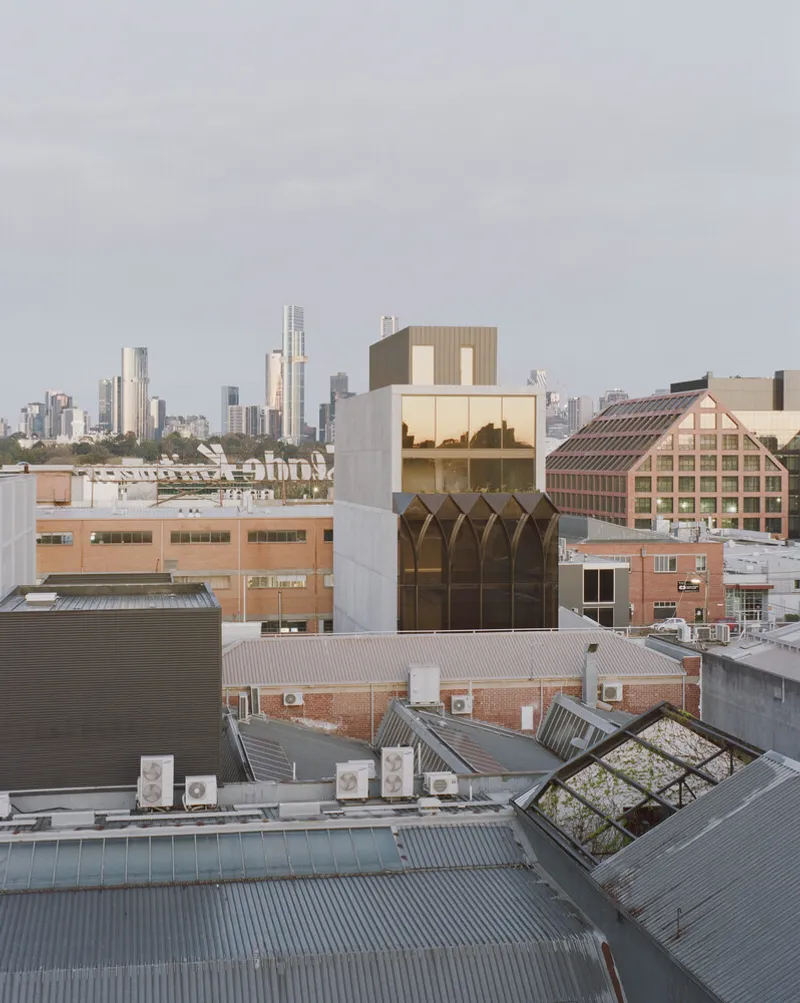
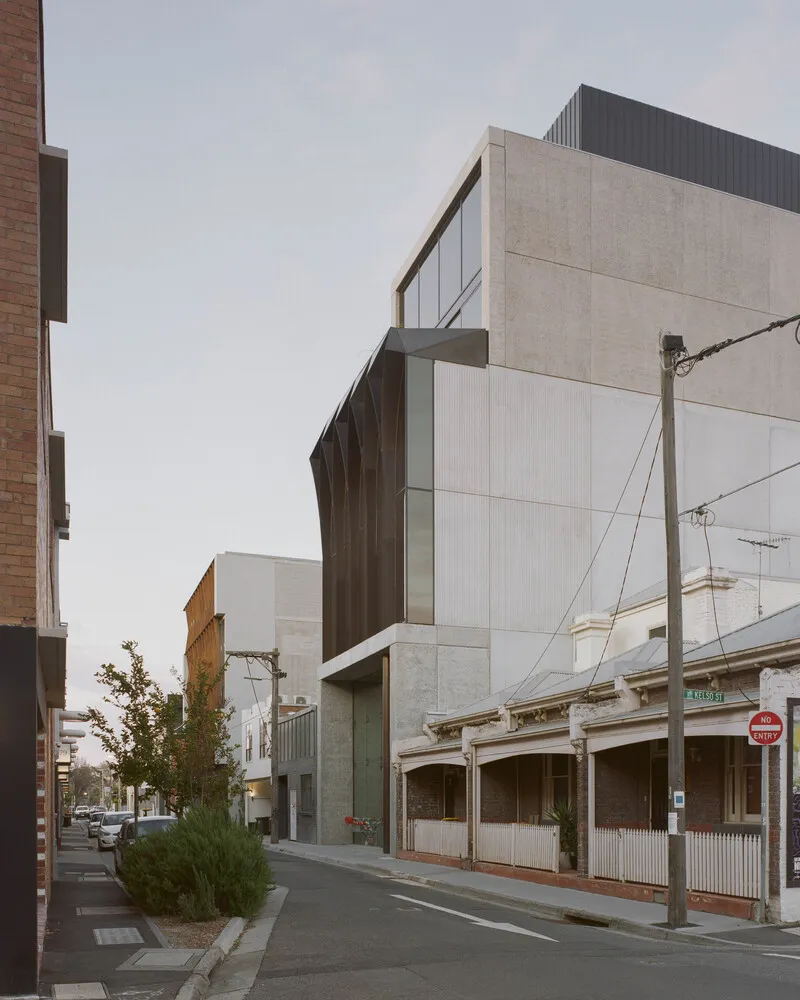
From the rooftop terrace, the tower's relationship to its neighbours becomes legible. It rises above the surrounding warehouse rooflines without overwhelming them, its angular volumes and mixed cladding (terrazzo panels, bronze, concrete) reading as an evolved version of the industrial vernacular rather than a foreign insertion. The dusk photograph captures this well: the tower glows from within while the sawtooth roofs of the warehouses form a low, dark horizon around it.
At street level, the building's angular facade volumes create a stepped profile that mediates between the scale of the heritage cottages and the taller structures further along the block. The terrazzo and bronze cladding panels wrap the upper storeys in a warm, textured skin that avoids the anonymous glass-box look common to speculative office projects. This is a building that wants to be a neighbour, not a monument.
Sustainability as Standard, Not Spectacle
The environmental strategy is integrated rather than performative. A comprehensive solar array and heat recovery system handle energy generation and reuse. The aluminium fins reduce solar gain on the lower storeys without blocking views, and the extensive glazing minimizes the need for artificial lighting during working hours. Bicycle storage and end-of-trip facilities are generous, reflecting Melbourne's cycling culture and the broader push toward active commuting. None of these features are advertised on the facade; they simply work.
This quiet approach to sustainability is more convincing than the green-wall-and-solar-panel signposting that dominates many commercial projects. The building's environmental performance is embedded in its architectural decisions: the orientation of the glazing, the depth of the screening, the thermal mass of the concrete. It does not need a certification plaque to prove its credentials.
Plans and Drawings
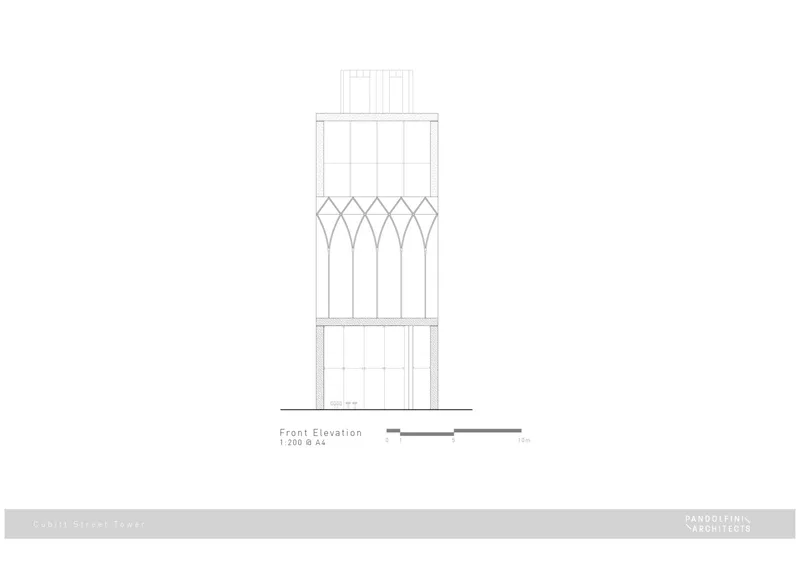
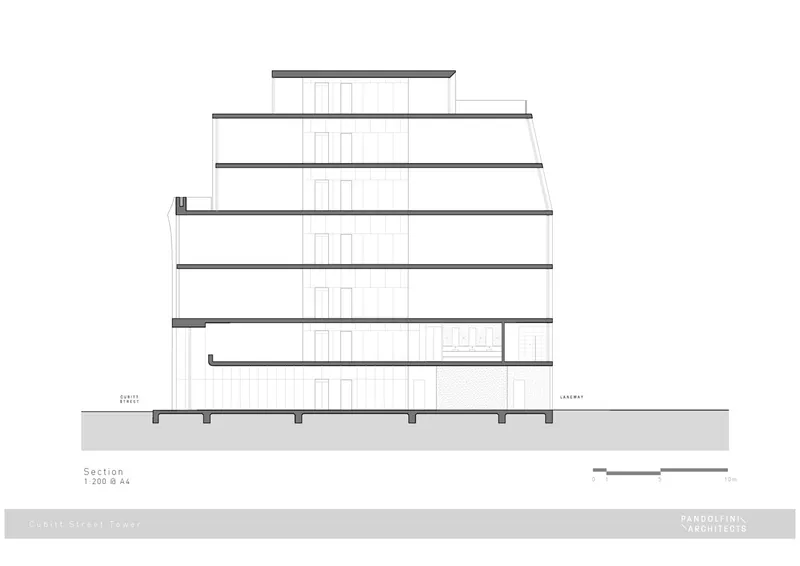
The front elevation drawing reveals the full extent of the Gothic arched window band, showing how the aluminium fin framework wraps the facade as a continuous screen. The section drawing clarifies the internal organization: five stepped floor plates stack around a central circulation core, with the double-height entry foyer at the base and the rooftop terrace at the crown. The setback of the first floor from the glazed facade is visible in section, explaining the floating effect experienced from the street. The compact core keeps floor plates open and flexible, maximizing usable area on each level.
Why This Project Matters
Cubitt Street Tower is a useful corrective to two common assumptions about small commercial architecture. The first is that tight urban sites demand neutral, polite buildings that defer to their neighbours. Pandolfini Architects proves the opposite: a building can be contextually literate and still have a strong formal identity. The aluminium fins, the bush-hammered concrete, the brass blade are all specific moves that root the tower in Cremorne's industrial history while pushing the material language forward.
The second assumption is that sustainability and craft are luxuries reserved for large-budget projects. At under 1,000 square metres of net lettable area, this is a small building by any measure, yet it integrates solar and heat recovery systems, passive shading, and generous cycling infrastructure without sacrificing design ambition. The result is a workplace that feels considered at every scale, from the shadow gap between terrazzo and bronze to the silhouette it cuts against the Melbourne sky. Projects like this set the terms for what commercial architecture in dense inner suburbs should aspire to be.
Cubitt Street Tower by Pandolfini Architects. Located in Cremorne, Melbourne, Australia. 966 sqm NLA. Completed 2022. Builder: Principle Constructions. Photography by Rory Gardiner.
About the Studio
Share Your Own Work on uni.xyz
If projects like this are the kind of work you want to make, uni.xyz is a place to publish your own, find collaborators, and enter design competitions.


Popular Articles
Popular articles from the community


David Macias Steps a Doorless Stone and Plaster House Down a Tropical Colombian Hillside
In the humid hills of Colombia, Threshold House replaces the front door with an open void and terraces its 850 m² down the slope instead of fighting it.

David Ortega Stacks a Two-Story Mexico City Penthouse Around a Steel Stair and a Pergola-Shaded Roof Terrace
In Colonia Roma, a 300 m² penthouse uses oak joinery, a planted steel stair and a slatted roof pergola to make a new-build apartment feel like a house.

Jaramillo Van Sluys Arquitectura and Urbanismo Turn a Demolished Registry Lot in Quito into an Orchard Plaza
In Quito's Centro Histórico, a 2,800 m² plaza exposes the San Agustín convent wall and redraws its lost Augustinian orchard in volcanic stone.

longwave studio Reorganizes a 112 m² Tainan Apartment Around the Daily Routines of a Family and Two Cats
In Tainan, Taiwan, birch plywood, rust-red furniture and a freestanding plaster wall link arrival, storage, work and family life in one apartment.

Similar Reads
You might also enjoy these articles


Hodi-Mandai Geram
Project Function: Preservation and revitalization of the Intangible heritage and socio-spatial identity of the Hodi by Housing, Cultural Memory Center, Sacred Grove, landscape, local tourism economy


Olio Towers: A Mid-Rise for Performers That Fuses Housing, Rehearsal, and Stage
Located blocks from Houston's Theater District, this modular tower stacks living units around a central performance atrium.

Oasis: Modular Green Housing Carved into Dhaka's Urban Fabric
A shortlisted Plugin Housing entry reclaims unauthorized settlements in Dhaka with stepped concrete volumes, green roofs, and ventilation-driven design.

Black Hole: A Floating Megastructure for the Post-Physical Era
Emiliano Mazzarotto envisions a spherical, self-scaling arena where e-sports, digital hotels, and holographic stadiums replace traditional public space.

Explore Architecture Competitions
Discover active competitions in this discipline

Challenge to reimagine the Iron Throne

Photograph architecture without architects

Illustrate the lost glory of Angkor Wat - Render Challenge

Competition to design a workstation for architects
Comments (0)
Please login or sign up to add comments
No comments yet. Be the first to comment!