
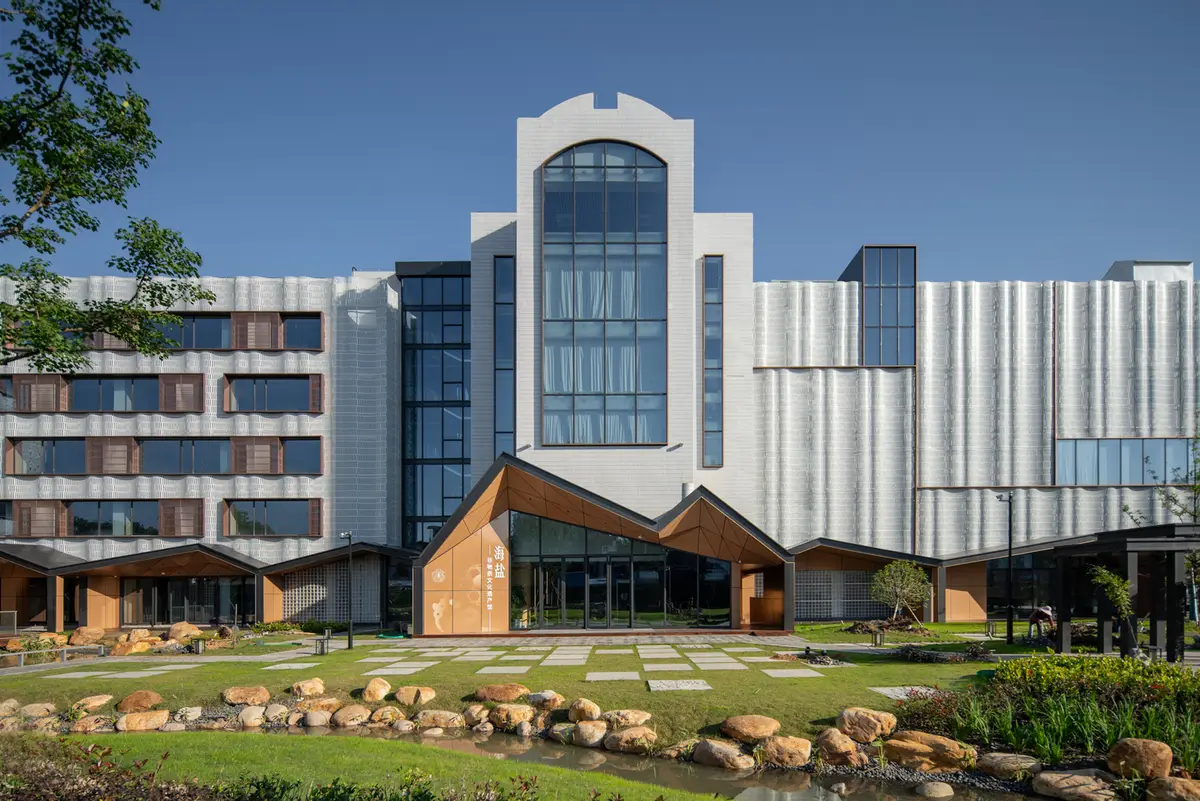
LYCS Architecture Converts a 1990s Factory in Zhejiang into an Intangible Cultural Heritage Museum
Perforated aluminum, restored ponds, and pitched-roof corridors weave a former instrument factory into Haiyan County's cultural precinct.


Haiyan County sits in a corridor of cultural landmarks: Qi Garden, Duwu Garden, Zhang Leping Memorial Hall, the county museum. What it lacked was connective tissue, a piece of architecture that could stitch those assets together and give the county's intangible heritage traditions a physical home. LYCS Architecture found that opportunity inside the decommissioned Haiyan Electric Instrument Factory, a modest industrial complex from the 1990s wedged between Wenchang West Road and Qiyuan Road. Completed in 2024, the 7,211-square-meter project transforms the old plant into a museum, a training center, a row of boutique homestays, and a set of commercial spaces, all linked by a continuous pitched-roof corridor that reads less like a single building and more like a small neighborhood.
The interesting move here is not the adaptive reuse itself but the granularity of the strategy behind it. LYCS organized the intervention around five distinct operations: demolition, restoration, preservation, renewal, and integration. Each existing structure got a different diagnosis. Some walls were kept bare. Some received new skins of ripple-patterned perforated aluminum. Temporary sheds were razed entirely, roads widened, and the historic Twin Pools scenic spot at the heart of the site was excavated back into existence. The result is a campus that refuses to treat heritage as a single, uniform gesture and instead calibrates old and new at the scale of individual facades, rooms, and courtyards.
Five Operations on One Site
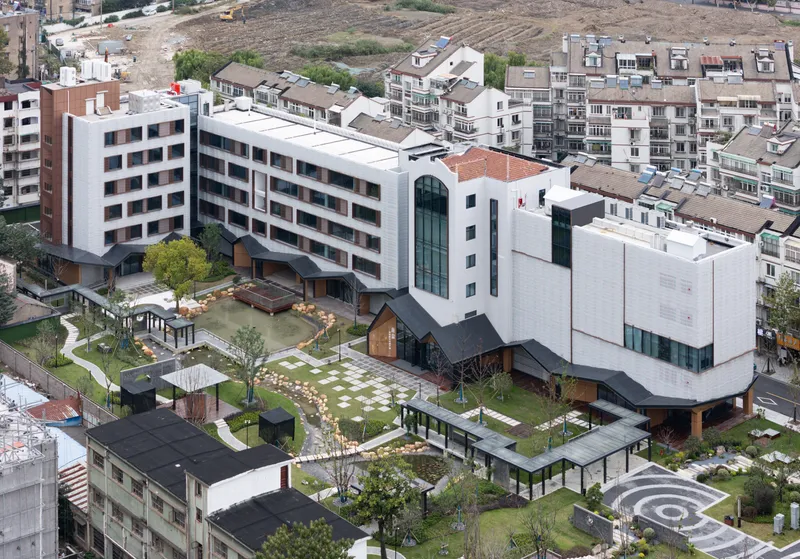


From the air, the campus reveals itself as a patchwork of interventions rather than a monolithic replacement. Gabled pavilions in timber cladding sit alongside taller volumes wrapped in ribbed metal. Tree-lined streets that once dead-ended at the factory perimeter now cut through the site, reconnecting it to the surrounding cultural precinct. The demolition of temporary structures and the widening of access roads were not afterthoughts; they were the first and arguably most consequential design decision, clearing enough space for the landscape, the ponds, and the pedestrian loops that now give the campus its openness.
This is a project that takes subtraction seriously. By pulling away the clutter that had accumulated over decades, LYCS gave the remaining factory buildings room to breathe and to be read as individual characters within a larger ensemble.
Old Brick Meets Perforated Aluminum
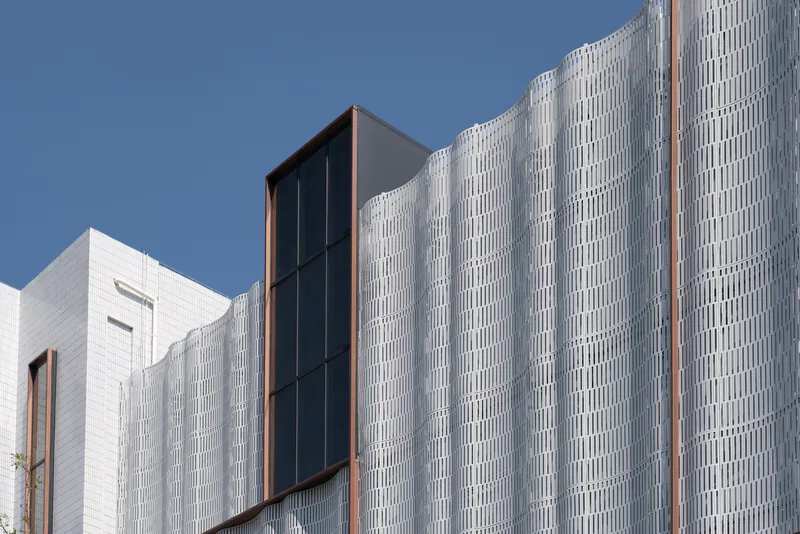
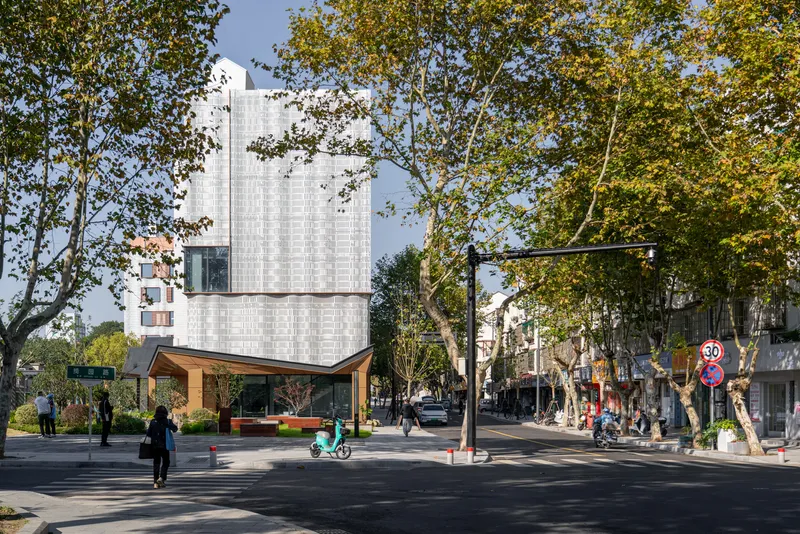
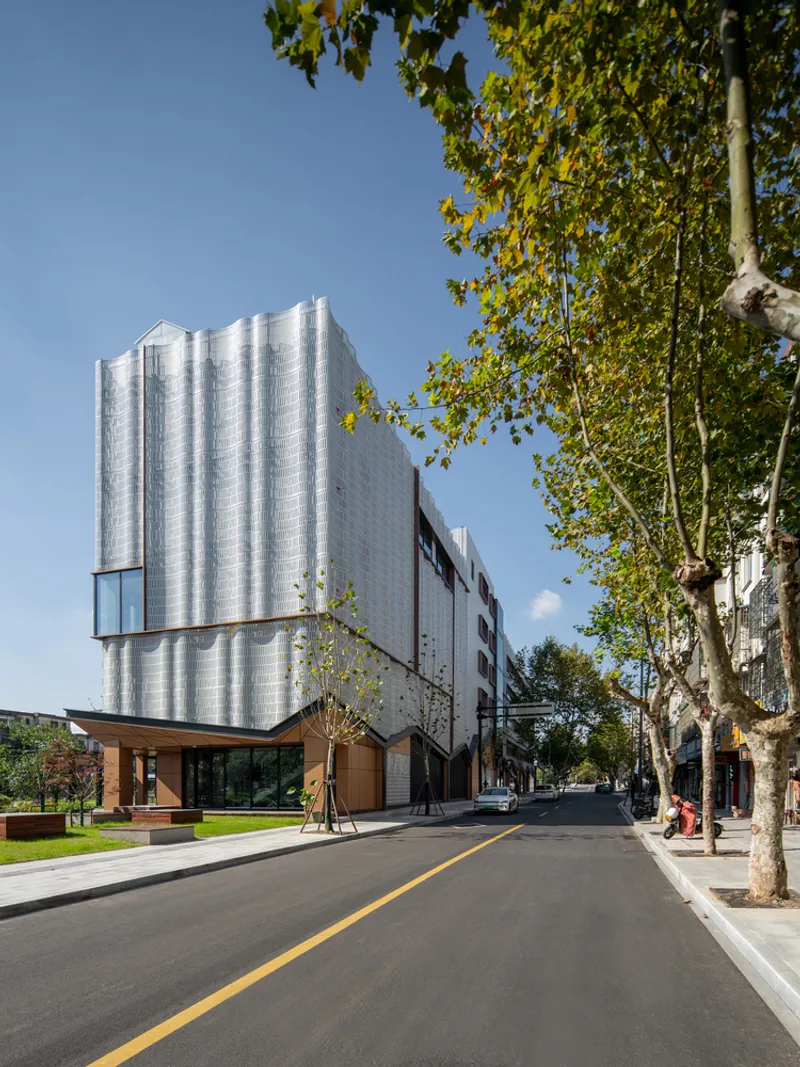
The most visually arresting element of the renovation is the new cladding system. Ripple-patterned perforated aluminum panels, bronze-toned in places and white in others, wrap the upper volumes of the former factory. They do not try to mimic the original brick; instead they sit above and beside it, creating a deliberate contrast between the weight of masonry and the lightness of metal. Under direct sunlight the curved panels cast shifting, water-like shadows across the facades, an allusion to the tidal bore culture of Haiyan County that manages to be poetic without being literal.
Where the old brick survives, LYCS left it exposed or lightly restored. The dialogue is most legible at corners where a corrugated metal volume cantilevered over a timber-and-glass ground floor meets the rough texture of preserved masonry just a few meters away. The juxtaposition is confident, not tentative, and it gives each material room to do what it does best.
Pitched Roofs as Vernacular Thread


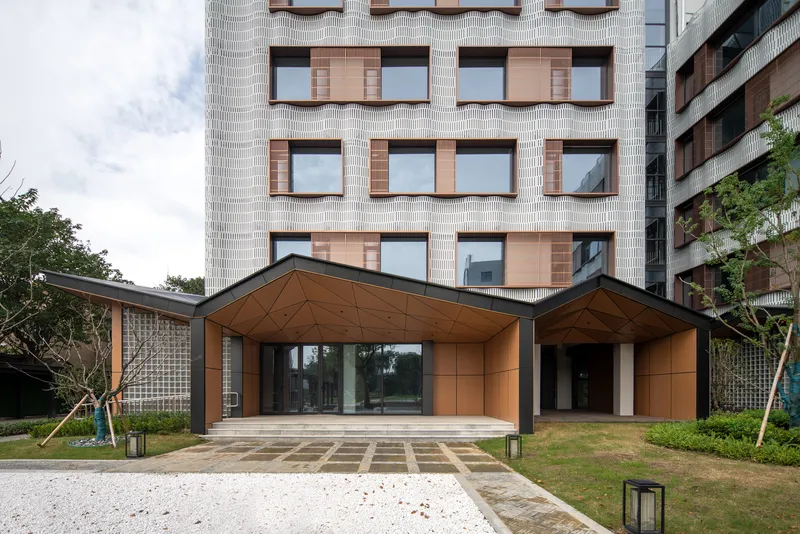
Continuous pitched roofs are the campus's organizing motif. They link the museum galleries to the historic doorways and onward to the boutique homestays, forming a covered corridor that visitors can follow from one end of the site to the other. The profile is borrowed from traditional Haiyan residential architecture, scaled up and stripped of ornament but still recognizably local. Timber cladding at ground level reinforces the domestic associations, while copper-toned canopies mark thresholds and entrances.
One pavilion wraps neatly around the trunk of a mature tree, a small gesture that says a lot about the project's priorities. Existing vegetation was not cleared to make way for architecture; architecture was shaped to accommodate what was already there.
The Twin Pools Return
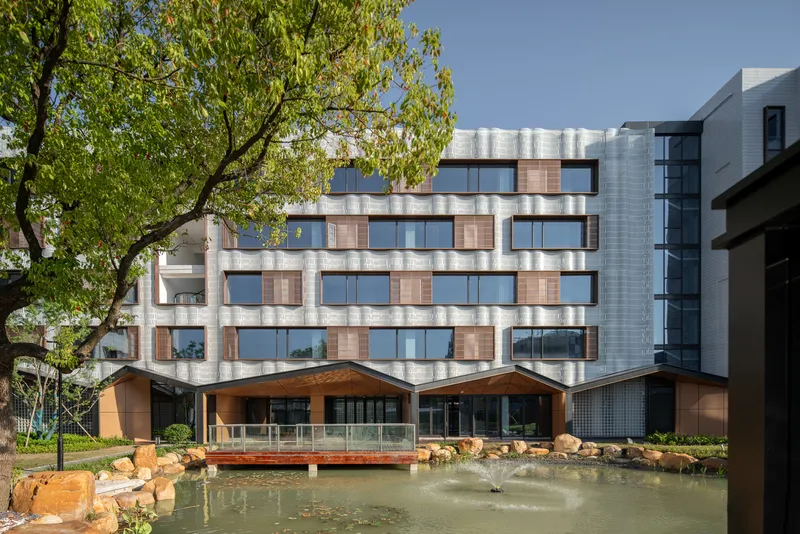
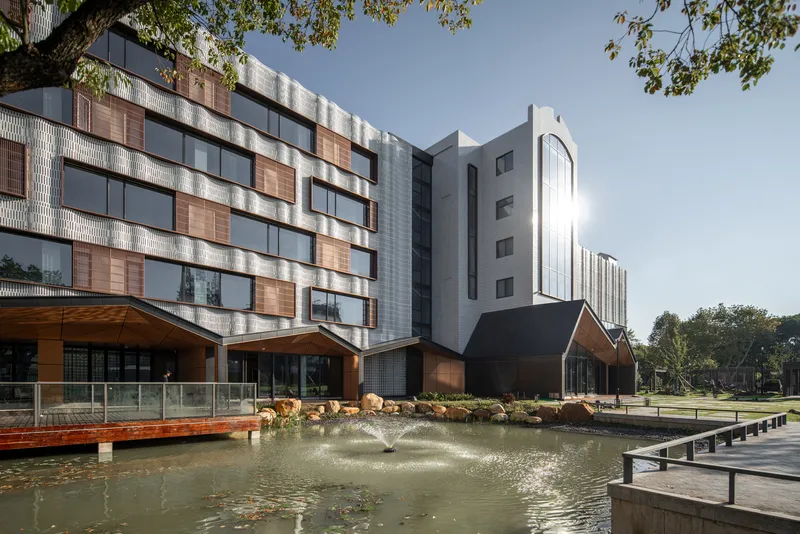
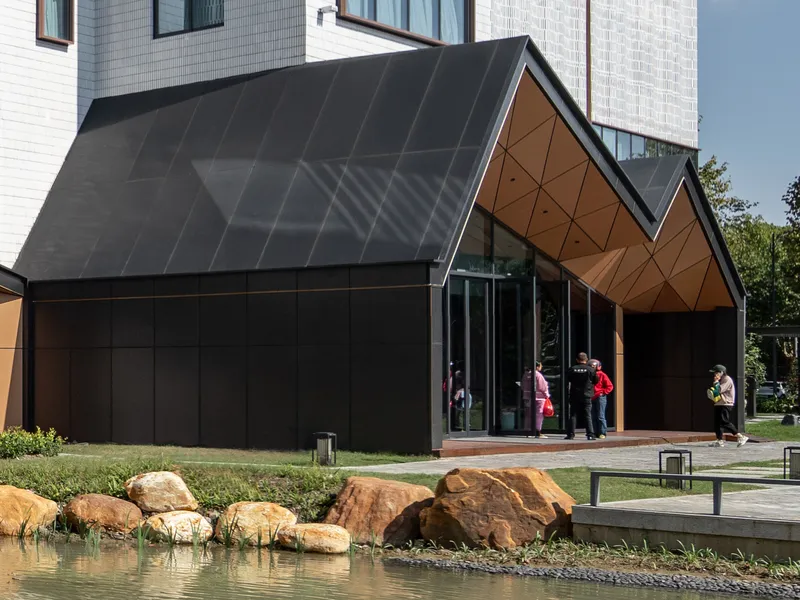
At the heart of the campus, the restored Twin Pools scenic spot anchors the landscape strategy. The pond, edged with rock boulders and wooden decking, occupies what had been a neglected and overgrown area within the factory footprint. LYCS incorporated elements of the Rolling Lantern Dance, a local intangible heritage tradition, into the garden layout, translating choreographic patterns into stepping-stone paths and planted zones. The water acts as a reflective foreground for several of the new facades, doubling their visual impact and cooling the microclimate on summer afternoons.
The restoration is not nostalgic recreation. The deck materials are contemporary, the planting is curated, and the relationship between pond and building is composed with the precision of a section drawing. It is heritage landscape treated as a design problem, not a preservation obligation.
Facade Details and Materiality
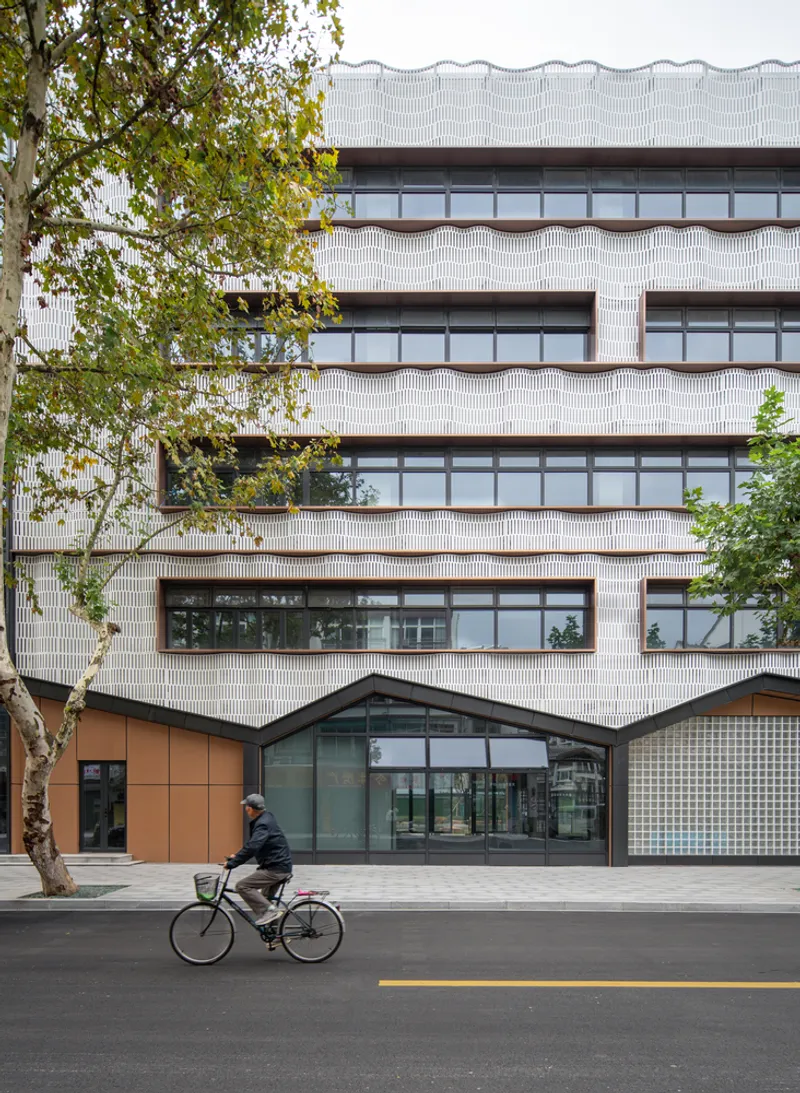
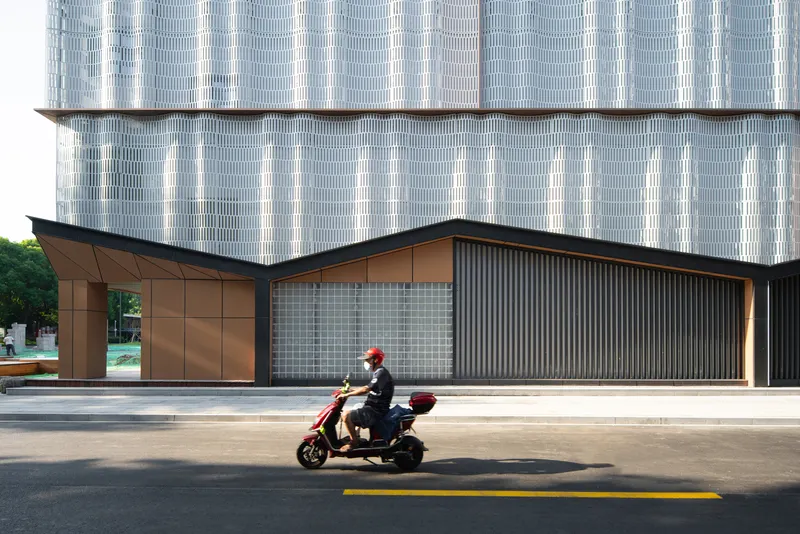
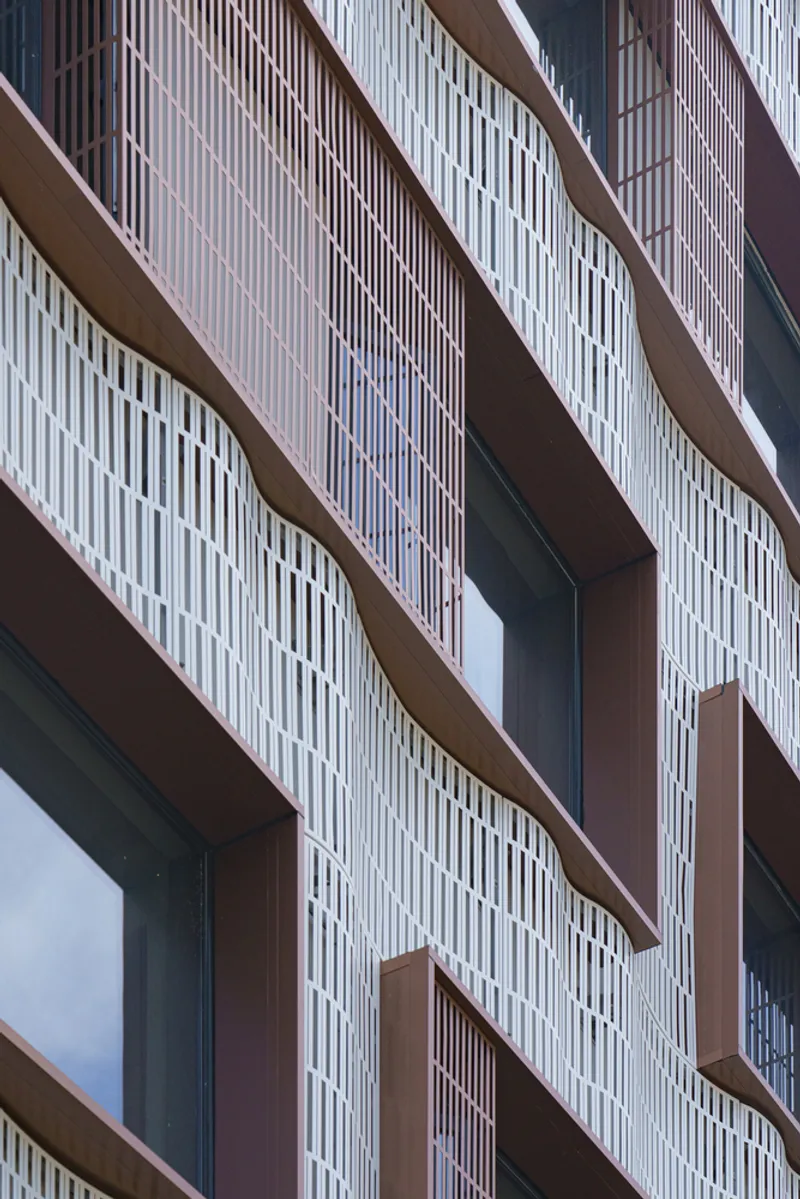
Up close, the project's material palette reveals a disciplined hierarchy. White ribbed tile volumes house the primary exhibition spaces and read as clean, institutional surfaces. Bronze-toned aluminum panels and copper window frames mark the commercial and homestay zones. Glass brick screens filter light into ground-floor corridors while maintaining privacy from the street. The staggered balconies on the tower volume, with their vertical white screening and bronze-toned soffits, suggest that even the most utilitarian program, the homestays, received careful facade treatment.
There is a lesson here about the economics of cultural infrastructure. When every facade gets the same attention regardless of the program behind it, the campus reads as a whole rather than as a museum with leftover buildings attached.
Tower and Threshold
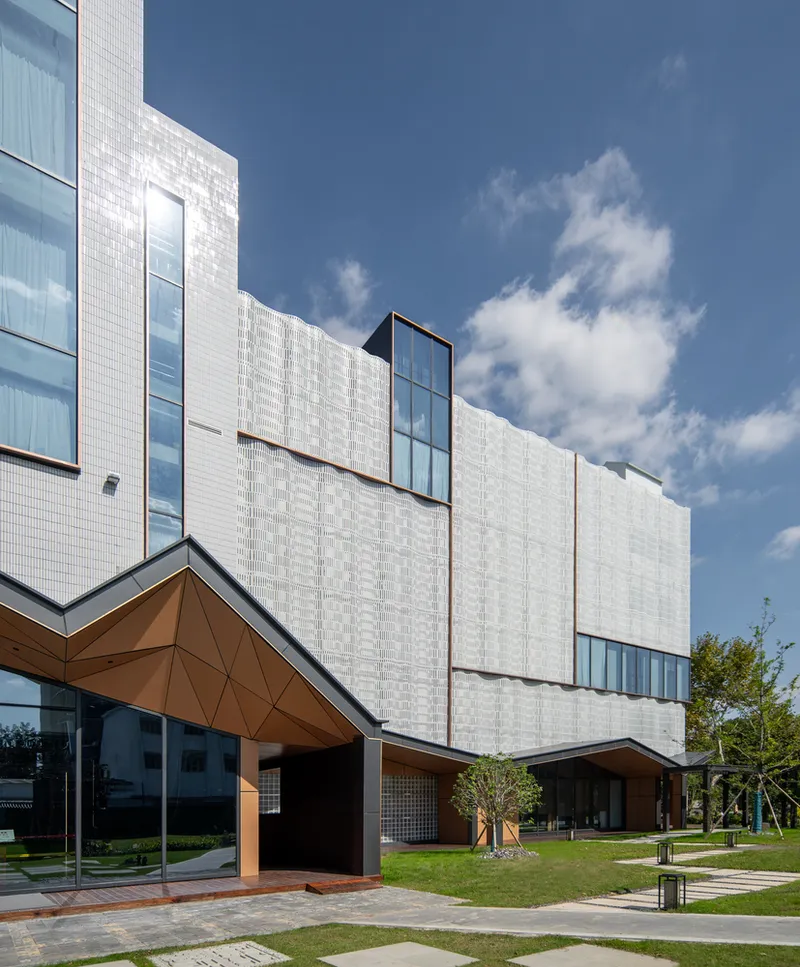
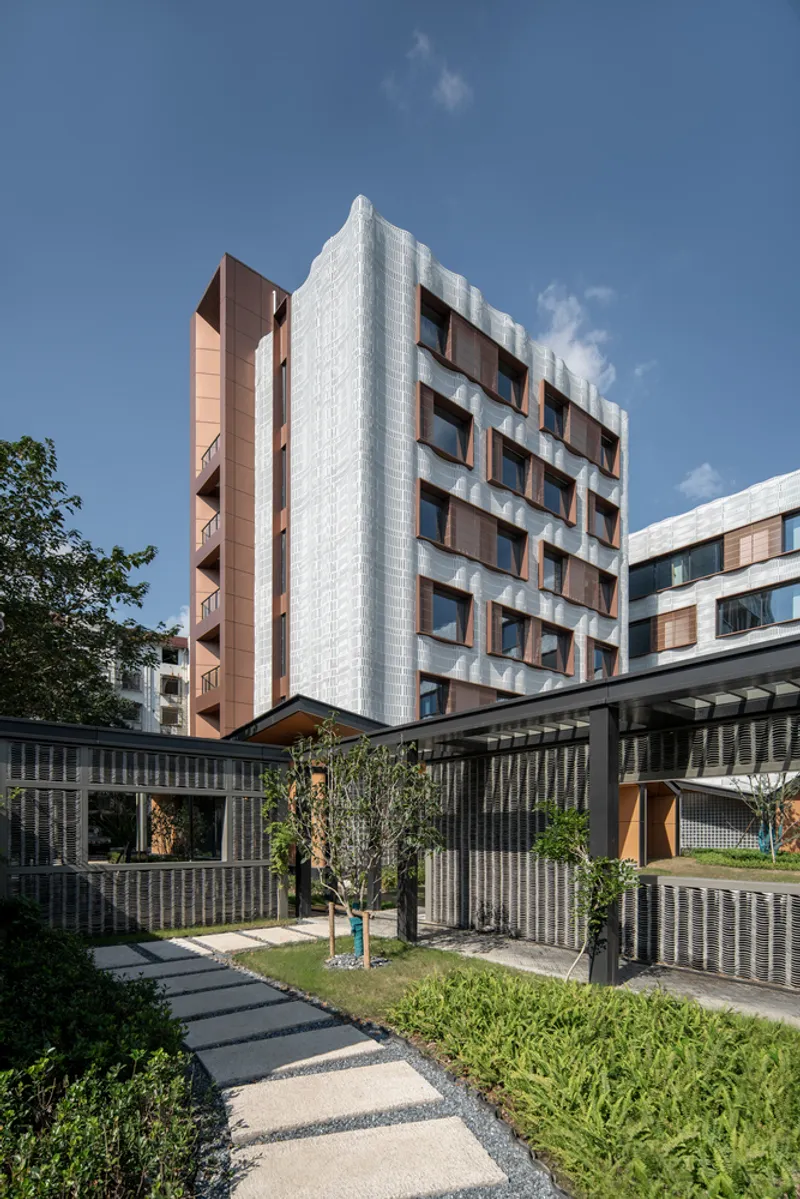
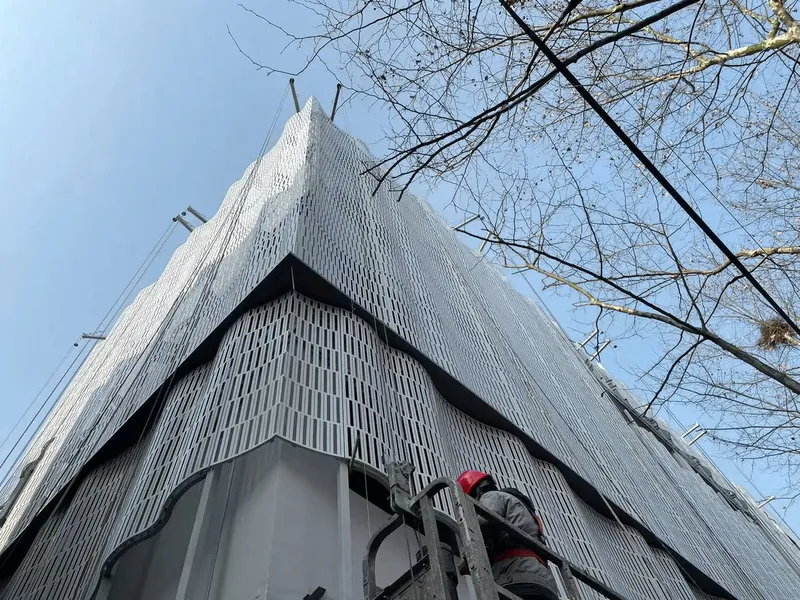
The tallest volume on the site rises above the angular copper canopy like a lantern, its white facade scored with vertical fins that catch low winter light. At its base, a low perforated screen wall encloses a courtyard garden with stepping stones, creating a semi-private buffer between street and interior. The tower is not a conventional museum gallery; it houses training spaces and homestay rooms, and its height gives the campus a landmark visible from surrounding streets. The triangular white facade seen from below, framed by bare branches, is the kind of image that will end up defining the project in the public imagination.
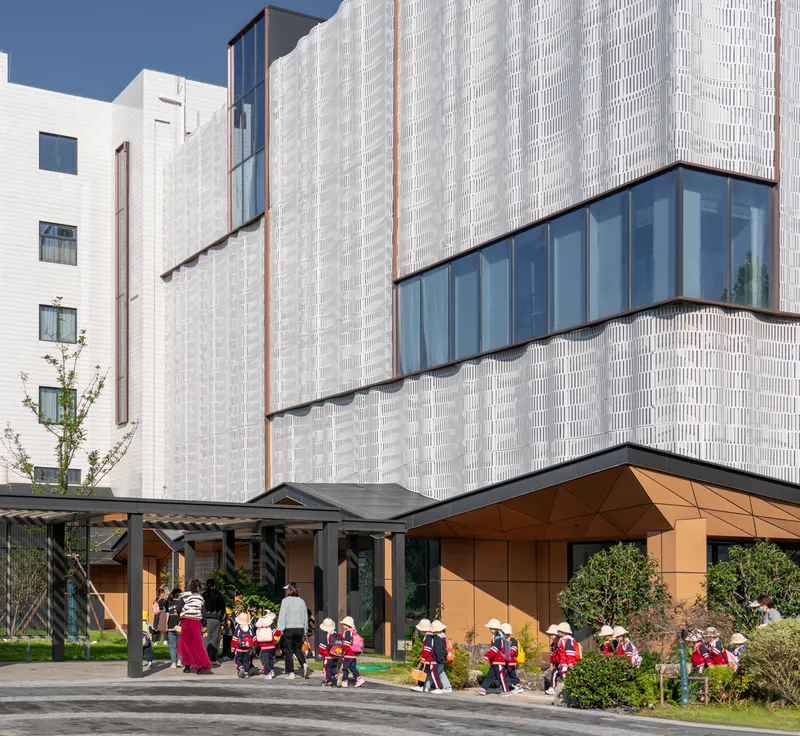
The entrance sequence, with its dual copper canopies sheltering patterned paving and young trees, is generous without being monumental. Schoolchildren in red vests file through it on field trips. Scooter riders zip past on the adjacent road. The architecture is civic but unpretentious, inviting engagement without demanding reverence.

Plans and Drawings
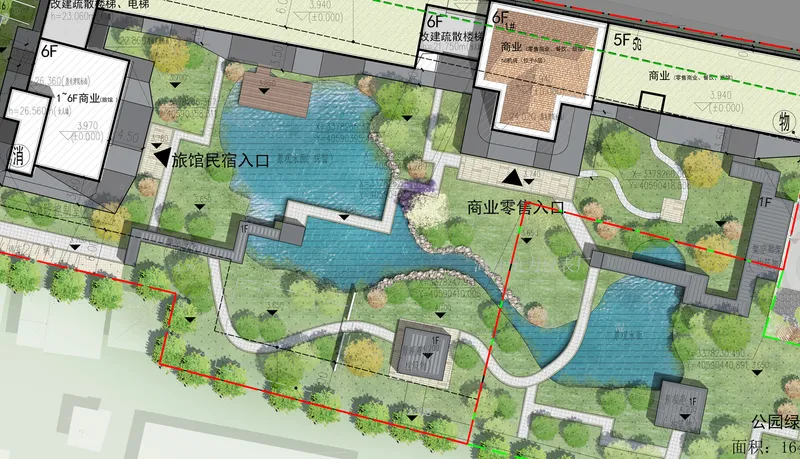
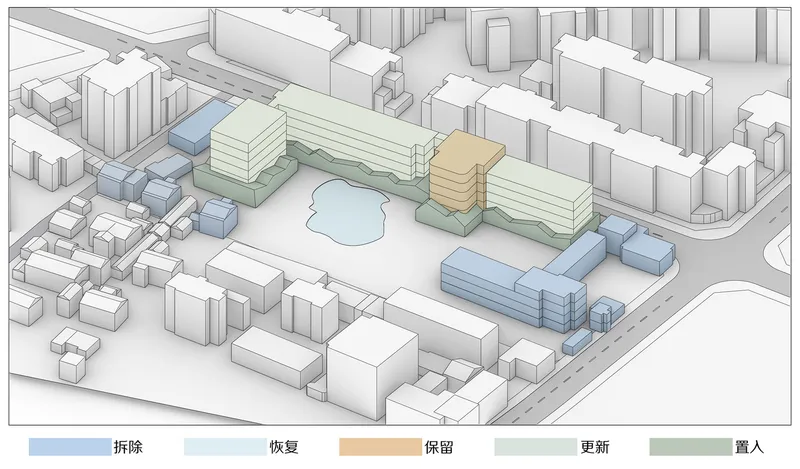

The site plan confirms the campus logic: two blue water features anchor the composition, with buildings arranged around their edges in a loose courtyard formation. Green buffers and planted areas mediate between structures and streets. The axonometric drawing, color-coded by intervention type, makes the five-part strategy legible at a glance: preserved volumes in one hue, renewed facades in another, demolished zones left open. The section sketch shows the tower rising from a layered sequence of pitched rooflines, clarifying the vertical relationship between the low timber corridors and the taller exhibition and homestay blocks. Together, these drawings reveal a project that was designed not as a single building but as an urban plan with architectural resolution.
Why This Project Matters
The Haiyan Intangible Cultural Heritage Museum matters because it demonstrates that adaptive reuse in a Chinese county seat can be as nuanced and site-specific as any high-profile urban conversion. LYCS did not apply a one-size-fits-all preservation strategy. They diagnosed each structure individually, assigned it an operation, and then designed the connective tissue, the corridors, the landscape, the facades, to make the whole campus cohere. The result is a cultural destination that feels grown rather than imposed, even though it was completed in roughly two years.
More broadly, the project offers a model for how intangible heritage can inform architecture without descending into pastiche. The rippling aluminum panels reference tidal bore culture. The pitched roofs echo vernacular housing. The garden integrates the Rolling Lantern Dance. None of these gestures are didactic; they work as architecture first and as cultural signifiers second. That restraint is what separates a good heritage museum from a themed attraction, and it is what will keep this project relevant long after its opening season.
Haiyan Intangible Cultural Heritage Museum by LYCS Architecture. Haiyan County, Jiaxing City, Zhejiang Province, China. 7,211 square meters. Completed 2024. Photography by LYCS.
About the Studio
Share Your Own Work on uni.xyz
If projects like this are the kind of work you want to make, uni.xyz is a place to publish your own, find collaborators, and enter design competitions.


Popular Articles
Popular articles from the community


Cloaked Colonization: A Mobile Underwater Habitat That Moves Like a Fish
Micah Abaya's shortlisted EHC Pacific entry reimagines ocean settlement as a dispersed network of self-sustaining architectural organisms.

Faces of the Soviet Avant-Garde: Turning Moscow's Street Names into an Open-Air Museum
A network of sculptural installations across a Moscow residential district transforms forgotten architect names into spatial encounters with cultural memor

Tsunami Convergenics: Turning Catastrophic Ocean Forces into Underwater Housing Infrastructure
A speculative underwater settlement off the coast of Onagawa, Japan, treats tsunamis and typhoons as energy sources rather than threats.

Singing Woman: An Opera House That Performs Before the Curtain Rises
Ovidiu Cristian Pavel's conceptual opera house translates Estonia's choral identity into a sculpted waterfront landmark facing the Baltic Sea.

Similar Reads
You might also enjoy these articles


Hodi-Mandai Geram
Project Function: Preservation and revitalization of the Intangible heritage and socio-spatial identity of the Hodi by Housing, Cultural Memory Center, Sacred Grove, landscape, local tourism economy


Olio Towers: A Mid-Rise for Performers That Fuses Housing, Rehearsal, and Stage
Located blocks from Houston's Theater District, this modular tower stacks living units around a central performance atrium.

Oasis: Modular Green Housing Carved into Dhaka's Urban Fabric
A shortlisted Plugin Housing entry reclaims unauthorized settlements in Dhaka with stepped concrete volumes, green roofs, and ventilation-driven design.

Black Hole: A Floating Megastructure for the Post-Physical Era
Emiliano Mazzarotto envisions a spherical, self-scaling arena where e-sports, digital hotels, and holographic stadiums replace traditional public space.

Explore Architectural Heritage Competitions
Discover active competitions in this discipline

Challenge to reimagine the Iron Throne

Photograph architecture without architects

Illustrate the lost glory of Angkor Wat - Render Challenge

Design challenge to reuse E-waste
Comments (0)
Please login or sign up to add comments
No comments yet. Be the first to comment!