
Dabbagh Architects Builds a Museum in Al Ain That Wraps Around the Archaeology Beneath It
An 8,000-square-meter cultural institution in the UAE oasis city treats its own excavated ground as the primary exhibit.


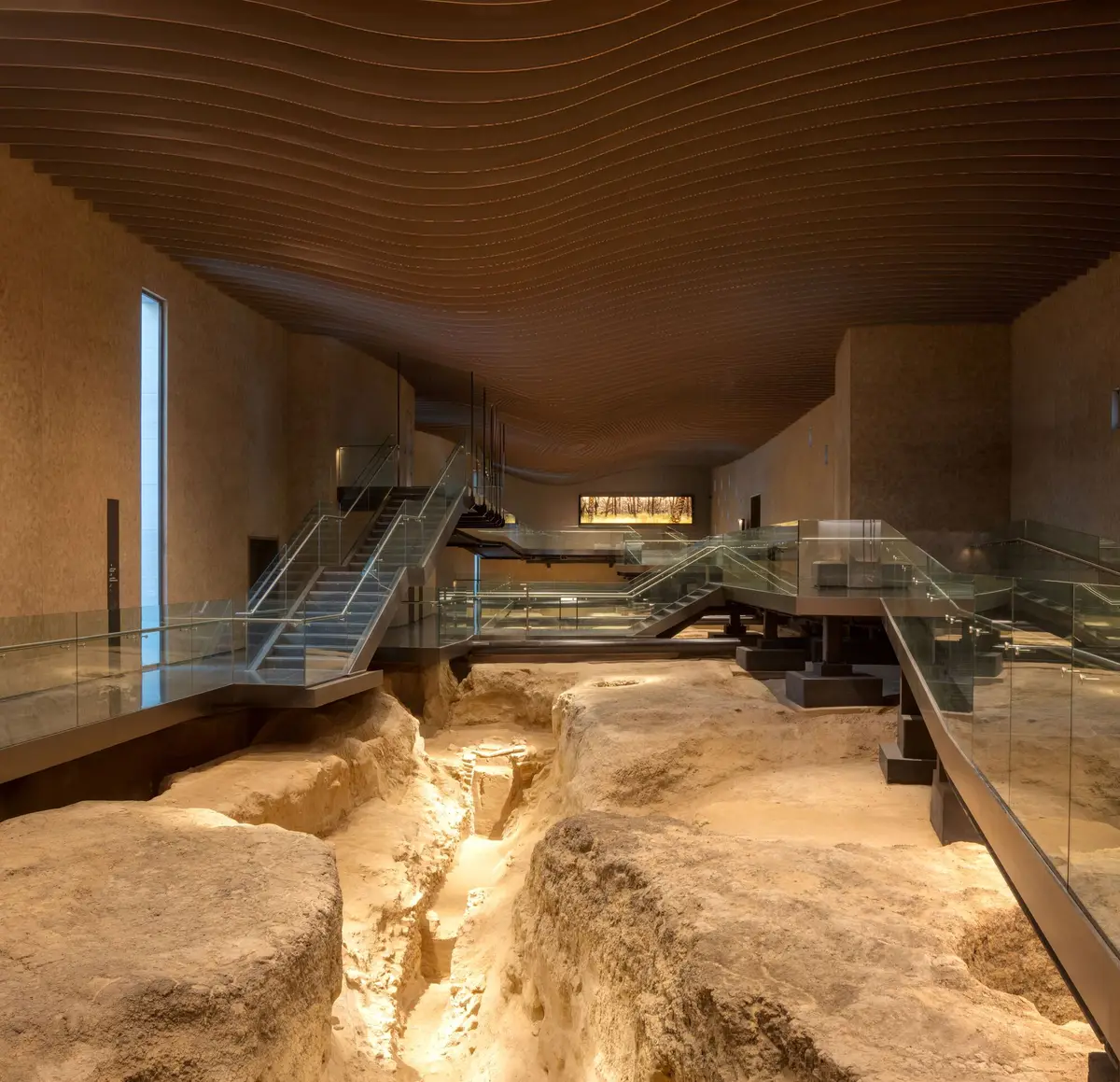
Most museums house artifacts brought from somewhere else. The Al Ain Museum, designed by Dabbagh Architects, does something rarer: it is built directly over the archaeological remains it exists to display. Glass walkways and circular floor panels suspend visitors above excavated trenches, turning the act of moving through the building into an act of looking down into deep time. The architecture doesn't just contain the collection. It frames the ground itself as the centerpiece.
Completed in 2025 in the United Arab Emirates, the 8,000-square-meter museum sits in Al Ain, a city defined by its oasis heritage and UNESCO World Heritage sites. Sumaya Dabbagh's firm has shaped the building as a cluster of perforated stone volumes arranged around courtyards and shaded plazas, drawing on the spatial logic of traditional Gulf settlements without mimicking them. The result is a building that feels genuinely rooted in its climate and terrain, not as an exercise in nostalgia but as a direct response to heat, light, and the fragile stratigraphy underfoot.
Stone Screens and Desert Light


The building's perforated stone facades do real environmental work. They filter the harsh UAE sun into patterns of softened light while allowing air to move through transitional zones between indoors and out. At sunset, the volumes glow with a warmth that feels earned rather than applied, the stone catching pink light in a way that reads as both geological and architectural. The gravel paths and planted shrubs around the perimeter reinforce the sense that this is a landscape project as much as a building.
What separates these screens from decorative mashrabiya pastiche is their scale and proportion. They wrap entire volumes rather than sitting as ornamental appliqué, and they establish a rhythm across the facade that gives the complex visual coherence without monotony.
Courtyards as Climate Strategy
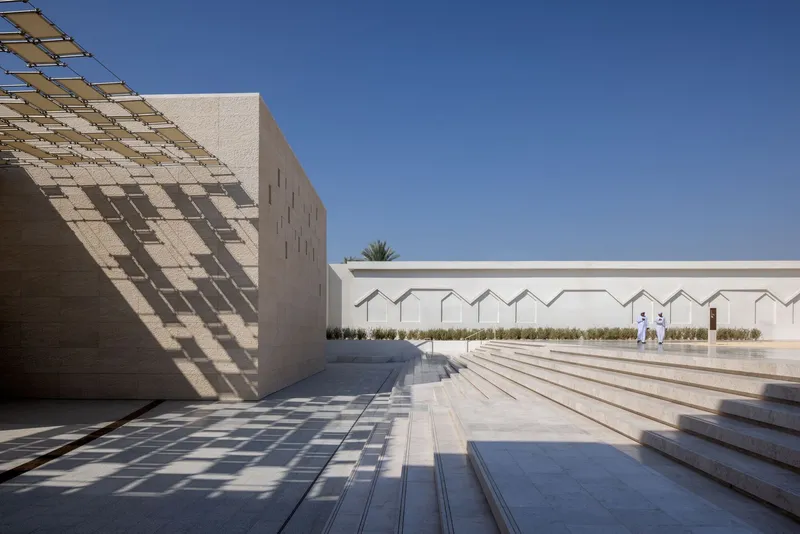
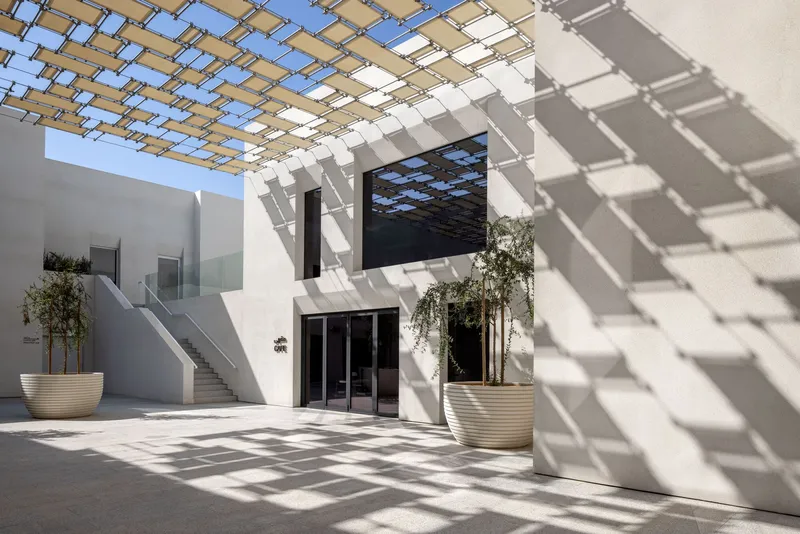
The courtyards are the building's lungs. Wide stone steps, potted olive trees, and timber pergolas create shaded outdoor rooms where the temperature drops noticeably. The geometric shadow patterns cast by the canopy structures are not incidental; they indicate a canopy geometry calibrated to block direct overhead sun while admitting lower-angle light during cooler hours. These are functional thresholds between the heat of the plaza and the controlled environment of the galleries.
In one courtyard, a staircase ascends beneath a lattice of timber beams, the shadows falling in sharp diagonals across white walls and stone treads. It is one of the most photogenic moments in the building, but it is also one of the most pragmatic: the pergola makes an otherwise punishing climb through open air entirely comfortable.
The Plaza and Its Historic Neighbors
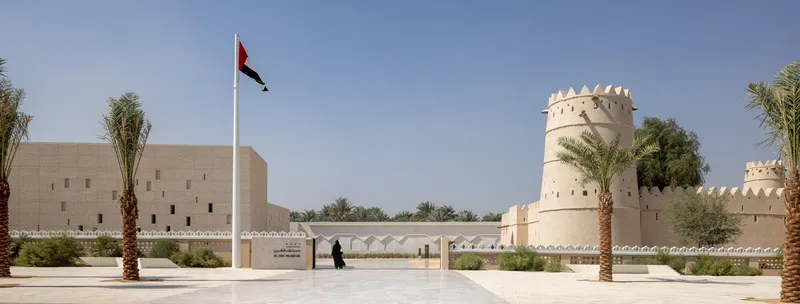

The museum's plaza reads as a civic threshold. Crenellated towers and white walls from neighboring historic structures share the frame with Dabbagh's new volumes, and the two architectural languages coexist without competing. The flagpole and palm trees anchor the composition in a familiar vocabulary of Gulf public space, while the museum's stone surfaces introduce a quieter, more textured materiality.
At dusk, an illuminated stone staircase with integrated linear lighting pulls visitors toward the entrance with the precision of stage design. The transition from bright outdoor plaza to this carefully lit threshold signals a shift in register, preparing visitors for the darker, more contemplative interior ahead.
Walking Over Deep Time
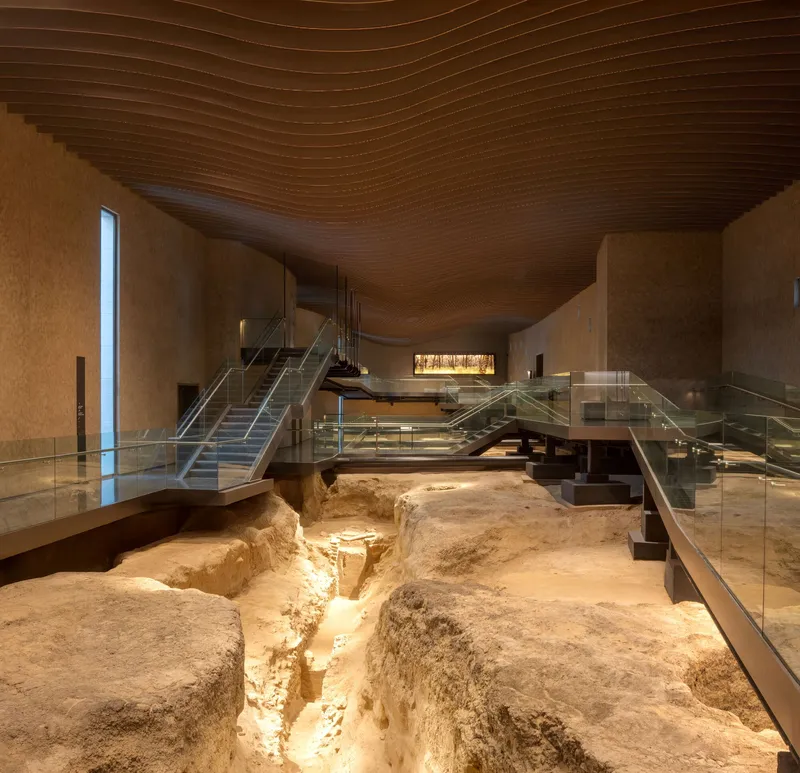
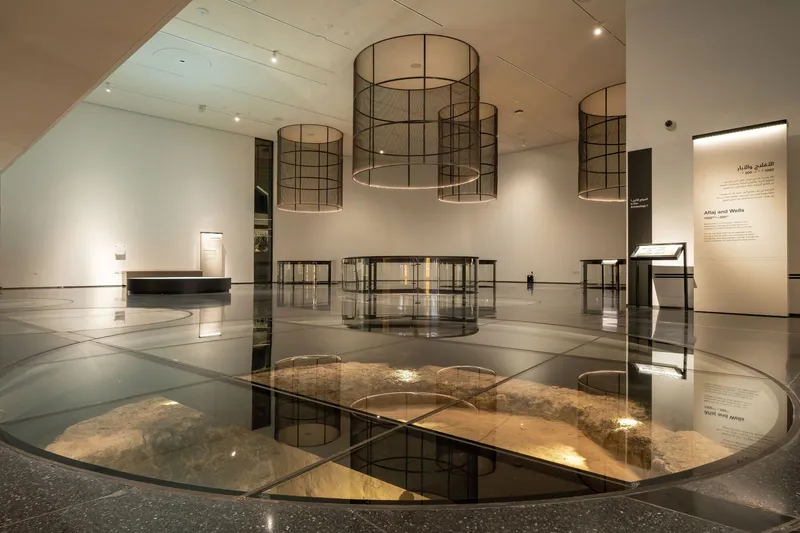
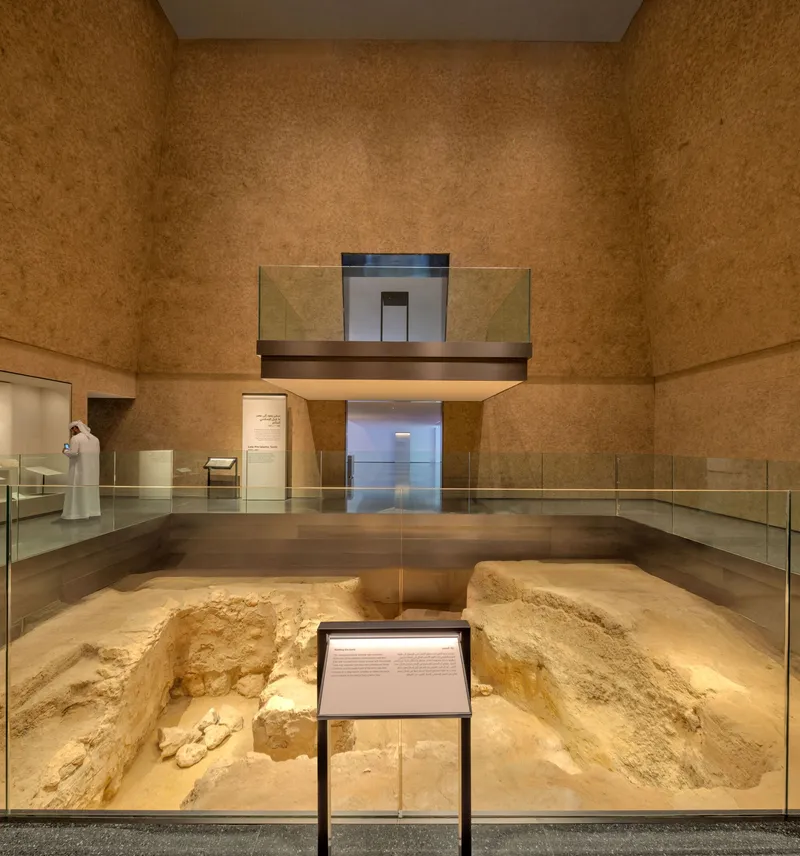
The museum's most striking spatial idea is the glass floor system that lets visitors look directly down into excavated archaeological layers. In one gallery, circular glass panels are set flush into the floor, each one illuminated from below to reveal a cross-section of cultural deposits. In another, a full glass walkway stretches over a trench of exposed remains beneath a curved timber ceiling. The effect is vertiginous and intimate at once: you are standing on history, separated from it by a thin plane of transparency.
The textured earthen walls in the gallery spaces reinforce the connection between the building's material palette and the archaeology it protects. There is no drywall here, no white-cube neutrality. The walls look like they were excavated too, as if the building simply revealed itself around the finds rather than being imposed upon them. This is a smart curatorial instinct expressed through architecture.
Framing the Desert Through Glass
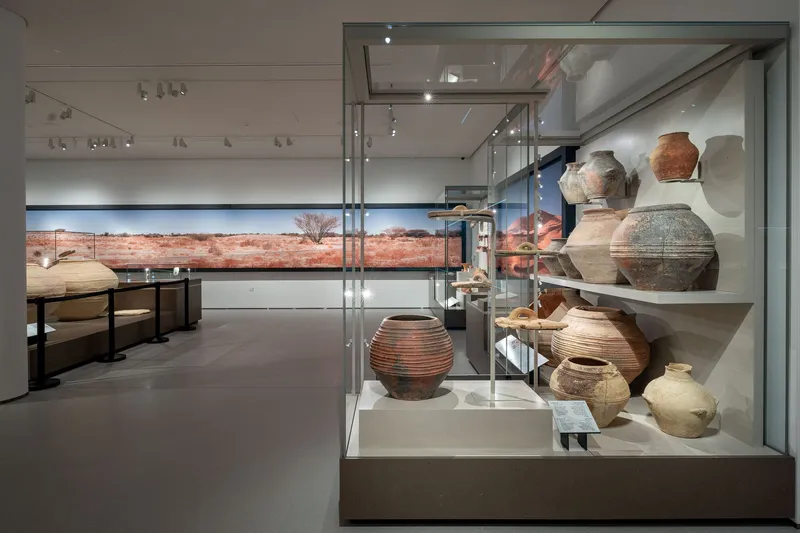
One gallery image captures the museum's dual orientation perfectly: glass display cases holding ceramic vessels sit in the foreground while a horizontal window behind them opens onto the desert landscape. The artifacts and their origin terrain are held in the same visual field. It is a simple move, a long slot window at eye level, but it collapses the distance between object and context in a way that no didactic panel could achieve.
This relationship between interior exhibit and exterior landscape recurs throughout the building. Dabbagh Architects has consistently refused to seal the museum off from its surroundings. Light, views, and heat are managed rather than excluded, and the result is a museum experience that never lets you forget where you are.
Plans and Drawings

The site plan confirms what the photographs suggest: the museum is organized as a cluster of discrete volumes rather than a single monolithic block. Pathways weave between the masses, threading through courtyards and shaded passages in a pattern that recalls the organic growth of traditional oasis settlements. Trees are distributed across the site with an almost agricultural regularity, reinforcing the landscape identity of Al Ain itself. The drawing reveals that the building's apparent informality is, in fact, carefully composed.
Why This Project Matters
The Al Ain Museum makes a strong case that cultural architecture in the Gulf does not need to choose between spectacle and sensitivity. Dabbagh Architects has delivered an institution that is visually compelling, climatically responsive, and genuinely engaged with its archaeological content. The decision to build over and around the excavated remains, rather than relocating them into vitrines, gives the entire project an integrity that many larger, more expensive museums lack.
At a moment when the region's architectural ambitions often default to imported typologies and globalized aesthetics, this building insists on specificity. It is specific to its climate, specific to its site, and specific to the material culture it preserves. That specificity is its greatest strength, and it positions Sumaya Dabbagh's practice as one of the most thoughtful voices working in Gulf architecture today.
Al Ain Museum by Dabbagh Architects. Located in Al Ain, United Arab Emirates. Completed in 2025. 8,000 m². Photography by Gerry O'Leary.
About the Studio
Share Your Own Work on uni.xyz
If projects like this are the kind of work you want to make, uni.xyz is a place to publish your own, find collaborators, and enter design competitions.


Popular Articles
Popular articles from the community


Temporary Home for Dogs: A Reversed Zoo Rethinks Animal Shelter Architecture
In Bucharest, a sinuous corridor and freed landscape flip the logic of containment, designing a shelter that works to make itself unnecessary.

Singing Woman: An Opera House That Performs Before the Curtain Rises
Ovidiu Cristian Pavel's conceptual opera house translates Estonia's choral identity into a sculpted waterfront landmark facing the Baltic Sea.

Opera by the Sea Estonia: Three Shells Dissolving Architecture into Tallinn's Coastline
A winning opera house proposal replaces monumental form with interconnected shells that blur the boundary between building, park and Baltic Sea.

Extended Shell: Retrofitting Kolkata's Balconies as Living Urban Thresholds
A modular retrofit system recovers the social and environmental intelligence of Kolkata's historic verandas for contemporary Park Street residents.

Similar Reads
You might also enjoy these articles

Pixel Gardens: One Repeated Module Stacked Into a Terraced Social Housing Tower for Famagusta
Salem Bader's shortlisted housing tower builds a vertical neighbourhood from one repeated module, offsetting units to carve terraces, light and air.

Bao Huynh Watercolor Atelier: A Serene Art Retreat in Hội An
Bao Huynh Watercolor Atelier in Hội An blends multifunctional art spaces, sustainable design, local materials, and family-friendly living in a serene environment.

Atelier Macri Concept Store Interior Design by CASE-REAL
Atelier Macri store features a "ko" counter, walnut wood details, cork displays, blending retail, gallery, and seamless customer experiences.

Manuel Vargas Izquierdo Stadium and High-Performance Sports Center: Architectural Excellence in Jalpa de Méndez
The Manuel Vargas Izquierdo Stadium blends sustainable design, inclusive sports facilities, and cultural-inspired architecture, revitalizing Jalpa de Méndez’s public spaces.

Explore Museum Competitions
Discover active competitions in this discipline

Challenge to design mud housing for contemporary communities

Bring back Drive In's
Comments (0)
Please login or sign up to add comments
No comments yet. Be the first to comment!