
Dabbagh Architects Wraps a 4,000-Year-Old Tomb in Concentric Sandstone Walls in the Sharjah Desert
The Mleiha Archaeological Centre radiates outward from a Bronze Age burial site at the foot of Fossil Rock Mountain in the UAE.


Architecture that takes its cue from an existing artifact risks two failures: it can overwhelm what it frames, or it can retreat into timid deference. At Mleiha, Dabbagh Architects found a third path. The 2,000 square metre centre does not stand beside the 4,000-year-old Umm Al Nar tomb it was commissioned to protect; it spirals out from it, generating form directly from the circular geometry of the Bronze Age relic. The result is a building that feels less like it was designed and more like it grew concentrically from the desert floor, sandstone wall after sandstone wall.
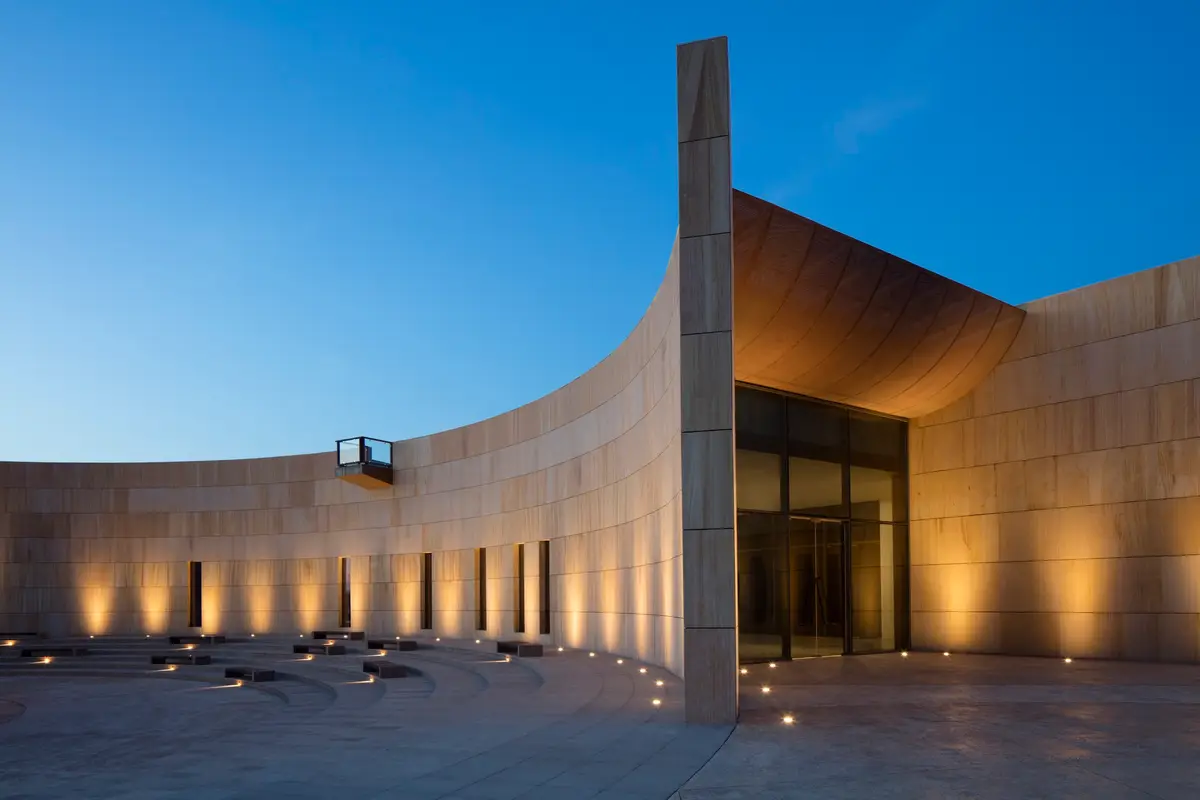
Sited at the foot of Fossil Rock Mountain near the village of Mleiha in Sharjah, the centre is part of a broader ecotourism push, yet it refuses the glossy visitor-centre playbook. There is no grand canopy, no heroic cantilever. Instead, lead architect Sumaya Dabbagh deployed locally sourced sandstone and copper, materials with direct archaeological resonance: copper workshops once operated in this very area. The semi-spherical form hunkers low against the terrain, its jagged copper roof echoing the sharp ridgeline of Fossil Rock itself. Everything about the project insists that the land was here first.
A Ceremonial Approach Through the Desert
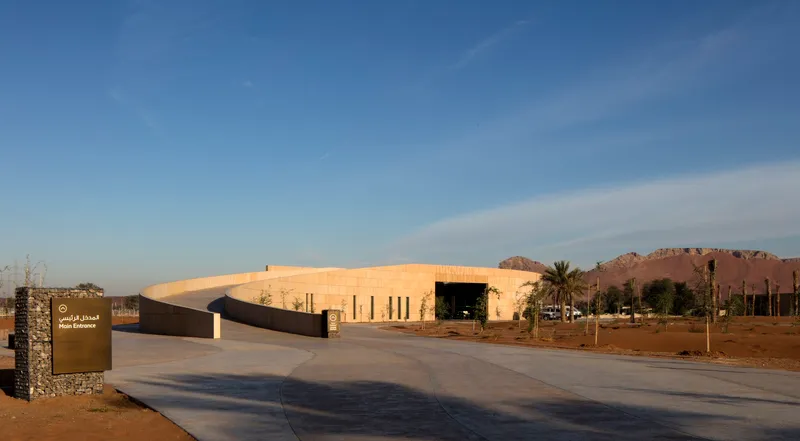
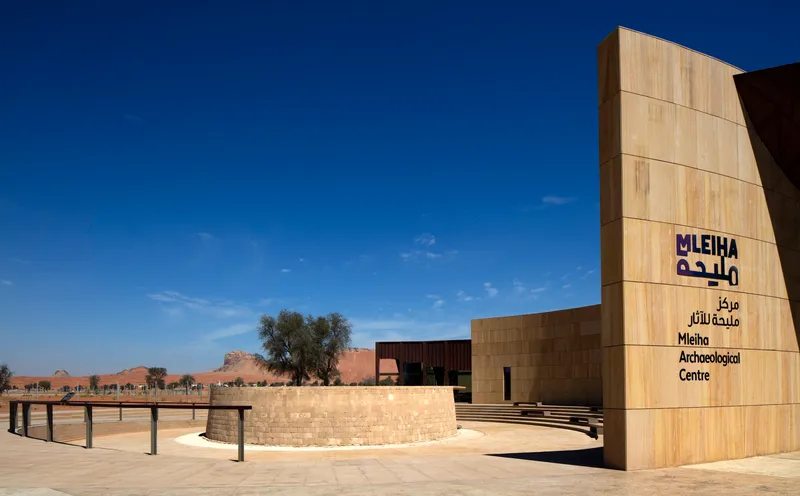
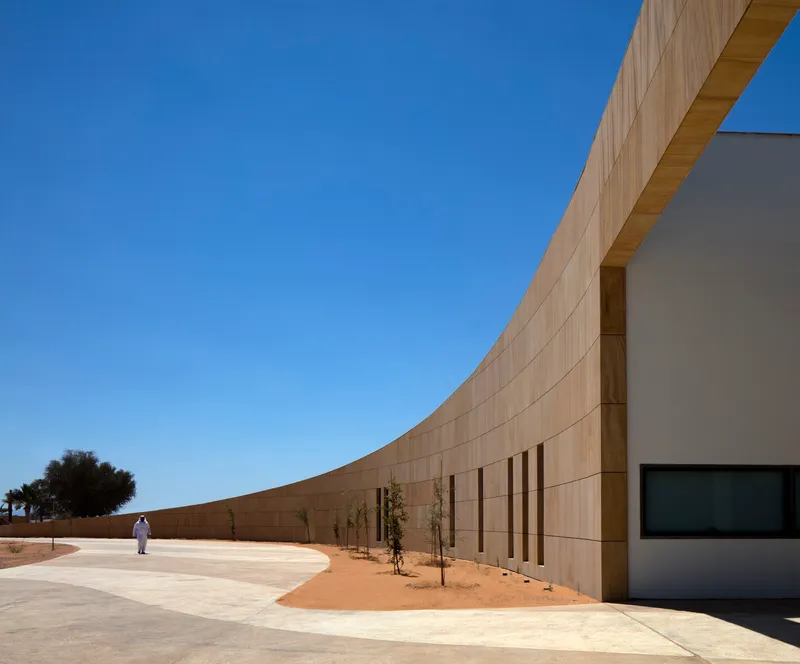
The building's relationship to its landscape is not incidental; it is the design's primary argument. Arriving from the access road, visitors encounter a low, sand-colored mass that barely crests above the scrubland. The entrance tower, clad in timber and marked with signage, acts as a vertical punctuation mark against the relentless horizontality of the desert. From here, a curved sandstone wall draws you along a pathway, its narrow vertical window openings offering controlled glimpses of the interior before you commit to entering.
The approach is deliberately processional. Dabbagh orchestrated a ceremonial sequence that leads the visitor to both the tomb and the building entrance simultaneously, collapsing the distinction between archaeological site and architectural threshold. It is a move that echoes the ritual significance of the tomb itself, turning arrival into a kind of pilgrimage.
Concentric Walls and Curved Facades
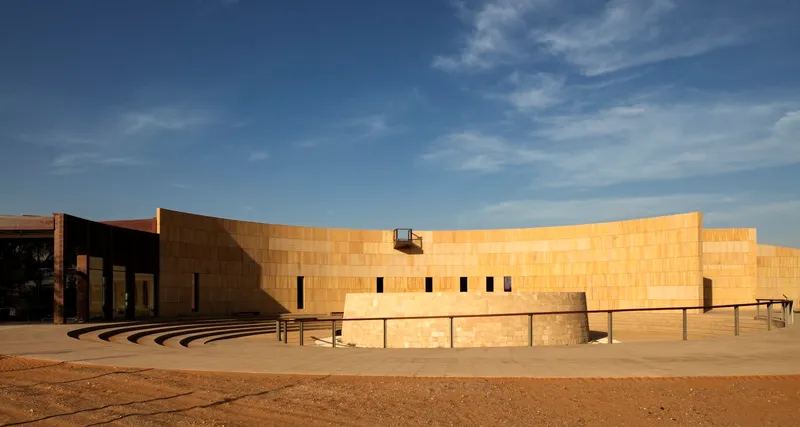
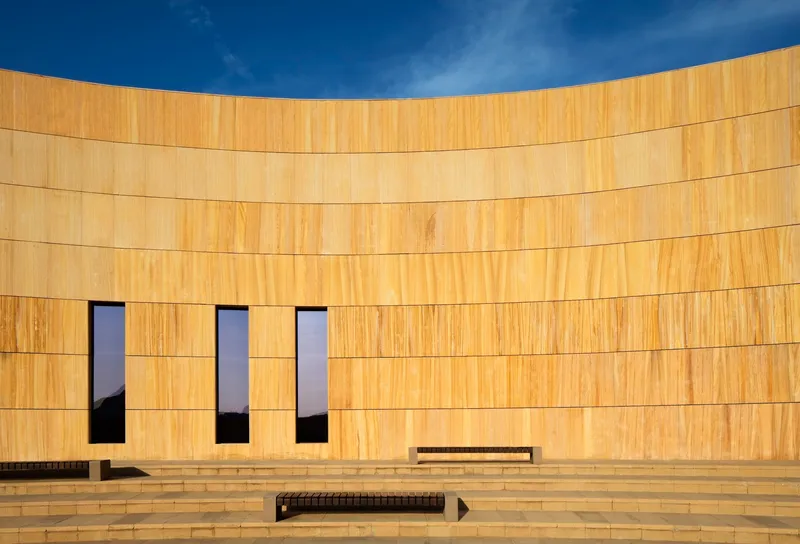
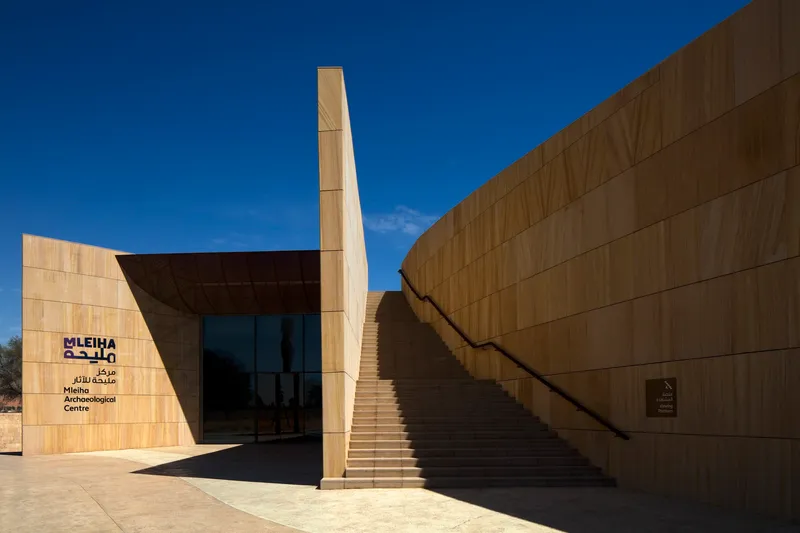
The concentric wall strategy is the project's structural and conceptual backbone. Radiating outward from the circular tomb, each successive sandstone arc establishes a new layer of program: lobby, exhibition hall, café. The curvature is constant but never repetitive; walls step, taper, and open at different intervals, producing shifting rhythms across the facade. Tall, narrow windows are cut into the stone at irregular spacings, admitting controlled daylight while maintaining the fortified solidity of the exterior.
The entrance plaza, visible in a wider view, reveals how the building integrates a freestanding tower element, an exterior staircase to the roof terrace, and stepped seating into a single composition. None of these elements feel applied; they register as erosions or extrusions of the same sandstone mass, reinforcing the idea that this architecture emerged from geological rather than drafting-table logic.
Copper, Glass, and Dusk

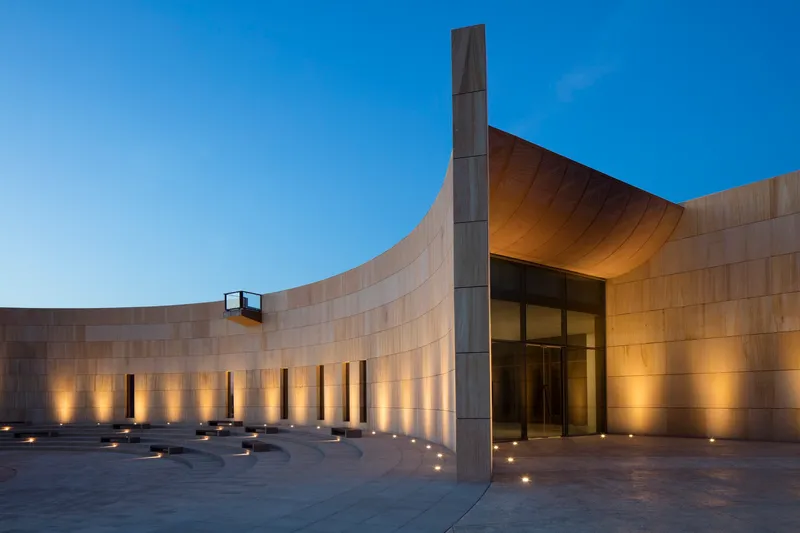
The café wing introduces a material shift that is both dramatic and historically grounded. Angled copper-clad panels cascade over glass walls, their sharp geometry a direct formal echo of Fossil Rock's craggy profile. At dusk, uplighting transforms the rammed earth facade into a warm, glowing surface, while the copper panels catch the last light and darken to bronze. The central entrance, framed between two curving walls, becomes a luminous void against the silhouetted desert.
Copper is not an arbitrary accent here. Ancient copper workshops once operated in the Mleiha area, making the material a genuine archaeological reference rather than a cosmetic choice. Paired with the glass-fronted café that opens toward Fossil Rock, the copper roof orients the visitor's gaze toward the very geological formation that gave the region its identity.
Interior: Timber Curves and White Ceilings
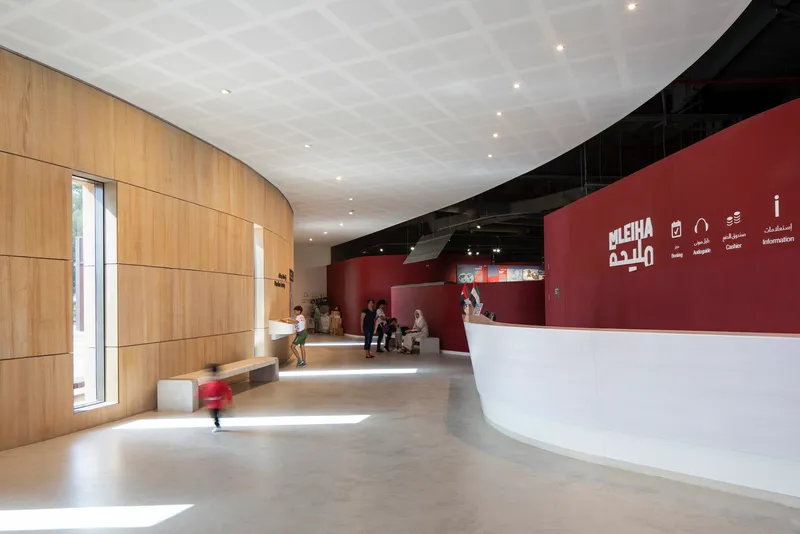
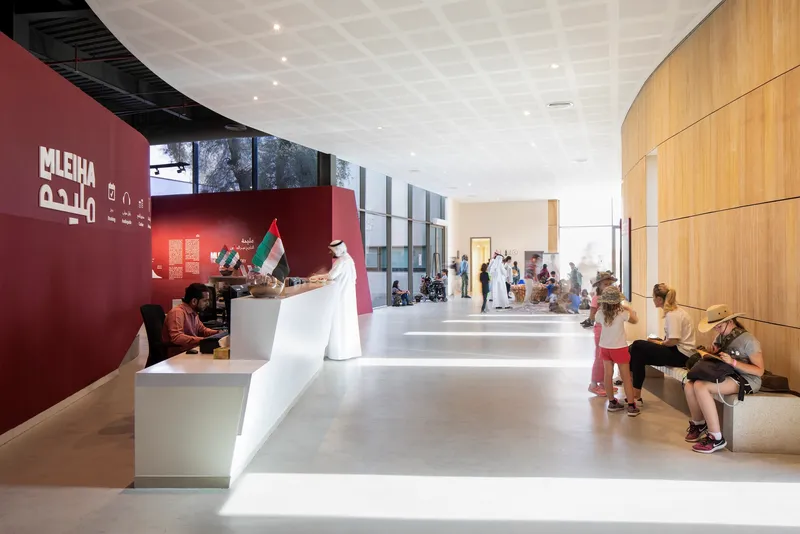

Inside, the concentric logic continues but softens. Curved timber panels line the reception lobby, their warm grain contrasting with a white coffered ceiling that diffuses daylight evenly across the space. The fluid layout carries visitors through exhibition rooms, a bookshop, and a cafeteria without the corridor-and-door rigidity typical of museum planning. Benches are integrated into the wall geometry, inviting pause rather than enforcing circulation.
An interior courtyard, framed by wood-paneled walls, introduces a single tree casting a sharp shadow on paved ground. It is a controlled moment of emptiness within a building that is otherwise dense with program. The courtyard reads as an internalized piece of desert, a reminder that the building's walls separate but do not sever the visitor from the landscape outside.
The Amphitheater as Landscape Device

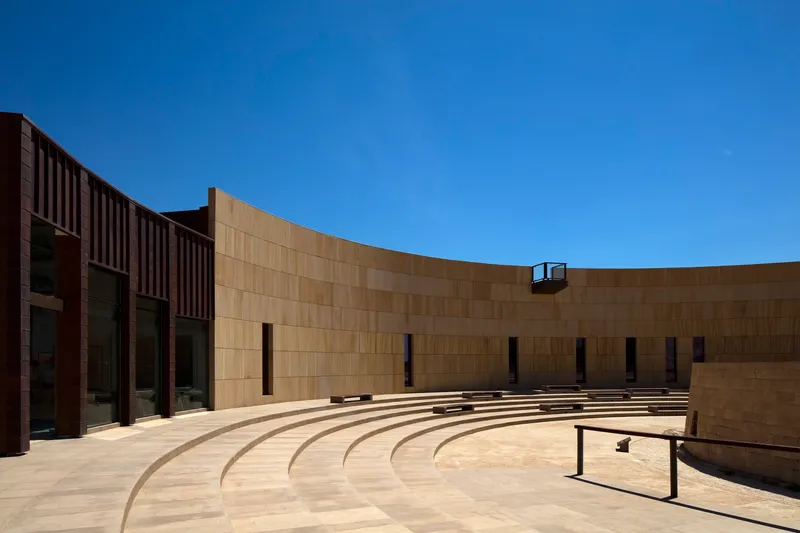
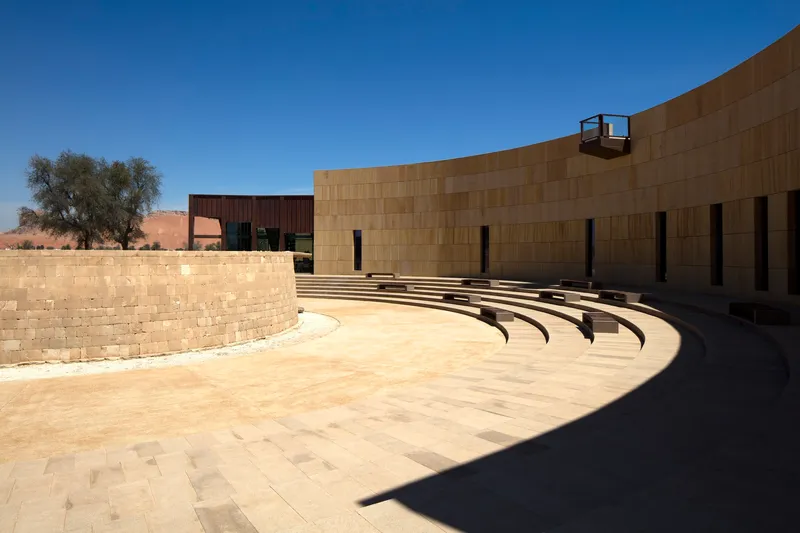
The outdoor amphitheater is the building's most extroverted gesture. Concentric stone seating tiers step down into the earth, creating a bowl that is simultaneously a gathering space and a topographic extension of the site. From the air, the spiral geometry of the amphitheater locks into the curving access road and the crescent-shaped plan of the museum, making the entire complex legible as a single, centrifugal composition.
At ground level, the amphitheater operates differently. Rammed earth walls define its perimeter, and the stepped seating frames views of the open desert and the distant hills. It is an outdoor room without a roof, a space that leverages the region's reliably clear skies to turn gathering into spectacle. The choice to build downward, scooping into the terrain rather than stacking upward, keeps the amphitheater's profile low and consistent with the building's desert-floor ethos.
Plans and Drawings


The site plan confirms what the photographs suggest: the building is organized as a crescent that wraps the circular amphitheater, with landscape plantings bridging the gap between architecture and desert. The ground floor plan reveals a single continuous interior volume subdivided by curved partitions rather than orthogonal walls, allowing the concentric geometry to govern spatial experience from entry to café. The roof plan shows the viewing terrace and a central skylight, the latter pulling light into the deepest point of the plan.
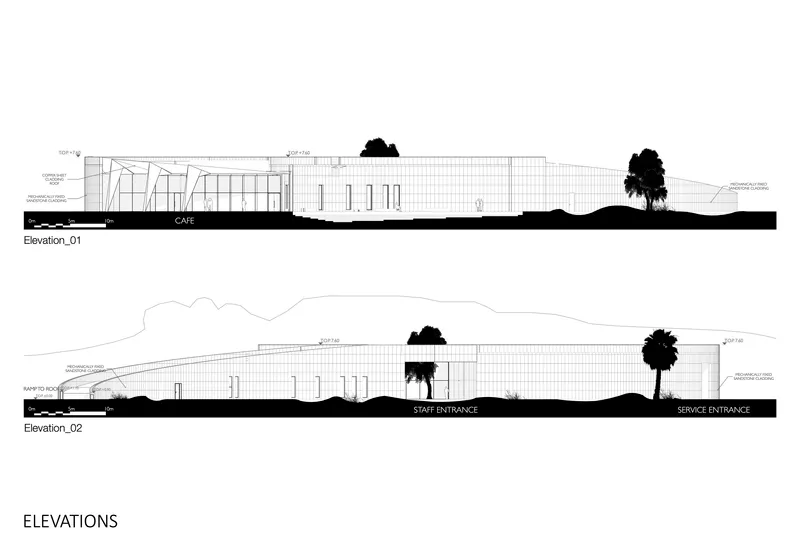
Section drawings are particularly revealing. The amphitheater bowl sinks below grade while the museum volume remains at a single storey plus roof, keeping the entire complex well below the horizon line of the surrounding landscape. The gentle ramp to the roof terrace is legible in the section as a continuous slope that doubles as structure, carrying visitors upward for panoramic views of the tomb, the desert, and Fossil Rock beyond. Elevations show a restrained, gridded facade punctuated by the narrow vertical openings seen in the photographs, their proportions calibrated to control solar gain while maintaining the wall's material presence.
Why This Project Matters
The Gulf region has no shortage of cultural buildings, but most of them import their formal vocabularies from elsewhere: parametric shells, crystalline envelopes, iconic silhouettes calculated for social media. Mleiha refuses all of that. Its form is generated by a specific artifact in a specific place, its materials are drawn from local geology and local history, and its profile defers to the terrain it sits within. That restraint is not modesty for its own sake; it is an argument that architecture can serve heritage without competing with it.
Sumaya Dabbagh's design also demonstrates something rarer: that the concentric, radiating plan type, so often reduced to diagram in academic projects, can produce genuinely compelling spatial sequences when it is tied to a real center. Here, the 4,000-year-old tomb is not a conceptual conceit. It is the literal origin point from which every wall, every ramp, and every sightline extends. The building does not interpret the tomb; it amplifies its presence. In a discipline that too often treats context as a constraint to overcome, Mleiha treats it as the generator of form itself.
Mleiha Archaeological Centre, Dabbagh Architects, Maleha, United Arab Emirates. 2,000 m², completed 2016. Photography by Gerry O'Leary and Rami Mansour.
About the Studio
Share Your Own Work on uni.xyz
If projects like this are the kind of work you want to make, uni.xyz is a place to publish your own, find collaborators, and enter design competitions.


Popular Articles
Popular articles from the community


The Amber Palace Opera: A Geological Fiction Surfaces on Tallinn's Baltic Waterfront
Pierre Brillard reimagines a Baltic legend as a public landscape, opera house, and waterfront promenade rooted in Tallinn's coastal identity.

Opera on the Sea: Driftwood Logic Shapes a Timber Opera House on Estonia's Coast
Trevor Orgill's opera house translates the entangled drift of floating timber into a civic building where wood, water, and music converge.


Cube Design Draws an Ecological Corridor Between Two Shenzhen Hills with the Nankai Building
Beside Shenzhen's container docks, the Nankai Building pairs stacked balconies with a climbing green screen to connect two hillsides across its height.

Aquadapt: An Underwater Habitat That Rewrites Its Rooms by the Hour
Curved modules ring the seabed while one shell shifts from breakfast room to cinema, farm and football pitch as residents' needs change.

Similar Reads
You might also enjoy these articles

LAVA Architecten Gives Vocational Education a Sawtooth-Roofed Face on a Mechelen School Campus
In Mechelen, Belgium, a 2,053 m² STEM school on a 6×6 m grid turns workshops and classrooms into rooms that can be rearranged as teaching changes.

KEMA Studio Turns a Derelict Marvila Attic into a 60 m² Lighthouse Apartment Above Lisbon
In Lisbon's Marvila district, a rebuilt roof, four skylights and two plywood volumes turn an unlivable attic into a bright home facing the Tagus.

Pixel Gardens: One Repeated Module Stacked Into a Terraced Social Housing Tower for Famagusta
Salem Bader's shortlisted housing tower builds a vertical neighbourhood from one repeated module, offsetting units to carve terraces, light and air.

Bao Huynh Watercolor Atelier: A Serene Art Retreat in Hội An
Bao Huynh Watercolor Atelier in Hội An blends multifunctional art spaces, sustainable design, local materials, and family-friendly living in a serene environment.

Explore Environmental Centre Competitions
Discover active competitions in this discipline

Challenge to reimagine the Iron Throne

Photograph architecture without architects

Illustrate the lost glory of Angkor Wat - Render Challenge

Design challenge to reuse E-waste
Comments (0)
Please login or sign up to add comments
No comments yet. Be the first to comment!