
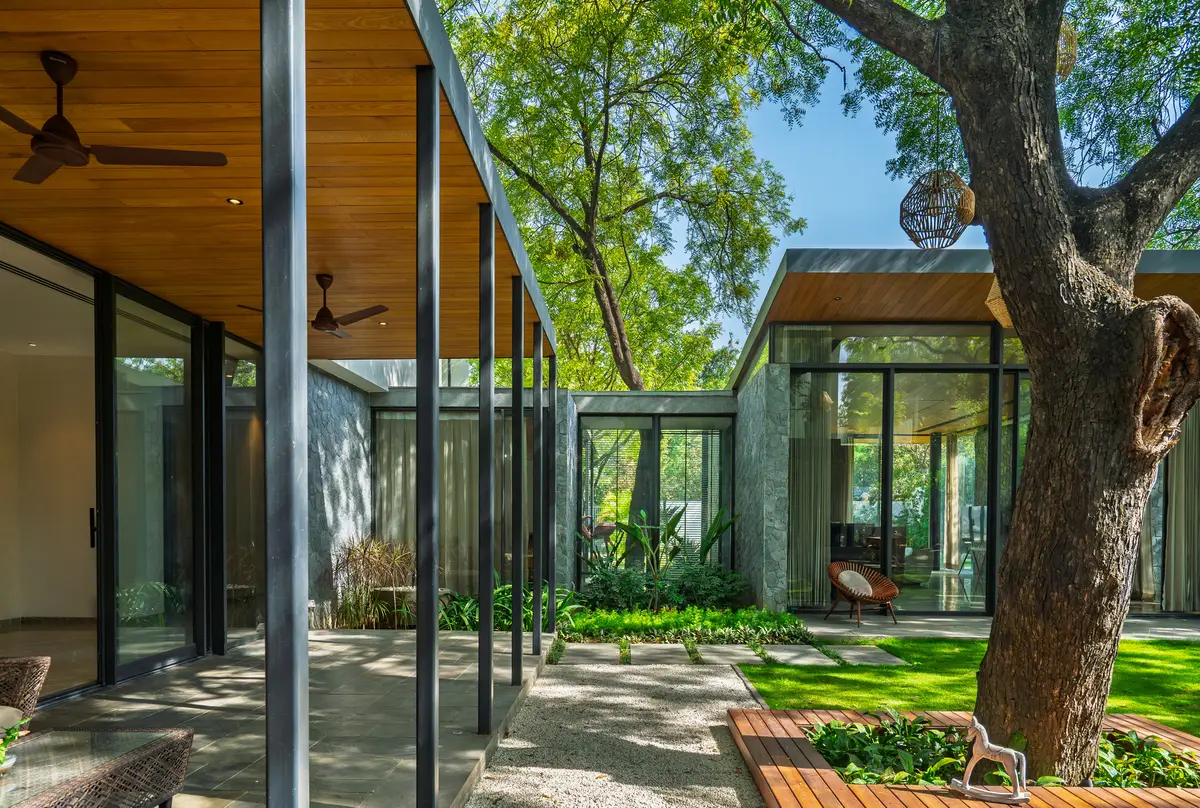
DADA Partners Builds a New Delhi Home Around the Gnarly Trunks of Ancient Neem Trees
On an 1,800-square-yard plot in India's capital, a 9,000-square-foot house defers to its towering trees at every turn.


In a city as dense and relentless as New Delhi, a plot crowded with mature Neem trees is less a building site than a provocation. DADA Partners, led by Mukul Arora, accepted the challenge with the Neem Tree House, a 9,000-square-foot residence for Deepti and Sumit Kapoor that treats its existing canopy not as an obstacle to be managed but as the primary organizing force. Every room, every walkway, every sightline defers to the blackened, deeply textured trunks and the luminous green foliage overhead.
The result is a house that reads less like a single building and more like a loose constellation of glass-walled pavilions anchored by heavy stone bases, all orbiting a central courtyard dominated by a towering Neem. It is a project about negotiation: between interior and exterior, between white stucco and rough stone, between Delhi's punishing climate and the desire to live outdoors. The architecture wins by stepping aside.
A Courtyard That Belongs to the Trees
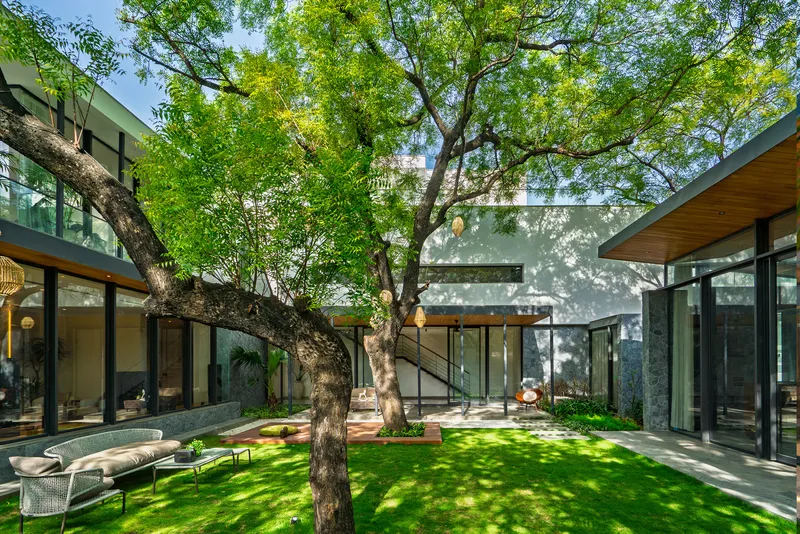
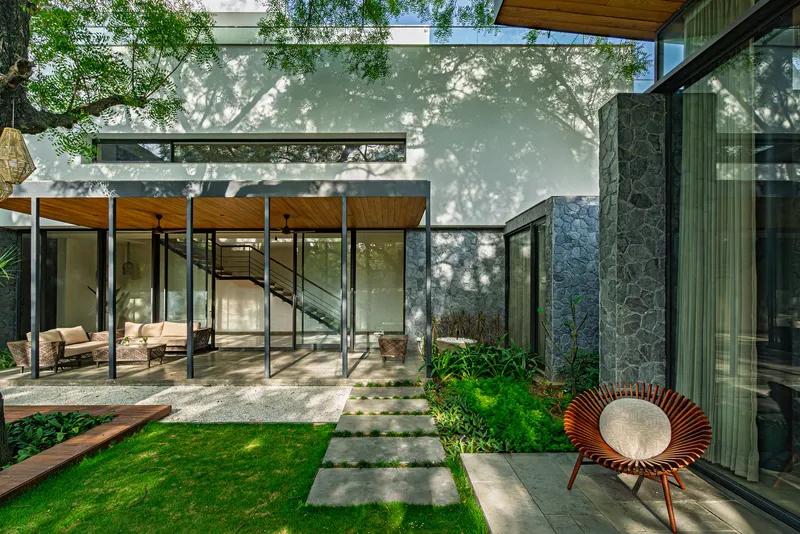
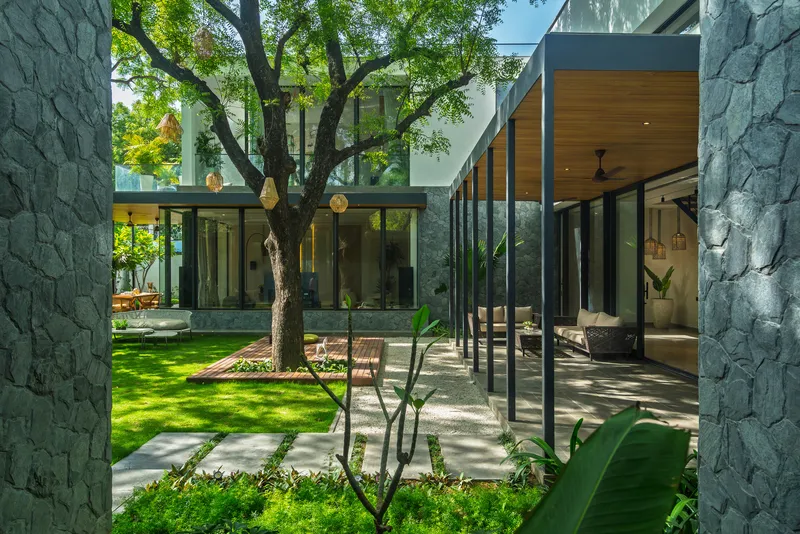
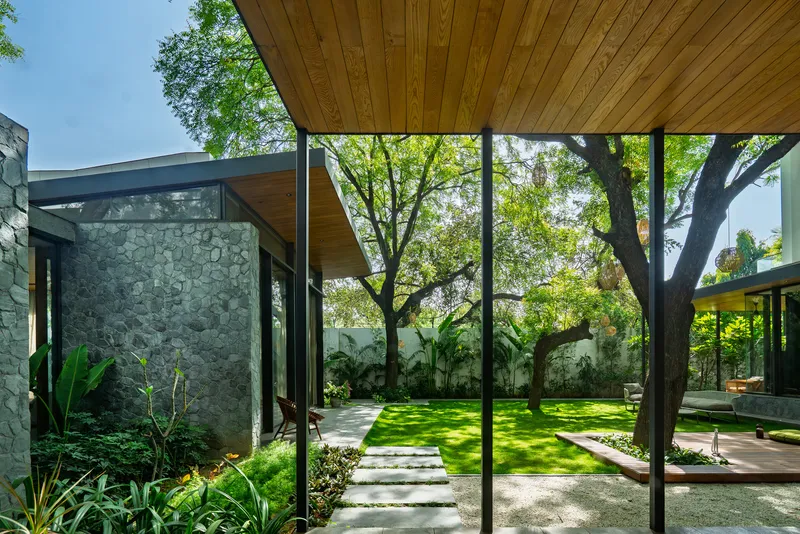
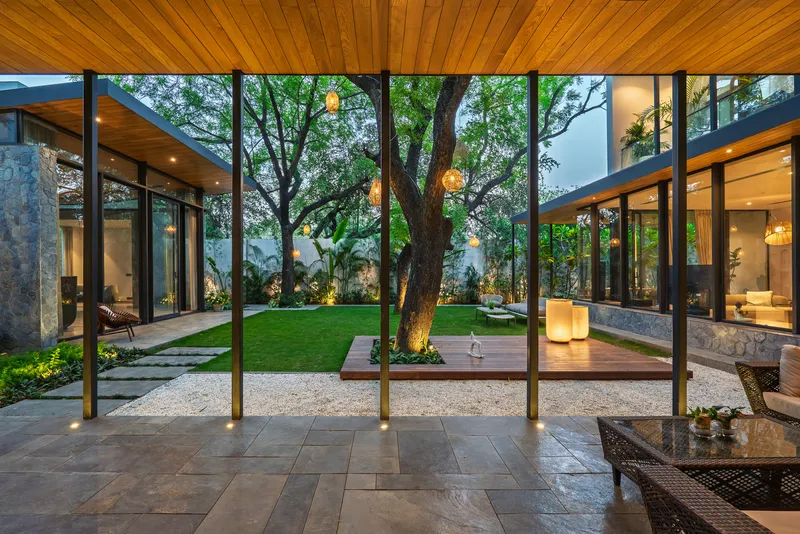
The central courtyard is the social and spiritual heart of the house, but its real occupant is the Neem tree at its center. The lawn spreads outward from the trunk, and the pavilions pull back to the perimeter, connected by glazed walkways and concrete stepping stones. Dappled shadows crawl across white walls throughout the day, producing a constantly shifting pattern that no rendering could predict. The courtyard is not decorative; it is the house's primary room, open to the sky.
What keeps the arrangement from feeling precious is the stone-clad volumes that ground each pavilion. These heavy bases echo the gnarled solidity of the Neem trunks, creating a visual rhyme between nature and construction that feels earned rather than forced. The court is enclosed enough to feel protected but porous enough to breathe, a critical balance in a city where summer temperatures regularly exceed 45°C.
Pergolas, Overhangs, and the Art of Shade
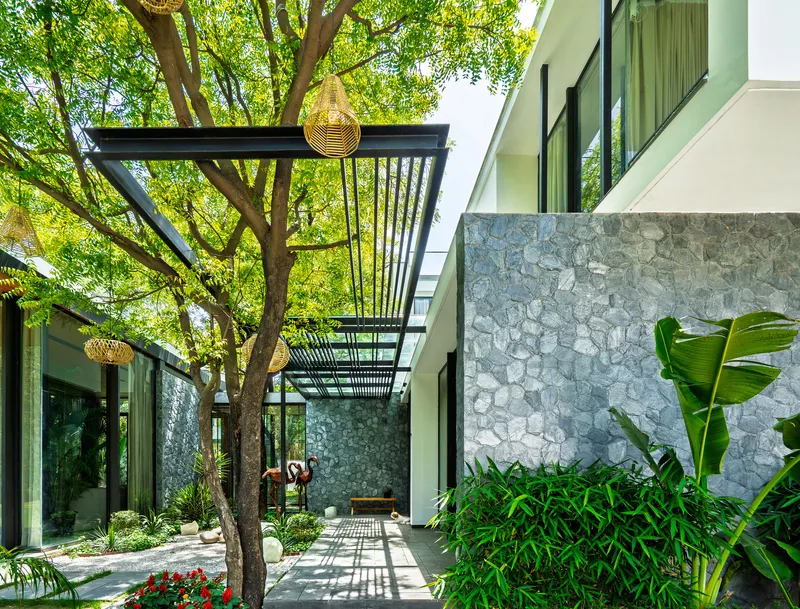
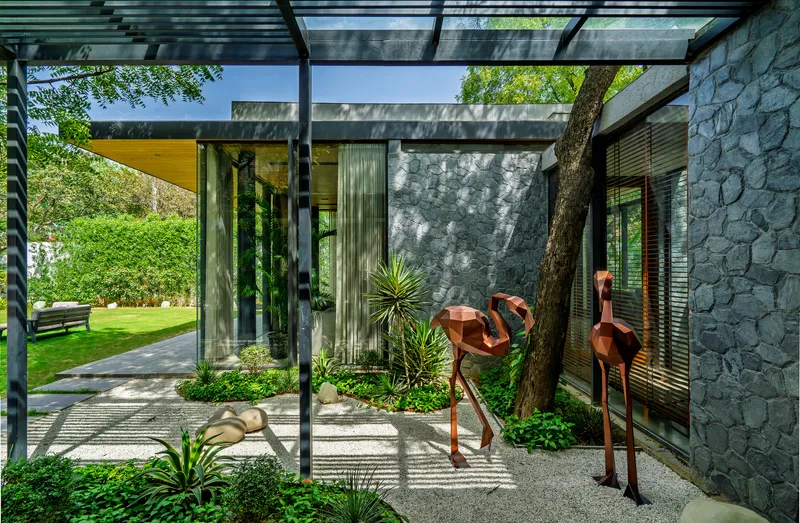
Delhi's climate is not a footnote in this project; it is a co-author. The steel pergolas and deep timber soffits that connect the pavilions serve a straightforward purpose: they make it possible to move through the house without baking. Woven pendant lights hang from the pergola frames, signaling that these passages are rooms in their own right, not mere corridors. A stone wall runs alongside one walkway, its rough face planted with tropical greenery at its base, reinforcing the sense that you are walking through a garden rather than a house.
The overhangs are generous. They shade the floor-to-ceiling glass below, cutting solar gain while preserving the visual connection to the garden. It is passive climate strategy at its most legible: you can see the shade working, feel the temperature drop as you step under a soffit. No elaborate mechanical system needed, just geometry and gravity.
Glass Pavilions as Frames
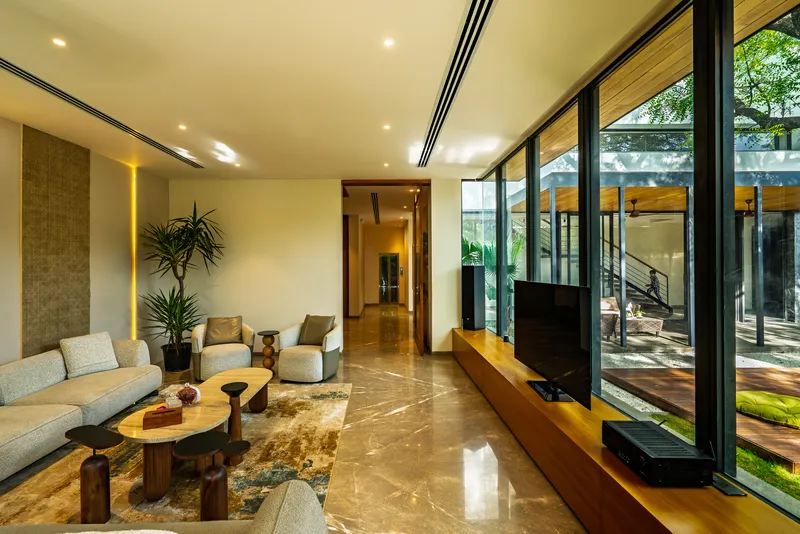
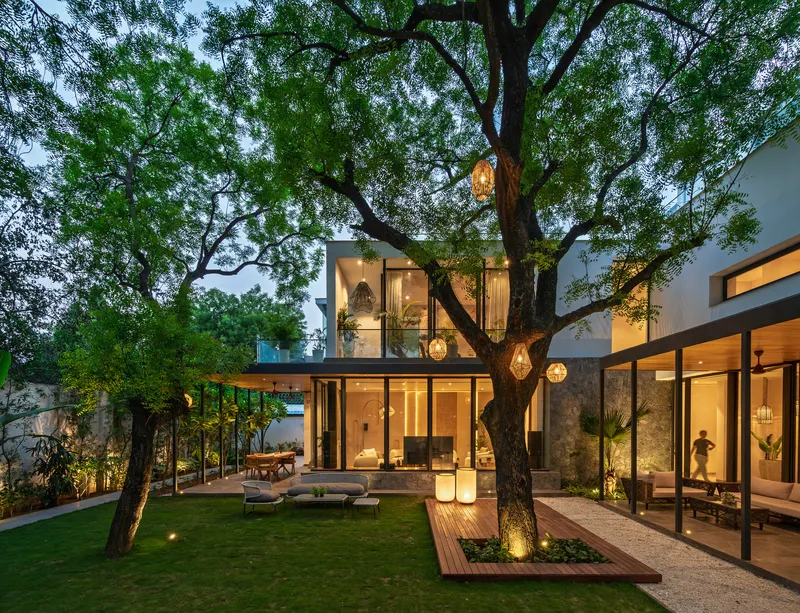
Inside the pavilions, the strategy is consistent: polished stone floors, restrained furnishing, and walls of glass that turn each room into a viewfinder aimed at the trees. The living room is a clear example. Its floor-to-ceiling glazing dissolves the boundary with the garden so thoroughly that the tree canopy becomes the room's visual ceiling. At dusk, the illuminated interiors glow against the darkening foliage, and the house inverts: it becomes a series of lanterns set among the Neem trunks.
The timber-framed glazing visible in the evening views gives the glass walls a human-scaled rhythm. Rather than uninterrupted sheets, the mullions break the garden into a series of vertical panels, almost like a screen. The effect is cinematic: you are always looking through something, and the framing makes you aware of the act of seeing.
Domesticity in the Details
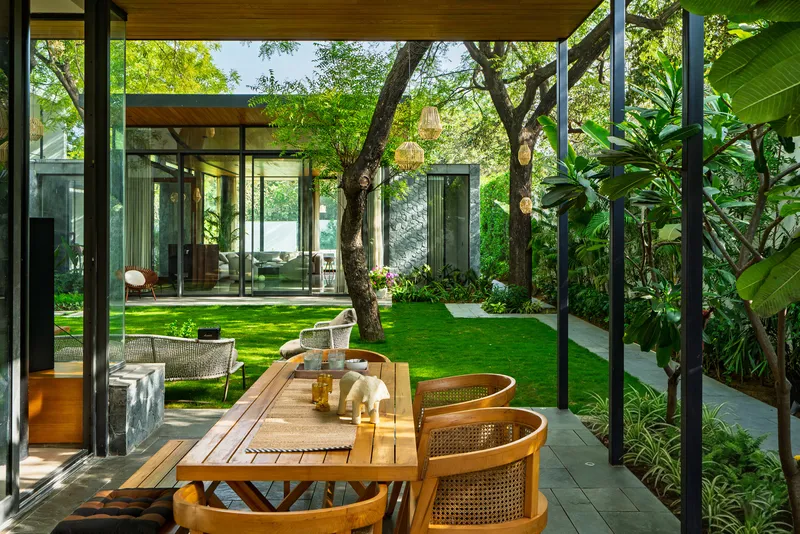
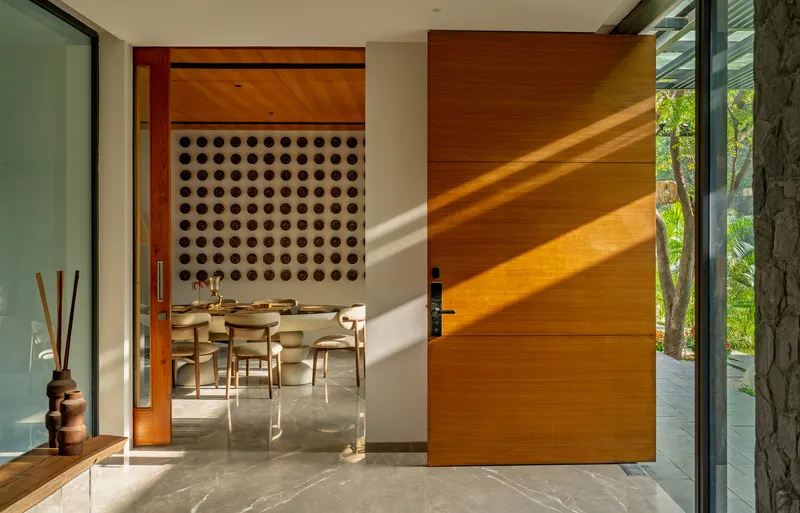
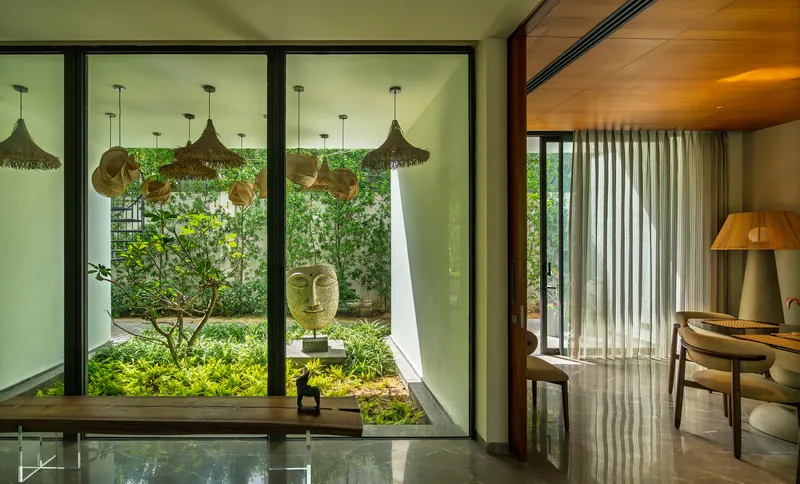
For all its architectural ambition, the Neem Tree House still has to function as a home, and the interiors show that DADA Partners has not lost sight of comfort. A covered terrace with a dining table and woven chairs overlooks the courtyard lawn, offering the kind of casual, half-outdoor meal that is the best thing about living in a warm climate. A timber pivot door catches afternoon light and leads to a dining room punctuated by a perforated wall panel, a small gesture that filters light and adds texture without shouting.
In the bedroom wing, a desk sits against a glass wall that opens onto a vertical garden, with woven pendant lamps suspended above. The vertical garden is not just decorative; it screens the bedroom from direct views while maintaining a green outlook. These details suggest a house that has been thought through room by room, not just diagrammatically.
The Pavilion Ensemble at Dusk
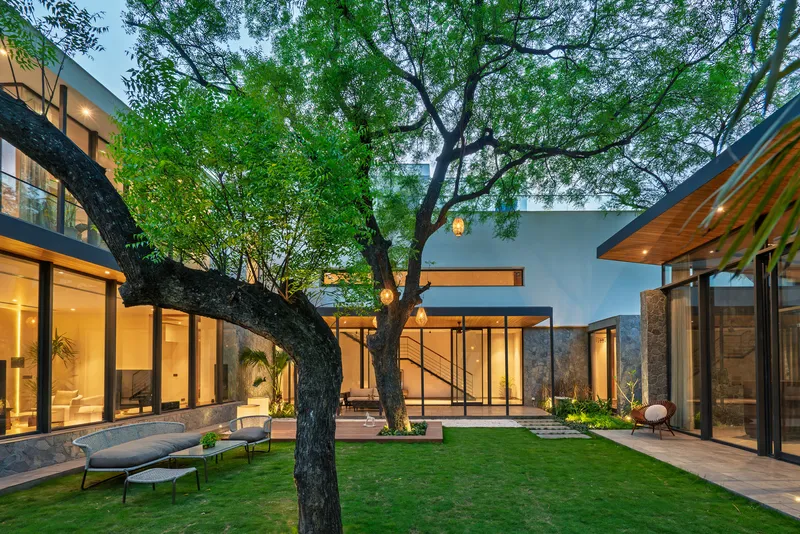
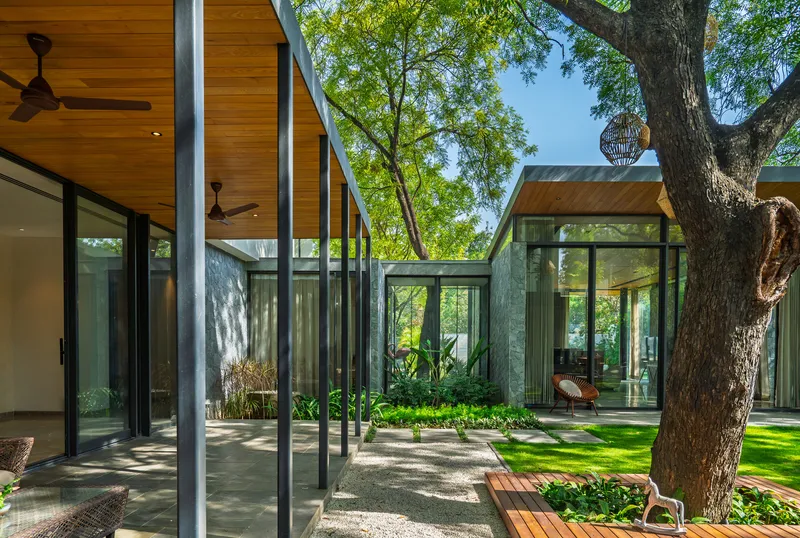
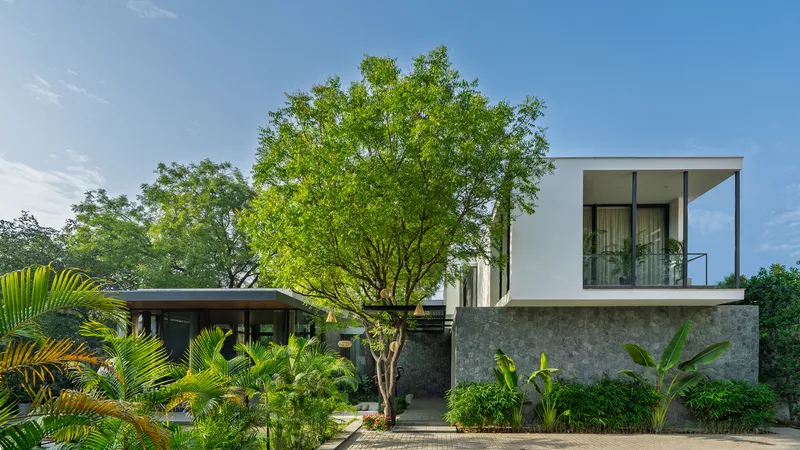
Seen from slightly above or at a distance, the house reveals its organizational logic most clearly. Multiple pavilions with timber soffits are arranged around the central garden, their flat roofs floating just below the tree canopy. The composition is deliberately anti-monumental. No single facade dominates; the house presents itself as a cluster, its scale broken down to fit comfortably beneath the trees. The street view shows a two-storey white volume with a stone base and a mature tree in the front garden, establishing the tonal palette before you even enter.
Under overcast skies or in the golden light of late afternoon, the stone and stucco surfaces shift in character. The stone reads as warm and tactile; the white volumes recede. The trees, always, hold the foreground. It is a hierarchy that the architects clearly intended and that the house faithfully maintains.
Plans and Drawings
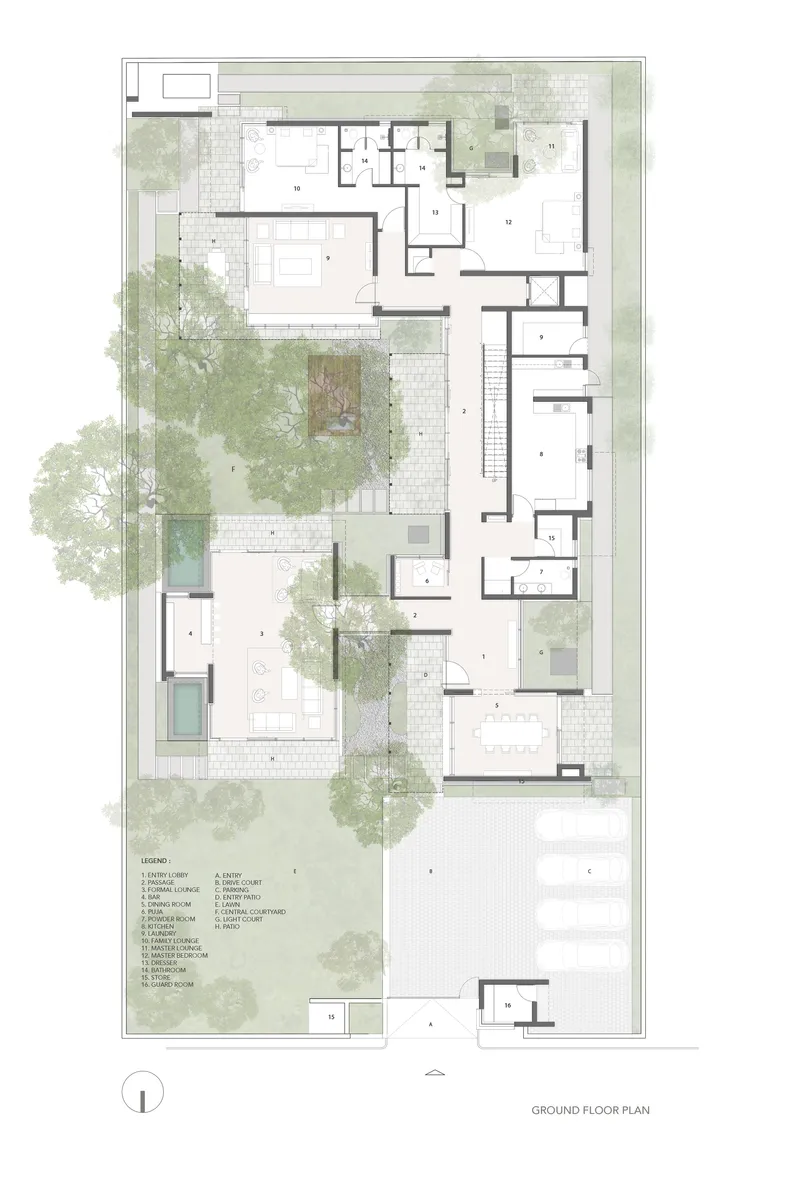
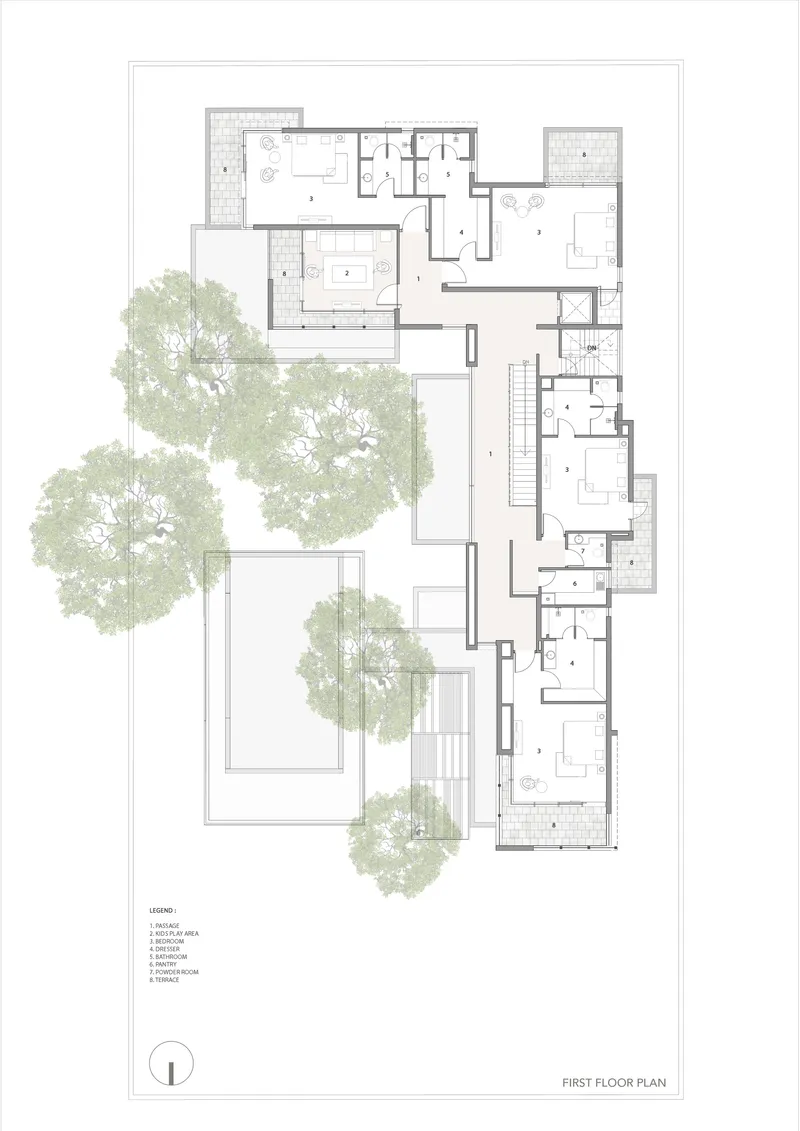
The ground floor plan confirms what the photographs suggest: rooms radiate outward from the central courtyard, wrapping around existing trees rendered in watercolor. The plan is not symmetrical, nor does it try to be. Each pavilion adjusts its footprint and orientation to accommodate a trunk or a root zone, producing an organic irregularity that feels more like a village than a villa. The first floor plan shows the bedroom wings and terraces, with the tree canopies overlaid to demonstrate how the upper level sits within, not above, the green canopy.
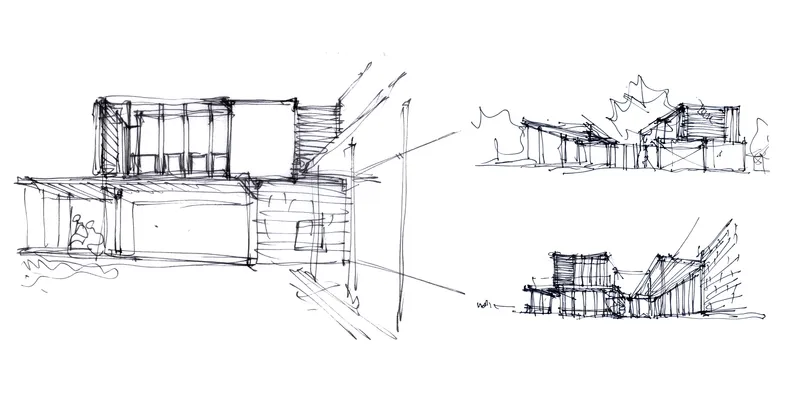
The sketch studies are revealing. Three perspective views show the roof overhangs and pavilion volumes in relation to the surrounding trees, and the proportional logic is clear: every overhang, every setback, every roof edge has been calibrated against the tree line. These are not form-finding exercises; they are exercises in spatial negotiation, working out how much building the site can absorb before the trees lose their primacy.
Why This Project Matters
The Neem Tree House matters because it takes a position that is easy to state and hard to execute: the trees come first. In a city where land values make every square foot precious, the decision to preserve a dense canopy of mature Neems and to design a 9,000-square-foot house around them rather than despite them is both an ecological commitment and a spatial strategy. The result is a house that could not exist anywhere else, shaped by its specific trees, its specific climate, its specific light.
DADA Partners has produced a domestic project that avoids the two most common traps of tree-centric architecture: making the trees feel like exhibits in a museum, or making the house feel like an apology for existing. The Neem Tree House is neither. It is a confident, well-crafted ensemble that knows exactly where it stands in the hierarchy, which is second, behind the trees. That restraint, sustained across every pavilion and walkway and overhang, is what gives the project its authority.
Neem Tree House by DADA Partners (lead architect: Mukul Arora), New Delhi, India. 9,000 sq ft on an 1,800 sq yard plot. Completed 2026. Photography by Ranjan Sharma / Lightzone India.
About the Studio
Share Your Own Work on uni.xyz
If projects like this are the kind of work you want to make, uni.xyz is a place to publish your own, find collaborators, and enter design competitions.


Popular Articles
Popular articles from the community


longwave studio Reorganizes a 112 m² Tainan Apartment Around the Daily Routines of a Family and Two Cats
In Tainan, Taiwan, birch plywood, rust-red furniture and a freestanding plaster wall link arrival, storage, work and family life in one apartment.

GROUP A Strips a 1969 Rotterdam Harbor Headquarters to Its Frame and Wraps It in Timber Louvers
In Rotterdam's M4H harbor district, Ferro Offices reuses a 1969 frame, adds one timber storey and reaches BREEAM-NL Outstanding.

David Ortega Stacks a Two-Story Mexico City Penthouse Around a Steel Stair and a Pergola-Shaded Roof Terrace
In Colonia Roma, a 300 m² penthouse uses oak joinery, a planted steel stair and a slatted roof pergola to make a new-build apartment feel like a house.

LT2A and OPEN Architectes Thread a Brick and Glass High School Through a Wooded Belgian Campus
In Braine-l'Alleud, a 3,000 m² wing for Collège Cardinal Mercier pairs pale brick with a glazed colonnade, deferring to a small chapel and a dense wood.

Similar Reads
You might also enjoy these articles


LAVA Architecten Gives Vocational Education a Sawtooth-Roofed Face on a Mechelen School Campus
In Mechelen, Belgium, a 2,053 m² STEM school on a 6×6 m grid turns workshops and classrooms into rooms that can be rearranged as teaching changes.

KEMA Studio Turns a Derelict Marvila Attic into a 60 m² Lighthouse Apartment Above Lisbon
In Lisbon's Marvila district, a rebuilt roof, four skylights and two plywood volumes turn an unlivable attic into a bright home facing the Tagus.

Pixel Gardens: One Repeated Module Stacked Into a Terraced Social Housing Tower for Famagusta
Salem Bader's shortlisted housing tower builds a vertical neighbourhood from one repeated module, offsetting units to carve terraces, light and air.

Bao Huynh Watercolor Atelier: A Serene Art Retreat in Hội An
Bao Huynh Watercolor Atelier in Hội An blends multifunctional art spaces, sustainable design, local materials, and family-friendly living in a serene environment.

Explore New Delhi Competitions
Discover active competitions in this discipline

Challenge to design a portable theatre

Challenge to design a portable music platform

Challenge to design an open learning module for the elderly

Challenge to design mud housing for contemporary communities
Comments (0)
Please login or sign up to add comments
No comments yet. Be the first to comment!