
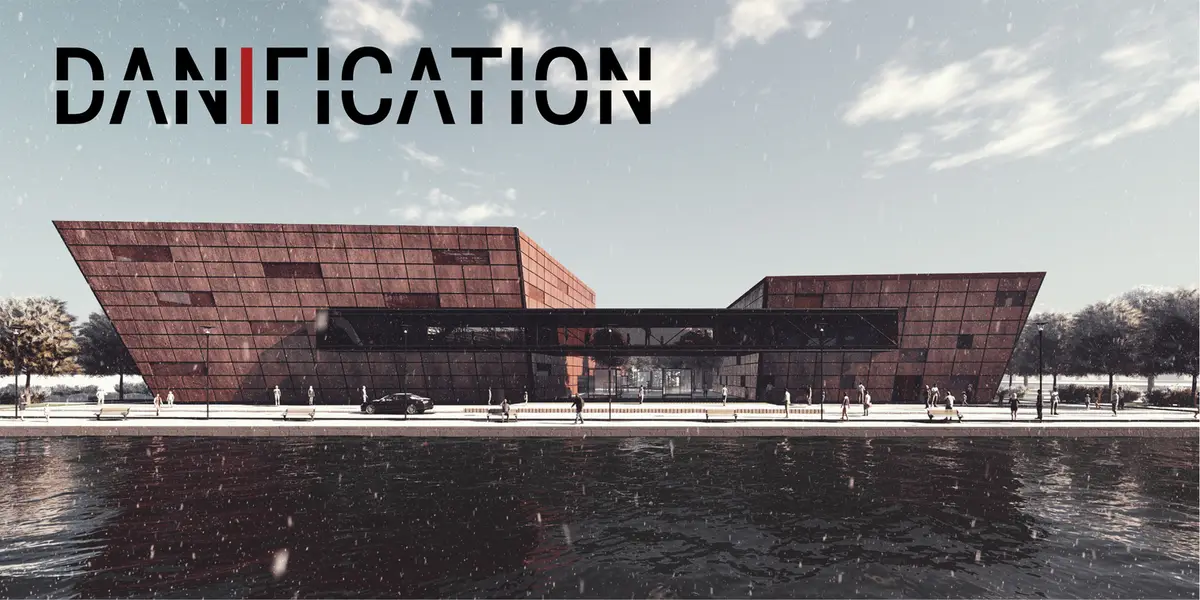
Danification Illustration
Athenaeum to Architecture

Since 9th century Danes had spread into the hinterland of Europe as Vikings, However, the invaders were homogenized after settlements built. The vernacular culture and art influenced Danes, and it merged into the formation of Scandinavian environment. In the following 1000 years, architecture as well as many kinds of imported knowledge added into the growing characteristics of Danish architecture.
But the process of assimilation and redevelopment always lags behind the main stream of world architecture, enabling Denmark to reconsider the influence of prevailing theories, practices and styles. Time gave spaces to test their pragmatism, which continued but also evolved from global mode.
Thus, it is essential to analysis architecture based not only upon buildings, but also on their contexts and eras, and also the influential effects. When Copenhagen (København) was selected as Capital of World Architecture 2023, the architecture of both Denmark and worldwide should be cast new light upon, which includes but also exceeds the material level to further inner. It might be composed of the historic context, function, users, and also urbanism, sustainability and social impact. In our design proposal, theses core features are separately presented by the means of architectural methods, but also united into a single form.
We try to simplify the features into mainly 5 parts, which include Forms, Content, Society, Scale and Nature:
1 Forms emphasize the change of architectural design and practice method, from classic facades to a more varied sections and plans. The main purpose of indicating changes of Forms is to enable visitors what has been changed and what not, and what leaded to the change of design.
2 Content is the possibilities architecture brings, including functions, and activities in or connected with buildings.
3 Society part focuses on the social impacts or benefits of architecture. It includes users, purpose of public built ups, and welfare.
4 Scale had long been ignored in the classic eras but it became significant since the highrises showed up and modernism stepped in. Denmark so far hardly has any skycrapers, the cities looks plain and dense in urban area. What makes strong contrast is the prevailing fashion of building highrises worldwide, from east Asia to North America. The scale part tries to reverse the modern highrise city into a question,challenging the urban cognition of visitors.
5 Nature is some kind of visible but hard to convey. Many consider the Nordic as an area close to Nature - from society to architecture, but Nature is more than just vegetation or green areas. The significance of nature exists in its circumstances, and architecture or city should find a balance between itself and nature.
The themes are clear but still need an integration. From the study of ancient architecture and contemporary ones the prototype initiated from the analysis of spaces. The Positive and Negative Spaces, along with time, changes from Human-Nature (Material) topic to Public-Private (Social) model. By specifying the two contradicts, it turned out to be Private, Interior Public, Semi-Public and Open Public. It’s obvious to recognize Private and open public, but the interior public and semi public has always been changing. The buildings are increasingly complicated therefore the edges and types of spaces become more clear.
From these 4 prototype of spaces, we need to dig out more about what kind of relationship happens among them. Then the content and activities are directly connected to the design purpose - an Athenaeum. Traditional Athenaeum usually has 2 simple type of rooms - Hall (for communication) and Library (for Knowledge). But the complexity of today’s architecture demands more. For current architecture athenaeum, it’s more than teaching from books and teachers, but also by the means of modeling, experiencing through both real and visual ones. An architectural complex is needed for these new kinds of knowledge. It aims to promote public aesthetics of architecture, providing a way to experience, to learn, to leisure and to create ideas.
Henceforth, experiencing through a complete circle gives public a general view of architecture, and deeper into the specified parts, reading and learning is an essential part of absorbing the knowledge from history, and communication also remains as an academic research way. Creation of new is also a new idea for attenders to take part in innovation and design themselves.
Now we relocate these contents into different themes through time. The stoned walls are symbols for inner city’s tracks and footpaths in buildings, and they create interior public spaces and private spaces. We create a factory warehouse using truss and steel columns to respond to the old industrial urban area and new factories built in the east. The heritages from industry is a hard issue on recycling and reuse, and it as an exhibition building exhibits the renovation of this topic. Commercial is always the driving force pushing society forth to evolve, and today the life in the city has everything connected with commerce. We use a commercial (or life) complex including revealing the relationship between architecture and society, and also an exhibition for how people lives with buildings. Looking over at the future (BIG’s sustainable riggers and copenhill), the creation part is a experimental field for tests and new practices facing the future.
Our site is an old shipyard area of Refshaleøen ever since 17th century, when the old dock and Castellet across the water formed an entrance for any ship came into central Copenhagen. Industry also took part in in the following centuries, and now it has been reused as new functions based on old circumstances. From the coast visitors can see the center of the city, and a north redeveloped vacation site. Just like a collage complex, visitors come here a little away from downtown, and quietly reached the center of the building. The opening and leading track from land to coast welcomes both side to imagine the new blueprint of this area. Looking back or around, the industry remains, parks and waters, old town and new skylines, are all kinds of scenery and memories.


Popular Articles
Popular articles from the community


The Amber Palace Opera: A Geological Fiction Surfaces on Tallinn's Baltic Waterfront
Pierre Brillard reimagines a Baltic legend as a public landscape, opera house, and waterfront promenade rooted in Tallinn's coastal identity.


LT2A and OPEN Architectes Thread a Brick and Glass High School Through a Wooded Belgian Campus
In Braine-l'Alleud, a 3,000 m² wing for Collège Cardinal Mercier pairs pale brick with a glazed colonnade, deferring to a small chapel and a dense wood.

Singing Woman: An Opera House That Performs Before the Curtain Rises
Ovidiu Cristian Pavel's conceptual opera house translates Estonia's choral identity into a sculpted waterfront landmark facing the Baltic Sea.

David Ortega Stacks a Two-Story Mexico City Penthouse Around a Steel Stair and a Pergola-Shaded Roof Terrace
In Colonia Roma, a 300 m² penthouse uses oak joinery, a planted steel stair and a slatted roof pergola to make a new-build apartment feel like a house.

Similar Reads
You might also enjoy these articles

Vereda Arquitetos Renovates a 40-Square-Meter Apartment Inside Niemeyer's Copan Building
A compact unit in São Paulo's most iconic residential tower gets a material overhaul that pairs exposed concrete with bold blue Formica.

Shakur's House: Exposed Brick as an Interior Organiser in a 168 m² Mashhad Residence
Brick moves indoors in this Mashhad residence, where masonry walls, glass partitions and teal planes sequence a compact home without closing it off.

Day and Night Park: A Time-Based Urban Newsstand in Beijing
A temporary urban newsstand in Beijing blending travel, light, and reading through poetic colors, compact form, and community-focused design.

Modernist Patio Renovation in El Masnou, Barcelona by Oliver Segura Arquitectura + Cebrià Arquitectura
Modernist patio renovation blending tradition and innovation with a movable pool, leveled floors, and Catalan materials in El Masnou.

Comments (0)
Please login or sign up to add comments
No comments yet. Be the first to comment!