
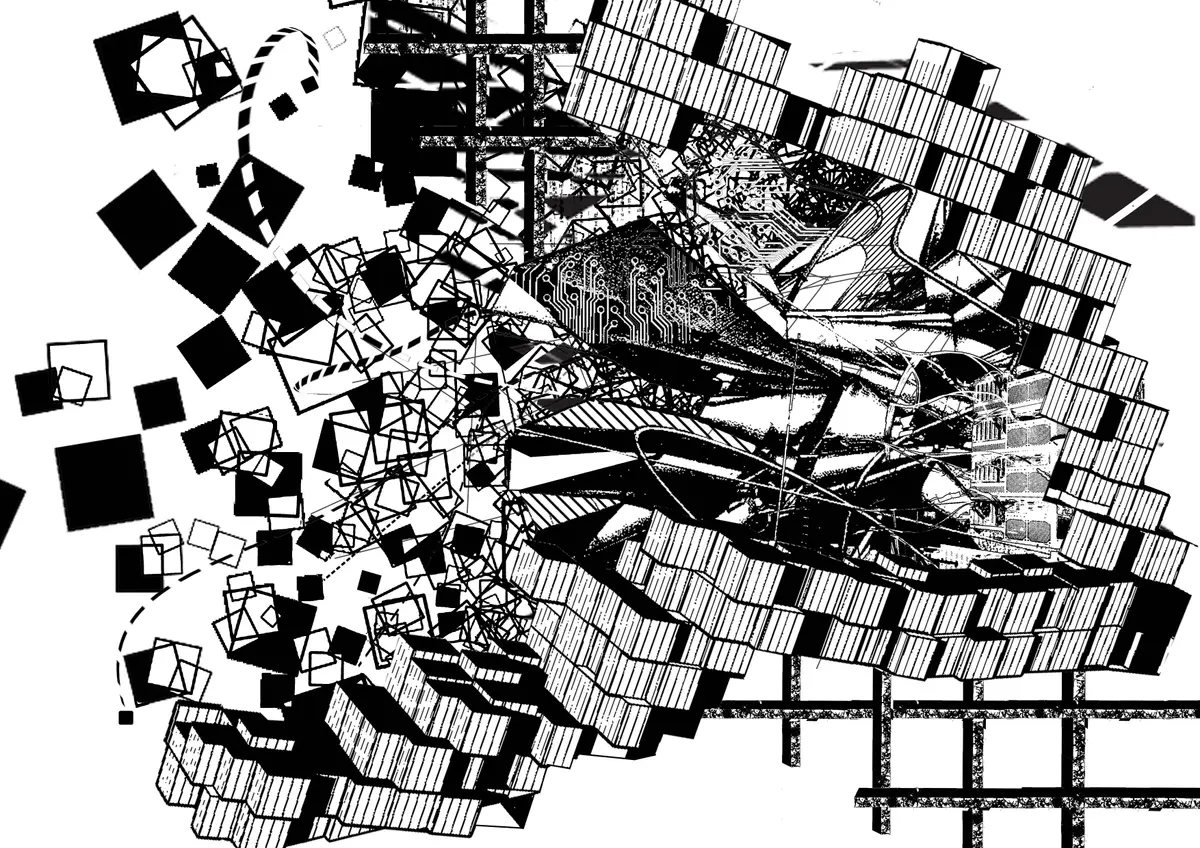
DATA DIFFUSION
The journal discusses how data centres can become more environmentally friendly towards the earth as time progresses.

With the rise of technology becoming an essential in
in society, the requirement for data storage is becoming more
necessary. As the contemporary world revolves around a significant
growth in demand for cloud services and the popularity of
mobile devices, the number of data centres and energy
utilised by data centres are continually increasing.
The common stereotype of data centres being oppressive
and separated from cities and towns, Data diffusion is a data
a centre which focuses on ‘living with data’. The Idea speculates
a new typology of a hybrid building between a data centre and a
youth living space.
Data diffusion looks at conventional data centre issues tackling
through the use of technology in order to make the hybrid
building sustainable for living use. The ideology behind
the building is based on the ‘data core’ powers the building
through the diffusion of pixels(data and living spaces).
Data centres are known to be kept away from cities but the idea
acknowledges and implements data into the design as this is the
future approach for data spread of data over a wide area or between a large number
of people.
As time goes on technology will advance and this is an opportunity to combine data with architecture not only to serve its purpose but also to help avoid issues that it causes towards the earth utilising elements such as water and sky.

Popular Articles
Popular articles from the community


LT2A and OPEN Architectes Thread a Brick and Glass High School Through a Wooded Belgian Campus
In Braine-l'Alleud, a 3,000 m² wing for Collège Cardinal Mercier pairs pale brick with a glazed colonnade, deferring to a small chapel and a dense wood.

U.GA Architects Wraps an Oval Rooftop Pool in Curved Board-Formed Concrete on Busan's Jeollidan-gil
In Busan's Jeonpo-dong, a 454 m² mixed-use block stacks a neighborhood facility, guest rooms and an oval rooftop pool inside spiraling concrete walls.

Cube Design Draws an Ecological Corridor Between Two Shenzhen Hills with the Nankai Building
Beside Shenzhen's container docks, the Nankai Building pairs stacked balconies with a climbing green screen to connect two hillsides across its height.

longwave studio Reorganizes a 112 m² Tainan Apartment Around the Daily Routines of a Family and Two Cats
In Tainan, Taiwan, birch plywood, rust-red furniture and a freestanding plaster wall link arrival, storage, work and family life in one apartment.

Similar Reads
You might also enjoy these articles

Yenisei Monitoring Center: A Sun-and-Moon Sphere Anchors a Research Campus on Siberia's Great River
In Krasnoyarsk, shifting square blocks, a glazed central sphere and descending window rhythms turn river science into a public spectacle on the Yenisei.
Andretta Artist's Village: A Node-Based Masterplan That Lets the Hills Write the Plan
A cultural landscape strategy for Palampur's artist colony threads studios, residences and stages along a porous spine shaped by the Dhauladhar terrain.
Street Children Rehabilitation Center: A Brick Campus That Eases Children From Street to Safety
A low-rise courtyard campus where learning streets, uthans and shaded verandahs stage a gradual passage from street into protective, family-scale life.

The NEON Culture: A Field of Pavilions Built for the 24-Hour City
Smaran Alva spreads galleries, stages, clubs and markets across a varied site, treating light, sound and ramped movement as the real building materials.

Comments (0)
Please login or sign up to add comments
No comments yet. Be the first to comment!