

David Chipperfield to Design Santa Giulia's New Arena in Milan.
Renowned Architect Chosen to Create State-of-the-Art Entertainment Venue for Milan's Santa Giulia District


Italian architecture and engineering firm ARUP, in collaboration with David Chipperfield Architects, has begun work on a new Arena in Santa Giulia, southeast Milan, for CTS Eventim. The arena is set to cater to sports and cultural events, with a capacity of up to 16,000 spectators. It is scheduled to open in 2025, in time for the Winter Olympic Games scheduled for early 2026. Outside of event hours, the ample outdoor areas will provide an opportunity for social interaction for people from the neighbourhood and the wider city.
The new arena is the focal point of the Milan Santa Giulia urban district, which is currently under redevelopment. Located just a few kilometres from the city centre, the area is connected to the high-speed train network and motorway. The new district, designed by Foster + Partners, encompasses residential buildings, structures for education, commerce and leisure, and an extensive park.
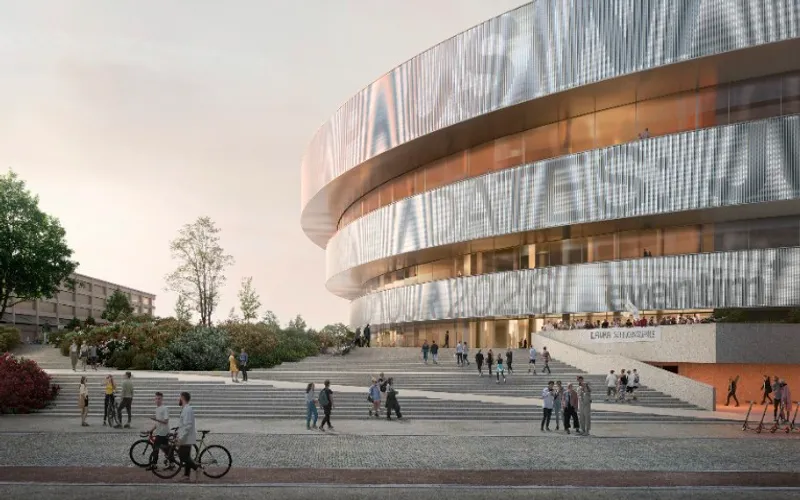 Visualisation © Onirism Studio
The arena is positioned in the southernmost part of the rectangular site. This strategic location creates a spacious piazza of over 10,000 square metres in the northern section of the site, which can also be used as an outdoor event venue. The building's elliptical form is inspired by the amphitheatre archetype, reinterpreted with modern tectonics and materials. The arena is slightly rotated from the north-south axis, welcoming arriving guests from the west. It is supported by a raised podium that occupies almost the entire site and opens up to visitors via a wide flight of steps and an entrance cut into the podium at street level.
The arena is designed as three rings of varying heights, which appear to float on top of each other. The metallic materiality is characterised by the shimmering aluminium tubes during the day and the LED strips of the large-scale media integration that lights up at night. The rings are connected by light, transparent glass bands in the spaces in between, as well as with the floor. Towards the piazza, the rings project irregularly, giving the building its dynamic form. The podium and arena's hard materiality are balanced by organically designed green spaces with trees that extend down the staircase, reminiscent of a green hilly landscape.
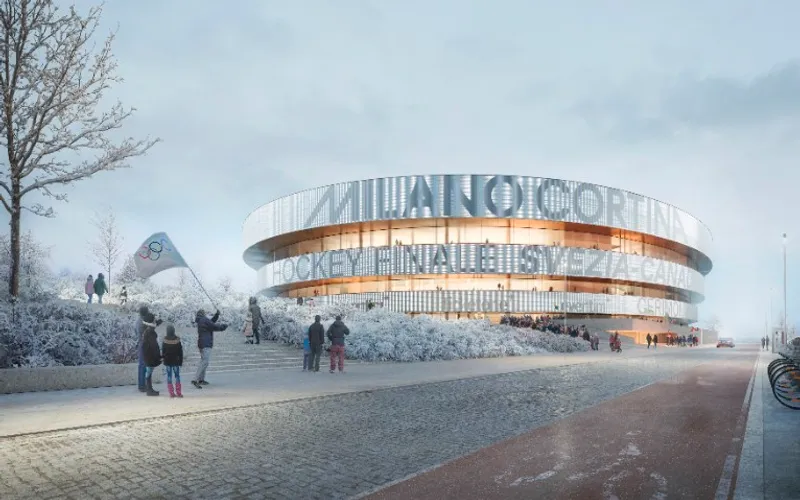 Visualisation © Onirism Studio
The arena's interior features two tiers above the parterre level, as well as a level with lounges and sky boxes. All seats are accessible via spacious lobbies at all levels, as are catering and service facilities. The necessary car parking spaces are located within the podium and a multi-storey car park evolves from the podium, closing off the site to the north. To reduce resource consumption and CO2 emissions, the sustainability concept includes photovoltaic systems on the roof, whose energy generated on-site largely covers the needs of the energy-efficient building.
 Visualisation © Onirism Studio
The arena's location in the Santa Giulia district provides a new focal point for residents and visitors, with an opportunity for social interaction and cultural experiences beyond sports events. The area's excellent transport links and connectivity to the city centre make it a prime location for the arena, as well as the wider district's redevelopment, which will enhance Milan's already thriving urban environment.
The collaboration between ARUP and David Chipperfield Architects ensures a building that not only meets the technical and functional requirements of a modern arena but also adds a new dynamic to the city's architectural landscape.
Press Release_ Courtesy of © David Chipperfield
Visualisation © Onirism Studio

Popular Articles
Popular articles from the community


Opera on the Sea: Driftwood Logic Shapes a Timber Opera House on Estonia's Coast
Trevor Orgill's opera house translates the entangled drift of floating timber into a civic building where wood, water, and music converge.
Tsunami Convergenics: Turning Catastrophic Ocean Forces into Underwater Housing Infrastructure
A speculative underwater settlement off the coast of Onagawa, Japan, treats tsunamis and typhoons as energy sources rather than threats.

Singing Woman: An Opera House That Performs Before the Curtain Rises
Ovidiu Cristian Pavel's conceptual opera house translates Estonia's choral identity into a sculpted waterfront landmark facing the Baltic Sea.
Cloaked Colonization: A Mobile Underwater Habitat That Moves Like a Fish
Micah Abaya's shortlisted EHC Pacific entry reimagines ocean settlement as a dispersed network of self-sustaining architectural organisms.

Similar Reads
You might also enjoy these articles
116 Rokeby Building, Collingwood
Sustainable Collingwood office building featuring double-skin façade, natural ventilation, rooftop amenities, and carbon-neutral design focused on wellbeing and longevity.
Contemporary Apartment Renovation in Spain: RV House by BIAN Opens Up to the Sea
A minimalist 1930s apartment in Santander is transformed into a flexible, sea-facing home through contemporary Spanish renovation.
3 Marías House: A Contemporary Mediterranean Courtyard Retreat by Bajet Giramé + Burckhardt
Mediterranean courtyard home blending traditional architecture with modern design, terracotta flooring, flexible interiors, sustainable climate strategies, and garden integration.
NZ10 Apartment by auba studio: Adaptive Reuse in Palma de Mallorca
Adaptive reuse apartment transforms bakery into light-filled home with patios, privacy layers, and wood interiors enhancing urban living experience.

Explore Architecture Competitions
Discover active competitions in this discipline


Challenge to reimagine the Iron Throne

Photograph architecture without architects

Illustrate the lost glory of Angkor Wat - Render Challenge

Design challenge to reuse E-waste
Comments (0)
Please login or sign up to add comments
No comments yet. Be the first to comment!