
deltastudio Wraps an Italian Warehouse in Curtains and Pink Light for Bottega Bruzziches
A 1,600-square-meter former warehouse on the edge of Viterbo becomes a seamless craft headquarters where design and production share one continuous floor.

Italian fashion has long depended on a decentralized network of home workshops, especially in the Tuscia region around Viterbo, where knitwear and leatherwork traditions run deep. When Benedetta Bruzziches outgrew the garage that served as the brand's first studio, the search for a proper headquarters led to a nearly 2,000-square-meter industrial warehouse on the city's rural fringe, between tufa outcrops and hazelnut groves. deltastudio was tasked with converting this anonymous shell into a space that could house every stage of production, from raw material storage to cutting, sewing, assembly, and presentation, under one roof.
What makes the project worth studying is a simple but radical decision: eliminate the boundaries between design and making. There are no corridors sequestering the style office from the sewing tables, no loading docks walled off from the showroom. A continuous resin floor runs from reception to workshop without a single threshold. The architecture uses translucent glass, fabric curtains, and lacquered wood service blocks to modulate privacy without ever severing the visual and spatial connection between one activity and the next. The result is 1,600 square meters that read as one room with many moods.
A Metal Frame That Divides Without Separating
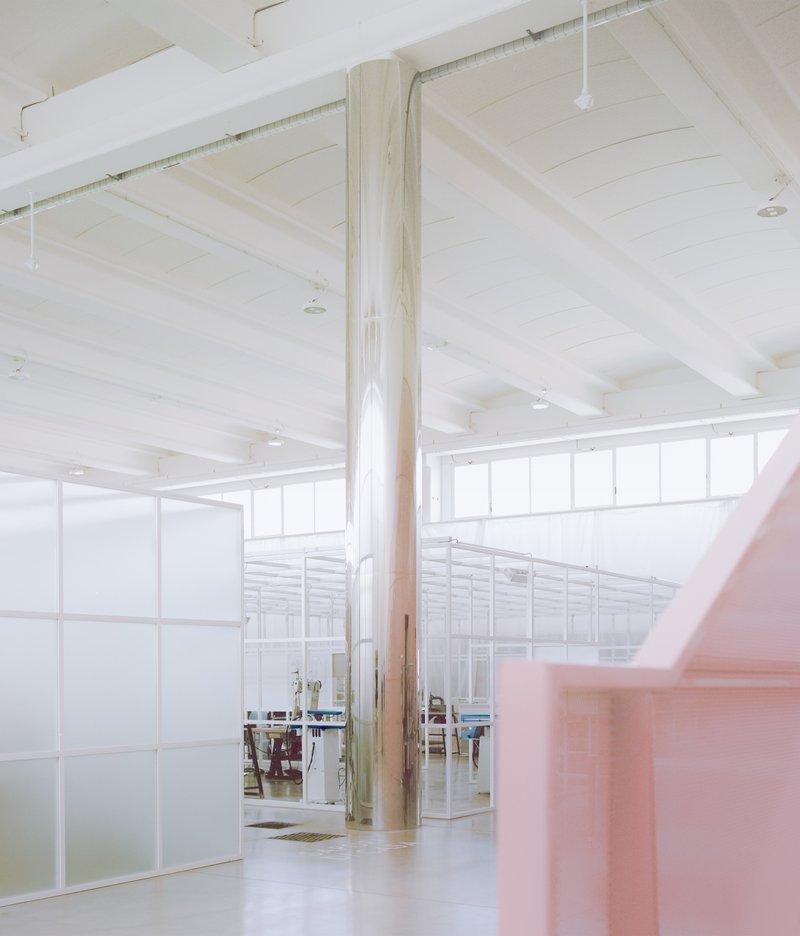
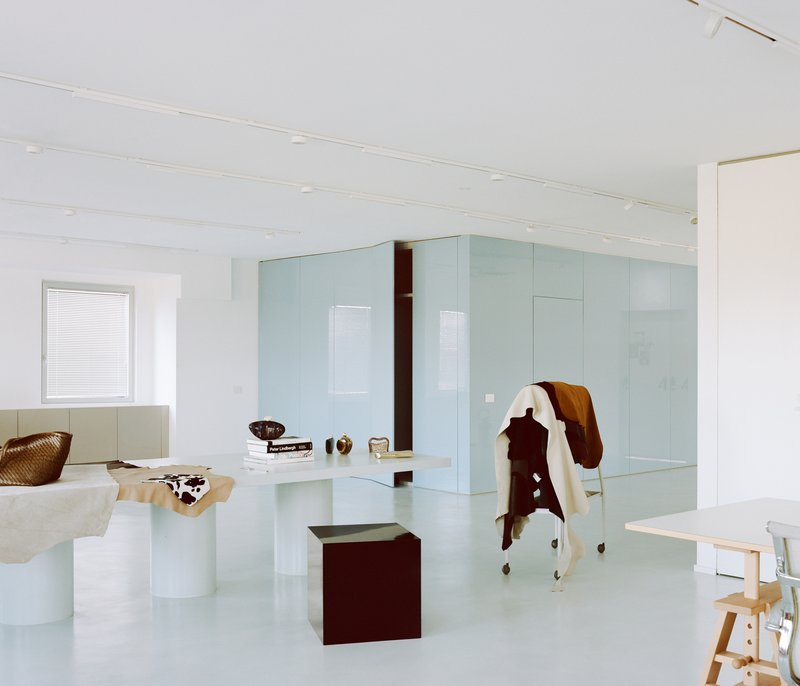
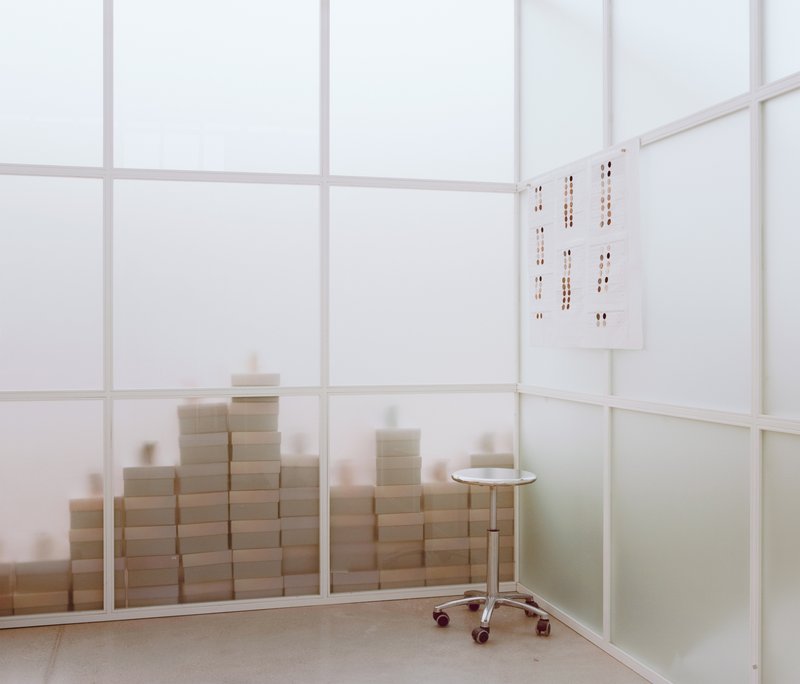
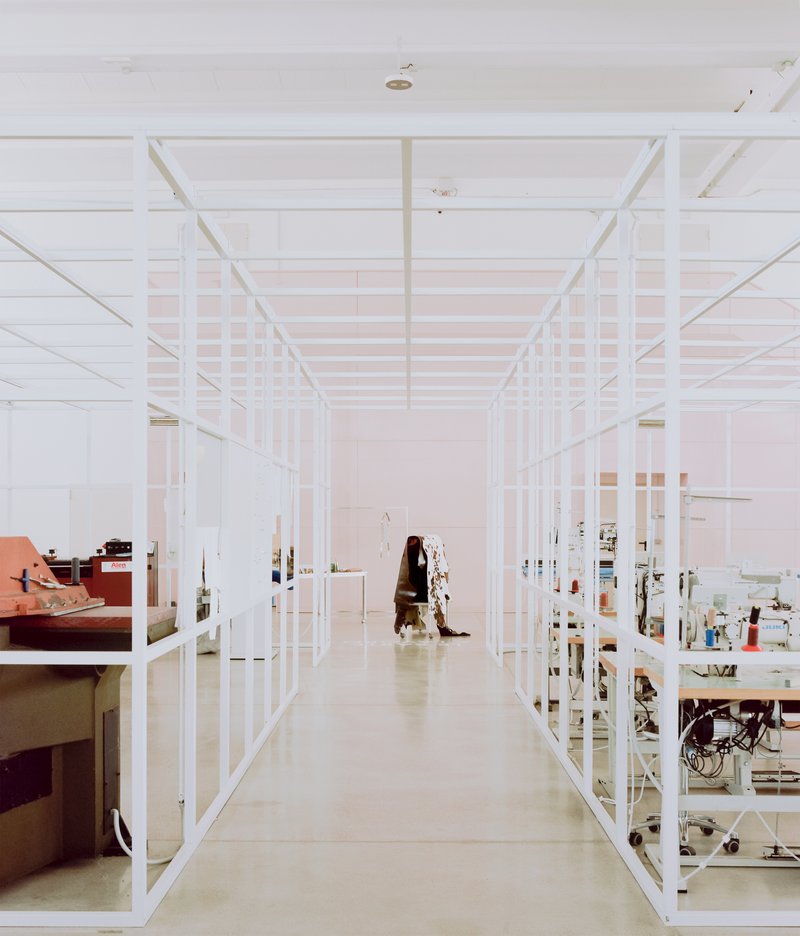
The primary organizational device is a metal structure that threads through the plan, defining zones while remaining visually permeable. Steel and iron columns mark rhythmic intervals, and between them, panels of opaline glass filter daylight rather than blocking it. The effect is closer to a scrim than a wall: you see silhouettes, color, and movement on the other side, but the acoustic and spatial separation is real enough to let focused work happen.
deltastudio made a deliberate choice to keep all technical installations concealed within this framework. No ductwork drops from the ceiling, no conduit snakes along the exposed timber beams. Function and display coexist inside the architecture itself, leaving the white-washed ceiling structure completely legible. The translucent partitions become furniture as much as architecture, stacking boxes and cowhide samples visible through frosted panes as if the building were a vitrine for its own process.
Pink as a Structural Color
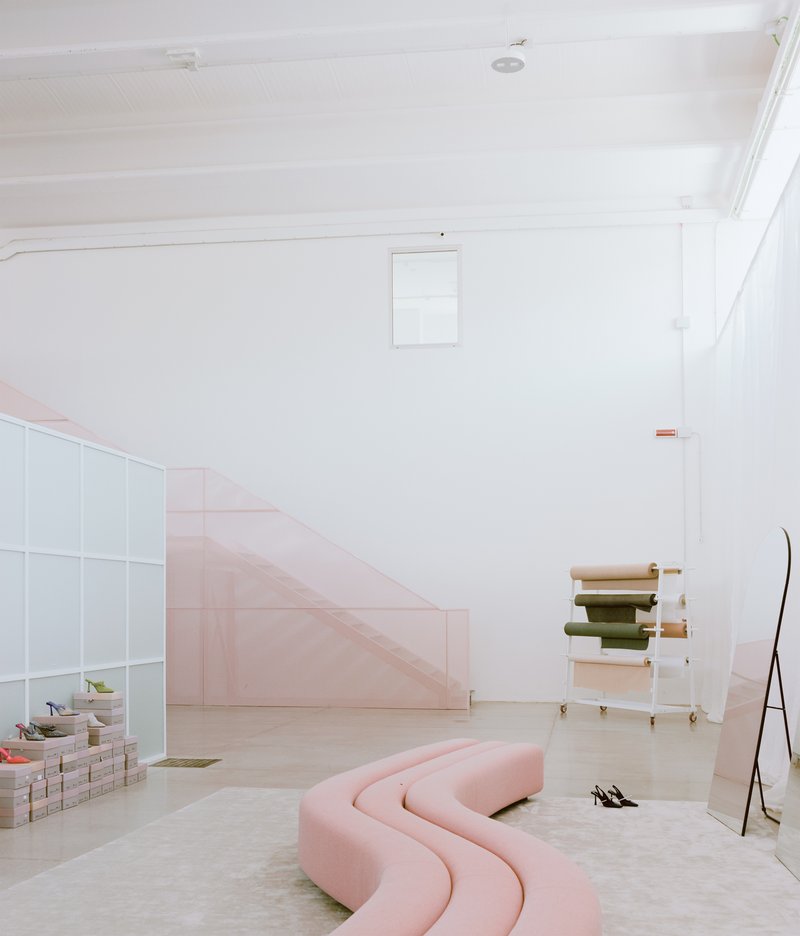
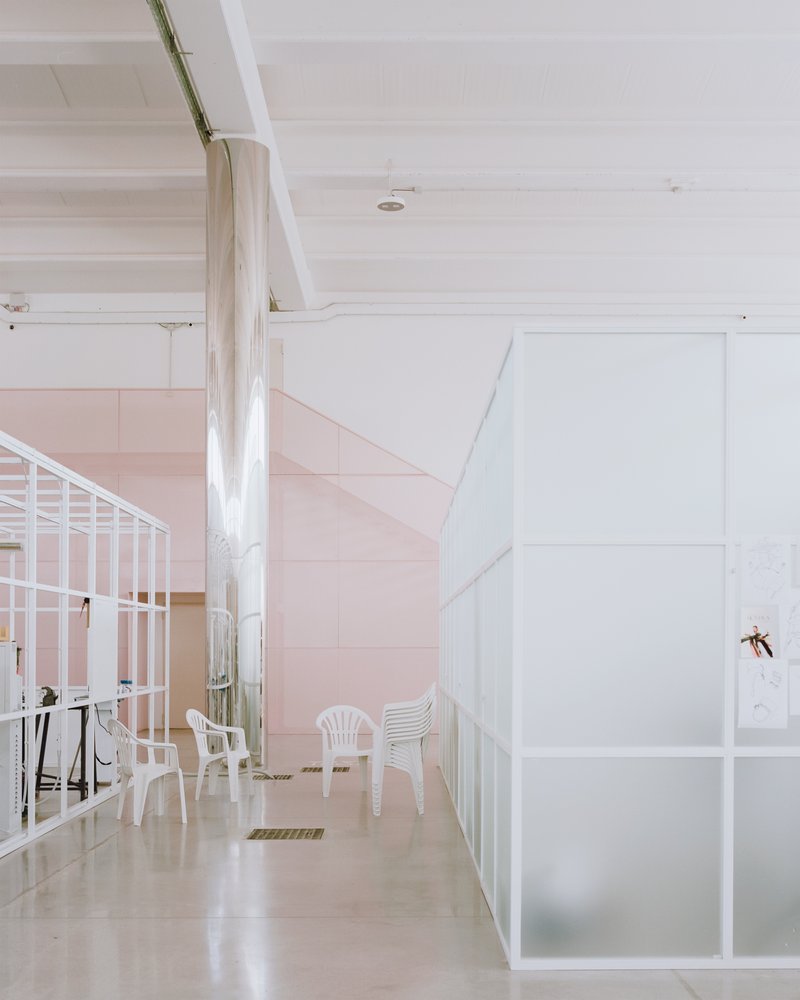
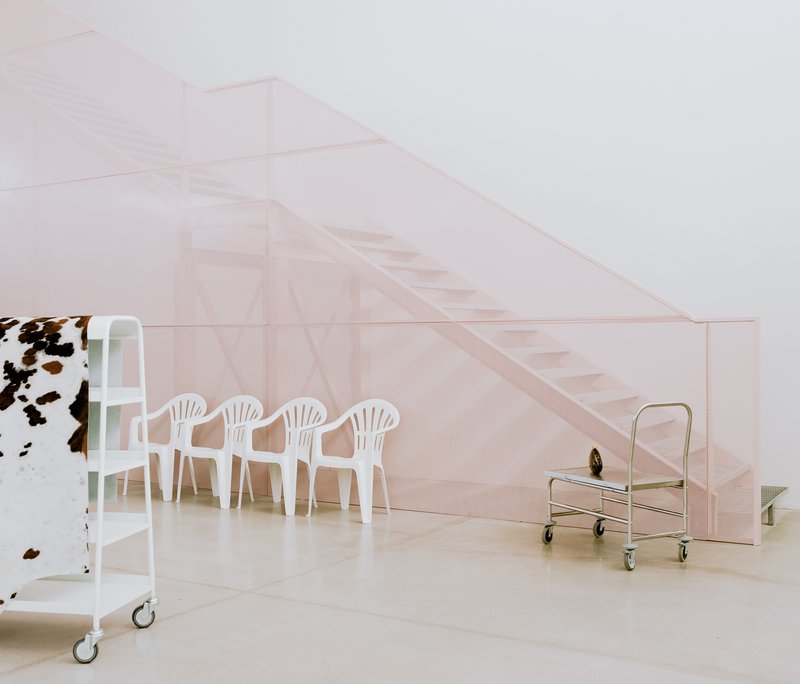
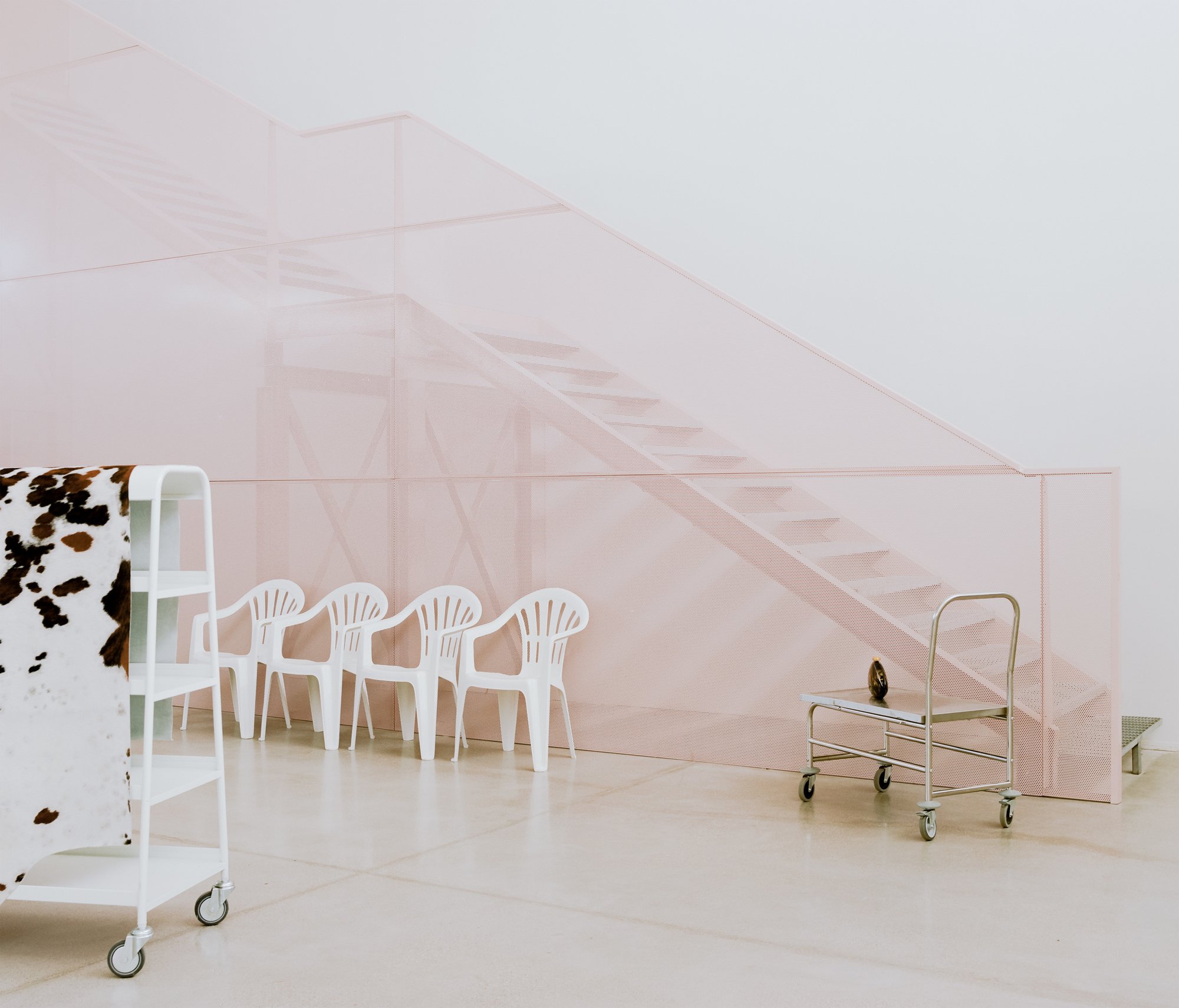
Color in workspace architecture usually stops at an accent wall. Here, pink operates at a structural scale. A perforated metal staircase in a blush tone connects the two levels of the administrative block, its perforations allowing natural light to cascade vertically through the section. Translucent pink enclosures wrap meeting and display areas, staining the light inside with a warm glow that is unmistakably branded without being garish.
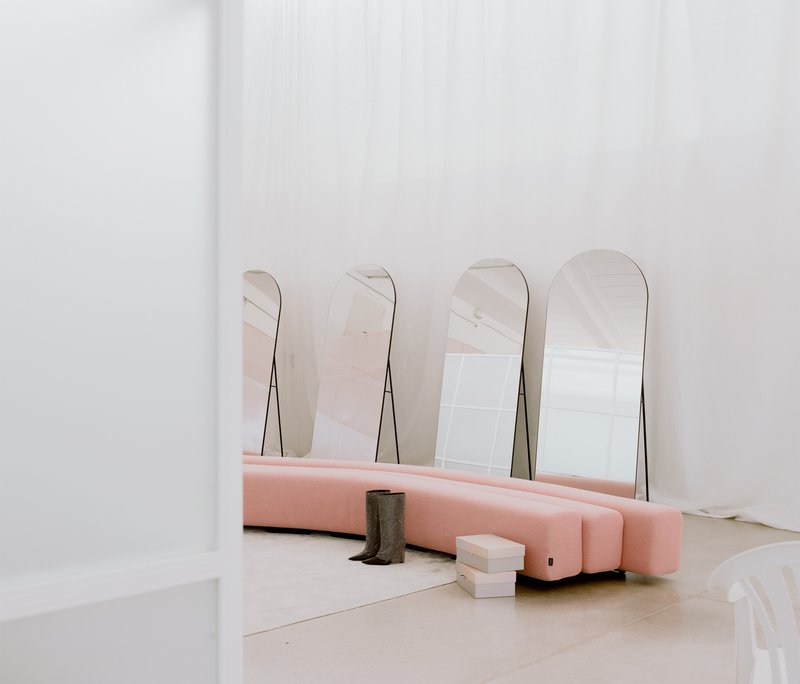
The palette never tips into sweetness because it is grounded by raw materials: polished concrete, timber columns, resin flooring that reads almost industrial. That tension, between the softness of the brand's aesthetic and the honesty of a working warehouse, is what keeps the interiors credible. The curved pink seating base in the reception area, paired with leaning arched mirrors, reads as an installation rather than decoration.
The Curtain as Architectural Element
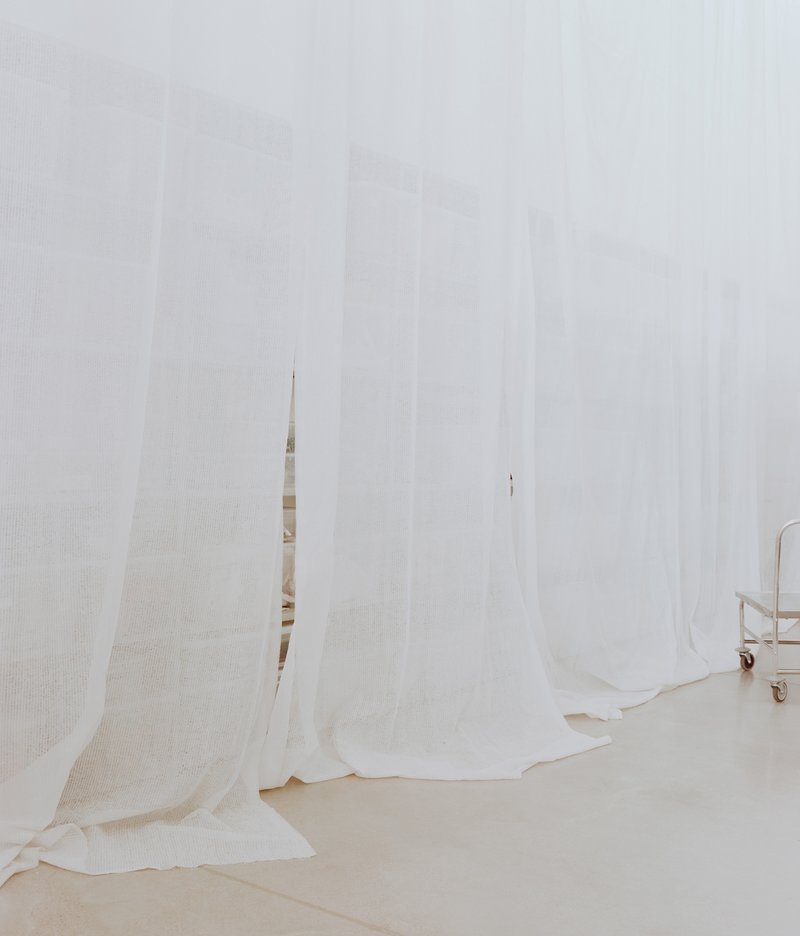
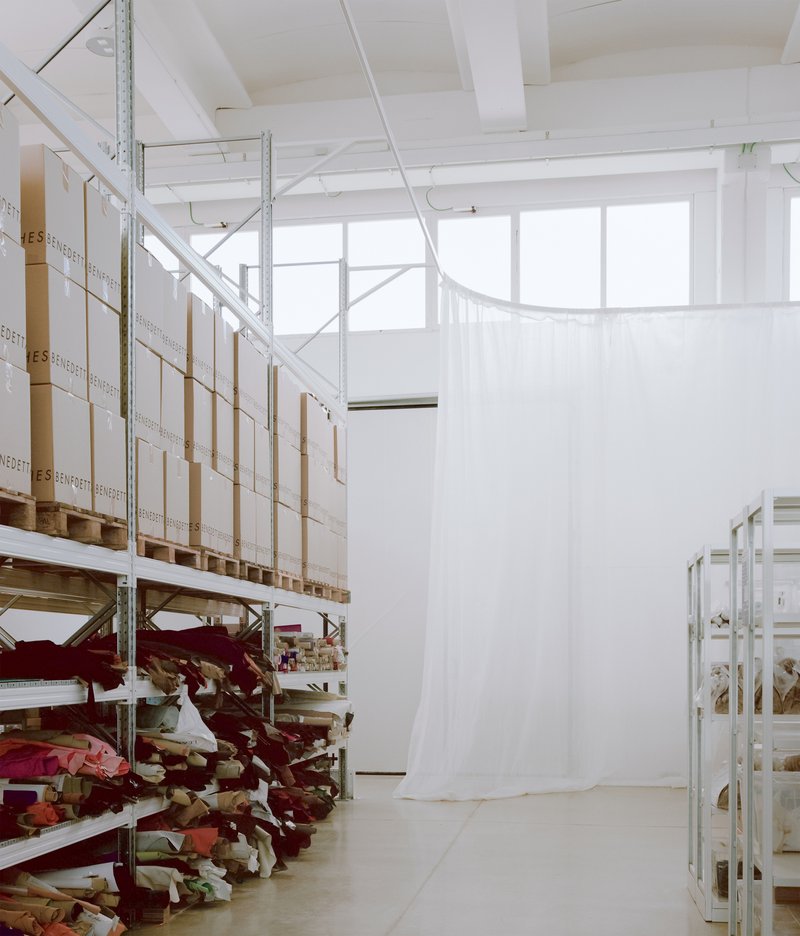
A single large curtain envelops the entire production block, and it may be the most consequential design move in the project. Hung from floor to ceiling in soft white mesh folds, the curtain conceals storage shelving and raw material racks while giving the double-height workshop the flexibility to transform for collection presentations and gatherings. Pull the fabric back and you see bolts of leather and haberdashery supplies on metal shelving; let it fall and the room becomes a blank canvas.
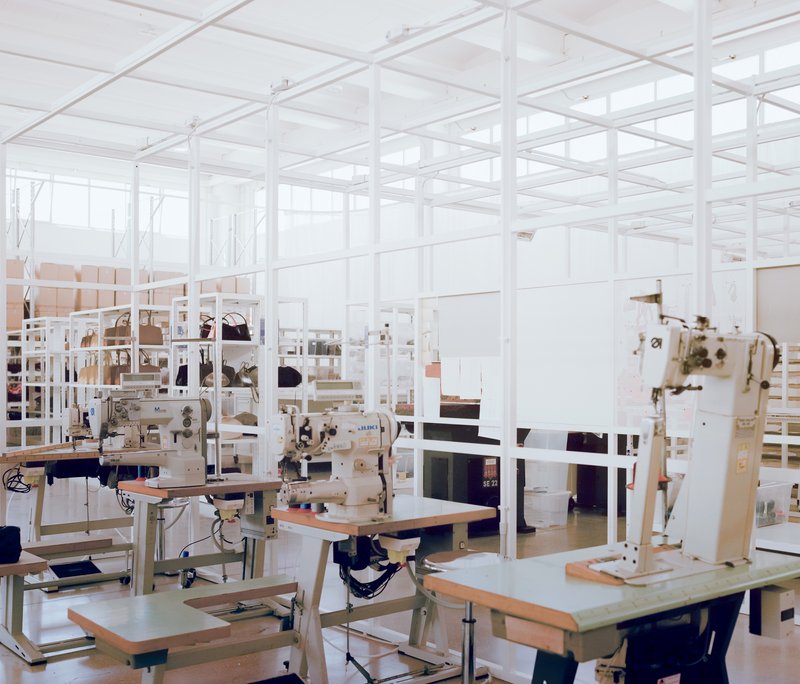
For a brand built on handcraft, using fabric as architecture is poetically apt. But it also solves a practical problem: how to keep a working factory presentable to buyers and press without building permanent walls that would choke the open plan. The sewing machines on plywood tables sit beneath a white metal grid ceiling, fully exposed, because the point is not to hide the labor but to frame it.
Display and Storage as Continuous Space
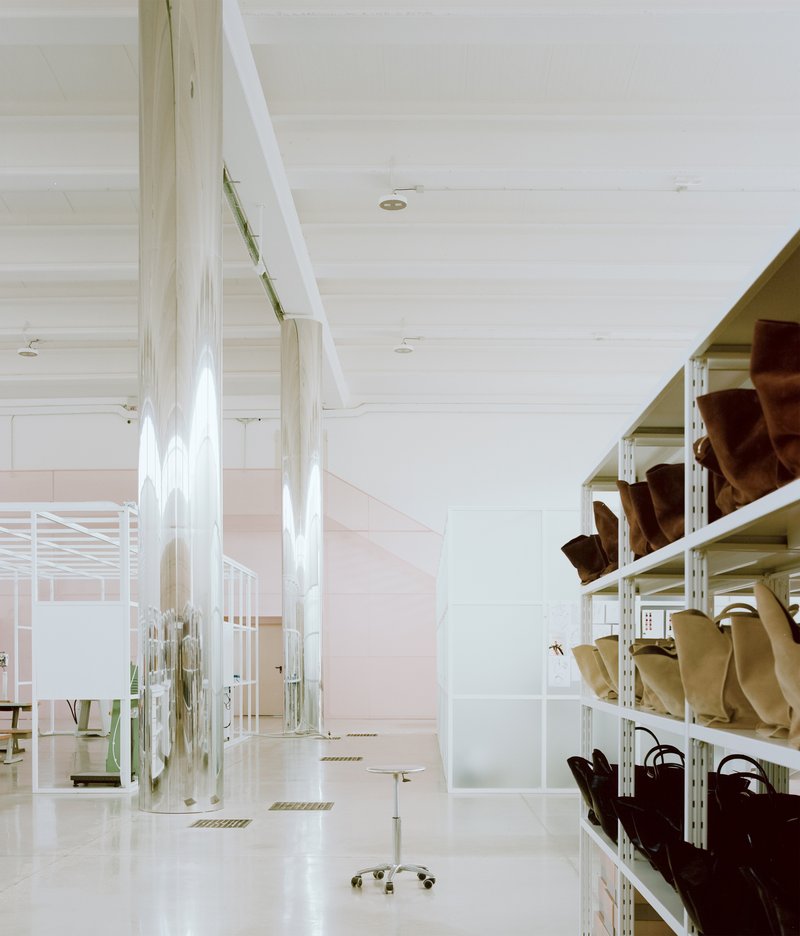
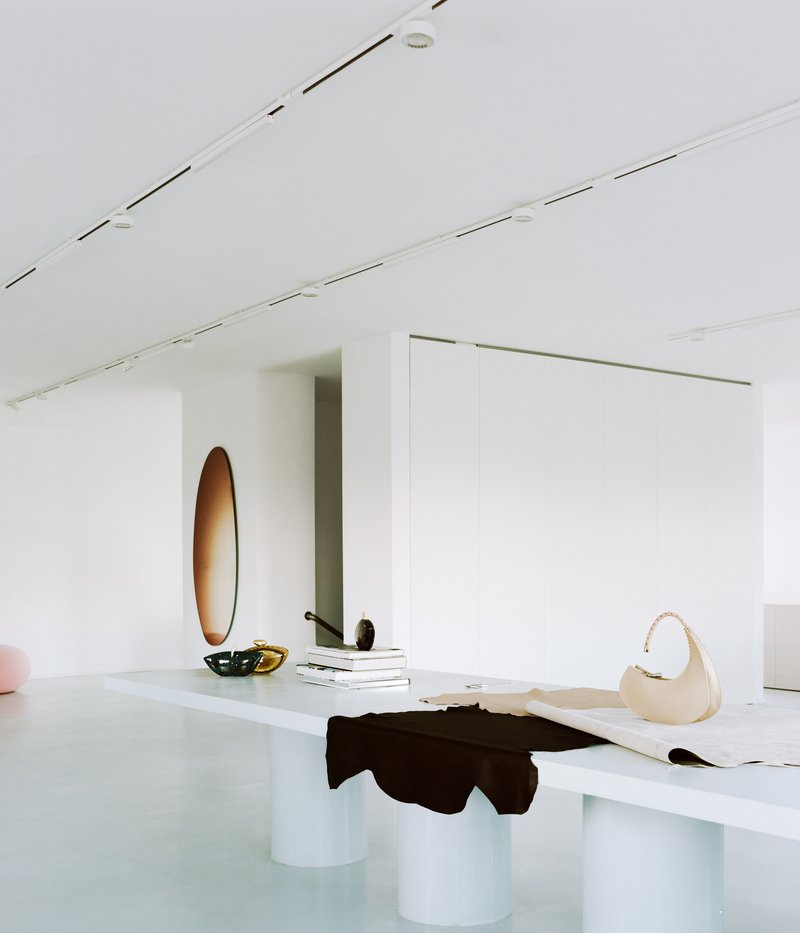
Retail brands typically segregate their back-of-house inventory from client-facing displays. Bottega Bruzziches collapses that distinction. White metal shelving units serve double duty: one aisle holds finished handbags and accessories beneath exposed timber beams, the next stores raw materials. A visitor walking through the showroom passes directly alongside production storage, reinforcing the narrative that every object here is made on site.
The stepped display platform and cylindrical pedestal counters are minimal, almost gallery-like, but they sit on the same resin floor and under the same ceiling as the cutting tables. The architecture refuses to grant hierarchy to the finished product over the process that created it. That is a deliberate philosophical stance, and the spatial continuity makes it legible.
Light as Ribbon and Filter
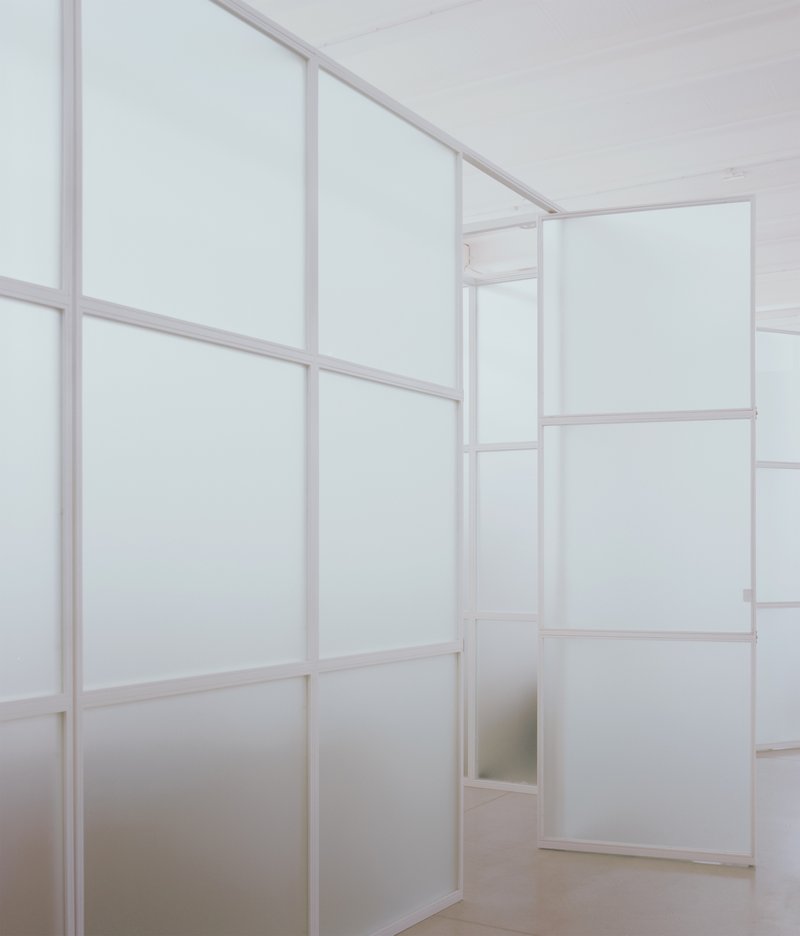
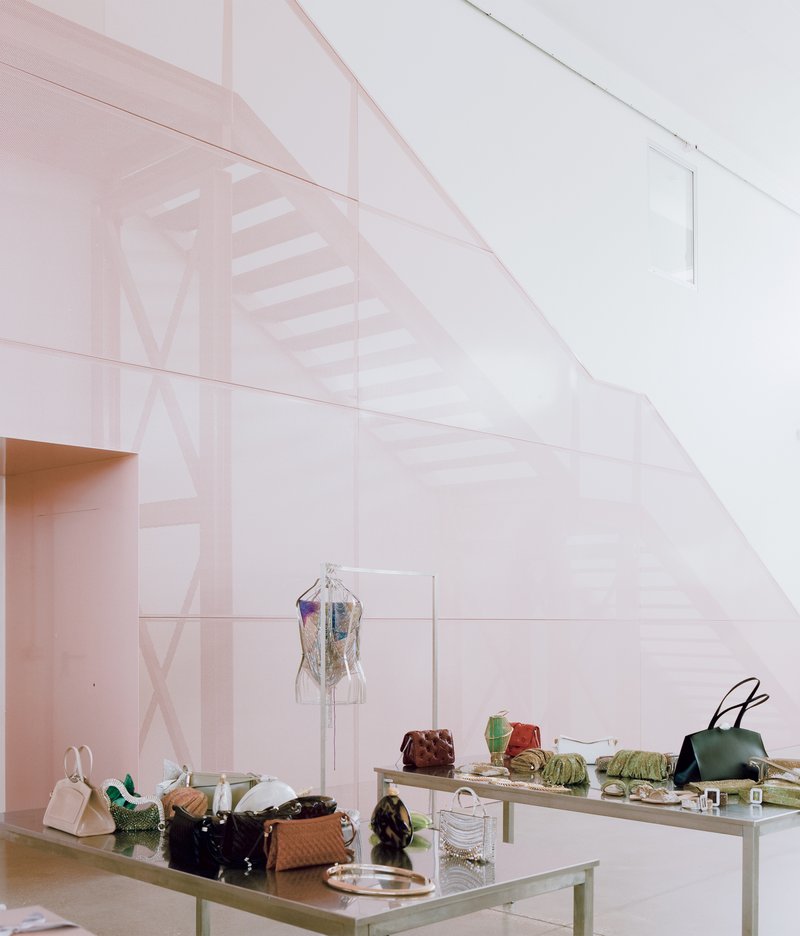
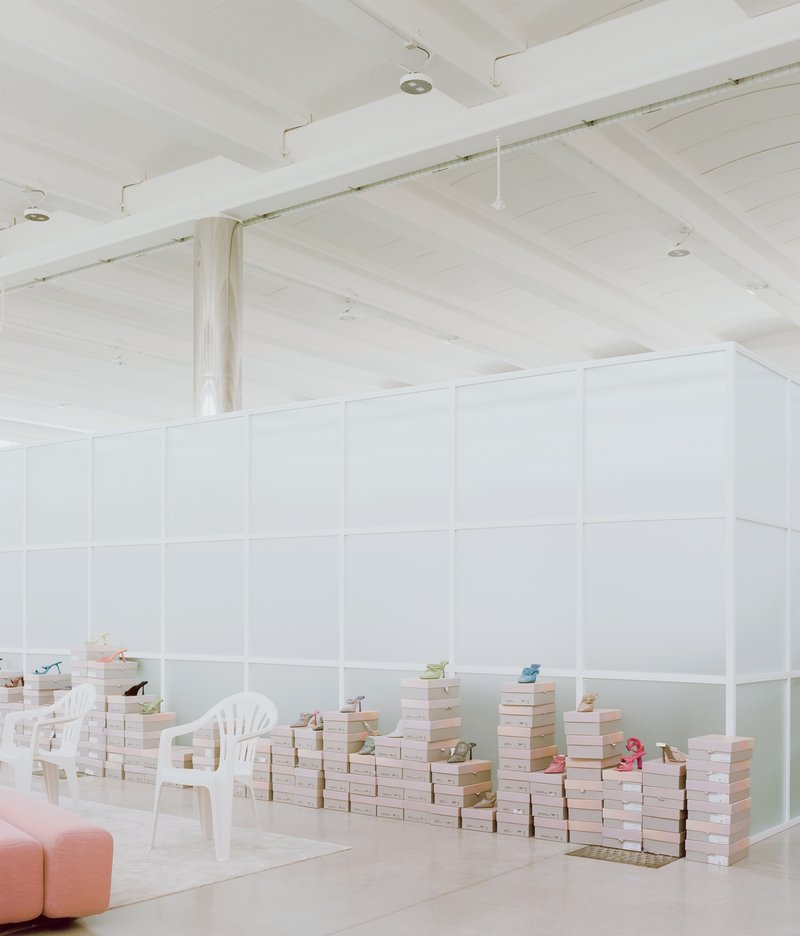
Ribbon windows wrap the entire perimeter of the building, flooding the interior with even, diffused daylight. Combined with the opal glass partitions, the light inside has a milky, almost photographic quality that flattens shadows and lets the products and materials read clearly. This is not accidental: a fashion brand that relies on photography for sales needs interiors that work as backdrops, and deltastudio delivered a space where nearly every corner is a plausible shoot location.
The translucent partitions framed in pale wood create layers of filtered light that shift throughout the day. Deep in the plan, enclosed rooms still feel luminous because light passes through multiple scrims before reaching them. The sloping ceiling in the display wing catches and redirects sunlight downward onto the handbags and garments, turning the architecture into a diffuser.
Thresholds Without Doors
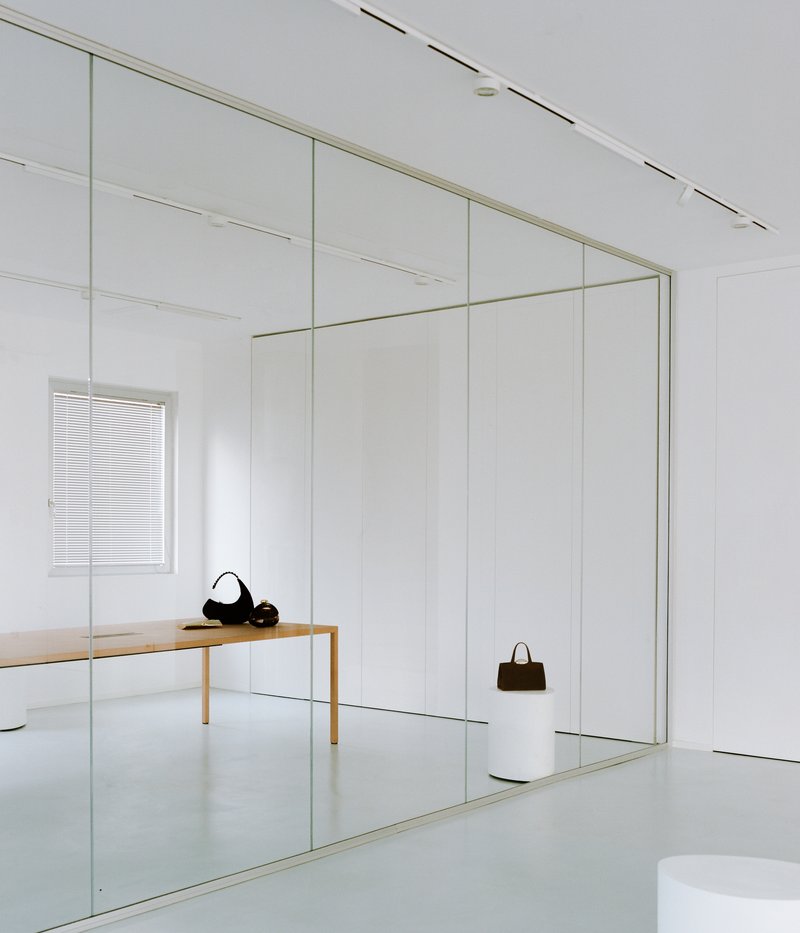
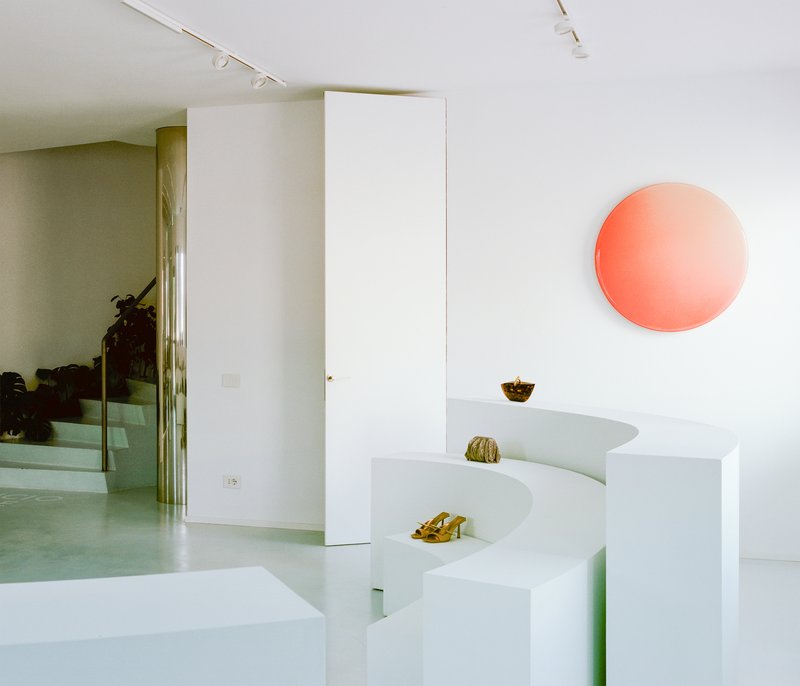
One of the subtlest moves is the way transitions are handled. Floor-to-ceiling glass partitions reflect timber benches and products, creating visual depth without physical barriers. Recessed doorways frame views but never close off rooms. The lacquered wood service blocks, which conceal bathrooms and technical equipment, act as freestanding volumes that you walk around rather than through.
The coral circular wall light above a stepped concrete platform, the arched mirrors leaning against a wall beside pink upholstered seating: these moments feel curated, almost domestic. They mark transitions between zones of the headquarters the way a change in rug might mark rooms in a loft apartment. The architecture trusts that spatial cues, not walls, are enough to organize behavior.
Staircase as Vertical Connector
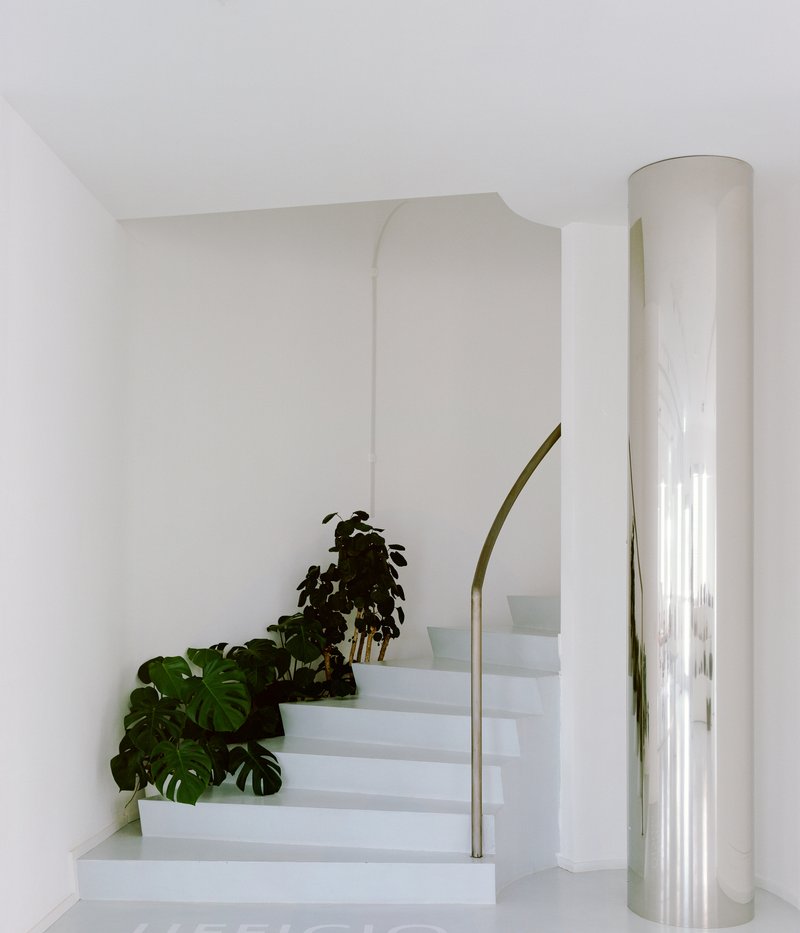
The second block, which houses administrative functions and the style office on two levels, relies on a white interior staircase with a curved handrail and potted plants to connect its floors. The staircase is deliberately generous, more a piece of furniture than an escape route, and its curvature mirrors the sweeping forms of the curtain partitions elsewhere in the building. Ascending from the ground-floor reception to the upper-level atelier, you remain within the same visual language of soft curves and white surfaces.
Plans and Drawings
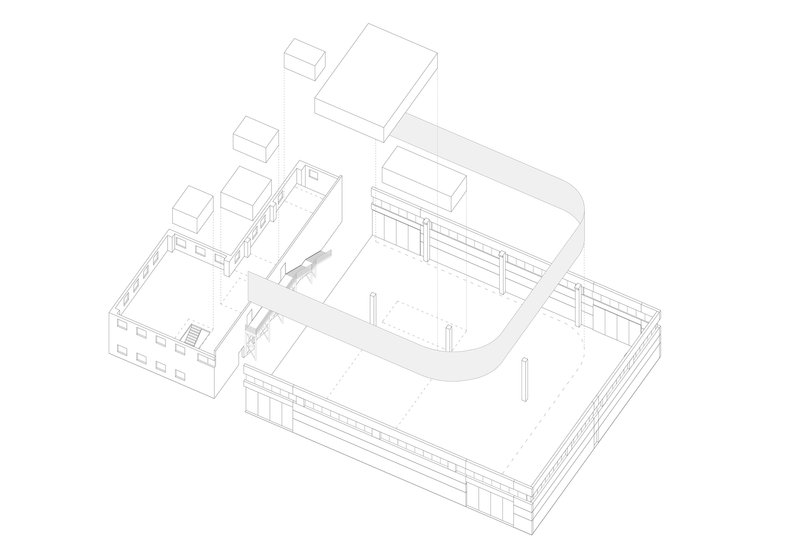
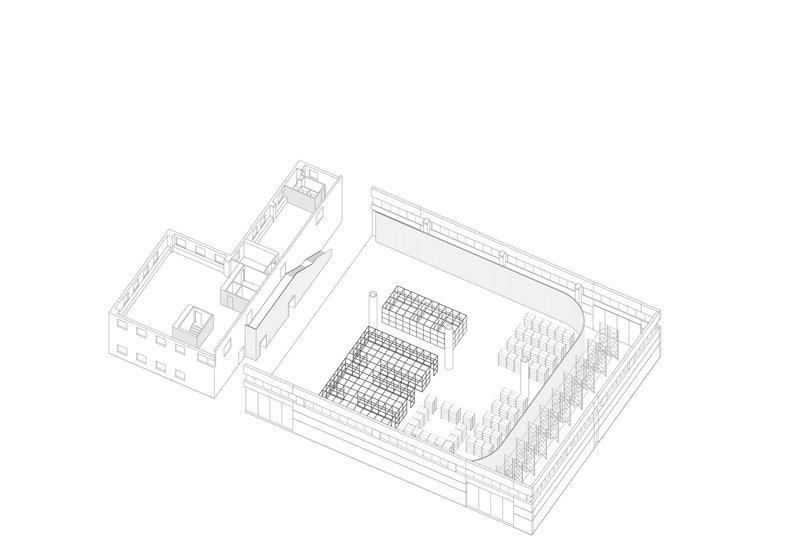
The axonometric drawings reveal how the two primary volumes interlock. A curved central space, likely the curtained production hall, sits between rectilinear blocks that house storage, offices, and display. The grid of columns in the larger volume confirms the structural regularity that enables the open plan, while the interior layout drawing shows how seating and workstations fill the floor without compartmentalizing it. The drawings make clear that the project's apparent looseness is, in fact, carefully gridded.
Why This Project Matters
The standard playbook for fashion headquarters separates creative direction from production, putting the atelier in a city center and the factory in an industrial park. Bottega Bruzziches and deltastudio reject that split entirely. By placing the style office, the sewing workshop, the photo studio, and the showroom on one continuous floor, they argue that craft and creativity are not sequential activities but simultaneous ones. The building is the organizational chart, and it has no hierarchy.
For architects, the takeaway is in the means. Fabric curtains, perforated metal, opaline glass, and resin flooring are not exotic materials. The innovation is in how they are deployed: as filters, scrims, and thresholds that create privacy gradients rather than binary open/closed conditions. In a moment when workplace design oscillates between hermetic private offices and performatively open plans, this project charts a genuinely different path. It is permeable, flexible, and grounded in the specific culture of making that it serves.
Bottega Bruzziches Headquarters by deltastudio. Viterbo, Italy. 1,600 m². Completed 2025. Photography by Simone Bossi.
About the Studio
Share Your Own Work on uni.xyz
If projects like this are the kind of work you want to make, uni.xyz is a place to publish your own, find collaborators, and enter design competitions.




Popular Articles
Popular articles from the community

Inside a Timeless Mumbai Residence by Aether Studio
Aether Studio's 2,250 sq ft apartment in Malad, Mumbai uses marble, brass, boucle, and disciplined restraint to build a quiet retreat from the city.
Eco Chapel: A Green Architecture Pavilion Designed in Symbiosis with the Forest
Eco Chapel uses green architecture to weave prayer, learning and reuse into a forest pavilion shaped by modular hexagonal canopies for life.

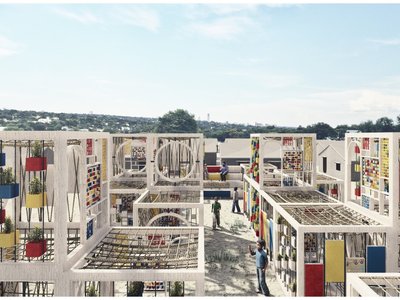
The Faith: Modular Architecture for Play, Learning, and Hope in Kutupalong Refugee Camp
A modular playground architecture project in Bangladesh where play, learning, safety, and hope rebuild childhood inside a refugee camp anew.
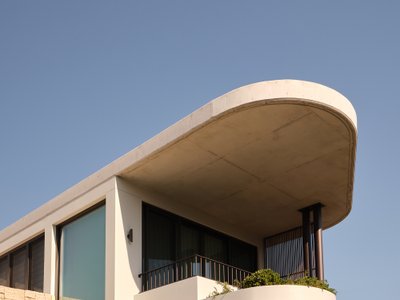
Stanton Architects Sculpts a Curving Family Home into Sydney's Inner West Fabric
Five Dock House uses cantilevers, curved concrete, and layered courtyards to carve out privacy on a tight suburban lot in Sydney.


Similar Reads
You might also enjoy these articles
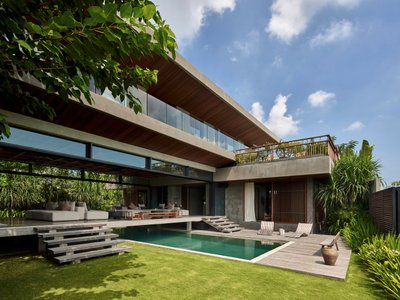
Freebird Residence by Alexis Dornier: A Tropical Modernist Sanctuary in Bali
Floating living pavilion above pool anchors H-shaped tropical villa, blending Japanese minimalism, sustainable strategies, lush landscape, and sculptural interiors.
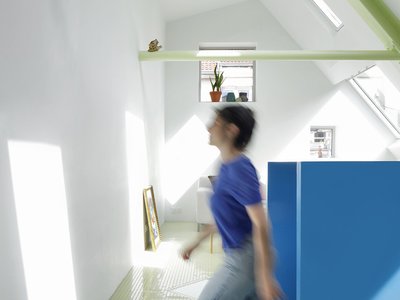
127af Flips a Tiny Bagnolet Rowhouse Upside Down with a Handcrafted Roof Extension
A 55-square-meter terraced house on the edge of Paris gains a luminous upper living floor through lightweight timber and steel.
1.61 Design Workshop Wraps a 600-Square-Meter Café in Vietnam in Sculptural Burgundy Drama
Reden Café & Bistro pairs a helical staircase, mosaic floors, and deep red interiors to rethink Vietnamese hospitality space.

The Unbound Brain: A School Shaped by Cognitive Architecture
Cylindrical learning pods radiate like neurons from a central cortex, turning the floor plan into a spatial model of human thought.

Explore Industrial Building Competitions
Discover active competitions in this discipline




Comments (0)
Please login or sign up to add comments
No comments yet. Be the first to comment!