

Desert Mirage: An Oasis-Museum That Reads Ancient Egyptian Water Wisdom as a Climate Strategy
A shortlisted Hourglass entry that sinks into the sand, threading water channels through columned halls to cool, guide and slowly regenerate the desert.


Most desert proposals treat sand as an obstacle to be conquered or a blank canvas to be filled. Desert Mirage does neither. It reads the desert as a living system and asks a pointed question: can human ambition coexist with ecological limits? Its answer comes from an unlikely archive. Ancient Egypt appears here not as nostalgia but as evidence of environmental intelligence, a civilisation in which water, land and architecture were bound together into a single working system.
Designed by 圆圆 林, the project was shortlisted in the Hourglass competition on uni.xyz. It stages a dialogue between kingship intervention, the Pharaoh-era impulse to reshape land, and the slower logic of natural processes. The result oscillates between a cultural museum and a resting oasis, and it uses water, shade and descent to make an argument about climate change, scarcity and restoration.
Six Phases of Water Rewriting the Sand
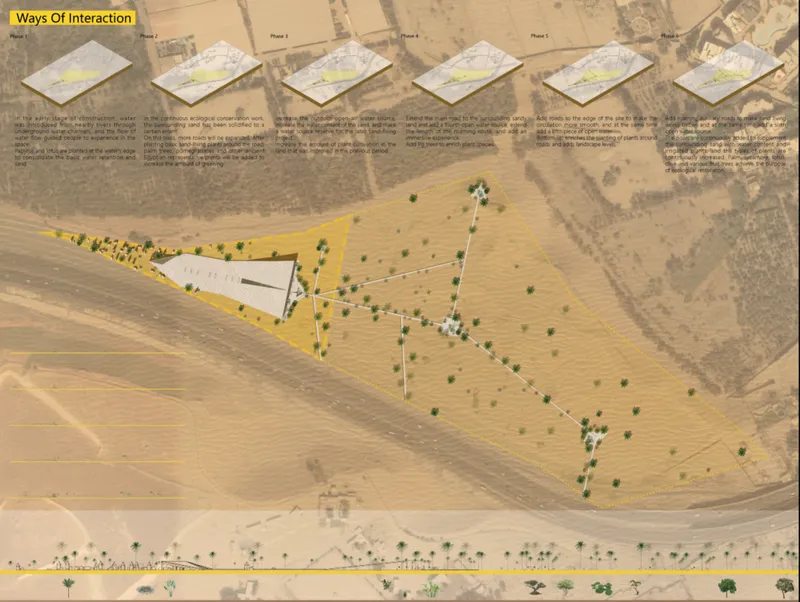
The site plan lays a triangular building over an aerial view of open desert, with sparse trees and pale paths scratched across the sand. Above it, six phase diagrams chart a gradual transformation of the landscape. This sequencing is the project's most persuasive move. Instead of presenting a finished oasis dropped onto the dunes, it proposes a process in which water arrives first as infrastructure and only later becomes landscape.
Water here is performative rather than ornamental. It directs circulation, forms microclimates and shapes the sensory experience of moving through the site. Treating the hydrological system as both utility and narrative gives the plan a dual reading: you can follow it as an engineering diagram or as a story about a desert slowly being coaxed back to life.
Descending Below the Heat Line

The interior view captures the architectural language at its most convincing. Rounded, sandy columns rise beside a narrow water channel and a planted bed, while a lone figure sits on tiered steps in warm, filtered light. The space is subterranean or semi-submerged, a strategy desert builders have long used for passive cooling. Visitors descend into the earth and move through a sequence of shaded corridors, channels and monumental columns.
What matters is how the environmental logic and the atmosphere reinforce each other. Mass and depth temper heat; the water channel adds evaporative relief and sound; the planting softens the monumentality of the columns. The project leans on passive design to reduce reliance on mechanical systems, and the image shows that this restraint produces a richer room, not a poorer one.
Rough Stone, Still Water, a Single Palm

Outside, the register shifts. A rough-cut sandstone wall opens onto a dark doorway, stepping stones cross a lily pond, and a tall palm stands against a hard blue sky. The palette is deliberately elemental. The stone reads as excavated from the ground rather than imported, and the pond turns the threshold into a moment of pause before the plunge into shade.
This is where the oasis half of the programme becomes tangible. Water, vegetation and architecture form a feedback loop that the designer frames as regenerative: each element supports the others and, over time, transforms the site. The stepping stones also make the visitor complicit in that cycle, asking them to cross water deliberately rather than walk past it.
Obelisks and Triangles Abstracted Into a Ritual Route

The space design sheet assembles the formal vocabulary in axonometric sketches: triangular volumes, groups of obelisks, stepped platforms and water channels, all stitched together by a dotted yellow path. The geometry is clearly drawn from Egyptian archetypes, yet nothing is reproduced literally. The forms are abstracted enough to read as a contemporary identity while still carrying their historical weight.
That dotted line is the key to the whole scheme. It organises the spaces into a sequence that mirrors a ritual journey, moving visitors from exposure to shelter, from monument to water. Framed as a museum walk, the route encourages people to confront the consequences of environmental degradation and then the possibility of restoration, turning circulation into an argument.
Why This Project Matters
Desert Mirage shows how historical precedent can be mined for performance rather than style. Its strongest ideas, phased water infrastructure, subterranean thermal comfort and a regenerative loop of water, planting and built form, sit squarely within the discourse of climate-responsive architecture and landscape urbanism. The jury recognised this. Juror Juan Pablo Aschner found that the proposal works effectively as a pleasant, welcoming oasis and resting space in the desert, while juror Yuriko Yagi highlighted its engagement with Egyptian history and its distinctive architectural language.
The same jurors also identified where the project could push harder. Aschner noted that the symbolic intention and the final objective could be communicated more clearly, and Yagi suggested that, given its museum-like character, the scheme could challenge contemporary issues more directly. Those critiques point to the next step: sharpening the message so the ritual route ends in a clearer statement about the present. Even so, the proposal offers a valuable model for treating the desert not as a void to be filled, but as a system to be listened to.
View the Full Project
About the Designers
Designer: 圆圆 林
Enter a Design Competition on uni.xyz
uni.xyz runs architecture and design competitions year-round that reward proposals with spatial conviction and real site intelligence.
Project credits: Desert Mirage by 圆圆 林 Hourglass (uni.xyz).


Popular Articles
Popular articles from the community


David Ortega Stacks a Two-Story Mexico City Penthouse Around a Steel Stair and a Pergola-Shaded Roof Terrace
In Colonia Roma, a 300 m² penthouse uses oak joinery, a planted steel stair and a slatted roof pergola to make a new-build apartment feel like a house.

LT2A and OPEN Architectes Thread a Brick and Glass High School Through a Wooded Belgian Campus
In Braine-l'Alleud, a 3,000 m² wing for Collège Cardinal Mercier pairs pale brick with a glazed colonnade, deferring to a small chapel and a dense wood.

Architekt Andreas Gruber Scatters 23 Dark Timber Chalets Across a South Tyrolean Forest Edge
In Molini di Tures, Amonti Chalets breaks a resort into a hamlet of gabled timber houses, with parking, storage and services pushed into the slope.

U.GA Architects Wraps an Oval Rooftop Pool in Curved Board-Formed Concrete on Busan's Jeollidan-gil
In Busan's Jeonpo-dong, a 454 m² mixed-use block stacks a neighborhood facility, guest rooms and an oval rooftop pool inside spiraling concrete walls.

Similar Reads
You might also enjoy these articles
Healing Façade: A Modular Chapel System That Restores Ethiopia's Sacred Forests
Winner of the Eco-Chapel competition, this circular timber façade collects water from air to rebuild soil and reforest degraded Ethiopian landscapes.
Kaffeebühnen: Where Coffee Shop Architecture Becomes a Civic Stage in Vienna
A linear sequence of timber boxes, transparent shells, and open yards turns the Viennese café tradition into a public performance space.
Eco Chapel: A Modular Forest Pavilion That Grows Like the Landscape It Protects
Hexagonal timber modules weave through existing trees, turning a chapel into a living system for prayer, education, and reforestation.


Urban Forest: A Vertical Ecosystem for 5,000 Workers in Singapore's Changi Business Park
Radially stacked pods and layered green decks turn a 7-acre plot into 47 acres of ecological workspace projected for 2040.

Explore Architecture Competitions
Discover active competitions in this discipline

Challenge to reimagine the Iron Throne

Photograph architecture without architects

Illustrate the lost glory of Angkor Wat - Render Challenge

Design challenge to reuse E-waste
Comments (0)
Please login or sign up to add comments
No comments yet. Be the first to comment!