
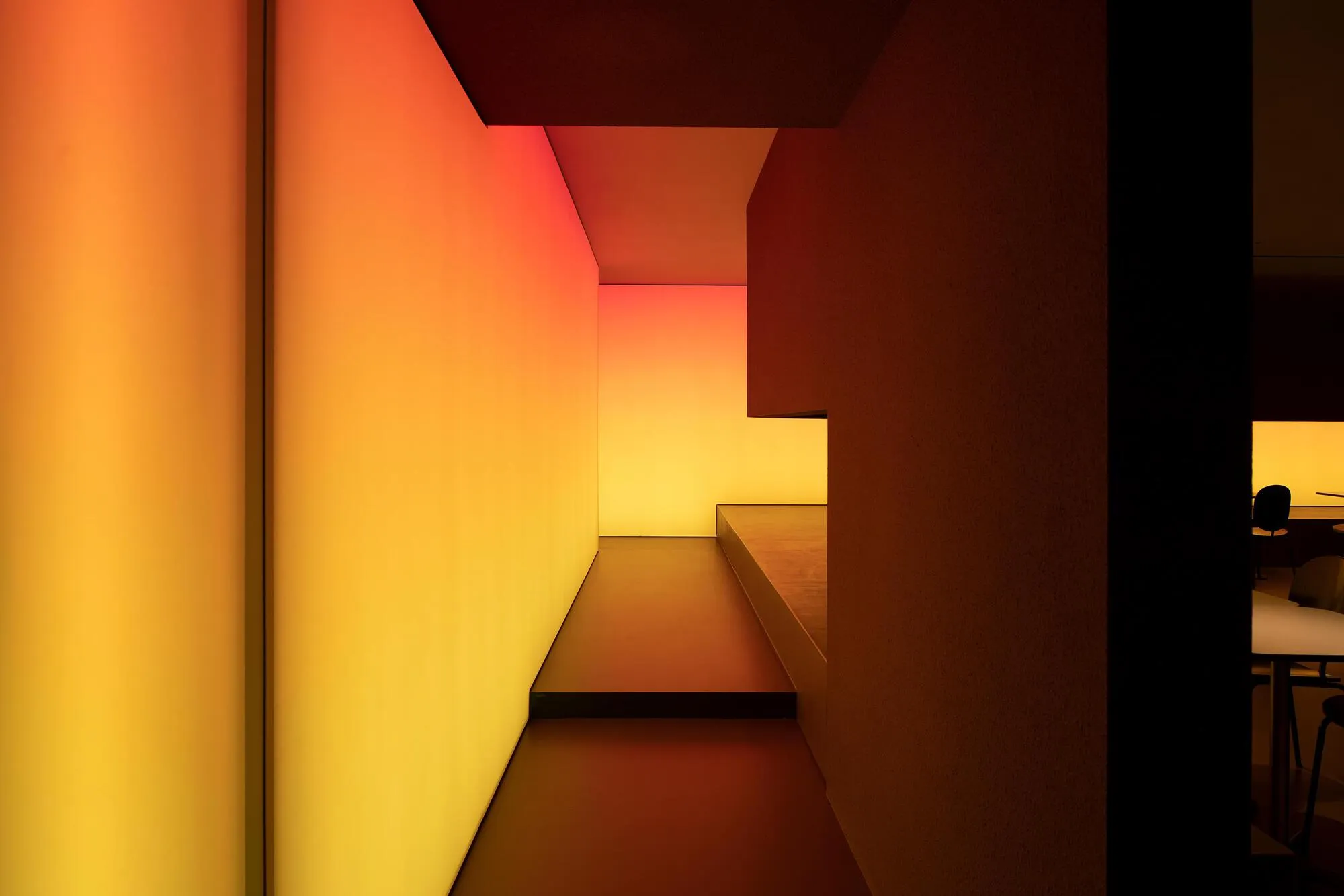
Design Studio BYO Carves a Glowing Cave for Zigbang's Windowless Gangnam Office
A 547-square-meter lounge office in Seoul transforms a sealed, lightless floor plate into a sequence of amber-lit rooms.


There is no shortage of offices that try to feel like something other than an office. Few of them start from a condition as hostile as this one: a 547-square-meter floor plate in Gangnam, Seoul, sealed on every side by walls, with no windows and no natural light. The brief came from Zigbang, a Korean proptech company that had already built a metaverse headquarters called SOMA and now wanted a physical counterpart, a place where employees could gather for meetings, meals, and the kind of low-stakes socializing that remote work quietly erodes.
Design Studio BYO responded not by fighting the darkness but by leaning into it. The office is conceived as a cave: a sequence of rooms defined not by walls and doors but by shifts in ceiling height, light temperature, and surface texture. Amber, terracotta, and deep ochre gradients replace daylight, and each zone glows from within as though carved out of warm stone. The result is an interior that feels geological rather than architectural, less a workplace than a lantern buried in the city.
Light as Material
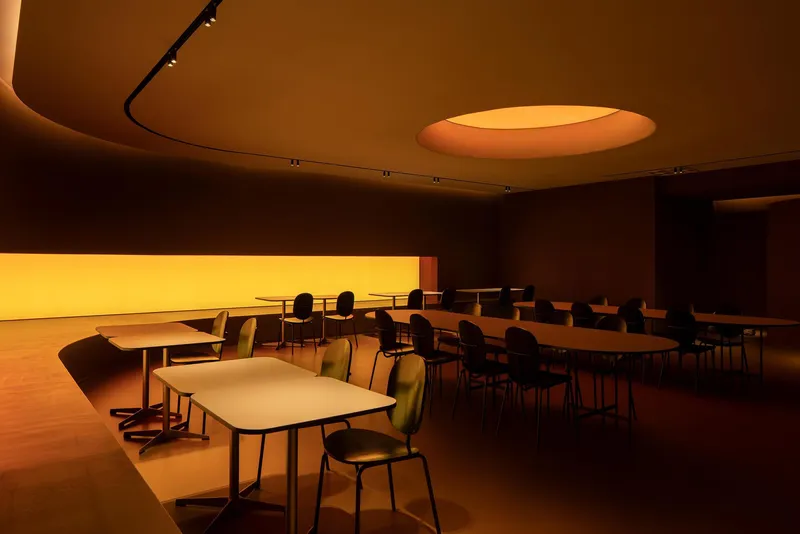


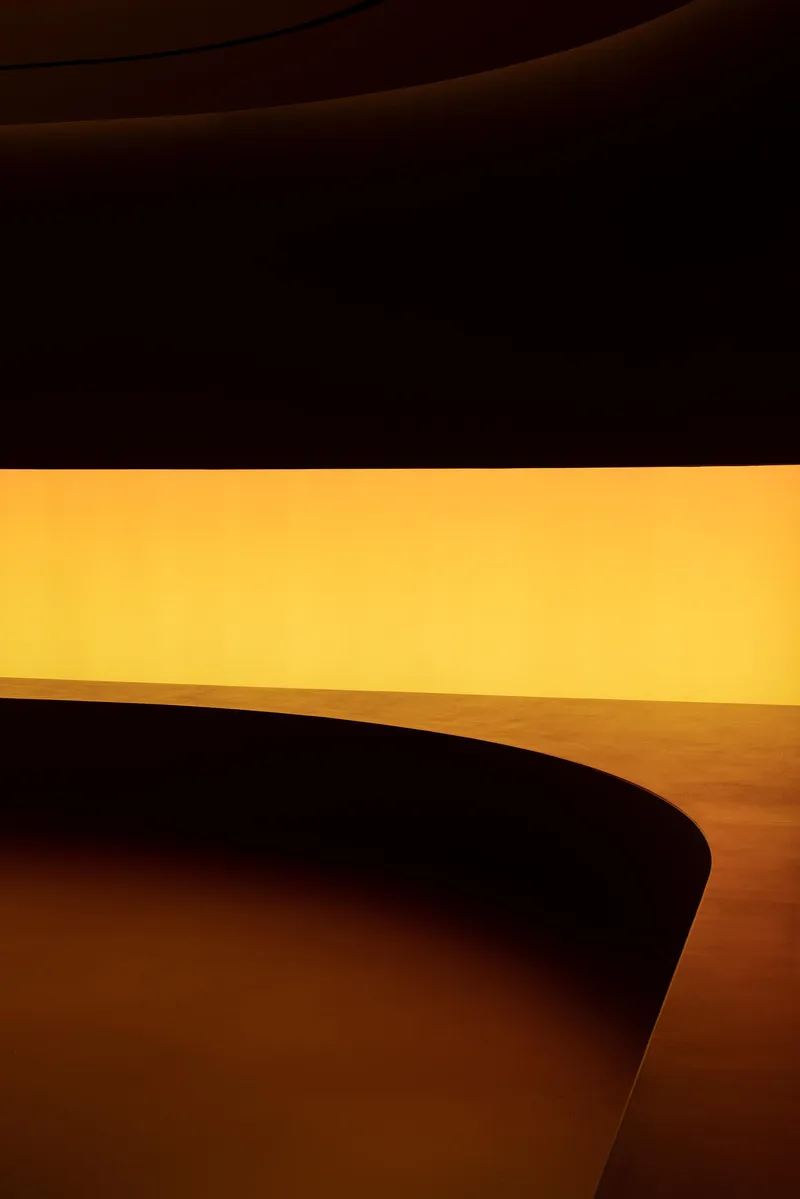
Without a single window to work with, BYO had to manufacture every lumen of atmosphere. The strategy is remarkably consistent: concealed LED sources behind translucent panels and within ceiling coffers produce a diffuse, omnidirectional glow that mimics the quality of light filtering into a natural cavern. Oval skylights and recessed oculi punctuate the ceilings, not as functional apertures to the sky but as sculptural surrogates for it, framing pools of warm light on the surfaces below.
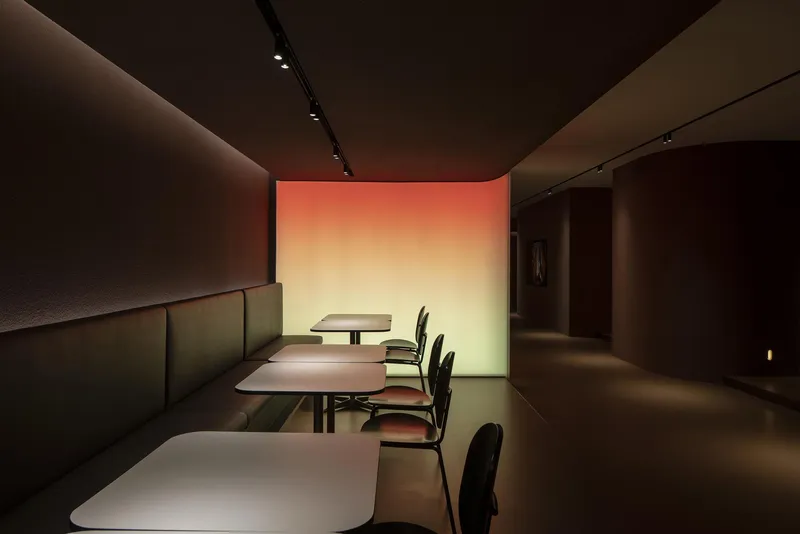
What keeps this from feeling like a themed restaurant is the precision of the gradients. The backlit panels transition smoothly from deep amber to pale gold, creating a sense of depth that flat, uniform illumination cannot. The layered ceiling planes in the corridor zones overlap like geological strata, casting soft amber shadows that change subtly as you move through the space. Light here is not decoration; it is the primary building material.
The Terracotta Corridor

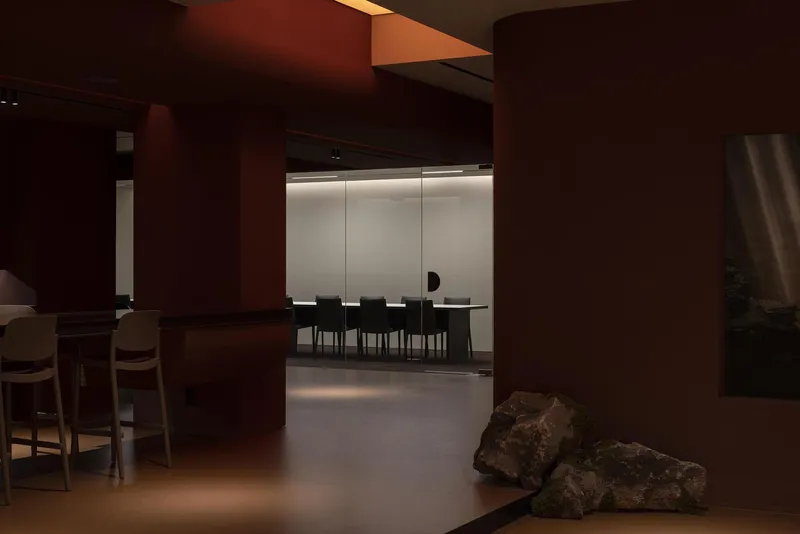

A central corridor finished in deep terracotta red acts as the spine of the plan, linking the dining zones, conference rooms, and lounge areas. Its walls are thick and slightly rough, and the ceiling coffers cast warm light downward in rhythmic intervals, producing the sensation of walking through an excavated tunnel. The portal framing at the threshold of the conference room, with its raw stone floor and backlit translucent wall, makes the transition between zones feel genuinely threshold-like: a passage from one chamber to another.
The narrow vertical openings that appear along some walls are a clever device. They offer glimpses into adjacent rooms without fully connecting them, maintaining acoustic separation while suggesting continuity. It is a borrowed trick from cave architecture, where fissures in rock offer partial views of deeper chambers, and it works well at this scale.
Dining as Program
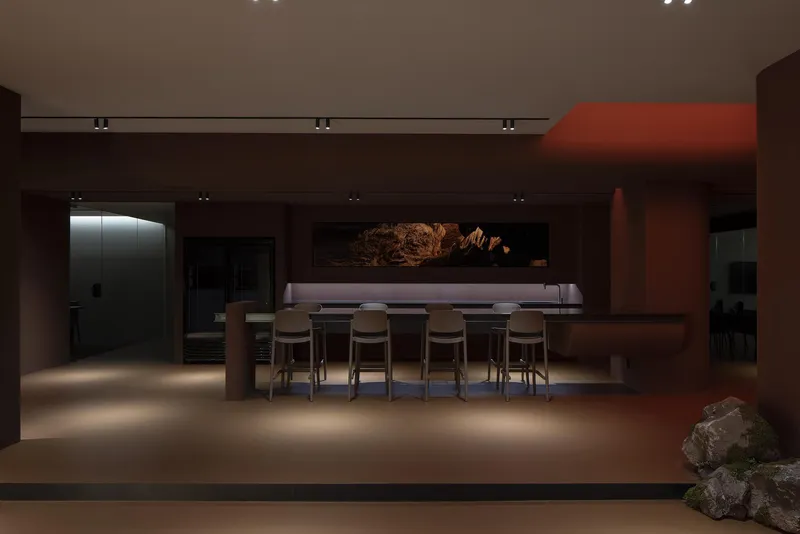
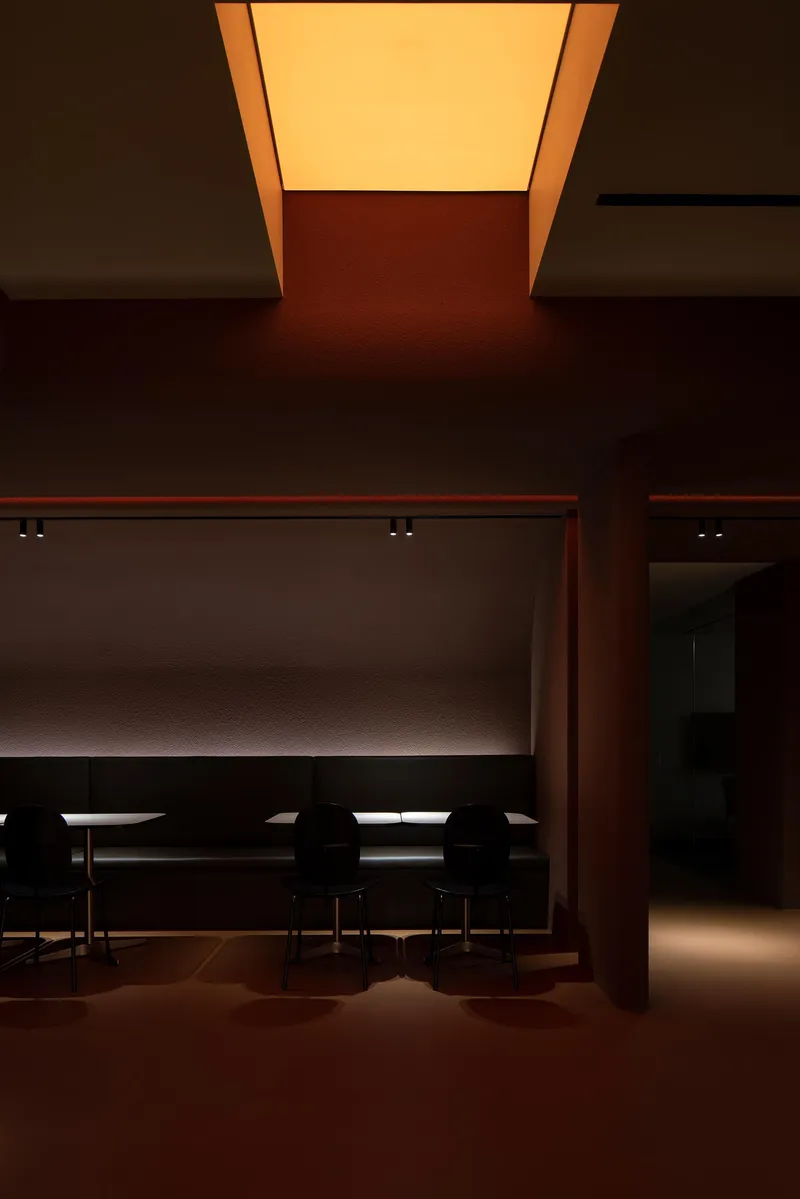
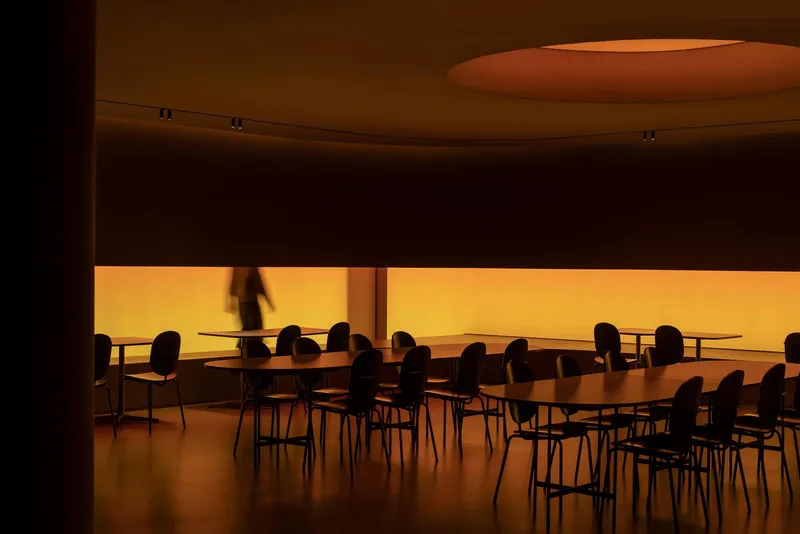
A significant portion of the floor area is given over to dining, and the variety of seating formats suggests that eating here is not incidental but central to the office's social function. Long communal tables sit beneath recessed amber ceiling panels. Banquette arrangements create more intimate settings for smaller groups. Upholstered stools line one side of a long table in a zone that reads more like a private supper club than a corporate cafeteria.
The curved ceiling with its oval oculus in the primary dining room is the most photographed moment in the project, and deservedly so. It compresses the space vertically while the glowing horizontal slot window stretches it laterally, creating a tension between enclosure and extension that keeps the room from feeling claustrophobic. The figure passing behind the backlit amber panel in one shot is a reminder that these rooms are designed for bodies in motion, not just for cameras.
Alcoves and Retreats
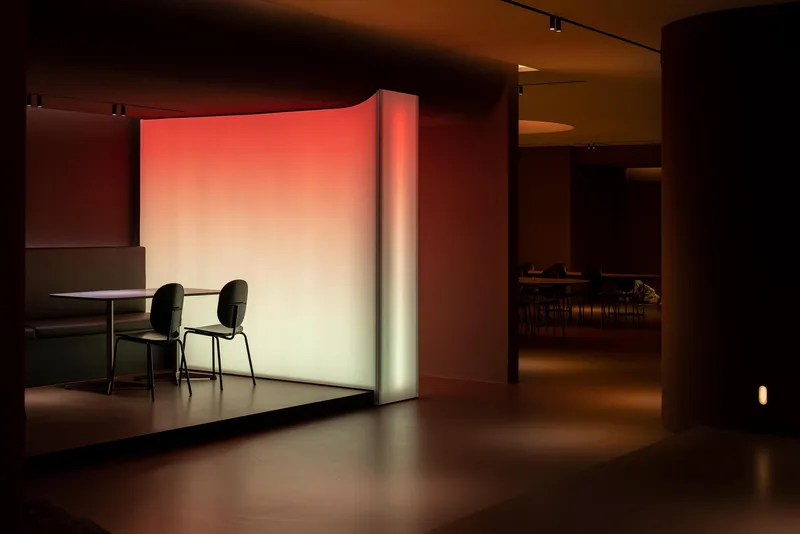

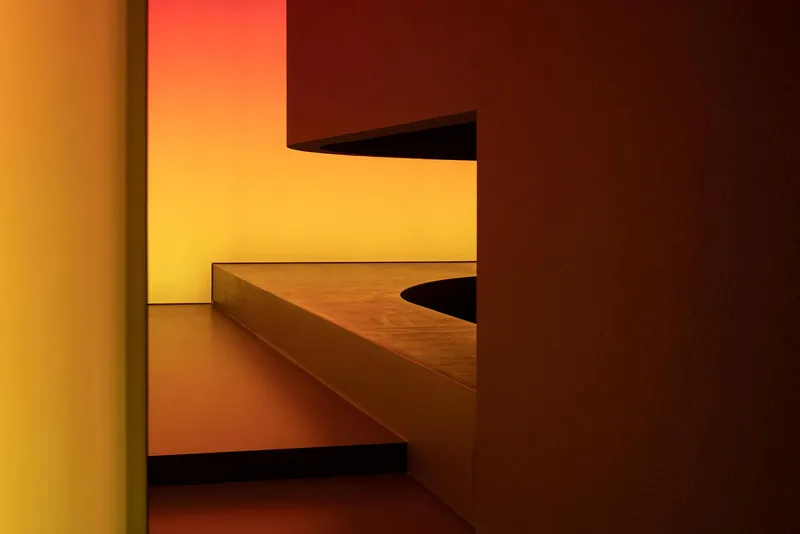
The most poetic moments in the project are its smallest. A seating nook for two chairs sits against a gradient wall that transitions from deep brown to pale amber, offering a sense of privacy without enclosure. A curved alcove houses moss-covered stones on a raised platform, a fragment of landscape brought indoors that reads as both biophilic amenity and contemplative art piece. A geometric timber bench and steps nestle beneath a glowing yellow panel in a recessed alcove that feels almost sacred in its stillness.
These moments of withdrawal are essential to the project's logic. A space conceived entirely as communal dining and meeting areas would exhaust its occupants quickly, especially one without windows. The alcoves provide pressure relief, places to sit alone or in pairs without leaving the cave entirely.
The Bar and Gallery
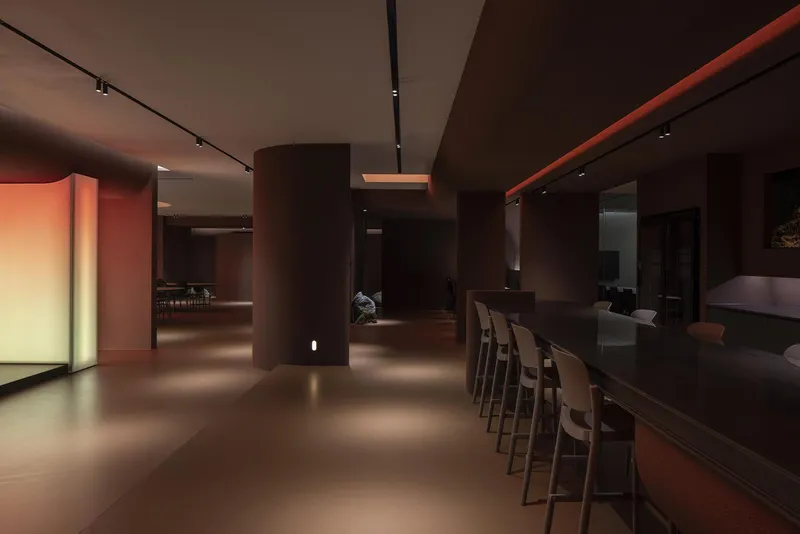

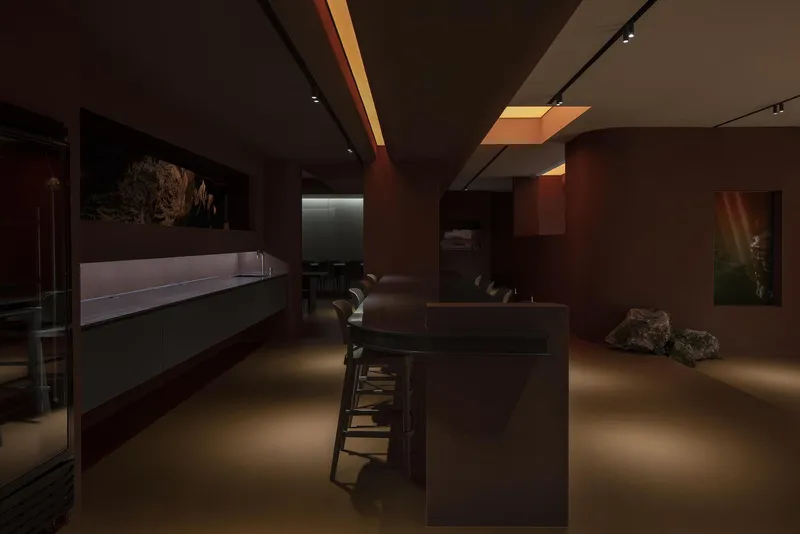
A continuous counter with bar seating occupies one zone of the plan, flanked by cylindrical columns and lit from above by track lighting. It is the most conventionally office-like element in the project, the kind of breakout bar that appears in every co-working space, but the material palette keeps it cohesive with the rest. The columns are smooth and pale, standing in contrast to the warm, rough-textured walls elsewhere.
Adjacent to it, a gallery corridor with brown walls and display cases introduces a curatorial dimension. Amber skylight strips illuminate the ceiling, and the room functions as both circulation and exhibition, a place to linger rather than pass through. For a company that sells the idea of space as a product, displaying objects and ideas along the daily path of employees is a smart programmatic choice.
Thresholds and Sequence


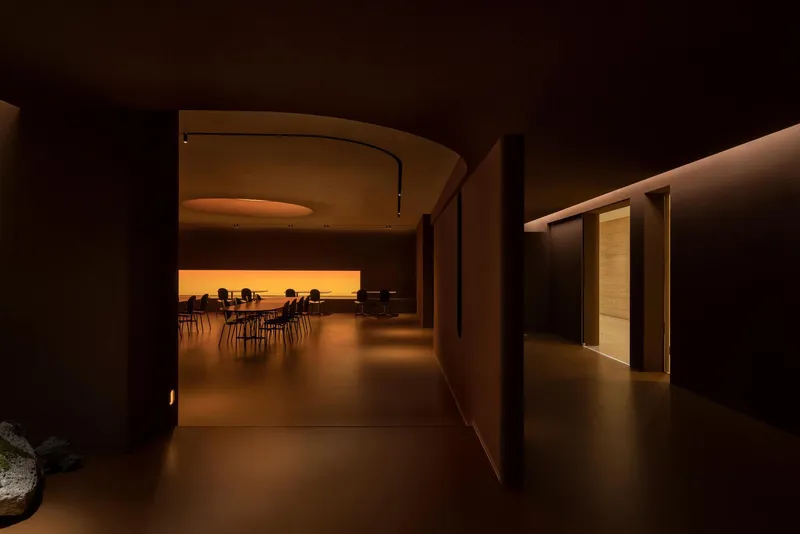
The long view through the recessed dining zones reveals BYO's strongest compositional move: enfilade. Each room frames the next through a carefully sized opening, and the backlit gradient panels in the distance pull the eye forward. The framed red illuminated opening at the end of the conference room operates on the same principle, acting as a visual anchor that gives directionality to an otherwise windowless plan.
The stepped corridor with its angular walls and yellow-to-orange gradient lighting is perhaps the most overtly theatrical space. The walls lean inward slightly, compressing the passage and amplifying the warmth of the light. It is not a space you would linger in, which is exactly the point: it accelerates movement toward the rooms beyond.
Plans and Drawings


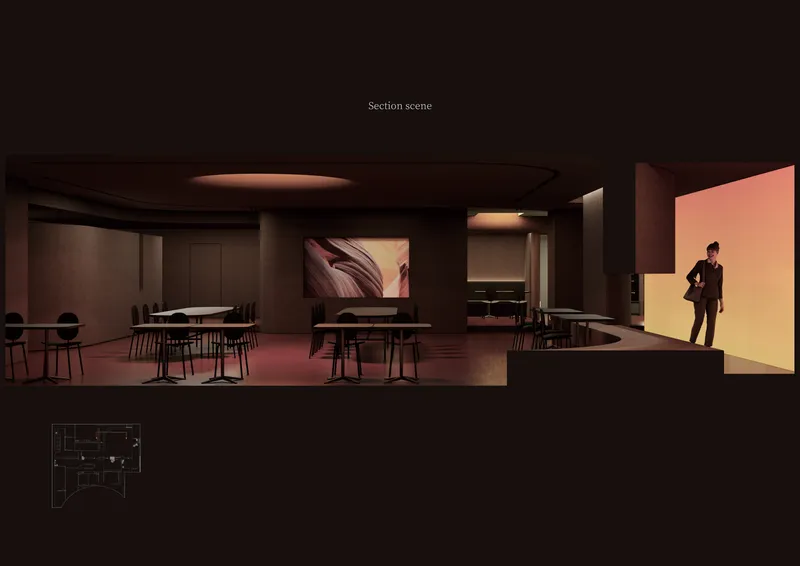
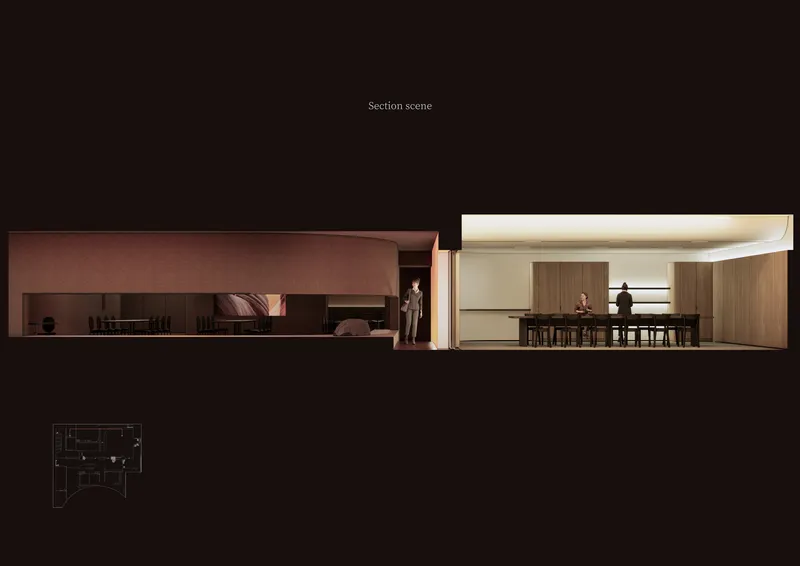
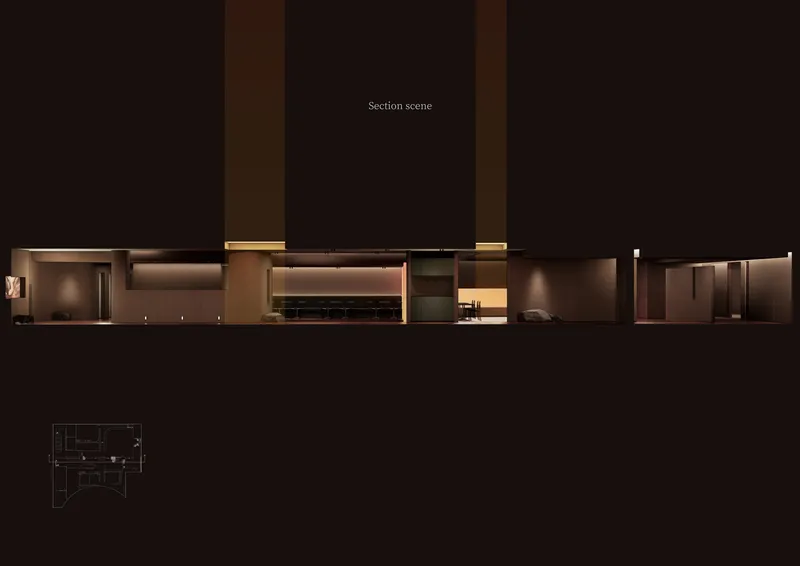
The floor plan confirms what the photographs suggest: the layout is not an open plan subdivided by furniture but a series of discrete rooms connected by narrow passages and portals. The sections are even more revealing. They show how BYO manipulated ceiling heights to differentiate zones, dropping the ceiling in corridors and lifting it over dining rooms and lounges. The circular ceiling recesses appear as deliberate voids scooped out of a continuous mass, reinforcing the cave metaphor at a structural level.
The contrast between the terracotta-toned lounge and the cream-lit dining space, visible in the sections, is handled through material and light rather than partition walls. This is the drawing set of an interior that treats atmosphere as architecture, and the sections make the argument more convincingly than any rendering could.
Why This Project Matters
The post-pandemic office has largely settled into a predictable formula: flexible desks, biophilic accents, a good coffee machine. SOMA Lounge Office rejects this template entirely. It starts from the premise that a space without natural light is not a liability to be mitigated but a condition to be embraced, and it builds an entire atmospheric world from that starting point. The cave metaphor could easily have become kitsch; BYO keeps it taut by exercising real control over light gradients, ceiling geometry, and material warmth.
More importantly, the project takes seriously the idea that an office for a company with a virtual headquarters needs to offer something the metaverse cannot: physical texture, shared meals, the warmth of amber light on a friend's face. It does not compete with the digital by being more efficient or more connected. It competes by being irreducibly, sensuously present.
SOMA Lounge Office by Design Studio BYO. Located in Gangnam-gu, Seoul, South Korea. 547 m². Completed in 2022. Photography by Kiwoong Hong.
About the Studio
Share Your Own Work on uni.xyz
If projects like this are the kind of work you want to make, uni.xyz is a place to publish your own, find collaborators, and enter design competitions.



Popular Articles
Popular articles from the community

AL-JANNAH: Sustainable Architecture and Permaculture for Afghan Widows
AL-JANNAH uses sustainable architecture and permaculture to create resilient oasis of housing, learning, work and renewal for Afghan widows.

The Earth Pod: 3D Printed Homes for Resilient Refugee Communities
The Earth Pod reimagines refugee housing through 3D printed homes made from clay, combining resilience, self-sufficiency, and rapid shelter.

Riyadh For All: Intergenerational Urban Design for Active Aging in Rabat
Riyadh For All reimagines urban design in Rabat with intergenerational co-living, adaptive courtyards, and Moroccan cultural exchange today.

Conexión: Biophilic Design Reimagines High-Rise Living in Hong Kong
Conexión reimagines high-rise living in Hong Kong through biophilic design, green facades, shared spaces, daylight, water and nature within.

Similar Reads
You might also enjoy these articles

Bao Huynh Watercolor Atelier: A Serene Art Retreat in Hội An
Bao Huynh Watercolor Atelier in Hội An blends multifunctional art spaces, sustainable design, local materials, and family-friendly living in a serene environment.

Atelier Macri Concept Store Interior Design by CASE-REAL
Atelier Macri store features a "ko" counter, walnut wood details, cork displays, blending retail, gallery, and seamless customer experiences.

Manuel Vargas Izquierdo Stadium and High-Performance Sports Center: Architectural Excellence in Jalpa de Méndez
The Manuel Vargas Izquierdo Stadium blends sustainable design, inclusive sports facilities, and cultural-inspired architecture, revitalizing Jalpa de Méndez’s public spaces.

KAKR Buluh Awar Hall: Revitalizing Community and Ecology Through Bamboo Architecture
Community built bamboo hall revitalizes Buluh Awar village, empowering youth, restoring ecology, celebrating vernacular craftsmanship through sustainable architecture and culture.


Comments (0)
Please login or sign up to add comments
No comments yet. Be the first to comment!