
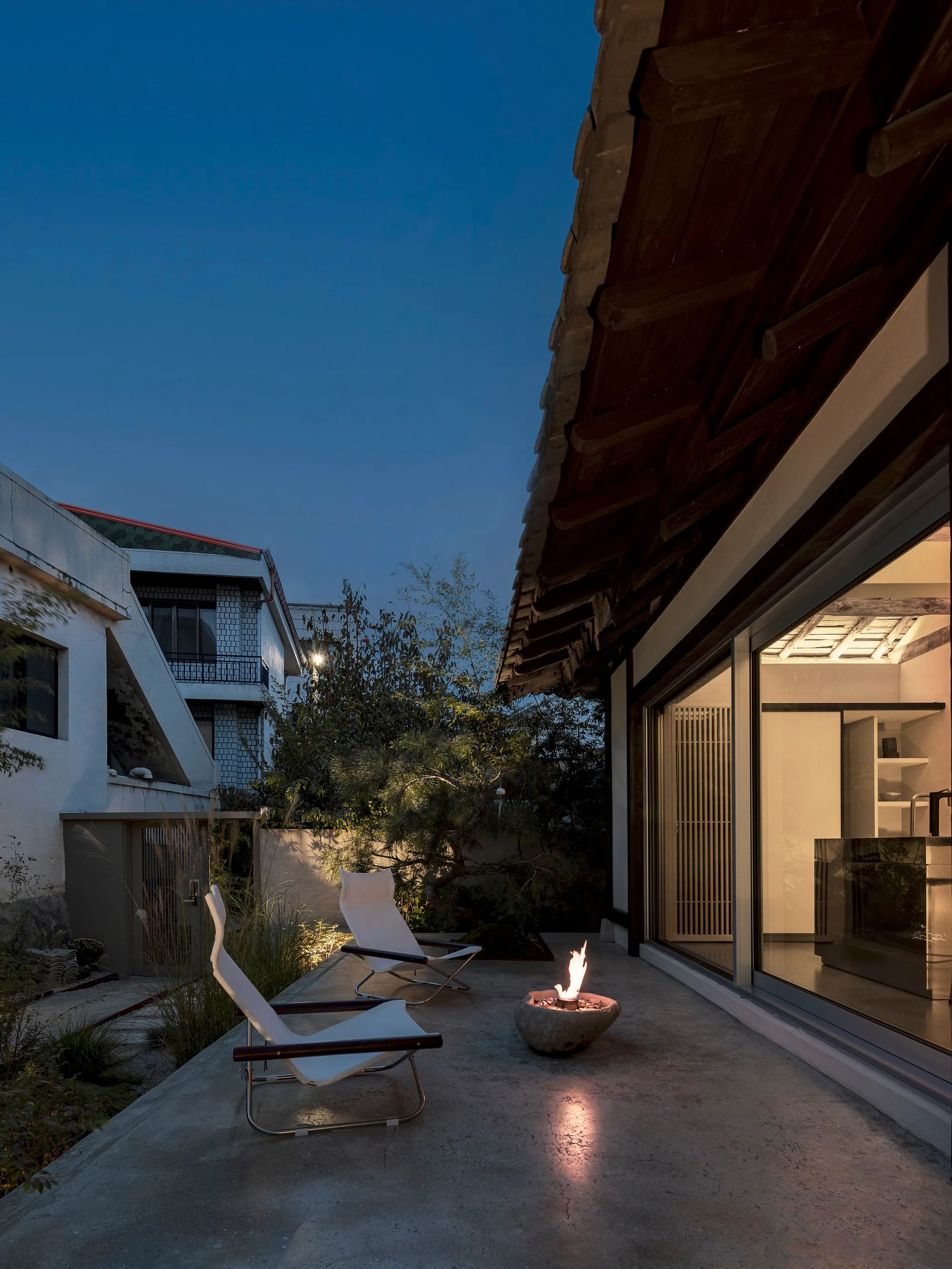
DESIGN2TONE Renovates a 64-Square-Meter Hanok in Gangneung into a Contemplative Guest Stay
In the historic Gyodong district, a traditional Korean villa becomes a hospitality retreat defined by material honesty and garden intimacy.


A hanok is not just a building type. It is a set of spatial manners: how a roof meets the sky, how a threshold negotiates inside and outside, how materials confess their age. At Hwangi Stay, DESIGN2TONE took a single-story hanok in the urban center of Gyodong, Gangneung, and renovated it into a hospitality space that keeps those manners intact while stripping everything back to essentials. At just 64 square meters, the project proves that restraint, not size, is what gives a room authority.
What makes Hwangi Stay genuinely compelling is the discipline with which lead architect Hyungyeong Choi treats every surface. Wood, concrete, stainless steel, and stone are left to speak in their original registers. There are no decorative overlays, no nostalgic gestures. The dark gray tiled roof and the white plastered walls are familiar to anyone who has walked through a Korean historic district, yet the interiors feel contemporary, even spartan. The result is a place where tradition is not performed but simply present, legible in the proportions, the eaves, and the relationship between rooms and courtyard.
Threshold and Entry


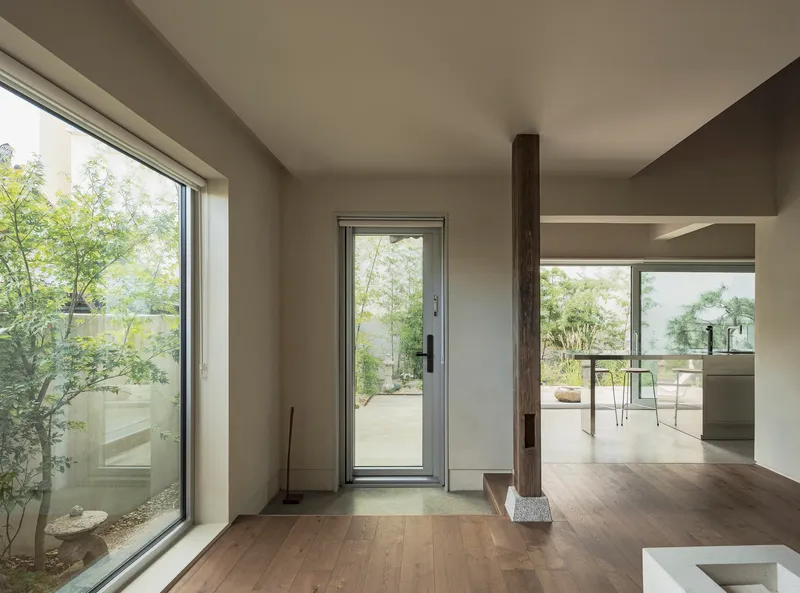
Arriving at Hwangi Stay is a slow compression. The entry sequence moves past dark timber columns and the sweeping line of tiled eaves, with tall bamboo standing sentry beside the path. A courtyard garden of gravel, rocks, and grasses intercedes before any door is reached, establishing a buffer zone between the noise of the city and the quiet of the interior. This is a classic hanok spatial strategy: the garden is not ornament but infrastructure, a device for shifting your state of mind.
The glazed door opening onto the courtyard further dissolves the binary of inside and outside. Bamboo plants flanking a dark timber column are visible from both directions. You do not enter Hwangi Stay so much as you are absorbed into it, one surface at a time.
Roof and Structure
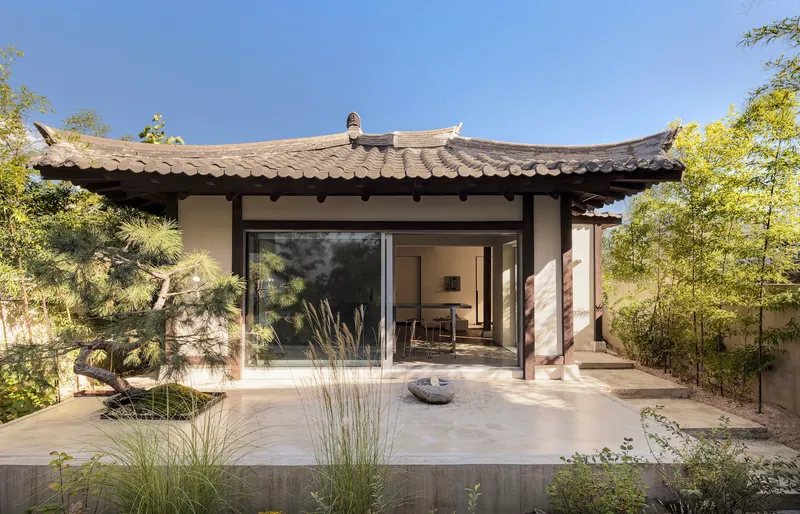
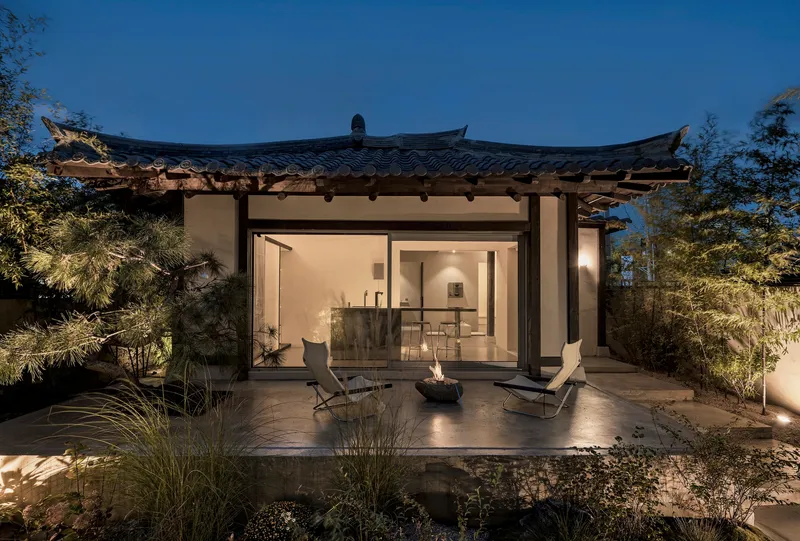
The curved tile roof is the defining gesture of the project, and DESIGN2TONE treats it with the attention it deserves. Exposed rafters radiate outward beneath dark gray tiles, their rhythm visible from the terrace and the garden at twilight. The pavilion condition, with its timber columns open to the air, recalls the maru platform of traditional hanok, a semi-outdoor space for sitting, eating, and watching weather change.
Structurally, the building is a composite of metal, concrete, and wood, which is a pragmatic departure from the all-timber tradition. But the visual hierarchy remains clear: wood dominates at the scale you touch and see, while concrete and steel do their work at the base and in the hidden connections. The eaves line, low and assertive, gives the building its silhouette against the sky and anchors it convincingly in the neighborhood.
Living and Kitchen

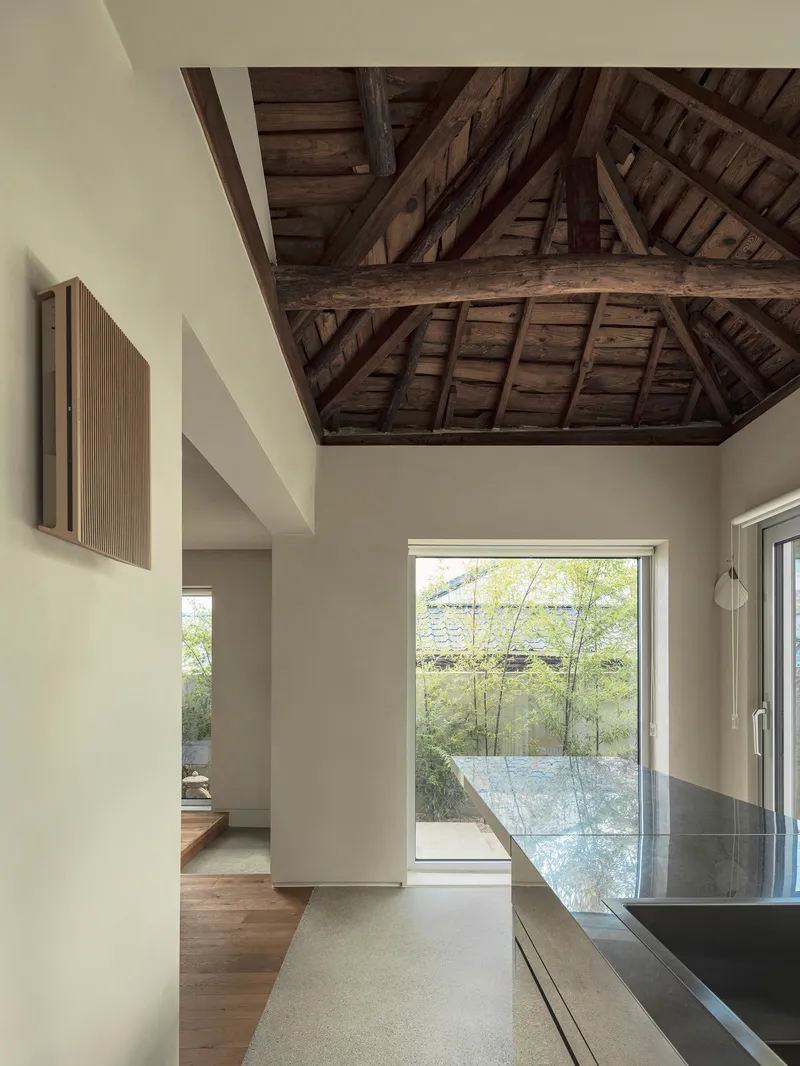
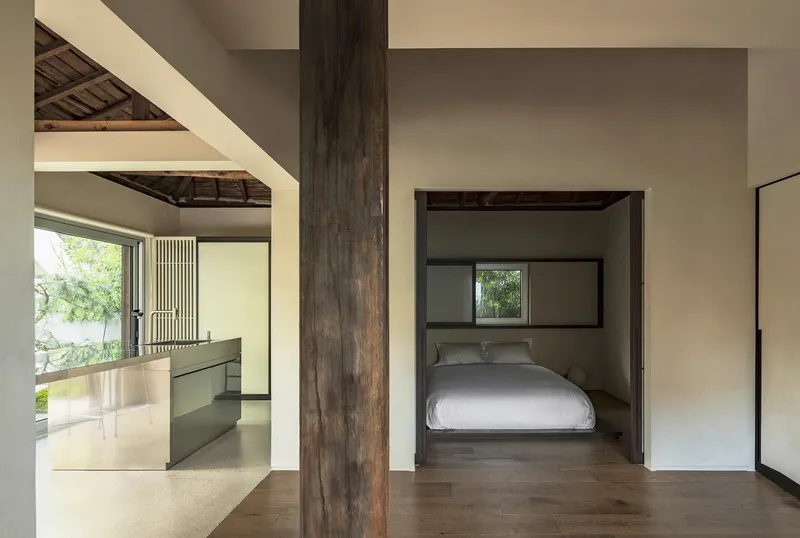
Inside, the kitchen island with bar seating sits beneath exposed timber roof trusses, and afternoon sunlight falls directly onto the work surface. The trusses are left unfinished, their grain visible, and they establish the ceiling as the most active plane in the room. Windows frame the gravel courtyard and bamboo on two sides, so that cooking and looking outward become simultaneous acts.
The view through a dark timber column toward the bedroom alcove reveals the compact logic of the plan. Rooms do not follow a corridor sequence; they open laterally into one another, separated by changes in level, material, or light rather than by walls. In 64 square meters, this strategy is not optional. It is the only way to give a small plan the feeling of generosity.
Sitting, Reading, Resting
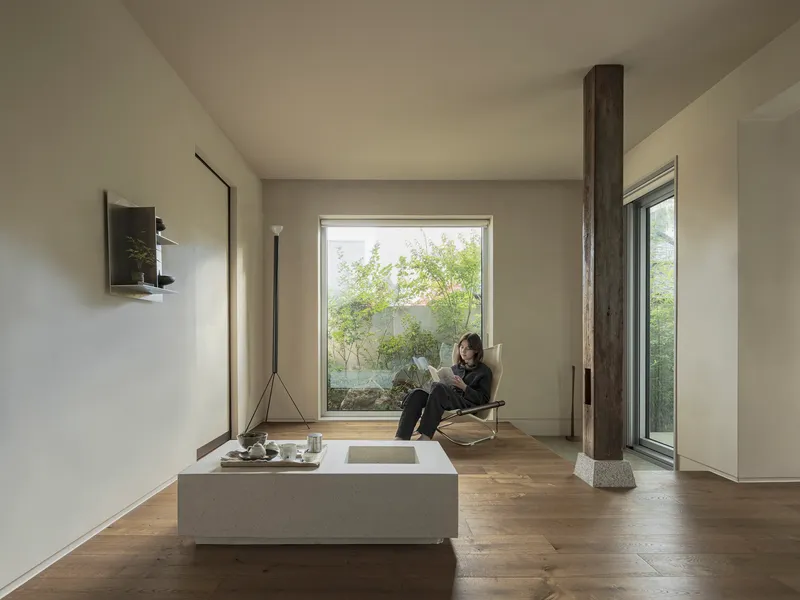
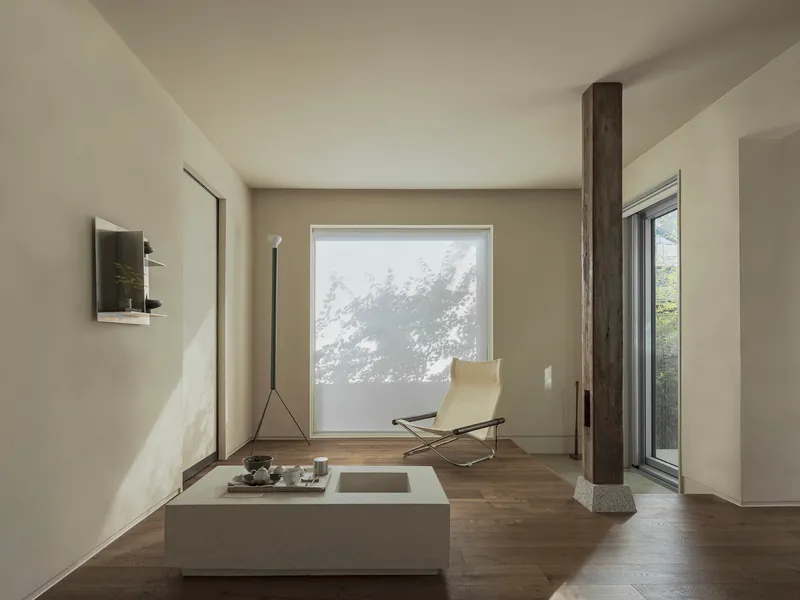
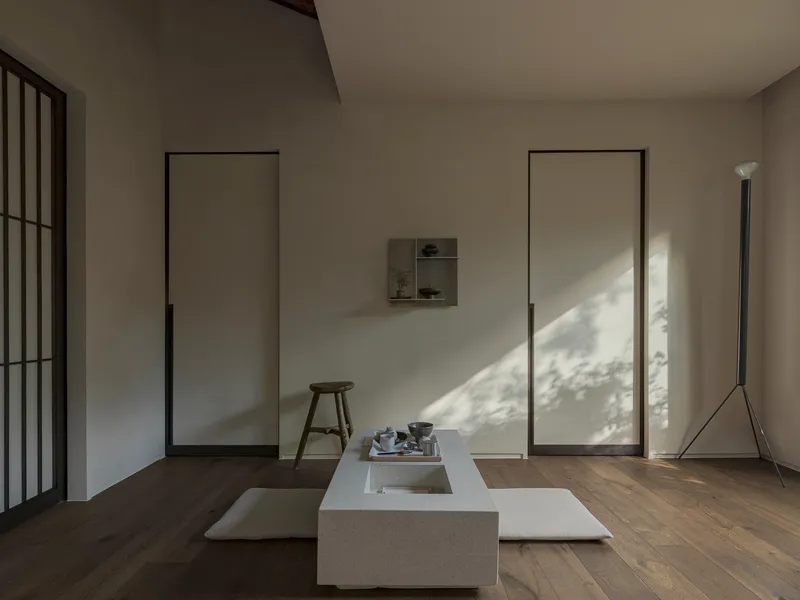
The picture window framing bamboo while a guest reads in a chair is the image that best captures what Hwangi Stay is after. It is not a boutique hotel posture; it is closer to the atmosphere of a private study. The living space with its low table, lounge chair, and translucent screen filtering tree shadows reinforces this quality. Light here is not designed in the theatrical sense. It is simply admitted and allowed to do what it wants across oak floors and flush panel doors.
A low stone platform and the minimal hardware on the doors point to the project's broader philosophy: materials reveal their original colors on every surface, whether line, plane, column, or ceiling. There is no applied finish that pretends to be something it is not. The palette is muted, but the textures are rich enough to hold your attention.
Bathing and Vanity


The bathing rooms are where the renovation's material confidence is most legible. A stone-lined tub sits below a window overlooking greenery, with a person kneeling beside it in a posture that feels almost ceremonial. The vertical timber screen and reclaimed wooden ceiling beams in the adjacent bathroom compress the space vertically while keeping the air warm and resonant. A terrazzo vanity counter with a rectangular basin and suspended mirror completes the sequence, offering the only moment of refined smoothness in a project otherwise dominated by grain and texture.
These are not large rooms, but their proportions are considered carefully enough that they avoid feeling tight. The window placement is key: each bathing space has at least one view to plant life, ensuring that privacy does not come at the cost of connection to the garden.
Courtyard at Dusk
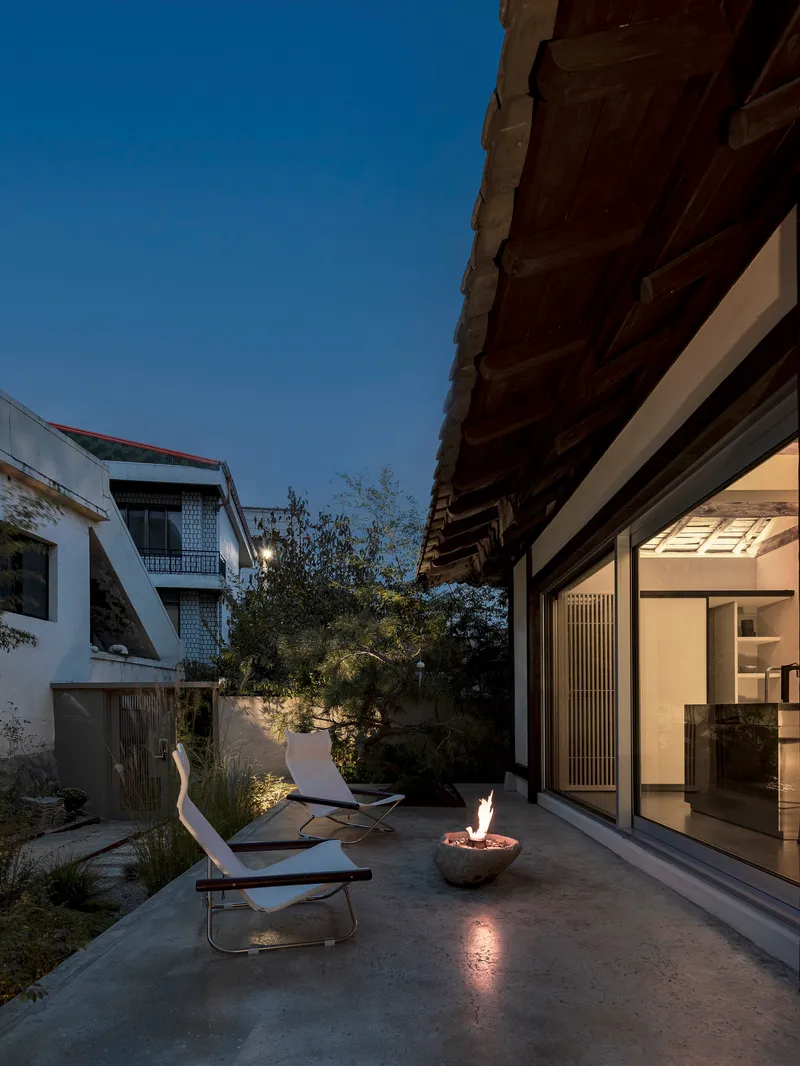
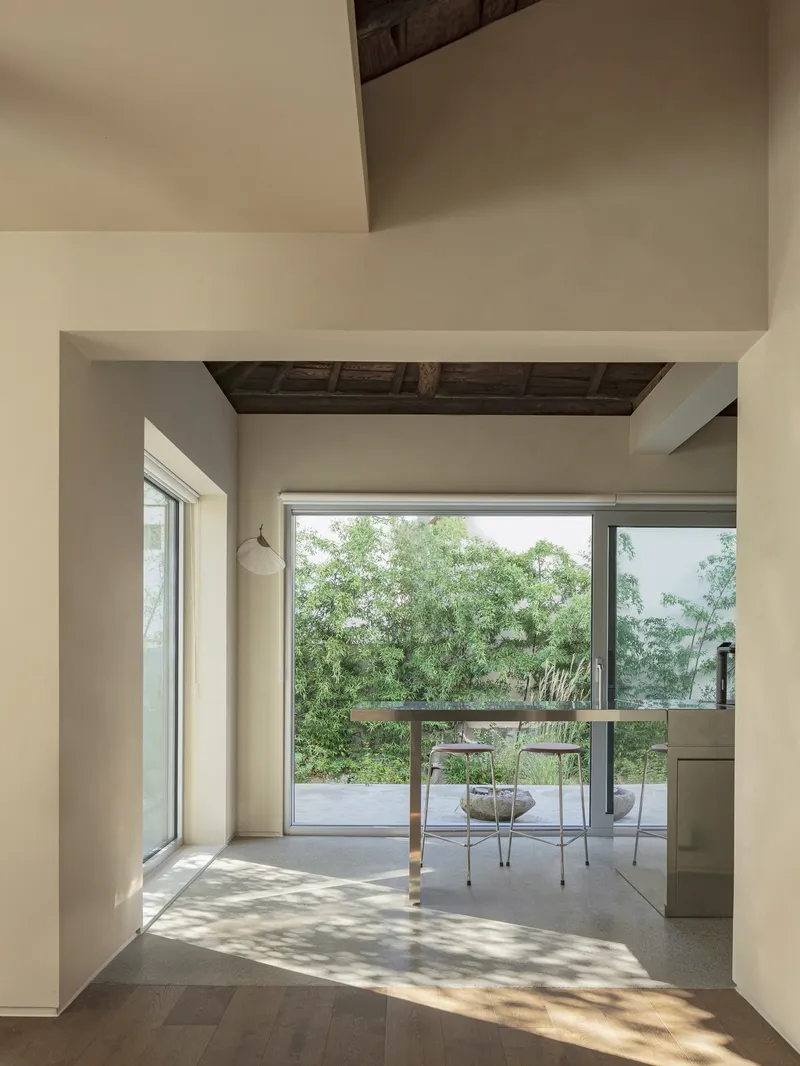

Hwangi Stay's most persuasive moment arrives at dusk, when the courtyard terrace with its fire bowl, lounge chairs, and timber eaves above glazed walls becomes the center of the plan. The house turns inside out: the rooms serve the garden, not the other way around. Dappled sunlight in the interior corridor during the day gives way to the warm glow of the fire and the ambient light leaking through the glass, and the building shifts from a daytime retreat to an evening one without any change in its architecture.
Small details, a hanging coat, a paper lantern against white plaster and exposed ceiling beams, accumulate into an atmosphere that feels lived-in rather than staged. DESIGN2TONE resists the urge to over-curate, and the result is a hospitality space with the gravity of a home.
Plans and Drawings
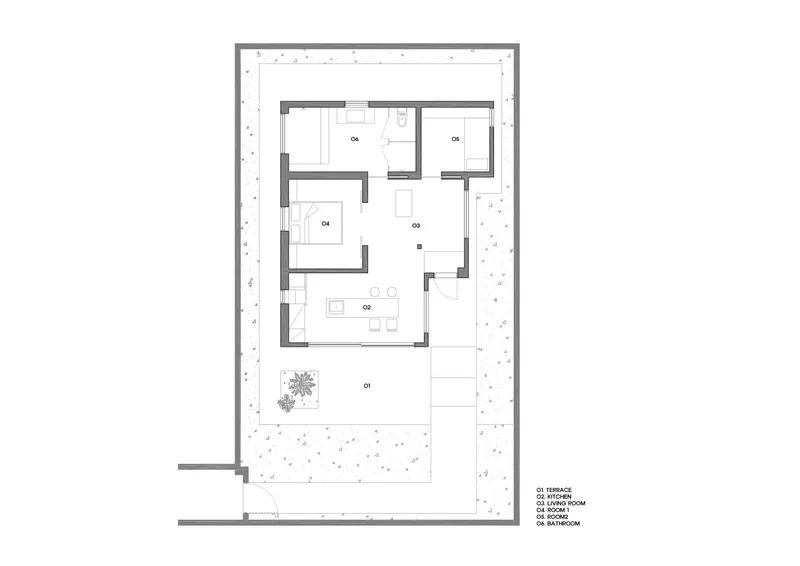
The floor plan confirms what the photographs suggest: a rectangular layout organized around a central living space, with rooms distributed laterally and a courtyard pulling the plan open at one edge. The compactness of the arrangement is striking. Every room has a direct or near-direct relationship to the garden, and circulation is absorbed into the living areas rather than given its own dedicated corridor. For a 64-square-meter renovation, this is a plan with no wasted space and no ambiguity about where you should be at any given hour.
Why This Project Matters
Hospitality renovations of historic building types face a persistent trap: they either embalm the original in a museum-like stillness or gut it for a contemporary program that has no memory of what was there before. Hwangi Stay avoids both mistakes. DESIGN2TONE treats the hanok not as a relic but as a living spatial system, one whose logic of thresholds, gardens, and material honesty still has things to teach contemporary architects. The renovation updates the building's performance without overwriting its character.
At a scale this small, every decision is magnified. The choice to leave wood unfinished, to use stone in the bathing rooms, to frame bamboo in every significant window: these are not flourishes, they are the architecture. Hwangi Stay matters because it demonstrates that a 64-square-meter project, executed with conviction and economy, can carry as much spatial intelligence as buildings ten times its size. That is a lesson worth repeating.
Hwangi Stay, designed by DESIGN2TONE (lead architect: Hyungyeong Choi), Gangneung-si, South Korea. 64 m², completed 2022. Photography by Yongjoon Choi.
About the Studio
DESIGN2TONE
Official website of DESIGN2TONE, one of the studios behind this project.
design2tone.spaceShare Your Own Work on uni.xyz
If projects like this are the kind of work you want to make, uni.xyz is a place to publish your own, find collaborators, and enter design competitions.




Popular Articles
Popular articles from the community


Co-Life: Senior Housing Design That Reconnects Older Adults With the City
Co-Life reimagines senior housing design through healing gardens, shared streets, workshops, and a sustainable community across generations.

The Ocean Hive: Sustainable Architecture for a Self-Sufficient Civilization at Sea
The Ocean Hive imagines sustainable architecture at sea, where modular habitats, algae, wave power and ocean waste sustain a growing colony.
EW PARK: Sustainable Architecture Reimagines the Future of Urban Parking
EW PARK reimagines city parking as a modular wooden tower combining automation, solar energy, electric mobility, and adaptable urban design.

The Earth Pod: 3D Printed Homes for Resilient Refugee Communities
The Earth Pod reimagines refugee housing through 3D printed homes made from clay, combining resilience, self-sufficiency, and rapid shelter.


Similar Reads
You might also enjoy these articles

Bao Huynh Watercolor Atelier: A Serene Art Retreat in Hội An
Bao Huynh Watercolor Atelier in Hội An blends multifunctional art spaces, sustainable design, local materials, and family-friendly living in a serene environment.

Atelier Macri Concept Store Interior Design by CASE-REAL
Atelier Macri store features a "ko" counter, walnut wood details, cork displays, blending retail, gallery, and seamless customer experiences.

Manuel Vargas Izquierdo Stadium and High-Performance Sports Center: Architectural Excellence in Jalpa de Méndez
The Manuel Vargas Izquierdo Stadium blends sustainable design, inclusive sports facilities, and cultural-inspired architecture, revitalizing Jalpa de Méndez’s public spaces.

KAKR Buluh Awar Hall: Revitalizing Community and Ecology Through Bamboo Architecture
Community built bamboo hall revitalizes Buluh Awar village, empowering youth, restoring ecology, celebrating vernacular craftsmanship through sustainable architecture and culture.

Explore Installations Competitions
Discover active competitions in this discipline



Challenge to design a portable theatre


Challenge to design a portable music platform


Challenge to design an open learning module for the elderly
Comments (0)
Please login or sign up to add comments
No comments yet. Be the first to comment!