

Compact Home: Industrial Steel Frames and Courtyards for Affordable Density
A modular housing system pairs exposed steel structure with planted courtyards to rethink compact living in warm climates.


Strip away the drywall, hide nothing, and let the skeleton of a building become its identity. That is the premise driving this compact housing proposal, which treats exposed steel cross-bracing and corrugated metal cladding not as budget compromises but as deliberate architectural language. The result is a neighborhood of three-story blocks that read simultaneously as industrial infrastructure and domestic architecture, held together by a rhythm of planted palm courtyards that soften the rawness of the frame.
Designed by Sara Zangeneh, Mohammad Pakdaman, Boshra Omidvar, Maede Soleiman, Yazdan Irannejad, and Saba Bashtani, the project was submitted to the Compact Homes competition on uni.xyz. The brief challenged entrants to reimagine small-footprint housing that remains livable, affordable, and replicable. This team responded with a modular steel system that can be assembled rapidly and adapted to different unit configurations, anchoring its site strategy in parallel linear blocks with generous shared green space between them.
Parallel Blocks, Palm Grids, and a Legible Site Logic
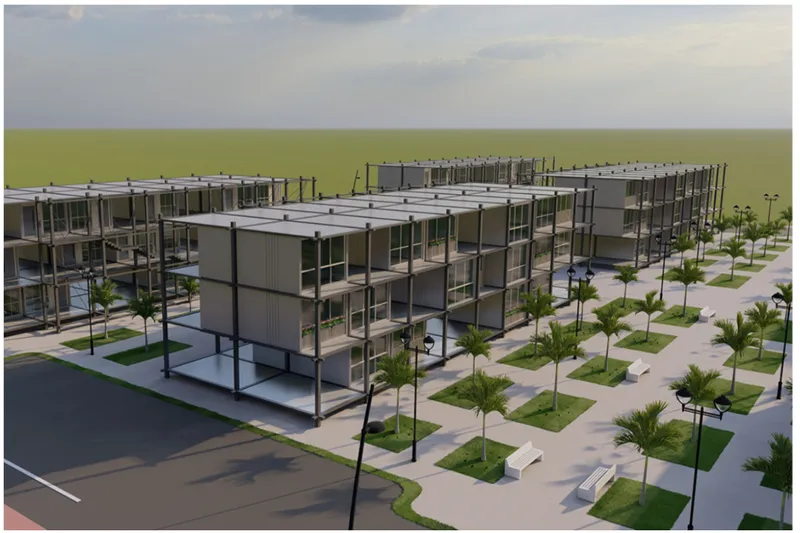
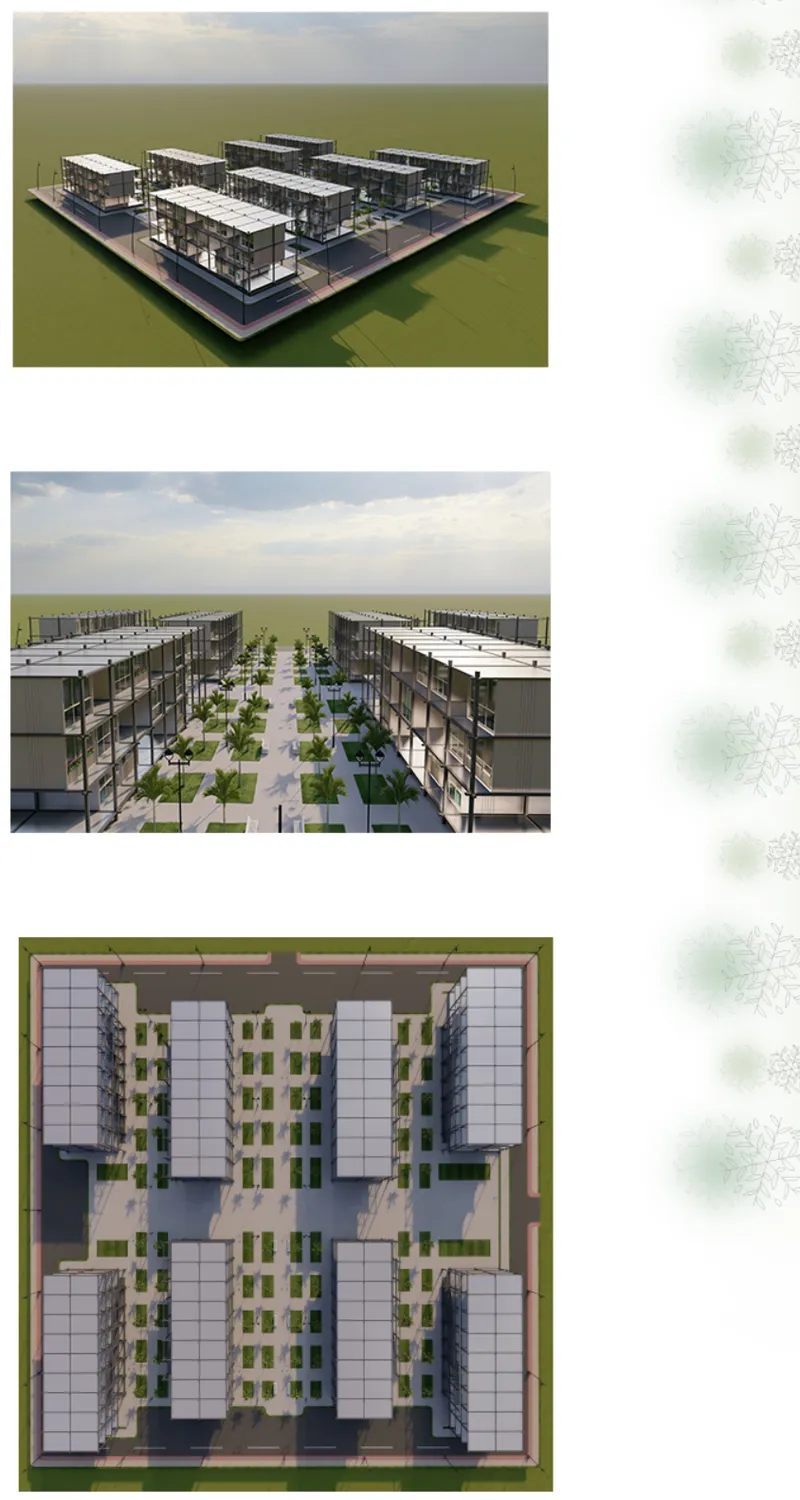
The aerial rendering and site plan reveal a straightforward organizational idea: rectangular housing blocks arranged in parallel rows with courtyards running between them like planted corridors. The grid of palm trees is not decorative filler; it establishes a microclimate strategy, filtering sunlight and channeling breezes through the gaps between buildings. In a warm climate, this matters enormously. The spacing between blocks is calibrated to allow each unit access to daylight while maintaining enough density to justify shared infrastructure.
What makes the layout convincing is its repeatability. Each block follows the same structural bay, which means the entire site can grow incrementally. Add another row, extend the palm grid, and the neighborhood scales without losing coherence. That kind of modular urbanism is difficult to achieve when every building insists on being unique. Here, consistency is a virtue.
The Skeleton as Facade: Exposed Steel and Corrugated Skin
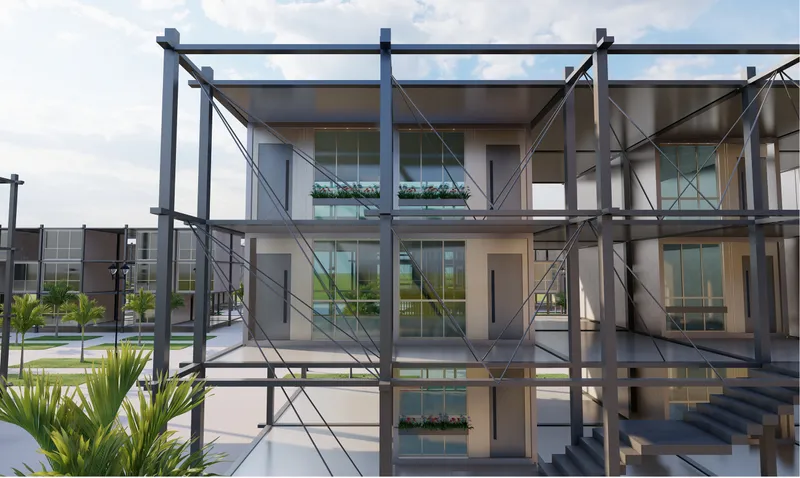
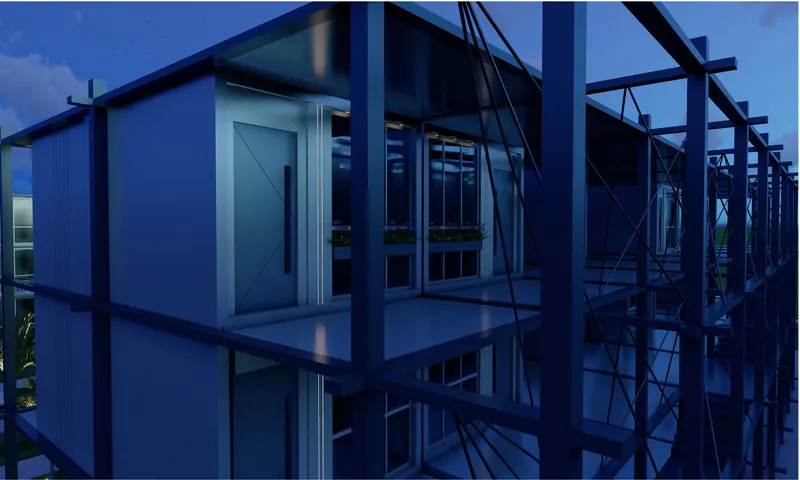
The close-up views of the structure make the design's real argument visible. Diagonal cross-bracing, bolted connections, and exterior steel staircases are all left exposed, turning the building's engineering into its primary ornament. The glazed units sit within this cage, and the contrast between the warm glow of interior light and the dark steel lattice gives the facades a lantern-like quality at dusk. There is an honesty to this approach: residents and passersby can read exactly how the building stands up.
Corrugated metal cladding fills the non-glazed bays, adding texture and a sense of material economy. The palette is deliberately limited: steel, glass, metal sheet, and concrete at grade. No applied finishes compete for attention. For a compact housing project, this restraint keeps construction costs legible and maintenance straightforward, two qualities that matter far more than they tend to in competition renderings.
Three Stories, One Street Presence
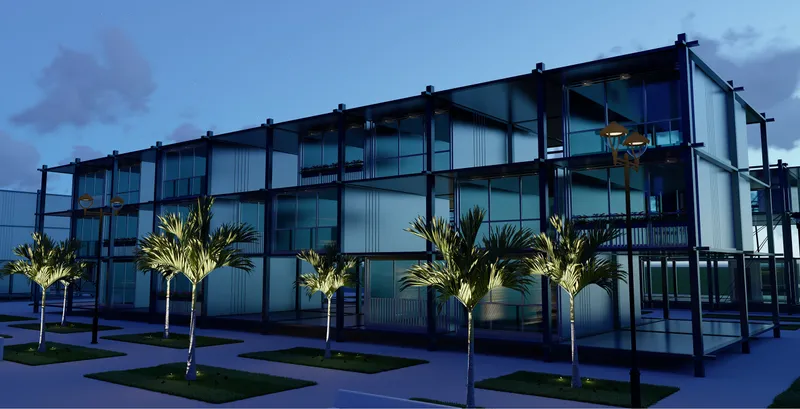
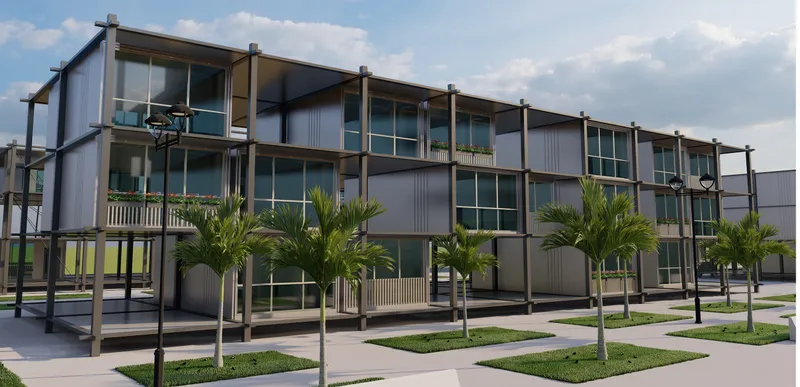
At the scale of a single block, the three-story massing keeps the project in a sweet spot: tall enough to achieve meaningful density, low enough to maintain a relationship with the ground plane and the palm canopy. The dusk rendering shows how the illuminated units create a varied pattern across the facade, with some bays open and others screened by corrugated panels. That variation suggests different unit types or different orientations within a common structural frame, hinting at a catalog of configurations rather than a single floor plan repeated endlessly.
The street-level presence is activated by the transparency of the steel frame. Ground-floor columns are slender enough that the building feels permeable, not fortress-like. Palms planted close to the facade blur the boundary between courtyard and building, creating a layered threshold that is neither fully public nor fully private.
Warm Interiors Behind the Industrial Shell
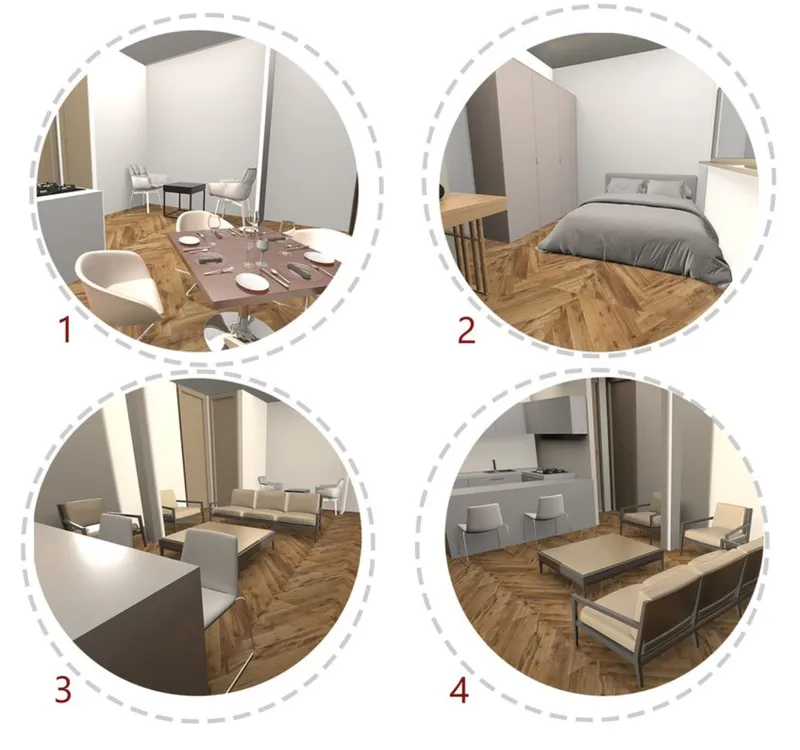
The four interior views reveal a deliberate tonal shift from the exterior's raw materiality. Herringbone wood flooring, arched openings between rooms, and warm ambient lighting create domestic spaces that feel generous despite their compact footprints. The arched openings are a particularly smart move: they introduce a softer geometry that counters the rectilinear steel grid outside, signaling to occupants that they have crossed from the collective structure into their own home. Each room, whether kitchen, living area, bedroom, or dining space, is compactly organized but never cramped.
The contrast between interior and exterior is not accidental. It suggests a design philosophy where the public face of housing can be economical and systemic while the private interior invests in tactile comfort. That distinction is worth noting: too many compact housing proposals treat austerity as a uniform condition. Here, the steel frame earns its keep by freeing interior walls from structural duty, allowing each unit to be configured with fewer constraints.
Why This Project Matters
Compact housing competitions often produce proposals that lean on clever furniture or transformable rooms to justify their small footprints. This project takes a different path, focusing instead on the structural and urban systems that make compact living viable at scale. The exposed steel frame is not an aesthetic choice layered on top of a conventional building; it is the building, and that directness gives the proposal credibility. You can imagine this being built, costed, and maintained without the kind of magical thinking that plagues many conceptual housing schemes.
The team of six designers managed something that larger groups often struggle with: a consistent voice. From the site plan to the interior detailing, every decision reinforces the same argument about honest materiality, modular repetition, and the strategic use of landscape as infrastructure. If compact housing is going to gain traction in rapidly urbanizing regions, it will need exactly this kind of systematic thinking, projects that treat economy not as a limitation but as a design driver.
View the Full Project
About the Designers
Designers: Sara Zangeneh, Mohammad Pakdaman, Boshra Omidvar, Maede Soleiman, Yazdan Irannejad, Saba Bashtani
Enter a Design Competition on uni.xyz
uni.xyz runs architecture and design competitions year-round that reward proposals with spatial conviction and real site intelligence.
Project credits: Compact homes by Sara Zangeneh, Mohammad Pakdaman, Boshra Omidvar, Maede Soleiman, Yazdan Irannejad, Saba Bashtani Compact Homes (uni.xyz).


Popular Articles
Popular articles from the community


Faces of the Soviet Avant-Garde: Turning Moscow's Street Names into an Open-Air Museum
A network of sculptural installations across a Moscow residential district transforms forgotten architect names into spatial encounters with cultural memor

Opera on the Sea: Driftwood Logic Shapes a Timber Opera House on Estonia's Coast
Trevor Orgill's opera house translates the entangled drift of floating timber into a civic building where wood, water, and music converge.

Cloaked Colonization: A Mobile Underwater Habitat That Moves Like a Fish
Micah Abaya's shortlisted EHC Pacific entry reimagines ocean settlement as a dispersed network of self-sustaining architectural organisms.

Singing Woman: An Opera House That Performs Before the Curtain Rises
Ovidiu Cristian Pavel's conceptual opera house translates Estonia's choral identity into a sculpted waterfront landmark facing the Baltic Sea.

Similar Reads
You might also enjoy these articles

Shakur's House: Exposed Brick as an Interior Organiser in a 168 m² Mashhad Residence
Brick moves indoors in this Mashhad residence, where masonry walls, glass partitions and teal planes sequence a compact home without closing it off.

Day and Night Park: A Time-Based Urban Newsstand in Beijing
A temporary urban newsstand in Beijing blending travel, light, and reading through poetic colors, compact form, and community-focused design.

Modernist Patio Renovation in El Masnou, Barcelona by Oliver Segura Arquitectura + Cebrià Arquitectura
Modernist patio renovation blending tradition and innovation with a movable pool, leveled floors, and Catalan materials in El Masnou.

Alto Residencial Coop: Cooperative Housing Development in Santiago de Compostela by Carbajo Barrios Arquitectos
A linear cooperative housing complex blending white volumes and perforated metal façades, enhancing community living, natural light, privacy, and urban integration.

Explore Modular Housing Competitions
Discover active competitions in this discipline

Challenge to visualize a collision of the future and past

Challenge to visualize future spaces of waste

Challenge to visualize slums of 2080

Challenge to illustrate the ruins of Petra
Comments (0)
Please login or sign up to add comments
No comments yet. Be the first to comment!