

Devyni Architektai Builds an 80 m² Retreat for One Man and His Motorcycle in Rural Lithuania
A barn-shaped plywood and timber shelter in the meadows of Švenčionys doubles as garage, kitchen, and personal escape.


The brief is absurdly specific and utterly honest: give one person a place to park a motorcycle, cook a meal, play foosball, and disappear from the world. Devyni Architektai, led by Jurgita Liubartaite and Arunas Skrolis, answered with an 80 m² gabled volume dropped into a meadow clearing near Švenčionys, Lithuania. The building borrows the proportions and silhouette of a regional barn, but every detail, from charred timber cladding to a conical pendant light cluster over a black steel kitchen island, is calibrated for a single occupant's rituals rather than agricultural storage.
What makes the project interesting is its refusal to treat leisure architecture as frivolous. The construction relies on wood sourced from surrounding workshops, local craftsmen, and a material palette (Ruukki metal roofing, Steico insulation, Fibo and Doleta components) that keeps the supply chain tight and the ecological footprint low. The result is a building that looks like it has always been in its field, yet the moment you step inside and see a motorcycle parked on a cowhide rug beneath exposed timber rafters, the program reveals itself as something far more particular.
A Barn That Belongs to Its Field
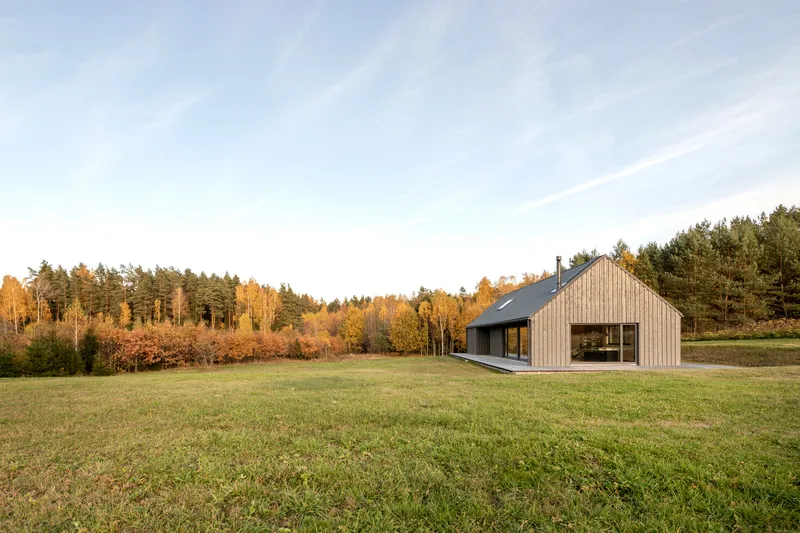
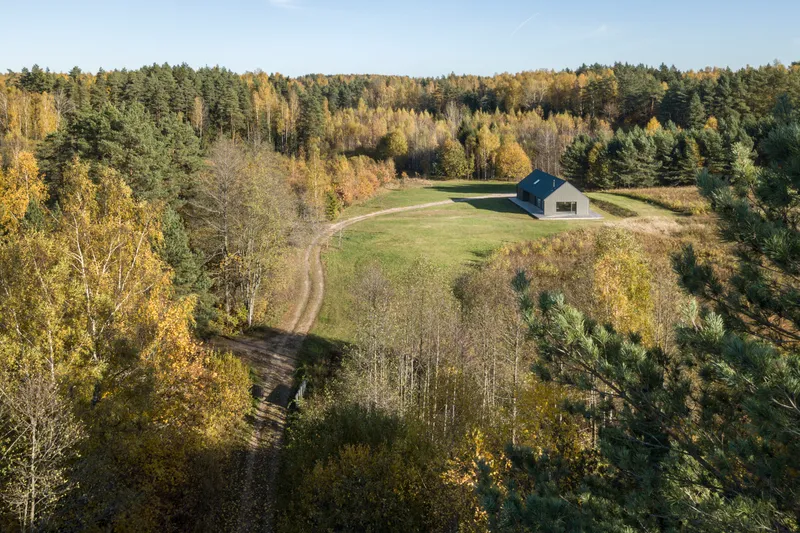
Positioned at the foot of a gentle slope, the building sits at the center of a clearing ringed by autumn forest. Aerial views make the strategy plain: a single gabled form, oriented to catch southern light, with a winding dirt track as its only connection to anything resembling a road. One side of the structure is nearly swallowed by the rising terrain and wild vegetation; the other opens fully to the meadow. The asymmetry gives the retreat two distinct personalities: a sheltered, almost hidden back and a confident, glazed front.
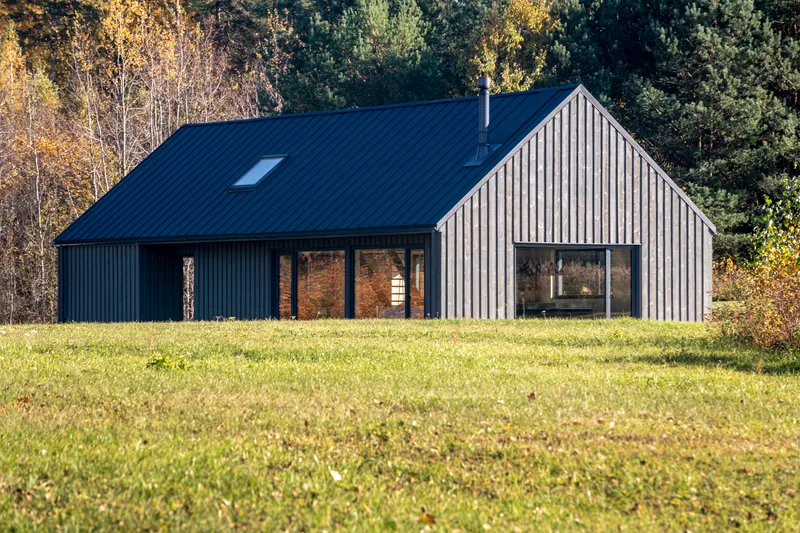
The proportions are deliberately modest. At 80 m² the footprint is closer to a generous garage than a house, but by stretching the gable vertically the architects create enough volume for a mezzanine loft without adding bulk. From a distance, especially at golden hour, the dark silhouette reads as nothing more exotic than a Lithuanian hay barn. That anonymity is the point.
Two Faces in Timber and Metal


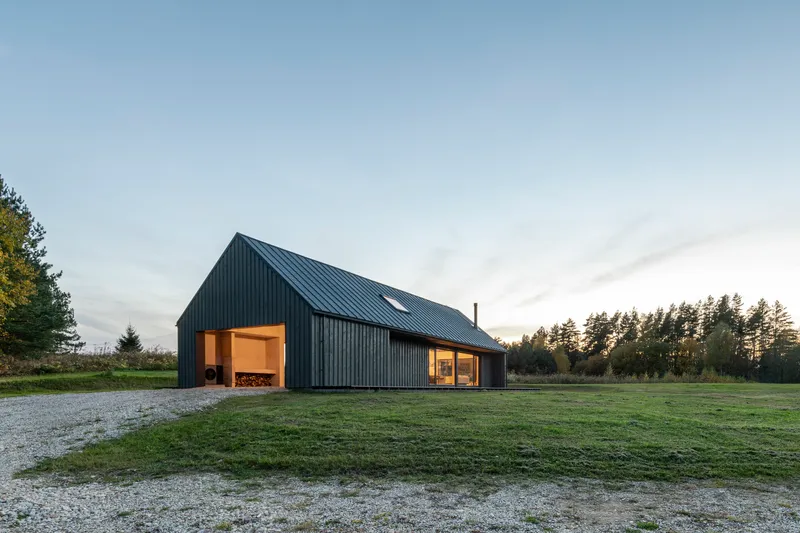
The cladding strategy divides the envelope into zones. Vertical timber boards, some left to weather to silver-grey, wrap the primary gable ends and the long facade that faces the meadow. A standing-seam metal roof in dark matte tones caps the volume cleanly, folding down at the eaves without overhangs. On the entry side the material shifts: dark corrugated metal siding with recessed openings and horizontal louvers creates a more industrial, closed expression.
The contrast is not decorative. The timber side is the social face, the one you see from the lawn, where full-height glazing and a timber deck invite you outside. The metal side is the service face, containing the covered approach and parking. Walk around the building and you move from pastoral warmth to something closer to a workshop aesthetic. Both readings feel correct for a space that is simultaneously a domestic refuge and a hobbyist's garage.
Threshold as Theater

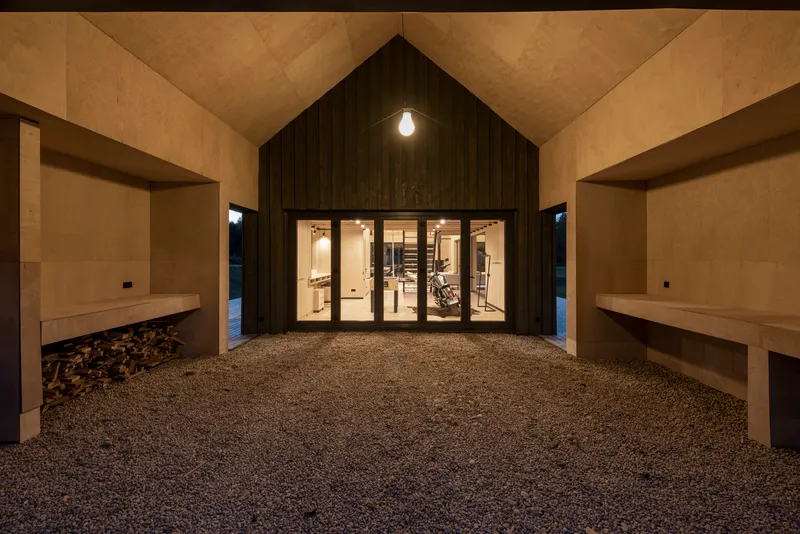
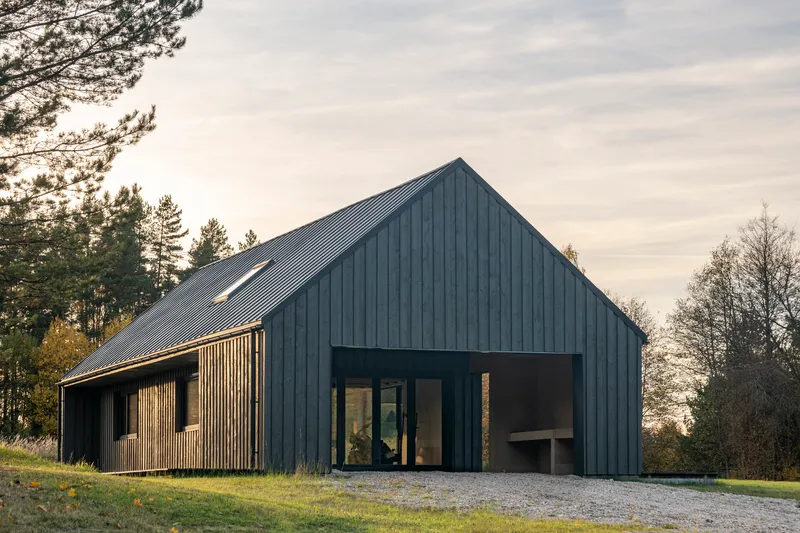
Arrival is handled with care. A wide central opening in the weathered gable end creates a framed void, a covered courtyard of gravel and light that mediates between the field and the interior. At dusk, warm light spills from within, turning the opening into a lantern. Timber screens and slatted panels filter views without sealing them off, and the deep recess gives the entrance a monastic gravity that feels intentional for a building nicknamed a "man cave."
The threshold sequence, from dirt track to gravel courtyard to interior, slows you down. There is no front door you push open in a hurry. Instead, you pass through layers: landscape, then shadow, then the warmth of plywood.
Living Under the Roof
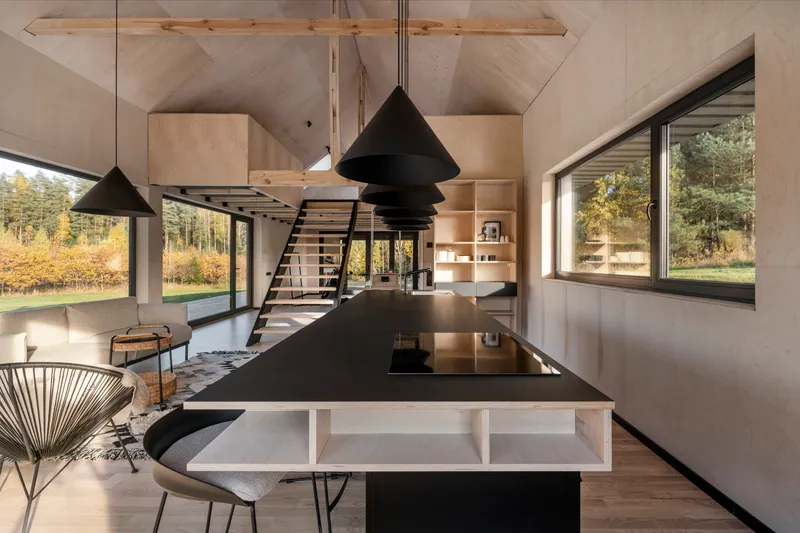

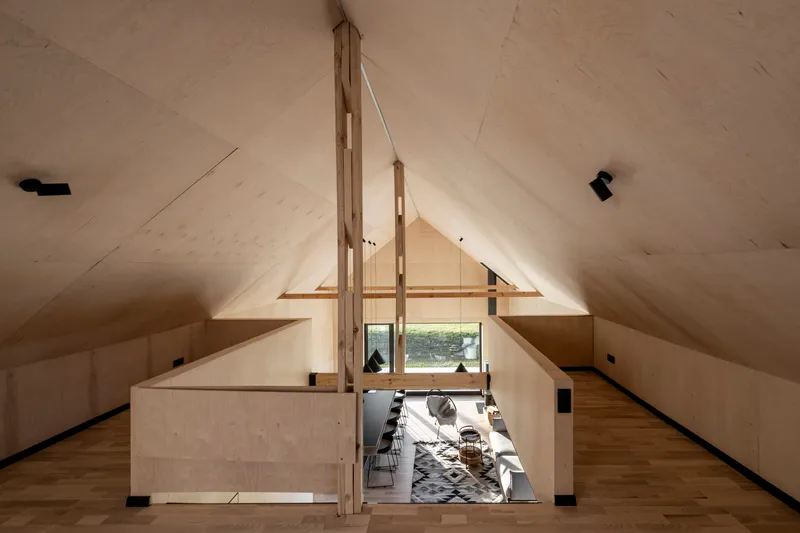
Inside, the pitched roof becomes the room. Plywood lines the vaulted ceiling, its warm honey tone offset by a black steel kitchen island and matching staircase. Four conical pendant lights drop from the ridge beam, clustering over the island like a small constellation. Exposed timber beams cross the space at regular intervals, giving rhythm to a plan that is otherwise entirely open.
A partial mezzanine level, reached via the steel stair, overlooks the double-height volume without subdividing it. From the loft you can look down at the kitchen, the living area, and, yes, the motorcycle parked on its rug. The section exploits every cubic meter the gable provides, turning what could be dead attic space into a second register of inhabitation.
Motorcycle, Foosball, and No Apologies
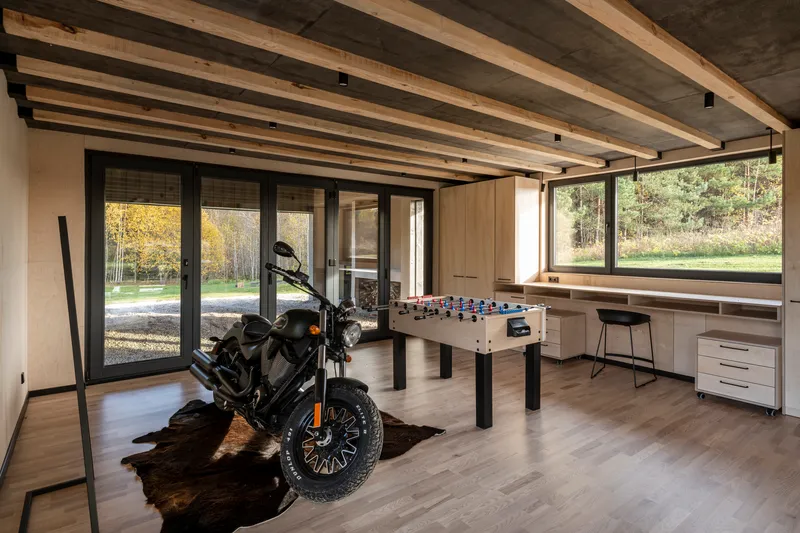
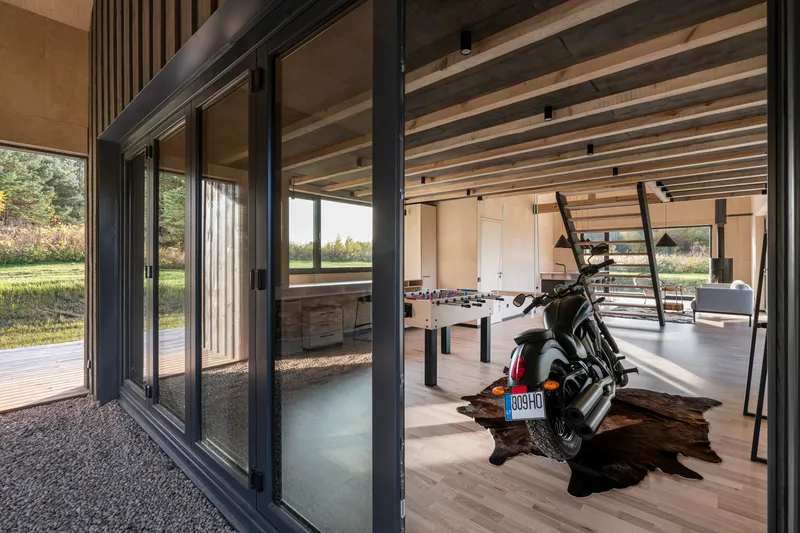
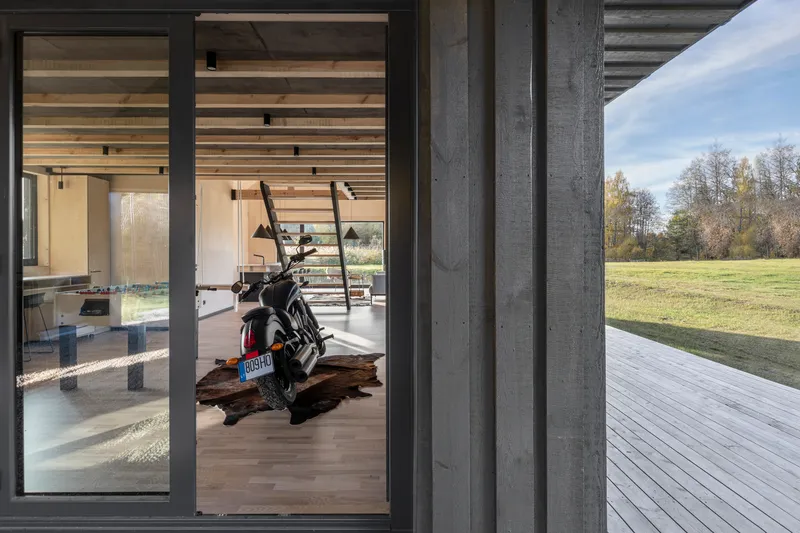
The program is unapologetically singular. A motorcycle sits in the main living space not behind a garage door but on display, framed by folding glass doors and exposed rafters. A foosball table occupies the remaining floor area. The charred timber cladding visible at the threshold gives way to warm plywood and cowhide inside, a material shift that marks the boundary between the rugged exterior world and a curated personal interior.
What saves this from being merely indulgent is the architectural discipline applied to such a casual brief. The folding glass panels collapse the wall between inside and meadow. The charred timber details at the door jambs show that fire-finishing was not a whole-facade gesture but a selective accent. These are decisions made by architects taking a playful commission seriously, and the building is better for it.
Landscape as Living Room
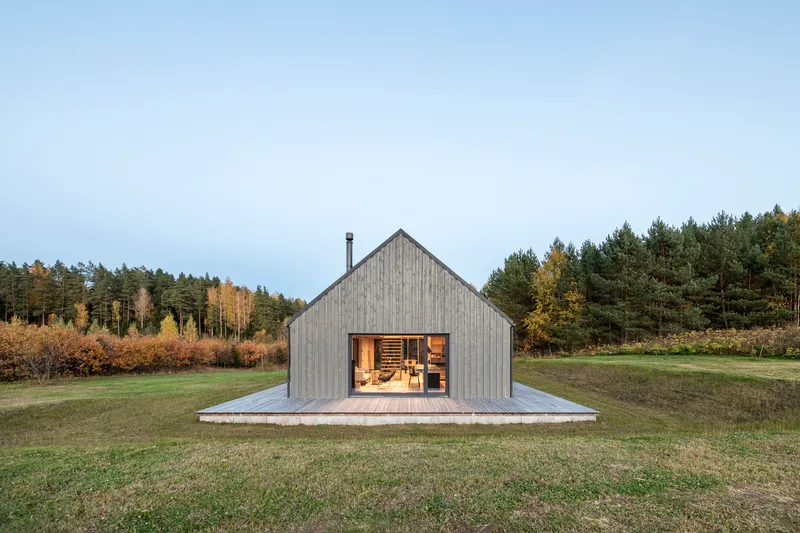
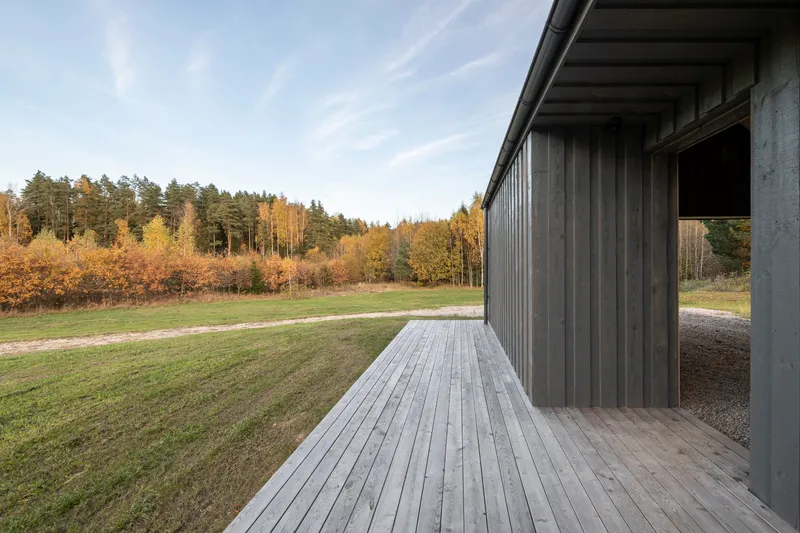
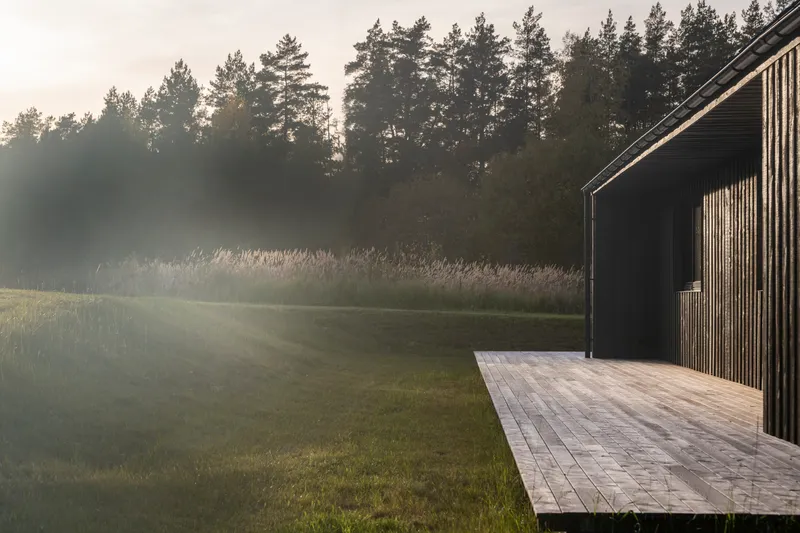
A timber deck extends from the glazed gable end into the meadow, functioning as an open-air room with no railing and no overhead cover. On misty mornings the deck dissolves into the field. At dusk, warm light from the interior stretches across the boards and onto the grass. The sliding window system allows the full gable end to open, erasing the wall plane entirely and turning the interior into a deep, sheltered porch.
Along the long facade a covered deck runs beneath the vertical-slatted screen, offering a shaded linear walkway with filtered views of autumn foliage. The two outdoor zones are complementary: one expansive and exposed, the other narrow and protected. Together they give the 80 m² interior a spatial reach far larger than its footprint.
Kitchen as Anchor

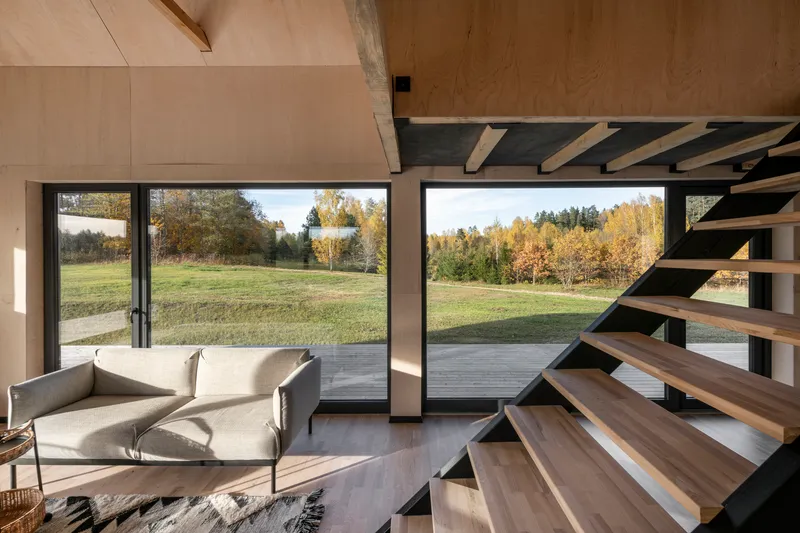
The black metal kitchen island is the building's gravitational center. Positioned directly below the pendant lights and in front of a horizontal window that frames the landscape like a letterbox, it organizes movement through the open plan. The staircase rises beside it, the motorcycle parks across from it, and the folding glass doors open just beyond it. Everything in the house relates to this counter.
From the exterior, the two-volume composition of dark and light timber gables reads as a pair of barns in conversation. But inside, the program is unified: one room, one island, one person's rituals. The architecture gives that simplicity a frame worthy of attention.
Dusk Portraits
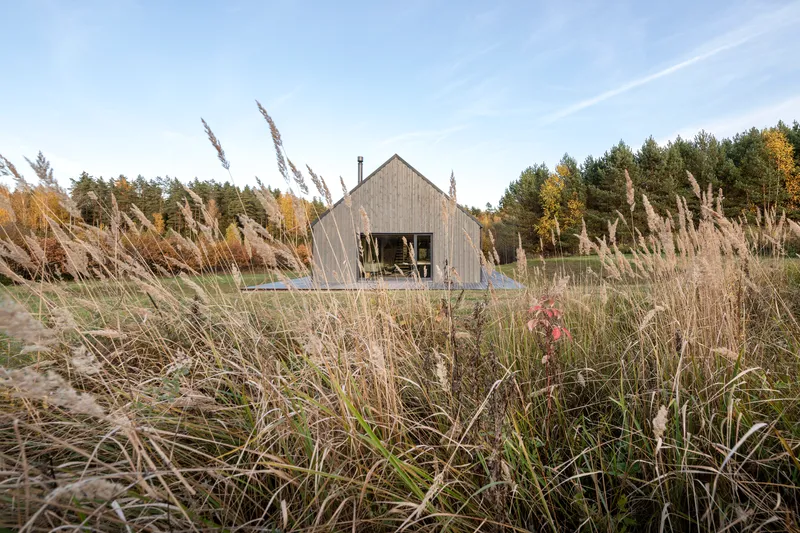

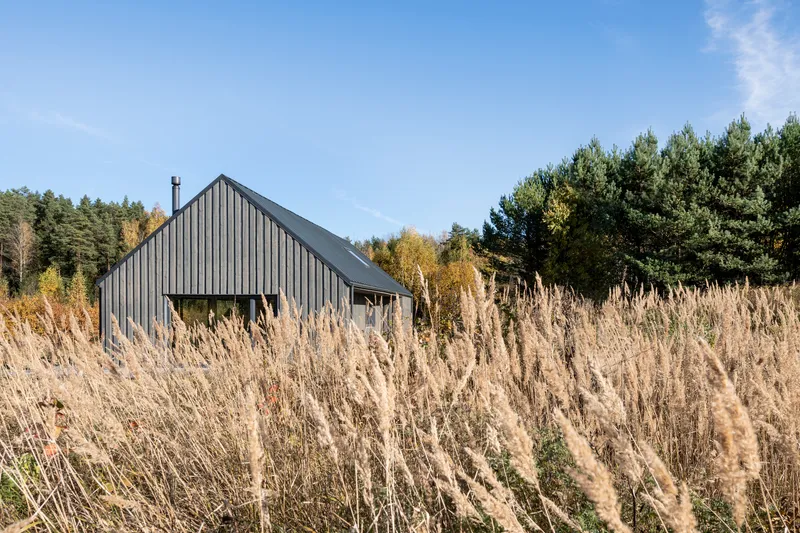
Seen through a foreground of wild grasses and flowering plants, the weathered timber gable end has the presence of a ruin already half-reclaimed by the landscape. The architects chose to let the wood age without treatment on certain panels, creating a gradient of silver and brown that will deepen over years. It is a bet on time, and at this stage it is already paying off.
Plans and Drawings
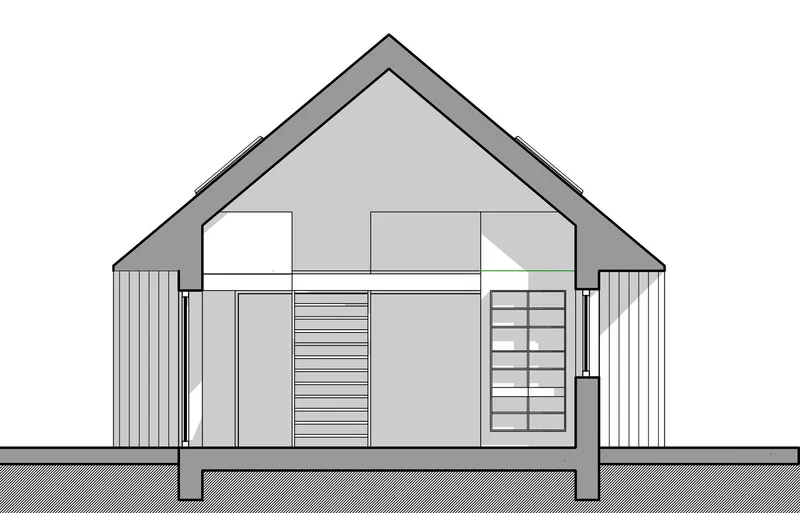
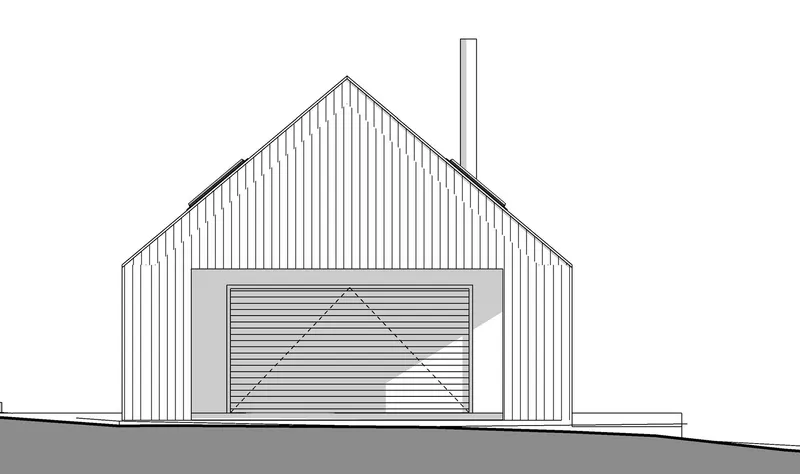

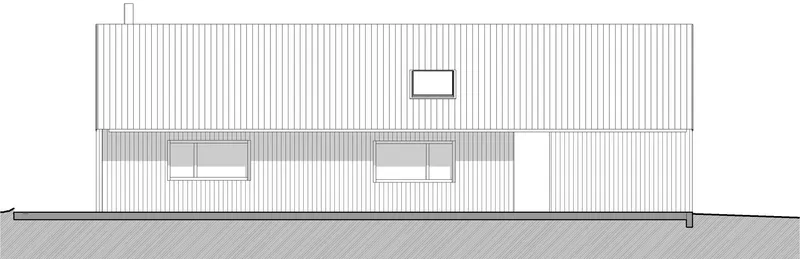
The floor plan confirms what the photos suggest: the entire ground level is a single open volume with the kitchen island at its center, a motorcycle and vehicle parking zone near the entry, and a staircase rising to a partial mezzanine. The section drawing reveals how the steep pitch of the gable creates a double-height space with the loft tucked under the ridge. Elevations document the contrast between the closed, louvered entry facade and the open, glazed meadow-facing end. Clerestory windows along the long sides pull daylight deep into the plan.
Why This Project Matters
The "man cave" label invites condescension, and that is precisely why the Lithuanian Man Cave is worth examining. Here is a building that takes a personal, even eccentric, brief and applies to it the same rigor you would expect from a cultural institution: locally sourced materials, a clear site strategy, a disciplined section, and a thoughtful relationship to landscape. The fact that its primary occupant is a motorcycle rather than a collection of paintings does not diminish the architectural intelligence at work.
Devyni Architektai demonstrates that small-scale rural commissions can produce architecture of real substance when architects refuse to coast on charm. The barn silhouette is a familiar trope, but the material specificity, the sectional play, and the deliberate blurring of interior and meadow push this project beyond pastiche. At 80 m² it is a reminder that constraint and conviction, not square meters, determine how much a building can say.
Lithuanian Man Cave, designed by Devyni Architektai (lead architects Jurgita Liubartaite and Arunas Skrolis). Located in Švenčionys, Lithuania. 80 m². Completed in 2022. Photography by Leonas Garbačauskas.
About the Studio
Share Your Own Work on uni.xyz
If projects like this are the kind of work you want to make, uni.xyz is a place to publish your own, find collaborators, and enter design competitions.


Popular Articles
Popular articles from the community


U.GA Architects Wraps an Oval Rooftop Pool in Curved Board-Formed Concrete on Busan's Jeollidan-gil
In Busan's Jeonpo-dong, a 454 m² mixed-use block stacks a neighborhood facility, guest rooms and an oval rooftop pool inside spiraling concrete walls.

Architekt Andreas Gruber Scatters 23 Dark Timber Chalets Across a South Tyrolean Forest Edge
In Molini di Tures, Amonti Chalets breaks a resort into a hamlet of gabled timber houses, with parking, storage and services pushed into the slope.

David Ortega Stacks a Two-Story Mexico City Penthouse Around a Steel Stair and a Pergola-Shaded Roof Terrace
In Colonia Roma, a 300 m² penthouse uses oak joinery, a planted steel stair and a slatted roof pergola to make a new-build apartment feel like a house.

GROUP A Strips a 1969 Rotterdam Harbor Headquarters to Its Frame and Wraps It in Timber Louvers
In Rotterdam's M4H harbor district, Ferro Offices reuses a 1969 frame, adds one timber storey and reaches BREEAM-NL Outstanding.

Similar Reads
You might also enjoy these articles


LAVA Architecten Gives Vocational Education a Sawtooth-Roofed Face on a Mechelen School Campus
In Mechelen, Belgium, a 2,053 m² STEM school on a 6×6 m grid turns workshops and classrooms into rooms that can be rearranged as teaching changes.

KEMA Studio Turns a Derelict Marvila Attic into a 60 m² Lighthouse Apartment Above Lisbon
In Lisbon's Marvila district, a rebuilt roof, four skylights and two plywood volumes turn an unlivable attic into a bright home facing the Tagus.

Pixel Gardens: One Repeated Module Stacked Into a Terraced Social Housing Tower for Famagusta
Salem Bader's shortlisted housing tower builds a vertical neighbourhood from one repeated module, offsetting units to carve terraces, light and air.

Bao Huynh Watercolor Atelier: A Serene Art Retreat in Hội An
Bao Huynh Watercolor Atelier in Hội An blends multifunctional art spaces, sustainable design, local materials, and family-friendly living in a serene environment.

Explore Cave Competitions
Discover active competitions in this discipline

Challenge to design mud housing for contemporary communities

Challenge to reimagine the Iron Throne

Photograph architecture without architects

Illustrate the lost glory of Angkor Wat - Render Challenge
Comments (0)
Please login or sign up to add comments
No comments yet. Be the first to comment!