
D'Houndt+Bajart and Associés Build a 228-Room Coliving Village Around a Wildflower Courtyard Near Lille
A concrete arcade frames communal life in Villeneuve-d'Ascq, turning a tired business district into a 13,500 m² neighborhood.


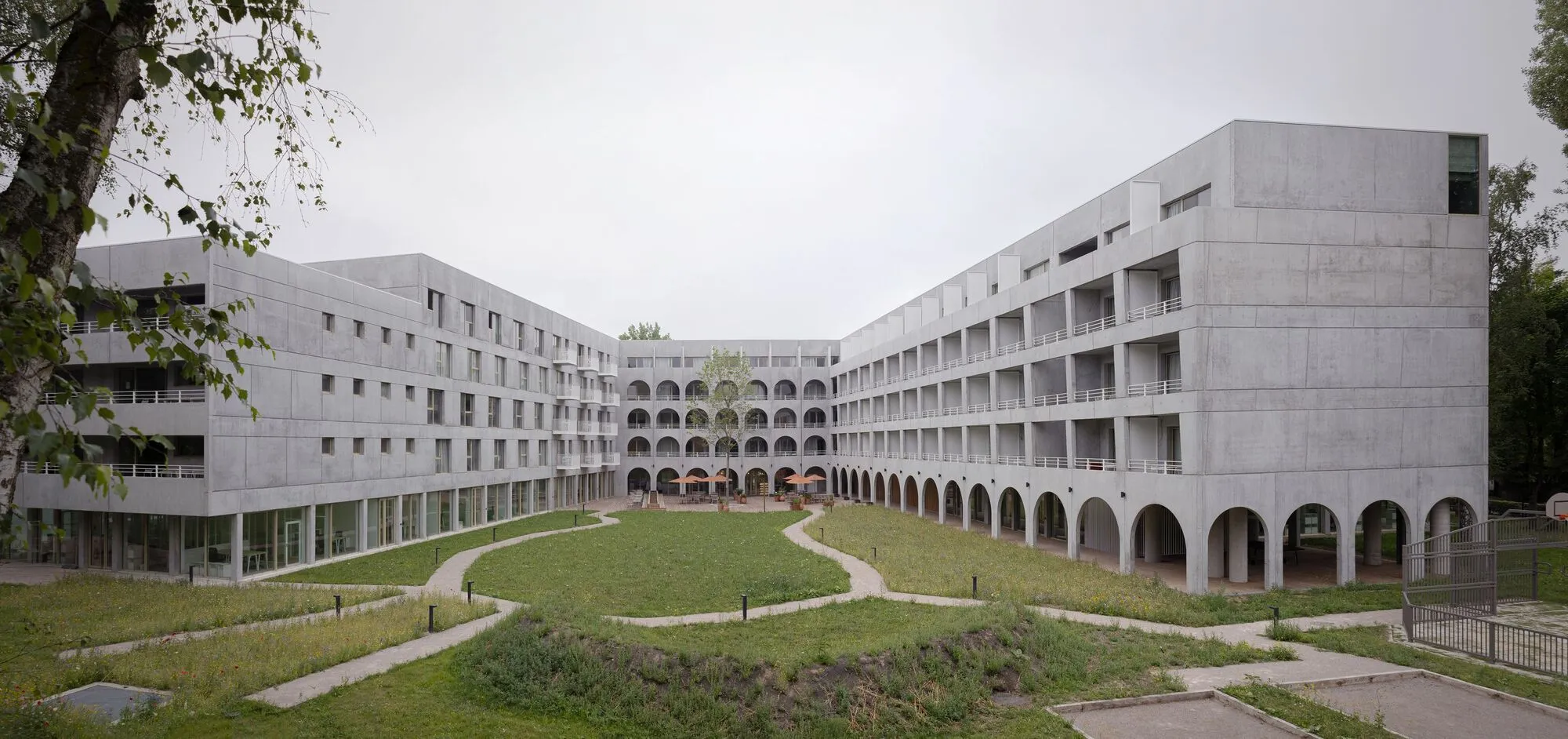
Coliving has become a familiar pitch in European real estate, but the buildings that house it rarely go beyond the formula of stacked micro-units with a shared kitchen on every floor. The Babel Community in Villeneuve-d'Ascq, completed in 2025 by D'Houndt+Bajart and Architectes Associés, takes a different approach. Instead of a single tower or linear slab, the architects organized 228 coliving rooms, 24 shared apartment rooms, 63 hotel rooms, 1,500 square meters of coworking, a restaurant, a fitness room, a squash court, and a city sports pitch around a generous central courtyard planted with wildflower meadows and young trees. The project reads less like a residence and more like a small campus, one that bets on ground-level social infrastructure rather than rooftop amenity decks.
What makes the architecture genuinely interesting is its commitment to the arcade as an organizing device. Rounded concrete arches run along the ground floor of nearly every wing, wrapping the courtyard in a continuous covered walkway that dissolves the line between indoor circulation and outdoor landscape. In a business district that was developed roughly forty years ago and designed primarily for cars, this pedestrian cloister is a deliberate provocation: it argues that the neighborhood's next chapter should be walkable, social, and generous at eye level.
A Concrete Arcade That Holds the Plan Together
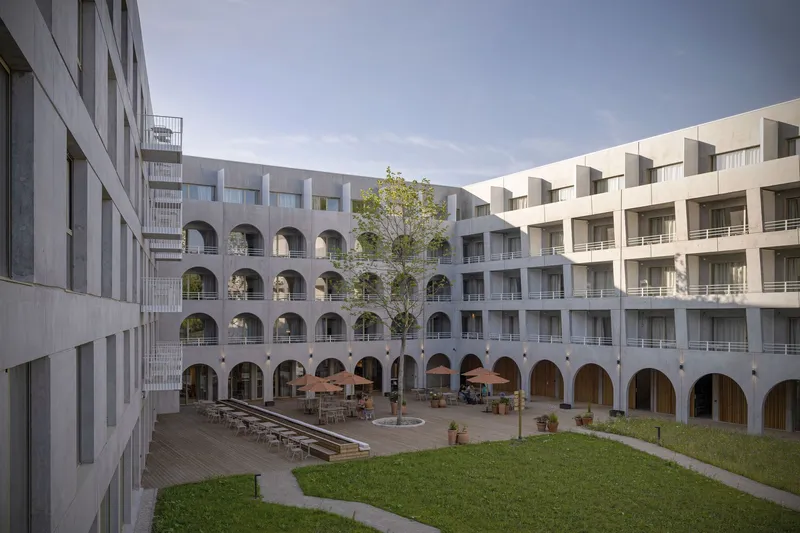
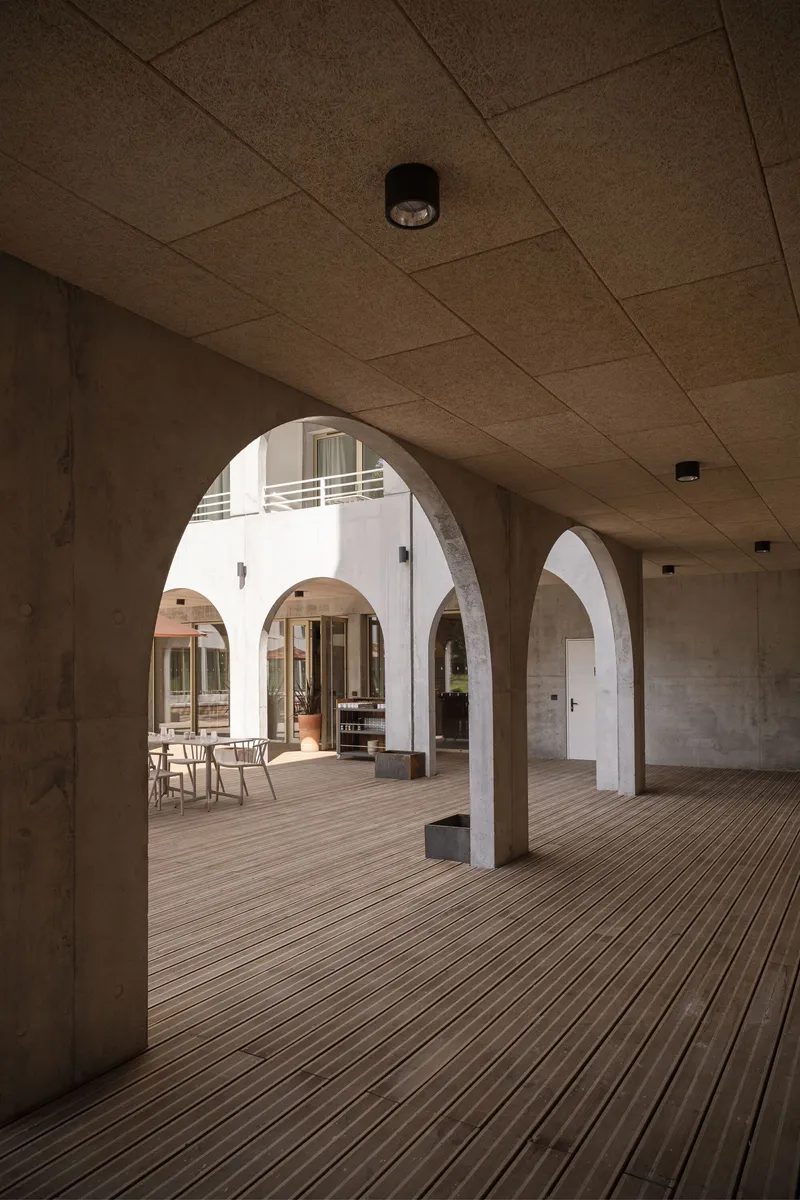
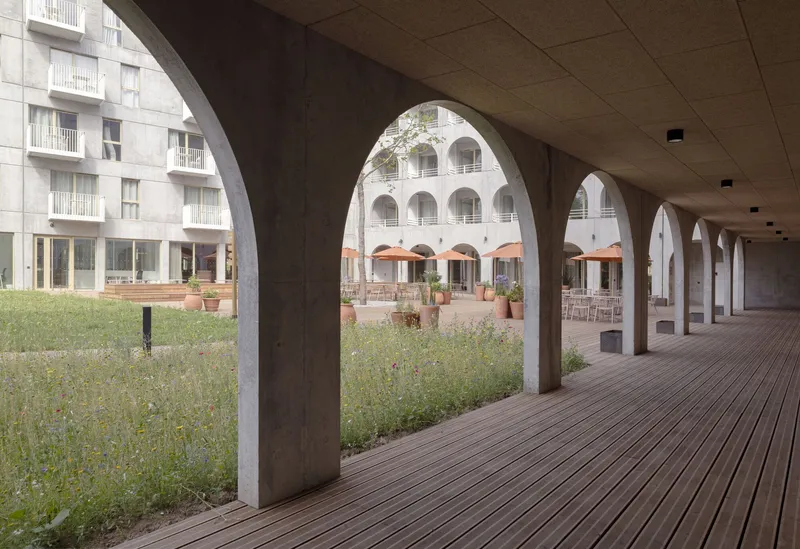
The recurring arched colonnade is the single strongest gesture in the project. It runs along the interior facades of every wing, forming a covered threshold zone where timber decking, potted plants, and café seating blur the boundary between the building and its courtyard. The arches are cast in concrete with a clean, slightly heavy profile that recalls Mediterranean loggia more than northern French industrial vernacular. Cork tile ceilings under the arcade soften acoustics and warm the palette, giving the passage the atmosphere of a hotel terrace rather than a transit corridor.
By making the arcade the primary circulation layer at ground level, the architects ensure that residents, hotel guests, and coworkers all cross paths outdoors regardless of where they sleep or work. It is the kind of spatial overlap that coliving operators talk about constantly but rarely build into the architecture itself.
Courtyard as Landscape, Not Leftover
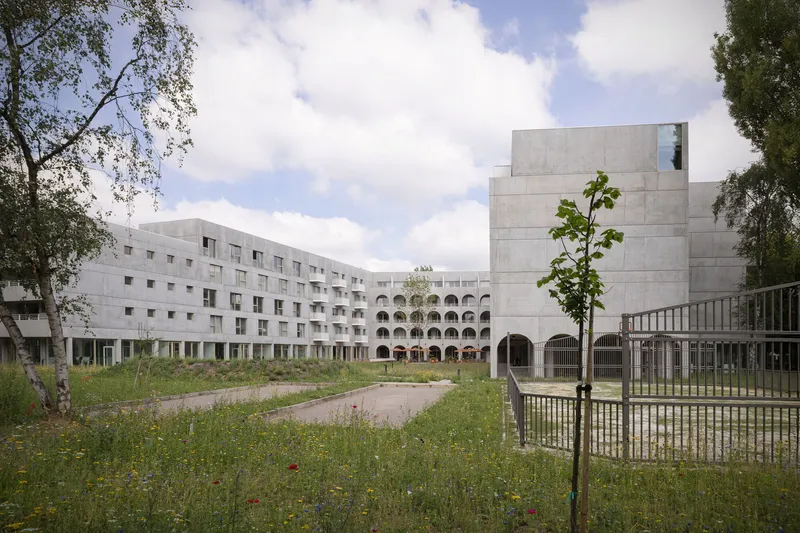
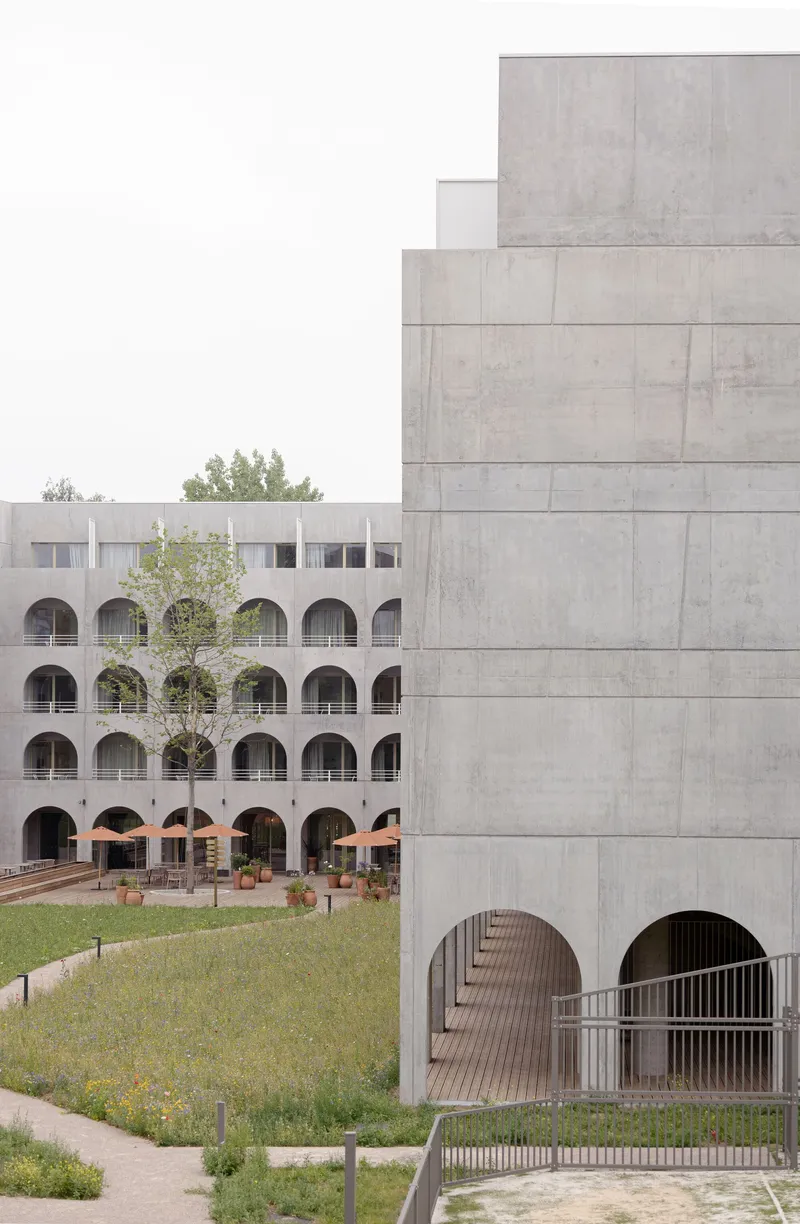
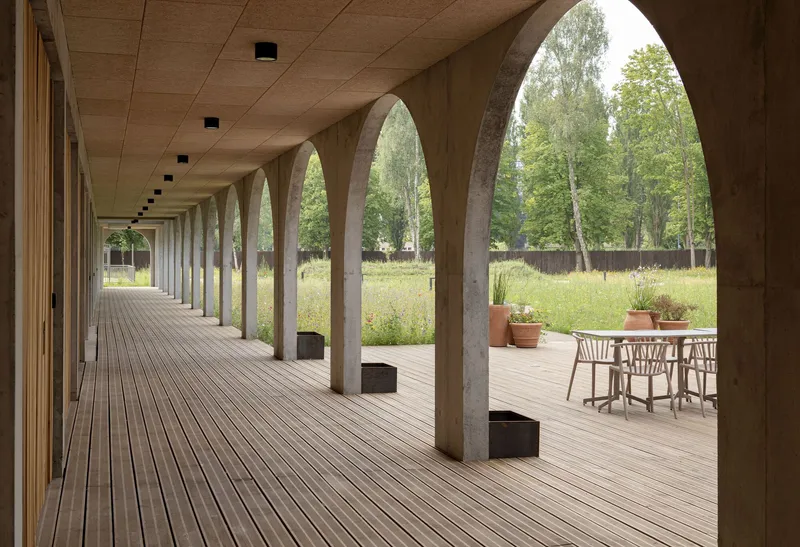
Too many courtyard buildings treat their interior open space as a tidy lawn that nobody uses. Here the courtyard is planted as a genuine meadow: wildflowers, sloping turf paths, young trees that will eventually canopy the space. The ground surface is not flat. Gentle mounds and gravel paths create micro-landscapes that give depth to what could have been a dead rectangle. The effect, even in its first growing season, already feels more park than plaza.
The 25,926 square meter site allows room for this generosity. With the building footprint pushed to the perimeter, the courtyard earns enough width to register as a real outdoor room rather than a light well. Standing under the arcade and looking across the meadow toward the opposite wing, you get a sense of distance that is rare in mid-rise housing.
Three Facade Languages on One Building
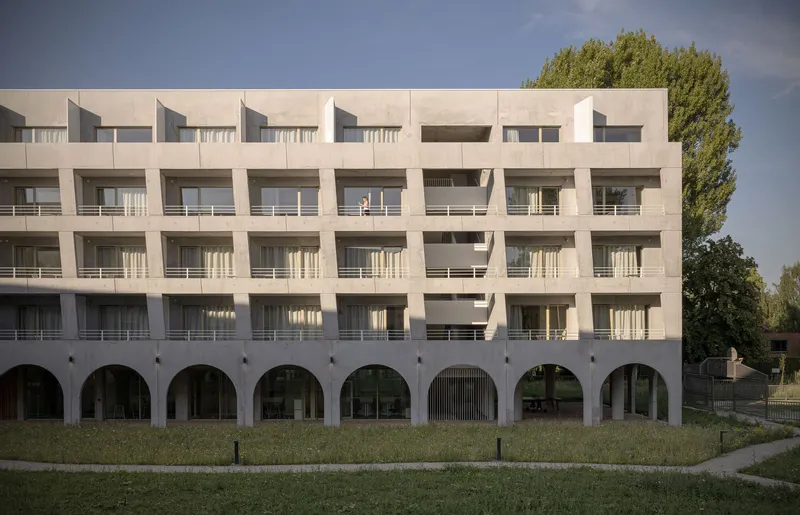
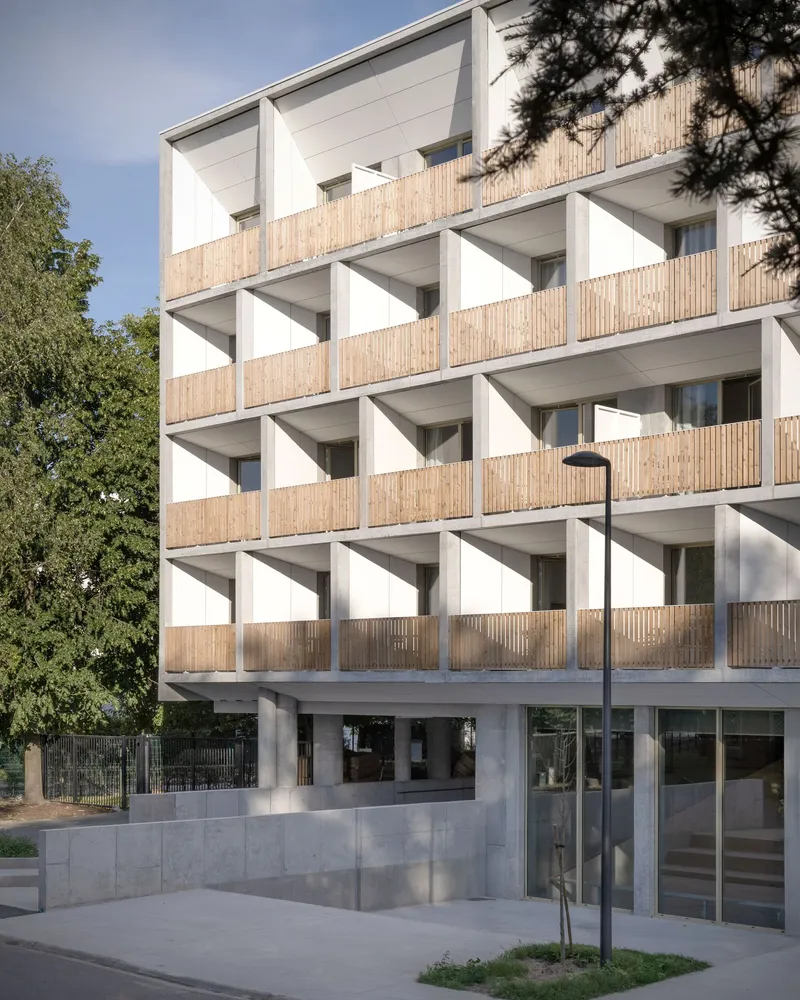
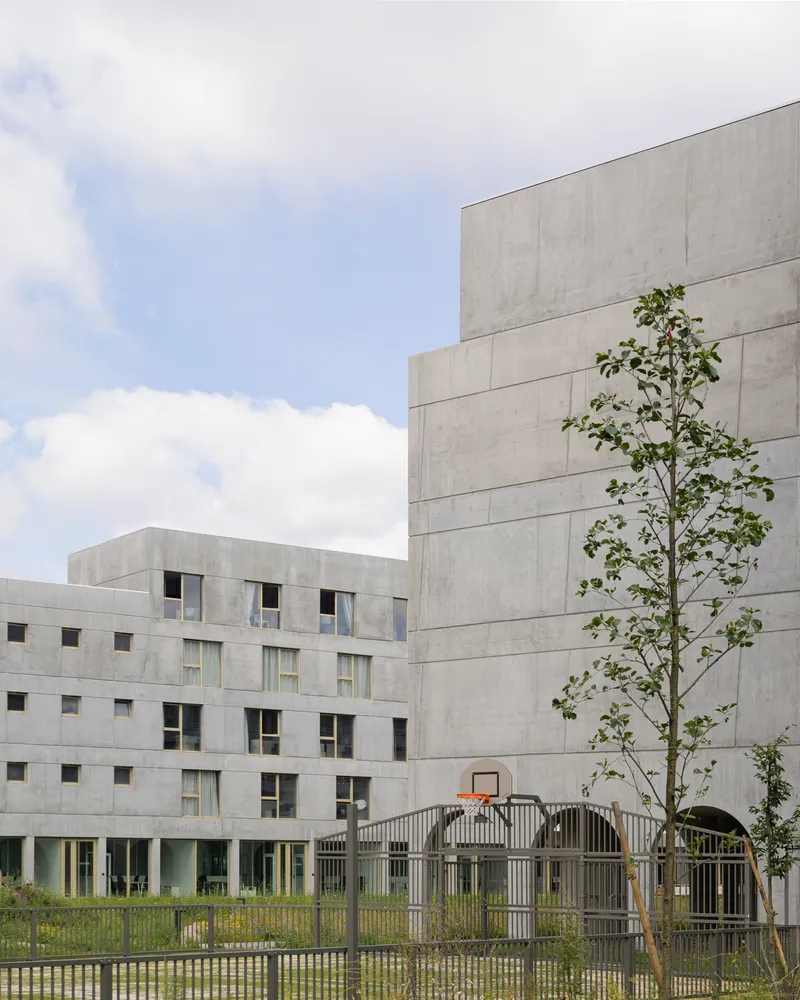
The exterior is not monolithic. D'Houndt+Bajart and Associés deploy at least three distinct facade treatments across the complex. The street-facing elevation is clad in white stucco with a formal arched colonnade and tiered balconies that give it an almost institutional composure. Another wing uses triangular white concrete sunshades layered over timber-screened balconies, creating a rhythm of deep shadow lines. A third block goes deliberately blunt: concrete block walls with small punched windows, stripped of ornament.
Rather than reading as indecision, this variety reflects the mixed program. The hotel wing gets the most public, most polished face. The coliving rooms get operable screens and deep loggias that prioritize privacy and cross-ventilation. The utilitarian block handles back-of-house and service functions without pretending to be something it is not. The result is a campus that acknowledges its own complexity instead of smoothing it into a single wrapper.
The Courtyard Facades: Timber and Concrete in Dialogue
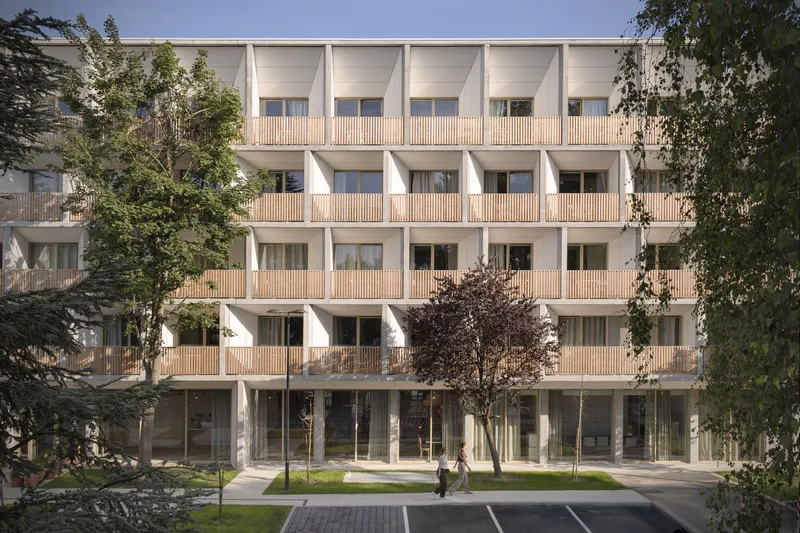
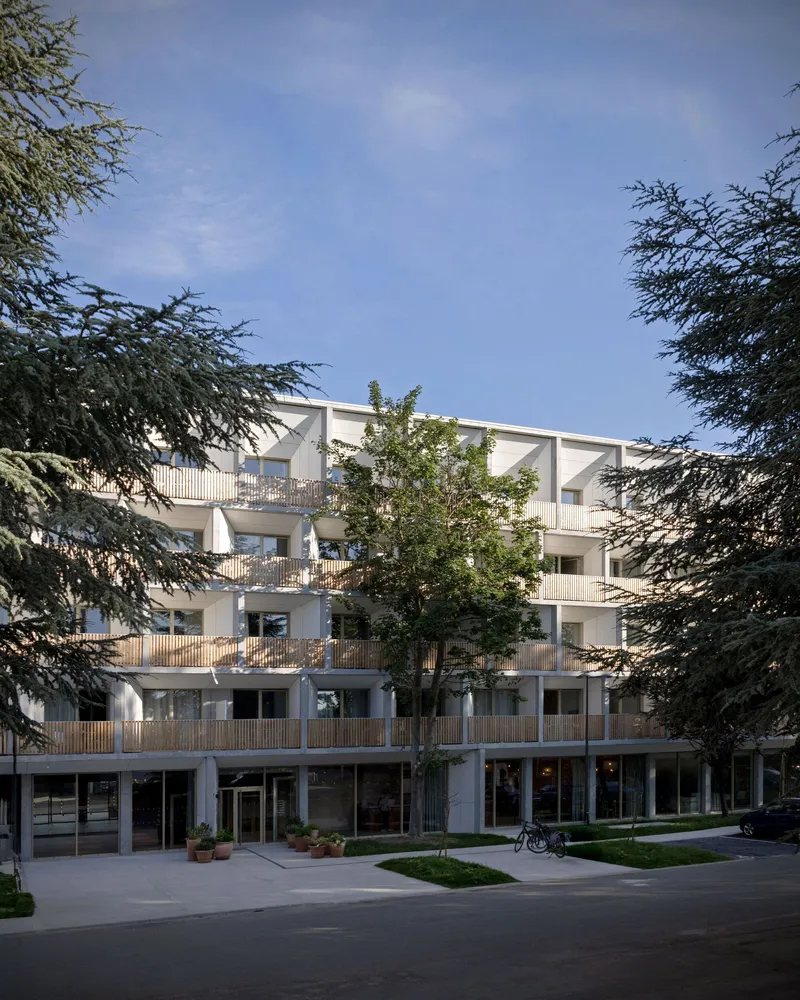
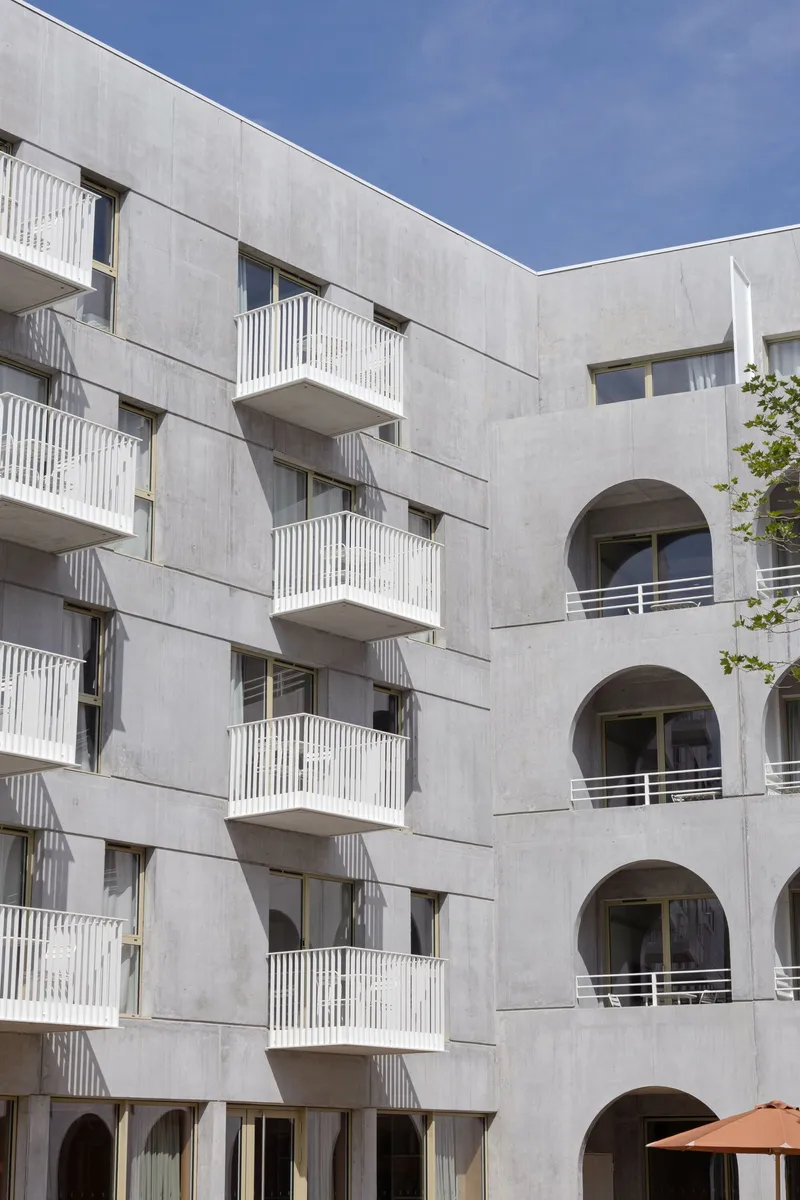
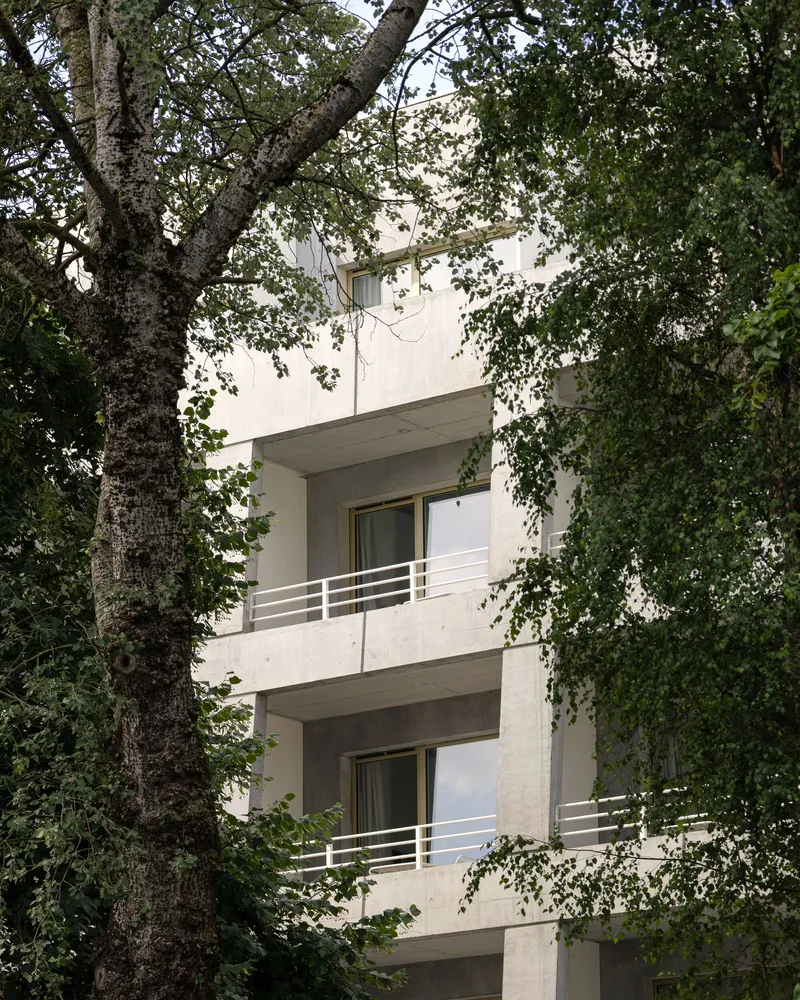
Facing inward, the building shifts register. Vertical timber battens screen the balconies on the courtyard wings, softening the concrete frame with a warm, tactile layer. The battens filter light into the rooms while giving each balcony a degree of visual privacy from the communal space below. White concrete frames remain visible at the structural bays, maintaining legibility of the grid while the timber fills in between.
The stacked balconies with their white metal railings and timber screens create a layered section that feels almost like a vertical garden wall when mature planting eventually fills in. For now, the young trees and the raw timber give the courtyard an honest, unfinished quality that will only improve with age.
Ground Floor Program: Restaurant, Coworking, and Street Life
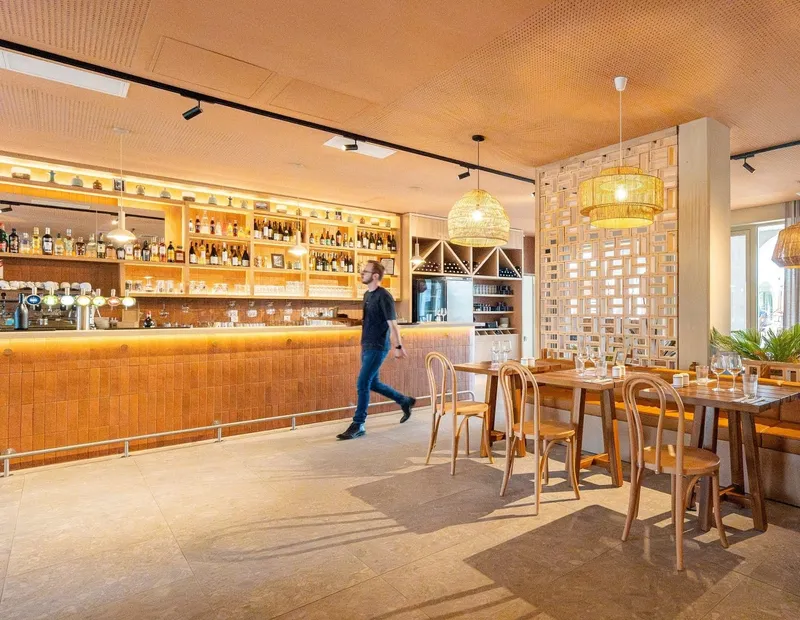
The restaurant interior anchors the communal program with a tiled bar counter, wicker pendant lights, and an informality that avoids the sterile co-living lounge aesthetic. It sits directly off the arcade, pulling foot traffic from the courtyard into a space that could plausibly serve the surrounding neighborhood as well as the building's residents. The adjacency is important: it means the ground floor is active, not locked behind a lobby desk.
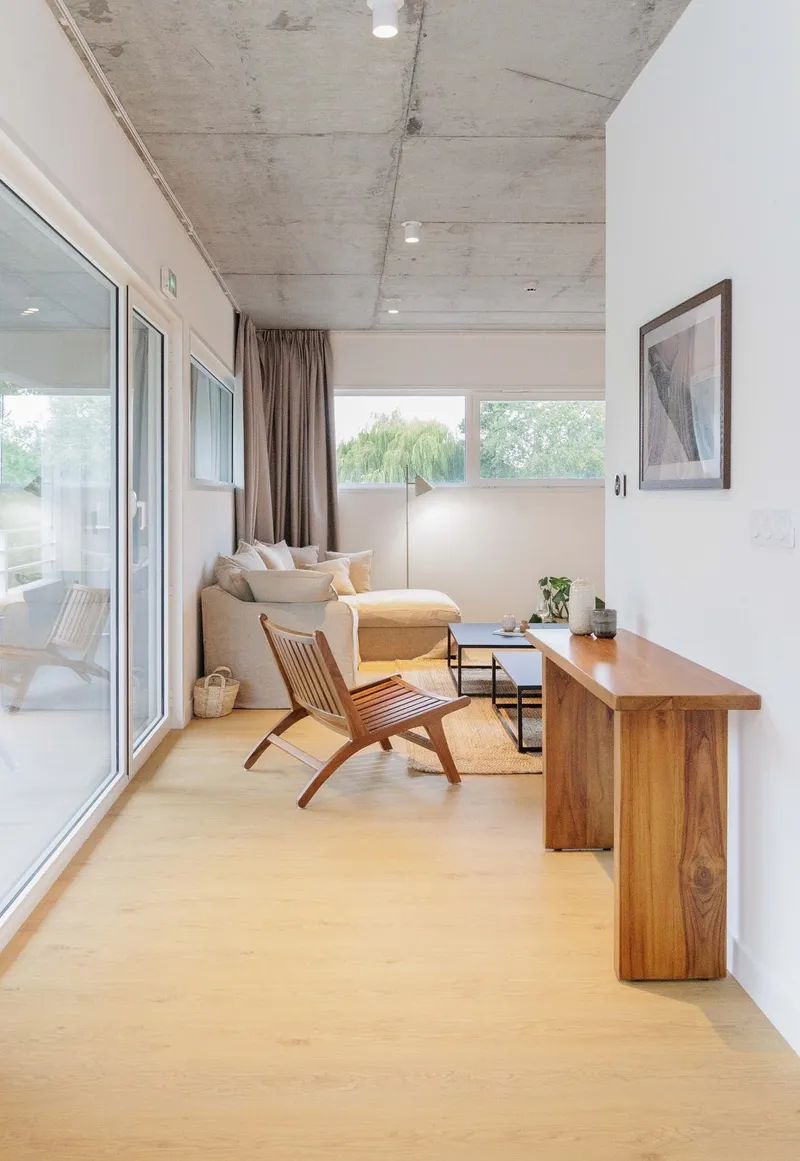
Upstairs, the living units are compact but well-proportioned. Exposed concrete ceilings, pale timber floors, and full-height glazed doors to the balcony give even the smallest rooms a sense of volume and daylight. The material palette is restrained: concrete, timber, white walls. Nothing competes for attention. The real luxury here is the balcony, which opens directly onto either the courtyard or the street-side tree canopy.
Towers, Stairs, and Vertical Incidents
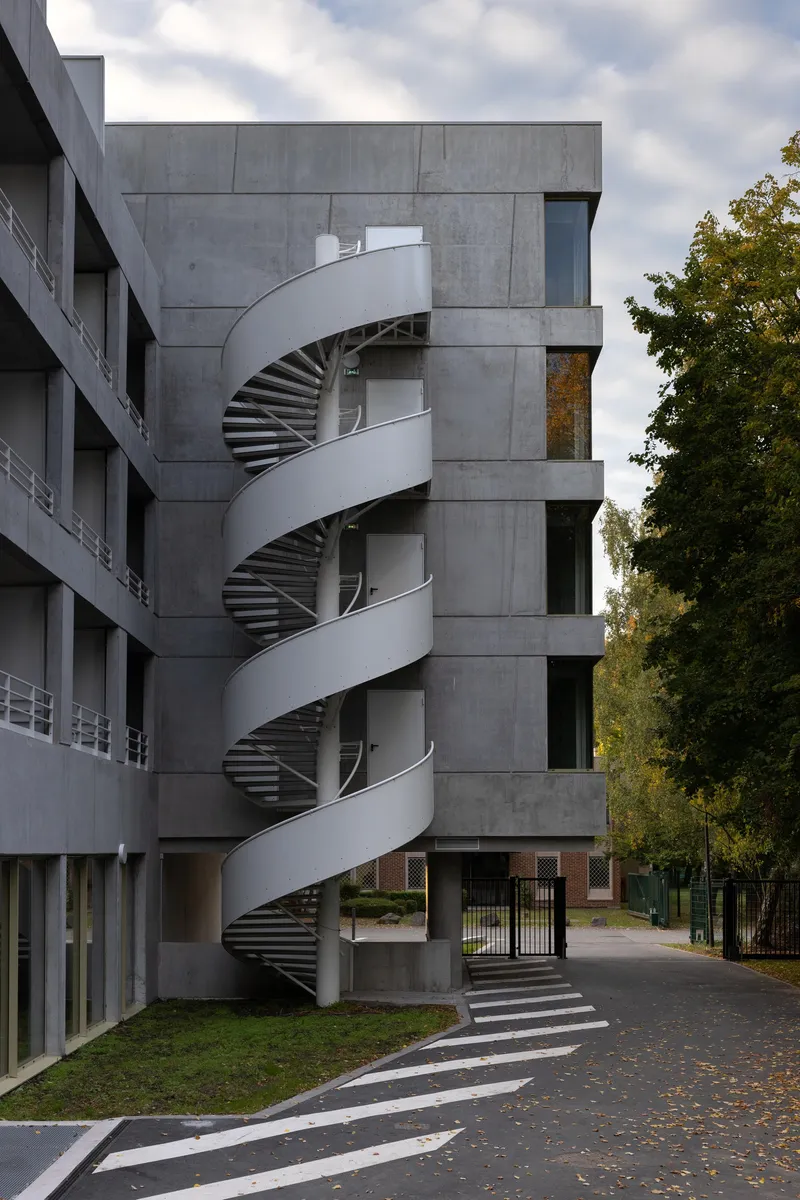
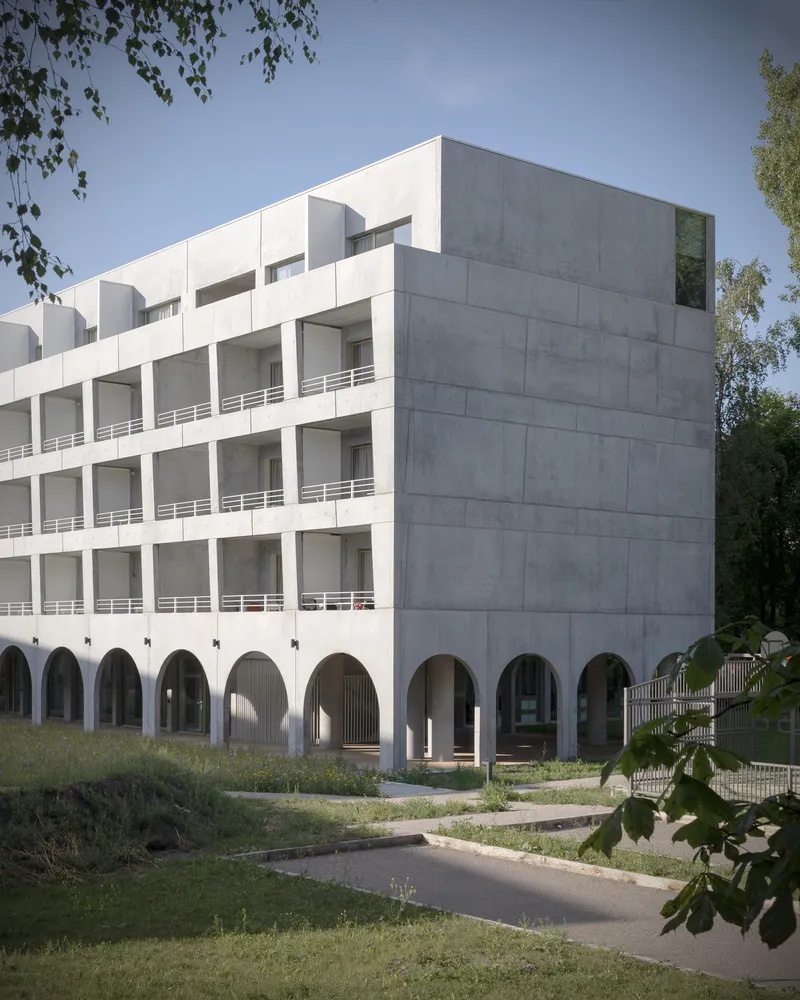
A white helical exterior staircase wraps one of the corner towers, giving the complex a sculptural vertical accent that doubles as a fire escape and secondary circulation route. It is a small move, but it breaks the horizontality of the four-storey block and provides an identifiable landmark from the street. The concrete tower it clings to is otherwise plain, which makes the spiral all the more striking.
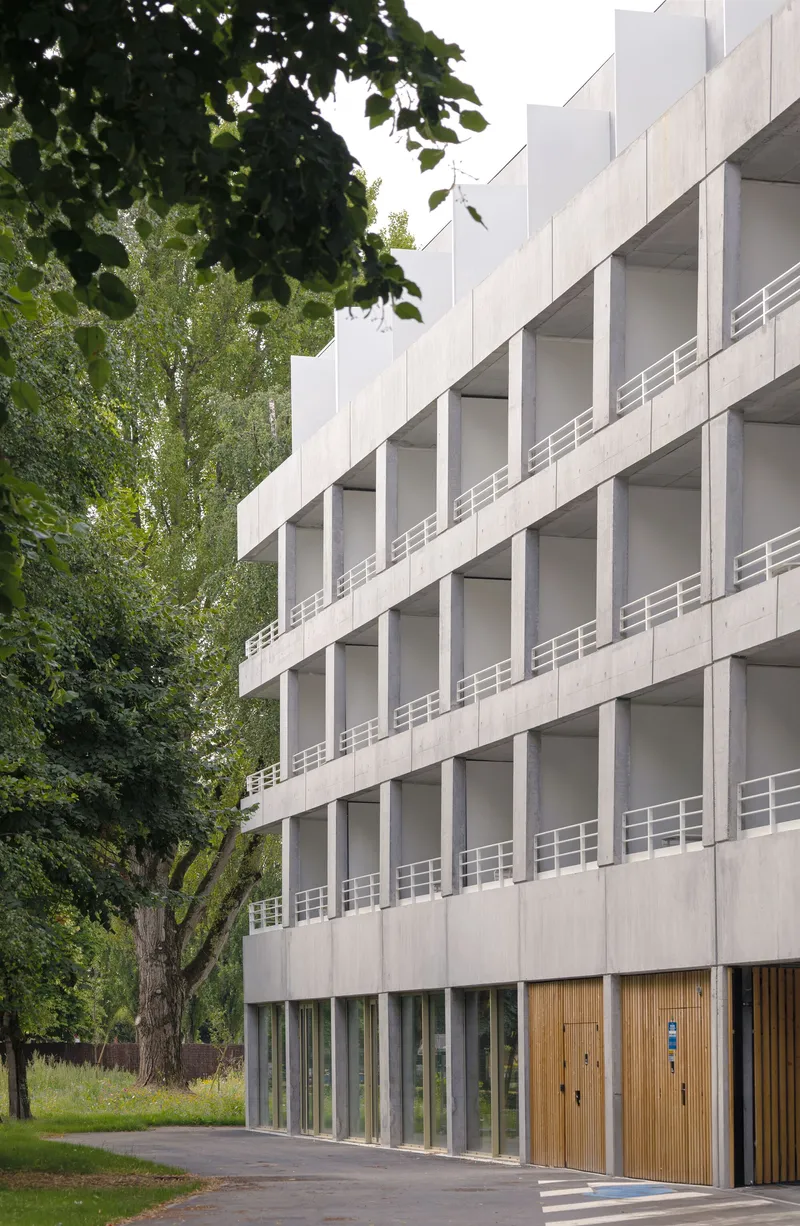
Elsewhere, the building's 16.2-meter height remains disciplined. Four floors above ground sit comfortably within the district's existing scale, and the recessed upper levels and deep balconies prevent any face from feeling like a sheer wall. The stacked balconies framed by tree trunks hint at the maturity the landscape will eventually reach, when the architecture recedes behind a green curtain.
Plans and Drawings
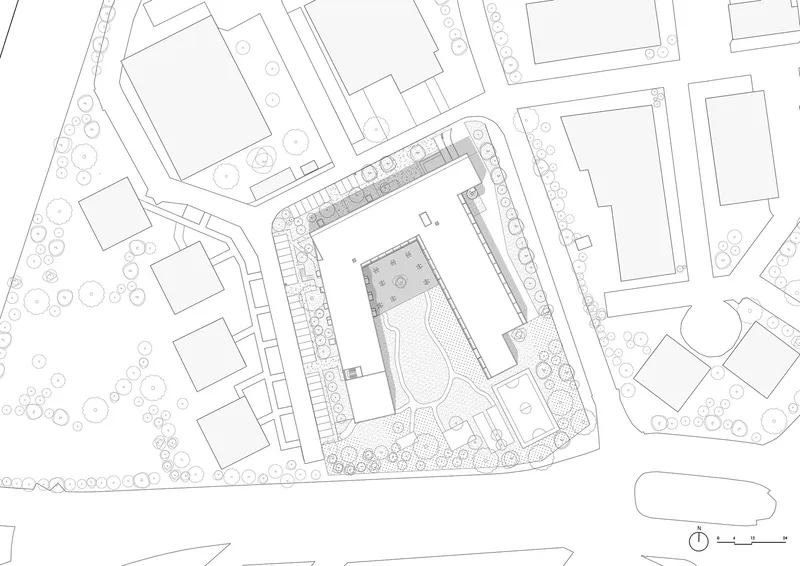
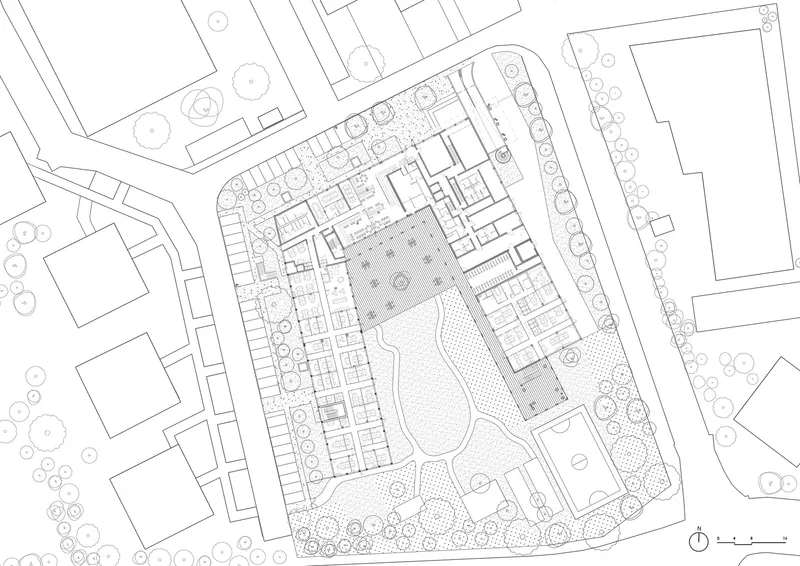
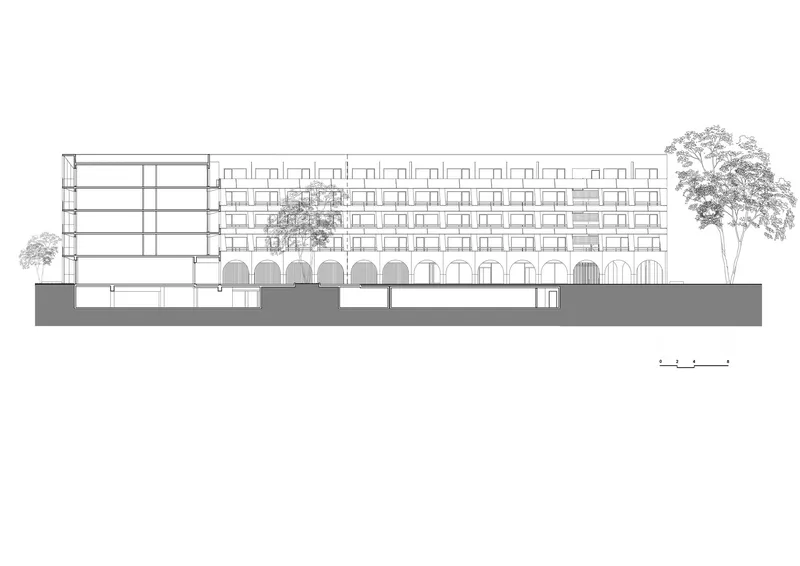
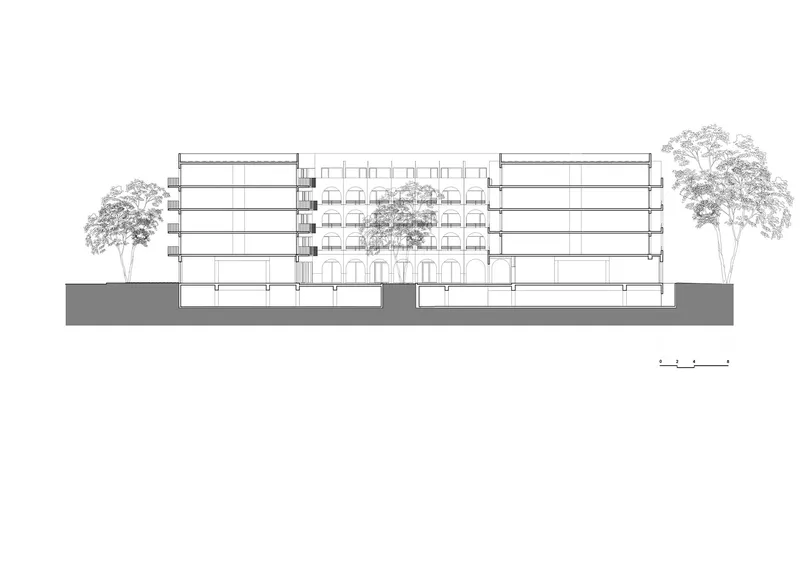
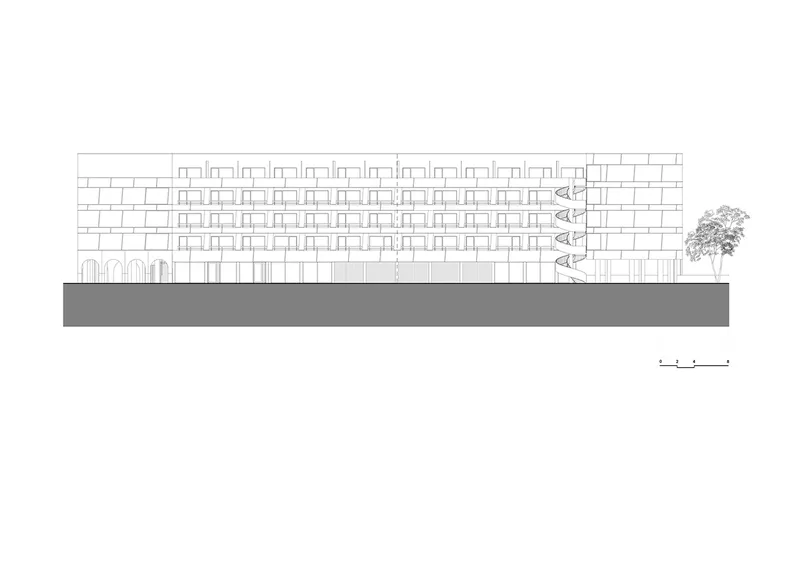
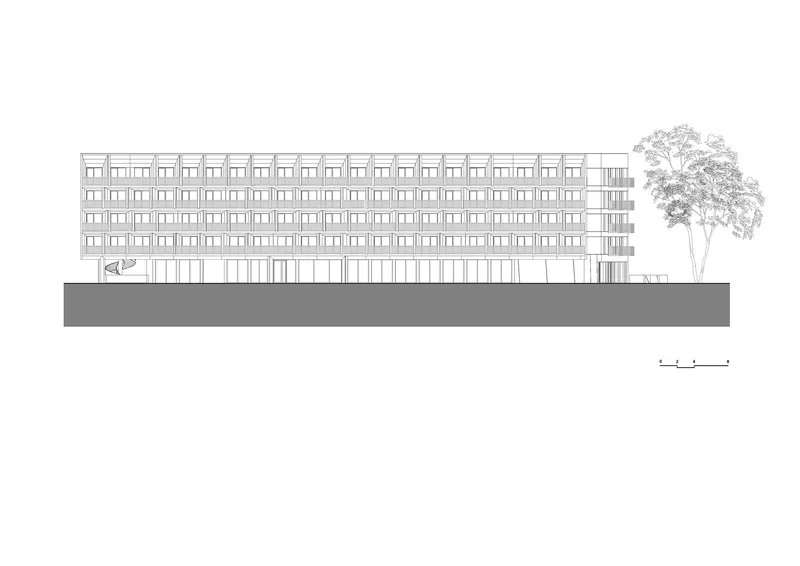
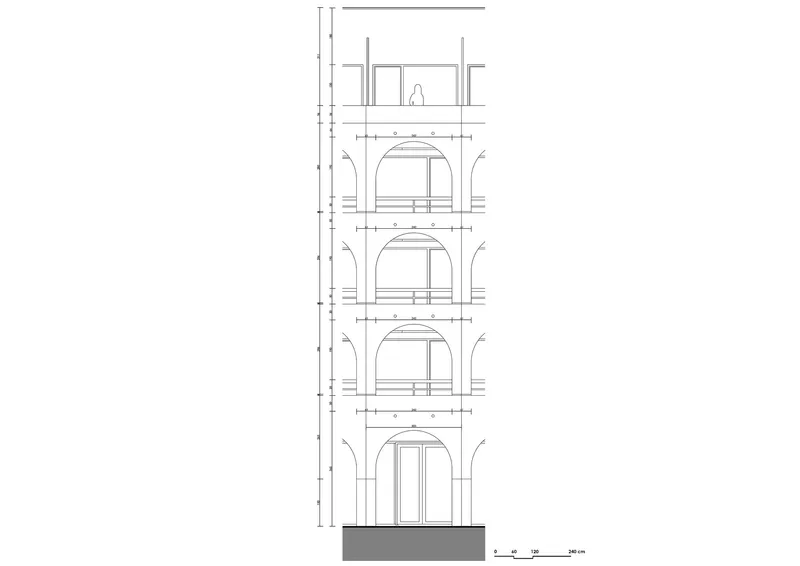
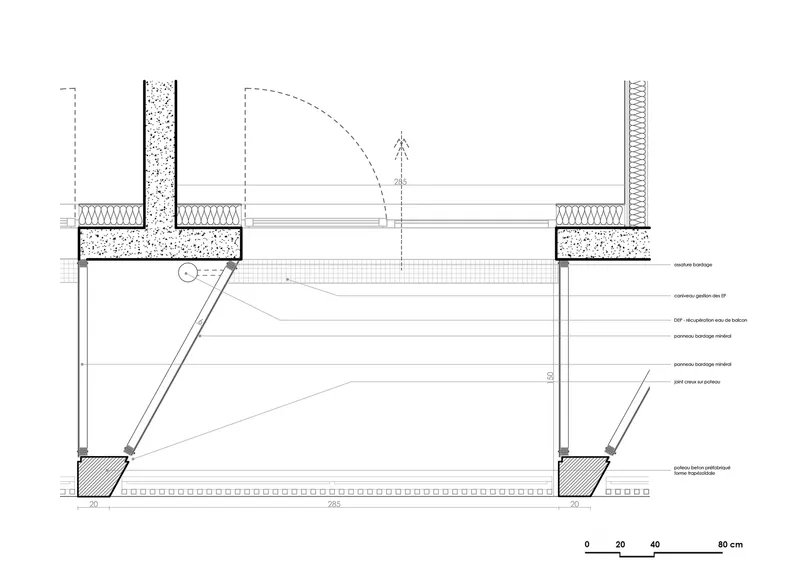
The site plan confirms the courtyard-centric strategy: the building wraps three sides of the block, leaving the fourth partially open to the surrounding park and street network. The ground floor plan shows the rooms arranged along double-loaded corridors on the upper wings, while the arcade and shared program occupy the courtyard edge. The multiple section drawings reveal how the arched ground floor acts as a plinth, lifting the residential mass above a generous public datum. One detail drawing exposes the roof-to-slab connection with diagonal bracing, a reminder that the formal generosity of those arches required real structural resolve.
Why This Project Matters
The Babel Community demonstrates that coliving can be more than an interior design exercise applied to developer-spec apartments. By investing in a courtyard landscape, a continuous arcade, and a genuine mix of uses at ground level, D'Houndt+Bajart and Associés have produced a building that creates a public realm rather than merely consuming one. In a 40-year-old business district that was planned for commuters, this is a meaningful intervention: it introduces the density, porosity, and street life that the area was never designed to support.
The project also offers a lesson in material restraint. Concrete and timber do all the heavy lifting. There is no parametric cladding, no gratuitous color, no gesture that exists solely for a drone photograph. The architecture earns its presence through proportion, repetition, and the discipline of a well-placed arch. When the meadow fills in and the trees grow tall, this building will age better than most of its contemporaries, because the design assumed from the start that time would be its best collaborator.
The Babel Community, Coliving Residence, by D'Houndt+Bajart Architectes and Architectes Associés. Villeneuve-d'Ascq, France. 13,524 m². Completed 2025. Photography by Paul Tahon.
About the Studio
BAJART Architectes
Share Your Own Work on uni.xyz
If projects like this are the kind of work you want to make, uni.xyz is a place to publish your own, find collaborators, and enter design competitions.




Popular Articles
Popular articles from the community


Hill & Cross Opera: Sculptural Opera House Architecture Shaped by Tallinn’s Landscape and Identity
Hill & Cross Opera reimagines opera house architecture in Tallinn through its sculptural hill, civic plaza, glass wave and a luminous cross.

Co-Life: Senior Housing Design That Reconnects Older Adults With the City
Co-Life reimagines senior housing design through healing gardens, shared streets, workshops, and a sustainable community across generations.

Lunar Spiral: Space Architecture Shaped by the Mathematics of the Universe
Lunar Spiral reimagines space architecture through Fibonacci geometry, lunar regolith, levitating habitats, and self-sustaining Moon living.

Co-life: Sustainable Architecture for Age-Friendly Community Living
Co-life reimagines sustainable architecture for seniors through courtyards, rammed earth, shared gardens, and spaces designed for belonging.

Similar Reads
You might also enjoy these articles

Bao Huynh Watercolor Atelier: A Serene Art Retreat in Hội An
Bao Huynh Watercolor Atelier in Hội An blends multifunctional art spaces, sustainable design, local materials, and family-friendly living in a serene environment.

Atelier Macri Concept Store Interior Design by CASE-REAL
Atelier Macri store features a "ko" counter, walnut wood details, cork displays, blending retail, gallery, and seamless customer experiences.

Manuel Vargas Izquierdo Stadium and High-Performance Sports Center: Architectural Excellence in Jalpa de Méndez
The Manuel Vargas Izquierdo Stadium blends sustainable design, inclusive sports facilities, and cultural-inspired architecture, revitalizing Jalpa de Méndez’s public spaces.

KAKR Buluh Awar Hall: Revitalizing Community and Ecology Through Bamboo Architecture
Community built bamboo hall revitalizes Buluh Awar village, empowering youth, restoring ecology, celebrating vernacular craftsmanship through sustainable architecture and culture.





Comments (0)
Please login or sign up to add comments
No comments yet. Be the first to comment!