

ASWA Carves Triangular Voids into Two Concrete Cubes for a Coffee Roastery in Northern Thailand
DIFF Coffee Roasters in Phitsanulok pairs a gray cube with a black cube, linked by a flyover that frames an existing tree.

Phitsanulok is not the first Thai city you associate with destination architecture, but ASWA may have changed that. DIFF Coffee Roasters, completed in 2024, occupies 800 square meters and organizes its program across two distinct cubic volumes: a larger gray concrete mass at the front and a smaller black cube housing the bar. The two are stitched together by a triangular elevated walkway that doubles as an observation deck, framing an existing mature tree that the architects kept as the project's spatial anchor. The result is a building that reads as a bold geometric composition from the street but opens up into something far more nuanced on the inside.
What makes this project genuinely interesting is the discipline of its formal vocabulary. Every opening, every void, every skylight derives from the triangle. That single geometric move could easily become a gimmick, but ASWA deploys it structurally and atmospherically, using the shape to control light, frame views, and create spatial drama in a nine-meter-tall atrium. The architecture is doing real work here: creating shadow patterns that shift through the day, pulling the eye upward, and giving a coffee shop the kind of sectional richness you rarely find outside a museum.
Two Cubes, One Conversation
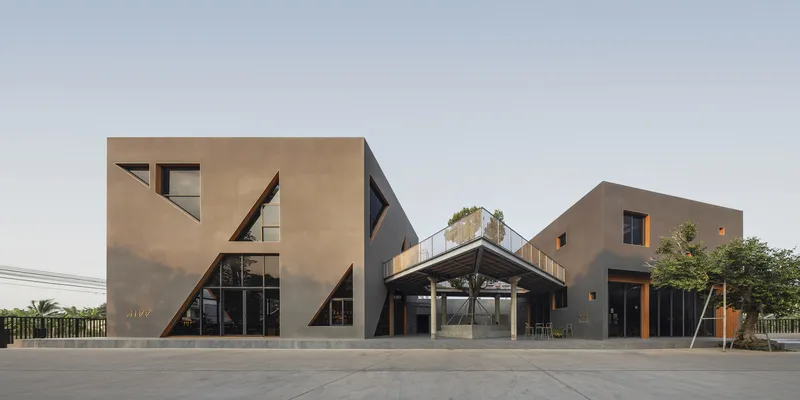
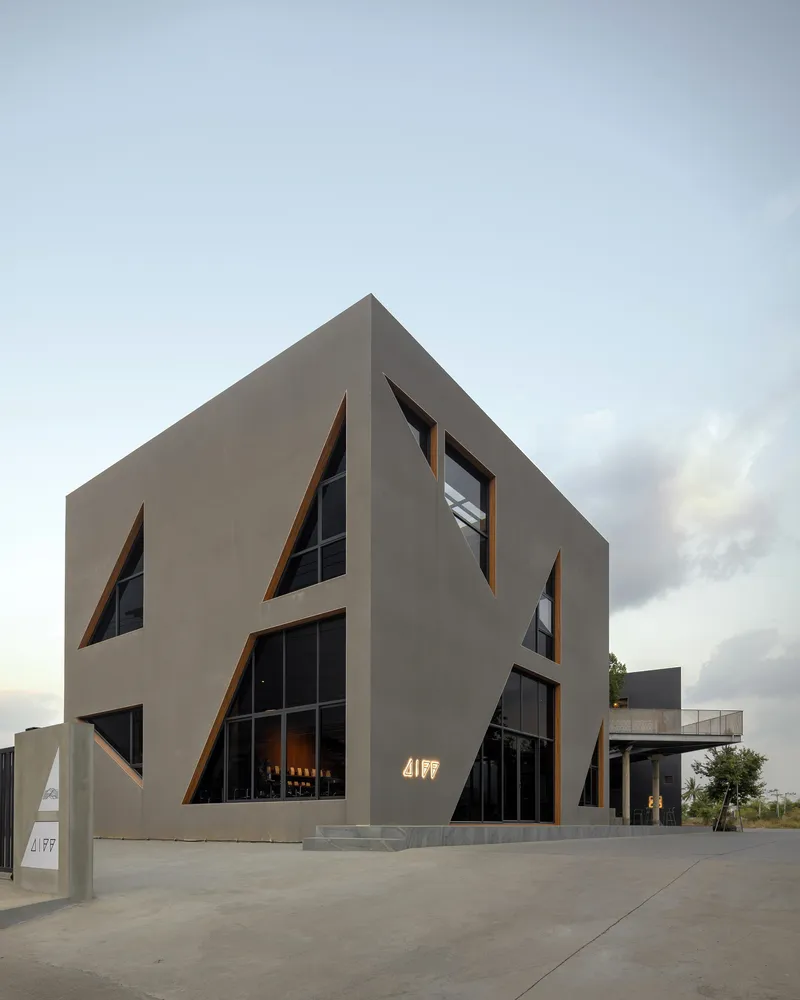

From street level, the building presents itself as a pair of stucco volumes with a restrained palette of tan, gray, and dark charcoal. The triangular window cutouts give the facade a sculptural tension that breaks any reading of these as simple boxes. At dusk, the openings glow from within, turning the building into a lantern that signals its public function without signage or spectacle.
The larger cube takes the foreground, grounding the project with its mass, while the smaller black volume recedes slightly and houses the more concentrated program of the bar. The contrast in color and scale creates a dialogue between the two: one expansive and communal, the other compact and focused. The elevated walkway connecting them acts less like a corridor and more like a threshold, a moment of transition that forces you to register the tree canopy at eye level before arriving at either destination.
The Triangle as Operating System
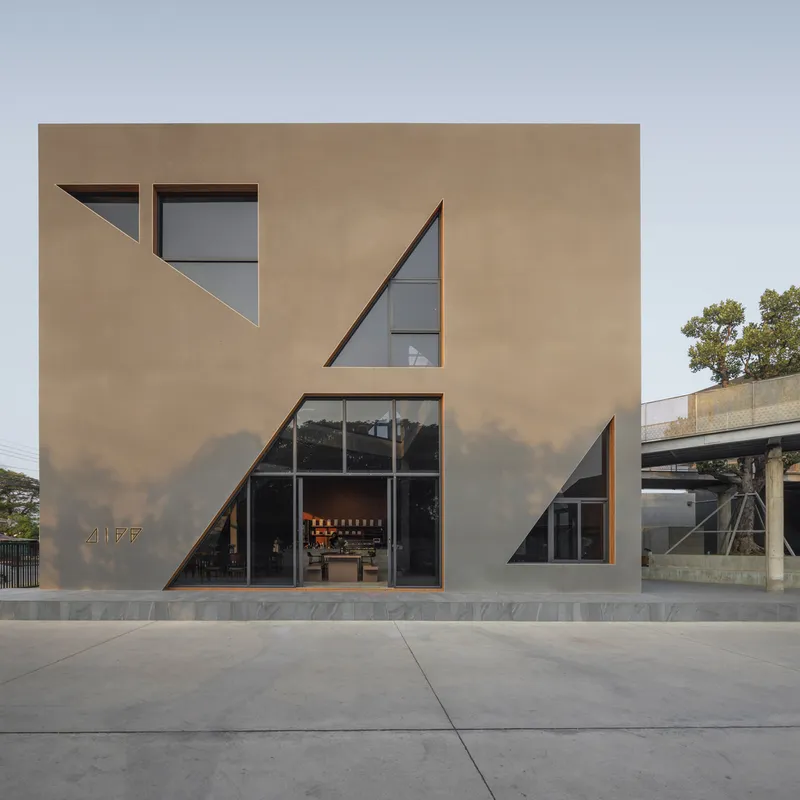
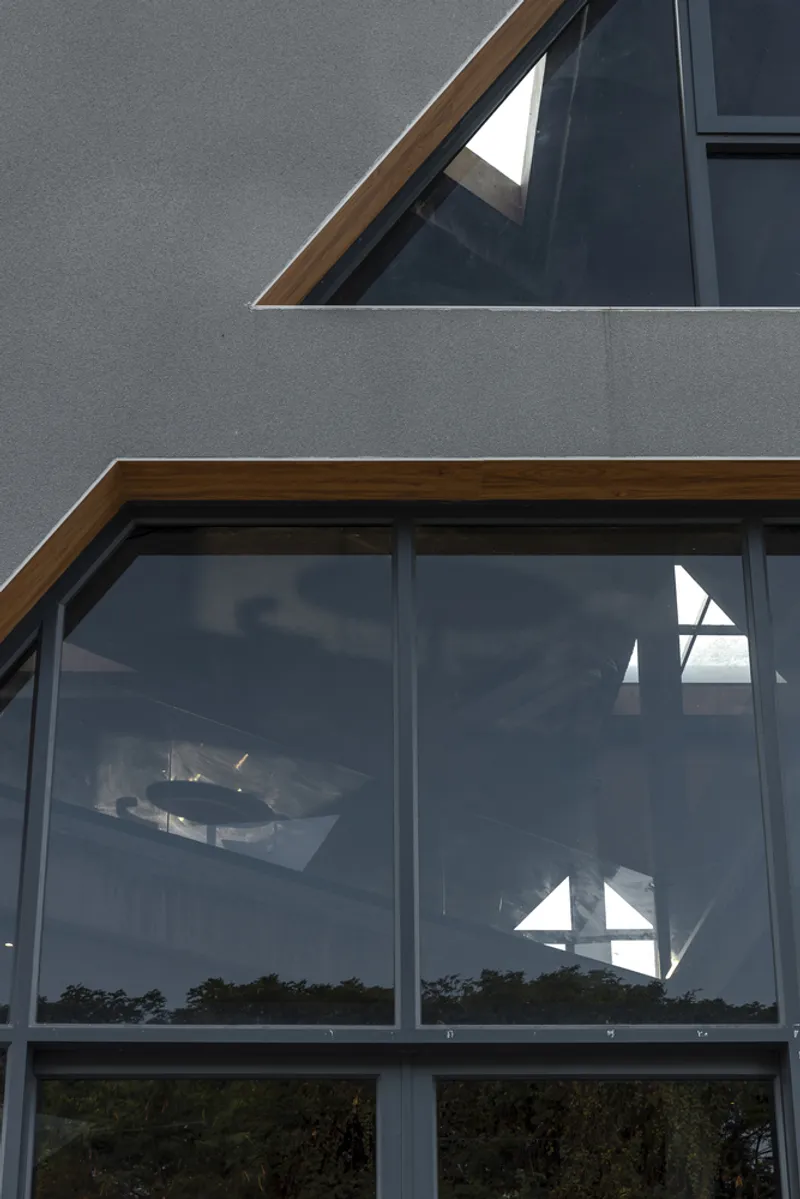
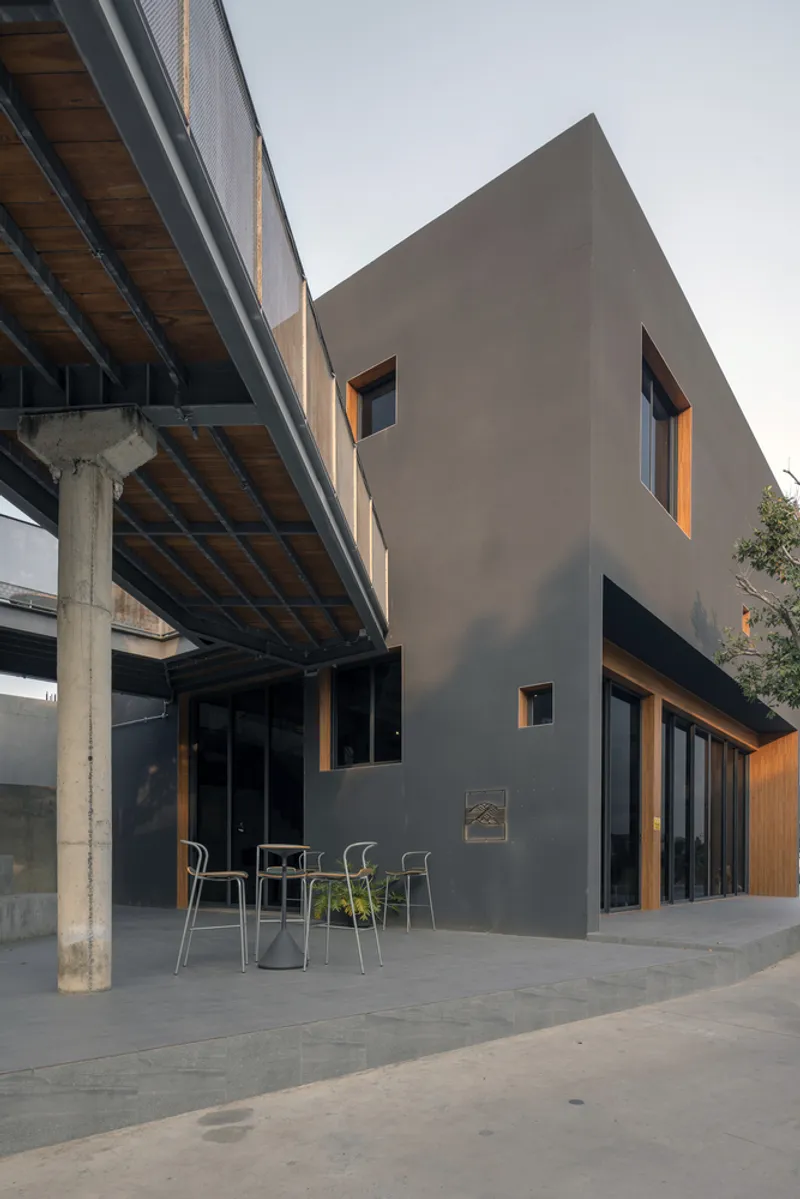
ASWA commits fully to the triangular motif, and the facade is where that commitment is most legible. Punched openings of varying scales are cut at angles into the rendered walls, creating a rhythm that avoids repetition. Timber frames inside these voids add warmth and depth, so the triangles read differently depending on whether you see them from outside (sharp, abstract) or from within (warm, framed by wood grain).
The perforated metal railings and the angled walkway reinforce the geometric language without overplaying it. There is no moment where the triangle feels forced onto a surface; instead, it emerges from the structural logic of how concrete can be opened to admit light and air. The consistency is rigorous but not monotonous, because the triangles vary in size, orientation, and depth across the building's surfaces.
A Nine-Meter Atrium That Earns Its Height
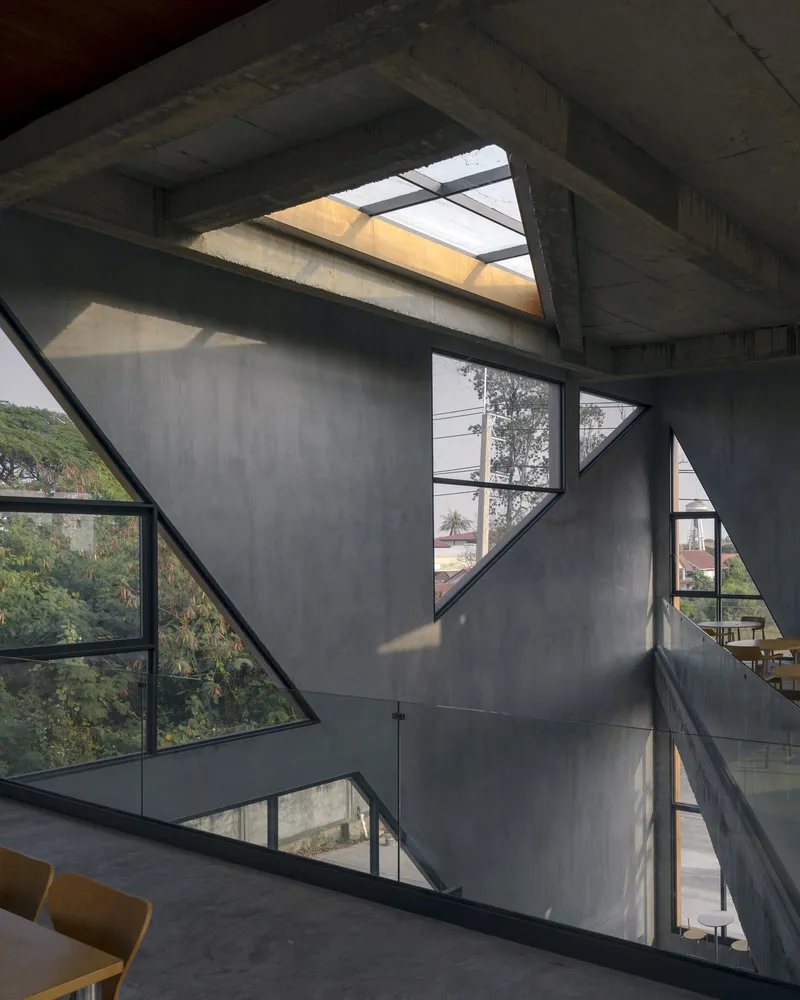
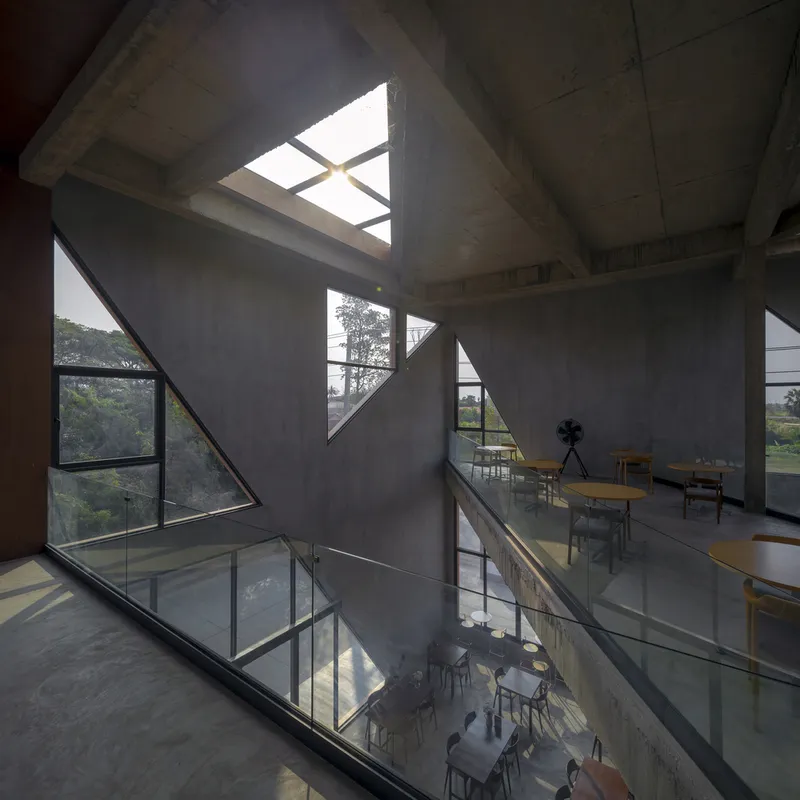
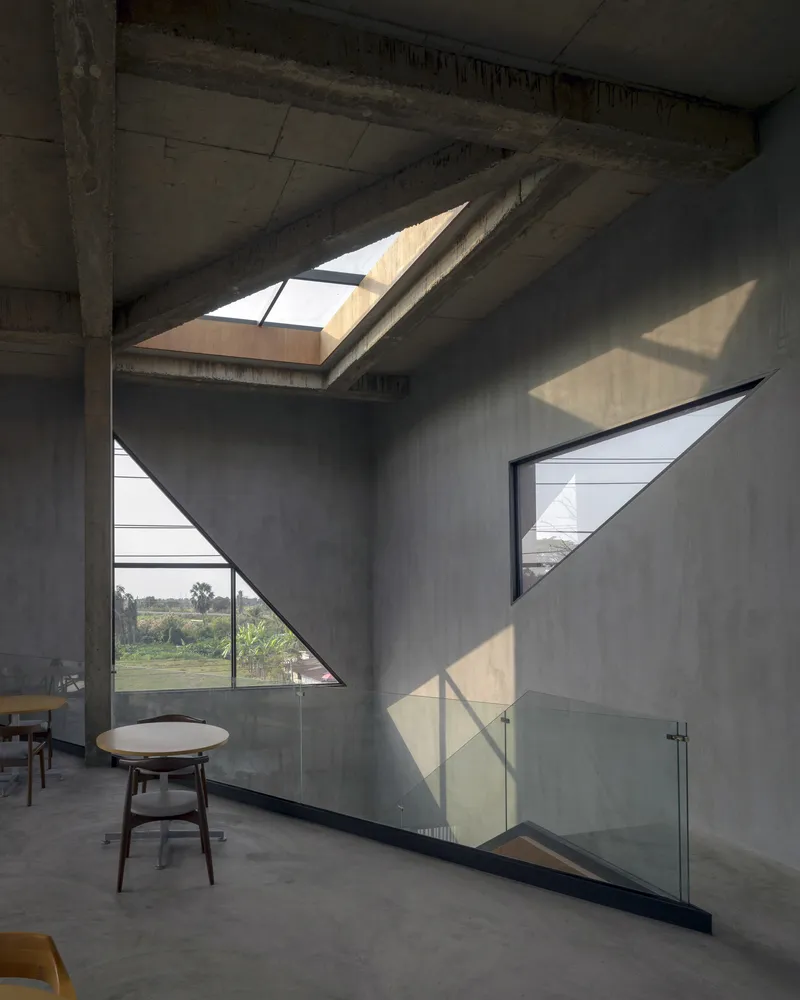
The main atrium is the project's spatial event. At nine meters tall, the volume is generous for a café, but ASWA justifies every centimeter. Triangular skylights puncture the ceiling and upper walls, sending shafts of light that sweep across the concrete surfaces as the sun moves. The resulting shadow play is not decorative; it is architectural, giving the interior a constantly shifting character that makes morning coffee and afternoon visits feel like encounters with different spaces entirely.
The exposed concrete beams and angular walls amplify this effect, catching light on their beveled edges and projecting geometric patterns onto floors and balustrades. Glass-railed mezzanines at the upper level allow the eye to travel the full height of the space, and the transparency between levels means you are always aware of the building's section, not just its plan.
Concrete, Timber, and the Art of Restraint
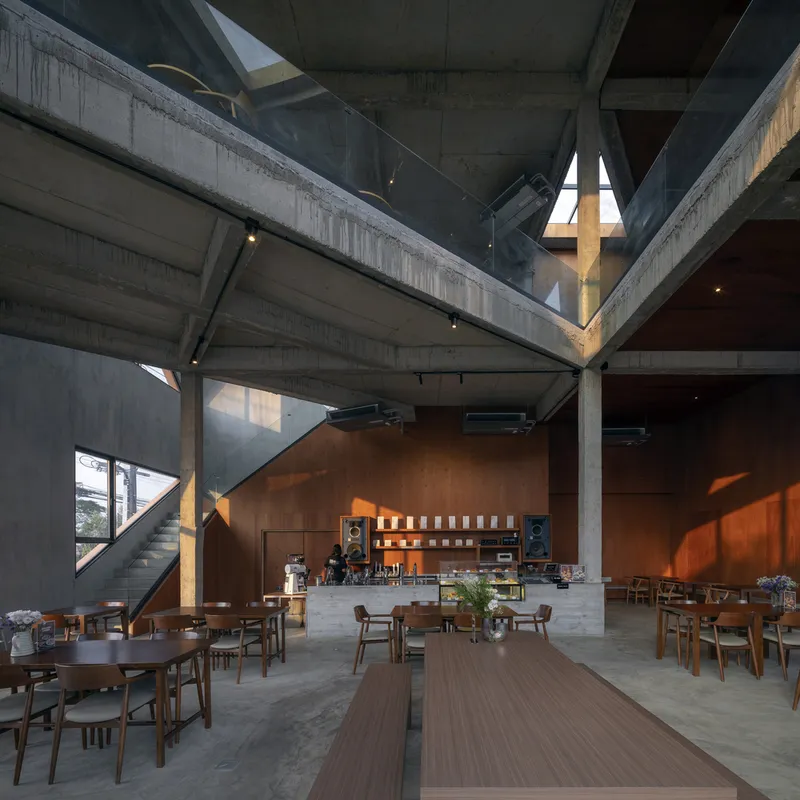

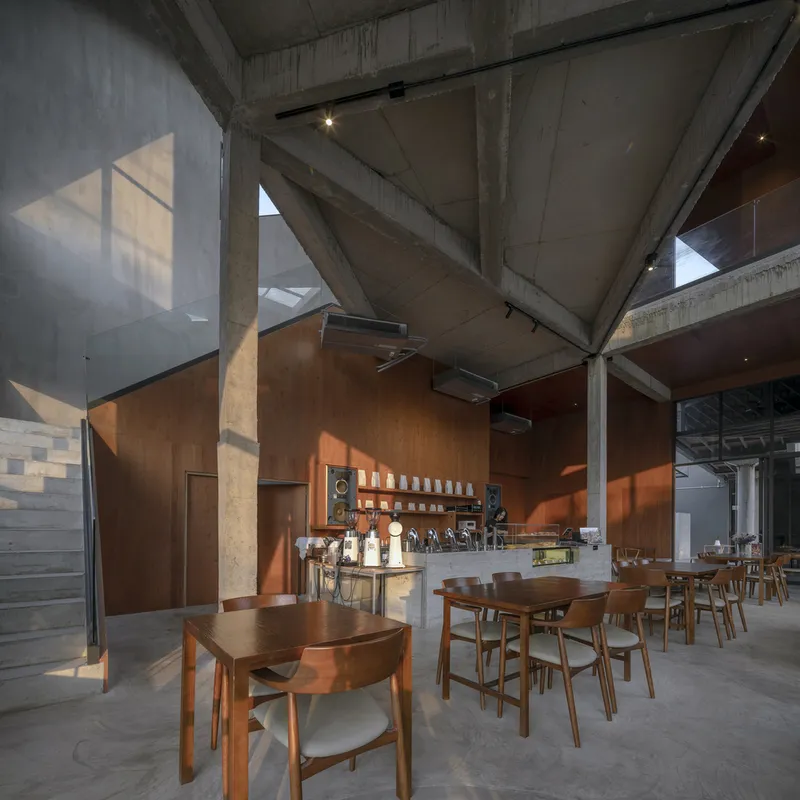
The material palette is deliberately narrow: smooth concrete for structure and enclosure, timber for warmth and human-scale surfaces, glass for transparency. ASWA does not soften the concrete with paint or plaster on the interior; the board-formed texture is left exposed, giving walls and ceilings a tactile honesty that grounds the space. The coffee bar, with its concrete counter and timber wall panels, exemplifies this balance: industrial enough to feel serious about the craft, warm enough to feel welcoming.
Timber cladding appears strategically on walls and ceilings where the body comes closest to the building: at seating niches, along the bar, and beneath the mezzanine. The choice reinforces a hierarchy of touch. You lean against wood, you look at concrete. It is a simple move, but one that many minimalist interiors get wrong by defaulting to a single material everywhere.
Dining Under Shifting Light

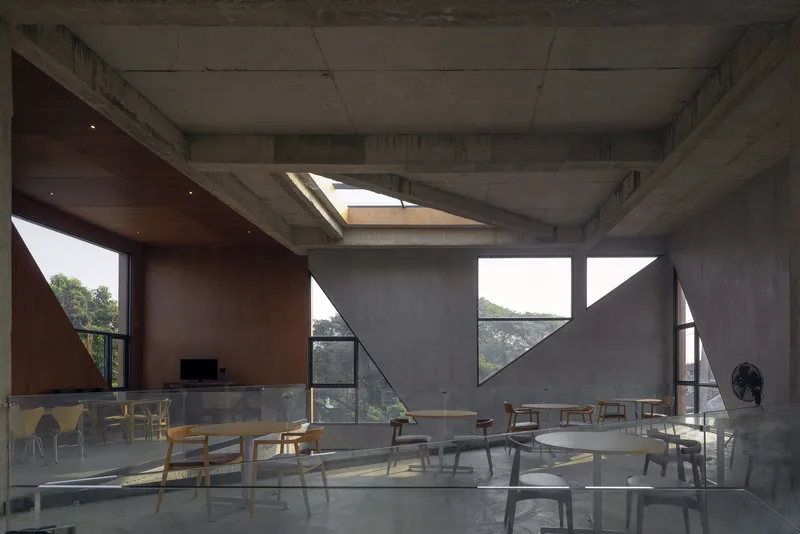
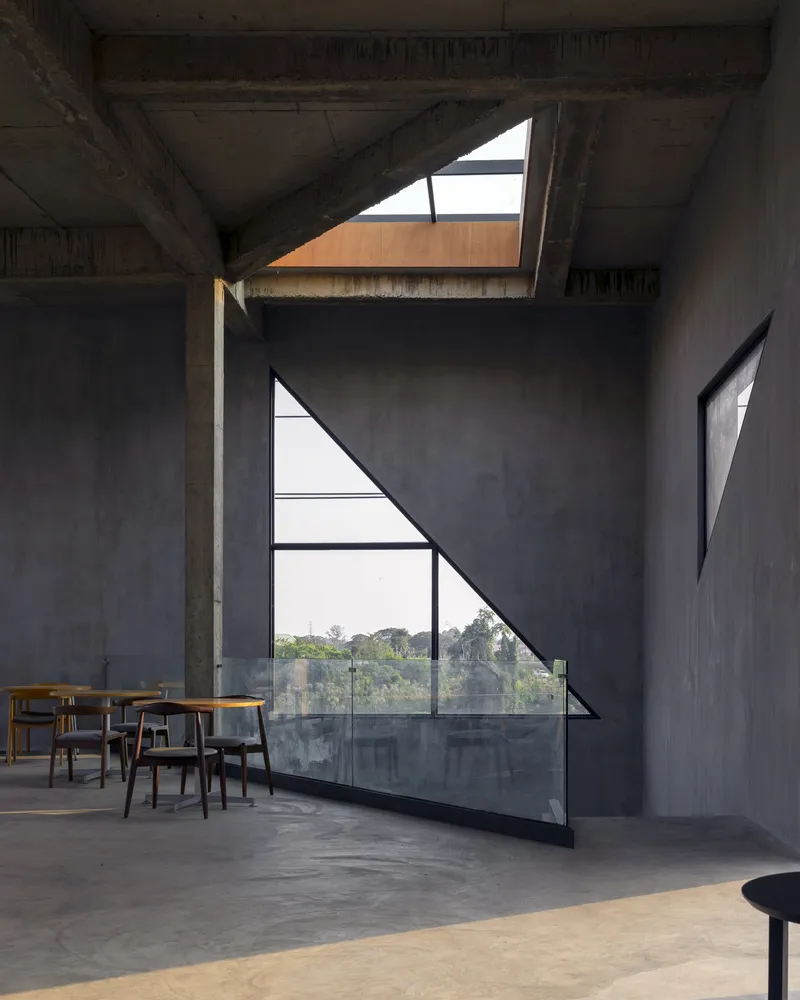
The main dining areas sit beneath timber ceiling beams and alongside triangular windows that filter afternoon sun into warm, directional light. Tables are scattered loosely rather than gridded, and the furniture itself, simple timber chairs in muted tones, defers to the architecture. The clerestory windows along the upper walls wash light across the room without creating glare, a detail that suggests real attention to comfort rather than just visual drama.
Polished concrete floors reflect the shifting patterns from above, doubling the effect. The scale of the dining hall is generous enough for a community gathering but broken up by columns and level changes that create pockets of intimacy. You can sit alone without feeling exposed, or gather a group without feeling squeezed. That flexibility is the mark of a layout designed through spatial analysis, not just furniture arrangement.
The Tree at the Center
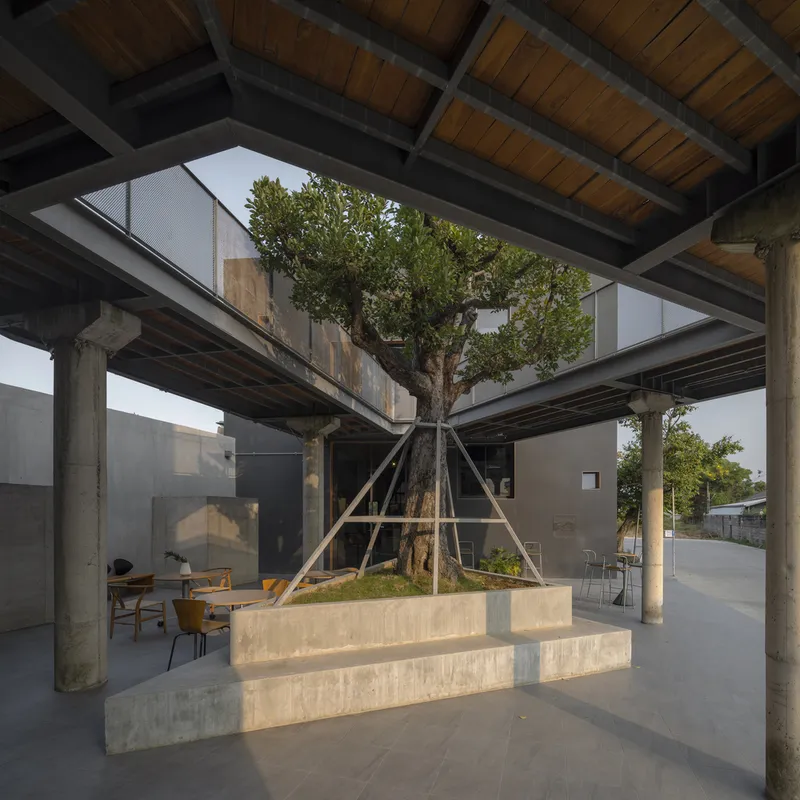
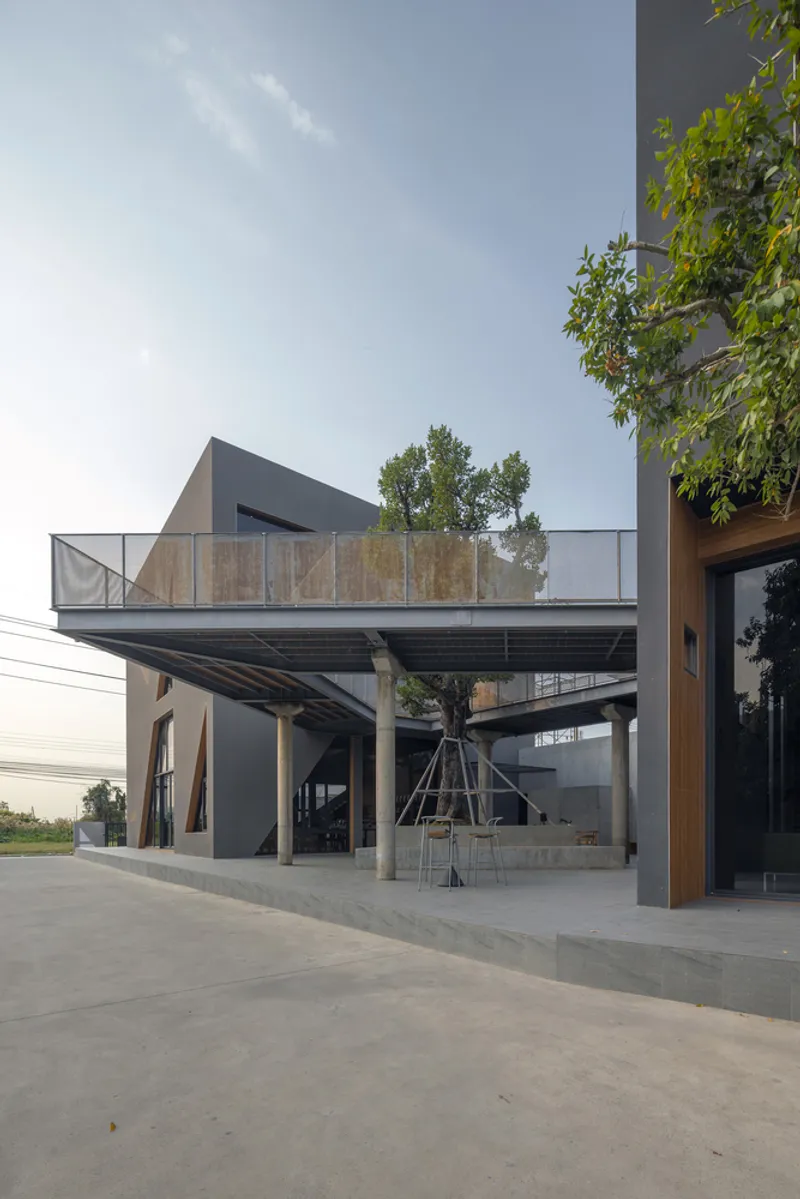
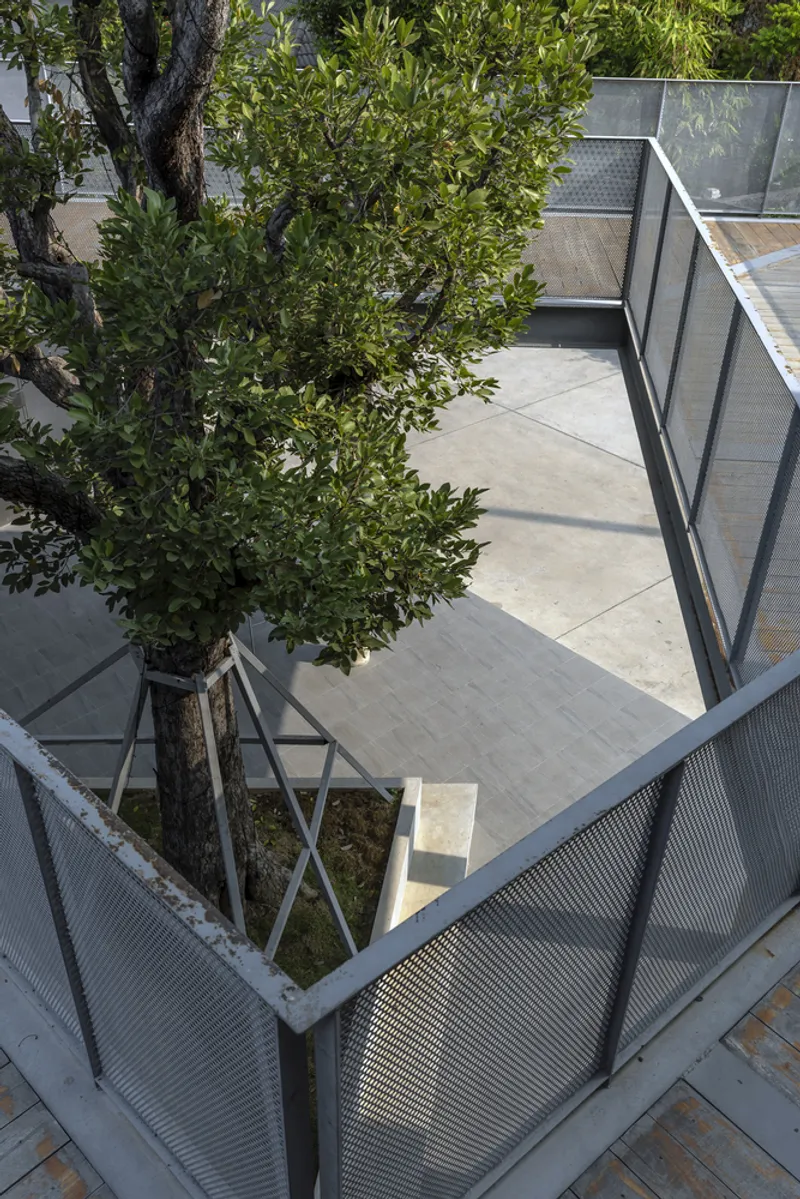
The existing tree is not an afterthought. ASWA organized the entire plan around its canopy, allowing it to grow through the timber deck and rise past the elevated terrace. The covered outdoor seating beneath the tree's branches creates a shaded zone that functions as a third room, neither fully interior nor fully exterior. In Phitsanulok's climate, this kind of passive shading strategy does more real work than any mechanical system could.
From the upper terrace, the tree becomes a companion at eye level. Glass balustrades and steel columns keep the structure visually light so the tree dominates the foreground. The perforated metal railings continue the geometric language while allowing air to move freely. It is a landscape strategy that doubles as a design philosophy: the building adapts to what was already there rather than clearing the site to start from zero.
Vertical Circulation as Spectacle
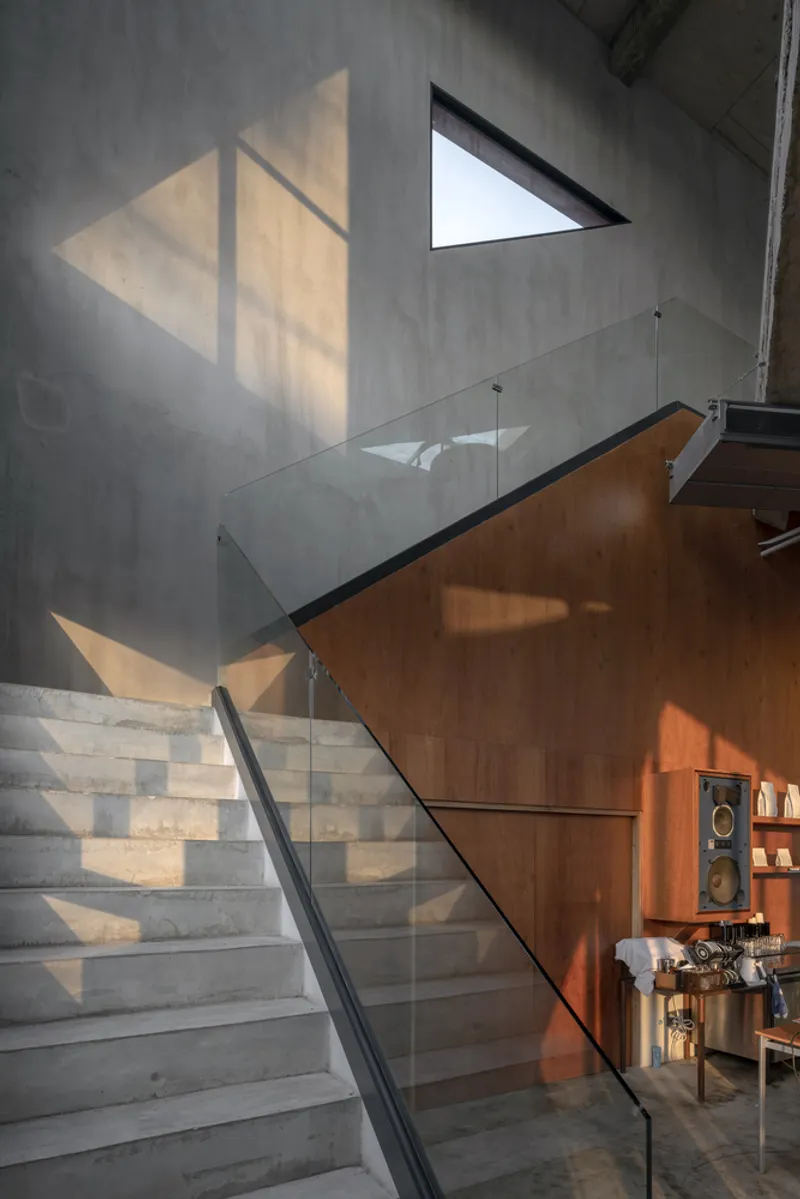
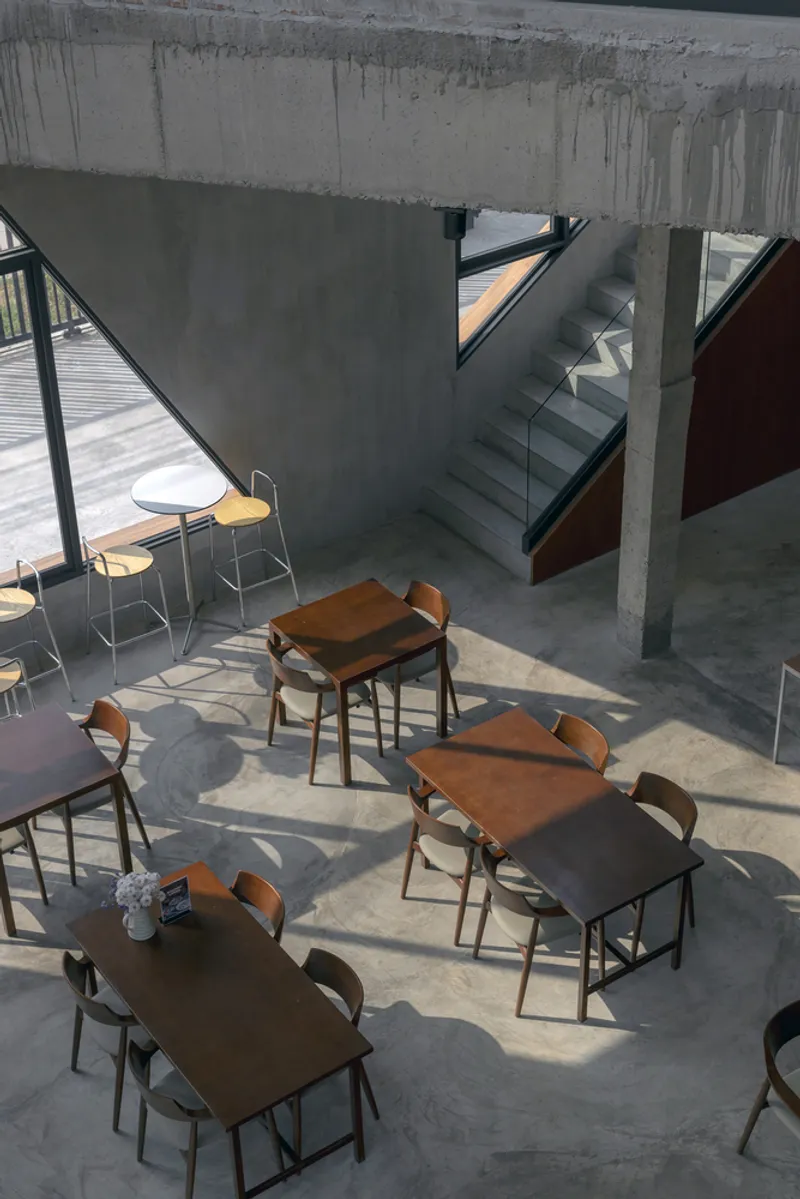

The concrete staircase is treated as a sculptural element in its own right. Glass guardrails keep sightlines open, and triangular skylights overhead cast geometric shadows that track the steps themselves, so the act of climbing becomes a visual event. The overhead views through glass floors and across level changes reveal the spatial complexity of the section, rewarding the visitor who looks down as much as the one who looks up.
From the mezzanine, you can read the entire ground floor layout in one glance: the bar, the dining hall, the tree courtyard. This legibility is a generous move. It lets first-time visitors orient themselves instantly and gives regulars the pleasure of seeing the space from a new vantage each time they ascend.
Plans and Drawings
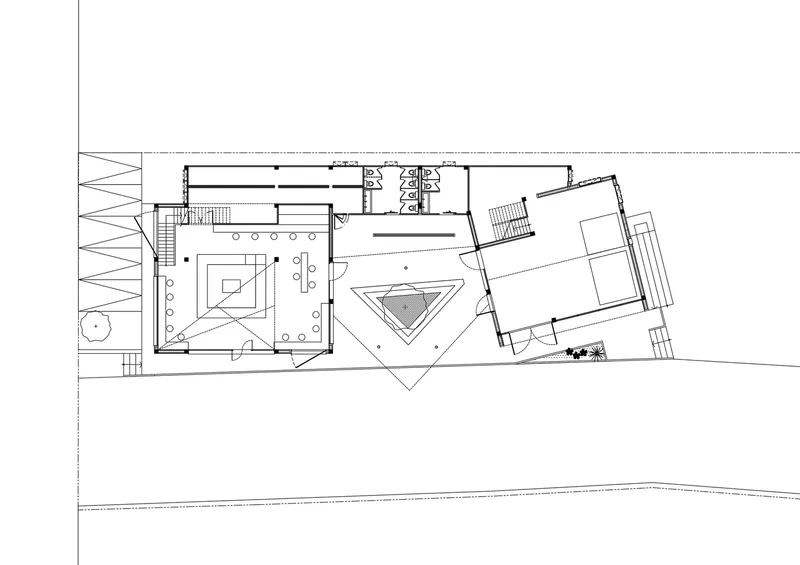


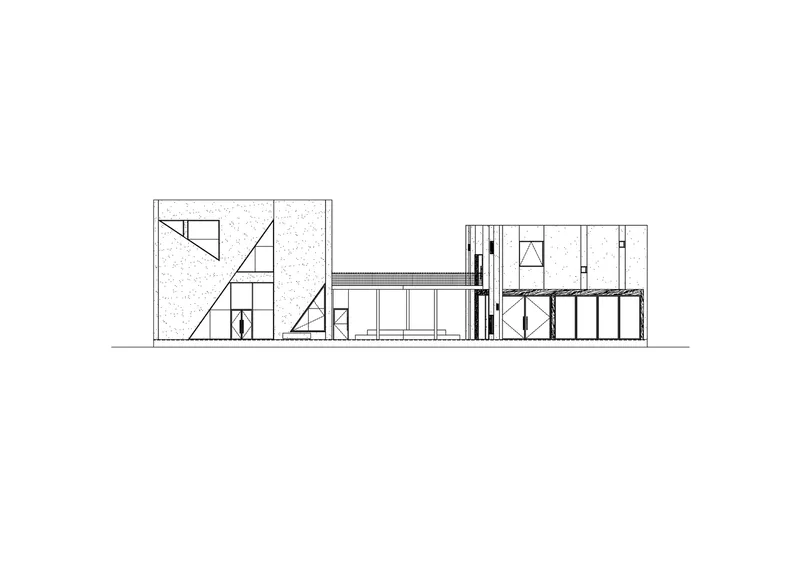
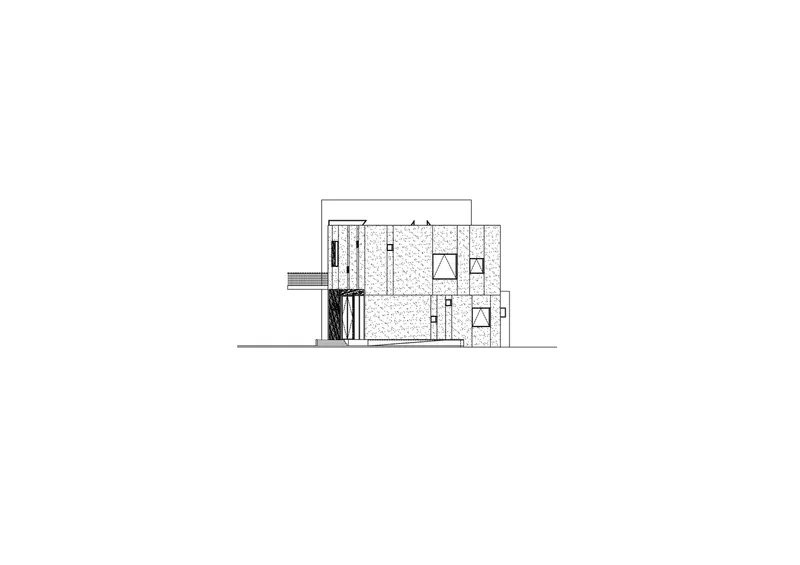
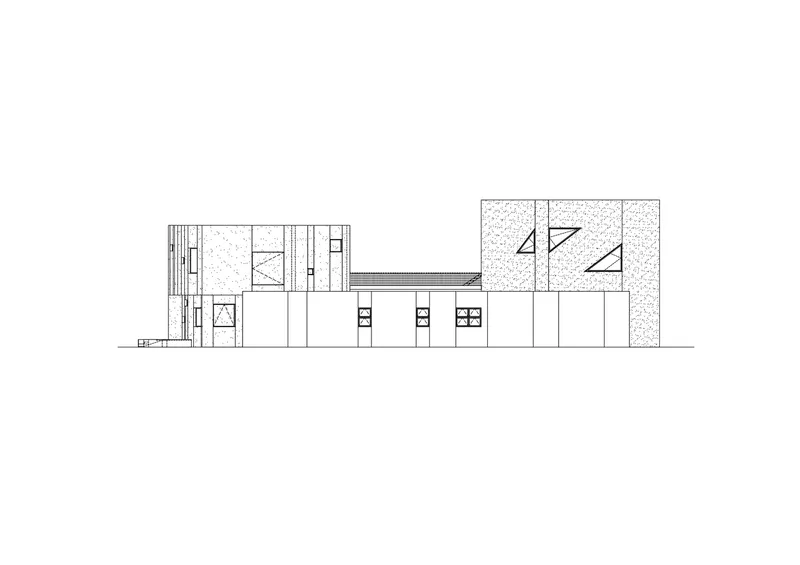
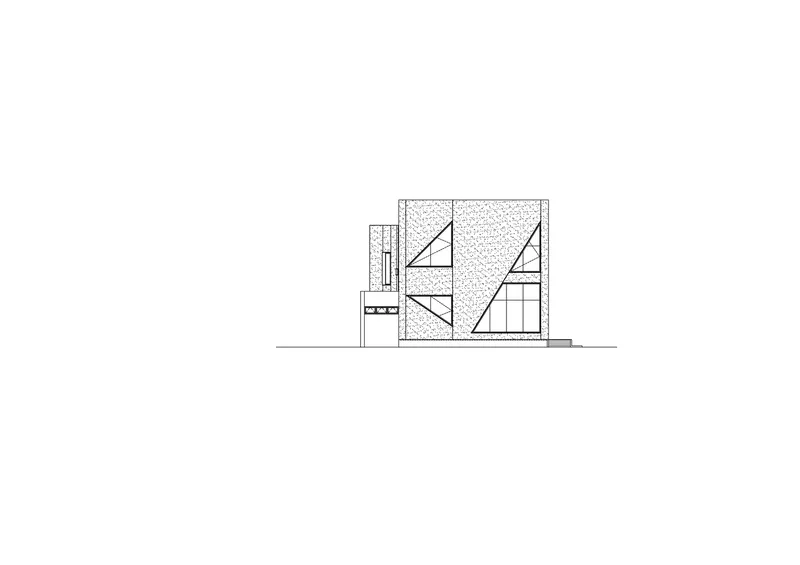
The floor plans confirm what the photographs suggest: the program is organized around a triangular courtyard void that separates and connects the two main volumes. The ground floor plan shows how the grid structure of the larger cube meets the angled geometry of the triangular openings, producing a tension between orthogonal structure and diagonal aperture. The upper floor plan reveals the open-plan mezzanine spaces and the triangular void that brings light and air deep into the building's core.
The section drawing through both volumes is the most revealing: you can see the nine-meter atrium, the bridge connecting the cubes, and the tree sitting between them at full height. The elevations document how the triangular openings are distributed asymmetrically across each facade, avoiding pattern repetition while maintaining a coherent formal language. These are drawings of a building that was clearly worked out in section first, with the plan following the logic of light, height, and connection.
Why This Project Matters
DIFF Coffee Roasters demonstrates that a café can be a legitimate piece of architecture without losing its function as a place to drink coffee. ASWA does not treat the triangular motif as decoration; it is embedded in the structure, the openings, and the spatial organization. The result is a building where the geometry serves the experience: controlling light, framing nature, and creating vertical drama in a program that most architects would flatten into a single-story box. In a market flooded with Instagram-ready cafés that prioritize surface over substance, this project stands apart because the architecture is the experience.
There is also something worth noting about the site strategy. By preserving and centering the existing tree, ASWA makes a quiet argument that good design begins with observation rather than erasure. The tree is not just a green amenity; it organizes the plan, provides passive cooling, and gives the project a temporal depth that no new planting could achieve. For a studio working in Thailand's northern region, far from the spotlight of Bangkok, this is a confident building that does not need to shout. It simply performs.
DIFF Coffee Roasters, designed by ASWA, Phitsanulok, Thailand. 800 square meters. Completed 2024.
About the Studio
Share Your Own Work on uni.xyz
If projects like this are the kind of work you want to make, uni.xyz is a place to publish your own, find collaborators, and enter design competitions.




Popular Articles
Popular articles from the community

Garden of Hope: Sustainable Architecture for a Resilient Community in Qandahar
Garden of Hope reimagines sustainable architecture as secure, organic community where women rebuild lives through housing, work, and nature.
AL-JANNAH: Sustainable Architecture and Permaculture for Afghan Widows
AL-JANNAH uses sustainable architecture and permaculture to create resilient oasis of housing, learning, work and renewal for Afghan widows.
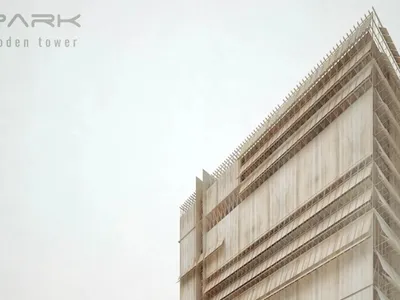
EW PARK: Sustainable Architecture Reimagines the Future of Urban Parking
EW PARK reimagines city parking as a modular wooden tower combining automation, solar energy, electric mobility, and adaptable urban design.

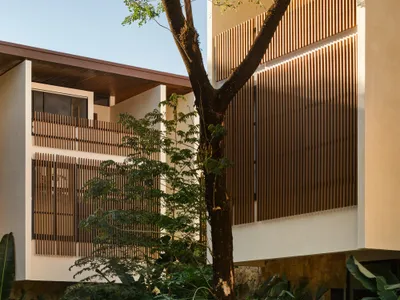
FAMM Arquitectura Organizes Ten Villas Around Courtyards and Jungle in Nosara, Costa Rica
El Molino pairs two elongated volumes with deep overhangs and timber louvers to build a compact coastal community five minutes from the beach.


Similar Reads
You might also enjoy these articles


Hodi-Mandai Geram
Project Function: Preservation and revitalization of the Intangible heritage and socio-spatial identity of the Hodi by Housing, Cultural Memory Center, Sacred Grove, landscape, local tourism economy


Olio Towers: A Mid-Rise for Performers That Fuses Housing, Rehearsal, and Stage
Located blocks from Houston's Theater District, this modular tower stacks living units around a central performance atrium.

Oasis: Modular Green Housing Carved into Dhaka's Urban Fabric
A shortlisted Plugin Housing entry reclaims unauthorized settlements in Dhaka with stepped concrete volumes, green roofs, and ventilation-driven design.

Black Hole: A Floating Megastructure for the Post-Physical Era
Emiliano Mazzarotto envisions a spherical, self-scaling arena where e-sports, digital hotels, and holographic stadiums replace traditional public space.


Explore Architecture Competitions
Discover active competitions in this discipline




The International Standard for Design Portfolios


The Global Benchmark for Architecture Dissertation Awards

The Global Benchmark for Graduation Excellence


Challenge to reimagine the Iron Throne
Comments (0)
Please login or sign up to add comments
No comments yet. Be the first to comment!