

mtthw Turns a Tokyo Home into a Layered Restaurant
Dining Above the Depot peels back decades of residential history to create a restaurant that treats time as a material, not a problem.


Adaptive reuse projects in Tokyo tend to fall into two camps: total gut jobs that erase the past, or precious restorations that treat every stain like a relic. Dining Above the Depot, designed by mtthw and led by Namiko Matsubara and Hiromu Tanaka, does neither. The 197 m² restaurant occupies a former residence that had already been modified multiple times across its life, and the architects chose to keep that layered history legible rather than resolving it into a single aesthetic statement.
The result is a space where raw concrete structure, timber panel ceilings, shoji screens, brick thresholds, and copper accents coexist without pretending they arrived at the same moment. It is a restaurant that feels lived in before any diner sits down, which is precisely the point. The question the project raises is worth paying attention to: what happens when you treat a building's accumulated modifications not as clutter to strip away but as a kind of material richness to work with?
Reading the Layers
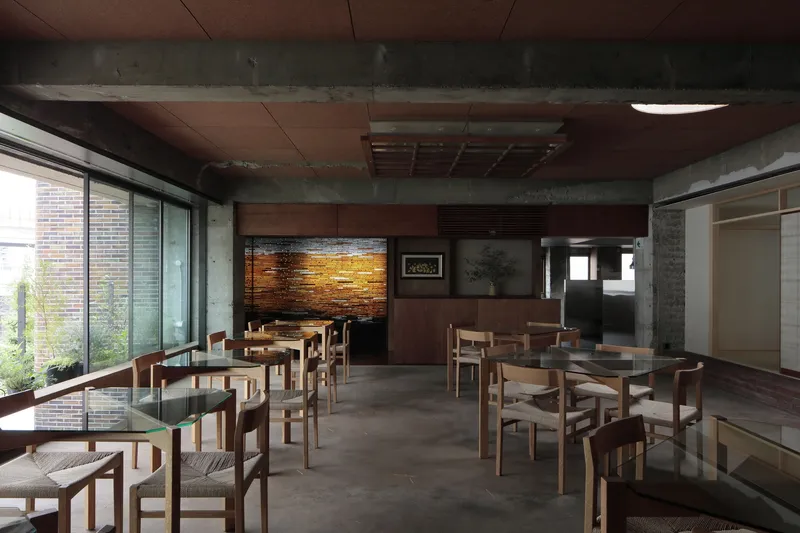


The ceiling tells the whole story. Exposed concrete beams from the original structure sit alongside reddish wood panels that belong to a later residential renovation, and the architects have added new slatted screens and light fixtures that read clearly as contemporary insertions. Nothing is disguised. The concrete column in the corridor stands bare beside freestanding timber partitions, and the junctions between old and new are left honest, even celebrated.
This approach requires real discipline. The temptation in any renovation is to sand everything down to a uniform palette. Here, mtthw trusts the eye to parse difference, and the dining experience is richer for it. You are eating inside a timeline.
The Tatami Room as Threshold
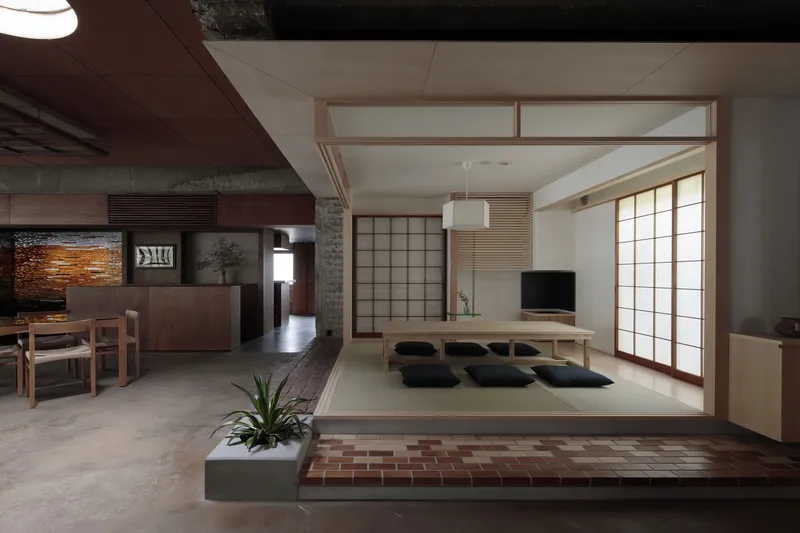

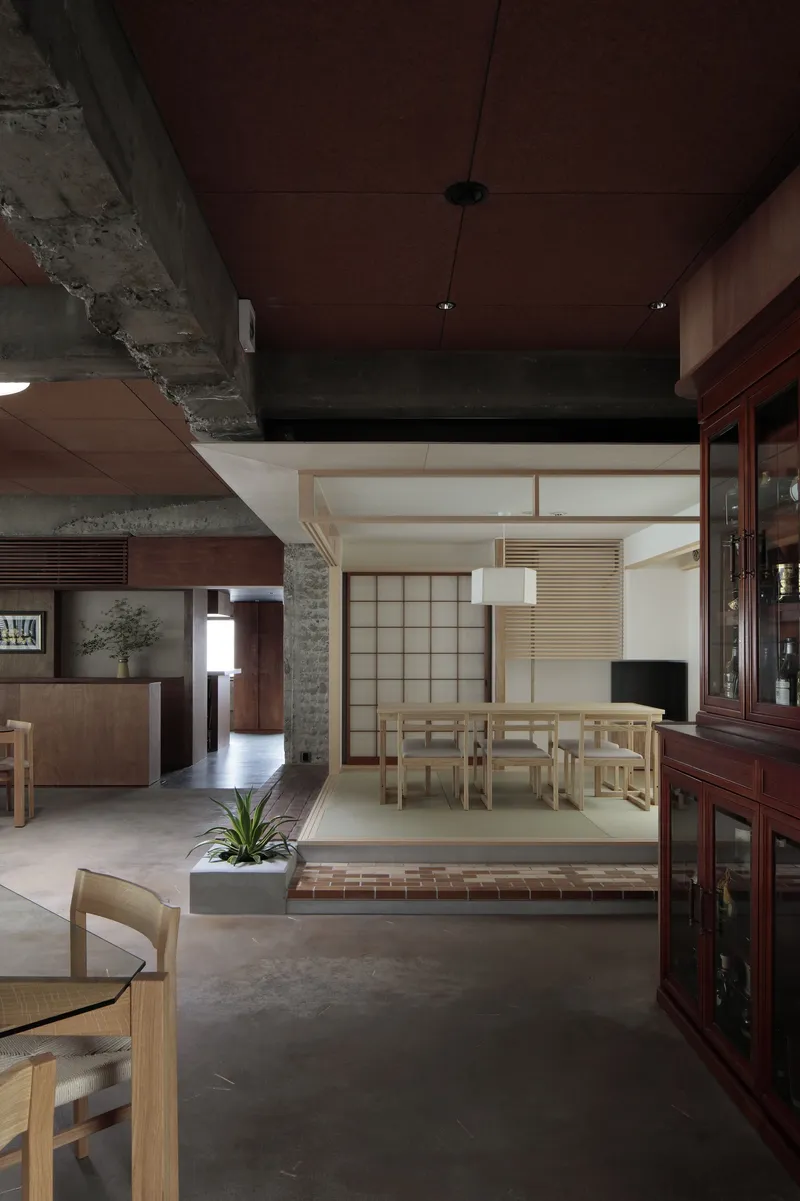
The elevated tatami platform is the most explicitly domestic gesture retained in the conversion. Raised above the main dining floor and enclosed by translucent shoji sliding panels, it functions as a semi-private room that references the building's residential past while serving a very practical restaurant purpose: a reservable space for groups that feels intimate without being sealed off.
The framing is key. Raw concrete beams overhead and a dark wood ceiling remind you that this is not a recreated tea room. It is a domestic fragment held inside an honest structural frame, and the shoji screens mediate between the two conditions with quiet elegance. Floor cushions replace chairs, and the shift in posture alone changes the quality of the meal.
Filtering Light, Filtering Views

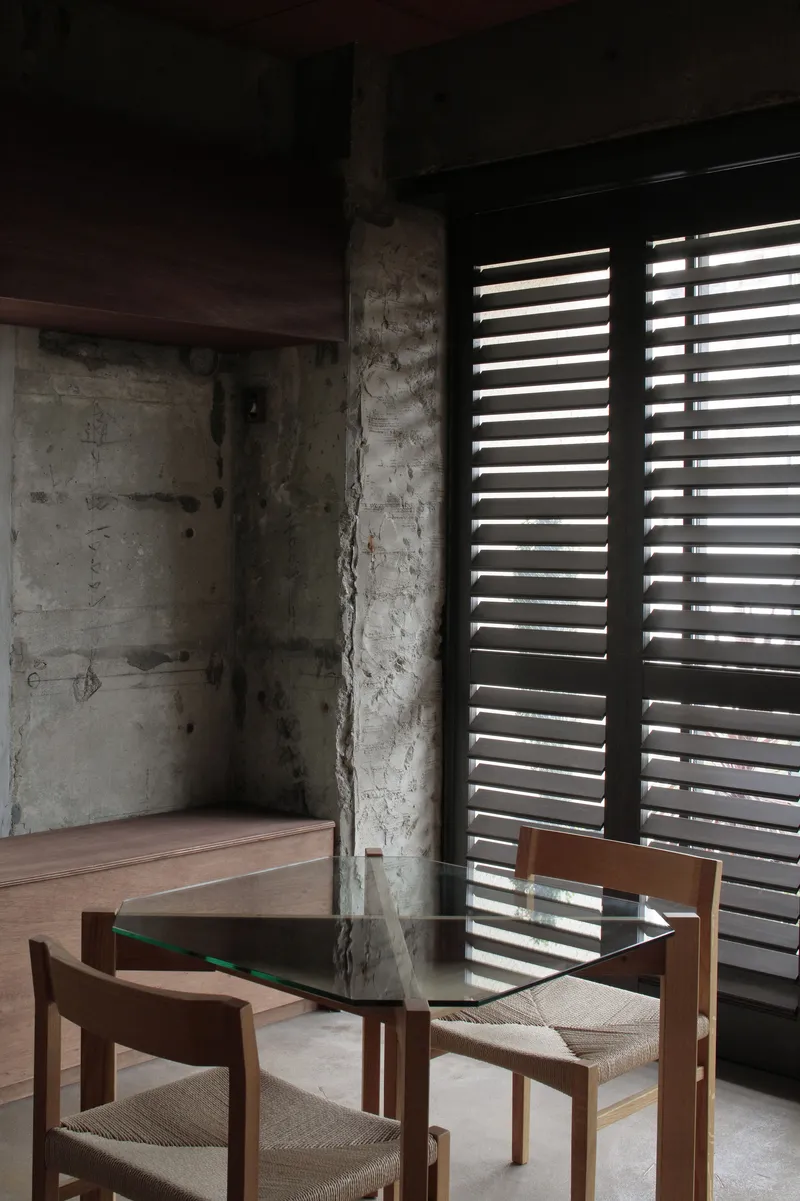
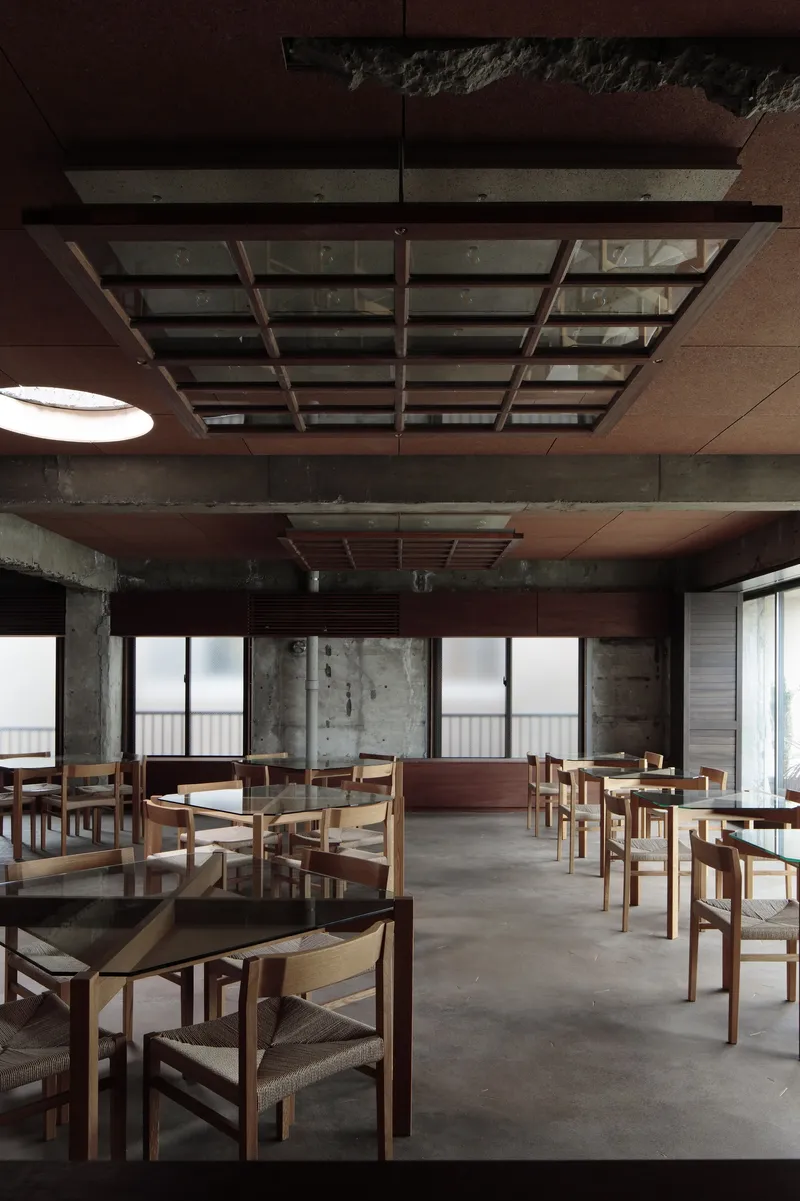
mtthw deploys an entire vocabulary of screens and louvers throughout the restaurant, and each one does slightly different work. Floor-to-ceiling louvered screens beside the dining chairs filter daylight into soft bands that shift across the concrete floor as the afternoon progresses. Horizontal louvers along the concrete walls create a moiré effect that softens the brutality of the exposed structure. Suspended slatted screens in the main ceiling zone break up the overhead volume without blocking sightlines.
The cumulative effect is a restaurant where no surface is hit by flat, unmediated light. Everything arrives filtered, and the interplay between timber screening and concrete mass gives the interior a warmth that feels earned rather than applied.
Courtyard and Exterior
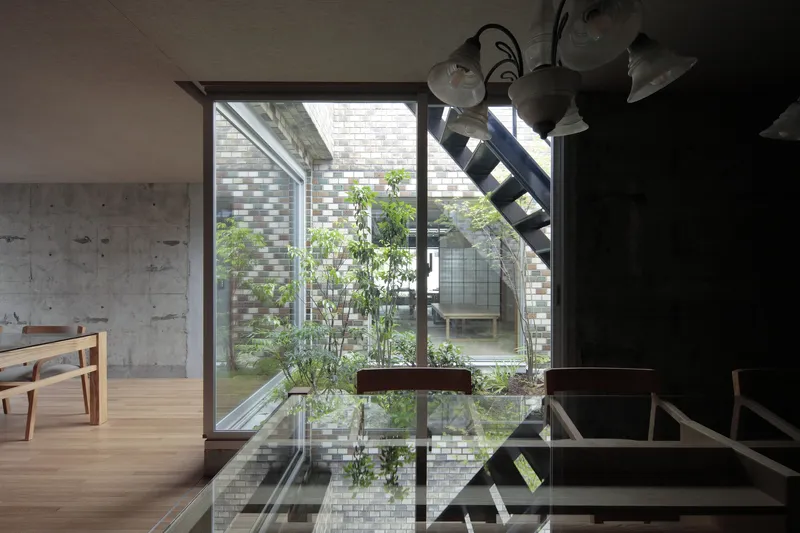
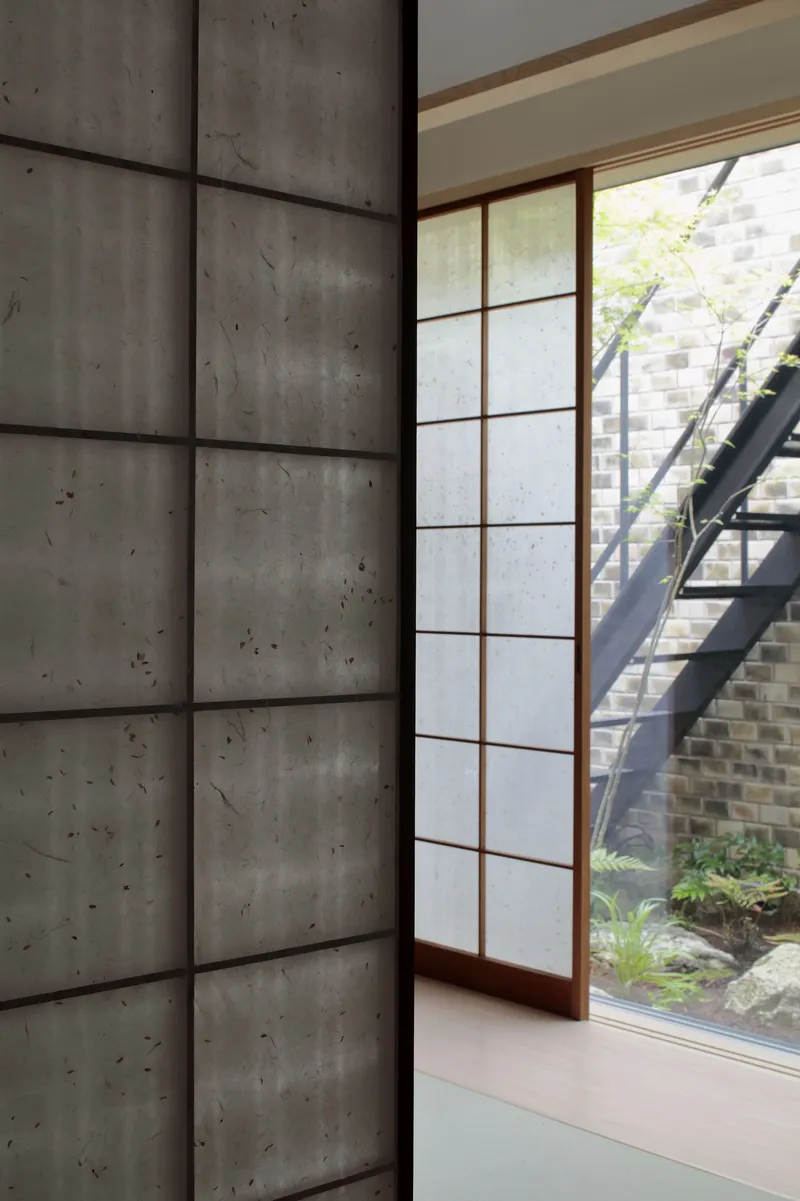

The interior courtyard, visible through floor-to-ceiling glazing, acts as both a light well and a piece of living scenography. Glass block walls bounce diffused light into the surrounding rooms, while planted trees introduce a shifting green palette that changes with the seasons. A steel staircase provides vertical circulation but also functions as a visual anchor, its industrial materiality complementing the board-formed concrete of the adjacent wall.
From the street, the project is restrained to the point of discretion. The second-floor terrace glows at dusk, hinting at the life within, but a roll-down shutter at ground level preserves the building's original commercial frontage character. The facade does not advertise the transformation happening inside, which feels like a deliberate choice in a city that often defaults to spectacle.
Bar, Kitchen, and Material Detail
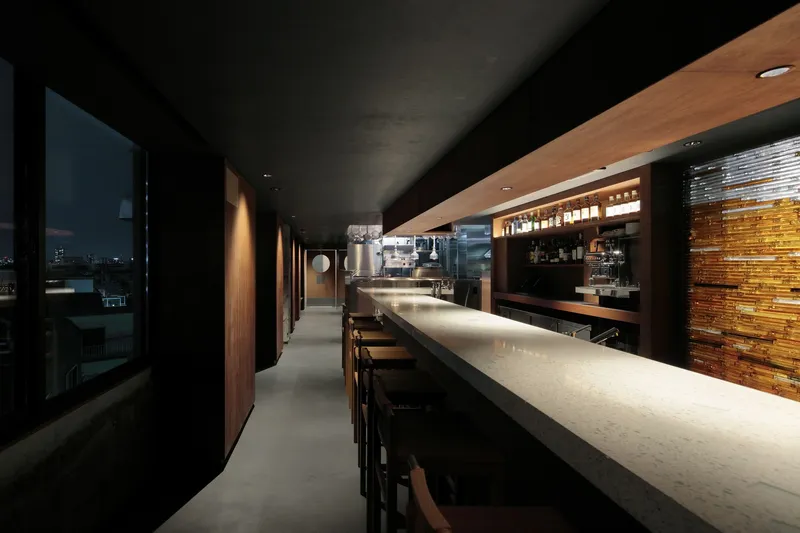
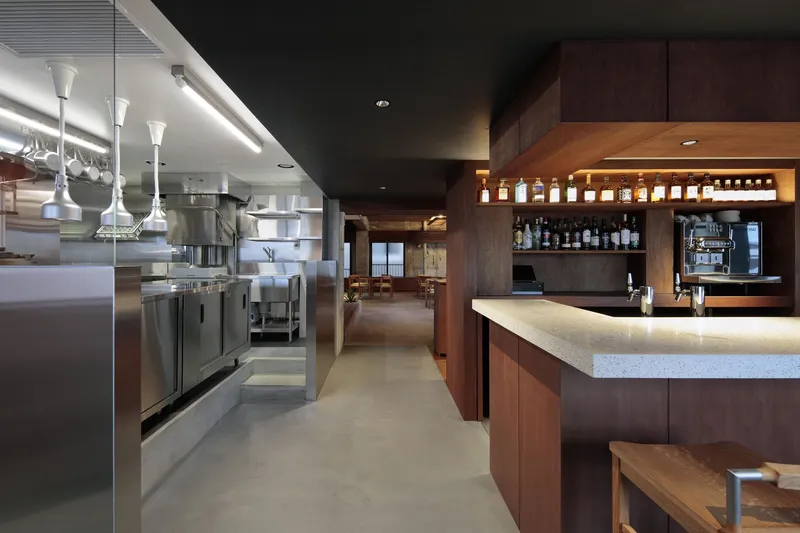

The long walnut bar counter with embedded lighting draws guests through the space toward the kitchen, where stainless steel equipment sits in plain view beneath linear ceiling lights. There is no attempt to hide the mechanics of a working kitchen, and the bar acts as a transitional zone where the warmth of the dining room meets the functional clarity of food preparation.
Material choices repay close inspection. The terrazzo counter edge meets its timber base with a precise joint that suggests real care in execution. These details are not decorative; they define the spatial hierarchy. Where surfaces intersect, the quality of the join tells you everything about the architects' priorities.
Evening Atmosphere and Copper Accents
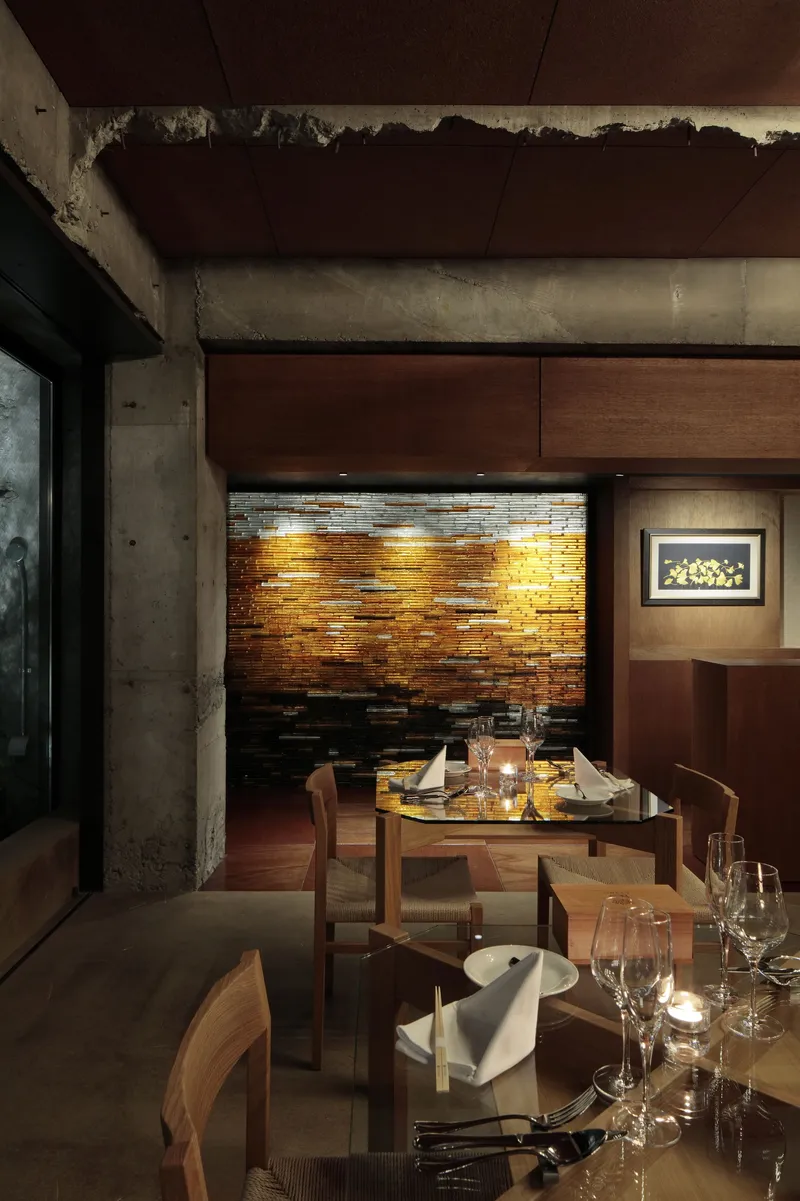
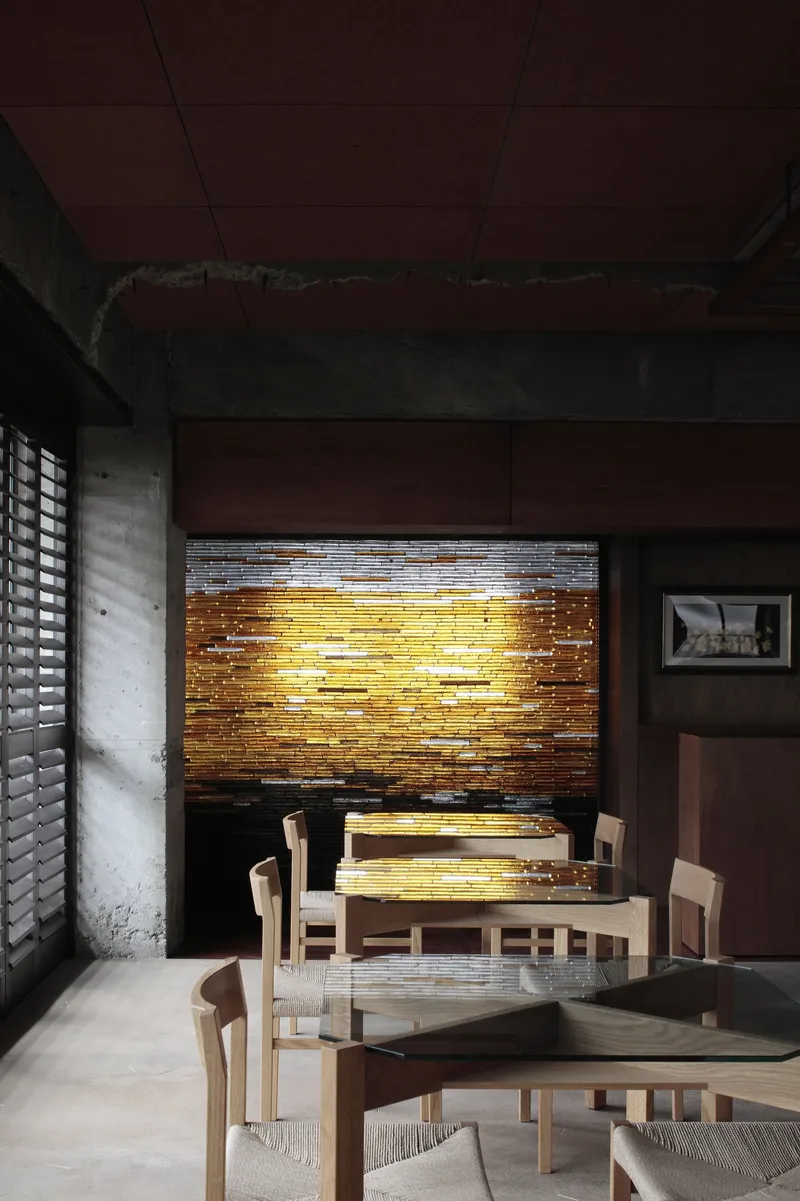
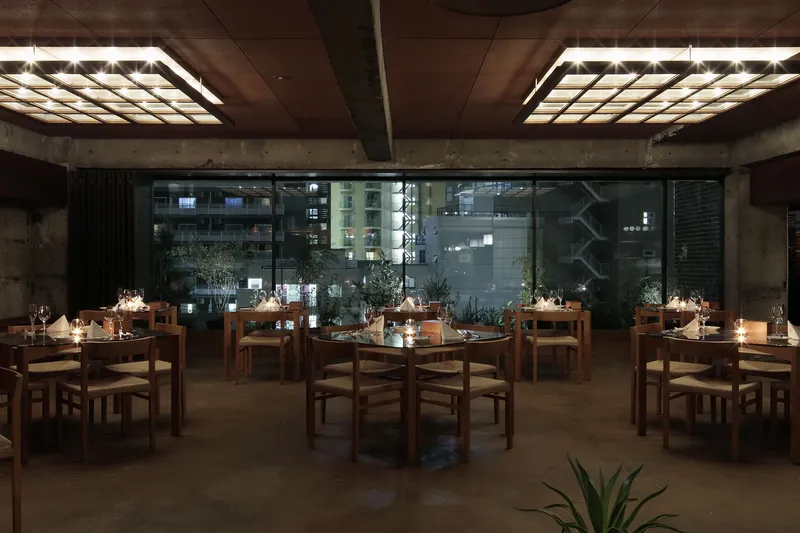
At night, the restaurant undergoes a material shift. The copper tile accent wall behind candlelit tables catches warm light and throws it back in unpredictable patterns, while the backlit horizontal timber screen wall becomes the dominant luminous surface, replacing daylight as the primary source of ambient glow. Ceiling panels overhead become illuminated planes, and the exposed concrete recedes into shadow.
This dual character, bright and filtered by day, warm and layered by night, is not accidental. It means the same room serves lunch and dinner as genuinely different spatial experiences, which is exactly what a good restaurant conversion should deliver.
Arrival and Private Rooms


The walnut veneer entrance door with its circular mirror and graphic signage sets the tone: precise, warm, and slightly mysterious. Stepping through into a corridor of polished concrete flooring and timber panelling, the transition from street to dining room is deliberately elongated. You are given time to shed the city before you eat.
The private dining room with its glass-topped timber table, chandelier, and corner windows onto a courtyard garden represents the most refined reading of the building's domestic past. It could be a living room. It could be a salon. The ambiguity is the point.
Spatial Fragments
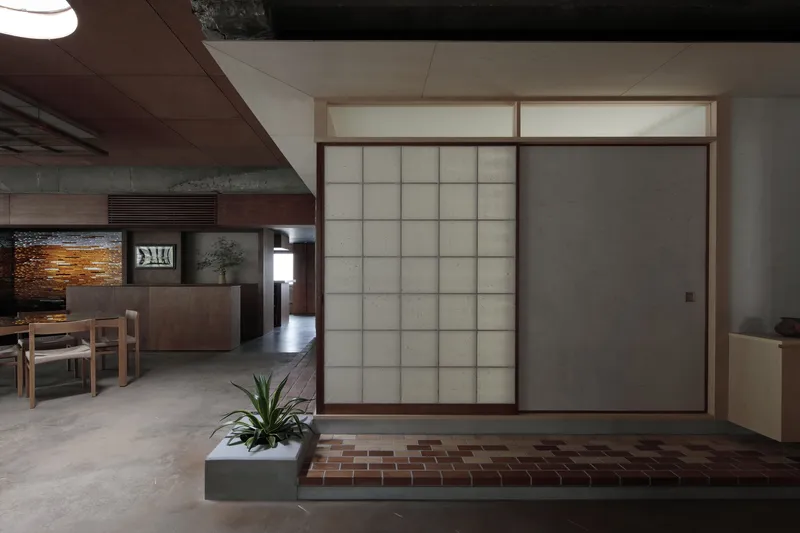
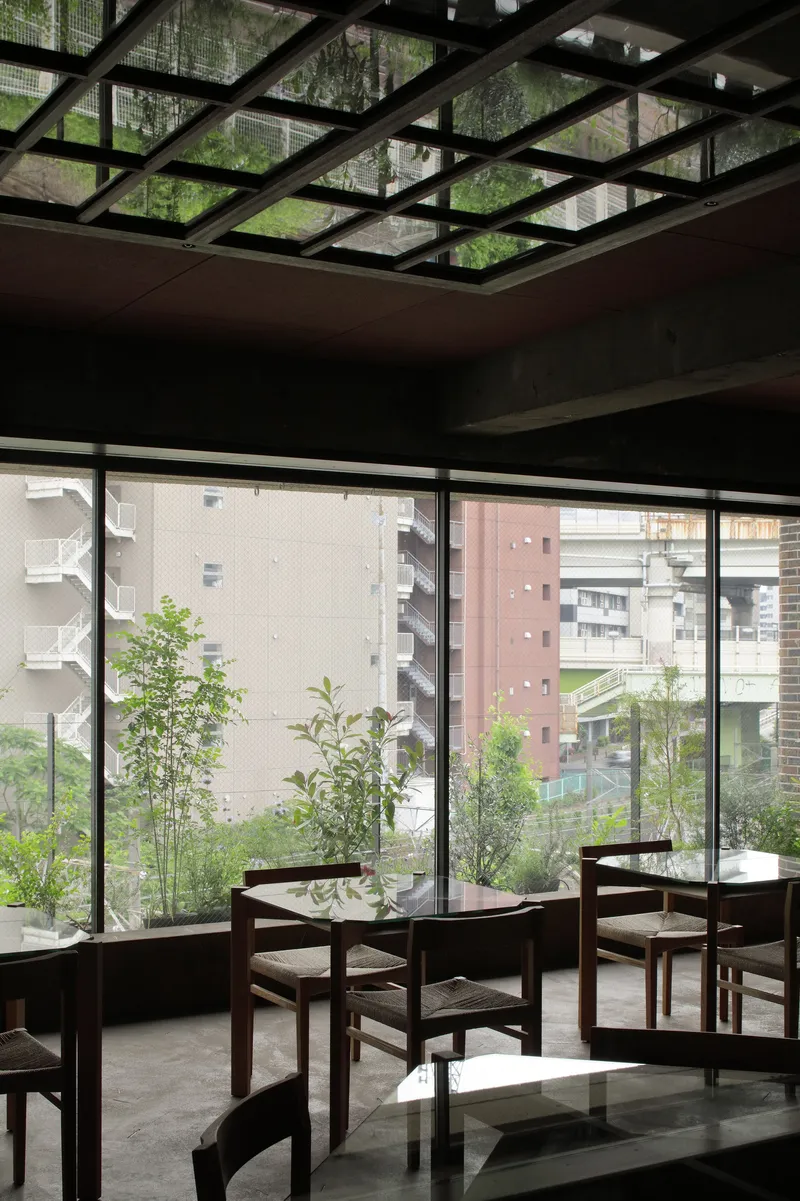
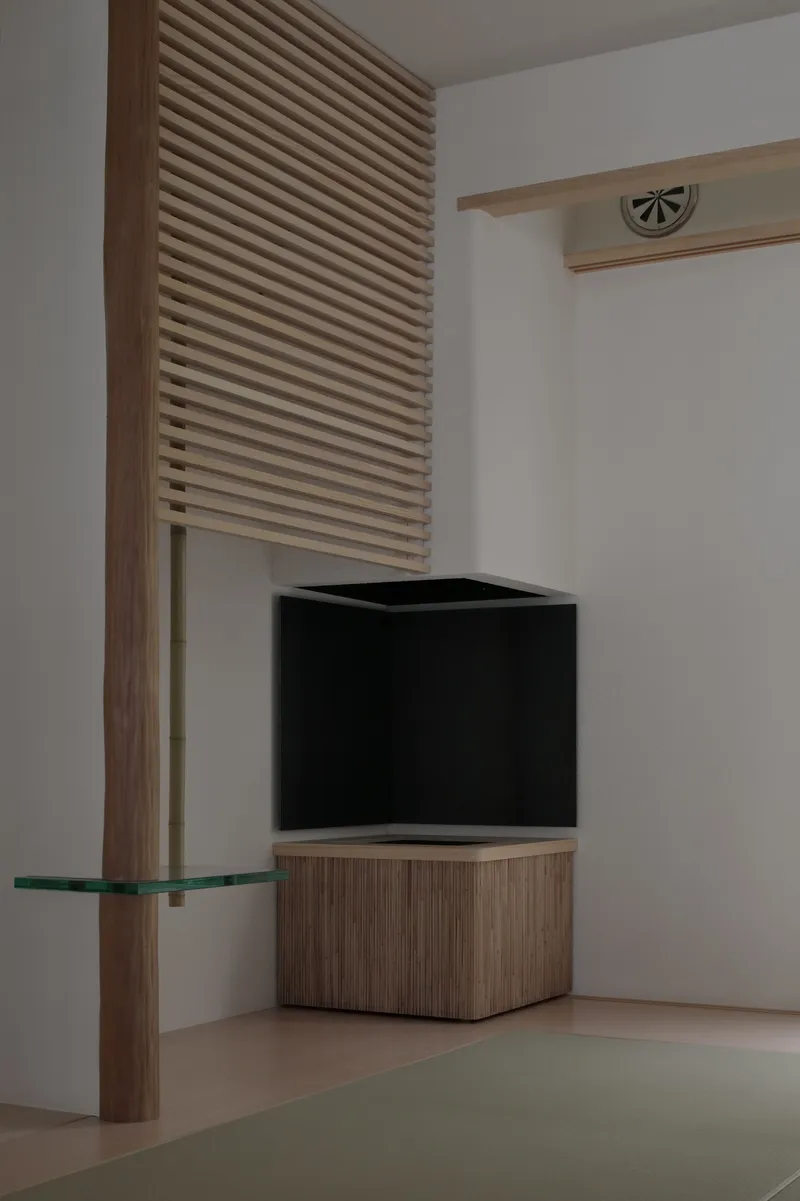
Several moments in the project resist easy categorization. A closed translucent panel beside an open shoji screen creates a threshold condition that is neither wall nor door. The black steel grid skylight overhead in one dining area opens the room to the sky while maintaining the sense of enclosure. A corner detail with a timber louvered panel, black metal box, and glass shelf reads almost like a still life, a composed fragment of the project's material vocabulary.
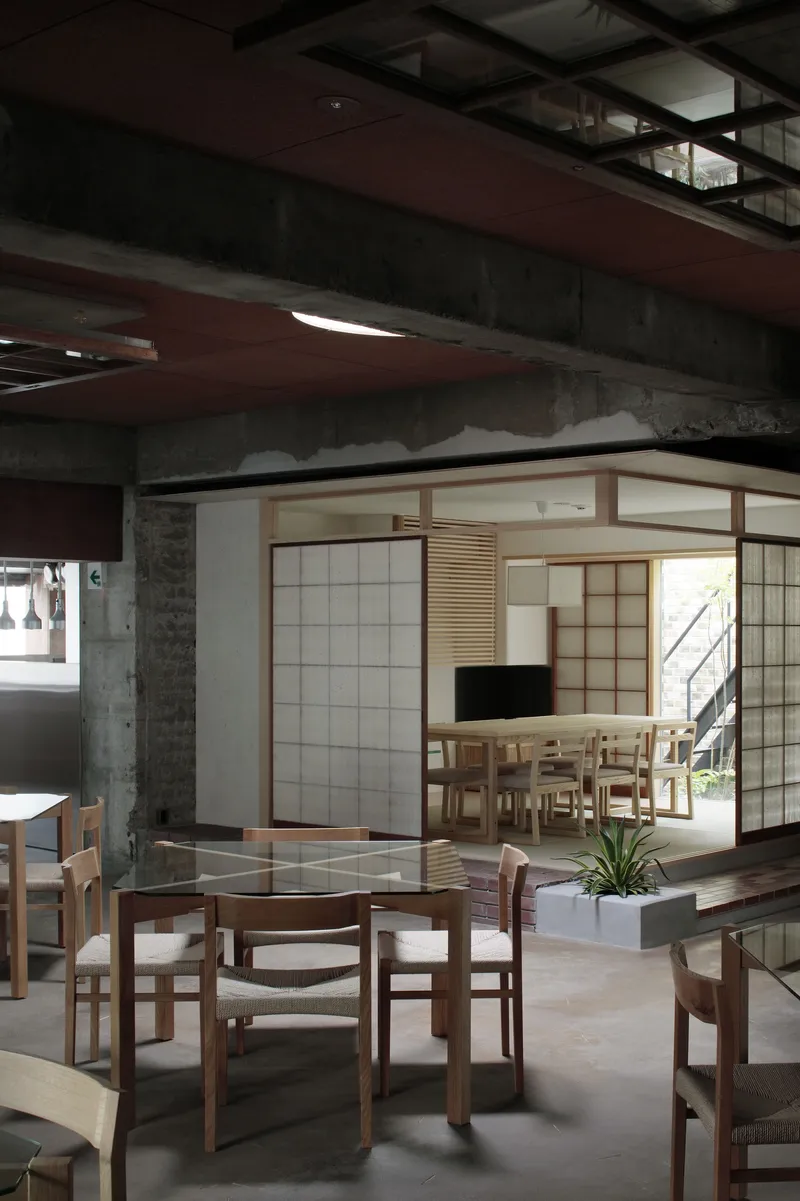
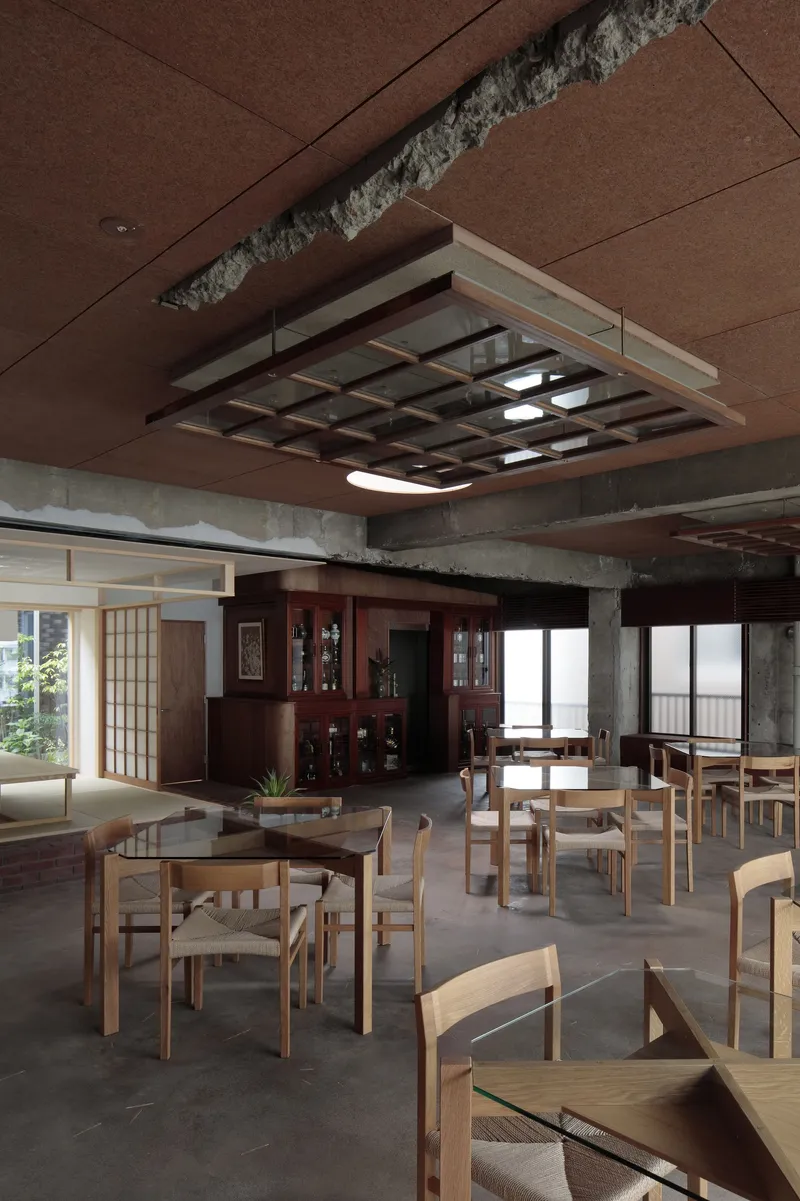
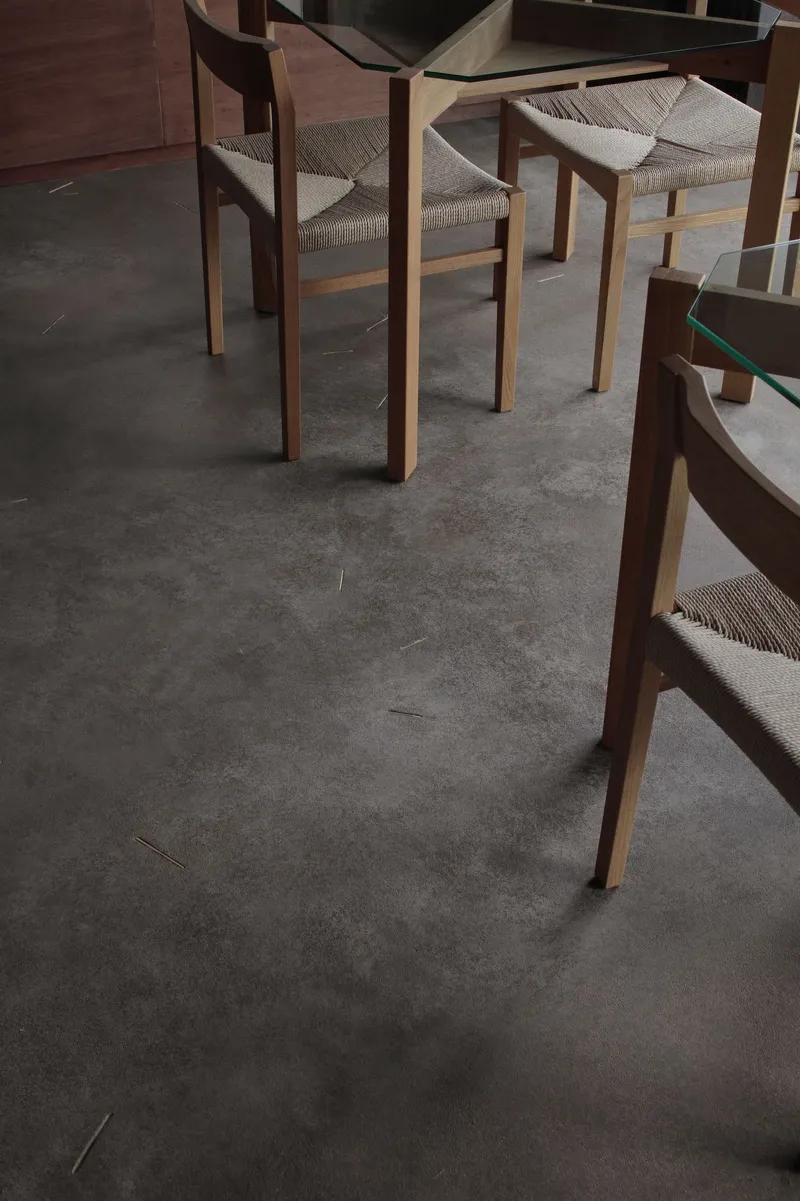
The gridded ceiling fixtures above dining tables, woven chair seats on polished concrete, suspended lattice light fixtures: these are the repeating motifs that stitch the various rooms together into a coherent whole. The furniture is simple and well made, never competing with the architecture for attention. Wooden chairs with woven seats sit comfortably on the concrete floor, and the contrast between handcraft and industrial finish runs through every room.
Plans and Drawings
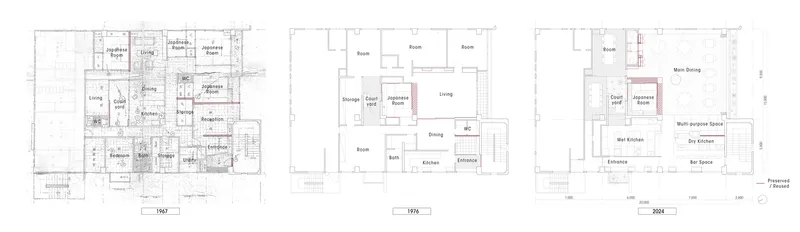
The floor plan drawings showing the evolution of the residential layout across three time periods are the project's most revealing document. They make explicit what the architecture implies: that this building has been a palimpsest for decades, and mtthw's intervention is simply the latest inscription. Each phase of modification is legible, and the current restaurant plan reads as an accumulation rather than a replacement.
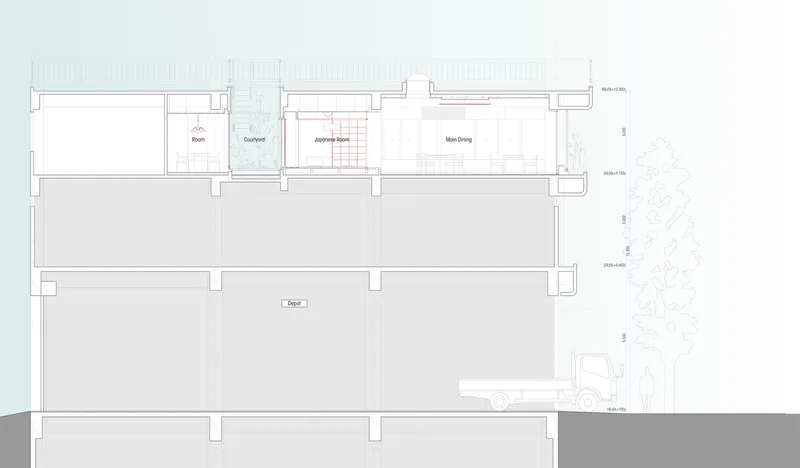
The section drawing is equally telling. It reveals the vertical relationship between upper residential spaces and the ground-floor commercial volume, with the courtyard acting as a hinge between the two. The decision to elevate dining above the depot, to place the social act of eating above the infrastructure of the street, gives the project its name and its spatial logic.
Why This Project Matters
Tokyo's restaurant scene is saturated with interiors that treat design as branding, spaces built to photograph well and be replaced in three years. Dining Above the Depot takes the opposite position. By keeping the building's residential history visible and working with its accumulated modifications rather than against them, mtthw has created a restaurant that carries genuine spatial depth. Every surface has a story that predates the menu.
The broader lesson is about adaptive reuse itself. Too many conversion projects treat the existing building as a container to be emptied and refilled. Here, the container is the content. The shifts in material, the visible joints between eras, the domestic fragments like the tatami room held within a commercial program: these are not compromises. They are the architecture. That is a harder thing to achieve than starting from scratch, and it is worth more.
Dining Above the Depot by mtthw (Lead Architects: Namiko Matsubara, Hiromu Tanaka). Tokyo, Japan. 197 m². Completed 2024. Photography by Koichi Torimura.
About the Studio
Share Your Own Work on uni.xyz
If projects like this are the kind of work you want to make, uni.xyz is a place to publish your own, find collaborators, and enter design competitions.


Popular Articles
Popular articles from the community


GROUP A Strips a 1969 Rotterdam Harbor Headquarters to Its Frame and Wraps It in Timber Louvers
In Rotterdam's M4H harbor district, Ferro Offices reuses a 1969 frame, adds one timber storey and reaches BREEAM-NL Outstanding.

Juan García Correa, John González and Claudia Rueda Sink a Circular Amphitheater into a Manizales Engineering Building
On the La Nubia campus in Manizales, Colombia, the S1 Building folds labs and offices into a hillside of ramped lawns that double as a campus route.

Jaramillo Van Sluys Arquitectura and Urbanismo Turn a Demolished Registry Lot in Quito into an Orchard Plaza
In Quito's Centro Histórico, a 2,800 m² plaza exposes the San Agustín convent wall and redraws its lost Augustinian orchard in volcanic stone.

David Macias Steps a Doorless Stone and Plaster House Down a Tropical Colombian Hillside
In the humid hills of Colombia, Threshold House replaces the front door with an open void and terraces its 850 m² down the slope instead of fighting it.

Similar Reads
You might also enjoy these articles


LAVA Architecten Gives Vocational Education a Sawtooth-Roofed Face on a Mechelen School Campus
In Mechelen, Belgium, a 2,053 m² STEM school on a 6×6 m grid turns workshops and classrooms into rooms that can be rearranged as teaching changes.

KEMA Studio Turns a Derelict Marvila Attic into a 60 m² Lighthouse Apartment Above Lisbon
In Lisbon's Marvila district, a rebuilt roof, four skylights and two plywood volumes turn an unlivable attic into a bright home facing the Tagus.

Pixel Gardens: One Repeated Module Stacked Into a Terraced Social Housing Tower for Famagusta
Salem Bader's shortlisted housing tower builds a vertical neighbourhood from one repeated module, offsetting units to carve terraces, light and air.

Bao Huynh Watercolor Atelier: A Serene Art Retreat in Hội An
Bao Huynh Watercolor Atelier in Hội An blends multifunctional art spaces, sustainable design, local materials, and family-friendly living in a serene environment.

Explore Interior Design Competitions
Discover active competitions in this discipline

Challenge to design luxury tourism on rails

VR headsets Storefront design competition

Designing a staircase for a client
Comments (0)
Please login or sign up to add comments
No comments yet. Be the first to comment!