
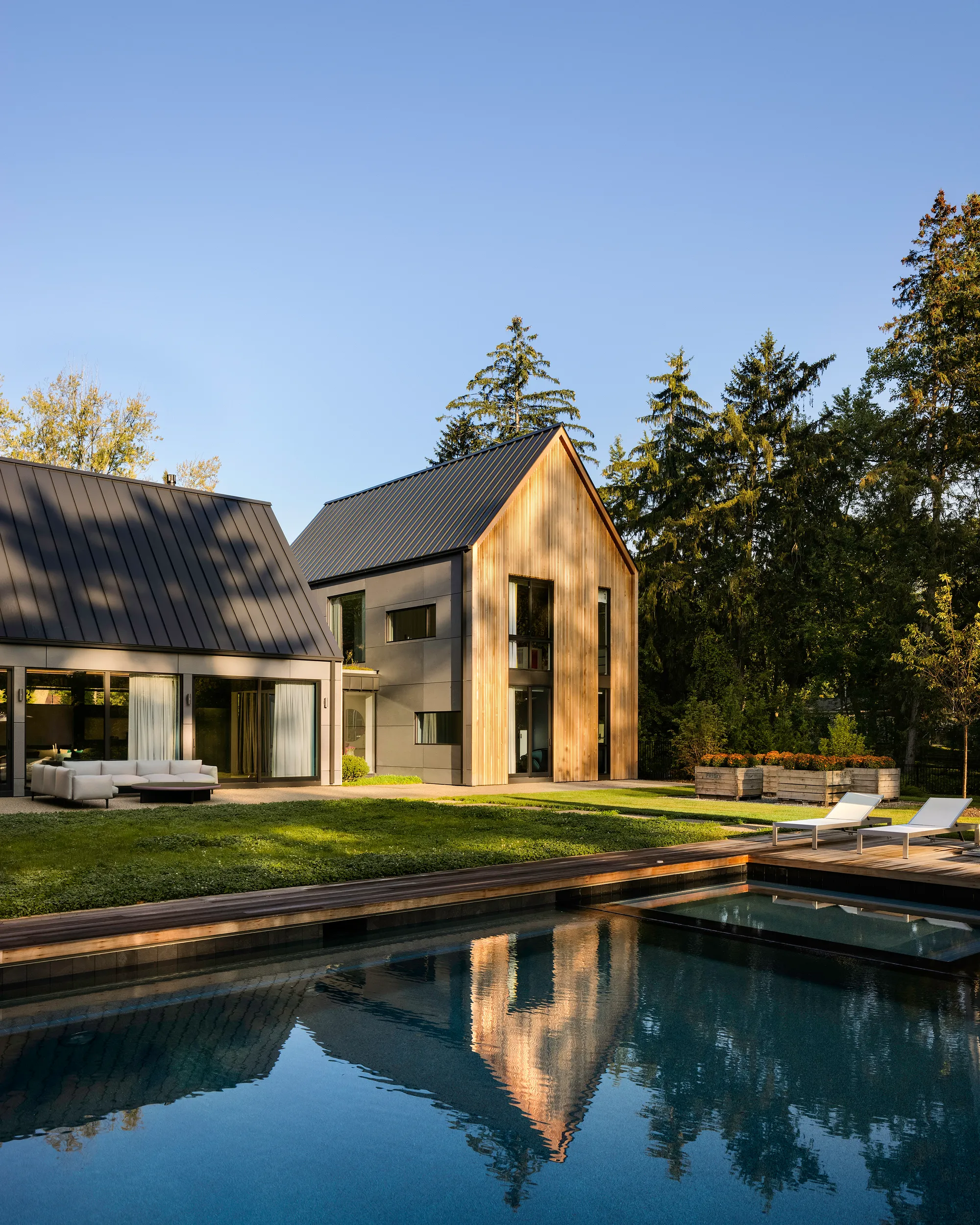
Disbrow Iannuzzi Scatters Four Gabled Pavilions Across a Michigan Farmstead
On 3.5 wooded acres in historic Franklin, Michigan, a residence composed of clustered volumes channels the logic of rural outbuildings.


There is a particular kind of ambition embedded in designing a house that does not want to be found. The client behind Briarcliff Residence, completed in 2021 by Disbrow Iannuzzi in Franklin, Michigan, reportedly asked that the home be "unplottable," invisible on a map. That desire for privacy shaped the architecture at every scale: the compound of four gabled pavilions is tucked behind earthen knolls sliced with Corten steel retaining walls, approached through a submerged motor court, and largely hidden from the street by a custom millwork wall. The house reveals itself slowly, in fragments, as you move through it.
What makes Briarcliff genuinely interesting is not the secrecy but the typological argument it makes. The design takes its cues from the classic Michigan farmstead, those aggregations of gabled structures built barn by barn over generations, and translates that logic into a single-family residence. Four distinct volumes separate public and private life, with the longest pavilion running side to side across the property in one uninterrupted span. The result is a home that reads as a small settlement rather than a single building, with each volume clad differently and each oriented to the landscape with specific intent.
A Farmstead Vocabulary in Cedar and Steel
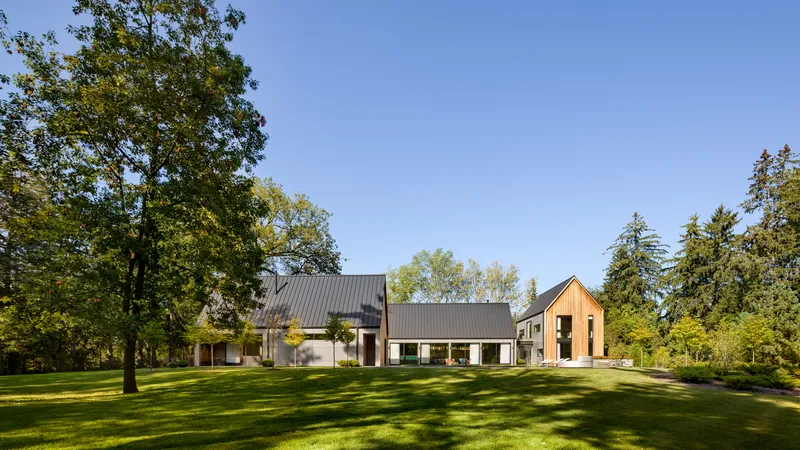


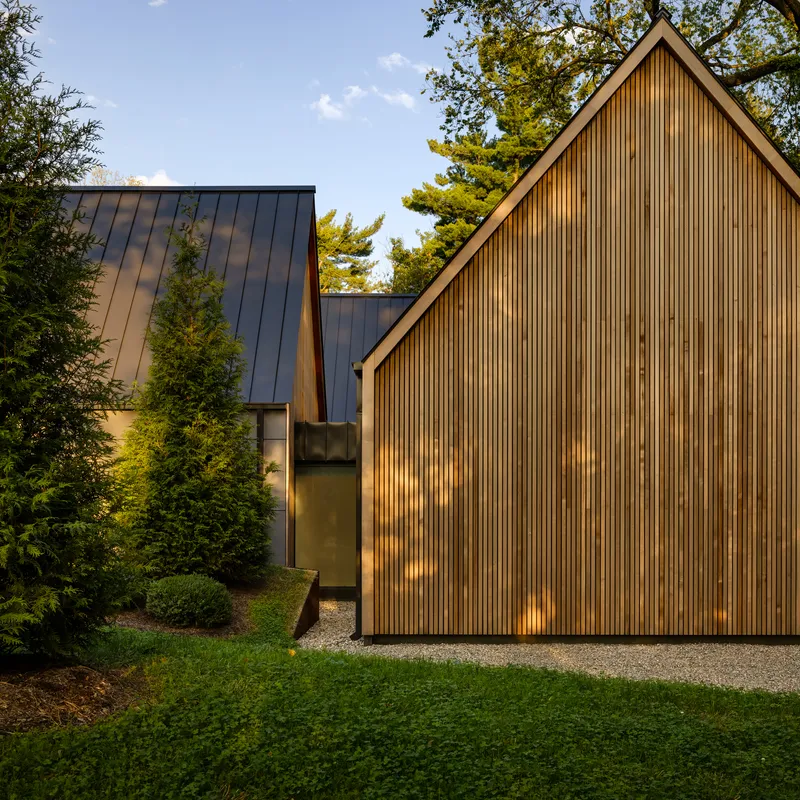
The material palette is legible from a distance: vertical cedar slats, fibre cement panels, and standing-seam metal roofs. Each pavilion wears its cladding slightly differently. Some volumes are wrapped entirely in timber; others combine timber with lighter panels. The gabled profiles are steep and declarative, echoing the proportions of agricultural buildings without mimicking them. A spreading oak tree at the junction of three forms acts almost like an organizing element, anchoring the cluster and reinforcing the idea that this grouping grew incrementally.
The detailing is sharp. Metal roof ridges meet cleanly, and the transitions between cedar and cement panel are handled without fussy trim. Disbrow Iannuzzi clearly invested in getting the proportions of each gable right: none of them feel interchangeable, yet they belong to the same family.
Sinking Into the Landscape


The approach sequence is one of the strongest moves in the project. A curved gravel drive descends into a motor court that sits below the natural grade, flanked by timber-clad volumes on both sides. You arrive in a courtyard between buildings rather than at a front door. This is the Corten steel retaining wall strategy at work: the knolls that screen the house from the road are retained with weathering steel, and the walkways between volumes are similarly walled. The effect is part fortification, part landform.
The siting preserves nearly all of the existing tree canopy, including a hundred-year-old American Elm. Rather than clearing and building, the pavilions slot between root zones. The gravel surfaces and planted knolls minimize hardscape, letting the property maintain its rural character even with 5,300 square feet of house distributed across it.
The Long Pavilion: Living Under Exposed Steel Bents
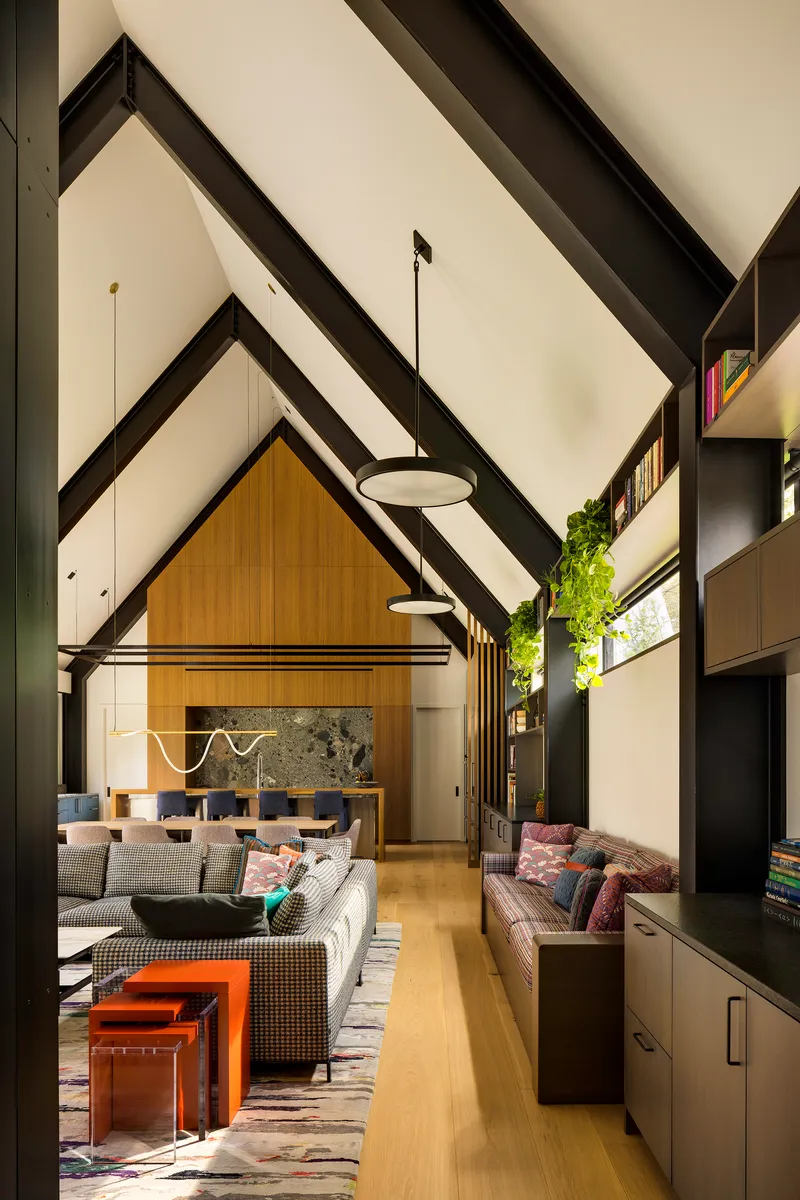


The entertainment pavilion, the longest of the four volumes, is where the structural ambition concentrates. Exposed steel bents march down the length of the space, supporting prefab roof panels that span between them without additional structure. The ceiling vaults high into the gable, and the steel members are painted black, giving them a graphic, almost diagrammatic presence against the lighter wood surfaces. Pendant lights hang from the ridge at carefully spaced intervals.
Living, dining, and kitchen all occupy this single volume. The space is open but not undifferentiated: the steel bents create a rhythm of bays, and changes in furniture grouping, floor material, and lighting define zones without walls. One end opens through floor-to-ceiling glazing onto the pool and garden; the other terminates in a vertical timber wall. It is a convincing demonstration that a single long room, properly structured, can handle the complexity of domestic life.
Millwork as Architecture
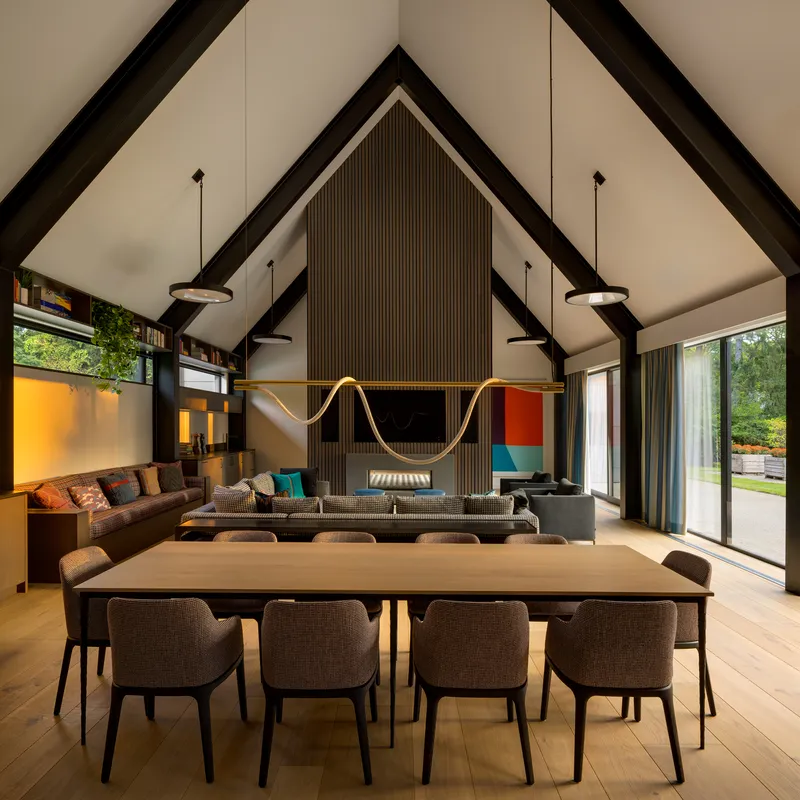


The interior is full of built-in millwork that does spatial work, not just decorative work. The vertical timber slat wall that runs through the dining area conceals a recessed linear fireplace and a television screen, compressing services into a single plane that doubles as an architectural surface. The stained walnut kitchen is handled with similar precision: an island anchored by four upholstered stools sits beneath a timber-clad gable wall with a terrazzo backsplash.
On the street side, a millwork wall creates the privacy screen the client wanted, filtering light and views without resorting to heavy masonry. Throughout the house, cabinetry and paneling are integrated into the structure rather than applied to it. The blued-steel fireplace hearth is a particularly good detail, its dark finish playing against the warmth of the surrounding cedar.
Connecting Volumes: Corridors and Thresholds


The connective tissue between pavilions is as carefully considered as the rooms themselves. A glazed corridor catches warm afternoon light along its full length, its exposed black rafters casting rhythmic shadows onto the floor. Another passage, painted white with flanking windows, lets dappled sunlight play across a terrazzo floor. These are not leftover spaces; they are transitions that calibrate your experience as you move from one volume to the next.
A glass pavilion linking two volumes offers filtered views through sheer curtains toward the lawn beyond. The house unfolds as a sequence of compressions and releases, narrow links opening into vaulted rooms, then compressing again. This is the direct consequence of the multi-pavilion strategy: every room has a threshold, and every threshold earns its architecture.
Private Quarters and Considered Details
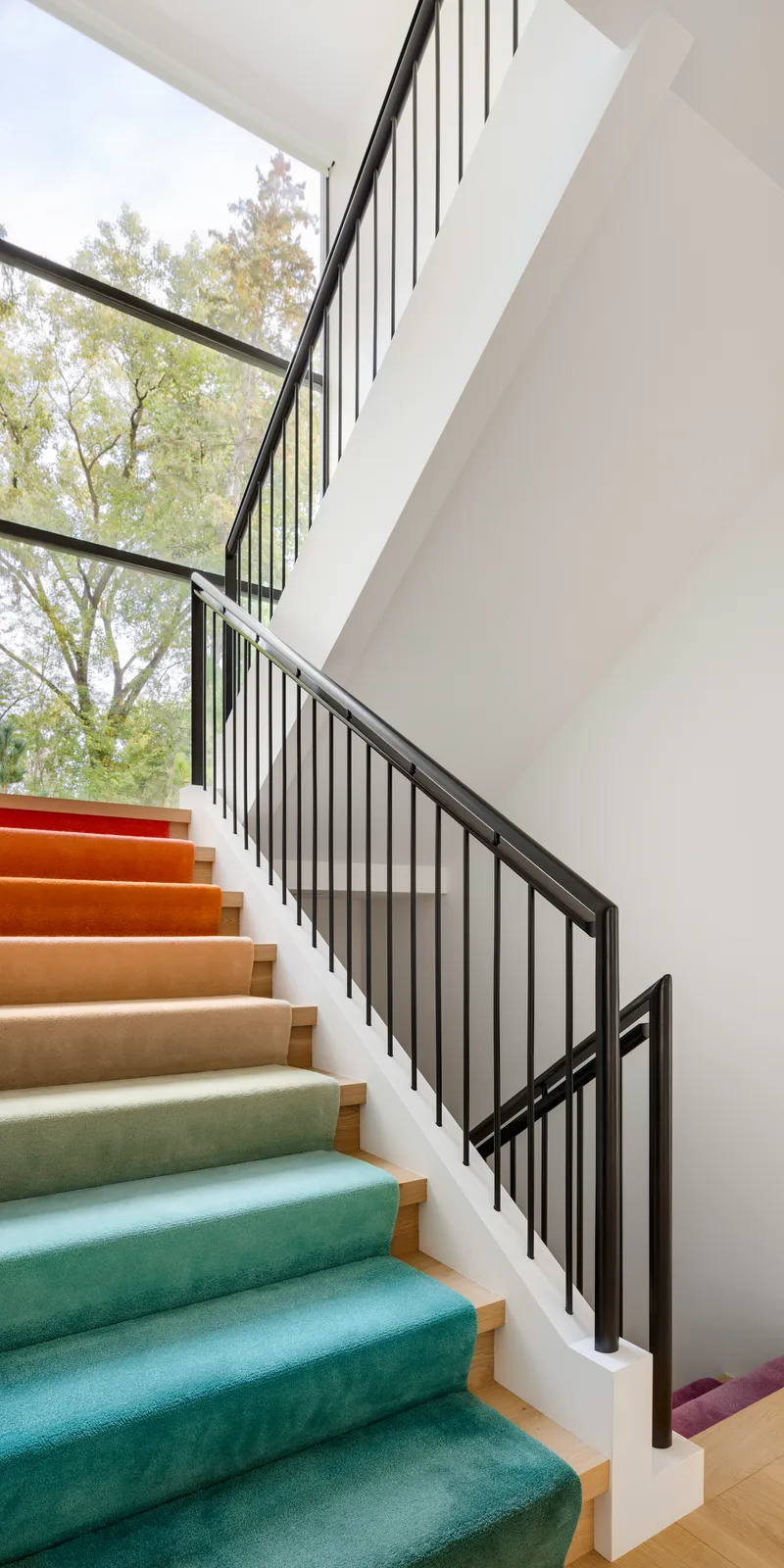

The upper level, reached by a staircase with a gradient-colored runner shifting from green to purple, houses bedrooms with horizontal strip windows that frame close-up views of the cedar cladding and metal roofs of adjacent pavilions. It is a thoughtful move: from inside, you read the compound as a landscape of rooftops and walls, reinforcing the farmstead idea even from your bed.
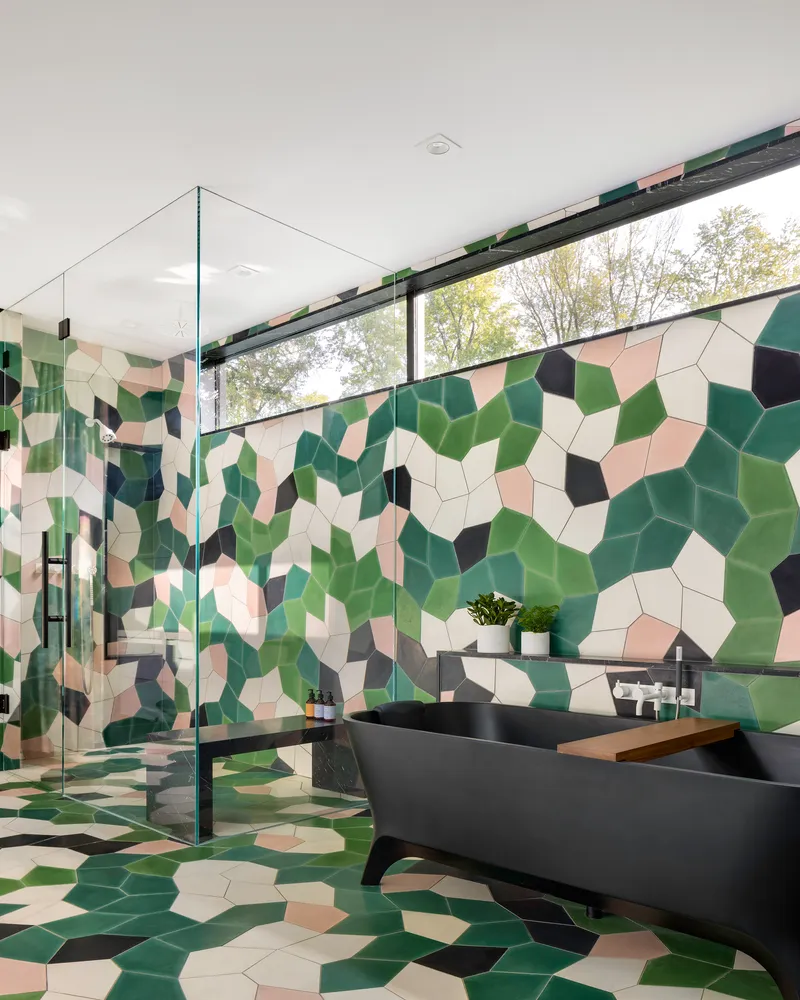
The bathrooms push further into personality. One features camouflage-patterned mosaic tile covering walls and floor, a bold choice that transforms the room into something almost geological. Another pairs a black freestanding tub with a geometric tile wall in green, black, and cream. A third keeps it quieter with penny-round tile and a recessed tub alcove. The variety suggests a house where each room has its own temperature, where uniformity was never the goal.
After Dark: The Compound as Lantern
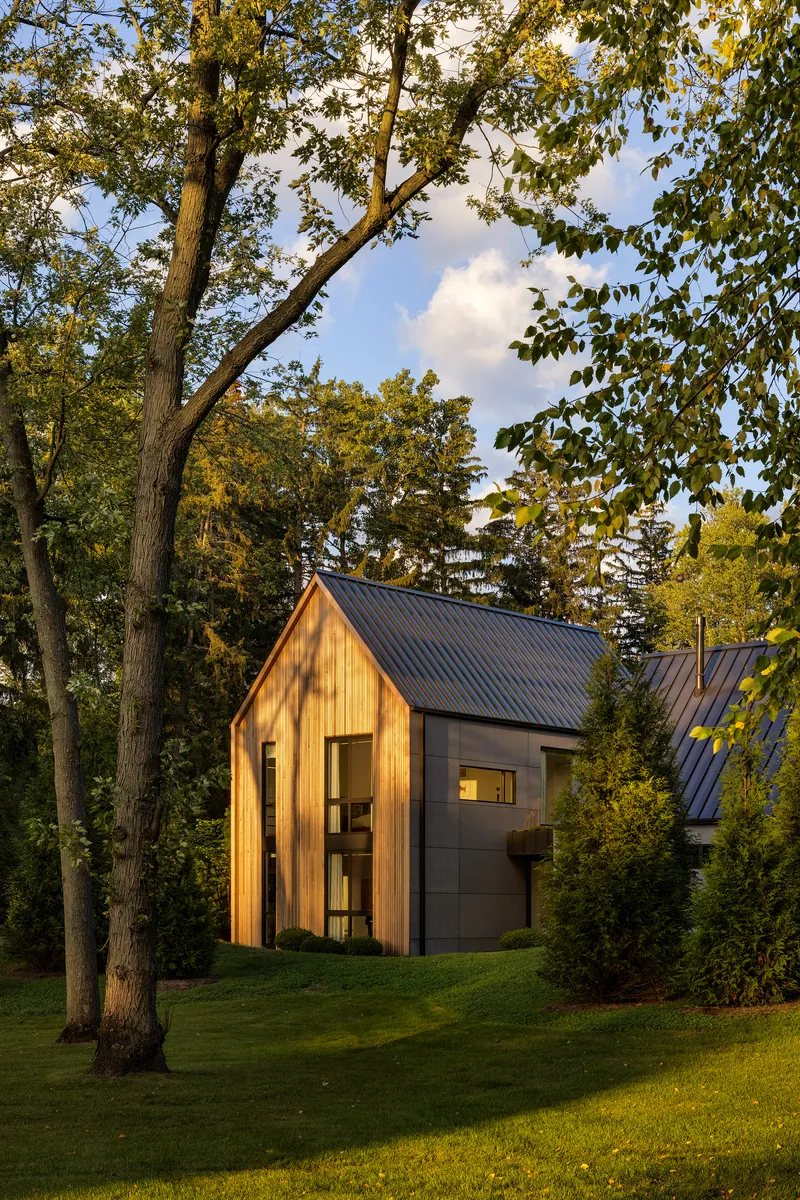
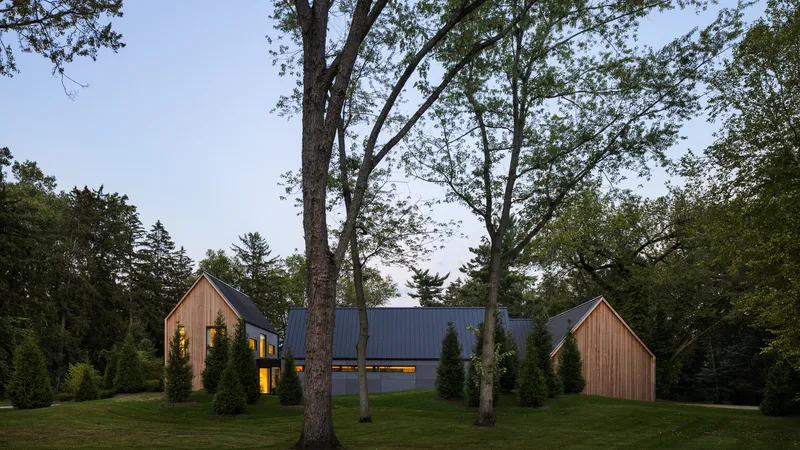

At dusk and into evening, the project becomes something else entirely. The gabled volumes, opaque by day, glow from within through their generous glazing. The pool catches and doubles the lit facades. The Corten retaining walls, which read as warm earth tones during the day, darken and recede. What you see at night is the essence of the plan: a cluster of illuminated volumes in a dark forest, each one a distinct room of light.
The architects clearly understood this transformation and designed for it. Glazed corners, the glass link pavilion, and the poolside orientation all contribute to a nighttime reading that is more dramatic than the daytime one. It is a house that lives two lives, which circles back neatly to the studio's own description: a house in two acts.
From Above: Compound Logic
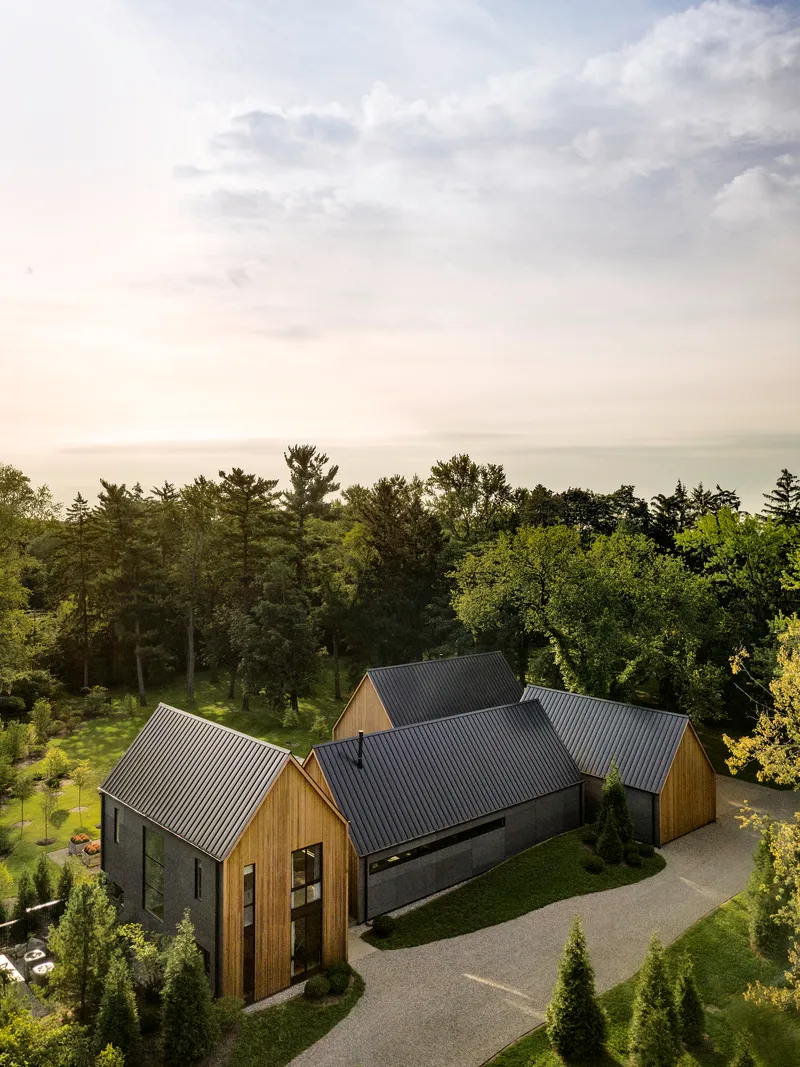


The aerial views confirm what the ground-level experience suggests: this is a building organized by landscape as much as by plan. The four gabled roofs cluster tightly, their metal surfaces catching light at different angles depending on orientation. The curved gravel drive and courtyard spaces create negative volumes between the pavilions that are as shaped as the buildings themselves. Dense forest wraps the property on three sides, and the rear terrace extends the living spaces toward a manicured lawn that dissolves into trees.
From above, the farmstead analogy becomes most legible. You can see how the perpendicular pavilions create sheltered outdoor rooms, how the long volume anchors the composition, and how the garage building sits slightly apart, like a genuine outbuilding. The layout is not arbitrary; it is calibrated to create enclosure without claustrophobia, density without bulk.
Plans and Drawings
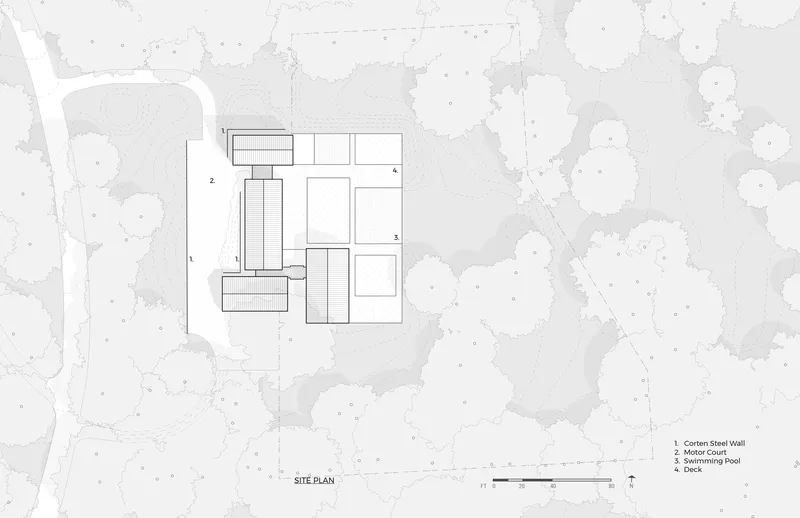
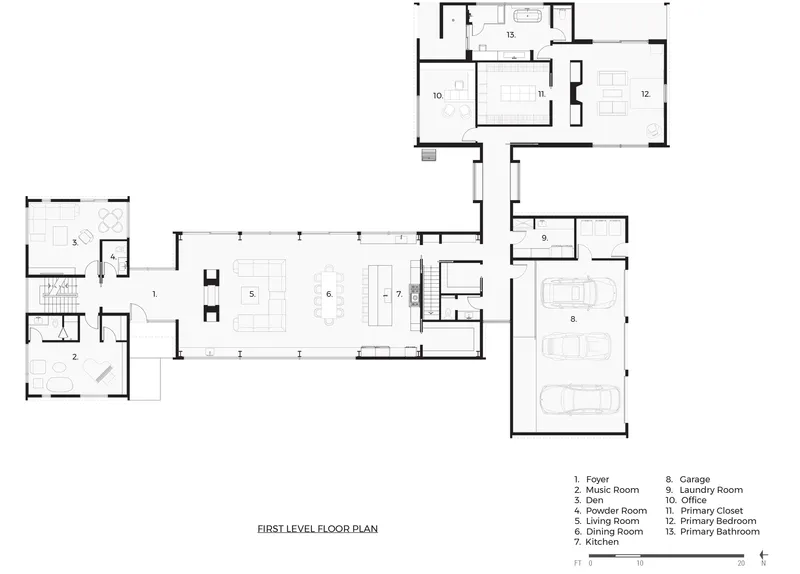
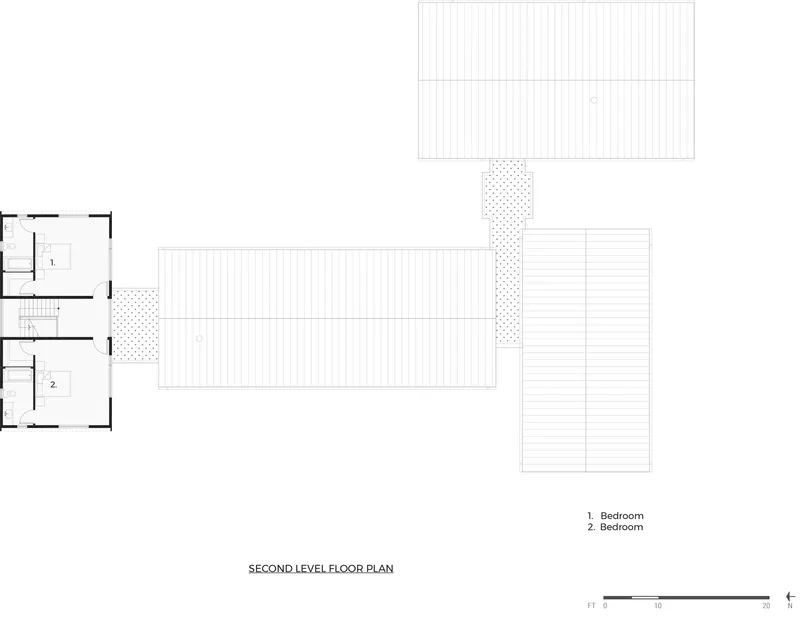
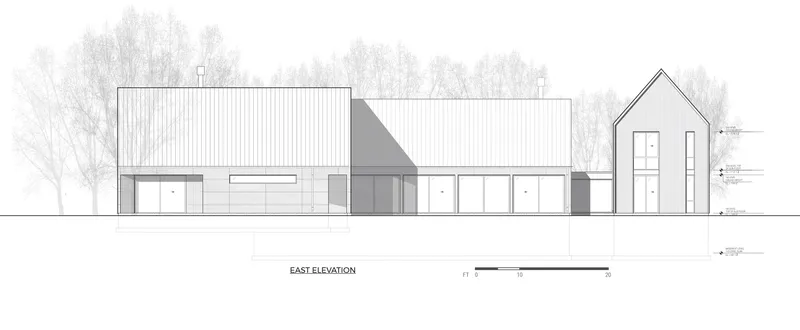

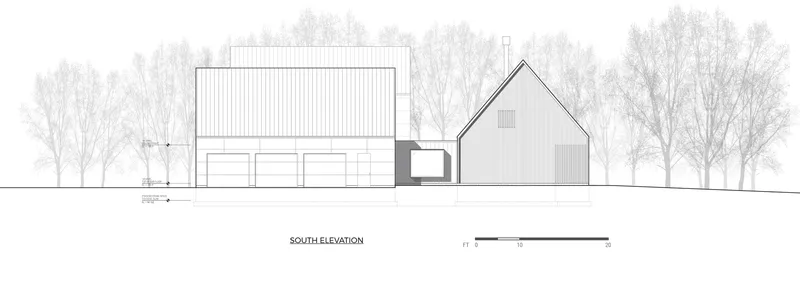

The site plan makes the landscape strategy explicit: the curved access road, the submerged motor court, and the careful avoidance of existing tree canopies. The first-level floor plan shows the open entertainment pavilion connected to the garage and a study wing, with the longest volume forming the compositional spine. The second level is minimal, just two bedrooms with an adjoining deck, keeping the massing low. The four elevation drawings reveal how each facade presents a different face to the landscape. The east and west elevations show the full spread of the compound, while the north and south readings are tighter and more intimate. Winter tree silhouettes in the drawings are a nice touch, acknowledging that this house will be experienced through Michigan's seasons.
Why This Project Matters
Briarcliff Residence is a convincing argument for fragmentation as a residential strategy. Rather than consolidating program into a single volume, Disbrow Iannuzzi distributes it across four pavilions and lets the spaces between them do as much work as the spaces within. The result is a house that feels larger than its square footage, more connected to its site than a single footprint could be, and more varied in its spatial experience than any open-plan box. The farmstead typology is not a nostalgic gesture here; it is a planning tool.
The project also demonstrates what happens when material honesty and structural expression are treated as design opportunities rather than engineering constraints. The exposed steel bents, the Corten retaining walls, the cedar slat screens: each material does structural or spatial work, and each is left legible. In a residential market saturated with white-box minimalism, Briarcliff offers something rarer: a house with a thesis about how buildings relate to land, to each other, and to the traditions of a specific place.
Briarcliff Residence by Disbrow Iannuzzi, Franklin, Michigan, United States. 5,300 sq ft. Completed 2021. Photography by Rafael Gamo.
About the Studio
Share Your Own Work on uni.xyz
If projects like this are the kind of work you want to make, uni.xyz is a place to publish your own, find collaborators, and enter design competitions.




Popular Articles
Popular articles from the community


AL-JANNAH: Sustainable Architecture and Permaculture for Afghan Widows
AL-JANNAH uses sustainable architecture and permaculture to create resilient oasis of housing, learning, work and renewal for Afghan widows.

Conexión: Biophilic Design Reimagines High-Rise Living in Hong Kong
Conexión reimagines high-rise living in Hong Kong through biophilic design, green facades, shared spaces, daylight, water and nature within.
EW PARK: Sustainable Architecture Reimagines the Future of Urban Parking
EW PARK reimagines city parking as a modular wooden tower combining automation, solar energy, electric mobility, and adaptable urban design.

The Musturak Paradise: Senior Living Architecture for a Connected Future in Temara, Morocco
The Musturak Paradise reimagines senior living architecture in Temara via private homes, social spaces, culture, community, and shared care.


Similar Reads
You might also enjoy these articles

Bao Huynh Watercolor Atelier: A Serene Art Retreat in Hội An
Bao Huynh Watercolor Atelier in Hội An blends multifunctional art spaces, sustainable design, local materials, and family-friendly living in a serene environment.

Atelier Macri Concept Store Interior Design by CASE-REAL
Atelier Macri store features a "ko" counter, walnut wood details, cork displays, blending retail, gallery, and seamless customer experiences.

Manuel Vargas Izquierdo Stadium and High-Performance Sports Center: Architectural Excellence in Jalpa de Méndez
The Manuel Vargas Izquierdo Stadium blends sustainable design, inclusive sports facilities, and cultural-inspired architecture, revitalizing Jalpa de Méndez’s public spaces.

KAKR Buluh Awar Hall: Revitalizing Community and Ecology Through Bamboo Architecture
Community built bamboo hall revitalizes Buluh Awar village, empowering youth, restoring ecology, celebrating vernacular craftsmanship through sustainable architecture and culture.
Explore Residence Competitions
Discover active competitions in this discipline



Challenge to design a portable theatre


Challenge to design a portable music platform


Challenge to design an open learning module for the elderly
Comments (0)
Please login or sign up to add comments
No comments yet. Be the first to comment!