

Dismantling the Urban Regime: Reclaiming Bhilai's Identity Through Market Architecture
A weekly makeshift vegetable market in Chhattisgarh becomes a permanent cultural square shaped by triangular geometry and bamboo craft.


What happens when a city built around a steel plant forgets its cultural roots? In Bhilai, Chhattisgarh, the answer plays out every week on a patch of open ground where a temporary vegetable market, or haat, materializes from makeshift stalls and dissolves again by evening. The impermanence is the problem. Dismantling the Urban Regime proposes replacing that cycle of assembly and erasure with a permanent, community-driven urban square that folds commerce, craft, micro-agriculture, and public gathering into a single triangular landscape. It is a pointed rejection of the generic development that has stripped Indian cities of regional character, and a bet that architecture rooted in local materials and social rituals can rebuild what modernization discarded.
The project is the work of Swati Dahake, published on uni.xyz. Situated at a site surrounded by residential communities and institutional buildings, the design leverages the location's centrality to create a cultural and commercial hub for Bhilai. Dahake frames Indian architecture as a historically layered medium, shaped by Hindu, Islamic, Buddhist, Portuguese, Dutch, and British influences, and argues that cities have grown homogenous precisely because contemporary development ignores that depth. The market becomes her vehicle for reversal: a place where bamboo canopies, jute seating, pocket farms, and craft installations give Bhilai back a legible identity.
Triangular Geometry as Organizational Logic
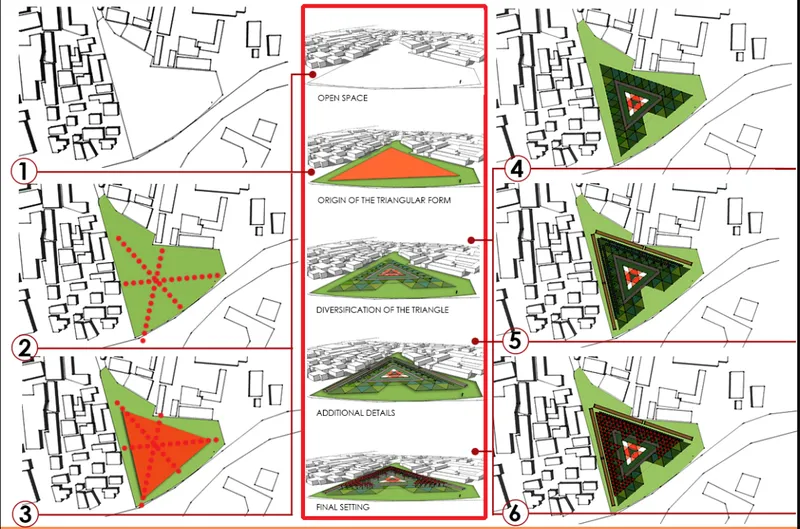
The diagram above traces the design's morphological evolution: an open site is subdivided through a triangular spatial form that gradually gains complexity through stages of diversification and detailing. The triangular geometry is not decorative. It organizes pedestrian movement, vendor zones, and community gathering spaces into a legible hierarchy, turning the market into a multifunctional environment rather than a single-purpose commercial strip. Each subdivision introduces a layer of program, from circulation paths to planted beds, so the final form reads as an accretion of social functions rather than a top-down masterplan.
A Site Plan Built on Cultural Program
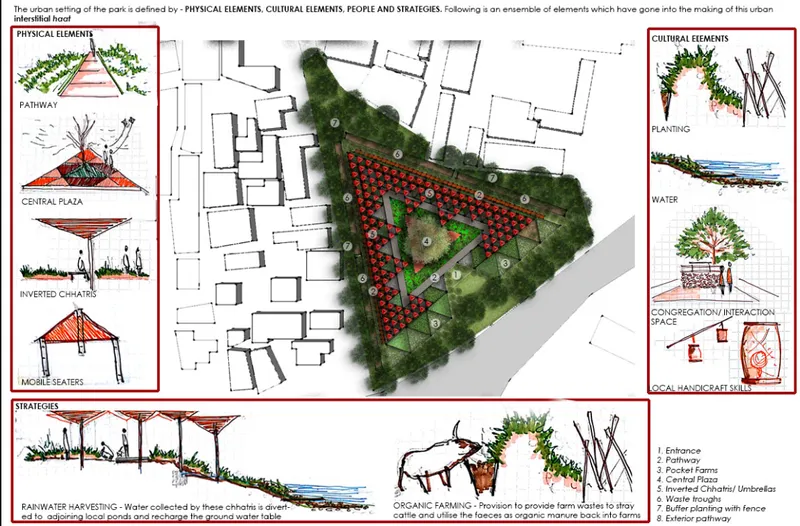
The rendered site plan reveals how pathways and a central plaza organize circulation while creating a core node for interaction. Surrounding vignettes illustrate the cultural program embedded within the landscape: spaces for craft demonstrations, performances, and informal exchange. Pocket farms, maintained by the community, occupy defined plots within the triangular grid, linking rural agricultural traditions to the urban fabric and reinforcing a model of local food security. The plan makes clear that the market is not merely a place to buy vegetables; it is a social, ecological, and cultural landscape compressed into a single civic space.
Inverted Chhatris and the Atmosphere of Dusk
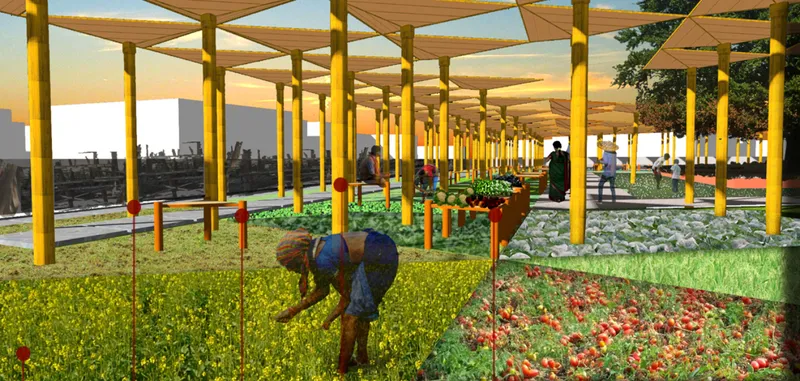
The rendered perspective captures the market at dusk, when the timber shade canopies over planted beds take on a warm glow and visitors move through the space at a pace that suggests leisure rather than transaction. These canopy structures draw on the concept of inverted chhatris, vernacular umbrella forms reimagined in bamboo to serve a dual function: providing shade during Chhattisgarh's intense heat and harvesting rainwater during the monsoon. The image communicates something the plan alone cannot: the experiential quality of being inside a market that feels like a garden, where the boundary between commercial infrastructure and public park dissolves.
Bamboo, Basketweave, and Woven Stools
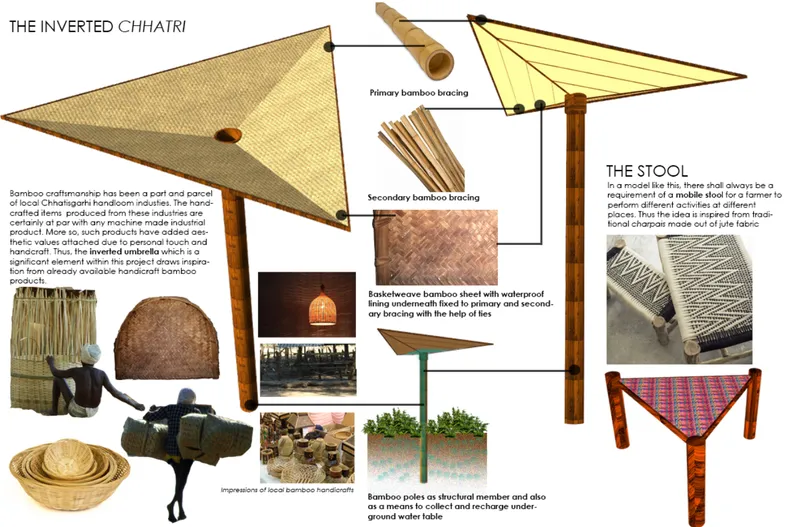
The materials board lays out the construction logic behind the project's craft-based approach. Bamboo forms the primary structural material for canopy construction, detailed here with joint annotations that suggest an assembly process accessible to local builders. Basketweave panels provide semi-transparent enclosure and shading, while woven stool components demonstrate how mobile seating can be fabricated from bamboo and jute using techniques already present in Chhattisgarh's artisanal traditions. Every material choice reinforces sustainability through low cost, local sourcing, and minimal environmental impact, while simultaneously embedding cultural legibility into the smallest furniture element.
Organic farming practices close the loop further: farm waste cycles back as manure for the pocket farms, creating a self-sustaining micro-ecology within the market. The participatory model Dahake proposes, where vendors, farmers, and artisans co-create and maintain the infrastructure, is essential. Without community ownership, even the most thoughtful material palette becomes scenography. With it, the market has a chance to remain vibrant across generations.
Why This Project Matters
The most persuasive aspect of Dismantling the Urban Regime is its refusal to treat cultural identity as ornament. The triangular geometry, the inverted chhatris, the bamboo joinery, the pocket farms: each decision serves a functional purpose that happens to also carry cultural meaning. That alignment between performance and symbolism is what separates genuine regionalism from nostalgic pastiche. In a city like Bhilai, where rapid industrialization produced an urban fabric largely indifferent to its Chhattisgarhi context, the argument for architecture as cultural catalyst feels urgent and specific.
Dahake's project also raises a productive question about permanence. The existing haat works precisely because it is temporary, flexible, and low-investment. The proposed intervention must prove that making the market permanent does not also make it rigid. The mobile seaters, the community-maintained farms, and the flexible stall configurations suggest Dahake has thought carefully about this tension. If the design can hold both structure and adaptability, it offers a replicable model for how Indian cities might reclaim public space not through grand monuments but through the quiet, sustained architecture of daily life.
View the Full Project
About the Designers
Designer: Swati Dahake
Enter a Design Competition on uni.xyz
uni.xyz runs architecture and design competitions year-round that reward proposals with spatial conviction and real site intelligence.
Project credits: Dismantling the Urban Regime by Swati Dahake.




Popular Articles
Popular articles from the community


Co-Life: Senior Housing Design That Reconnects Older Adults With the City
Co-Life reimagines senior housing design through healing gardens, shared streets, workshops, and a sustainable community across generations.
AL-JANNAH: Sustainable Architecture and Permaculture for Afghan Widows
AL-JANNAH uses sustainable architecture and permaculture to create resilient oasis of housing, learning, work and renewal for Afghan widows.
EW PARK: Sustainable Architecture Reimagines the Future of Urban Parking
EW PARK reimagines city parking as a modular wooden tower combining automation, solar energy, electric mobility, and adaptable urban design.

The Earth Pod: 3D Printed Homes for Resilient Refugee Communities
The Earth Pod reimagines refugee housing through 3D printed homes made from clay, combining resilience, self-sufficiency, and rapid shelter.


Similar Reads
You might also enjoy these articles

The Musturak Paradise: Senior Living Architecture for a Connected Future in Temara, Morocco
The Musturak Paradise reimagines senior living architecture in Temara via private homes, social spaces, culture, community, and shared care.

The Leaf Center: Cultural Center Architecture for Social Integration in Amsterdam
Cultural center architecture becomes a bridge at The Leaf Center, connecting international students with Amsterdam through art and exchange.

Conexión: Biophilic Design Reimagines High-Rise Living in Hong Kong
Conexión reimagines high-rise living in Hong Kong through biophilic design, green facades, shared spaces, daylight, water and nature within.

Wander to Wonder: Modular Playground Design for Children in Kutupalong Refugee Camp
Wander to Wonder uses modular playground design to create flexible, imaginative play spaces for children in Kutupalong refugee camp.

Comments (0)
Please login or sign up to add comments
No comments yet. Be the first to comment!