
Bovenbouw Architects Designs an Antwerp Police Station That Balances Bulletproofing with Openness
On Antwerp's Left Bank, a 917-square-meter district office borrows from Louis Sullivan's small-town banks to rethink civic security.


A police station has to do two things that usually contradict each other: make citizens feel welcome and keep officers safe. Bovenbouw Architects took on that contradiction directly for a new district office on Antwerp's Left Bank, drawing an unlikely line of influence back to Louis Sullivan's early twentieth-century bank buildings in small American towns. Those banks were civic monuments that projected solidity while inviting the public through generous, daylit interiors. The same logic drives this 917-square-meter building completed in 2022: thick grey brick walls that satisfy bullet-resistance requirements, paired with large glazed openings that let the neighbourhood see in.
The result is a building that reads neither as a fortress nor as a generic office block. Its curved roofline and carefully proportioned facade give it a quiet institutional presence without the hostility that security architecture often carries. Inside, the program splits into two dominant spaces: a street-facing reception hall where citizens can walk in for information, and a shared landscape office at the rear that opens onto a planted backyard. Bovenbouw, led by Dirk Somers alongside Myrthe Geelen, Carole Boeckx, Sander Laureys, and Matilde Everaert, threaded warmth through the whole interior using chipboard panels framed in poplar stud walls, terrazzo floors, and splashes of blue and orange that keep the atmosphere far from sterile.
A Civic Face in Grey Brick


The exterior communicates permanence without aggression. Grey brick wraps the building in a monolithic shell, its mass interrupted by deeply set windows that signal security through proportion rather than bars or bollards. The curved roofline lifts what could have been a squat box into something more expressive, giving the corner elevation a profile that announces itself on the street without shouting. A police van parked at the entrance is the only immediate clue to the building's function.
The stacked window detail on the side elevation is worth pausing at. Two openings punched into thick brick, one above the other, frame a person in the upper aperture and reinforce how substantial the walls actually are. These are not thin curtain-wall assemblies dressed up as masonry; they are load-bearing walls that do real security work. The depth of the reveal becomes an honest expression of what it takes to make a building bullet-resistant while still letting light pour in.
Reception as Public Threshold


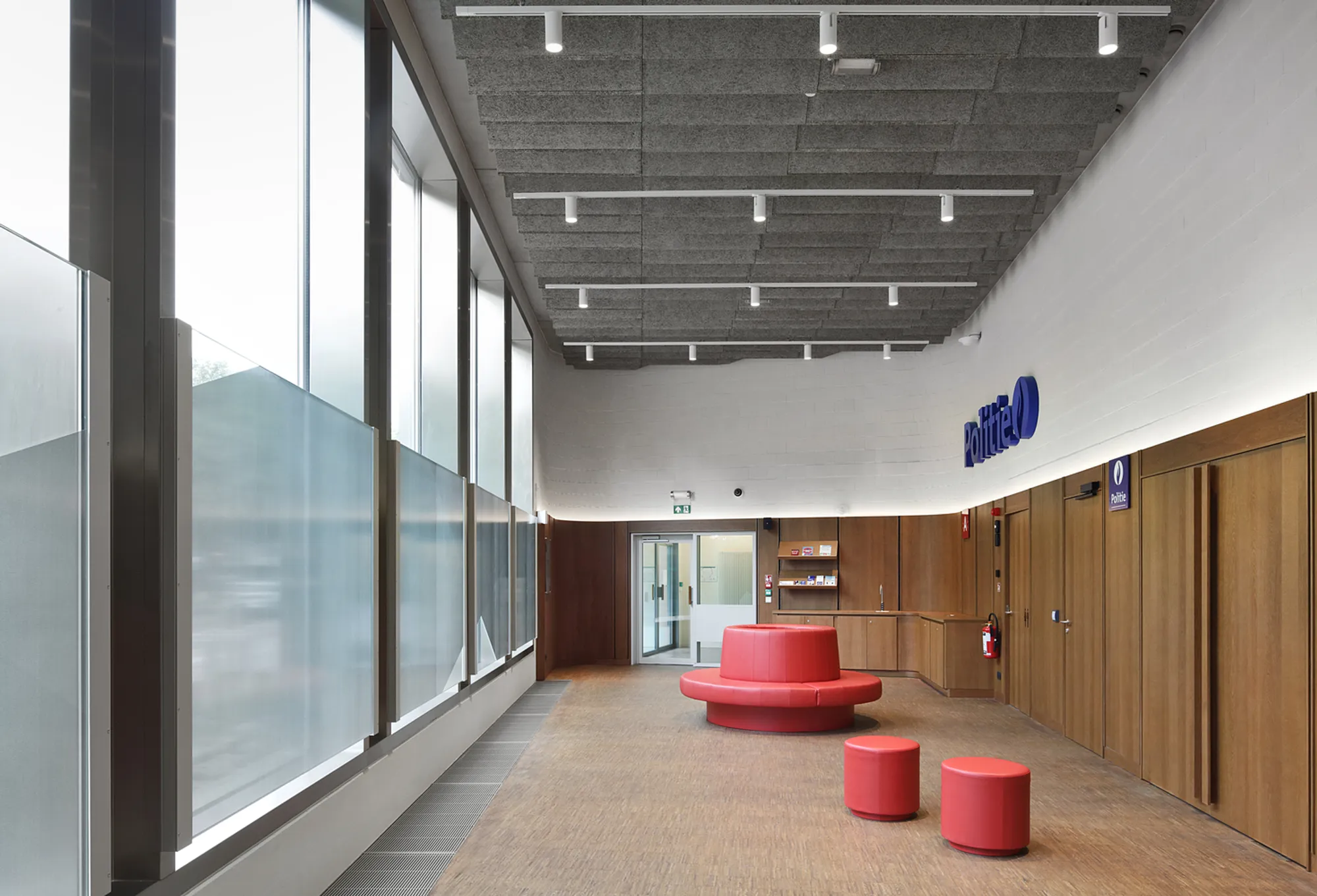
The lobby is the hinge between city and institution. Full-height glazing wraps the reception area, and an exposed concrete ceiling with linear lighting gives the space a civic scale that feels more like a library foyer than a police intake. Red circular seating softens the room's materiality and provides a waiting area that does not feel punitive. The reception desk sits here as a low-key information counter, not a barricaded checkpoint.
Step further in and an internal courtyard appears, glazed on all sides and topped with a steel-frame pergola strung with pendant lights. This semi-outdoor zone blurs the line between inside and out, pulling natural light deep into the plan. It also serves as a visual breather between the public-facing reception and the more controlled office zones behind it, giving the sequence through the building a rhythm that gradually shifts from open to private.
The Landscape Office and Its Green Backyard


At the back of the building, the shared workspace occupies a large, open floor plate with terrazzo flooring and blue workstation partitions that subdivide the room without closing it off. A curved stair with vertical blue slats connects levels and becomes a sculptural element in its own right, breaking up the horizontal expanse. The overall effect is of a contemporary co-working space, not a back-office bullpen.
The rear elevation reveals how much glass faces the garden. White sunshades filter light across the glazed facade, and a simple lawn stretches out toward residential towers in the distance. The backyard is framed on one side by a carport and on the other by new trees planted along the border with an adjacent fire brigade site. For officers who spend long shifts inside, this green outlook is not a decorative amenity but a genuine workplace quality factor.
Colour, Material, and the Anti-Sterile Interior

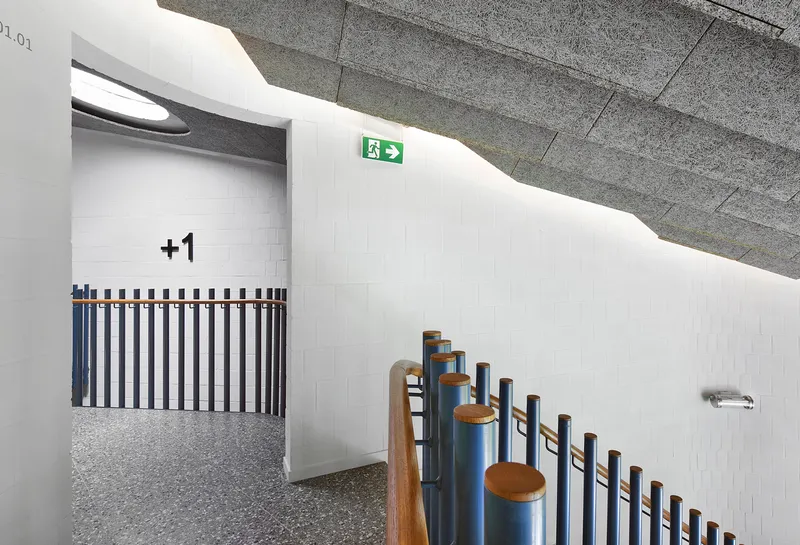

Bovenbouw clearly made a deliberate decision to prevent the interior from sliding into the grey-and-white neutrality that plagues most government buildings. A circular skylight at the stair landing washes the ceiling in an orange accent, while blue steel railings and vertical blue slat balustrades run through the circulation zones. These are not arbitrary colour choices; they create a wayfinding logic that guides movement through the building without signage overload.
The break room is equally intentional: wood cabinetry, a white dining table, and cylindrical pendant lights hanging from a curved ceiling plane. It reads as a space designed for people who actually need to decompress during a shift, not an afterthought tucked behind a corridor. The curved white wall with its timber-and-blue handrail detailing shows the same level of care in the secondary spaces. When a stairwell feels considered, the whole building gains credibility.
Circulation as Architectural Event
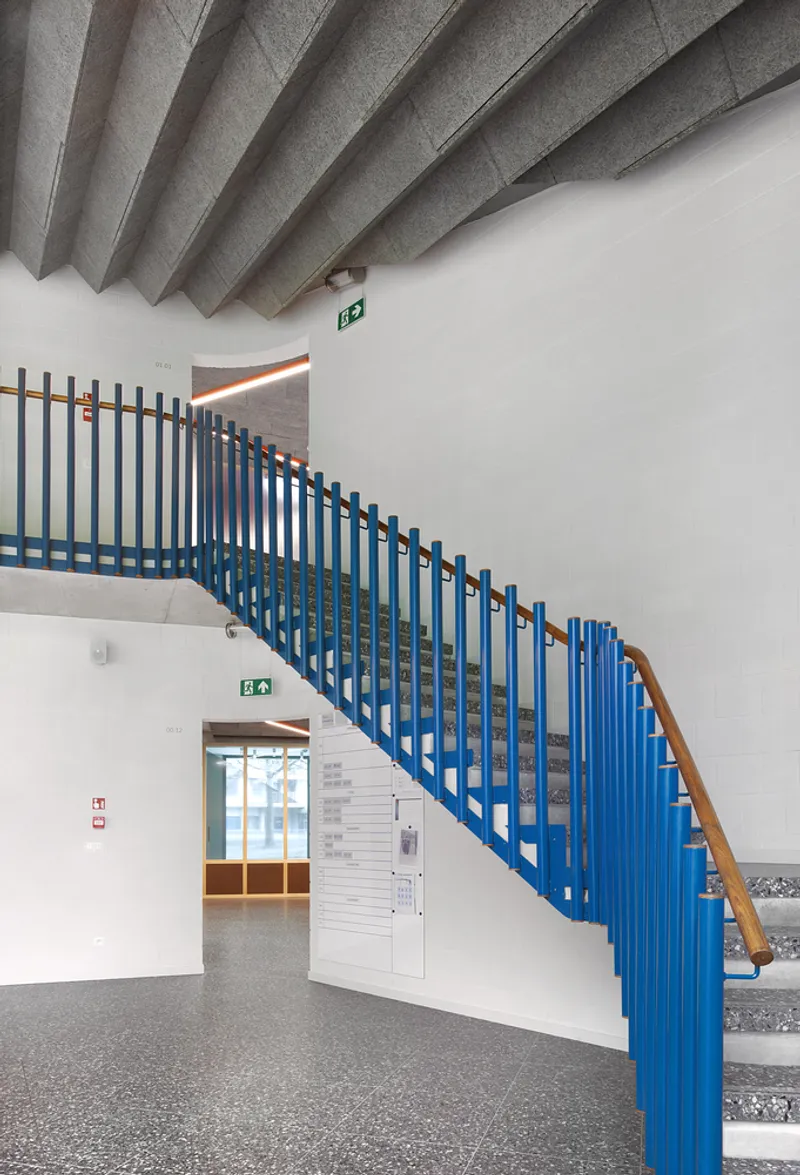
The curved staircase with its blue vertical balustrades and timber handrail is one of the building's strongest gestures. Angled concrete ceiling slabs overhead compress the space just enough to give the ascent a sense of passage, not just utility. The stair is generous in width, comfortable in proportion, and detailed with the same palette that runs through the rest of the building. It ties the two dominant programmatic zones together without feeling like an interruption.
Skylights at the landing and the orange ceiling accent above create a vertical shaft of natural light that draws the eye upward. In a building where thick walls and security requirements could easily produce dark, bunker-like corridors, Bovenbouw has made sure that every transition between spaces receives daylight and architectural attention. The circulation is not leftover space; it is one of the project's most carefully composed sequences.
Why This Project Matters
Police architecture sits at a difficult intersection of public trust and institutional control. Most stations default to either aggressive fortification or anonymous office typologies. What Bovenbouw has done on Antwerp's Left Bank is demonstrate that a third option exists: a building that meets every operational requirement for safety and durability while still functioning as a welcoming civic address. The Sullivan reference is not nostalgic posturing; it is a genuine structural idea about how thick, secure walls can coexist with transparency.
At 917 square meters, the district office is modest in scale, but the lessons it offers apply far beyond its footprint. Colour, material warmth, garden views, and considered circulation are not luxuries reserved for cultural buildings. They are tools that any public institution can deploy to improve the daily experience of both staff and visitors. Bovenbouw's project is a quiet argument that the architecture of security does not have to look or feel like punishment.
District Office Police by Bovenbouw Architects. Antwerp, Belgium. 917 m². Completed 2022. Lead architects: Dirk Somers, Myrthe Geelen, Carole Boeckx, Sander Laureys, Matilde Everaert. Photography by Filip Dujardin.
About the Studio
Share Your Own Work on uni.xyz
If projects like this are the kind of work you want to make, uni.xyz is a place to publish your own, find collaborators, and enter design competitions.




Popular Articles
Popular articles from the community


The Earth Pod: 3D Printed Homes for Resilient Refugee Communities
The Earth Pod reimagines refugee housing through 3D printed homes made from clay, combining resilience, self-sufficiency, and rapid shelter.

The Musturak Paradise: Senior Living Architecture for a Connected Future in Temara, Morocco
The Musturak Paradise reimagines senior living architecture in Temara via private homes, social spaces, culture, community, and shared care.

Co-life: Sustainable Architecture for Age-Friendly Community Living
Co-life reimagines sustainable architecture for seniors through courtyards, rammed earth, shared gardens, and spaces designed for belonging.

Hill & Cross Opera: Sculptural Opera House Architecture Shaped by Tallinn’s Landscape and Identity
Hill & Cross Opera reimagines opera house architecture in Tallinn through its sculptural hill, civic plaza, glass wave and a luminous cross.

Similar Reads
You might also enjoy these articles


Hodi-Mandai Geram
Project Function: Preservation and revitalization of the Intangible heritage and socio-spatial identity of the Hodi by Housing, Cultural Memory Center, Sacred Grove, landscape, local tourism economy


Olio Towers: A Mid-Rise for Performers That Fuses Housing, Rehearsal, and Stage
Located blocks from Houston's Theater District, this modular tower stacks living units around a central performance atrium.

Oasis: Modular Green Housing Carved into Dhaka's Urban Fabric
A shortlisted Plugin Housing entry reclaims unauthorized settlements in Dhaka with stepped concrete volumes, green roofs, and ventilation-driven design.

Black Hole: A Floating Megastructure for the Post-Physical Era
Emiliano Mazzarotto envisions a spherical, self-scaling arena where e-sports, digital hotels, and holographic stadiums replace traditional public space.


Explore Office De Architects Competitions
Discover active competitions in this discipline



Challenge to reimagine the Iron Throne


Photograph architecture without architects


Illustrate the lost glory of Angkor Wat - Render Challenge


Design challenge to reuse E-waste
Comments (0)
Please login or sign up to add comments
No comments yet. Be the first to comment!