

DNA
The core design of this project is an nternal spiral and ring in the middle of the container building that reflects the flora and growth, the DNA chain.

The objective has been to design an inwardly living building that can be located in the rustbelt, the peripheral and neglected areas of the cities. However, with its green focal point it provides a liveable space for students and young workers who enter the job market. What we have endeavoured here to create is a small green island in the city. In this way the value of these peripheral areas of the city may rise. The young people who move in here may initiate positive social and communal developments in the life of the city.
In the design it is an important element that the container building is built on a structural grid, so that the structure takes a space as small as possible on the ground. The building stands on four smaller containers.
The central point of the design is an internal spiral and ring that creates the core of the building, planted with greenery. The spiral form of the core itself is a reflexion of the forms of the flora or the growth, the DNA chain. Therefore, the building has two faces: it lives inwardly and outwardly at the same time. The internal core glimmers through when you pass by the building. The more rigid form of the containers is balanced by the internal core oozing a relaxed atmosphere. When designing the plan, we used the two most basic geometrical forms: the square and the circle. This square-based framing can be seen again on the facades.
In the building itself the smaller and bigger size containers are located alternately. In the niches created in this way on the upper floors we designed platforms for private and communal use. These platforms are able to extend the tighter living space defined by the container apartments, and at the same time allow a possibility of communal life for the inhabitants of the container building.
The facade of the container building is geometrical, and we put square monitor windows on it. At certain intervals, the frames of these windows hang out from the wall face, thus moderating the rigidity of the facade. The alternating container types and the slewed design result in the rhythmical changes of the facade openings, which follow the floor plan functions.
We have not covered the containers from outside, instead we focussed on the internal space. While designing the building we thought it is more important to concentrate on a liveable internal environment and coating. Having found the atrium-like outlay we put the emphasis on the fine-tuning of the internal spiral and the furnishing of the containers. We devised several variants for the spiral. During the designing process it was a significant factor that the young people who move in here are career entrants for whom it is indispensable to get an affordable rent or apartment.
The internal layout of the containers varies according to the container sizes and the floor. On a given floor there are only either smaller or bigger containers. The odd number floors are the reflexions of each other. On the basis of this simple construction principle the building can be extended upwards.
For each smaller container we designed a bathroom and a mini kitchen, and also we planned four different types of furnishing for one or two persons. The draw-bed makes it possible to have guests from time to time. The containers on the ground floor open to the internal court, too. On the upper floors the containers are open both to the platforms and the external facade. As for the bigger containers we designed two types: 1. two apartments have one jointly used bathroom, 2. the two apartments have their own bathrooms. In the case of the big containers, too, we planned four different types of furnishing. The apartments can accommodate 2 to 4 persons. All the big containers have mini kitchens. During the planning we sought to maximally exploit the space. We made an effort to create extra storage place higher up on the wall in the small living space. In the present design there is accommodation for 56 persons.
In the outskirts of the city, you can raise several of these container buildings. They can also serve as dormitories for educational institutions. The container buildings can be extended upwards. The furnishing is interchangeable and can be modified according to the needs of the inhabitants. If we put double-decked beds in the containers there is a possibility to accommodate more students, or young couples.


Popular Articles
Popular articles from the community


Solar Steam: A Climate-Responsive Architecture That Redefines the Monument
A climate-responsive memorial architecture that transforms heat, decay, and time into a living system reflecting humanity’s ecological impact.
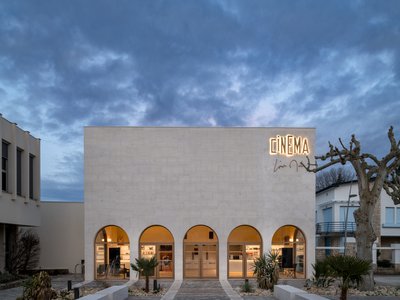
Louis Malle Cinema: A Limestone Cultural Landmark Revitalizing Community Life in Prayssac
Limestone cinema extension with public forecourt, blending heritage and modern design to create flexible cultural spaces and strengthen community interaction.
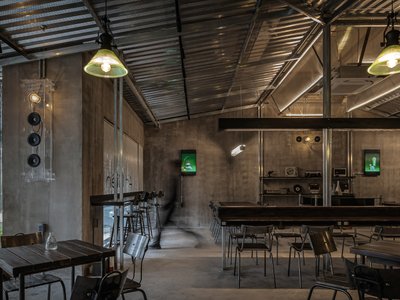
An Miên Lumière Cafe by xưởng xép, Ho Chi Minh City, Vietnam
An industrial-inspired café where layered steel and warm light create a dynamic, immersive environment shaped by reflection, depth, and perception.
On the Brooks House by Monsoon Collective – A Contemporary Kerala Home Rooted in Tradition
Kerala home blending tradition and modernity with water-inspired design, brick architecture, courtyard planning, and sustainable rainwater harvesting strategies.

Similar Reads
You might also enjoy these articles
Converge Hub – A Human-Centered and Sustainable Mobility Hub at the Urban Edge
Its open and permeable design promotes sustainable movement through walkable connections, green axes, and integrated public transport
51st Annual KRob - Ken Roberts Memorial Delineation Competition
Join us in celebrating 51 years in excellence in architectural representation! With $2,400 in prize money awarded across 8 categories, this prompt-less competition is accessible to all!



Explore Residential Building Competitions
Discover active competitions in this discipline




The Global Benchmark for Architecture Dissertation Awards


Challenge to design mud housing for contemporary communities

Design challenge to reuse E-waste
Comments (0)
Please login or sign up to add comments
No comments yet. Be the first to comment!