
Studio Kyriakos Miltiadou Reinvents the Cypriot Courtyard House with Domus Maya
In Cyprus, a white cubic residence organizes domestic life around twin circular patios, an olive tree, and flashes of yellow.


The courtyard house is one of the oldest spatial ideas in Mediterranean architecture, but longevity does not guarantee relevance. Too often, contemporary projects treat the typology as a stylistic accessory: a token void punched into a floor plan for ventilation and a nice Instagram moment. Domus Maya, designed by Studio Kyriakos Miltiadou in Cyprus, takes the courtyard more seriously. It makes the open-air void the organizational spine of the entire house, splitting domestic life into two halves that face each other across a pair of circular planted patios.
What elevates the project beyond a competent plan diagram is its material restraint and the precision of its color strategy. The house is relentlessly white, inside and out, interrupted only by a saturated yellow that marks the threshold between public and private, exterior and interior. That yellow door on the street facade is the first signal, and the same hue reappears at pergola beams, wall accents, and structural elements throughout. The result is a house that feels both rooted in Cypriot tradition and unapologetically contemporary.
A Quiet Street Presence


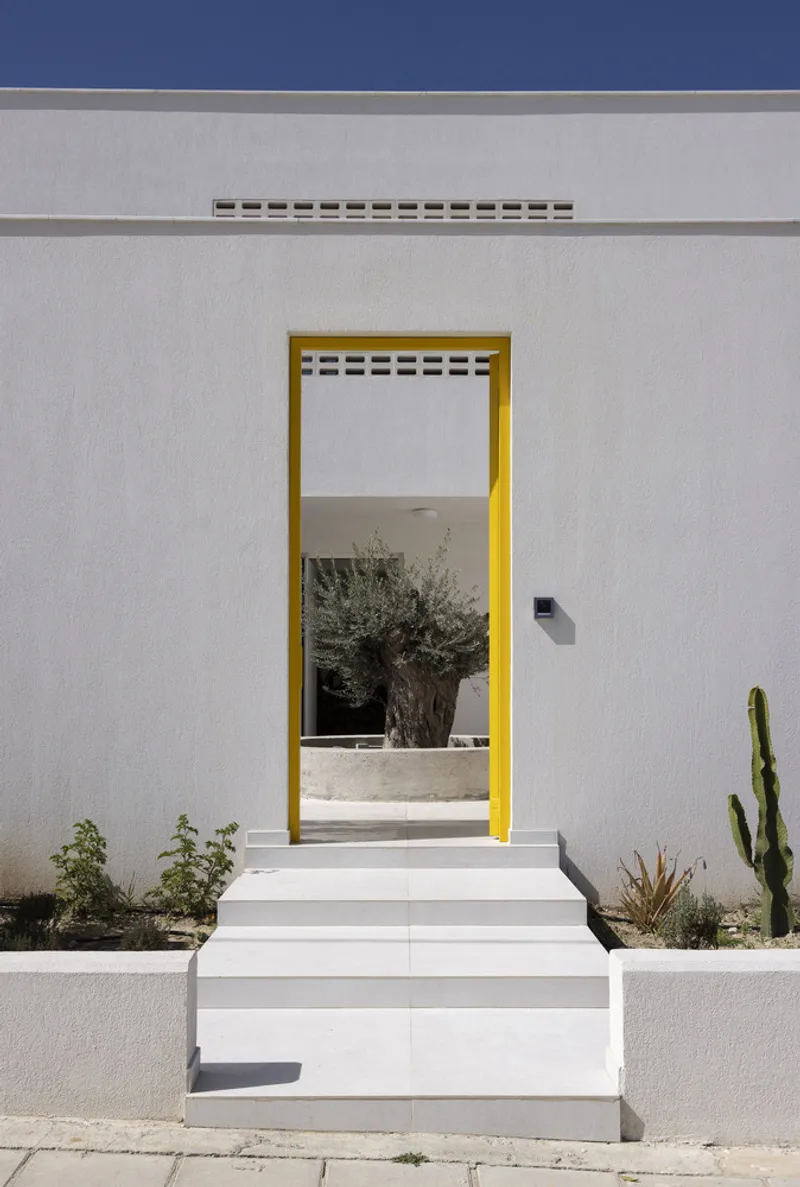
From the street, Domus Maya presents a deliberately opaque face. White cubic volumes stack and stagger, revealing almost nothing of the life inside. A perforated ventilation grille and a pair of raised planting beds are the only concessions to the sidewalk. The yellow entry door punches through this restraint like a declaration, pulling your eye to the single point of access. At twilight, the house glows with a cool, almost institutional calm, but that bright threshold keeps it from feeling aloof.
The facade strategy is classic Mediterranean: minimize street-facing openings to manage heat gain and maximize privacy, then reveal everything inward. What makes it work here is the composition's confidence. There are no gratuitous formal gymnastics, no exaggerated cantilevers. The massing reads as a family of interlocking boxes, each slightly offset, creating subtle shadow lines that shift throughout the day.
The Courtyard as Protagonist
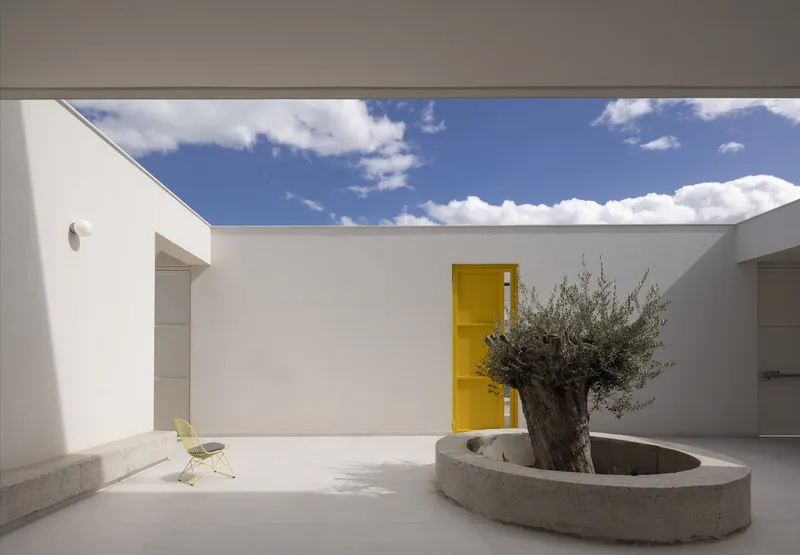


Step through the yellow door and you encounter the courtyard immediately: a circular concrete planter holding a mature olive tree, open to the sky, with the house wrapping around it on all sides. The ground floor plan reveals two such circular patios that anchor the spatial sequence. Every room has a visual or physical connection to one of them, so the boundary between indoors and outdoors dissolves at nearly every turn.
The circular geometry of the planters is a deliberate counterpoint to the orthogonal volumes above. It softens the plan and gives each courtyard an almost sacred quality, like impluviums scaled for contemporary life. The olive tree is not decorative; it is the spatial fulcrum around which corridors, living spaces, and bedrooms orient themselves.
Green Veins and Vaulted Light


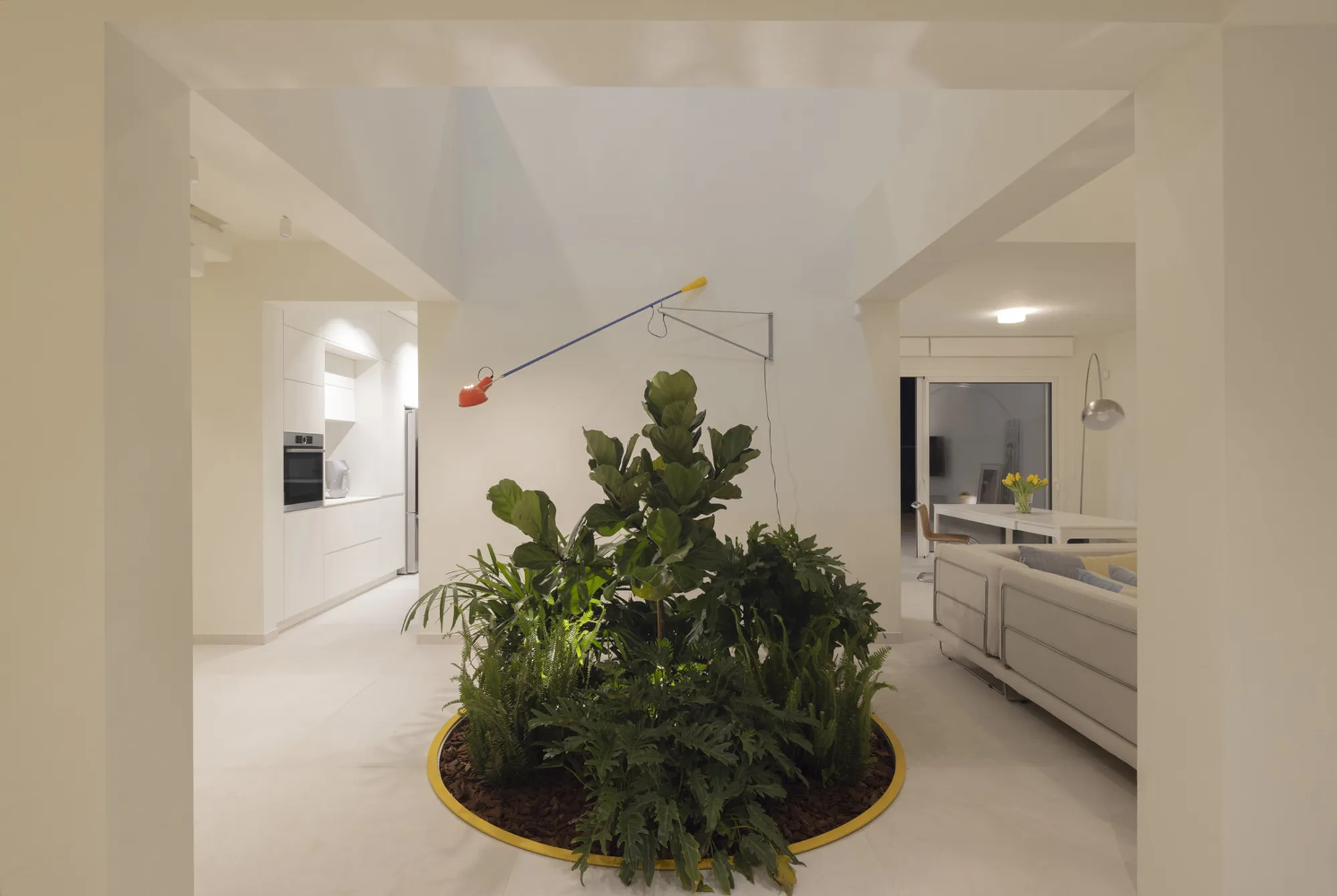
Beyond the primary courtyards, the house threads planting into its interior corridors. A central indoor planting bed fills with tropical foliage beneath a vaulted ceiling, creating a verdant seam where two wings of the house meet. At dusk, the greenery catches ambient light and becomes almost theatrical, turning a circulation space into something closer to a conservatory. The double-height hall nearby compounds this effect: a skylight washes the stairwell in natural light, while potted plants at ground level blur the line between garden and living room.
These interstitial planted zones serve a practical purpose beyond aesthetics. They pull cooled air through the house via stack ventilation, exploiting the height differences between single and double-story volumes. The architecture performs thermally as well as it performs visually.
Living Spaces That Open Wide


The main living areas lean into a strategy of selective porosity. Clerestory windows bring light deep into rooms without exposing them to the street, while full-height sliding glass doors collapse the boundary to the terrace when weather permits. The concrete media shelf in the living room grounds the space and signals a deliberate material hierarchy: white plaster for walls, exposed concrete for furniture-like elements, timber and textiles for warmth.
At dusk, the living room becomes a lantern in reverse, with interior light spilling onto the terrace while the clerestory above captures the last of the sky's color. It is a room designed for the transition between day and evening, and the architects clearly understood that the moment you slide open a glass wall, you double the room's footprint in a single gesture.
Private Rooms and Framed Sky
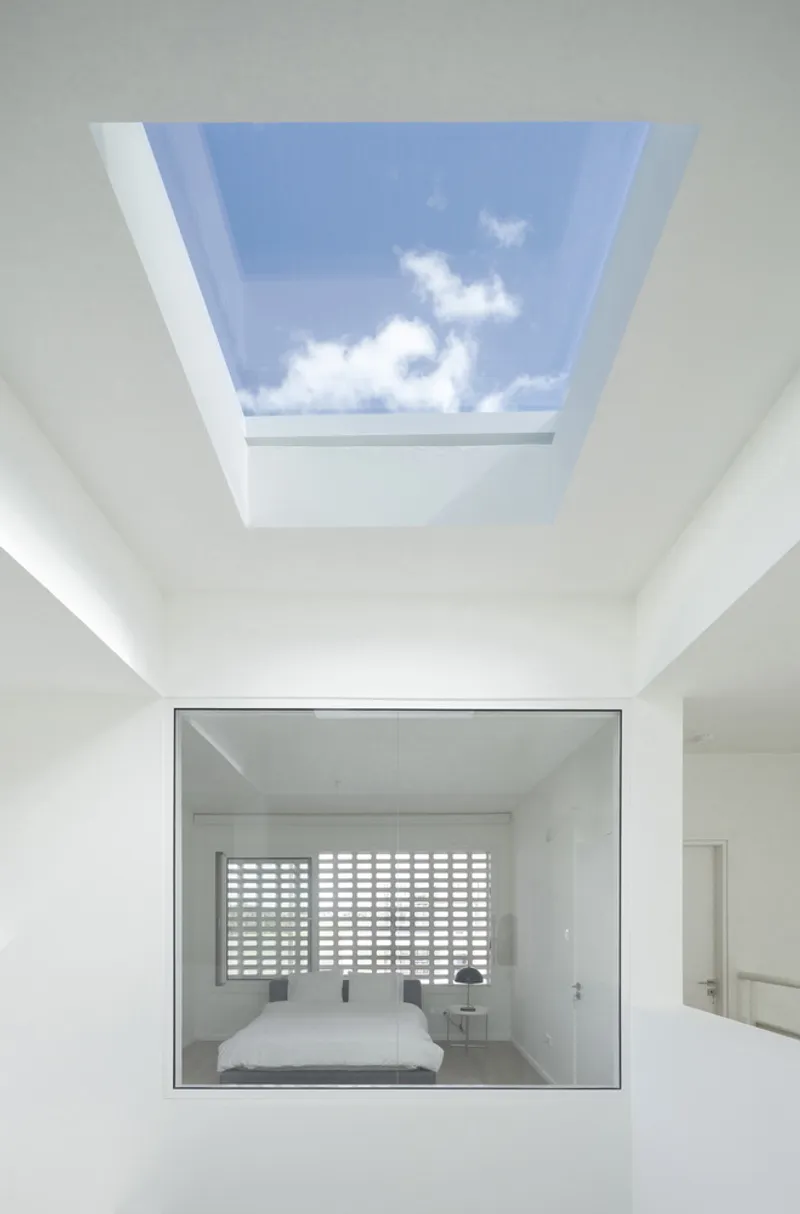


Upstairs, the house becomes quieter. Bedrooms and bathrooms are more contained, with openings carefully composed to frame specific views. A rectangular skylight above a recessed bedroom window turns the sky itself into a painting: clouds drift through a precise concrete aperture, and the room's atmosphere shifts with the weather. The white bathroom takes a similar approach, positioning a picture window to look over green landscape rather than at neighboring rooftops. Privacy is achieved through elevation and orientation, not through shutting the world out.
The staircase connecting these levels is sculptural in its simplicity. A figure caught in motion on the upper landing suggests the house's vertical circulation is more than functional; it is a spatial event, with changing light conditions and glimpses of the courtyards below animating each ascent and descent.
Yellow as a Spatial Signal

Color in this project is not applied casually. The yellow appears at moments of transition: the front door, the pergola beams over the courtyard, accent walls at key junctions. It functions as a wayfinding device embedded in the architecture, signaling thresholds and pauses without resorting to signage or material changes. Against the relentless whiteness of everything else, even a small dose of yellow carries enormous visual weight.
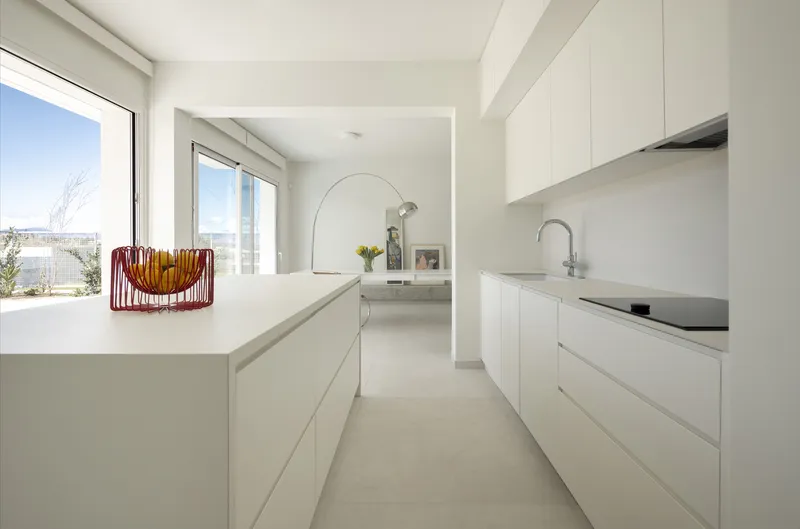
The galley kitchen, by contrast, is pure restraint. Flush white cabinetry, a minimal countertop, and a single window letting in clear sky. It is a room that trusts its proportions and needs nothing else. The tension between these moments of saturation and moments of austerity gives the house its rhythm.
Plans and Drawings
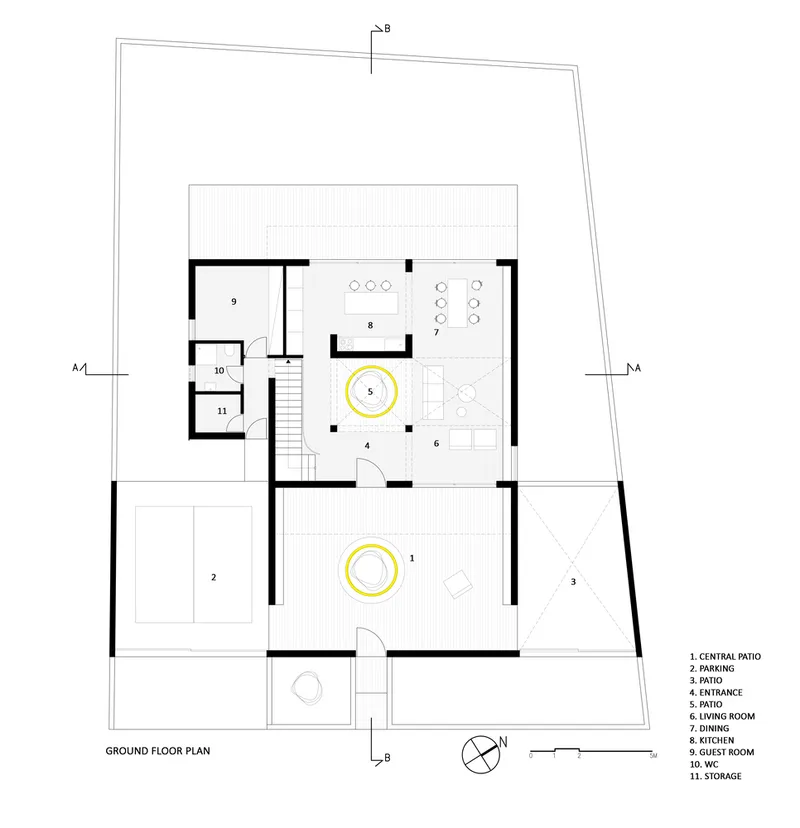





The ground floor plan makes the organizational logic unmistakable: rooms radiate around two circular patios, numbered and precise, with every primary space claiming a courtyard view. The first floor plan consolidates bedrooms and the master suite, with a highlighted balcony projecting over the courtyard below. The roof plan shows how the interlocking rectangular volumes create a varied roofscape that manages solar exposure across different orientations.
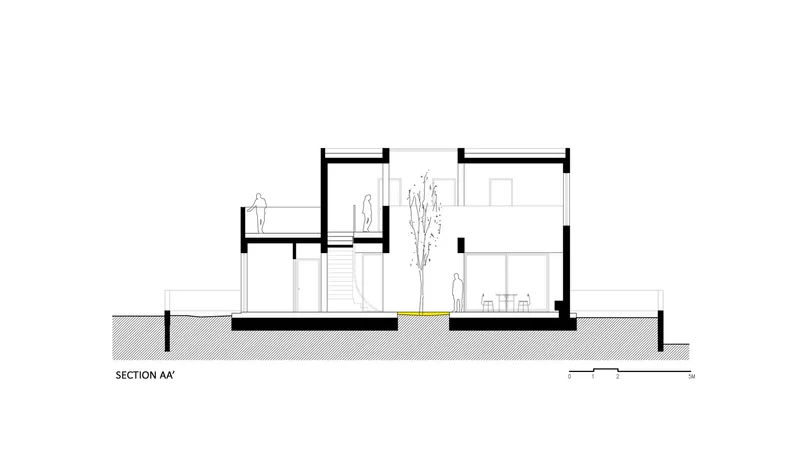
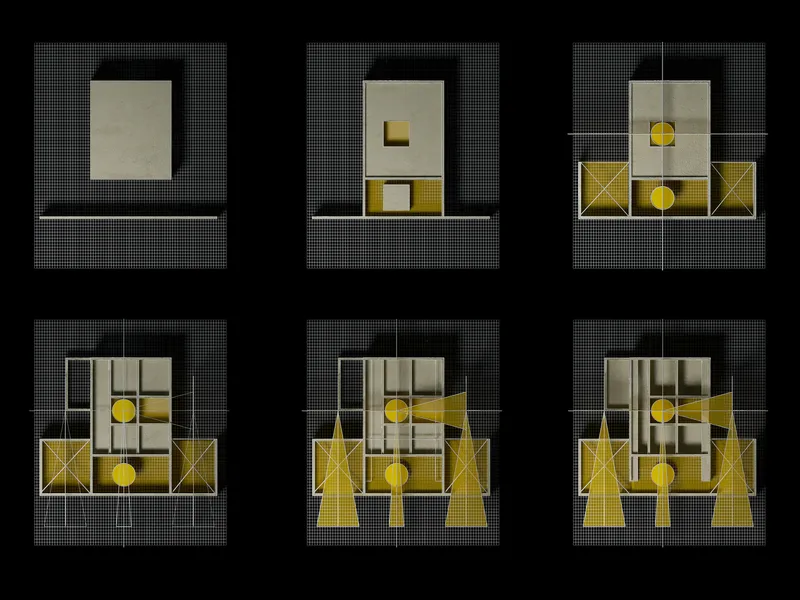
The sections are revelatory. Split-level interior spaces step up and down around the courtyards, with trees drawn at mature height to show the intended spatial relationship between canopy and ceiling. Human figures scattered throughout the drawings confirm the domestic scale. The progressive plan sequence, showing yellow geometric forms emerging across six levels, reads like a time-lapse of the design's conceptual development: simple volumes gaining complexity through rotation and overlap.
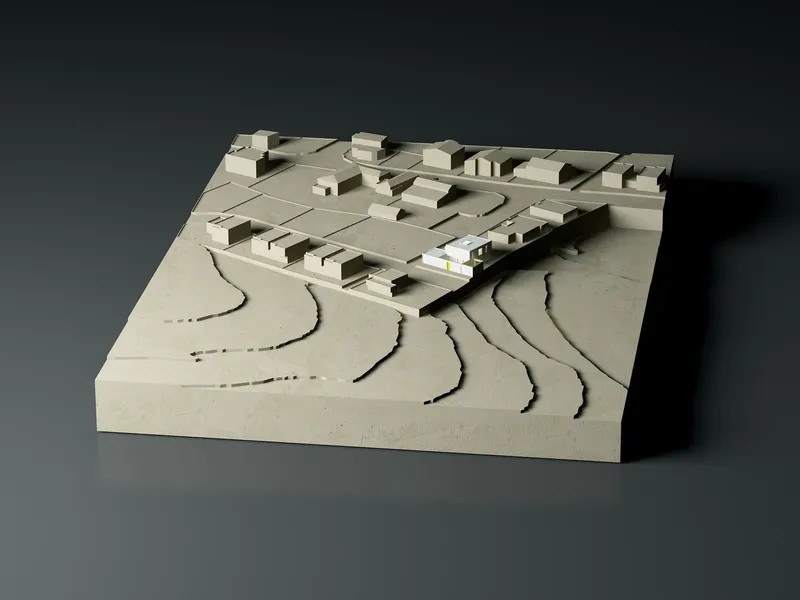
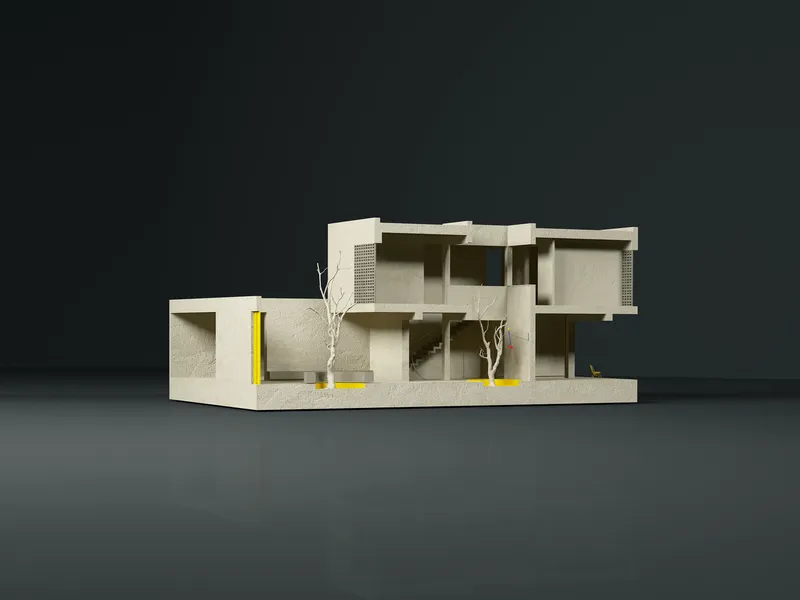
The physical models reinforce what the drawings suggest. The sectional model, with its yellow columns and bare winter trees, strips the project to its structural essentials. The topographic site model reveals the sloped terrain that the house negotiates, placing the project in its broader landscape context and demonstrating how the staggered volumes respond to grade changes.
Why This Project Matters
Domus Maya matters because it demonstrates that vernacular typologies do not need to be museumified or ironically quoted to remain productive. The Cypriot courtyard house is not a relic here; it is a working spatial strategy, updated with contemporary materials and environmental logic but faithful to the underlying idea that domestic life in a hot climate should organize itself around open sky and shade. The twin circular patios are not gestures. They are the architecture.
Studio Kyriakos Miltiadou has produced a house that is disciplined without being austere, colorful without being decorative, and deeply local without being parochial. In a residential landscape that too often defaults to either nostalgic pastiche or context-blind minimalism, Domus Maya occupies a more productive middle ground. It proves that the courtyard house still has things to teach us, provided the architect is willing to listen to the typology rather than merely cite it.
Domus Maya House by Studio Kyriakos Miltiadou, Cyprus. Photography by Creative Photo Room.
About the Studio
Share Your Own Work on uni.xyz
If projects like this are the kind of work you want to make, uni.xyz is a place to publish your own, find collaborators, and enter design competitions.




Popular Articles
Popular articles from the community


The Musturak Paradise: Senior Living Architecture for a Connected Future in Temara, Morocco
The Musturak Paradise reimagines senior living architecture in Temara via private homes, social spaces, culture, community, and shared care.

Conexión: Biophilic Design Reimagines High-Rise Living in Hong Kong
Conexión reimagines high-rise living in Hong Kong through biophilic design, green facades, shared spaces, daylight, water and nature within.

AL-JANNAH: Sustainable Architecture and Permaculture for Afghan Widows
AL-JANNAH uses sustainable architecture and permaculture to create resilient oasis of housing, learning, work and renewal for Afghan widows.

Co-Life: Senior Housing Design That Reconnects Older Adults With the City
Co-Life reimagines senior housing design through healing gardens, shared streets, workshops, and a sustainable community across generations.


Similar Reads
You might also enjoy these articles


Hodi-Mandai Geram
Project Function: Preservation and revitalization of the Intangible heritage and socio-spatial identity of the Hodi by Housing, Cultural Memory Center, Sacred Grove, landscape, local tourism economy


Olio Towers: A Mid-Rise for Performers That Fuses Housing, Rehearsal, and Stage
Located blocks from Houston's Theater District, this modular tower stacks living units around a central performance atrium.

Oasis: Modular Green Housing Carved into Dhaka's Urban Fabric
A shortlisted Plugin Housing entry reclaims unauthorized settlements in Dhaka with stepped concrete volumes, green roofs, and ventilation-driven design.

Black Hole: A Floating Megastructure for the Post-Physical Era
Emiliano Mazzarotto envisions a spherical, self-scaling arena where e-sports, digital hotels, and holographic stadiums replace traditional public space.


Explore Courtyard Competitions
Discover active competitions in this discipline



Challenge to reimagine the Iron Throne


Photograph architecture without architects


Illustrate the lost glory of Angkor Wat - Render Challenge


Design challenge to reuse E-waste
Comments (0)
Please login or sign up to add comments
No comments yet. Be the first to comment!