

DRIFT: Adaptive Reuse Architecture Reimagining an Offshore Oil Rig as an Ocean Research Sanctuary
Adaptive Reuse Architecture transforms an offshore oil rig into a drifting ocean research sanctuary for science, art, and reflection.


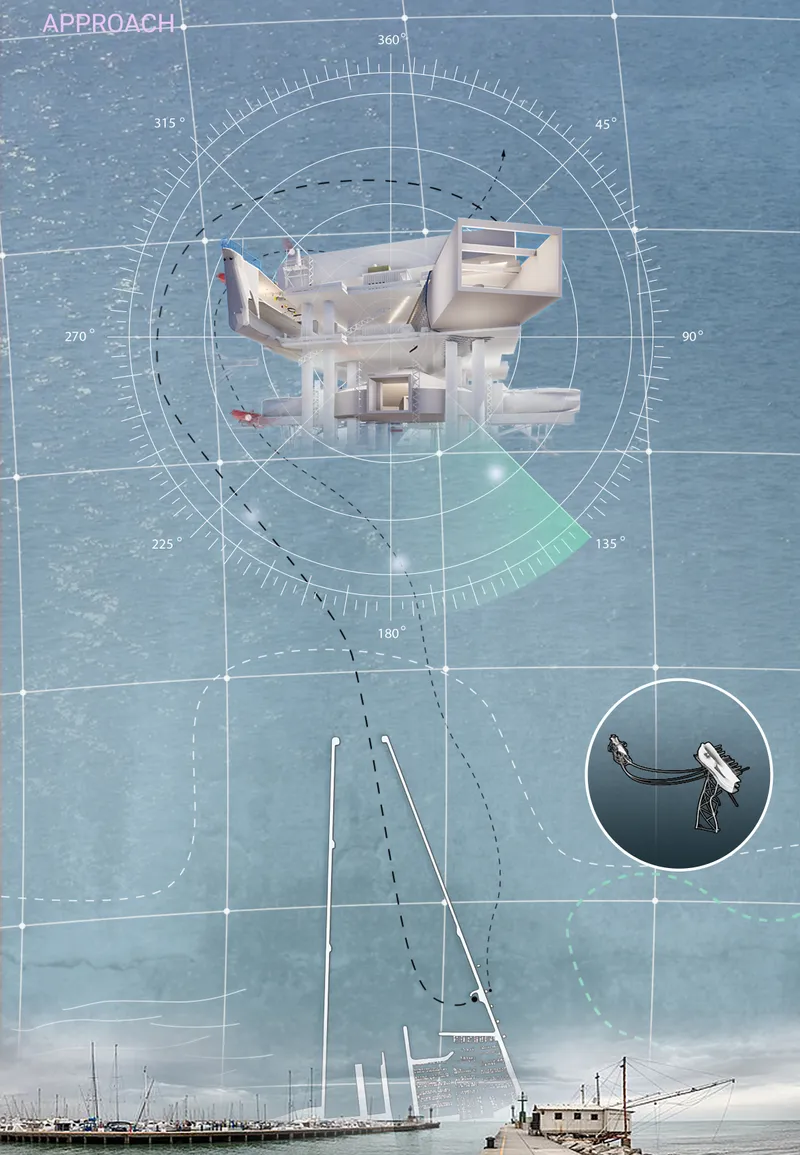
As industries evolve and offshore infrastructure reaches the end of its operational life, architects are increasingly exploring new ways to transform these structures into meaningful destinations. DRIFT, a visionary project by Calvin Ridenour of the University of Texas at Arlington, demonstrates how Adaptive Reuse Architecture can convert an abandoned oil rig into a floating ecosystem of research, contemplation, and human connection.
Originally conceived as an entry for Proximity Island, the project challenges conventional perceptions of offshore platforms. Rather than viewing an oil rig as an obsolete industrial relic, DRIFT imagines it as a dynamic environment where science, art, philosophy, and environmental stewardship converge.
Situated within the vast waters of the Adriatic Sea, the project creates a unique architectural dialogue between permanence and movement, stability and exploration, isolation and community.


Reimagining the Oil Rig as an Architectural Laboratory
The concept behind DRIFT begins with a fundamental question: what happens when an industrial structure no longer serves its original purpose?
Instead of demolition, the project embraces transformation. The existing oil rig becomes a framework for exploration, allowing architecture to evolve beyond traditional land-based limitations.
The design establishes a relationship between two interconnected systems:
- An anchored research platform
- A drifting buoyant vessel
Together, these components create a conversation between fixed infrastructure and nomadic exploration. The result is an architectural environment that continuously engages with the sea while remaining connected to scientific investigation and public interaction.
This strategy places DRIFT firmly within the growing field of Adaptive Reuse Architecture, where existing structures become catalysts for innovation rather than waste.
Architecture Inspired by the Ocean
The architectural language of DRIFT is deeply informed by the characteristics of the sea itself.
Unlike conventional buildings that resist environmental forces, the project embraces movement, currents, and changing conditions. The drifting module becomes an extension of the ocean, responding to waves and surface conditions while collecting valuable environmental data.
Translucent membranes and ballasted structures create spaces that appear suspended between worlds. Above the water, visitors encounter observation decks, galleries, and research facilities. Below the surface, underwater viewing environments establish a direct connection with marine ecosystems.
The architecture becomes neither entirely terrestrial nor entirely aquatic. Instead, it occupies a unique threshold where human experience and oceanic phenomena intersect.
A Platform for Scientific Discovery
At the heart of DRIFT lies a commitment to scientific research and environmental understanding.
The anchored platform functions as an international laboratory dedicated to studying oceanographic conditions, climate systems, and marine ecosystems. Researchers use the facility to investigate the complex relationships between oceans, weather patterns, and planetary health.
Specialized research programs include:
Oceanography Research
Scientists monitor currents, marine biodiversity, and changing ocean conditions to better understand environmental systems.
Climate Observation
Advanced equipment collects data related to atmospheric patterns, sea-level variations, and long-term climate change.
Deep-Sea Studies
Experimental facilities simulate deep-sea conditions and ocean turbulence, enabling researchers to investigate underwater environments and ecological processes.
Astronomy and Celestial Observation
With minimal light pollution, the offshore location provides exceptional opportunities for stargazing, astronomical mapping, and scientific observation of the night sky.
These diverse research activities transform the former industrial platform into a center for interdisciplinary discovery.
The Concept of Drifting Habitation
One of the project's most compelling features is its system of drifting habitation units.
These compact living spaces are designed for artists, scientists, and explorers who temporarily disconnect from the anchored platform and drift with ocean currents.
The experience offers participants a rare opportunity to inhabit the sea directly, fostering deeper awareness of isolation, movement, and environmental conditions.
Rather than functioning as conventional residences, these units become instruments of observation and reflection. Occupants gather data, record experiences, and return insights to the central platform.
This approach introduces a powerful human dimension to the project, transforming research into an immersive journey of discovery.

Art, Culture, and Public Engagement
DRIFT is not limited to scientific investigation. The project also creates opportunities for public engagement through art and cultural programming.
Exhibition spaces integrated throughout the platform allow visitors to explore themes related to climate change, marine ecosystems, ocean exploration, and human relationships with nature.
The architecture itself becomes part of the exhibition experience. Visitors move through spaces that reveal changing perspectives of the sea, sky, and horizon.
Large immersive environments simulate drifting experiences, enabling guests to understand the psychological and emotional dimensions of life at sea.
Through these cultural programs, the project bridges the gap between scientific knowledge and public awareness.
Spatial Organization and Experience
The design organizes activities through a central hub that connects multiple research and habitation zones.
A series of elevated circulation paths guide movement across the platform while maintaining visual connections to the surrounding ocean.
Key programmatic areas include:
- Research laboratories
- Artist residency spaces
- Public galleries
- Observation decks
- Underwater viewing chambers
- Ocean simulation environments
- Astronomical observation platforms
- Data collection facilities
This layered spatial arrangement allows visitors and researchers to experience the ocean from multiple perspectives, reinforcing the project's central theme of coexistence between humanity and the marine environment.
Sustainability Through Adaptive Reuse Architecture
The environmental significance of DRIFT extends beyond its research mission.
By repurposing an existing offshore oil rig, the project demonstrates how Adaptive Reuse Architecture can reduce waste, preserve resources, and extend the lifespan of industrial infrastructure.
Rather than removing the structure and generating significant environmental impacts, the design transforms it into a productive asset that contributes to scientific knowledge and ecological awareness.
This strategy highlights the growing importance of adaptive reuse within contemporary architecture, particularly as designers seek sustainable alternatives to demolition and reconstruction.
A New Identity for Offshore Infrastructure
DRIFT proposes a future in which decommissioned oil rigs become platforms for education, research, and cultural exchange.
As energy systems transition and offshore structures become increasingly obsolete, projects like DRIFT suggest new possibilities for their continued relevance.
Some platforms may become research stations. Others may support artistic residencies, environmental monitoring programs, or public educational initiatives.
In every case, the goal remains consistent: transforming industrial remnants into spaces that generate knowledge, inspire curiosity, and strengthen humanity's relationship with the natural world.
DRIFT presents a compelling vision for the future of Adaptive Reuse Architecture. Through the transformation of an offshore oil rig into a floating research and cultural sanctuary, the project challenges conventional assumptions about infrastructure, sustainability, and the role of architecture in environmental stewardship.
Designed by Calvin Ridenour of the University of Texas at Arlington, the proposal demonstrates how architecture can move beyond static construction to become a living framework for exploration, scientific discovery, and human reflection.
By embracing the ocean as both context and collaborator, DRIFT creates an extraordinary model for how obsolete industrial structures can find new purpose in a changing world.


Popular Articles
Popular articles from the community

Faces of the Soviet Avant-Garde: Turning Moscow's Street Names into an Open-Air Museum
A network of sculptural installations across a Moscow residential district transforms forgotten architect names into spatial encounters with cultural memor

Extended Shell: Retrofitting Kolkata's Balconies as Living Urban Thresholds
A modular retrofit system recovers the social and environmental intelligence of Kolkata's historic verandas for contemporary Park Street residents.

Manzana Morphosis: Stretching Barcelona's Grid into a Living Landscape for 2050
A radical reworking of the Eixample manzana turns density into a tool for generous public space, vertical ecology, and environmental performance.

The Amber Palace Opera: A Geological Fiction Surfaces on Tallinn's Baltic Waterfront
Pierre Brillard reimagines a Baltic legend as a public landscape, opera house, and waterfront promenade rooted in Tallinn's coastal identity.

Similar Reads
You might also enjoy these articles

Eco Chapel: A Green Architecture Pavilion Designed in Symbiosis with the Forest
Eco Chapel uses green architecture to weave prayer, learning and reuse into a forest pavilion shaped by modular hexagonal canopies for life.
Kaffeebühnen: Coffee Shop Architecture Designed as a Civic Stage Between Vienna’s City and Park
Kaffeebühnen turns coffee shop architecture into a civic stage, linking Vienna’s park edge, urban life, warm timber yards, and coffee craft.
Healing Façade: Sustainable Architecture for Reforestation, Community, and Sacred Ecology in Ethiopia
Healing Façade reimagines sustainable architecture as a living wall that restores soil, catches water and renews Ethiopia's forest churches.


Urban Forest: A Vertical Ecosystem for 5,000 Workers in Singapore's Changi Business Park
Radially stacked pods and layered green decks turn a 7-acre plot into 47 acres of ecological workspace projected for 2040.

Comments (0)
Please login or sign up to add comments
No comments yet. Be the first to comment!