

DRIFT: Turning a Spent Adriatic Oil Rig into an Anchored Laboratory and a Drifting Research Module
Calvin Ridenour pairs a retired offshore platform with a nomadic floating module, holding ocean research between fixed infrastructure and open sea.


Most offshore oil rigs end their lives in one of two ways: they are cut apart and towed away, or they are left to rust. DRIFT proposes a third outcome. It keeps the steel and changes what the steel is for, recasting an abandoned platform as a research sanctuary that studies the very ocean it once drilled. The sharpest move is a split. A fixed, anchored platform is paired with a drifting module that moves with the currents, so the project is never only a building and never only a vessel.
The project is by Calvin Ridenour of the University of Texas at Arlington and was first developed as an entry for Proximity Island. It is sited in the Adriatic Sea, where the platform sits between a harbor coastline and open water. Ridenour treats the rig as an obsolete industrial relic that can still serve as a framework. Oceanography, climate observation, contemplation and public access share one structure, and the design is built around the tension between permanence and movement.
A Hull-Shaped Pool Pulls the Sea Inside the Structure

The cutaway shows what makes DRIFT more than a deck conversion. Below the stilted platform, a hull-shaped pool drops beneath the waterline. A diver and a yellow submersible work in bubbling water, which suggests a contained experimental volume rather than a decorative basin. This matches the brief's most ambitious research program: facilities that simulate deep-sea conditions and ocean turbulence, so researchers can study underwater environments and ecological processes without leaving the platform.
What matters spatially is the threshold. The design calls for ballasted structures and translucent membranes, with observation decks, galleries and laboratories above the water and underwater viewing spaces below it. The section makes that vertical sequence readable at once. The architecture is neither terrestrial nor aquatic, and the waterline becomes the plane the whole project is organized around.
Stacking Water, Deck and Plan as One Research Instrument

The exploded axonometric separates DRIFT into three layers: the hull-shaped water chamber, the stilted platform deck and a plan view, all drawn in a pale blue haze. Pulling them apart shows how much of the project depends on the original rig's logic. The stilts stay. The deck stays. The new program fills in around and beneath them, so the existing structure works as scaffolding instead of something to clear away.
This layering also explains the research program. The anchored platform works as an international laboratory for oceanography, tracking currents, marine biodiversity and changing ocean conditions, and for climate observation, recording atmospheric patterns and sea-level variation. The same offshore isolation that cuts light pollution makes the deck a place for astronomy and celestial mapping. One frame holds instruments that look down into the water, out at the weather and up at the night sky.
Navigation Graphics That Tie the Rig Back to the Harbor

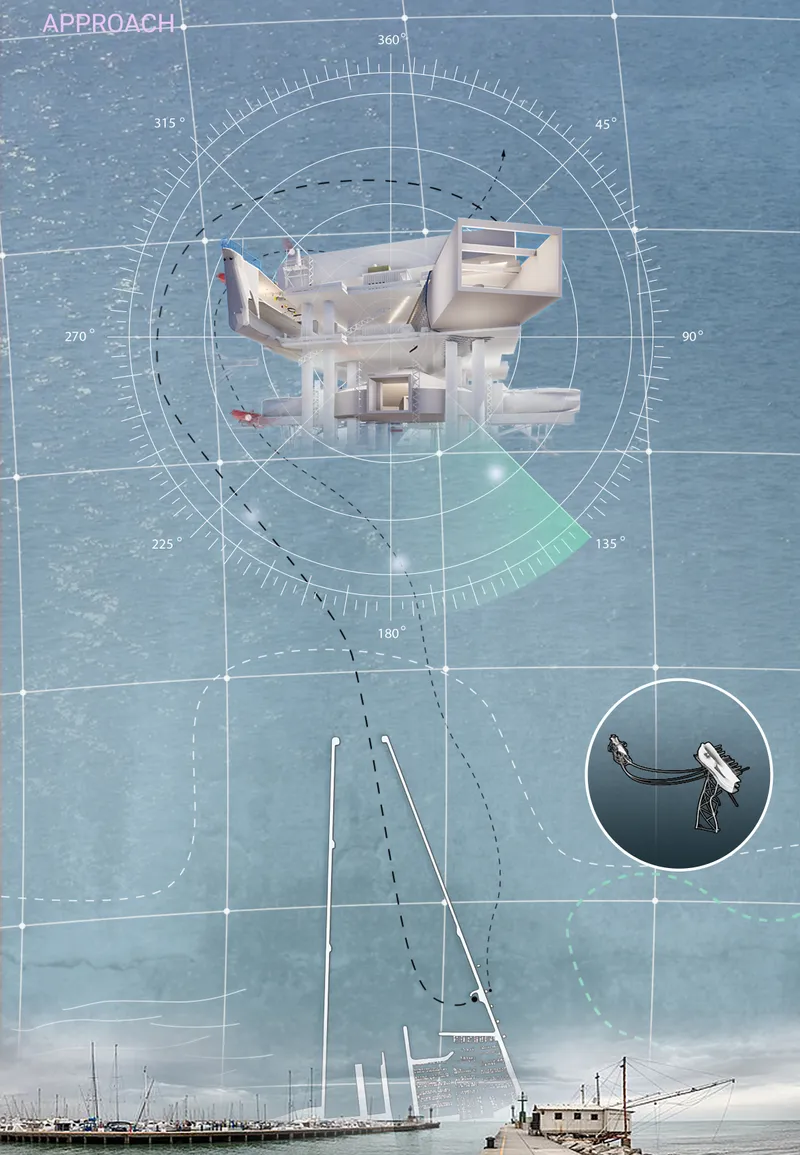
The two site renderings borrow the language of marine navigation. In the first, the stilted platform sits inside a compass-style radar overlay, and a dashed approach route runs toward a harbor jetty under an overcast sky. In the second, compass bearings frame the platform, and a dashed boat path leads back to a harbor mole with a small fishing hut. The graphics make a quiet but important point: the sanctuary is remote, but it is not cut off.
That link to shore is where the drifting idea becomes meaningful. The anchored rig is the fixed reference point, and the mobile module responds to waves and surface conditions while it collects environmental data. The radar rings and dashed paths read as diagrams of that relationship, with a stable center and routes going out and coming back. Placing a modest fishing hut beside a former industrial giant also signals that the project is about the Adriatic's working coast as much as its open water.
Why This Project Matters
Decommissioned offshore infrastructure is becoming a real design problem, and DRIFT treats it as a chance to work with what already exists. Keeping the rig avoids the waste of demolition, and the reuse fits the structure's original location: an object built to extract from the sea now houses research into the sea's health. This is Calvin Ridenour's strongest argument. Adaptive reuse can change what a structure means as well as what it holds.
The pairing of fixed and drifting parts is the idea worth carrying forward. Many floating-architecture proposals pick one condition and commit to it. DRIFT keeps both and makes the movement between them part of the program. The scheme still leaves questions about mooring the module and phasing its operations, but it gives a clear spatial model for building at the waterline, where stability and exploration operate side by side.
View the Full Project
About the Designers
Designer: Calvin Ridenour
Enter a Design Competition on uni.xyz
uni.xyz runs architecture and design competitions year-round that reward proposals with spatial conviction and real site intelligence.
Project credits: DRIFT by Calvin Ridenour.


Popular Articles
Popular articles from the community

Faces of the Soviet Avant-Garde: Turning Moscow's Street Names into an Open-Air Museum
A network of sculptural installations across a Moscow residential district transforms forgotten architect names into spatial encounters with cultural memor

Opera on the Sea: Driftwood Logic Shapes a Timber Opera House on Estonia's Coast
Trevor Orgill's opera house translates the entangled drift of floating timber into a civic building where wood, water, and music converge.
Manzana Morphosis: Stretching Barcelona's Grid into a Living Landscape for 2050
A radical reworking of the Eixample manzana turns density into a tool for generous public space, vertical ecology, and environmental performance.
Opera by the Sea Estonia: Three Shells Dissolving Architecture into Tallinn's Coastline
A winning opera house proposal replaces monumental form with interconnected shells that blur the boundary between building, park and Baltic Sea.

Similar Reads
You might also enjoy these articles

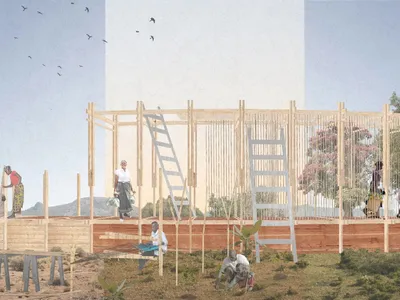
Healing Façade: A Modular Chapel System That Restores Ethiopia's Sacred Forests
Winner of the Eco-Chapel competition, this circular timber façade collects water from air to rebuild soil and reforest degraded Ethiopian landscapes.
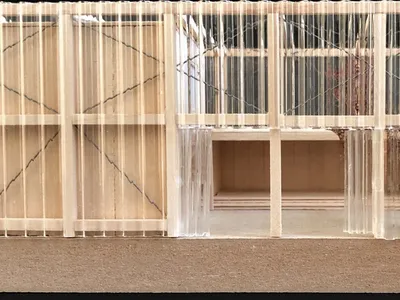
Kaffeebühnen: Where Coffee Shop Architecture Becomes a Civic Stage in Vienna
A linear sequence of timber boxes, transparent shells, and open yards turns the Viennese café tradition into a public performance space.
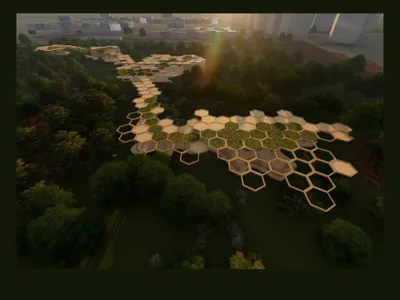
Eco Chapel: A Modular Forest Pavilion That Grows Like the Landscape It Protects
Hexagonal timber modules weave through existing trees, turning a chapel into a living system for prayer, education, and reforestation.


Urban Forest: A Vertical Ecosystem for 5,000 Workers in Singapore's Changi Business Park
Radially stacked pods and layered green decks turn a 7-acre plot into 47 acres of ecological workspace projected for 2040.

Comments (0)
Please login or sign up to add comments
No comments yet. Be the first to comment!