
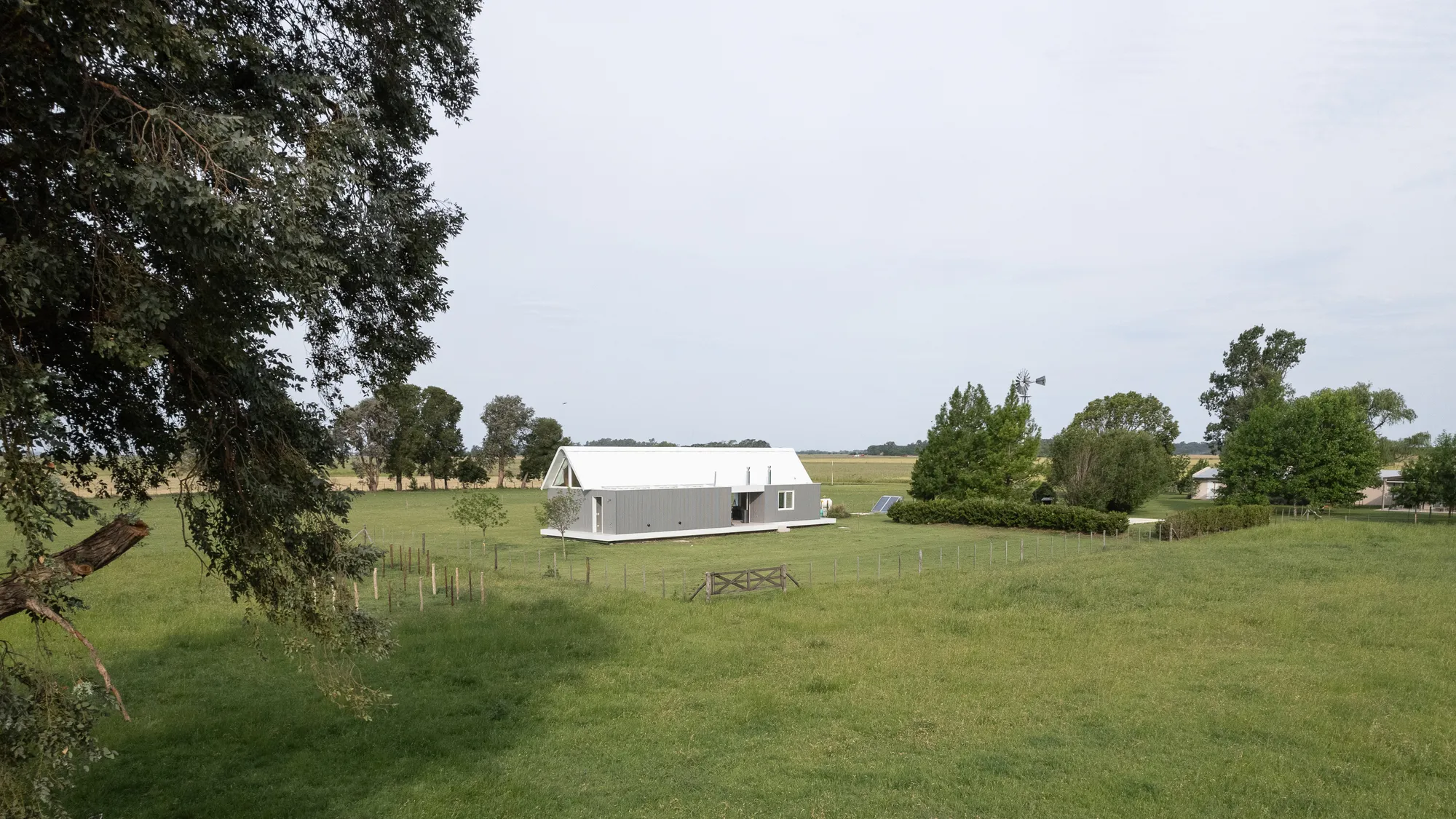
DUB Arquitectura Insulates a Pampas Guest House with Discarded Sheep Wool
La Escocesa is a modular steel-framed retreat in rural Buenos Aires province that turns agricultural waste into high-performance building insulation.


Every year, roughly 4,000 tons of sheep wool are discarded or burned across Buenos Aires province. It is a byproduct of an agricultural economy that has no use for lower-grade fleece, and it typically ends up as waste. DUB Arquitectura, led by Angie Dub and Belén Butler, saw an insulation material. La Escocesa House, a 150-square-meter guest house on a working farm in Veinticinco de Mayo, wraps its steel-framed modules in blankets of locally sourced sheep wool, with insulation thickness calibrated to each façade's solar exposure. The result is a building that operates entirely off the grid and requires almost no air conditioning in the subtropical Pampas climate.
What makes this project worth studying is not just the wool. It is the way the architects treated flexibility as a structural principle. La Escocesa is organized as four discrete modules: a kitchen and dining room, a two-bedroom unit, a split bathroom, and a multipurpose attic. Each module can be activated independently depending on occupancy, and the plan is oriented so that future expansion toward the northeast can proceed without blocking views from the main family home. Low maintenance drove every material decision, from corrugated metal cladding to phenolic plywood interiors. The house is a case study in doing more with less, and doing it with what is already lying around.
A Metal Shell on the Open Plain
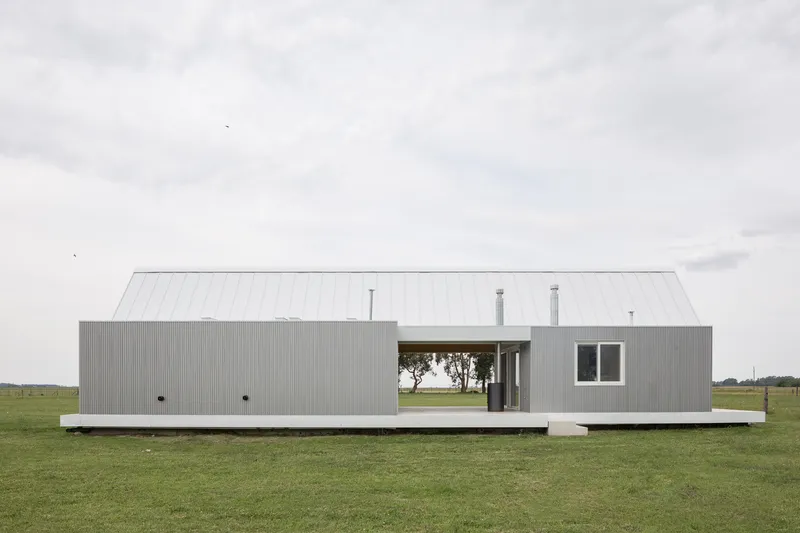
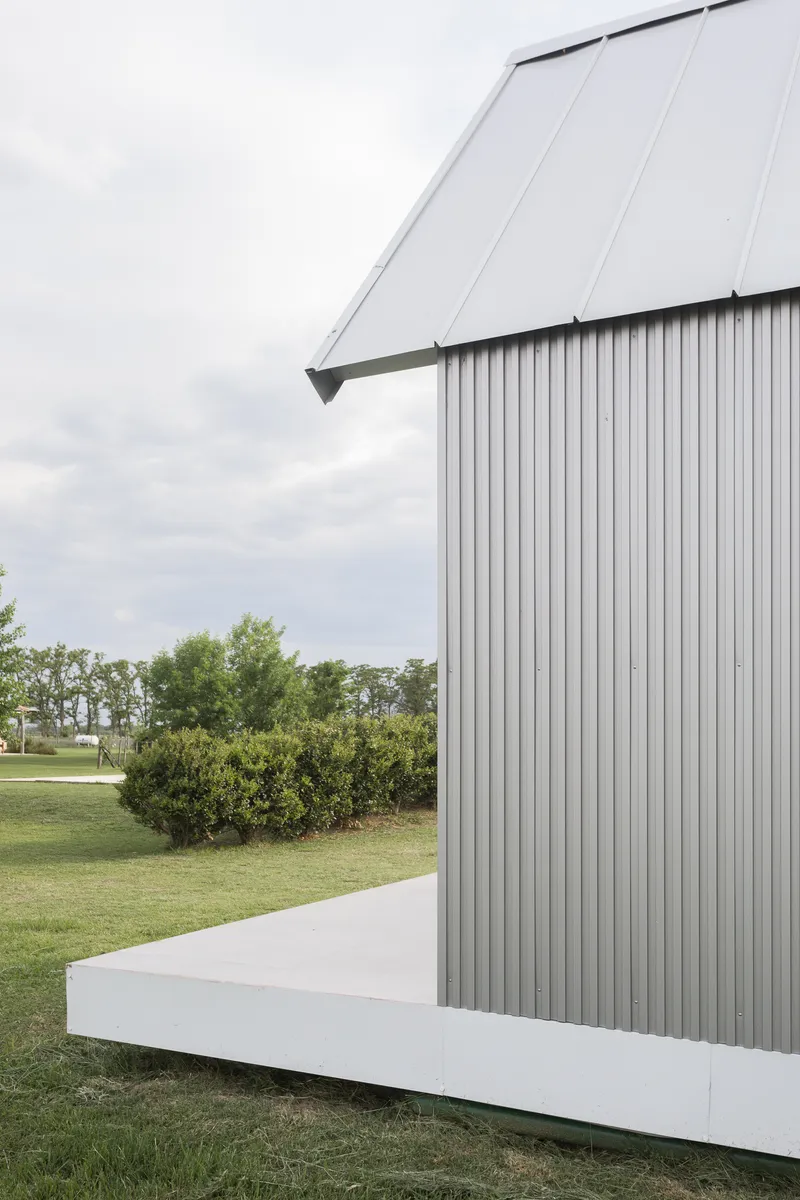
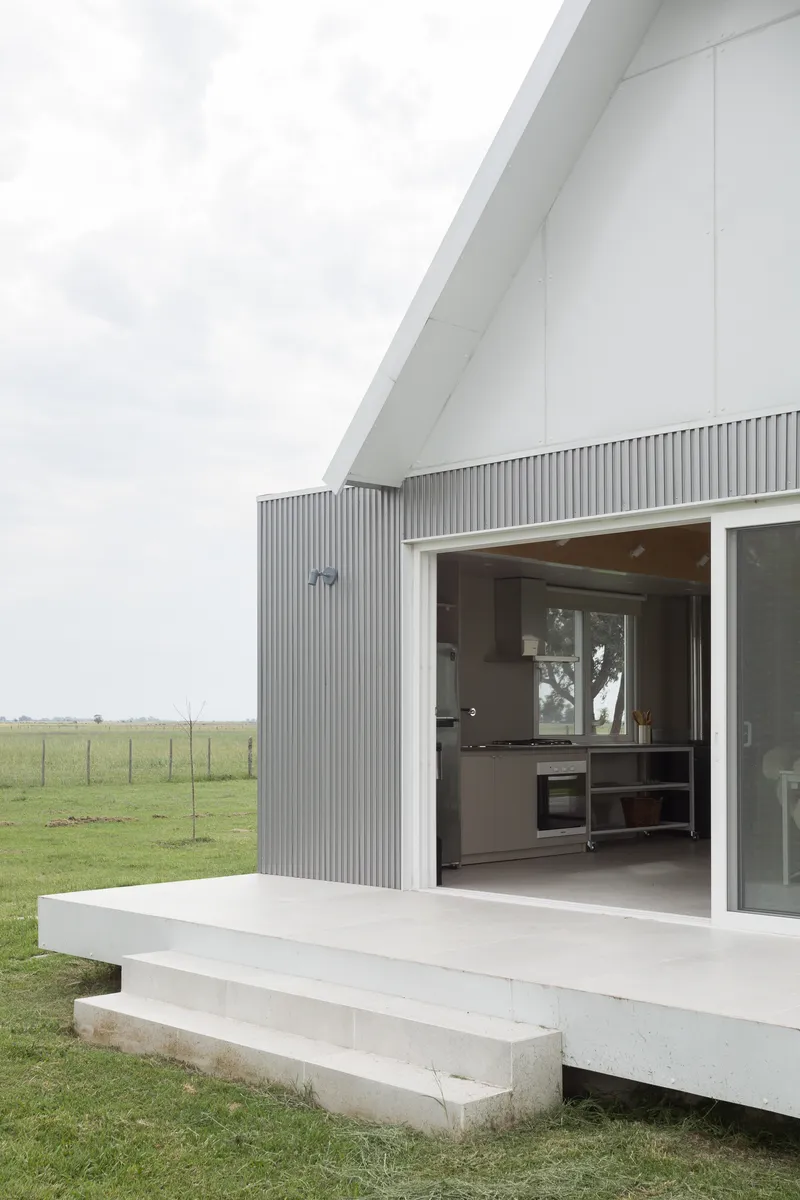
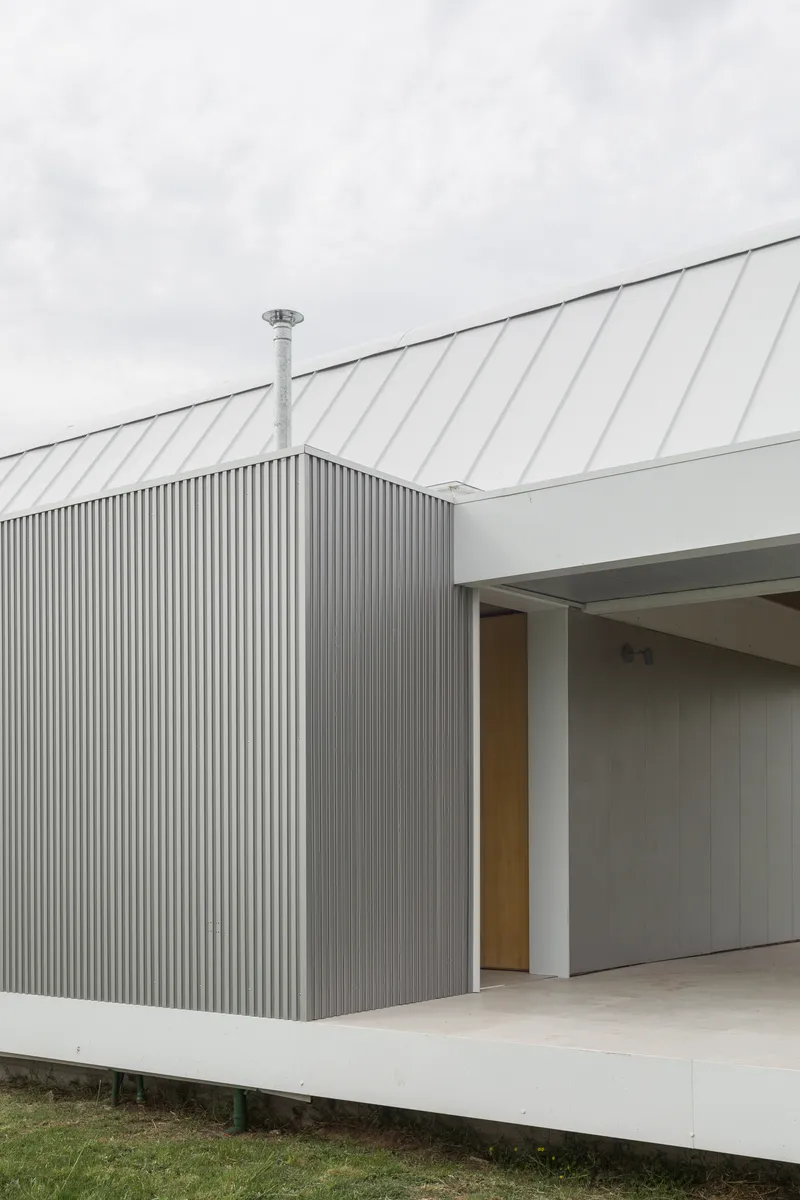
From a distance, La Escocesa reads as a long, low corrugated metal bar sitting on a concrete plinth. The gabled form is deliberate: it echoes the agrarian sheds and barns already present on the farm, folding into the landscape rather than asserting itself against it. The vertical corrugation catches raking light across the Pampas' flat horizon, turning the façade into a surface that shifts through the day.
The raised platform serves both a practical and a compositional purpose. It lifts the steel frame above potential ground moisture and creates a clear datum that separates the building from the grass. The proportions are modest, almost understated, and the material palette is limited to metal and concrete on the exterior. There is no ornament, no excess, just the logic of a shell designed to protect the wool-insulated cavity behind it.
The Breezeway as Social Spine
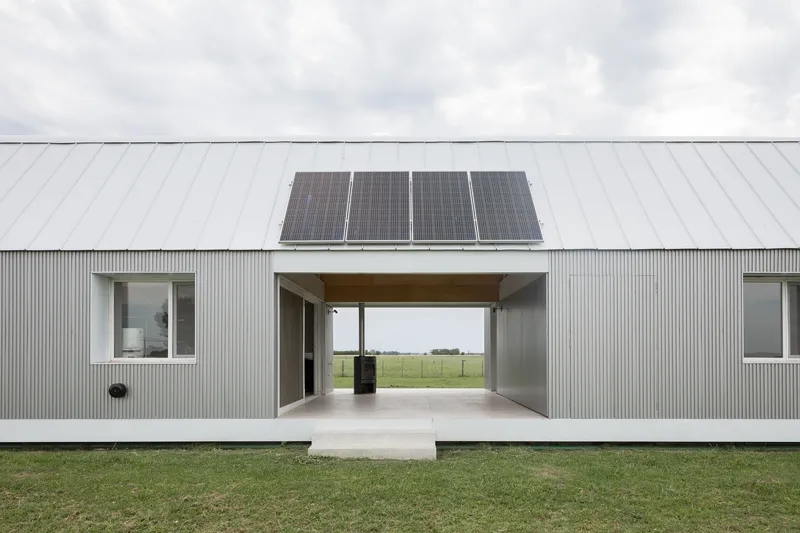
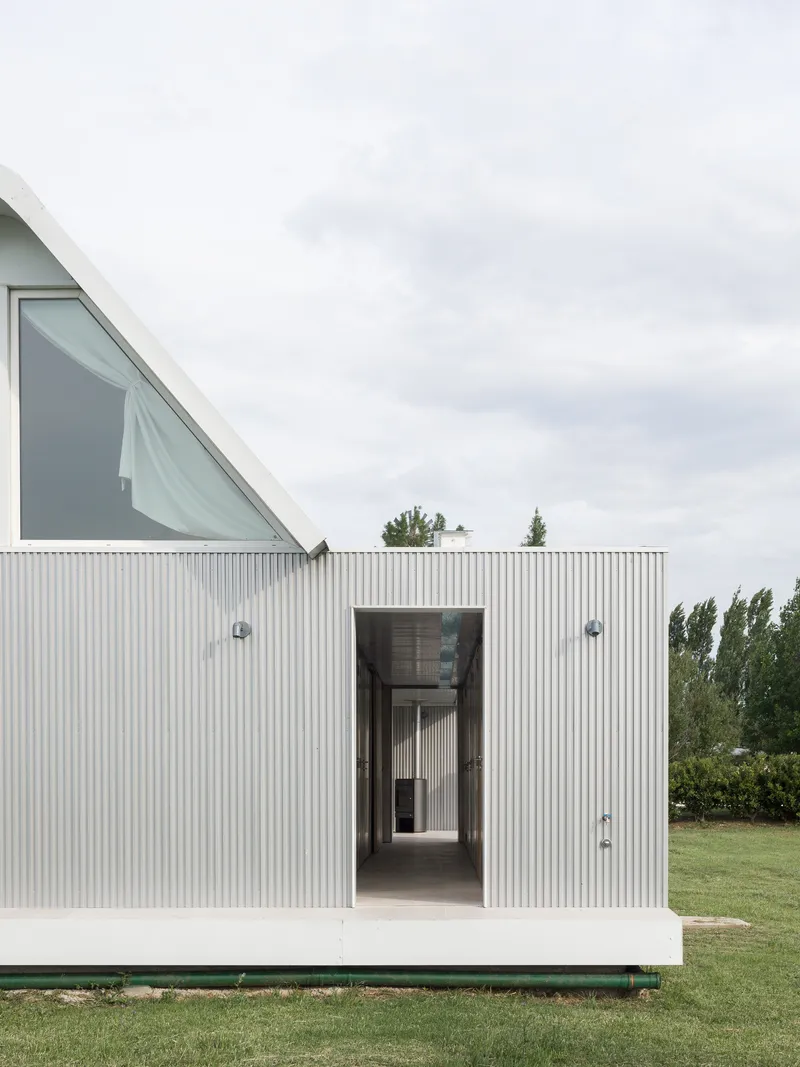
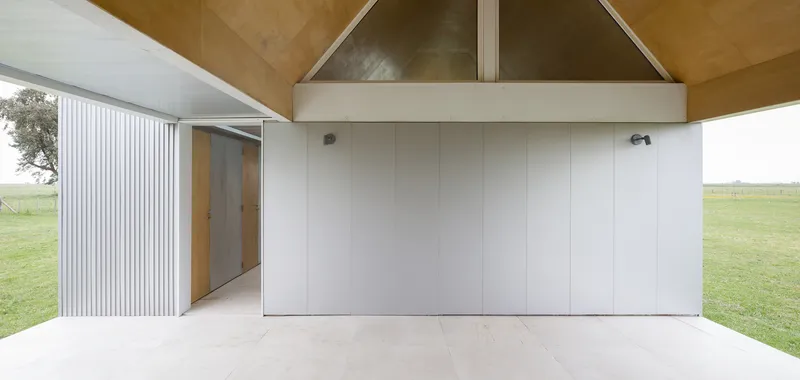
The plan is organized around a central open-air corridor that doubles as a breezeway and a patio. This outdoor passage connects the modules and functions as what the architects describe as a distribution hall. It is the space where residents actually gather, where cross ventilation is pulled through the building, and where the threshold between interior and landscape dissolves.
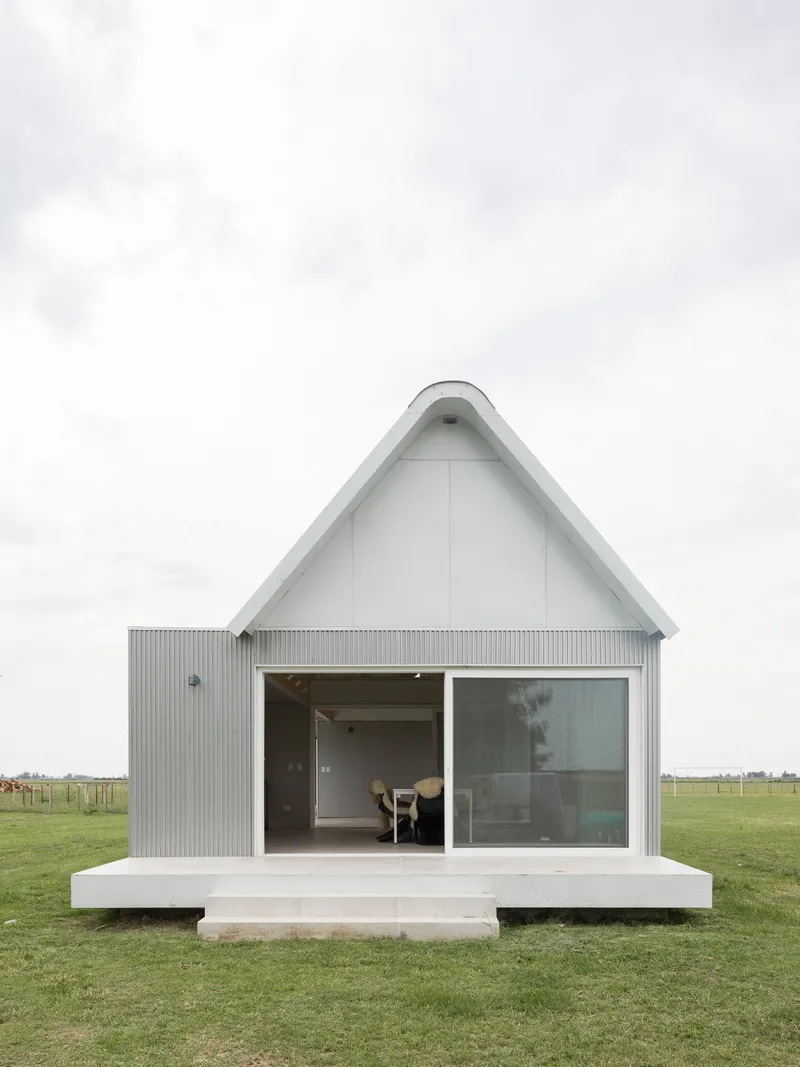
The breezeway is legible from the gable end: a clean cut through the corrugated volume that frames views straight through to the fields beyond. It is a simple move, but an effective one. Rather than circulating through a dark hallway, guests pass through open air to reach each module. The covered terrace on either side extends the usable area without adding conditioned space, which keeps the energy footprint tight.
Plywood Warmth Under the Gable
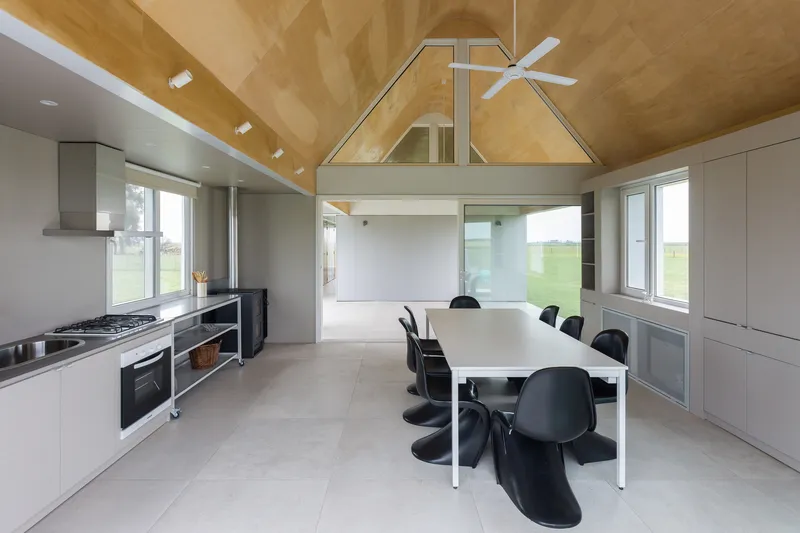
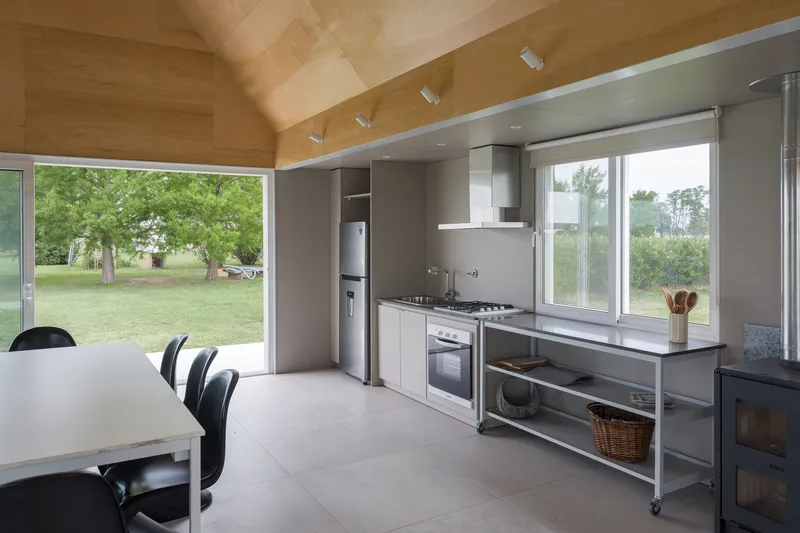
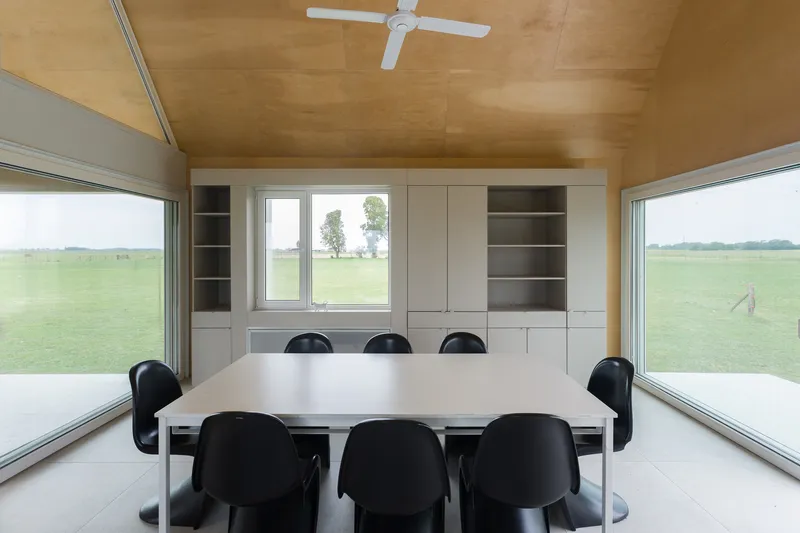
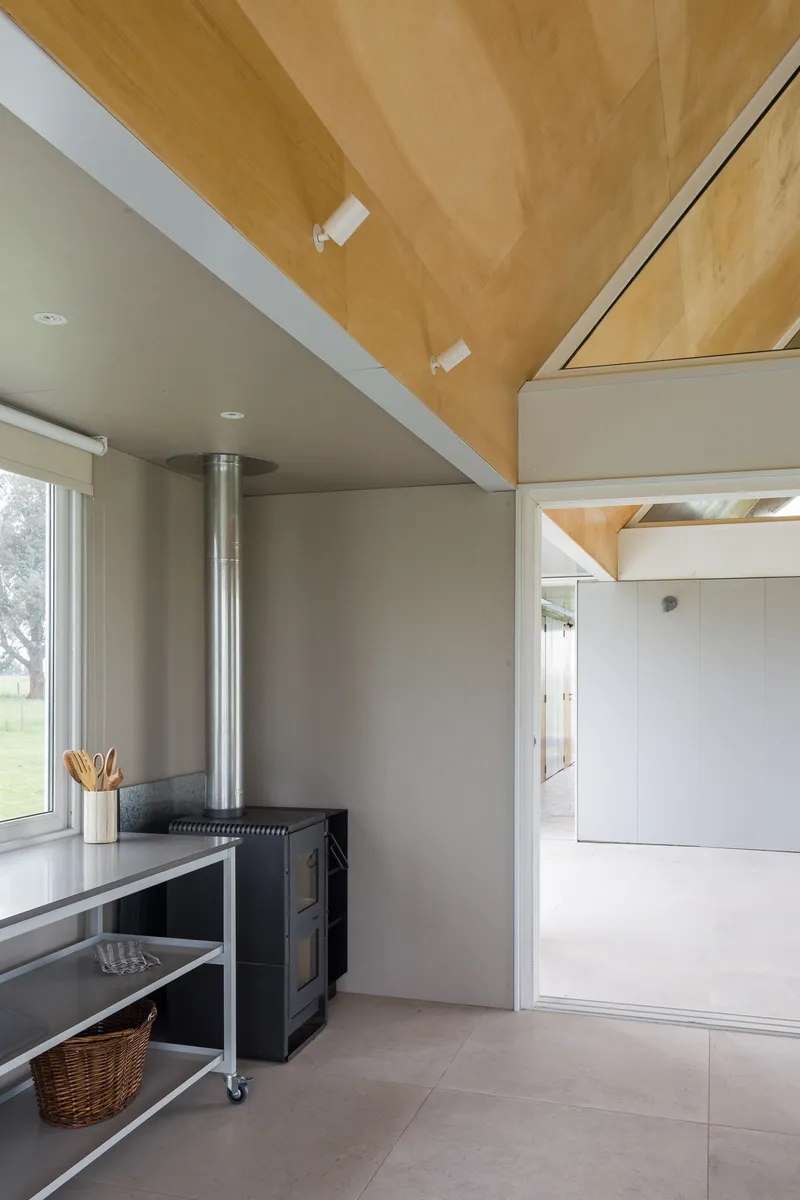
Inside, the cold metal shell gives way entirely to phenolic plywood. The vaulted ceilings follow the gable geometry, creating a pitched volume that feels generous despite the compact floor area. White cabinetry and kitchen surfaces contrast with the warm timber tone, and the detailing is intentionally restrained: flush panels, minimal trim, steel shelving that reads as furniture rather than architecture.
The open kitchen and dining room is the largest module and the social heart of the house. Floor-to-ceiling windows on the northeast side open onto the lawn, while glass is minimized on the south and west to reduce heat gain. A freestanding wood stove sits in the kitchen corner, offering supplementary heating on the handful of cold nights that the wool insulation cannot handle alone.
Bedrooms, Staircase, and the Attic Module
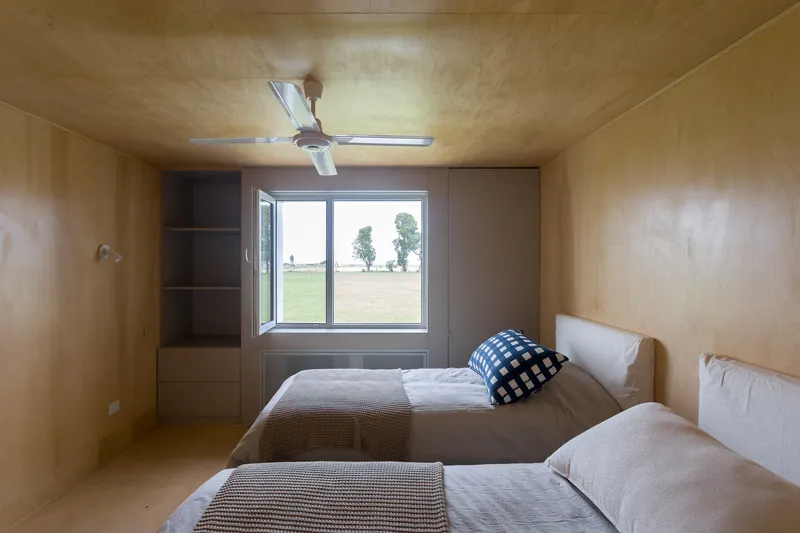
The two-bedroom module is compact and deliberate. Each room gets a single window that frames the landscape like a painting: distant trees, open lawn, the scale of the Pampas reduced to a domestic aperture. The plywood lining continues without interruption from walls to ceiling, reinforcing the sense that each module is its own self-contained capsule.
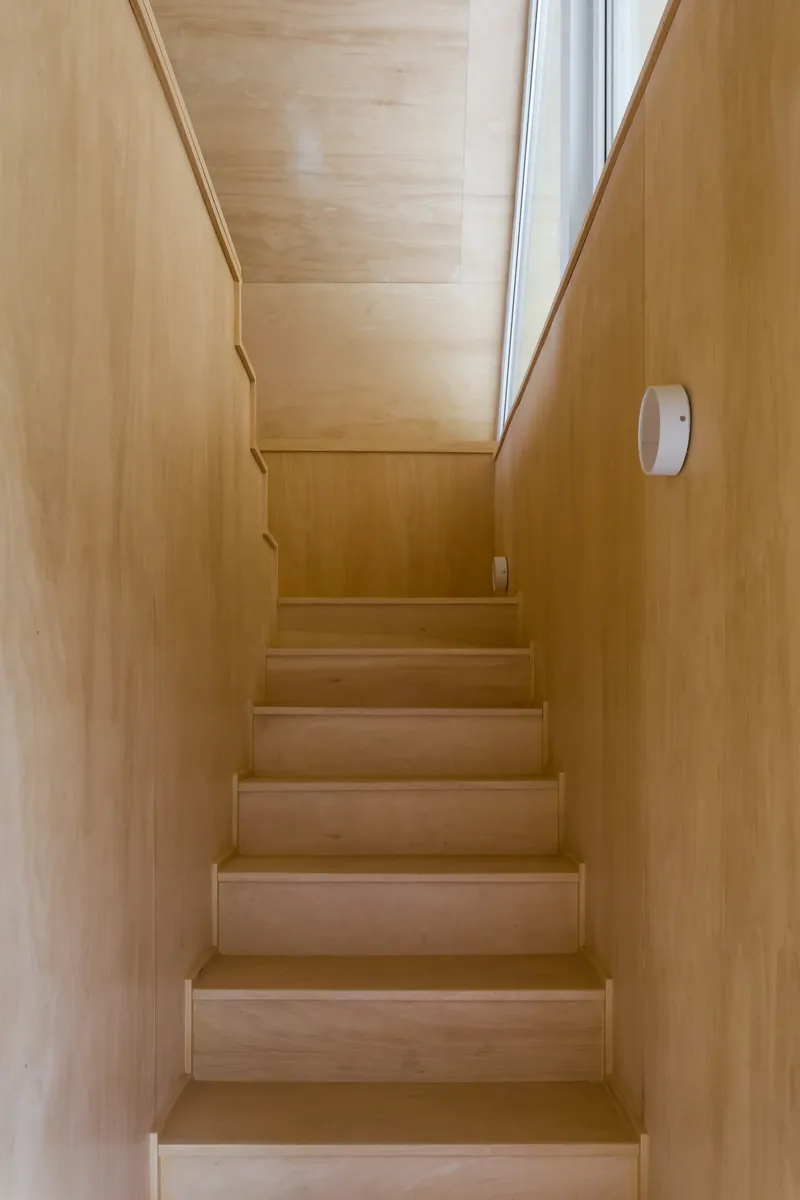
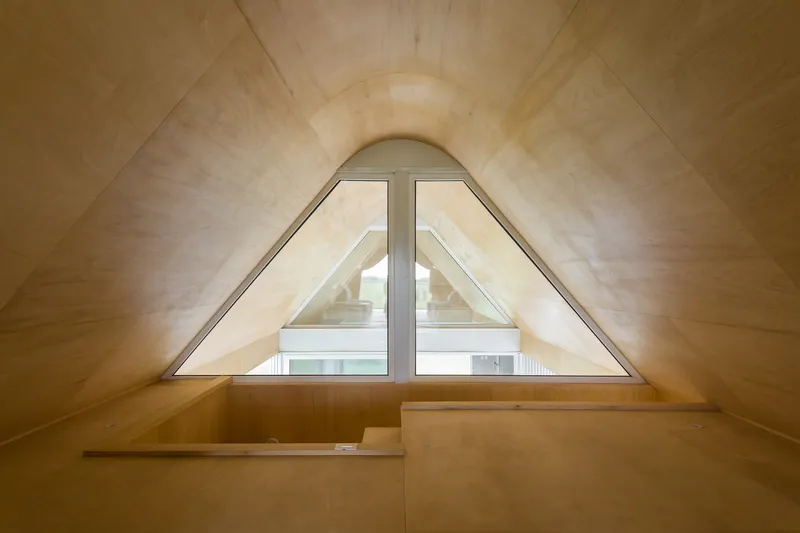
A narrow staircase, lined entirely in plywood and lit from above by a skylight, leads up to the multipurpose attic. At its peak, an arched triangular window sits in the gable wall with a built-in bench below. It is a small, contemplative space, separate from the communal ground floor, and the kind of gesture that turns a guest house into a place worth lingering in.
Corrugated Metal in the Wet Rooms
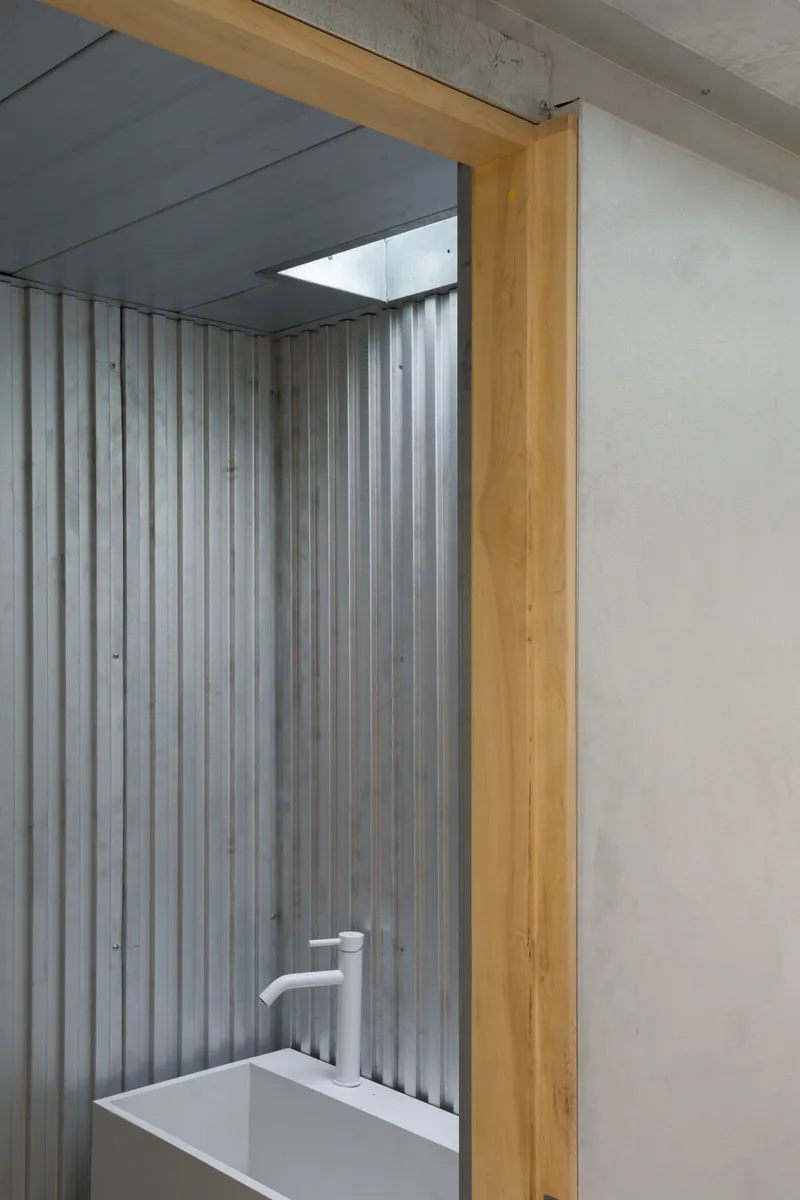
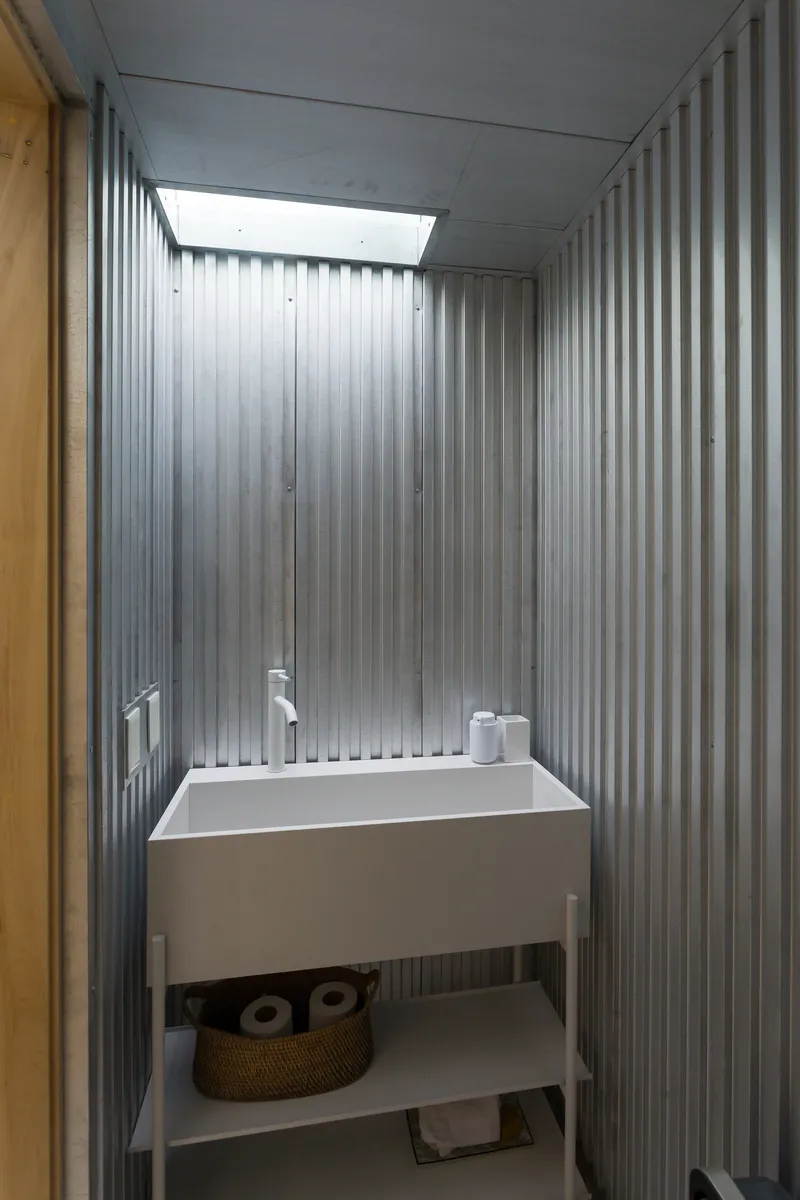
In the bathrooms, the architects reverse the material logic: the corrugated metal that clads the exterior reappears inside, used as a waterproof wall finish. It is an honest, slightly industrial choice that avoids the expense of tiling and keeps the maintenance burden close to zero. Rectangular skylights cut into the ceiling bathe these small rooms in daylight, reducing dependence on artificial light to a minimum.
The timber framing is left partially exposed, reinforcing the construction legibility that runs through the entire project. Nothing is hidden. You understand how the building is made by standing inside it.
Solar Panels and Off-Grid Performance
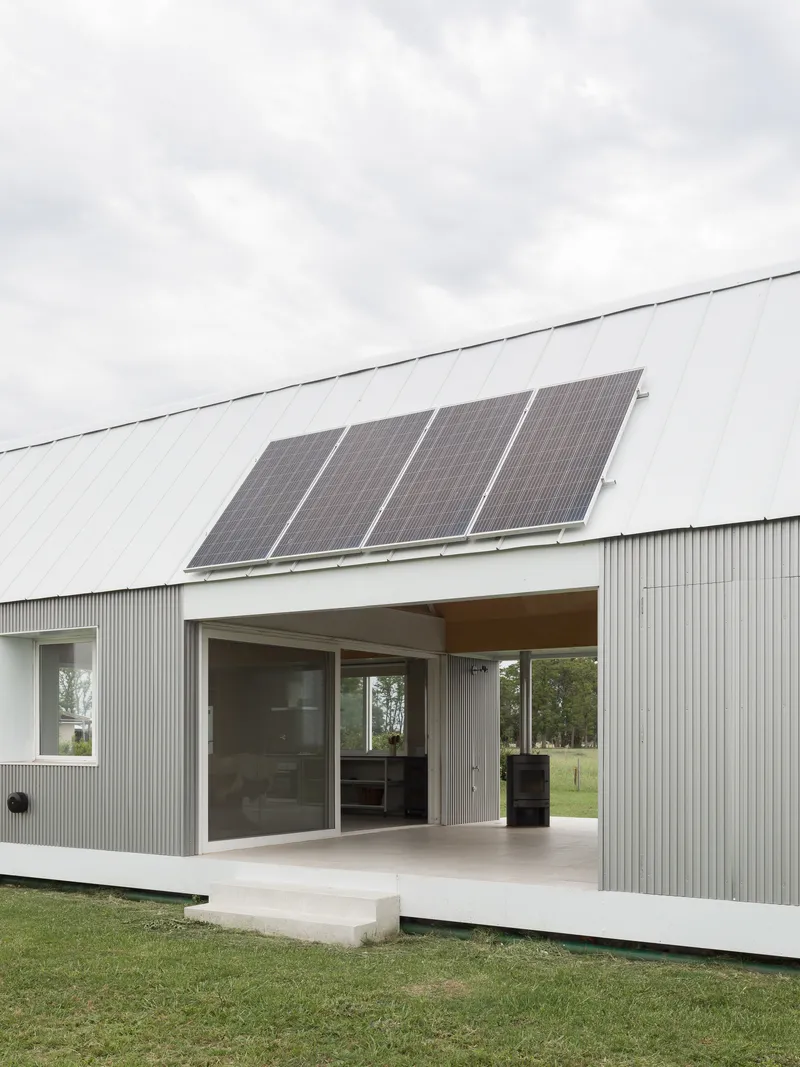
Four solar panels sit on the south-facing slope of the gabled roof, providing all of the electricity the house requires. La Escocesa does not connect to the grid. Combined with the passive strategies (cross ventilation in every room, orientation-specific insulation thickness, minimized glass on unfavorable exposures), the active solar array closes the loop. The building produces what it needs and asks for nothing else.
The concrete terrace on the northeast side, accessed through full-width sliding doors, functions as an outdoor room for most of the year. The deep roof overhang provides constant sun protection, and the doors can open the kitchen module entirely to the outside. It is a straightforward climate response for a region where the distinction between indoors and outdoors is more a matter of shade than enclosure.
Gable Details and Façade Articulation
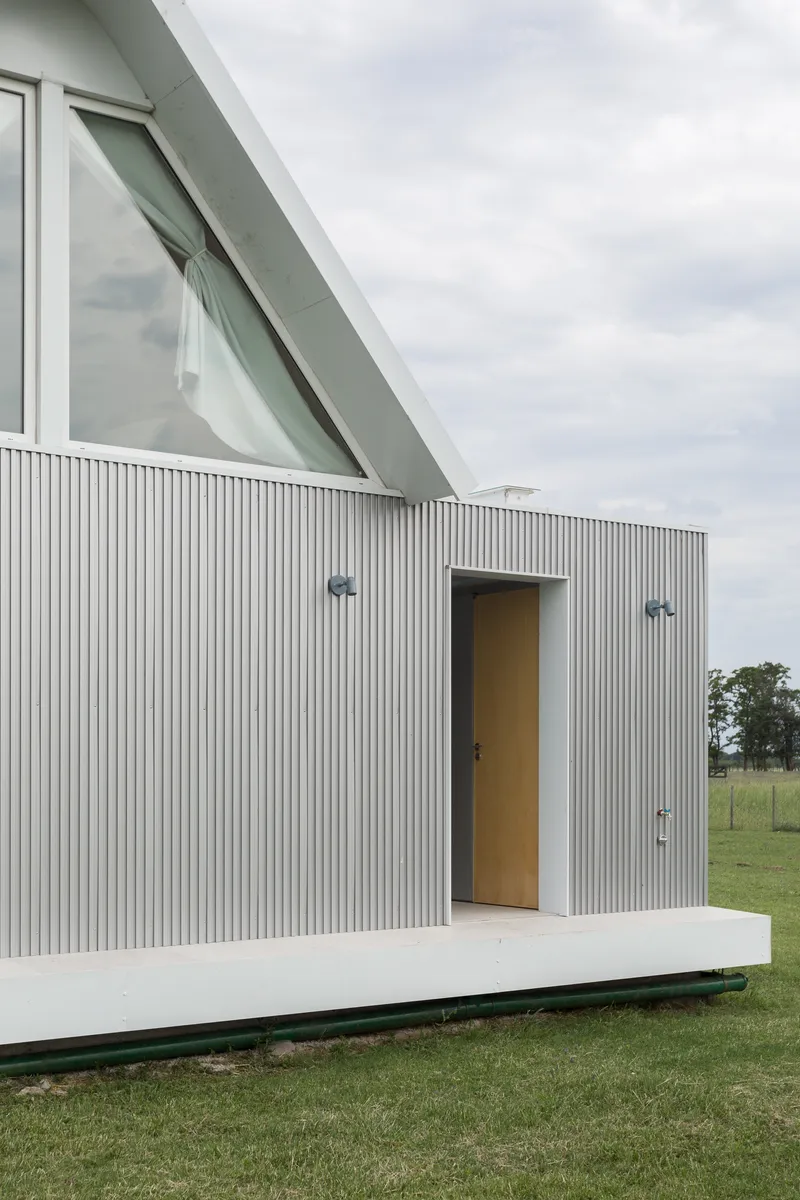
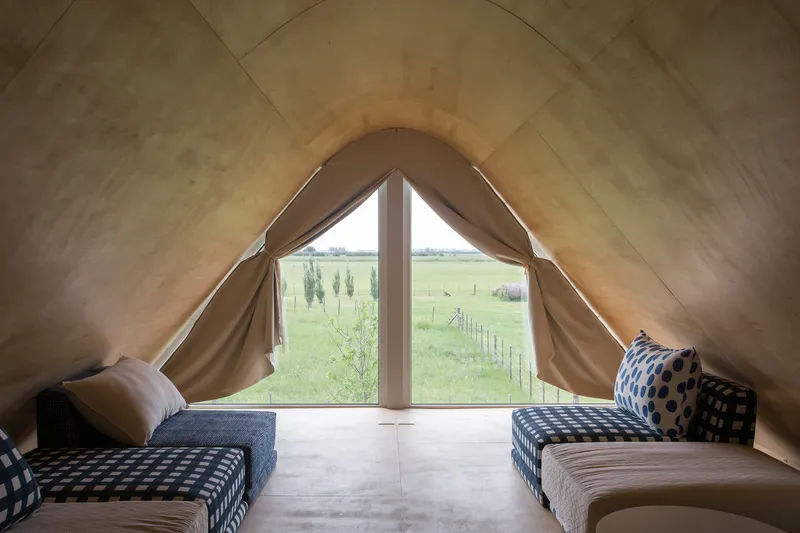
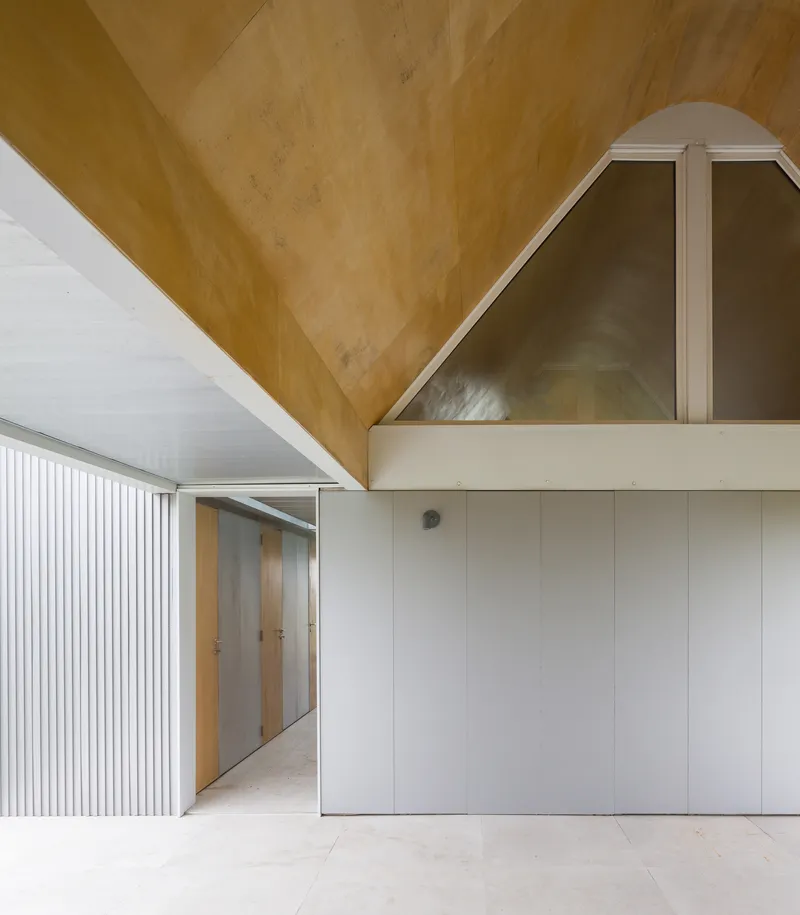
The gable ends are where the building reveals its character. A triangular glazed opening sits above the corrugated volume on one end, pulling light into the attic and establishing a visual marker on the otherwise uniform elevation. On the interior side, the pointed window frames the open farmland in a near-symmetrical composition, with the plywood ceiling converging overhead.
The interior hallway at the intersection of modules exposes the pitched ceiling meeting white storage volumes. These storage walls act as spatial dividers, tucking services and closets into the boundaries between modules. It is efficient planning that avoids corridors: every surface either stores something or defines a room.
Plans and Drawings
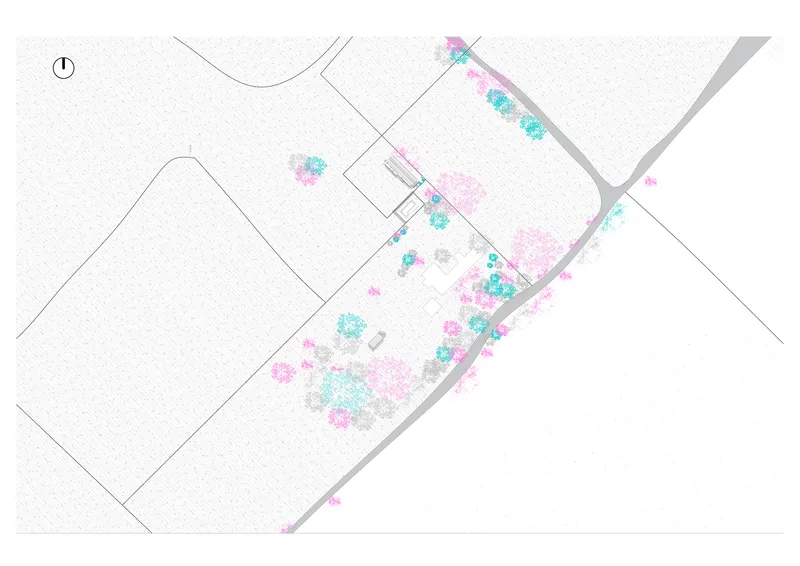
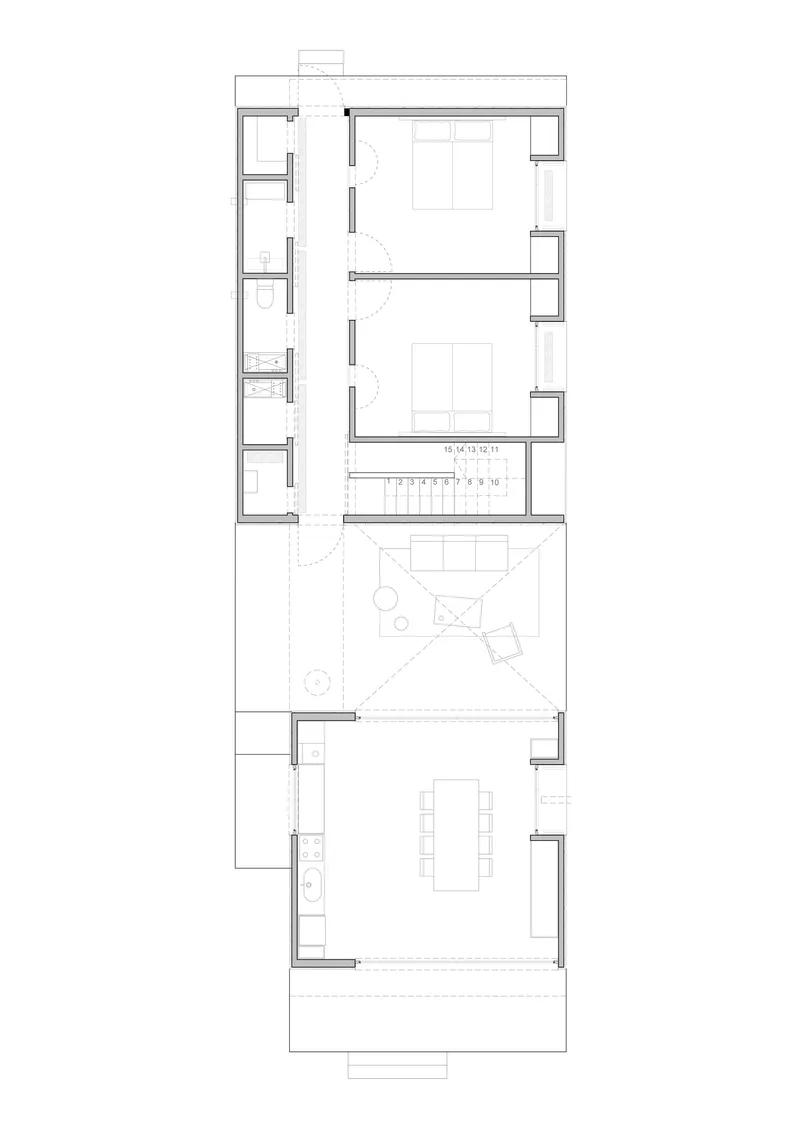
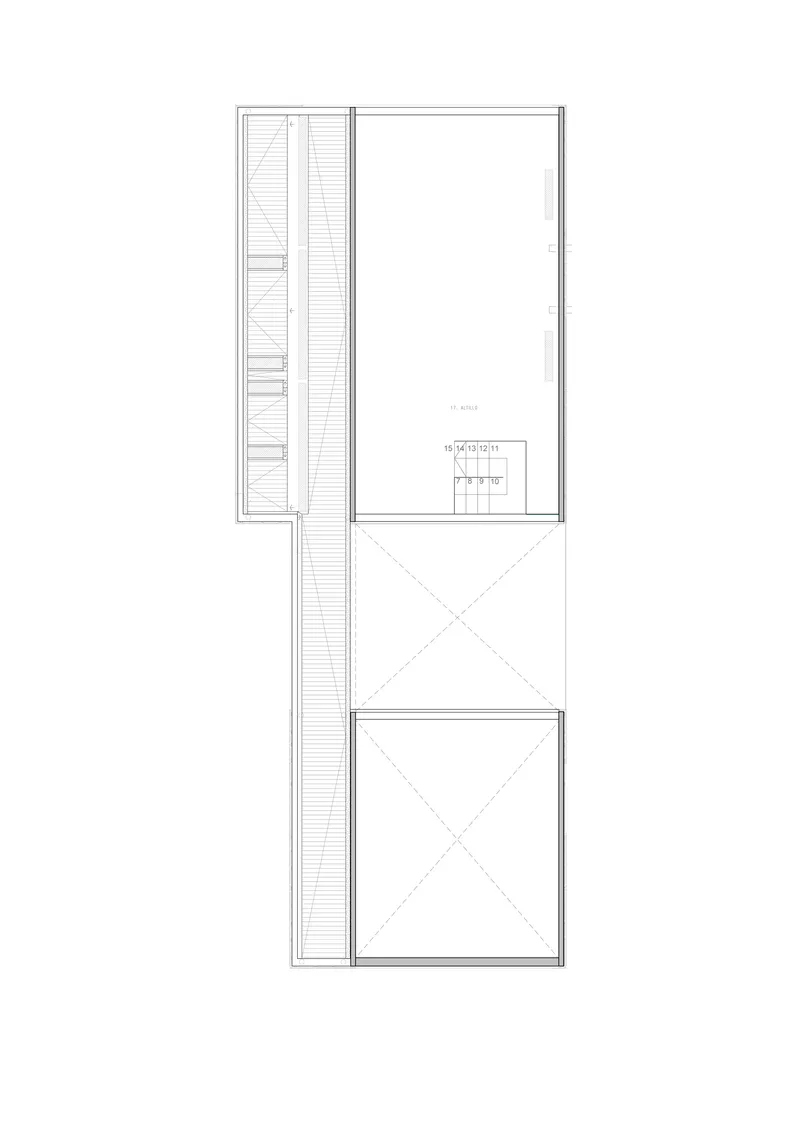
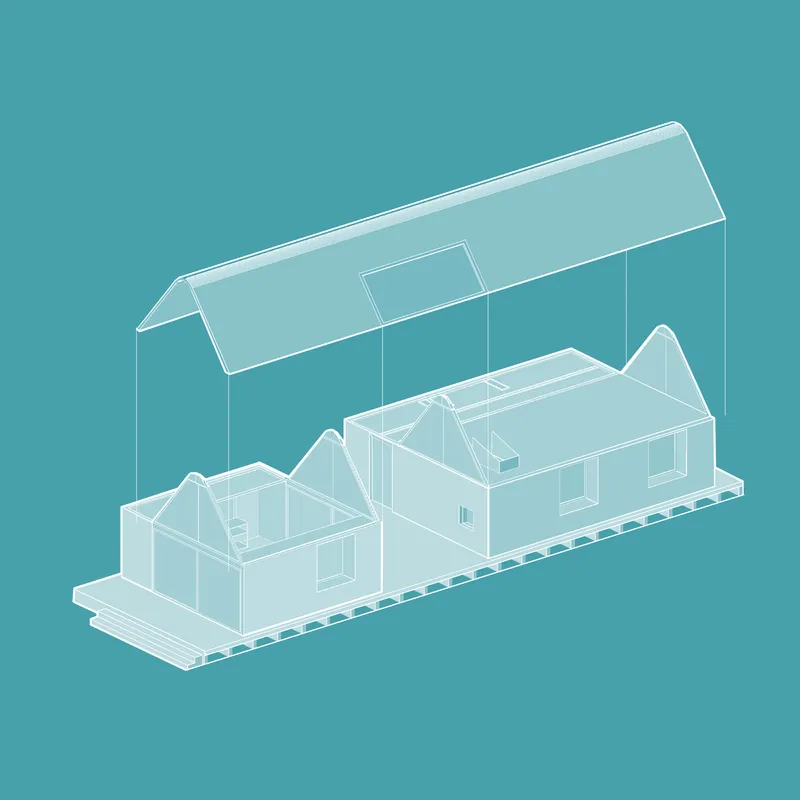
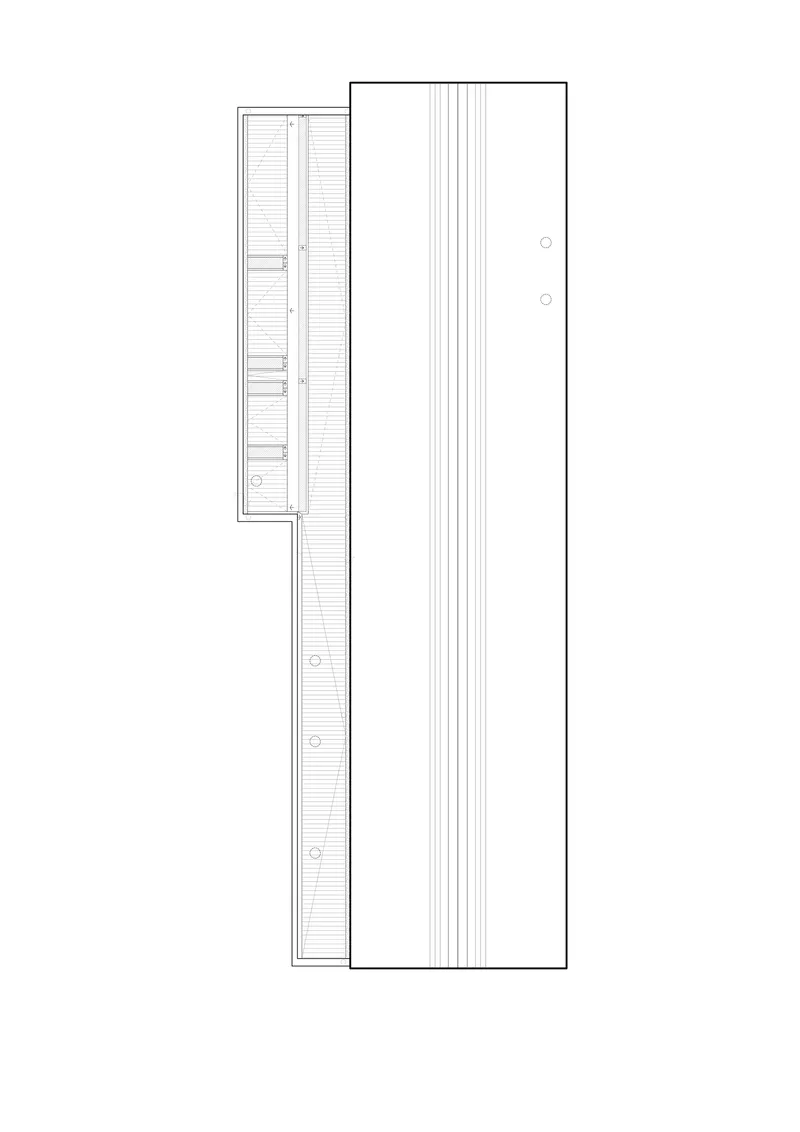
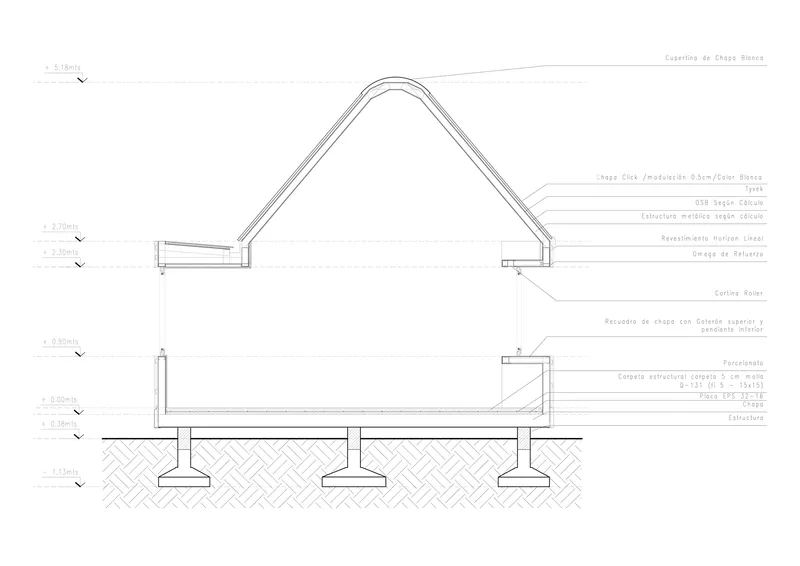
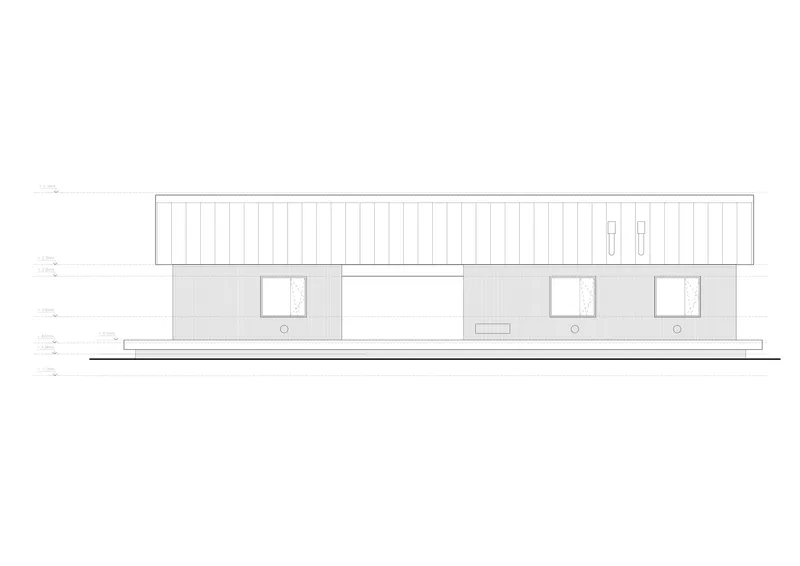
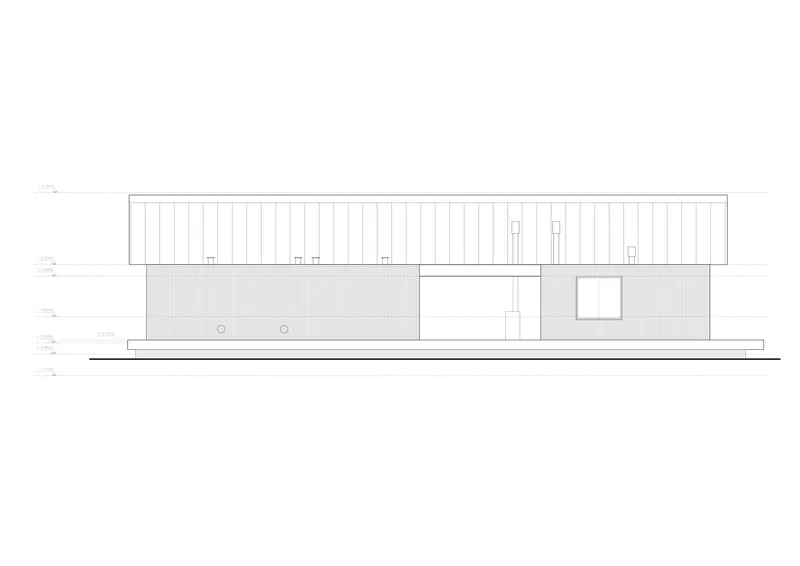
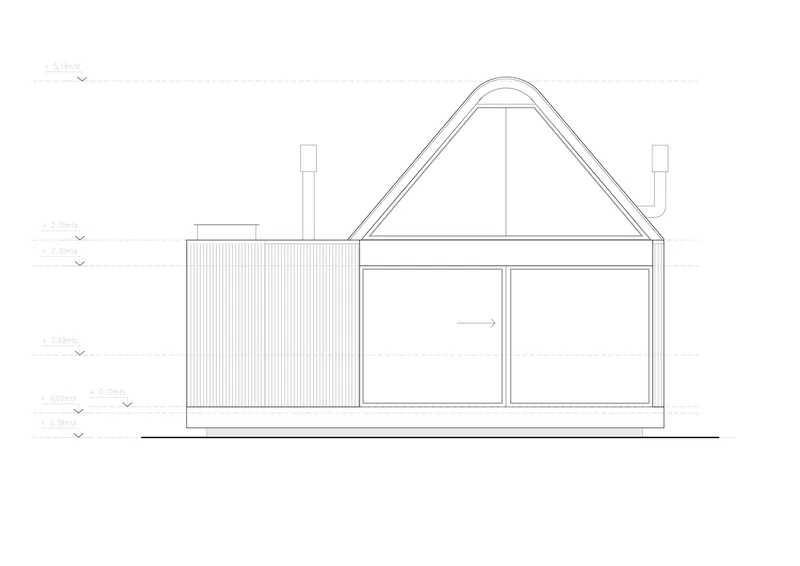
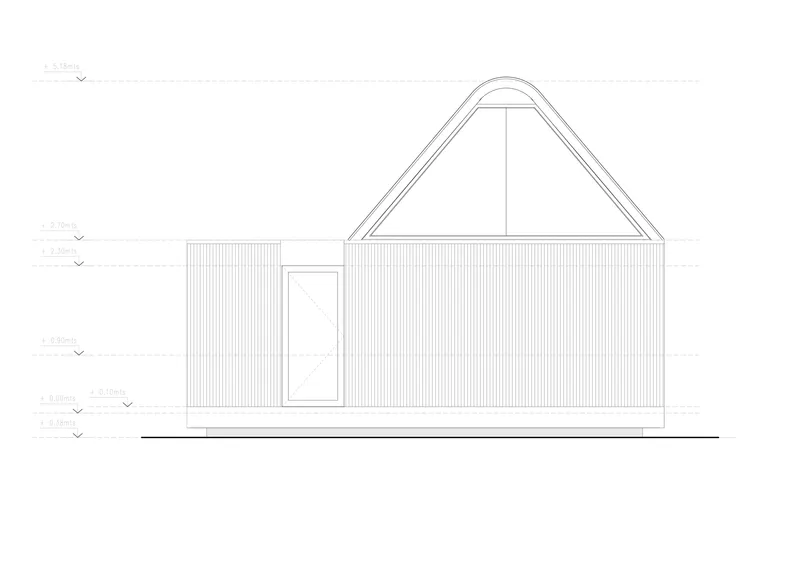
The axonometric drawing makes the organizational logic immediately clear: two gabled volumes are connected by a shared terrace under a continuous protective roof. The floor plans reveal the strip-shaped layout, with the staircase positioned at the junction between the social and private modules. The sections show the arched double-layer roof structure, the cavity between layers where the wool insulation sits, and the relationship between the concrete foundation and the lightweight steel frame above.
The site plan positions the house along a diagonal roadway on the farm, respecting pre-existing structures and orienting the long axis to maximize northeast exposure. The elevations confirm the restrained vocabulary: vertical corrugated cladding, square window openings punched at regular intervals, and a single entrance on the long façade. What is notable in the drawings is how much the sections communicate about the environmental strategy. The layered roof, the raised platform, and the asymmetric glazing are all visible in a single cut.
Why This Project Matters
La Escocesa House takes a regional waste stream and turns it into the core of a passive building strategy. The sheep wool insulation is not a romantic gesture toward craft or tradition; it is a practical intervention in a supply chain that currently burns thousands of tons of usable material every year. The fact that the building performs off-grid with minimal mechanical conditioning validates the approach. If this project serves as a case study, as the architects intend, it could shift how rural construction across the Pampas handles thermal performance.
Beyond the wool, the modular logic and the material discipline are worth attention. DUB Arquitectura made a guest house that can expand, contract, and adapt to different levels of use without architectural surgery. Every material was chosen for longevity and zero maintenance, which is the only responsible approach for a remote rural site. In an era when sustainable architecture often means expensive technology and proprietary systems, La Escocesa argues for something simpler: use what is already there, build only what you need, and design so that nothing has to be replaced.
La Escocesa House by DUB Arquitectura (Angie Dub, Belén Butler), Veinticinco de Mayo, Buenos Aires Province, Argentina. 150 square meters. Completed in 2022. Photography by Fernando Schapochnik.
About the Studio
Share Your Own Work on uni.xyz
If projects like this are the kind of work you want to make, uni.xyz is a place to publish your own, find collaborators, and enter design competitions.



Popular Articles
Popular articles from the community


The Musturak Paradise: Senior Living Architecture for a Connected Future in Temara, Morocco
The Musturak Paradise reimagines senior living architecture in Temara via private homes, social spaces, culture, community, and shared care.

The Ocean Hive: Sustainable Architecture for a Self-Sufficient Civilization at Sea
The Ocean Hive imagines sustainable architecture at sea, where modular habitats, algae, wave power and ocean waste sustain a growing colony.

Play: Fragments of Their World
Familiar architecture becomes modular playground design, creating safe spaces where displaced children can learn, connect, imagine and play.

Riyadh For All: Intergenerational Urban Design for Active Aging in Rabat
Riyadh For All reimagines urban design in Rabat with intergenerational co-living, adaptive courtyards, and Moroccan cultural exchange today.


Similar Reads
You might also enjoy these articles

Bao Huynh Watercolor Atelier: A Serene Art Retreat in Hội An
Bao Huynh Watercolor Atelier in Hội An blends multifunctional art spaces, sustainable design, local materials, and family-friendly living in a serene environment.

Atelier Macri Concept Store Interior Design by CASE-REAL
Atelier Macri store features a "ko" counter, walnut wood details, cork displays, blending retail, gallery, and seamless customer experiences.

Manuel Vargas Izquierdo Stadium and High-Performance Sports Center: Architectural Excellence in Jalpa de Méndez
The Manuel Vargas Izquierdo Stadium blends sustainable design, inclusive sports facilities, and cultural-inspired architecture, revitalizing Jalpa de Méndez’s public spaces.

KAKR Buluh Awar Hall: Revitalizing Community and Ecology Through Bamboo Architecture
Community built bamboo hall revitalizes Buluh Awar village, empowering youth, restoring ecology, celebrating vernacular craftsmanship through sustainable architecture and culture.


Explore Residential Building Competitions
Discover active competitions in this discipline


Challenge to design mud housing for contemporary communities


Challenge to reimagine the Iron Throne


Photograph architecture without architects


Illustrate the lost glory of Angkor Wat - Render Challenge
Comments (0)
Please login or sign up to add comments
No comments yet. Be the first to comment!