
Dub Studios Designs a Santa Monica Retirement Home Around a Dining Table for 32
A couple's move from New York to Los Angeles becomes a house built for togetherness, crafted in concrete, stucco, and wood.


Most retirement homes are designed around retreat: fewer rooms, quieter spaces, a gentle narrowing of the world. The Bearing House in Santa Monica, completed in 2023 by Dub Studios, works in the opposite direction. When a couple in their late seventies moved from New York to Los Angeles, their central demand was not privacy or serenity but a dining table that seats 32 people. The house was literally organized around that table, and around the premise that gathering the entire family under one roof is the highest function a home can serve.
What makes the project worth studying goes beyond its program. Dub Studios found a way to translate the architectural language of upstate New York, specifically the barn-on-masonry-base typology, into something native to the Southern California coast. Cast-in-place concrete forms a solid bearing base (the name is not accidental), topped by volumes finished in hand-applied stucco chosen for its fireproof and marine-climate properties. The material palette is limited, the craft is visible, and the spatial logic is direct. The result won an AIA California 2025 Residential Design Award, and it earned the recognition.
A Barn Reimagined for the Pacific Coast
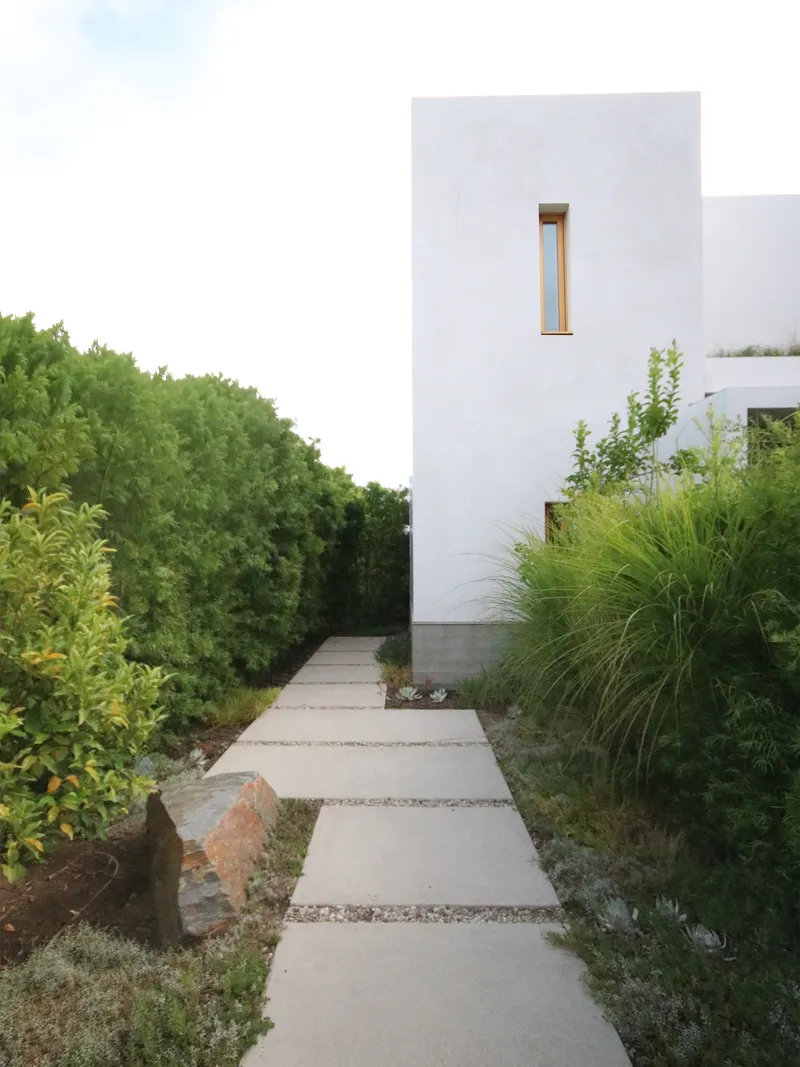
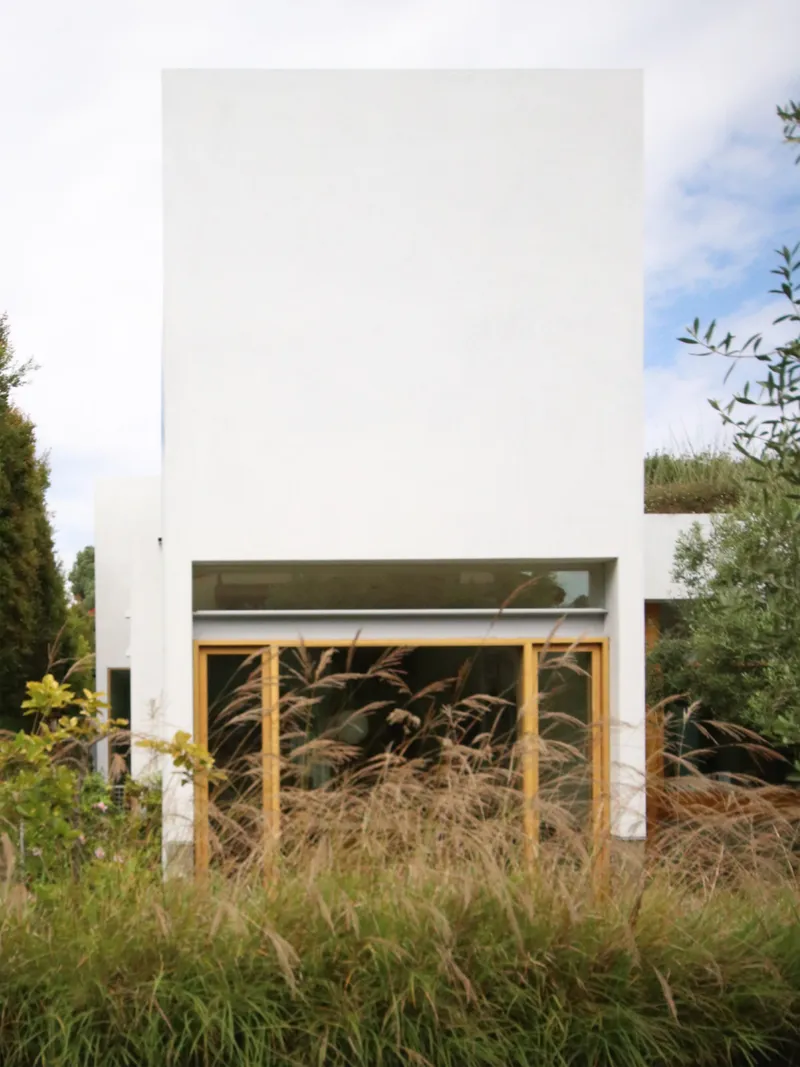
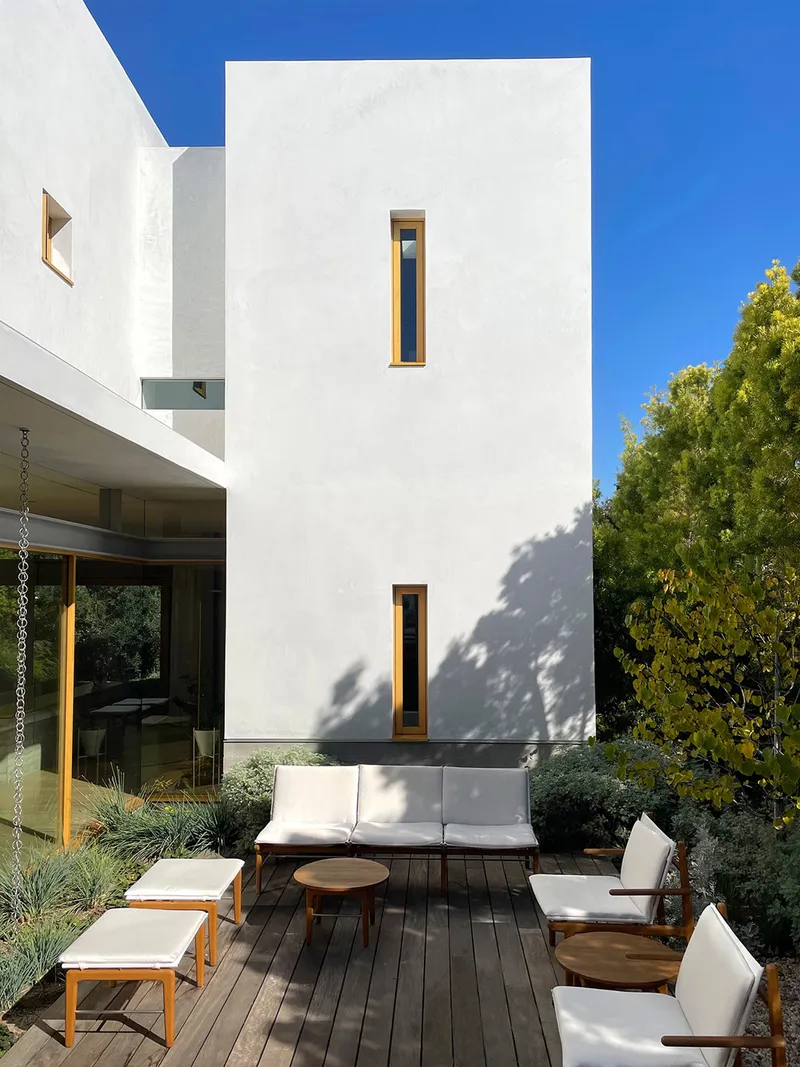
The clients came from the Northeast, and the architecture carries that heritage without replicating it. The white stucco volumes, with their slim flat roof profiles and vertical slot windows, read as abstracted agricultural forms set down on a narrow Santa Monica lot. Tall grasses and planted borders soften the edges, making the building recede behind its landscape rather than announcing itself from the street. The tower-like volume visible on approach sets the vertical counterpoint to what is otherwise a long, low, horizontal plan.
Hand-applied stucco is a traditional technique that Dub Studios chose as much for performance as for texture. In a city that contends with wildfire risk and salt-laden ocean air, the material serves double duty. It also ages gracefully, and the slightly irregular surface it produces gives the facade a warmth that machine-finished panels cannot replicate.
Concrete as Foundation and Furniture
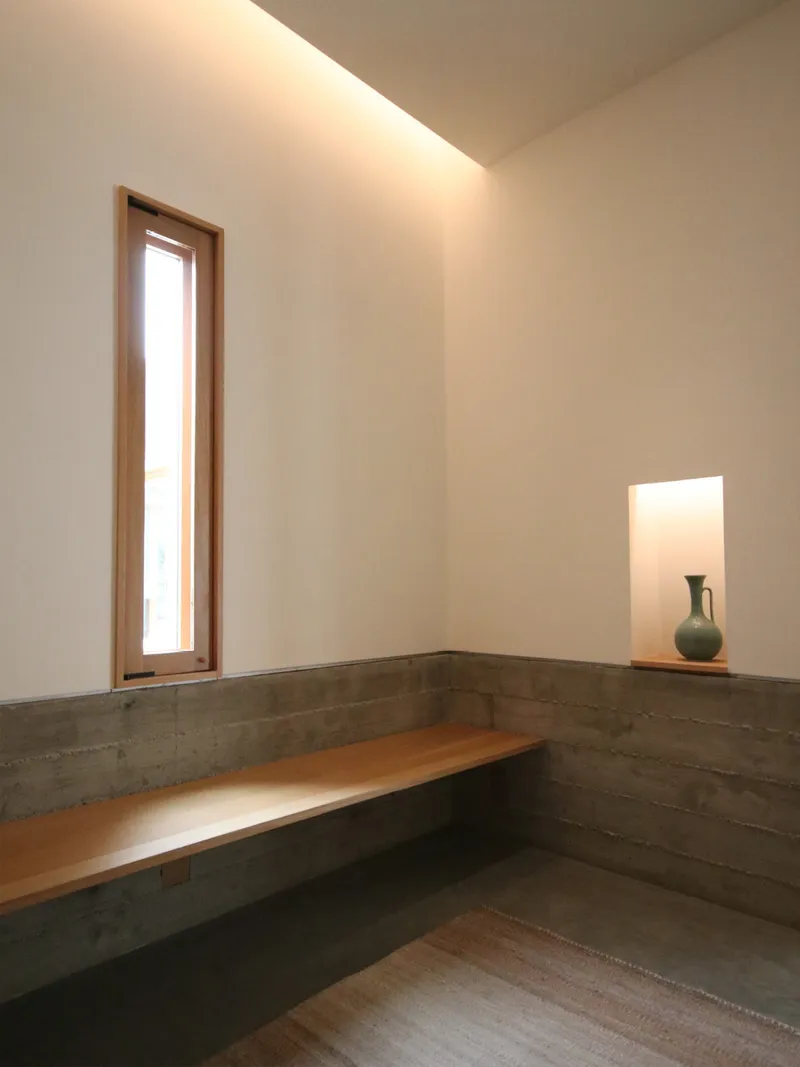
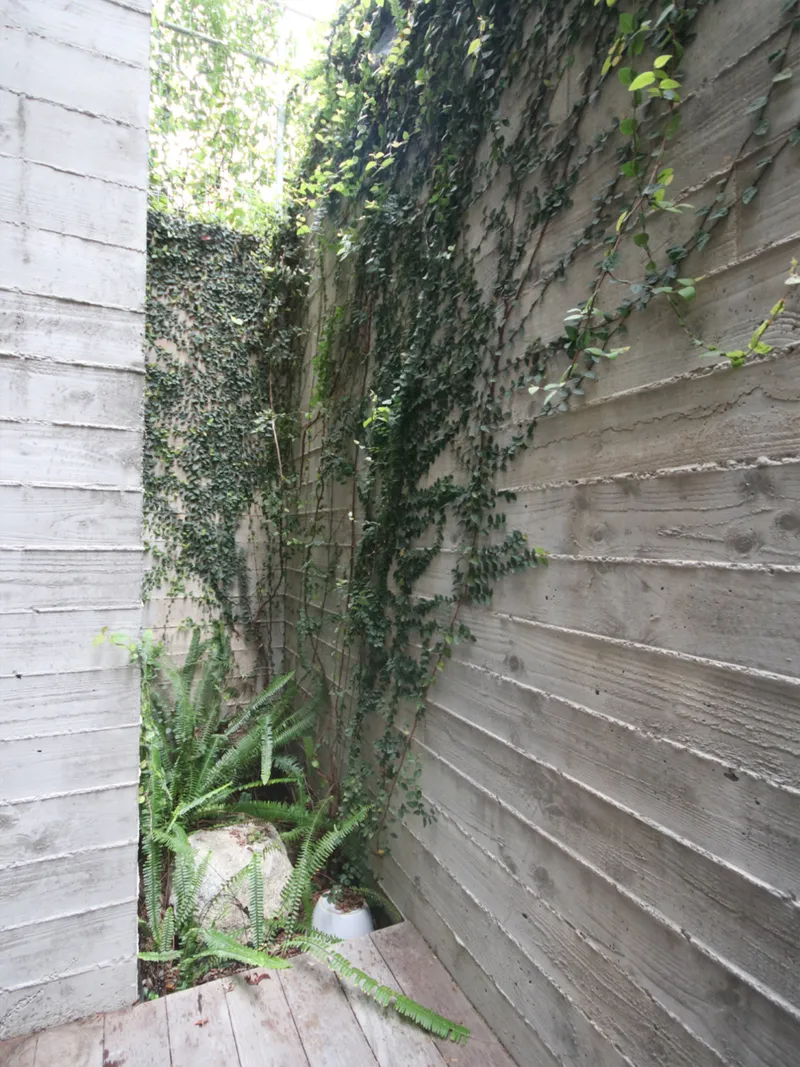
Board-formed concrete appears everywhere the house meets the ground. Exterior passages are carved between concrete walls where climbing ivy and ferns have already begun to colonize the surface. Inside, the same material serves as built-in seating, wall planes, and thresholds. A seating nook with a board-formed bench and a narrow timber window shows how the architects treated concrete not just as structure but as domestic furniture, something you sit on, lean against, and live with.
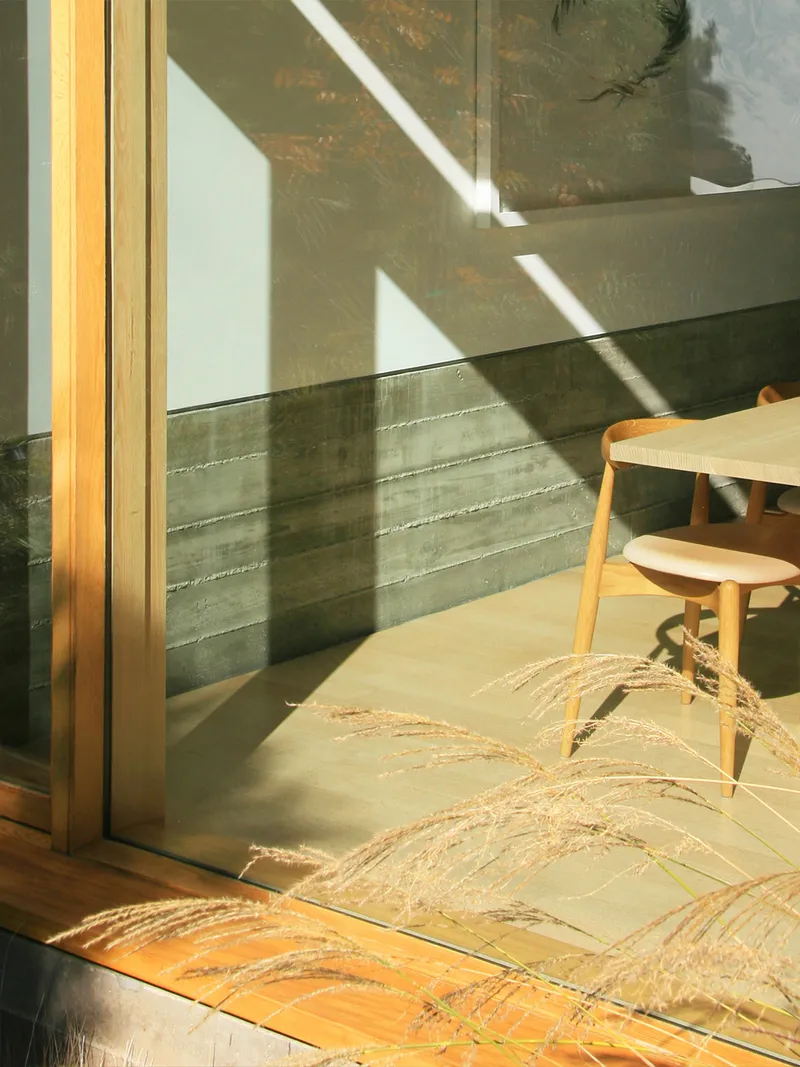
The grain of the formwork is left readable throughout, which gives the concrete a directional quality. It runs horizontally on walls and vertically where it marks transitions, subtly guiding movement through the house. Diagonal shadows cast through timber-framed glass doors animate these surfaces throughout the day, making the material responsive to light in a way that painted drywall never could be.
The Table That Organized the Plan
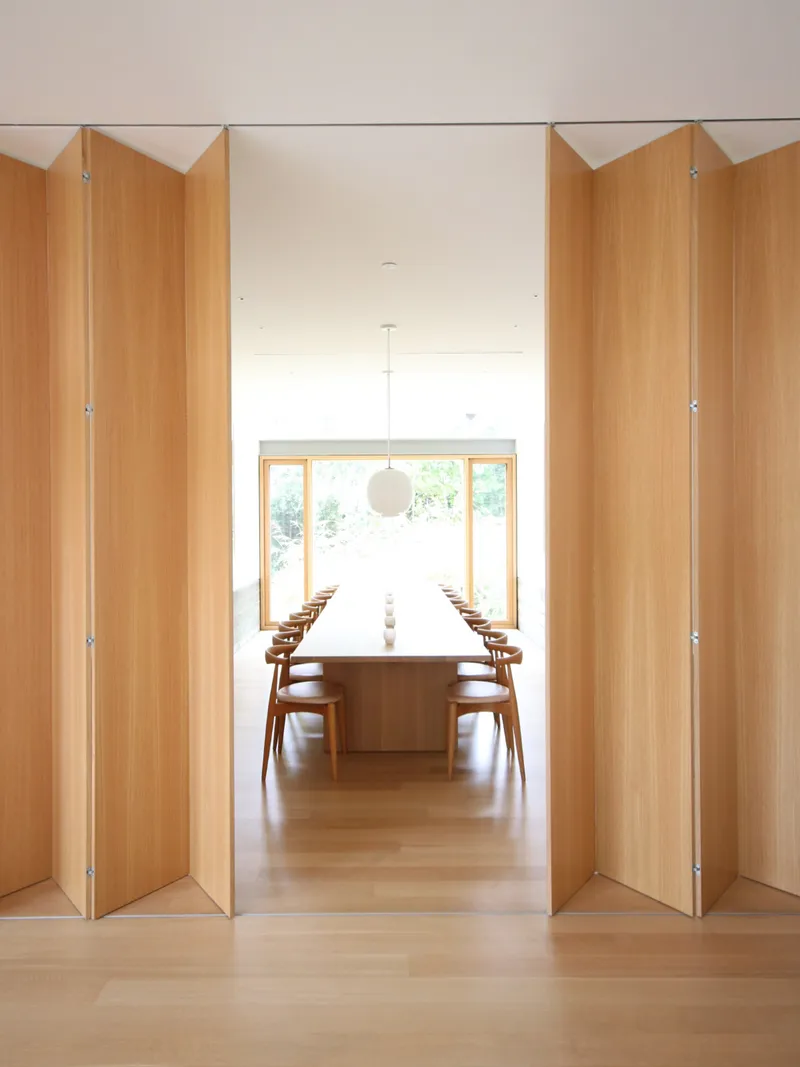
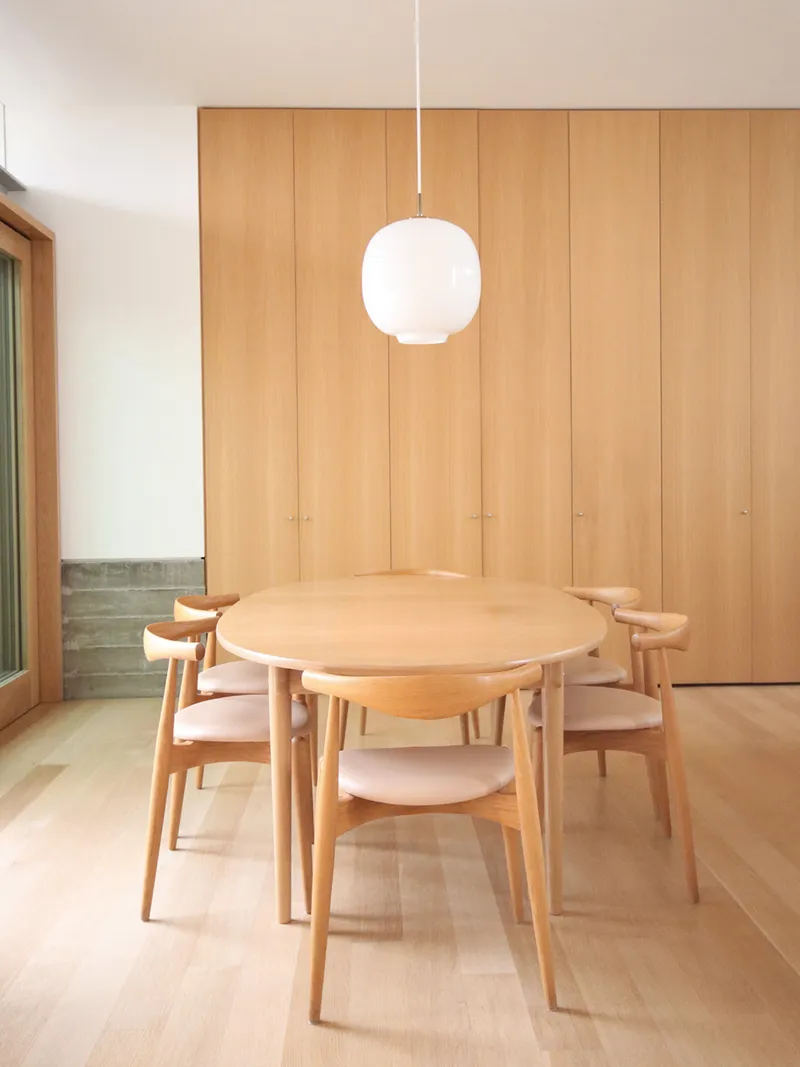
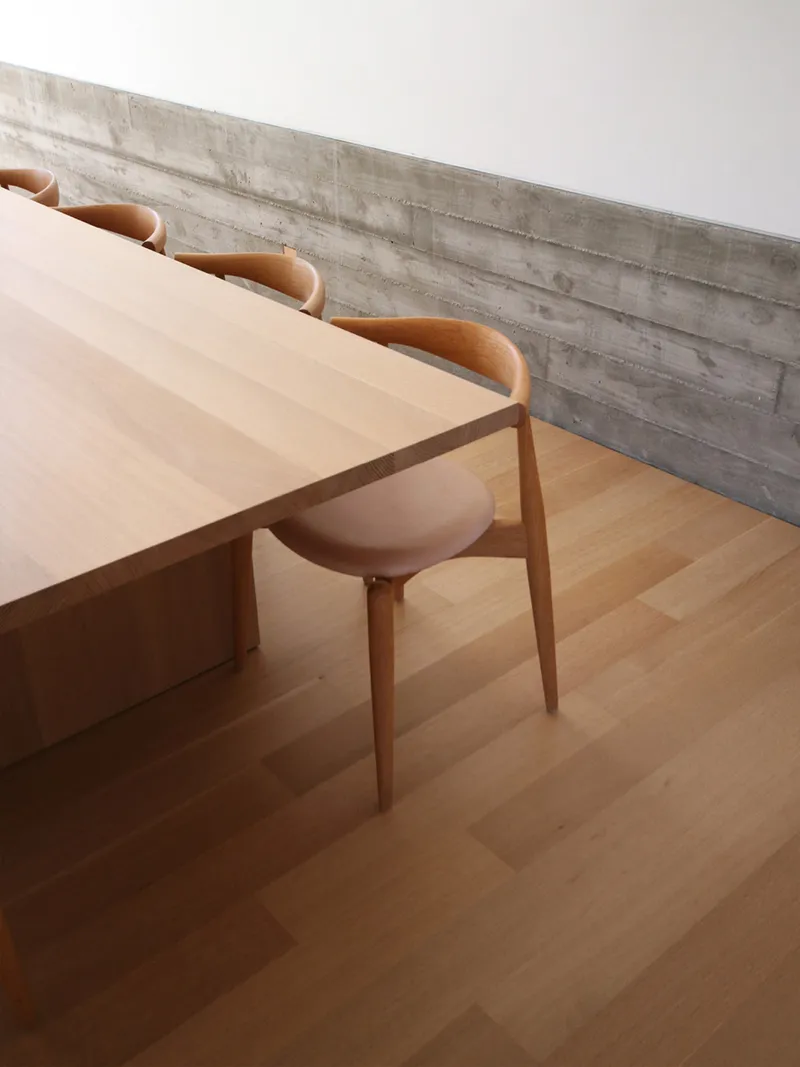
The dining room is the center of gravity here. It seats 32, it overlooks the south-west garden, and it was the first programmatic element locked in during the design process. Everything else, the kitchen, living room, small study, and three upstairs bedrooms, arranges itself around this one social act. The long table seen through the open angled timber doors is not a set piece; it is the reason the building exists.
Dub Studios handled the scale of this room with restraint. Floor-to-ceiling wood paneling wraps the walls, and pendant lighting hangs low enough to create intimacy even in a space sized for a crowd. A second, smaller dining arrangement against a board-formed concrete wall offers a more private alternative for everyday meals. The wood species appear consistent throughout, and the tone is warm without veering into rusticity.
Wood, Light, and the Long Section
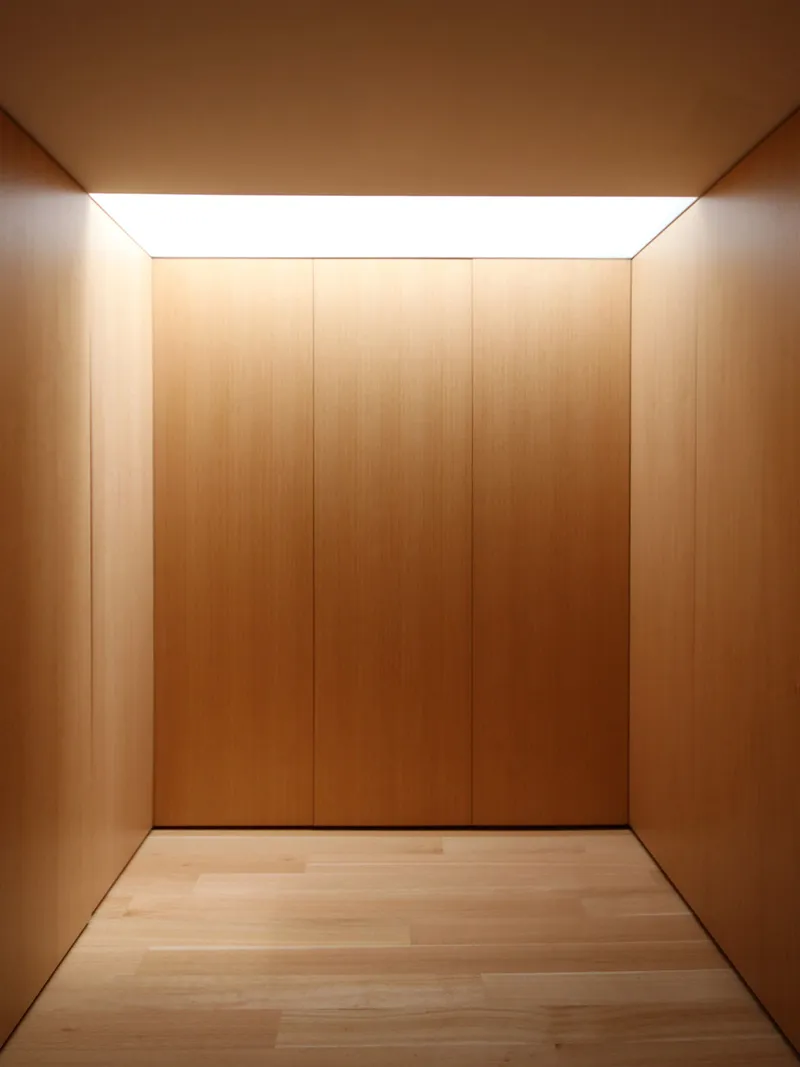
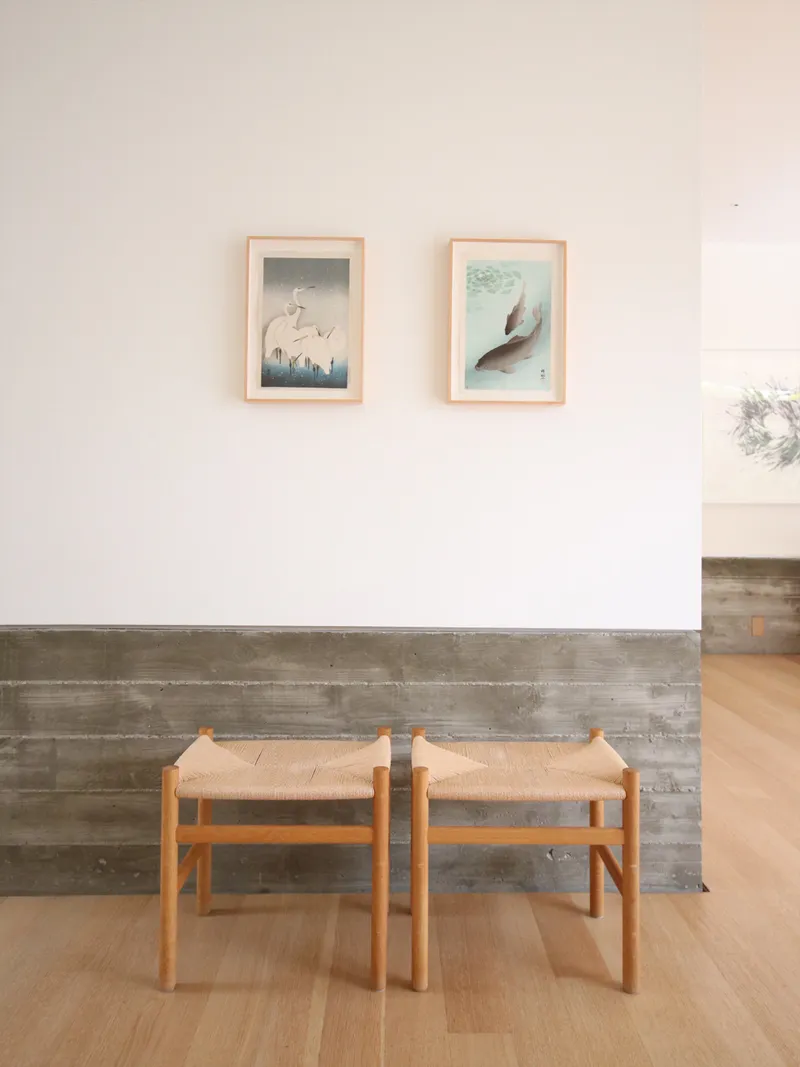
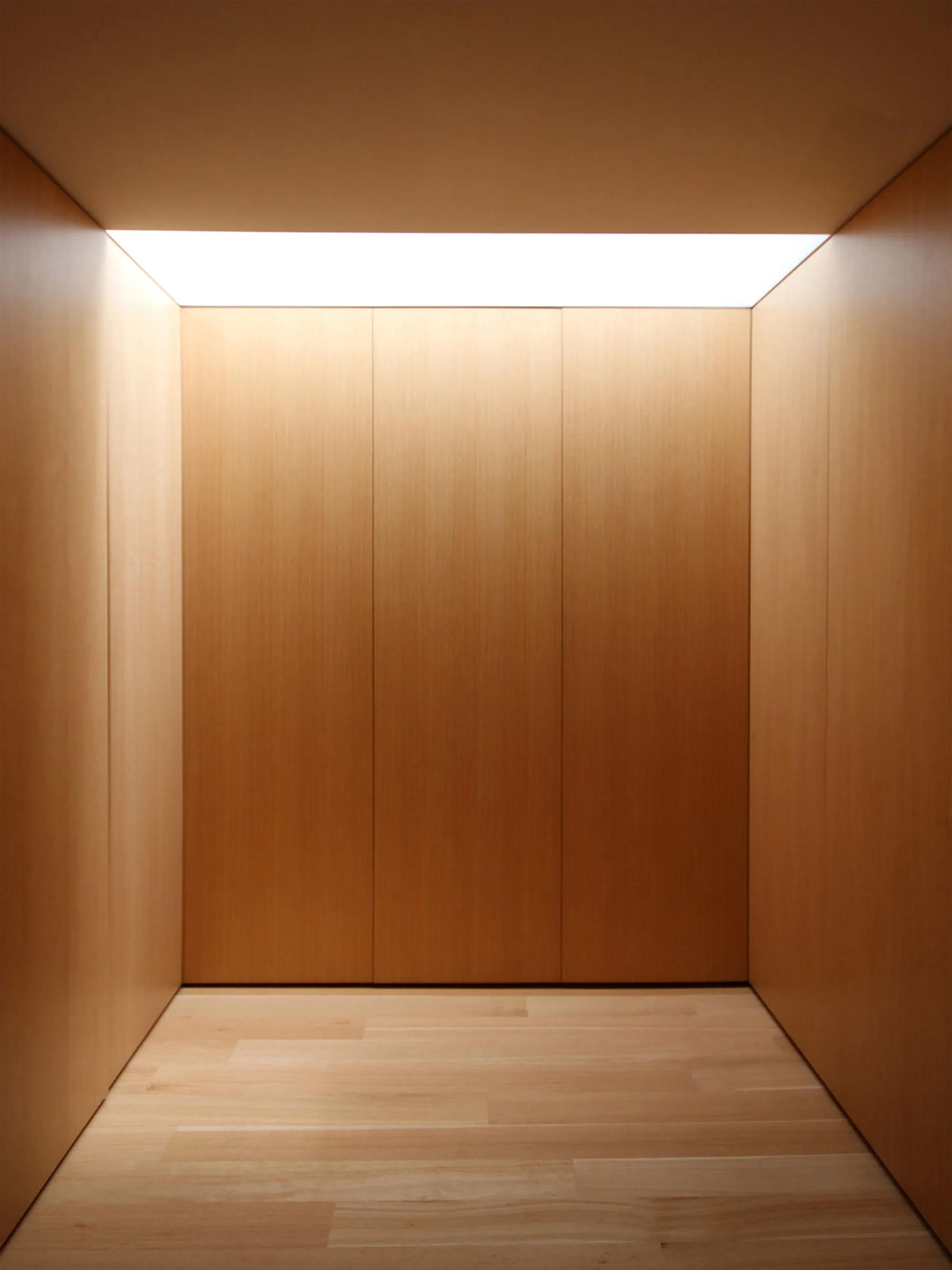
The house sits on a narrow, long plot, and the architects leaned into that constraint rather than fighting it. A timber-lined corridor runs the length of the plan beneath a continuous skylight, functioning as the spine of the entire ground floor. This is one of the strongest moves in the project. The corridor is not merely circulation; it is a room in itself, washed in daylight from above, connecting every space without the need for dark hallways or awkward transitions.
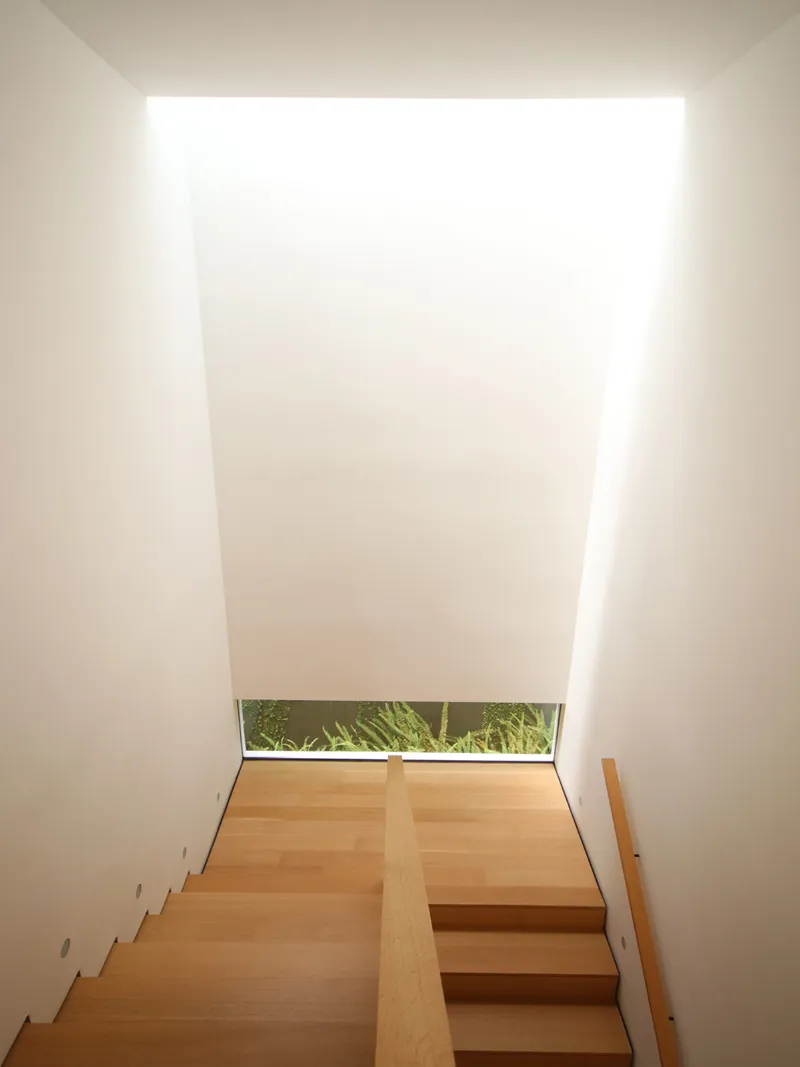
A top-down view of the staircase reveals how the skylight continues vertically, pulling light down through the section while offering garden glimpses through adjacent windows. Reclaimed wood wainscoting and locally sourced timber finishes keep the palette tight. The details are calm: timber stools, framed artworks, ceramic vessels placed with the quiet confidence of people who have spent decades knowing exactly what they want in a home.
Garden on Three Sides
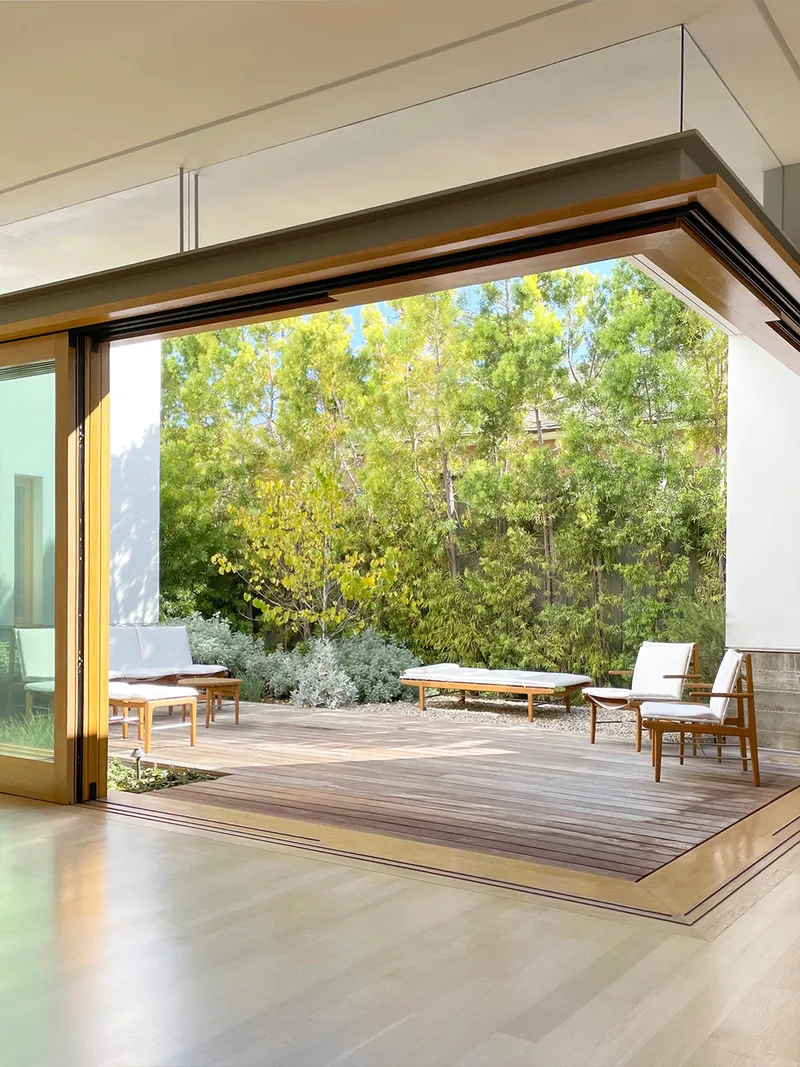
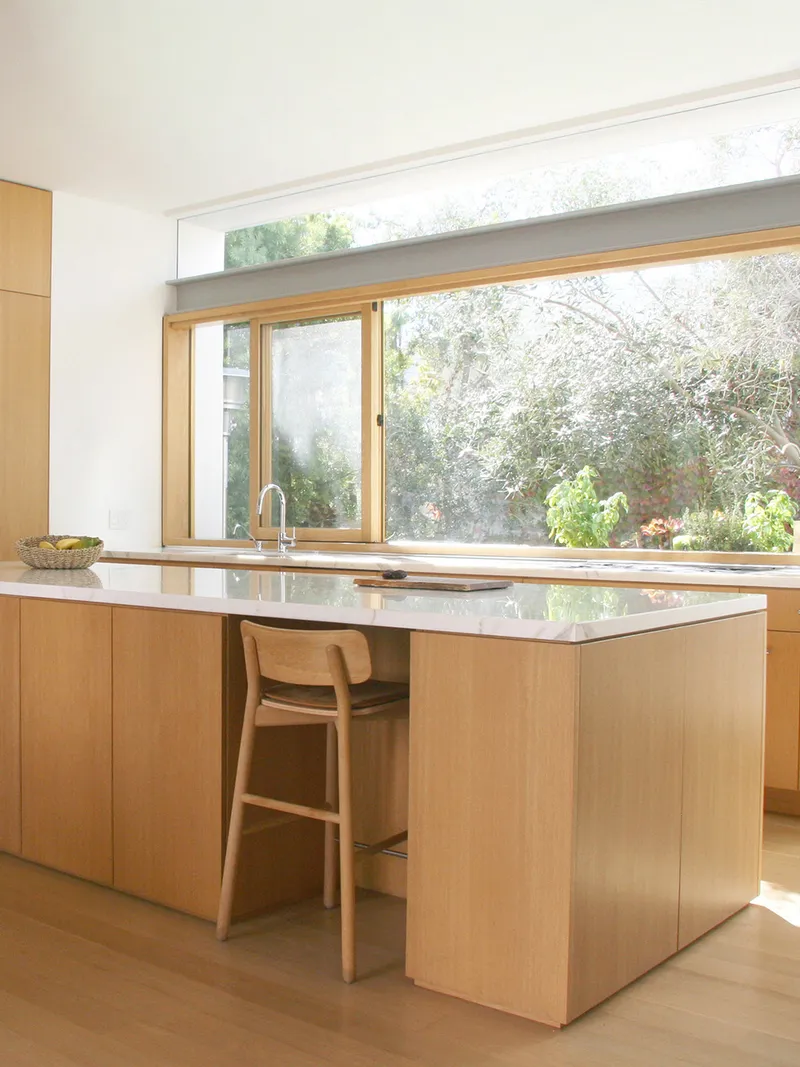
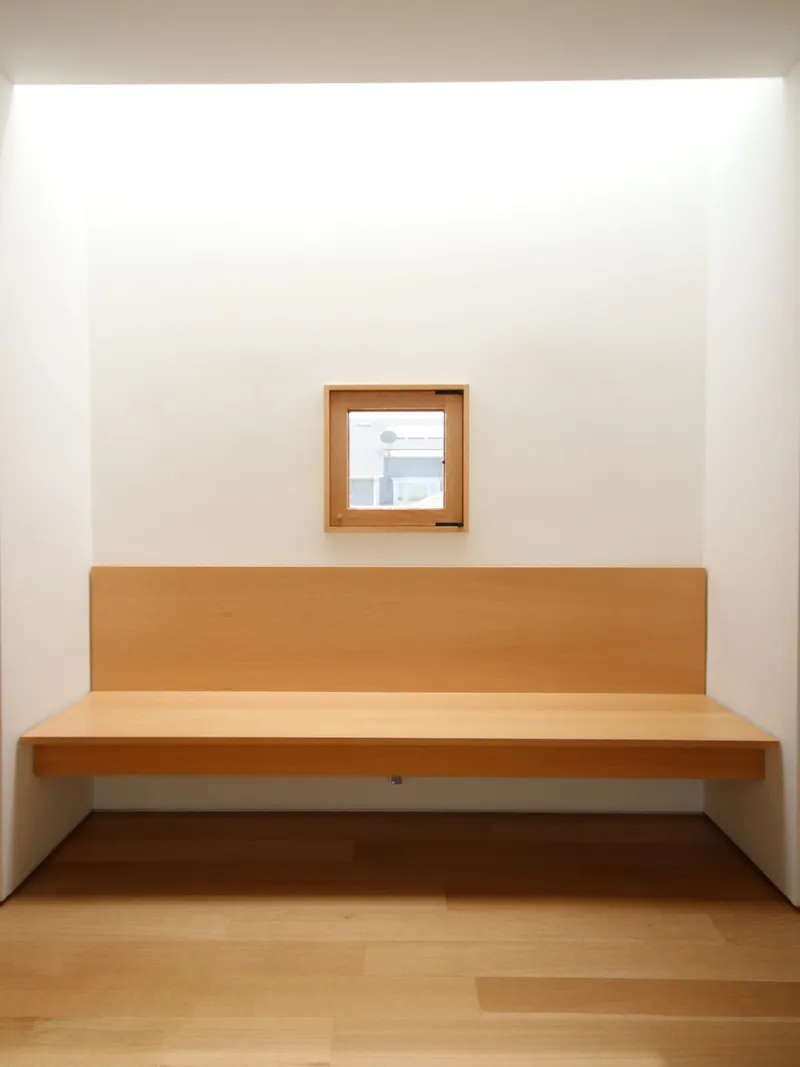
Sunken patios and gardens wrap three sides of the house, and the boundary between interior and exterior is intentionally porous. Wide sliding doors open from the living spaces directly onto timber deck terraces, and the kitchen island is positioned to face timber-framed windows that look straight into planted beds. A built-in timber bench tucked into a white alcove beneath a framed window captures what the house does best: it creates places to sit, look out, and be still.
A green roof terrace adds a planted layer above, while an integrated gutter system with rain chains handles drainage from the slim flat roof. These are not afterthoughts. They are the kind of decisions that make a house perform well for decades, which matters more than usual when the clients are building what they intend to be their final home. The landscape strategy is practical and generous in equal measure.
Why This Project Matters
The Bearing House makes a case for architecture that serves a specific, even eccentric, brief without turning eccentric itself. Organizing a house around a 32-seat dining table could have produced something overwrought, but Dub Studios kept the spatial logic legible and the material expression understated. The translation of New York barn vernacular into a California coastal idiom is handled with enough rigor that it reads as design intelligence rather than nostalgia.
More broadly, the project challenges the assumption that homes for aging clients should shrink. Here, the square footage and the ambition expand precisely because the clients understood what they wanted from the next chapter: not less life, but more people around the table. The concrete base, the hand-applied stucco, the locally sourced wood, these are materials chosen to outlast trends and to age alongside the people who live with them. That kind of alignment between client, architect, and material is rare, and it is the reason the house holds together as convincingly as it does.
Bearing House by Dub Studios, Santa Monica, United States. Completed 2023. Photography by Dub Studios.
About the Studio
Share Your Own Work on uni.xyz
If projects like this are the kind of work you want to make, uni.xyz is a place to publish your own, find collaborators, and enter design competitions.




Popular Articles
Popular articles from the community


The Musturak Paradise: Senior Living Architecture for a Connected Future in Temara, Morocco
The Musturak Paradise reimagines senior living architecture in Temara via private homes, social spaces, culture, community, and shared care.

Hill & Cross Opera: Sculptural Opera House Architecture Shaped by Tallinn’s Landscape and Identity
Hill & Cross Opera reimagines opera house architecture in Tallinn through its sculptural hill, civic plaza, glass wave and a luminous cross.

The Earth Pod: 3D Printed Homes for Resilient Refugee Communities
The Earth Pod reimagines refugee housing through 3D printed homes made from clay, combining resilience, self-sufficiency, and rapid shelter.

Lunar Spiral: Space Architecture Shaped by the Mathematics of the Universe
Lunar Spiral reimagines space architecture through Fibonacci geometry, lunar regolith, levitating habitats, and self-sustaining Moon living.


Similar Reads
You might also enjoy these articles

Bao Huynh Watercolor Atelier: A Serene Art Retreat in Hội An
Bao Huynh Watercolor Atelier in Hội An blends multifunctional art spaces, sustainable design, local materials, and family-friendly living in a serene environment.

Atelier Macri Concept Store Interior Design by CASE-REAL
Atelier Macri store features a "ko" counter, walnut wood details, cork displays, blending retail, gallery, and seamless customer experiences.

Manuel Vargas Izquierdo Stadium and High-Performance Sports Center: Architectural Excellence in Jalpa de Méndez
The Manuel Vargas Izquierdo Stadium blends sustainable design, inclusive sports facilities, and cultural-inspired architecture, revitalizing Jalpa de Méndez’s public spaces.

KAKR Buluh Awar Hall: Revitalizing Community and Ecology Through Bamboo Architecture
Community built bamboo hall revitalizes Buluh Awar village, empowering youth, restoring ecology, celebrating vernacular craftsmanship through sustainable architecture and culture.


Explore Power Generation Competitions
Discover active competitions in this discipline


Challenge to design mud housing for contemporary communities


Challenge to reimagine the Iron Throne


Photograph architecture without architects


Illustrate the lost glory of Angkor Wat - Render Challenge
Comments (0)
Please login or sign up to add comments
No comments yet. Be the first to comment!