
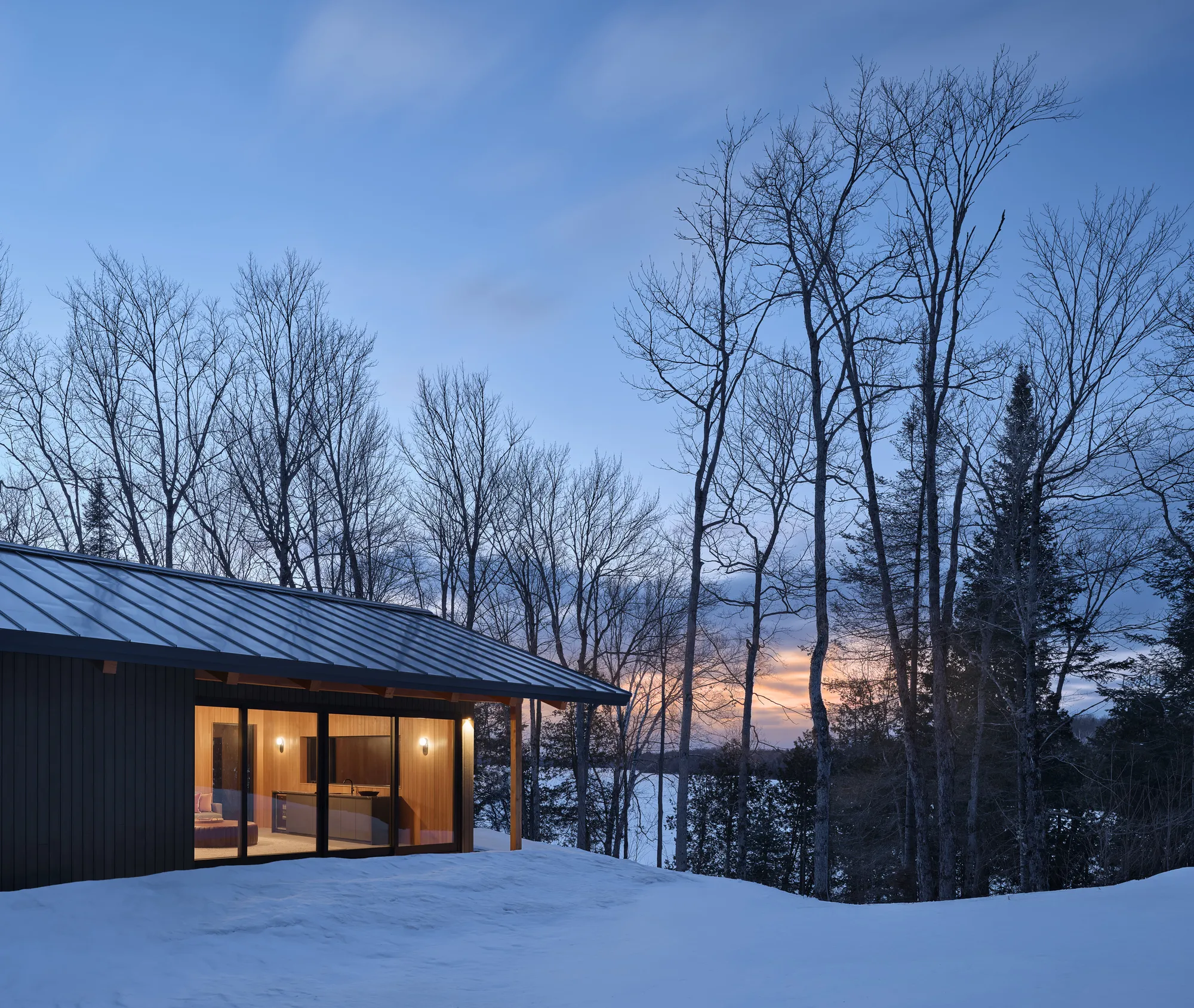
Dubbeldam Architecture + Design Places an Off-Grid Clubhouse at the Edge of an Ontario Solar Clearing
A 151-square-metre hybrid of garage, guest suite, and recreation pavilion powered entirely by a neighbouring photovoltaic array in rural Canada.


Solar arrays need clearings. Clearings, it turns out, make excellent sport courts. And sport courts need a place to stash racquets, shelter players, and pour drinks. That chain of practical reasoning is the origin story of Cardwell Clubhouse, a 151 m² building by Dubbeldam Architecture + Design that sits at the edge of a photovoltaic field serving a larger off-grid cottage compound in rural Ontario. Rather than treating the solar infrastructure as an awkward neighbor, architect Heather Dubbeldam turned the adjacency into a program: the clearing doubles as a multi-sport court for tennis, basketball, pickleball, bocce, and horseshoes, while the clubhouse anchors one edge with a garage, a flexible guest suite, and a vaulted gathering room.
What makes the project genuinely interesting is its refusal to be precious. The building borrows the elongated, gabled profile of Ontario's agricultural outbuildings and distills that vernacular into a single emphatic move: structure, shelter, craft, nothing more. Every watt comes from the solar array and on-site battery storage. Every piece of wood is FSC-certified, locally milled hemlock and cedar. The triple-glazed windows and high-performance insulation keep the interior comfortable through Ontario winters with only radiant in-floor heating. It is a building that takes its off-grid status seriously without performing austerity.
A Barn Archetype, Sharpened
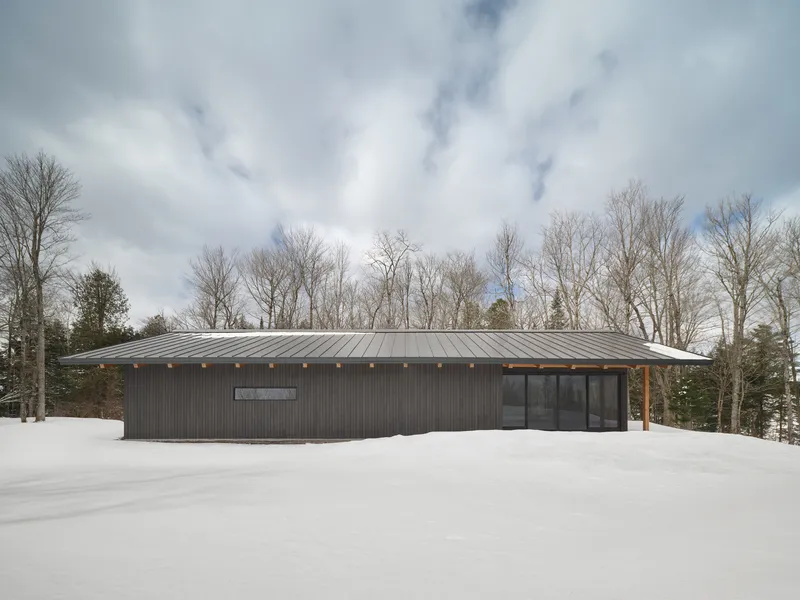


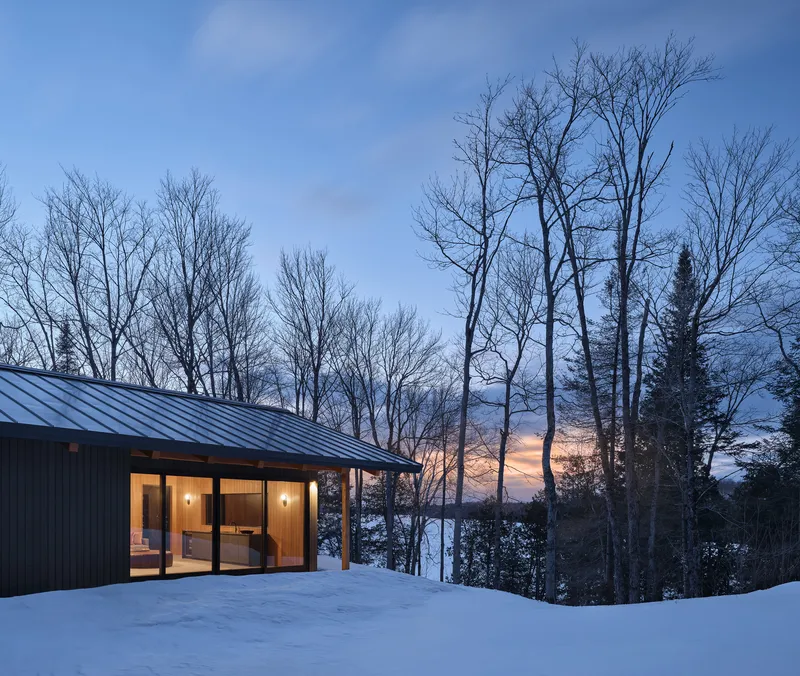
The silhouette is immediately legible: a low, gabled volume with deep overhangs on all four sides, clad in dark-stained vertical wood siding under a standing-seam metal roof. The proportions are long, narrow, and grounded, sitting close to the earth rather than rising above it. Seen through bare winter trees, the building reads as something that could have been on this site for decades. The dark cladding absorbs into the forest edge while the metal roof catches light and snow in equal measure.
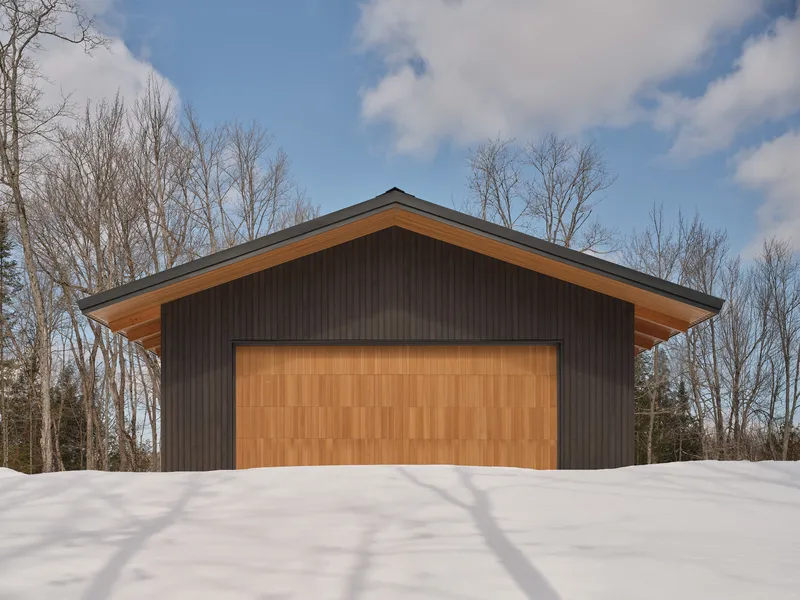
Dubbeldam references Ontario's agricultural and lodge vernaculars without quoting them literally. The timber garage door, the generous eaves, the rhythmic exposure of structural beams at the soffit line all point back to utilitarian building traditions. But the crisp detailing and restrained material palette keep the composition firmly contemporary. It is a barn that went to architecture school and came back knowing exactly what to leave out.
Deep Overhangs and the Threshold Between Inside and Out

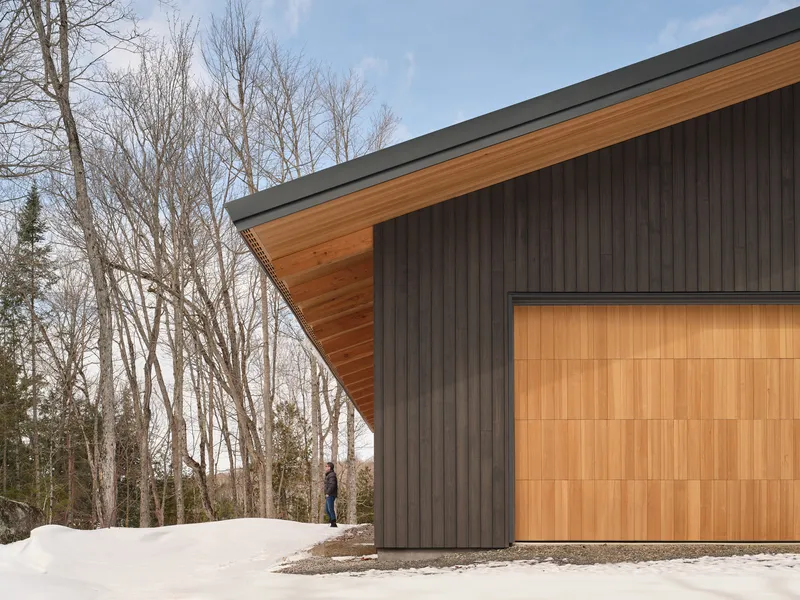

The deep overhangs do real work here. They shelter the perimeter, creating covered passageways and protected entries that blur the boundary between indoors and out. At dusk, the passageway under the extended eave becomes a threshold space, lit from within and open to the cold air, where the building's structural honesty is most visible. Exposed timber brackets cantilever outward, their rhythm marking the soffit like the ribs of a long canoe turned upside down.
The corner detail where the timber soffit meets the dark vertical siding and the wood-paneled garage door is the kind of junction that separates careful architecture from competent construction. The materials shift cleanly, each asserting its own logic: metal above, timber at the edge, stained wood on the face. No trim pieces mediate. The joints speak for themselves.
A Vaulted Room That Does Everything
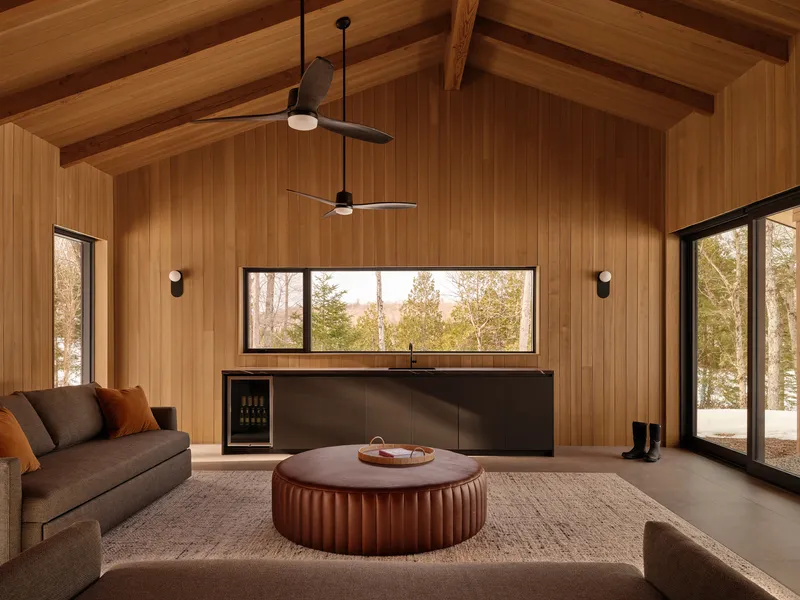
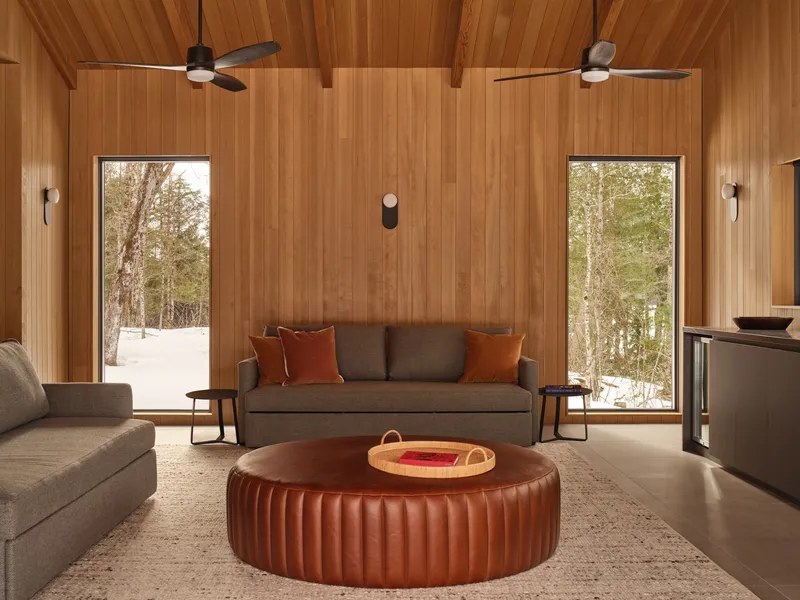
Inside, the main volume is a single vaulted room lined in locally milled hemlock and cedar. Vertical wall boards accentuate the upward sweep of the ceiling, drawing the eye to the exposed timber rafters overhead. Twin ceiling fans hang from the ridge, and tall windows on multiple sides flood the space with diffuse forest light. The grey tile floor, durable enough for muddy boots and sports gear, grounds the warm timber palette with something cooler and harder underfoot.
The room's flexibility is the real achievement. It works as a clubhouse for post-game gatherings, a guest suite when the main cottage overflows, and a retreat in its own right. The horizontal window bands frame the surrounding forest at precisely seated eye level, turning the landscape into a series of panoramic screens. Radiant in-floor heating keeps the space comfortable without visible mechanical systems intruding on the clean interior geometry.
The Guest Suite as Forest Lookout

The bedroom end of the building is defined by two glazed doors that frame winter forest views with the symmetry of a diptych. Vertical wood paneling wraps the walls and ceiling continuously, making the room feel like the interior of a finely finished timber box. There is a restraint here that trusts the landscape to do the decorating.
At dusk, the glass-walled end of the pavilion becomes a lantern in the trees, its overhanging eave hovering above a view of bare branches and frozen lake. The triple-glazed windows earn their cost in moments like these, holding a thin pane of warmth against the Ontario cold while eliminating the visual barrier that a smaller, more cautious window would impose.
Solar Clearing as Recreation Landscape
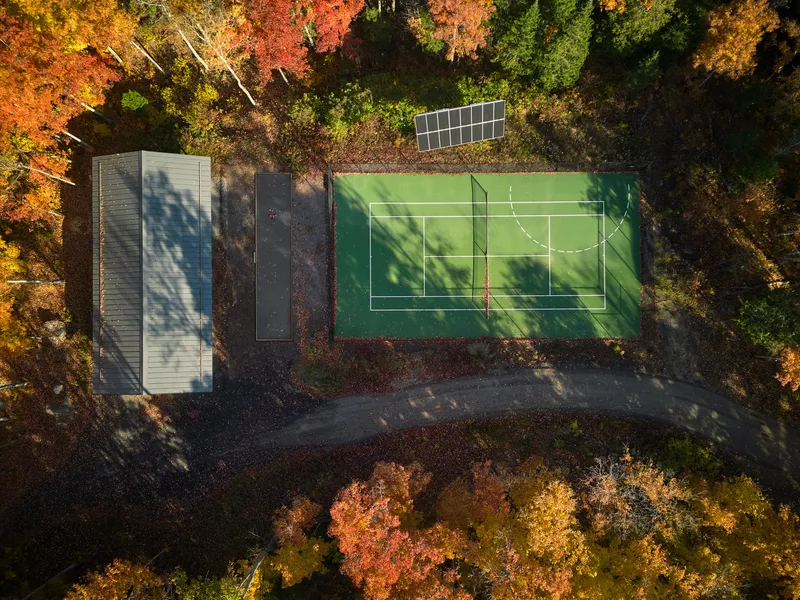

The aerial view reveals the full logic of the site strategy. The green sport court occupies the clearing that the photovoltaic array required, surrounded by a canopy of autumn foliage that makes the open ground feel like a room within the forest. The clubhouse sits at the court's edge, oriented to watch the action. It is a smart piece of landscape planning: infrastructure that would otherwise be purely utilitarian becomes the catalyst for a recreational program.
In winter, the courts and their surrounding clearings accommodate cross-country skiing and snowshoeing, with the garage providing storage for all the necessary equipment. The building's relationship to the ground, low, anchored, sheltered on all sides, means it functions as a base camp year-round. The deep overhangs keep snow off the entries, and the compact plan minimizes the energy required to heat a space that may sit unoccupied between visits.
Plans and Drawings
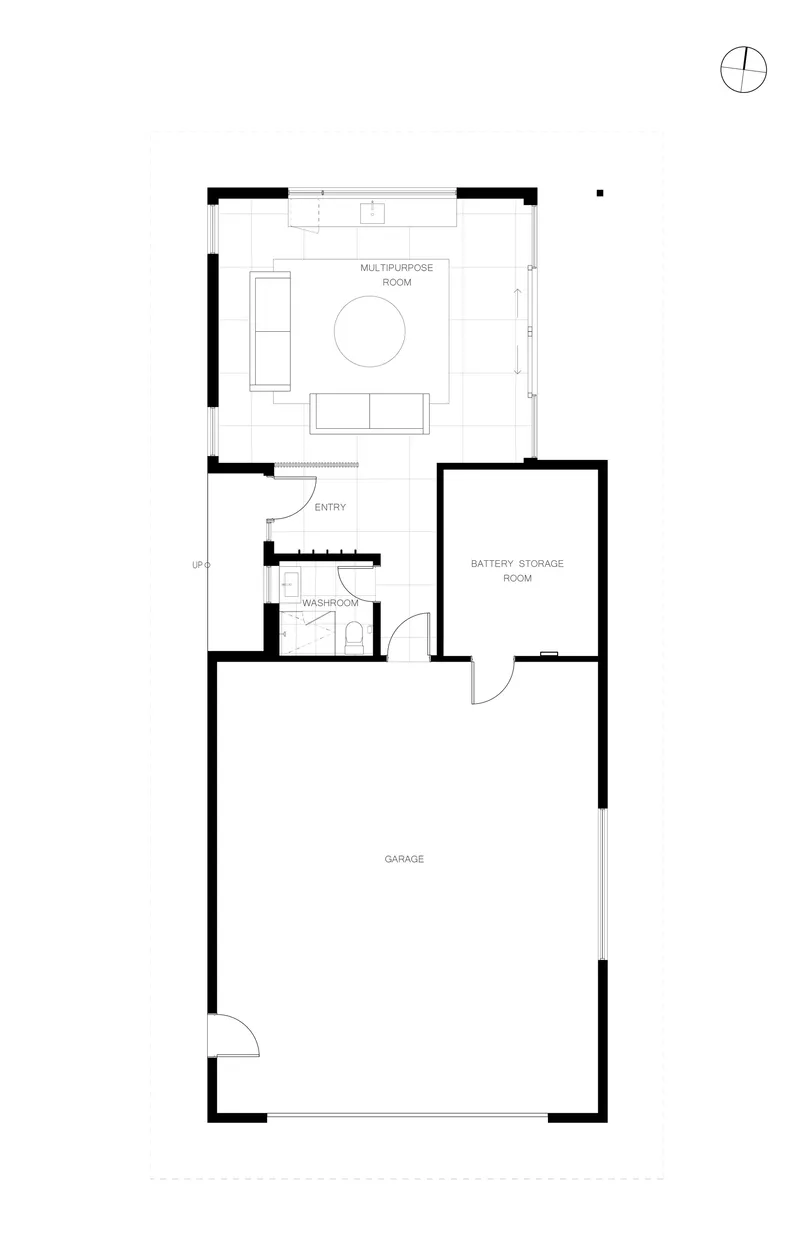
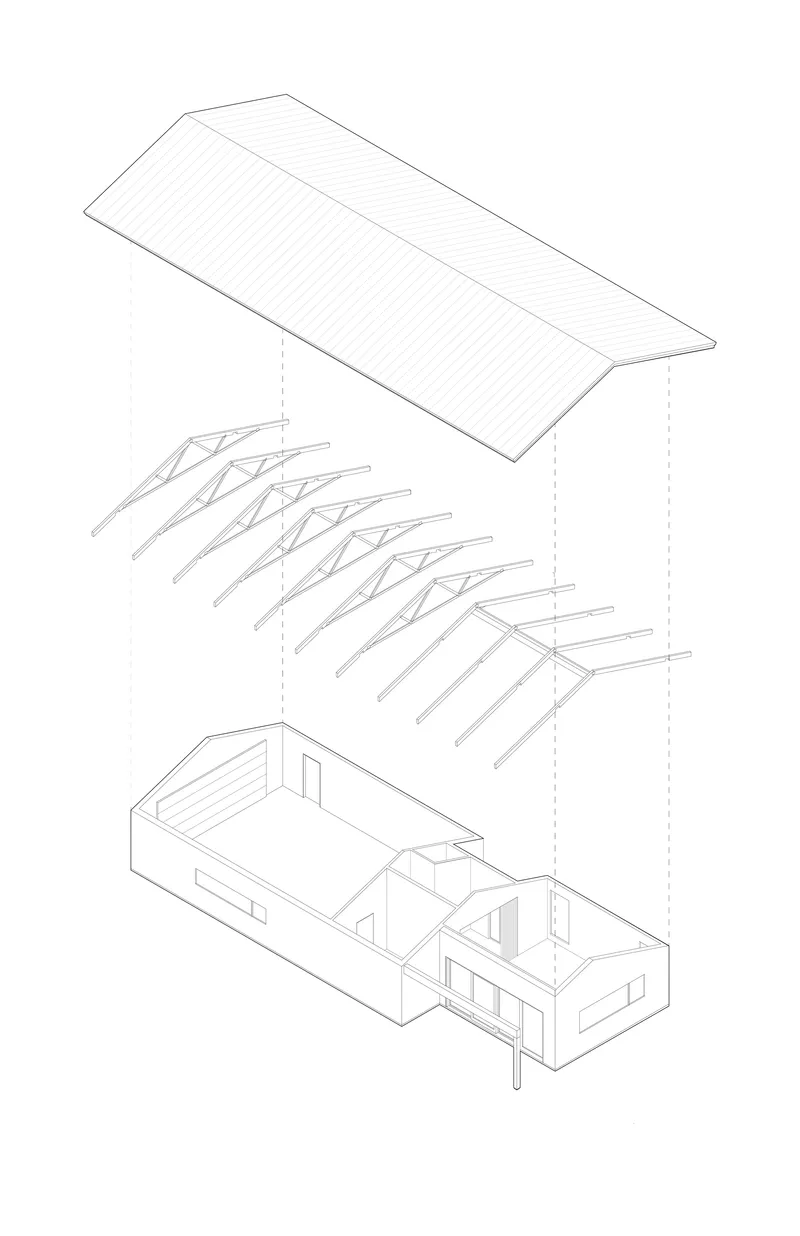
The floor plan confirms the building's straightforward organization: a multipurpose room occupies the larger volume, with an entry, bathroom, and battery storage room forming a service spine that separates the living space from the garage. The battery room is a telling inclusion, a reminder that off-grid living requires real square footage for the systems that make it possible. The exploded axonometric drawing peels back the layers clearly: standing-seam metal roof on top, timber truss structure in the middle, and the living volume below. The structural honesty visible in the finished building is not a styling decision. It is the actual building logic, laid bare.
Why This Project Matters
Cardwell Clubhouse is a small building that thinks clearly about big questions. How do you build responsibly in a forest? How do you turn the infrastructure of off-grid living into something more than a compromise? Dubbeldam's answer is to collapse the boundary between necessity and delight: the solar clearing becomes a court, the equipment shed becomes a guest suite, the timber structure becomes the ornament. At 151 square metres, there is no room for anything that does not earn its place.
The project also demonstrates that off-grid architecture does not have to look like a survivalist manifesto or an Instagram cabin fantasy. It can look like a well-detailed Ontario barn, grounded in local materials and local building knowledge, heated by the sun and insulated against the cold with straightforward high-performance technology. That combination of regional sensitivity and environmental seriousness, delivered without a single gratuitous gesture, is what makes this building worth studying.
Cardwell Clubhouse by Dubbeldam Architecture + Design, led by Heather Dubbeldam. Located in Ontario, Canada. 151 m². Completed in 2025. Photography by Riley Snelling.
About the Studio
Share Your Own Work on uni.xyz
If projects like this are the kind of work you want to make, uni.xyz is a place to publish your own, find collaborators, and enter design competitions.




Popular Articles
Popular articles from the community


Co-Life: Senior Housing Design That Reconnects Older Adults With the City
Co-Life reimagines senior housing design through healing gardens, shared streets, workshops, and a sustainable community across generations.
EW PARK: Sustainable Architecture Reimagines the Future of Urban Parking
EW PARK reimagines city parking as a modular wooden tower combining automation, solar energy, electric mobility, and adaptable urban design.

Hill & Cross Opera: Sculptural Opera House Architecture Shaped by Tallinn’s Landscape and Identity
Hill & Cross Opera reimagines opera house architecture in Tallinn through its sculptural hill, civic plaza, glass wave and a luminous cross.

AL-JANNAH: Sustainable Architecture and Permaculture for Afghan Widows
AL-JANNAH uses sustainable architecture and permaculture to create resilient oasis of housing, learning, work and renewal for Afghan widows.


Similar Reads
You might also enjoy these articles

Bao Huynh Watercolor Atelier: A Serene Art Retreat in Hội An
Bao Huynh Watercolor Atelier in Hội An blends multifunctional art spaces, sustainable design, local materials, and family-friendly living in a serene environment.

Atelier Macri Concept Store Interior Design by CASE-REAL
Atelier Macri store features a "ko" counter, walnut wood details, cork displays, blending retail, gallery, and seamless customer experiences.

Manuel Vargas Izquierdo Stadium and High-Performance Sports Center: Architectural Excellence in Jalpa de Méndez
The Manuel Vargas Izquierdo Stadium blends sustainable design, inclusive sports facilities, and cultural-inspired architecture, revitalizing Jalpa de Méndez’s public spaces.

KAKR Buluh Awar Hall: Revitalizing Community and Ecology Through Bamboo Architecture
Community built bamboo hall revitalizes Buluh Awar village, empowering youth, restoring ecology, celebrating vernacular craftsmanship through sustainable architecture and culture.




Comments (0)
Please login or sign up to add comments
No comments yet. Be the first to comment!