
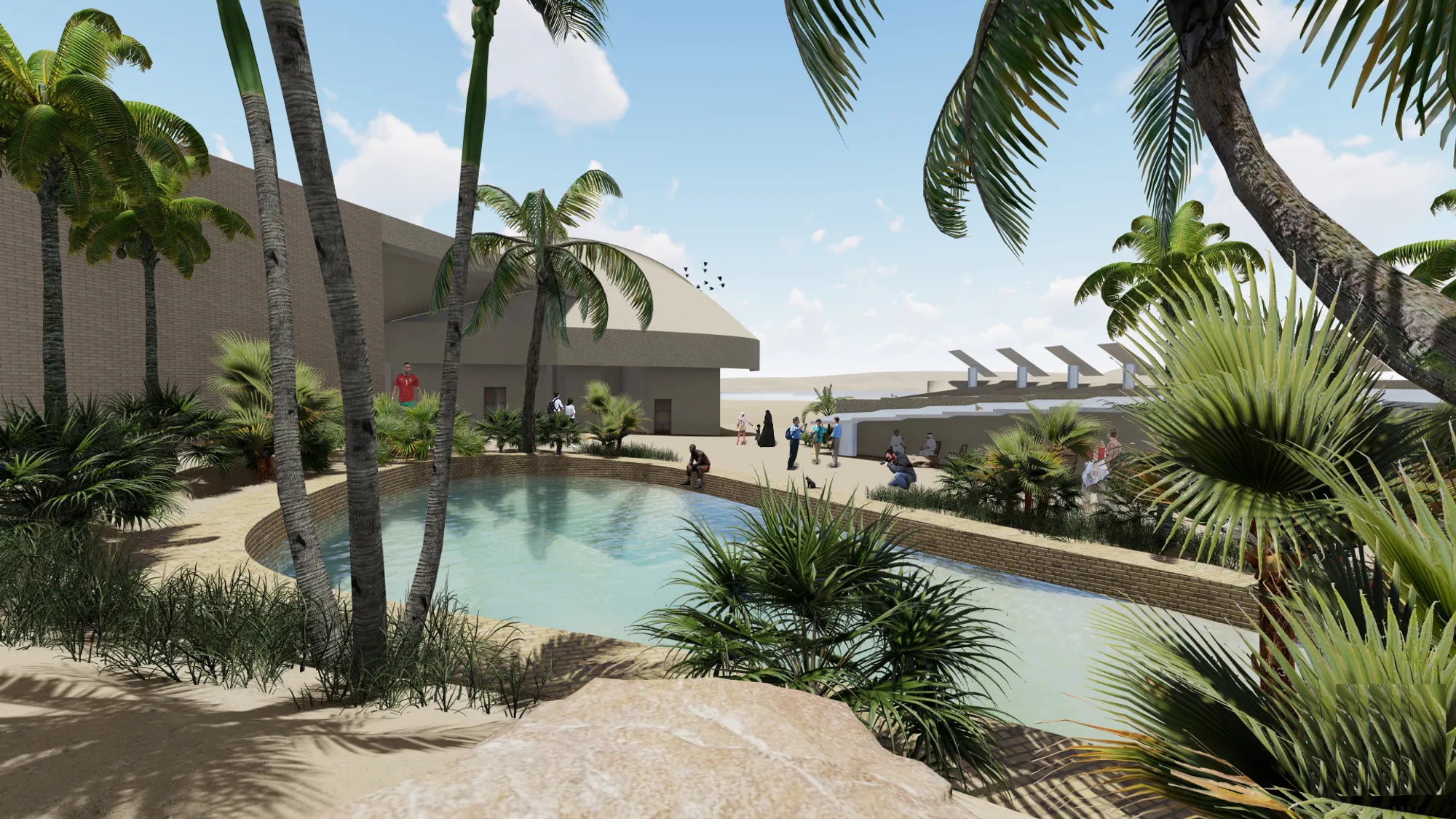
Earin Alasid Cultural Center
Rooted in tradition, history, culture, and the future, enter the den of the Lion to explore what the future of Morocco has in store for the world.
Greetings!
Welcome to the Earin Alasid Cultural Center where the excited murmurs of eager merchants in the Marketplace, where the sounds of laughter from crowds watching a play, where artists carry out their passion all happen in the Lion’s Den. Taken from Arabic, the Earin Alasid Cultural Center - translated as the Lion’s Den - was created as a model of Morocco’s sustainable future that compliments both the environment and culture of Morocco.
Site Creation:
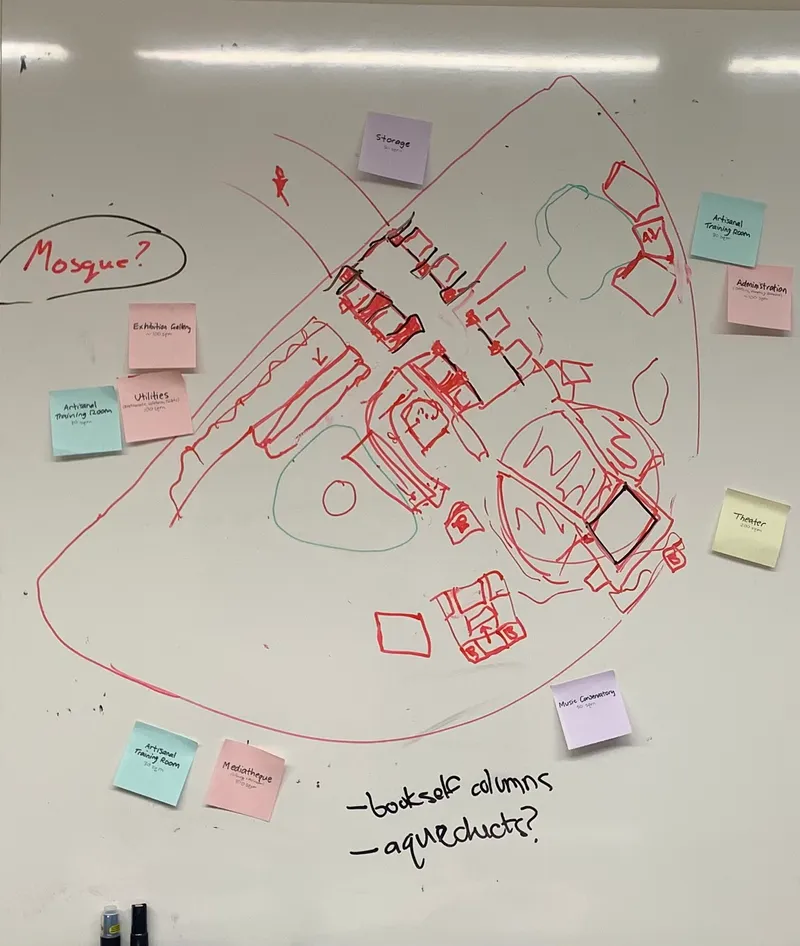
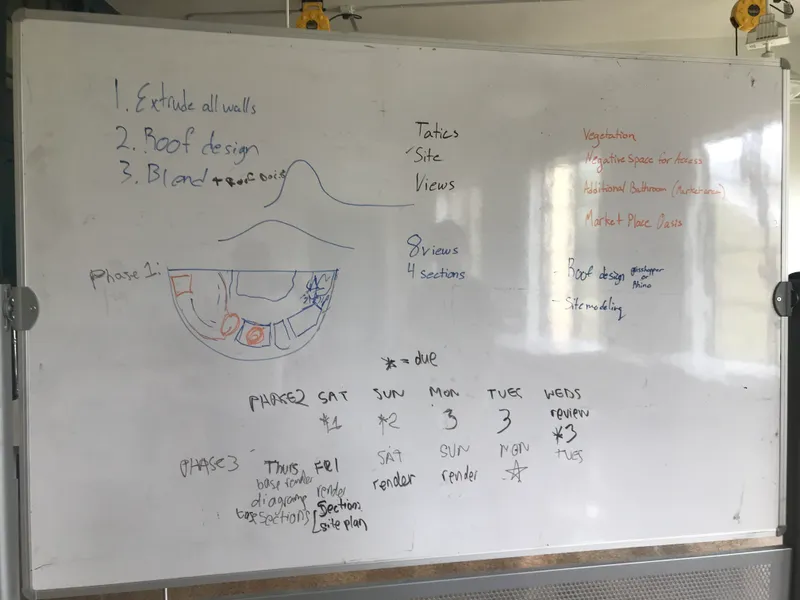
Upon reviewing the brief, we first did our own individual site analyses. After two to three weeks we began to meet to discuss the general layout of our site. Surrounded by the peaceful lake Lalla Takerkoust in the Agafay Desert in Marrakech, Morocco, we recognized that the site is planted with lucious palm, eucalyptus, and olive trees and orchards. The Cultural Center is organized with the intention of being a place of safety and exploration for visitors and locals alike as a Den should be - home. The various programs of the Center were organized in a way that created “mini-villages.” For instance, where the Library is located we wanted it to be designated the “Academic Village” whereas the Music Conservatory was the “Musical Village” and the theater the “Entertainment Village” and so on. From there we arranged the villages according to the more public programs on one side to the more private programs on the other side for the separation of privacy versus public - loudest to quietest - aspect of society.
When organizing these spaces, we knew we wanted the visitors to be introduced to the main programs of the building: The theater, Office spaces, Music Conservatory, Artisanal training rooms, and a library garden first. Then we focused on the urban development of the site which included the marketplace. The Marketplace provides most of the rich Moroccan culture and is supposed to replicate that of a busy street in Marrakech and the variety of trades from the souks. Finally, we look towards adding more features to the site itself such as the synthetic lake with an oasis seating area as a complement to provide shade and seating for visitors.
Model Building:
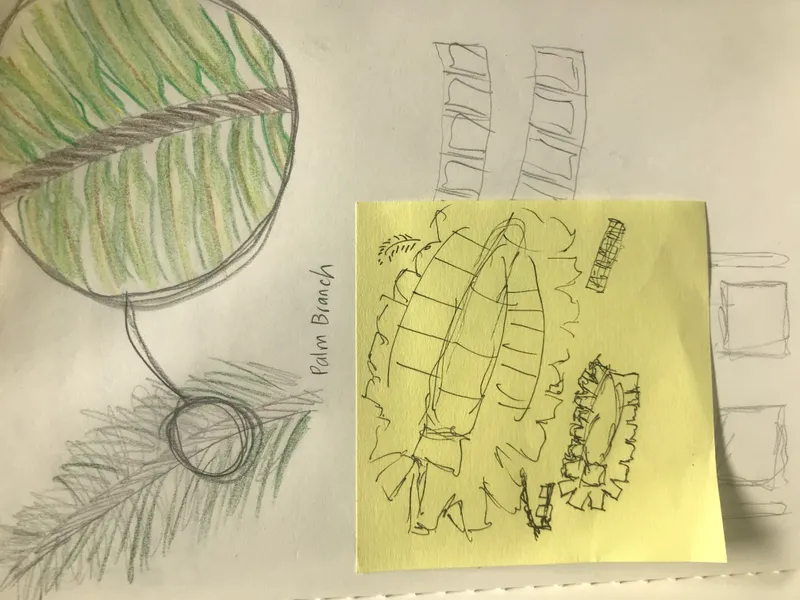
The original idea was to lay out our program in the shape of a palm tree, but as the passage of time can only tell, it slowly changed to be the roar and flow of a lion’s mane. After we decided on the placement of our programs, we gave the programs form by giving them walls and depth. After the floor plan was completed and finalized, we began extruding the walls and shaping them to the mold of our inspirations: the lion mane, the desert sand dunes, and a palm tree branch. The roof was the last thing we created as we wanted it to be a “canopy” that shields the programs from the heat of the Moroccan sun, reflective of the loving care of the mother lion in the Lion’s Den. Finally, as a nod to its environment and topography, the marketplace is organized to resemble a palm tree branch providing life to the site. Palm trees are quite common in Morocco and provide an abundance of shade for people and animals. Taking the organic form of the trunk, the palm tree branch design is also meant to bring in sustainable designs that are relevant to Morocco’s environment. This is accomplished by implementing the shading ability of a palm tree branch while also providing literal life to the marketplace through the solar panels implemented into the roof system much like how a real palm branch supports life for the palm tree. The shading ability of the design allows light to seep into the marketplace to illuminate the many colorful items the Moroccan people have to offer.
During this phase, the issue of what materials we were going to choose constantly haunted us. We tackled this haunting by analyzing the materials of the surrounding cities of Marrakesh, Casablanca, and Rabat. Through that we were able to gain enough knowledge of the most suitable material for our desired structures. For the entrance wall, we decided it best for it to be made out of adobe brick to resemble the fortress-like structures scattered throughout southern Morocco. Through this resemblance, we also wanted to create the experience of walking through Morocco’s past to experience its future. The wall symbolized the strength of Morocco’s past while the Center symbolized being in the present experiencing the future. For the roof, we chose a sandy colored reinforced concrete to replicate the smooth flow of a lion’s mane and the spirit of the desert. The walls of the center are made of limestone plaster to recreate the intricate, and colorful designs of Moroccan culture. The flooring, except for the interior of the various programs of the Center, is made up of a yellowish brick to match the effect of a Moroccan city and the sand dunes of the site.
The Final:
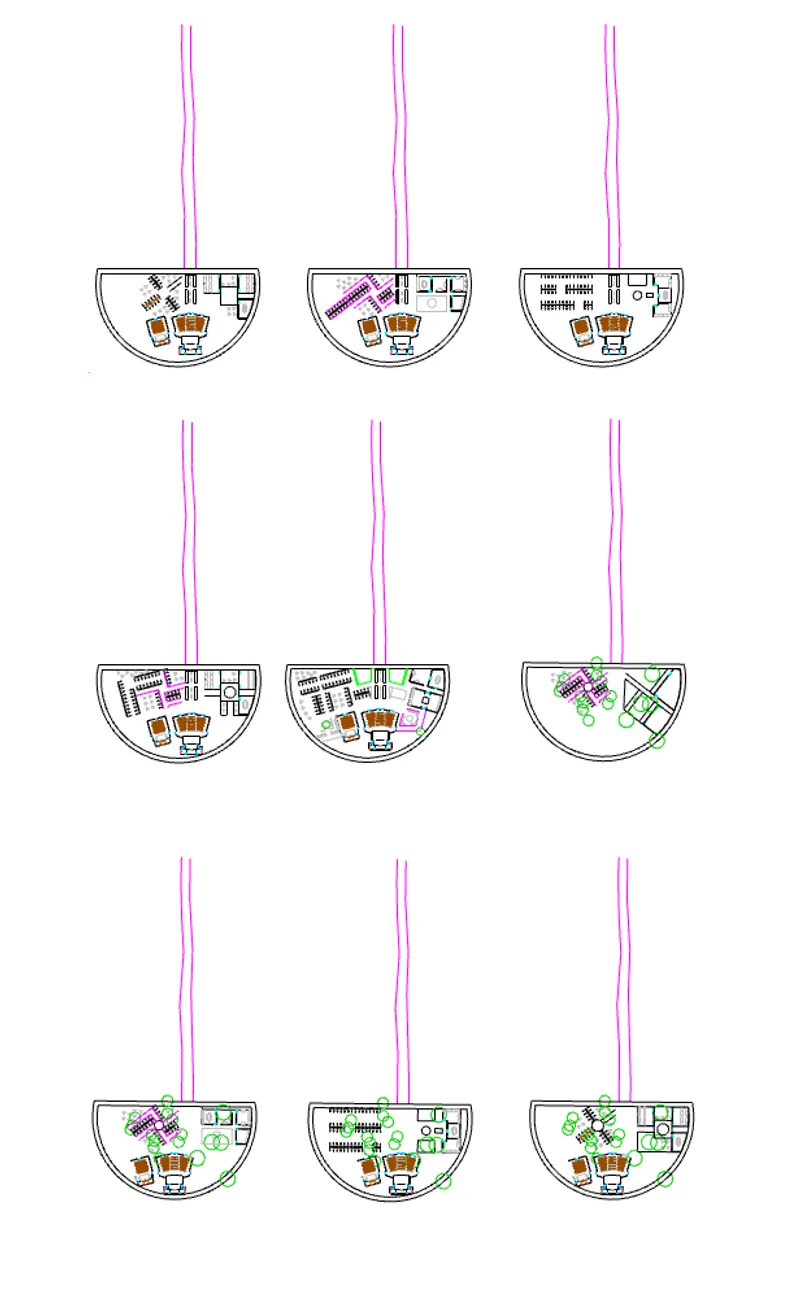
In total, our scheme for the Cultural Center totaled around 30 different schemes as we explored different ways of making our programs fit within the site limitations as well as fit the organic flow and curves of the topography of the site. The market stalls and roof proved to be the most difficult to decide upon as a final for our design as we took on the challenge of using nature to be an influence in the form of our structure.
With this design proposal, our hope as it was at the beginning was to be a symbol of safety and futuristic innovation for Morocco. The Lobby is a big enough space that we hope the users would take advantage of in displaying weather resistant exhibits or for local dancers and musicians to carry out performances. We hope that through the passage of time, the souk’s market vendors and merchants would change and bring with them the culture and artifacts relevant to Morocco at its present. We hope you explore our design and you enjoy your experience like a lion drinking water from the oasis.
Ma'a salama!

Popular Articles
Popular articles from the community


Hill & Cross Opera: Sculptural Opera House Architecture Shaped by Tallinn’s Landscape and Identity
Hill & Cross Opera reimagines opera house architecture in Tallinn through its sculptural hill, civic plaza, glass wave and a luminous cross.

Co-life: Sustainable Architecture for Age-Friendly Community Living
Co-life reimagines sustainable architecture for seniors through courtyards, rammed earth, shared gardens, and spaces designed for belonging.

Riyadh For All: Intergenerational Urban Design for Active Aging in Rabat
Riyadh For All reimagines urban design in Rabat with intergenerational co-living, adaptive courtyards, and Moroccan cultural exchange today.

Conexión: Biophilic Design Reimagines High-Rise Living in Hong Kong
Conexión reimagines high-rise living in Hong Kong through biophilic design, green facades, shared spaces, daylight, water and nature within.
Similar Reads
You might also enjoy these articles
The Rhythm of Seasons
A Farmers' Market Connecting Nature and the City

More Than a Building-Designing a Living System
More Than a Building-Designing a Living System
Base Beyond
DESERT COMPOUND ARID: TOURISM OF ABSENCE AND ABUNDANCE



Comments (0)
Please login or sign up to add comments
No comments yet. Be the first to comment!