Echoes of the Earth
Preserving Bangladesh’s Agricultural Heritage: An Agricultural Discovery Museum and Research Hub

Abstract
Agriculture is the foundation of Bangladesh’s civilization, economy, and cultural identity. Despite its central role in shaping the nation, Bangladesh lacks a comprehensive national institution dedicated to preserving and interpreting its agricultural heritage. This paper presents the conceptual, cultural, and architectural framework of the proposed Agricultural Discovery Museum & Research Hub in Postogola, Dhaka. The project envisions a hybrid museum model combining diachronic (historical) and synchronic (experiential) storytelling to celebrate the dignity of farmers, preserve traditional tools and knowledge, and promote agricultural innovation. Positioned along the Buriganga River, the museum will serve as a cultural landmark, research platform, and educational catalyst for future generations.
1. Introduction: Agriculture as National Identity
Agriculture is the heartbeat of Bangladesh. It has shaped the land, society, and culture, forming the backbone of rural civilization for centuries. From riverine cultivation to seasonal harvest festivals, farming practices have defined social rhythms and economic survival. Yet, despite this profound legacy, there is no national museum dedicated to fully documenting the evolution of agriculture or honoring the farmers who sustain the nation.
While private initiatives such as the Shah Agricultural Information Library and Museum in Naogaon and the Boalmari Agricultural Museum in Faridpur have attempted to preserve agricultural artifacts, these institutions remain small, underfunded, and regionally limited. They lack the scale, research integration, and national representation required to narrate Bangladesh’s complete agricultural history.
This absence represents a cultural gap — one that this project seeks to address.
2. Historical Context and Cultural Representation
The agricultural narrative of Bangladesh extends from ancient plough-based subsistence farming to modern mechanized systems. Traditional tools such as the wooden nangol (plough), hand sickles, bamboo irrigation devices, and clay storage systems reflect centuries of indigenous knowledge.
Agricultural festivals — Nabanna, Poush Parbon, Asharh rituals — demonstrate the synchronic relationship between land, labor, and spirituality. These rituals align with the Bengali agricultural calendar, embedding farming deeply into social and cultural structures.
The emotional and spiritual connection between farmers and land has also been profoundly captured in the works of SM Sultan, whose paintings portrayed the resilience, dignity, and strength of rural farmers. His artistic representations transcend documentation; they serve as cultural testimony to the sacred relationship between land and labor.
However, agricultural history also includes colonial exploitation. Indigo cultivation under British rule and the Zamindari system imposed structural inequalities on farmers, shaping socio-economic struggles that persist today. These narratives are essential to understanding agriculture not merely as production, but as resistance and survival.
3. Project Vision
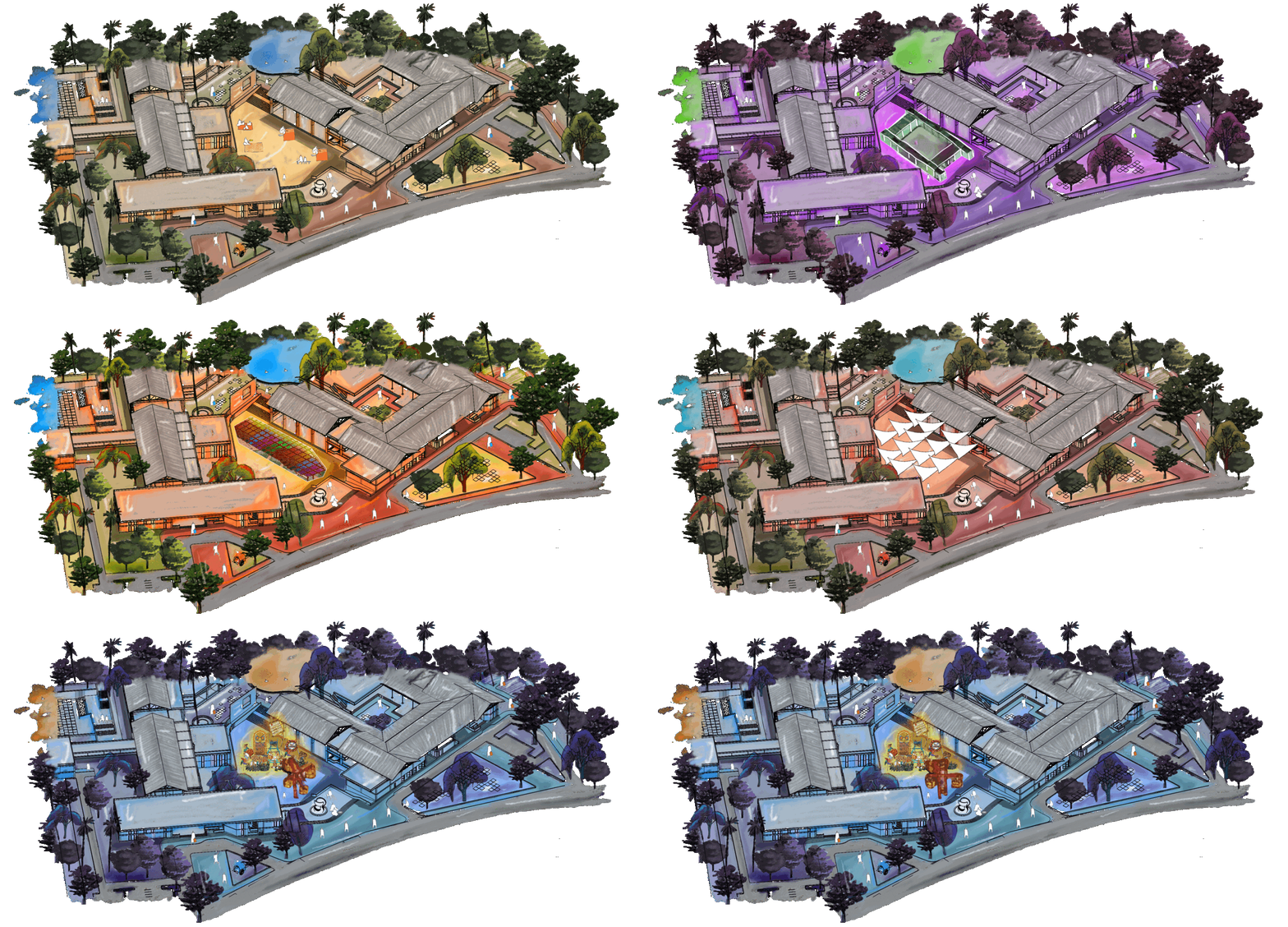
To address this cultural and institutional gap, the Ministry of Agriculture under a BISIC initiative proposes the establishment of the Agricultural Discovery Museum & Research Hub on a 13-acre riverside site in Postogola, Dhaka, along the Buriganga River.
The location is symbolically significant. Rivers have historically shaped Bengal’s agricultural systems, irrigation networks, and settlement patterns. The site embodies continuity between ecological landscape and cultural memory.
The museum introduces a hybrid conceptual model:
- Diachronic Narrative — tracing the chronological evolution of agriculture from ancient tools to modern mechanization.
- Synchronic Experience — immersive, region-specific spaces that allow visitors to experience festivals, homesteads, crops, and rural practices interactively.
This dual framework transforms the museum from a static archive into a living cultural landscape.
4. Programmatic Structure
The museum will be the first large-scale, government-supported facility in Bangladesh dedicated exclusively to agricultural heritage.
Key Components:
- Permanent Galleries Chronological evolution of farming tools Colonial agricultural systems Green Revolution and mechanization
- Seasonal & Utsob Galleries Agricultural calendar-based exhibitions Harvest festivals and regional celebrations
- Live Demonstration Fields Crop cycles Traditional irrigation systems
- Reconstructed Farmers’ Homesteads Immersive rural spatial experiences
- Children’s Interactive Learning Zone Hands-on agricultural science Sensory learning environments
- Research Hub Modern agricultural innovation Climate resilience studies Knowledge-sharing platforms
The museum bridges preservation and innovation — honoring tradition while supporting progress.
5. Socio-Economic Significance
This initiative addresses critical national needs:
- Preservation of endangered farming tools and oral knowledge
- Recognition of farmers’ contributions
- Educational awareness among urban populations
- Promotion of rural tourism
- Support for agricultural research and policy development
Despite agriculture’s role in food security, employment, and climate resilience, farmers’ voices remain marginalized. This project restores agriculture to the center of Bangladesh’s national narrative.
6. Architectural Concept and Construction Strategy
The architecture reflects a dialogue between tradition and modernity.
Structural System
Type-1 Structure
- Light metal roofing
- Steel beams
- Clay-covered columns
- Wooden beams with rope detailing
- Clay soil walls mixed with phosphorus for durability and texture
Type-2 Structure
- Pitched and sloped roofs
- Iron truss joists
- MS bar columns
- Reinforced structural stability
Material Strategy
The project uses locally sourced materials:
- Clay
- Bamboo
- Wood
Combined with industrial materials:
- Steel
- Concrete
This hybrid approach ensures structural resilience while minimizing carbon footprint. The architecture itself becomes an exhibit — demonstrating vernacular intelligence and sustainable adaptation.
7. Cultural Continuity and National Legacy
Agriculture is not merely economic production; it is memory, ritual, and identity. From traditional ploughs to precision farming, from riverbank cultivation to research laboratories, the agricultural journey defines Bangladesh.
The Agricultural Discovery Museum & Research Hub will stand as:
- A tribute to farmers
- A center for innovation
- A bridge between rural and urban society
- A national archive of agricultural memory
By combining preservation, education, research, and immersive storytelling, the project ensures that future generations understand their roots and the profound role agriculture plays in shaping their identity.
Conclusion
The Agricultural Discovery Museum & Research Hub is more than an architectural project — it is a cultural intervention. It recognizes agriculture as the foundation of Bangladesh’s history and future. By honoring farmers, preserving tools, and fostering innovation, the museum restores agriculture to its rightful place at the center of the national story.
In doing so, it transforms a neglected narrative into a celebrated legacy — ensuring that the dignity, resilience, and wisdom of Bangladesh’s farmers endure for generations to come.
References (3)
Ministry of Agriculture – Government of the People’s Republic of Bangladesh
Official government website providing policy documents, development plans, research initiatives, and strategic frameworks related to agricultural development in Bangladesh. It outlines national agricultural policies, climate adaptation strategies, and innovation programs relevant to the Agricultural Discovery Museum & Research Hub project.
Convention for the Safeguarding of the Intangible Cultural Heritage (2003)
International framework recognizing the importance of safeguarding cultural traditions, rituals, and knowledge systems. Relevant to the preservation of agricultural festivals, traditional farming practices, and rural intangible heritage in Bangladesh.
Artist– Life and Works
Biographical and archival information about SM Sultan, renowned Bangladeshi painter known for portraying rural farmers, agrarian labor, and the spiritual relationship between people and land. His works provide cultural context for understanding the dignity and struggles of farmers in Bangladesh.



Popular Articles
Popular articles from the community


Lunar Spiral: Space Architecture Shaped by the Mathematics of the Universe
Lunar Spiral reimagines space architecture through Fibonacci geometry, lunar regolith, levitating habitats, and self-sustaining Moon living.

Co-Life: Senior Housing Design That Reconnects Older Adults With the City
Co-Life reimagines senior housing design through healing gardens, shared streets, workshops, and a sustainable community across generations.

Conexión: Biophilic Design Reimagines High-Rise Living in Hong Kong
Conexión reimagines high-rise living in Hong Kong through biophilic design, green facades, shared spaces, daylight, water and nature within.

Riyadh For All: Intergenerational Urban Design for Active Aging in Rabat
Riyadh For All reimagines urban design in Rabat with intergenerational co-living, adaptive courtyards, and Moroccan cultural exchange today.

Similar Reads
You might also enjoy these articles

Day and Night Park: A Time-Based Urban Newsstand in Beijing
A temporary urban newsstand in Beijing blending travel, light, and reading through poetic colors, compact form, and community-focused design.

Modernist Patio Renovation in El Masnou, Barcelona by Oliver Segura Arquitectura + Cebrià Arquitectura
Modernist patio renovation blending tradition and innovation with a movable pool, leveled floors, and Catalan materials in El Masnou.

Alto Residencial Coop: Cooperative Housing Development in Santiago de Compostela by Carbajo Barrios Arquitectos
A linear cooperative housing complex blending white volumes and perforated metal façades, enhancing community living, natural light, privacy, and urban integration.
Vil Genis School by BPA ARCHITECTURE – Massy, France
Vil Genis School in Massy, France, features sustainable design, south-facing classrooms, community integration, accessible spaces, and modern educational architecture.






Comments (0)
Please login or sign up to add comments
No comments yet. Be the first to comment!