

UNStudio and HPP Architects Spiral a Vertical Campus Around Six Atria in Düsseldorf
PwC Germany's 16-story headquarters on Kennedydamm uses a three-dimensional helix to connect 1,200 workstations to daylight and each other.


Most office towers organize themselves floor by floor: slabs stacked, cores centered, corridors looping. The Eclipse Campus on Düsseldorf's Kennedydamm does something less common. Designed by UNStudio and HPP Architects for PwC Germany, the 60-meter tower takes a triangular footprint dictated by its awkward intersection of two federal roads and turns the constraint into a spiraling sequence of six atria that corkscrew up through the section. Workstations are arranged around these social voids rather than the reverse, a hierarchy that puts collective space at the center and desks at the periphery.
Completed in 2022, the building packs roughly 27,000 square meters of office space and 1,200 workstations into 16 stories above a two-story podium connected to the neighboring 1970s Hilton Hotel. Its cantilevered tip, hovering 11 meters above the driveway on a single V-shaped column, marks the entrance with structural drama. But the real argument the building makes is quieter: that a workplace can be vertically dense, sensor-driven, and genuinely pleasant to inhabit, all at once.
A Triangular Tower Meets the Street
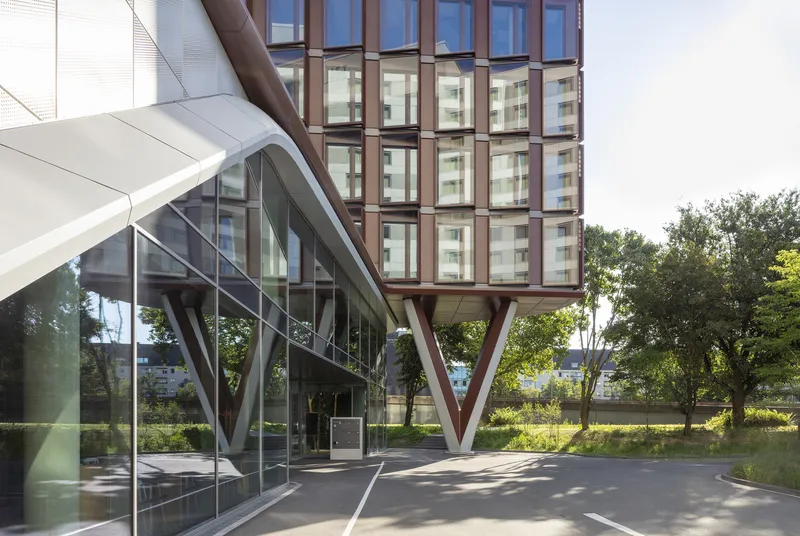
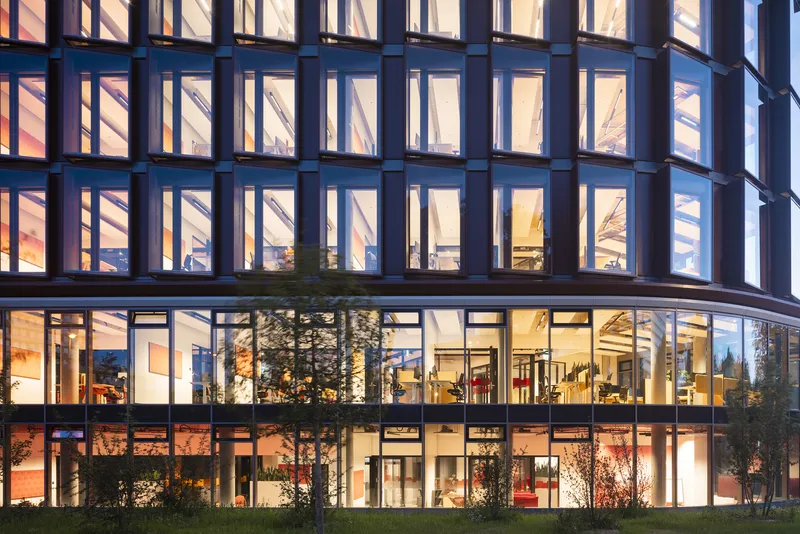
The site sits at the northern gateway to Düsseldorf's city center, hemmed by Kennedydamm and the constant noise of traffic. Rather than retreating behind a solid shell, UNStudio and HPP leaned into transparency. The ground floor is fully glazed, and the shingle-type glass facade above is framed in a rusty red-painted metal grid that reads as warm rather than corporate. At night the tower glows like a lantern, the interior floors legible from the street, making the building's vertical clustering of programs visible to passers-by.
The cantilever over the entrance is more than theatrical. It pulls the building mass away from the pedestrian level, creating a generous covered threshold that distinguishes the main approach. The diagonal framing of the setback contrasts opaque and transparent facade portions, giving the base a compositional tension that the regular grid above resolves.
The Lobby as Urban Living Room

Step inside and the double-height lobby immediately reframes expectations. Floor-to-ceiling glazing floods the space with daylight, while a centrally located skylight overhead pulls light deep into the plan. The southern facade mirrors this move, linking the interior visually to an outdoor conference terrace. Because the surrounding roads generate significant noise, the architects wisely placed communal and social functions inside the building rather than on exposed balconies, an inversion that turns a limitation into a stronger interior public realm.
The Helix: Atria as Vertical Connectors

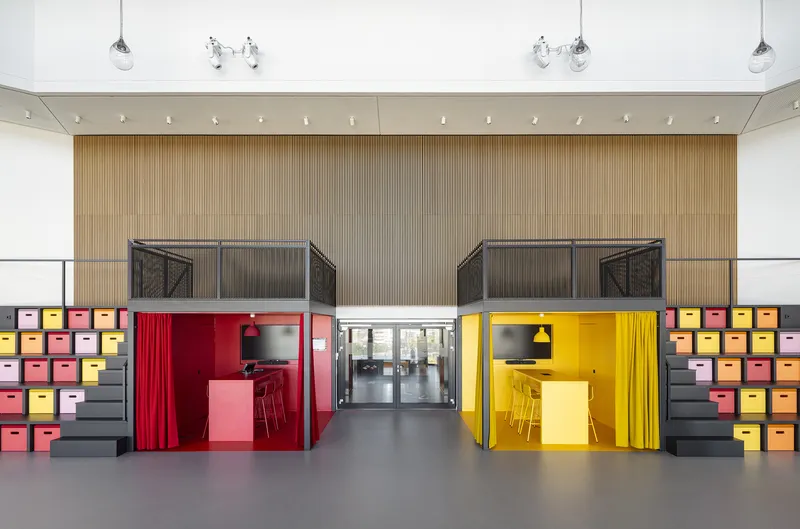
The building's backbone is a three-dimensional helix: a spiraling chain of atrium spaces that climb the facade, connecting office clusters across multiple floors and culminating in a panoramic roof garden roughly 170 square meters in area. Six atria in total punctuate the section, some extending over three stories. They function simultaneously as light wells, informal meeting grounds, and orientation devices. You always know where you are relative to the void.
The white helical staircase wrapping timber-clad meeting pods is the most photogenic expression of this idea, but the principle runs deeper. By stacking social zones vertically and letting them interrupt the office floors, the architects short-circuit the isolation that plagues conventional towers. You don't ride an elevator to a designated breakout floor; you encounter communal space as a matter of course.
Workspaces Organized Around People, Not Plans


The office floors themselves offer a spectrum of settings: cellular offices for concentrated work, open layouts for team projects, glazed meeting rooms along corridors, and informal lounges with freestanding vertical plant walls that soften the acoustics as much as the aesthetics. A pink kitchen counter wrapping a cylindrical concrete column captures the tone. The palette is warm, slightly playful, and materially honest, with exposed ceiling services, timber cladding, and white porcelain stoneware panels doing the heavy lifting.
Critically, the layouts are designed to be reversible. Walls can shift, zones can be reconfigured, and the ratio of open to enclosed space can evolve as work culture changes. For a building housing 1,200 people at a single auditing and consulting firm, this adaptability is not a luxury; it is a survival strategy against the churn of organizational restructuring.
2,000 Sensors and the Quiet Case for Smart Buildings
The Eclipse Campus embeds approximately 2,000 sensors throughout the structure, feeding real-time occupancy, daylight, and air-quality data to a centralized smart-engine system that adjusts artificial lighting and ventilation accordingly. The result is a claimed saving of up to 200 tonnes of carbon per year. The building targets both DGNB Platinum and DGNB Diamond certification, the latter reserved for projects that meet the highest standards of design and building-culture quality in Germany.
Sustainability here is not expressed through conspicuous green gestures like a living wall or a wind turbine on the roof. It is embedded in the operational logic: sensors that dim lights when a room empties, ventilation that throttles back when nobody is breathing the air. It is less photogenic but arguably more effective than performative ecology.
Plans and Drawings

The axonometric drawing reveals how the tower's interior is organized as a series of interlocking layers. Blue and magenta highlights distinguish the spiraling atria from the office plates, making the helix concept legible in a way the photographs alone cannot. The triangular plan becomes clear, with each face of the triangle responding to a different urban condition: the northern facade running parallel to Kennedydamm, the southern face aligning with the Hilton Hotel, and the acute corner housing the cantilevered entrance.
Why This Project Matters
The Eclipse Campus is interesting not because it reinvents the office tower but because it demonstrates how precisely a conventional type can be calibrated. Every decision, from the spiraling atria to the sensor-driven climate system to the reversible floor layouts, addresses a specific problem: social isolation in tall buildings, energy waste in large-volume interiors, the obsolescence of fixed plans. The collaboration between UNStudio and HPP Architects brings together conceptual ambition and German pragmatism in a way that neither firm would likely achieve alone.
For Düsseldorf, the building redefines what a corporate headquarters on a busy arterial road can offer its neighborhood. Rather than presenting a sealed, branded box, it shows its insides, connects to the adjacent hotel, and makes a genuine, glazed gesture toward the city. In a district dominated by business parks and hotel blocks, that openness matters more than the cantilever.
Eclipse Campus, designed by UNStudio and HPP Architects. Location: Kennedydamm, Düsseldorf, Germany. Area: approximately 30,000 square meters (gross). Completed: 2022. Photography by H.G. Esch.
About the Studio
Share Your Own Work on uni.xyz
If projects like this are the kind of work you want to make, uni.xyz is a place to publish your own, find collaborators, and enter design competitions.




Popular Articles
Popular articles from the community


Riyadh For All: Intergenerational Urban Design for Active Aging in Rabat
Riyadh For All reimagines urban design in Rabat with intergenerational co-living, adaptive courtyards, and Moroccan cultural exchange today.

The Ocean Hive: Sustainable Architecture for a Self-Sufficient Civilization at Sea
The Ocean Hive imagines sustainable architecture at sea, where modular habitats, algae, wave power and ocean waste sustain a growing colony.

Hill & Cross Opera: Sculptural Opera House Architecture Shaped by Tallinn’s Landscape and Identity
Hill & Cross Opera reimagines opera house architecture in Tallinn through its sculptural hill, civic plaza, glass wave and a luminous cross.

The Musturak Paradise: Senior Living Architecture for a Connected Future in Temara, Morocco
The Musturak Paradise reimagines senior living architecture in Temara via private homes, social spaces, culture, community, and shared care.

Similar Reads
You might also enjoy these articles


Hodi-Mandai Geram
Project Function: Preservation and revitalization of the Intangible heritage and socio-spatial identity of the Hodi by Housing, Cultural Memory Center, Sacred Grove, landscape, local tourism economy


Olio Towers: A Mid-Rise for Performers That Fuses Housing, Rehearsal, and Stage
Located blocks from Houston's Theater District, this modular tower stacks living units around a central performance atrium.

Oasis: Modular Green Housing Carved into Dhaka's Urban Fabric
A shortlisted Plugin Housing entry reclaims unauthorized settlements in Dhaka with stepped concrete volumes, green roofs, and ventilation-driven design.

Black Hole: A Floating Megastructure for the Post-Physical Era
Emiliano Mazzarotto envisions a spherical, self-scaling arena where e-sports, digital hotels, and holographic stadiums replace traditional public space.


Explore Office Building Competitions
Discover active competitions in this discipline



Challenge to reimagine the Iron Throne


Photograph architecture without architects


Illustrate the lost glory of Angkor Wat - Render Challenge


Design challenge to reuse E-waste
Comments (0)
Please login or sign up to add comments
No comments yet. Be the first to comment!