

Eco-Chapel: Sustainable Architecture Rooted in Faith, Forest, and Community
A bamboo eco chapel in Addis Ababa blends sacred worship, community learning, forest calm, and sustainable architecture into daily life now.


Project Name: Eco-Chapel
Location: Bole, Addis Ababa, Ethiopia
Project Type: Chapel and Community Centre
Project By: Stanislav Milchev
Recognition: Shortlisted entry of Eco-Chapel
Eco-Chapel by Stanislav Milchev is a sensitive proposal for a chapel and community centre in Bole, Addis Ababa, Ethiopia. Designed as a shortlisted entry of Eco-Chapel, the project explores how sustainable architecture can support worship, education, gathering, and ecological awareness within one carefully arranged site.
The design places the chapel at the centre of the plot, on the highest part of the land. This central position gives the sacred building symbolic and spatial importance. It is not treated as a detached object, but as the heart of a wider community landscape. Surrounded by forest, the chapel is protected from urban noise and pollution, creating a quiet setting for worship and reflection.
At the entrance, the community centre welcomes visitors into the site. This placement allows the project to work at two scales. The community centre responds to everyday social needs, while the chapel offers a deeper spiritual anchor. Together, both buildings create a circular relationship between faith, gathering, learning, and nature.
Sustainable Architecture as a Community Framework
The strongest idea in Eco-Chapel is its use of sustainable architecture not only as a technical solution, but as a cultural and social framework. The project does not rely on sustainability as a visual label. Instead, it uses local materials, passive environmental strategies, and spatial traditions to form a living community place.
Bamboo, rammed earth, woven bamboo walls, and bamboo roof systems are central to the design. These materials lower construction costs, reduce environmental impact, and connect the building to local craft traditions. The proposal also recognizes that materials once associated with poverty can return as contemporary ecological solutions when used with care, intelligence, and architectural clarity.
In Ethiopia, where bamboo is locally available, its use becomes both practical and symbolic. It supports lightweight construction, roof structures, shading systems, and expressive architectural form. Rammed earth walls add thermal mass, durability, and a grounded relationship with the site. Together, these materials shape a building that feels rooted rather than imported.
Site Planning: Chapel at the Heart, Community at the Edge
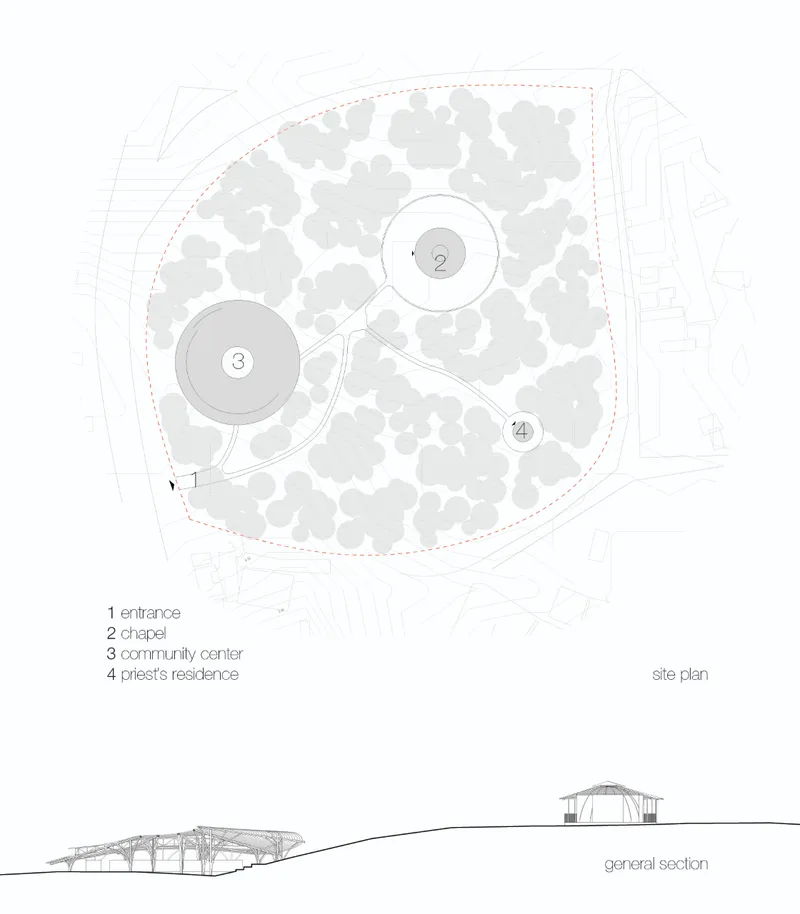
The site plan shows four main elements: entrance, chapel, community centre, and priest’s residence. The arrangement is simple but meaningful.
The community centre is located near the entrance, making it accessible for daily activities, workshops, classrooms, eating spaces, and social gatherings. This public placement allows the building to act as the first point of contact between the neighbourhood and the religious site.
The chapel is placed deeper within the site, at the centre and highest point. This makes the journey toward worship more gradual. Visitors move from the public edge into the forested interior, leaving behind the noise and pressure of the city. The chapel is embraced by trees, turning the forest into a protective buffer and a spiritual threshold.
The priest’s residence is positioned separately, allowing privacy while still remaining connected to the larger religious and community programme. The overall plan creates a calm hierarchy: arrival, gathering, retreat, worship, and residence.
Concept: The Church as the Heart of the Community
The concept is based on Ethiopian customs of celebrating holidays through large community gatherings. Unlike smaller family-based celebrations common in many parts of the world, these events often become festival-like gatherings. Many are church-oriented and deeply important to public life.
Eco-Chapel translates this cultural pattern into architectural form. The chapel and community centre are designed to complete each other. The well-like opening in the community centre repeats the circular geometry of the chapel, creating a strong symbolic relationship between the two buildings.
This circular language is important. It suggests unity, continuity, protection, and collective identity. The church becomes the heart of the community, while the community centre extends that spiritual heart into daily social life.
The Community Centre: Learning, Making, Eating, and Gathering
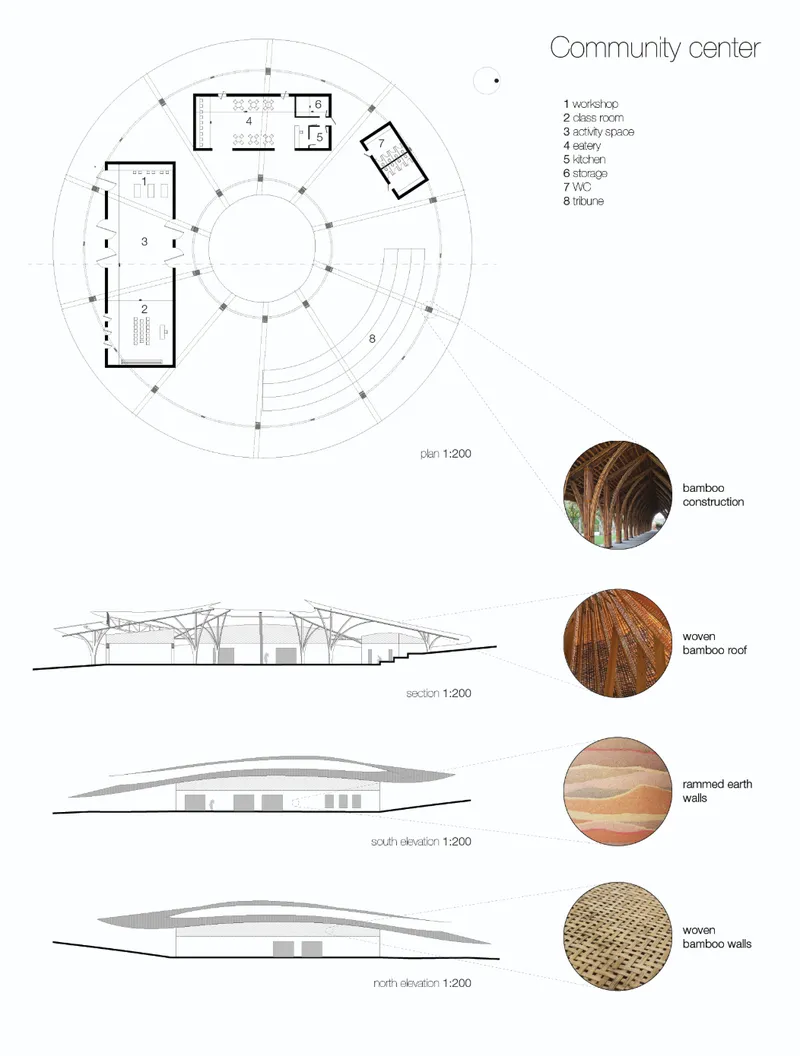
The community centre is organized around a circular plan with a central open space. Its programme includes a workshop, classroom, activity space, eatery, kitchen, storage, bathrooms, and a tribune. This mix of uses makes the building more than an accessory to the chapel. It becomes a civic platform for education, craft, social interaction, and events.
The classroom and workshop support study and making activities. The open activity space can adapt to multiple functions, allowing the building to remain flexible. The eatery and kitchen connect the centre to hospitality and collective meals, which are essential to community life.
A quarter-circle shaped ground-formed tribune functions as a large stage or seating landscape. It can support performances, informal conversations, gatherings, teaching, and celebrations. This gives the project a social dimension that strengthens its architectural purpose.
The central well or roof opening creates a spatial focus. Upon exiting the enclosed activity areas, visitors arrive beneath this opening, where light and air enter the building. The result is a courtyard-like interior condition that links architecture, climate, and gathering.
The Chapel: A Sacred Circle in the Forest
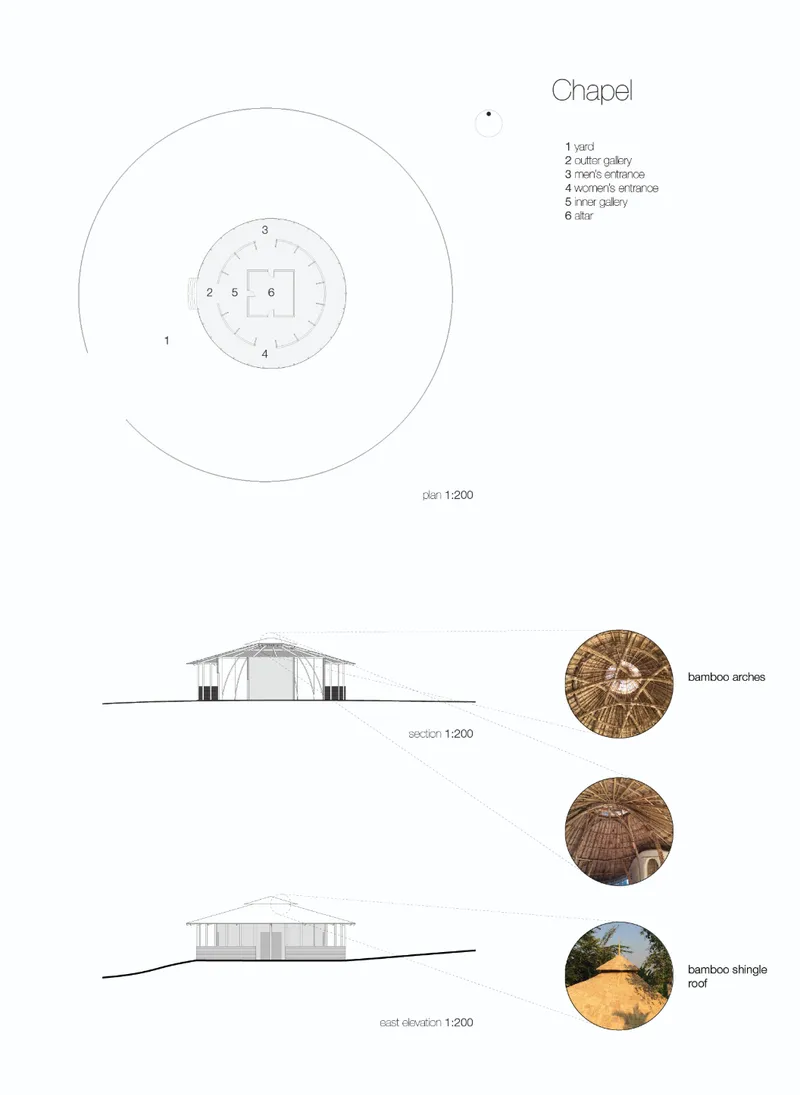
The chapel plan is circular and composed around a sequence of sacred zones. It includes a yard, outer gallery, men’s entrance, women’s entrance, inner gallery, and altar. The circular configuration reinforces the idea of gathering around a spiritual centre.
The chapel’s position within the forest gives it a quiet intensity. It is separated from the busier entrance area, yet it remains part of the same community system. This balance between seclusion and connection is one of the project’s strongest architectural gestures.
The use of bamboo arches and a bamboo shingle roof gives the chapel a natural structural identity. The roof form appears light, protective, and contextual. It shelters the sacred interior while allowing the building to belong to the landscape.
Material Strategy: Bamboo, Rammed Earth, and Woven Surfaces
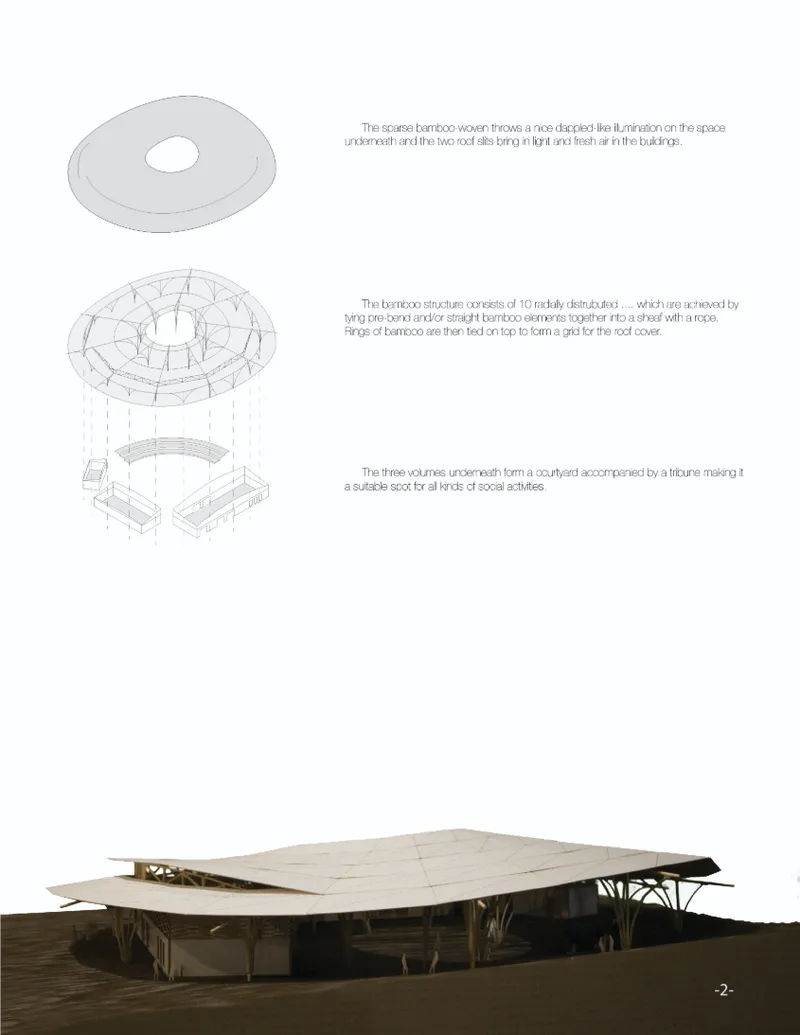
Eco-Chapel’s material palette is direct and ecologically grounded. Bamboo construction is used for columns, arches, roof structures, and woven surfaces. Rammed earth walls add solidity and thermal performance. Woven bamboo walls create filtered enclosure, allowing the building to breathe while maintaining a crafted texture.
The community centre uses bamboo construction, a woven bamboo roof, rammed earth walls, and woven bamboo walls. The chapel uses bamboo arches and a bamboo shingle roof. These choices create a consistent architectural language across the site while allowing each building to have its own character.
The bamboo-woven roof creates dappled illumination inside the spaces below. This filtered light gives the interiors a soft, atmospheric quality. It also reduces harsh solar exposure, which is important in a warm climate. Roof slits bring in daylight and fresh air, improving environmental comfort without dependence on mechanical systems.
Passive Design and Air Circulation
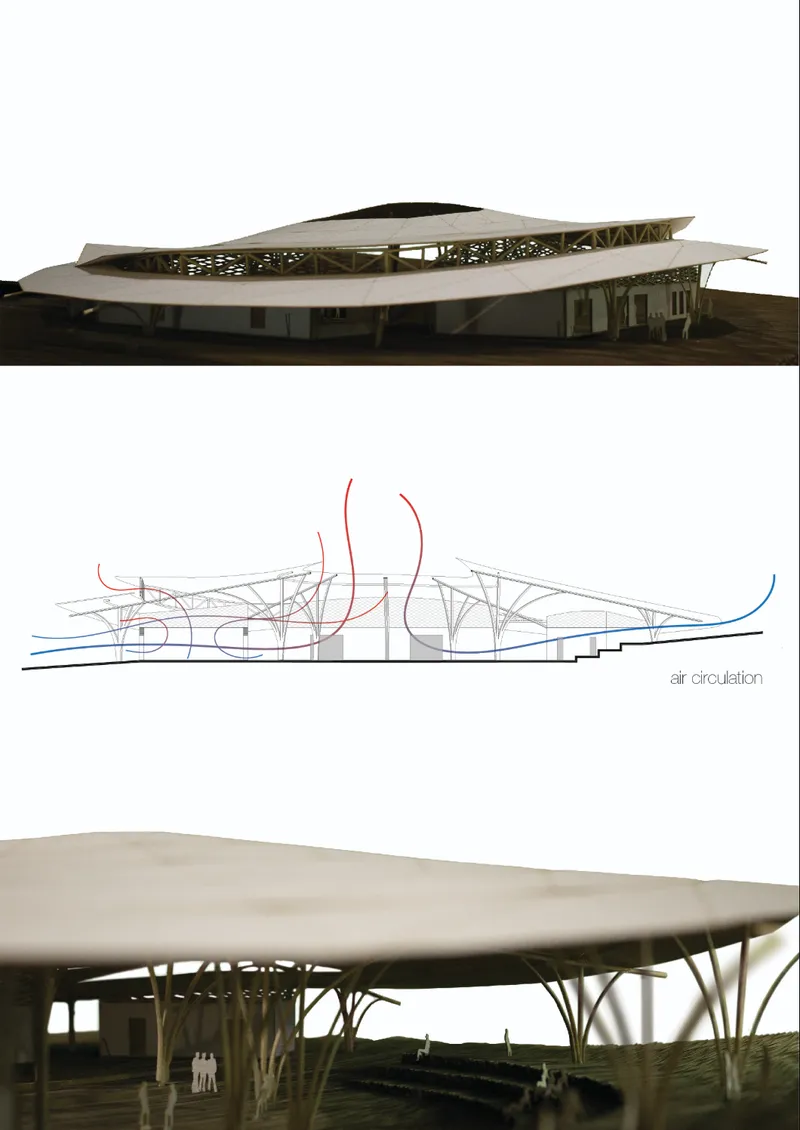
The air circulation diagram shows how the architecture uses roof openings, shaded edges, and section-based ventilation to move air through the buildings. Cool air can enter from lower openings, while warm air rises and exits through higher roof gaps. This stack-effect logic supports passive cooling.
The wide roof planes also protect the walls and activity spaces from direct sun and rain. The roof is not just a shelter. It becomes an environmental device that manages light, shade, ventilation, and comfort.
This approach makes Eco-Chapel a strong example of sustainable architecture because it treats climate as a design generator. Instead of adding sustainability after the form is decided, the project builds environmental response into the structure, section, and material system.
A Roof That Becomes a Social Landscape
The roof of the community centre is one of the project’s most expressive features. It is broad, low, and layered, with openings that allow light and air to enter. Beneath it, bamboo columns branch upward like trees, reinforcing the relationship between architecture and forest.
The model images show the building as a sheltered landscape rather than a conventional enclosed structure. People gather under the roof, move through shaded areas, and occupy the space between interior rooms and open courtyards. This creates a flexible social environment suited to workshops, meals, performances, and daily interaction.
The roof also helps unify the different programme elements. It covers classrooms, workshops, activity areas, the eatery, and the tribune, bringing them together under one architectural gesture.
Cultural Sensitivity and Local Identity
Eco-Chapel is not a generic religious structure. It responds to Ethiopian holiday customs, community gathering patterns, local materials, and Orthodox church-oriented social life. The project understands that sacred architecture in this context is not limited to worship. It also supports collective memory, social identity, and public gathering.
By combining chapel and community centre, the proposal avoids separating spiritual life from everyday life. It places education, food, performance, craft, and worship within one ecological site. This gives the project cultural depth and architectural relevance.
The chapel’s central location and the community centre’s circular well create a formal relationship between sacred and civic space. The design suggests that the church is not only a destination, but also a source of community cohesion.
Forest as Buffer, Sanctuary, and Design Element
The forest is not treated as leftover landscape. It is an active part of the design. Around the chapel, trees create acoustic and environmental protection from the surrounding city. They reduce noise, filter pollution, and define a calm sacred territory.
The placement of the chapel within this forested zone creates a ritual movement from the urban edge toward a protected centre. This journey strengthens the spiritual character of the site. The visitor does not immediately arrive at the chapel. Instead, the site invites gradual transition.
For sustainable architecture, this is important. Landscape is not decoration. It becomes infrastructure, atmosphere, and spatial narrative.
Why Eco-Chapel Matters
Eco-Chapel matters because it proposes a model of religious architecture that is ecological, affordable, social, and culturally grounded. It does not present sustainability as a separate technical layer. Instead, it integrates sustainability into material choice, site planning, community programming, passive ventilation, and symbolic form.
The project shows how bamboo and rammed earth can return to contemporary architecture with dignity and performance. It also shows how a chapel can become more than a worship space. By pairing the chapel with a community centre, the design creates a place for learning, making, eating, gathering, and celebration.
As a shortlisted entry of Eco-Chapel, Stanislav Milchev’s proposal offers a thoughtful vision for Addis Ababa. It demonstrates how sustainable architecture can respond to climate, culture, faith, and community at the same time.
Eco-Chapel is a quiet but powerful architectural proposal. Set within a forested plot in Bole, Addis Ababa, it places the chapel at the spiritual centre and the community centre at the social threshold. The result is a balanced design that connects sacred worship with everyday communal life.
Through bamboo construction, rammed earth walls, woven surfaces, passive ventilation, circular planning, and forest integration, the project builds a strong case for sustainable architecture rooted in local identity. It is not only an eco chapel. It is a community framework, a cultural gathering place, and a calm spiritual refuge shaped by material intelligence and environmental sensitivity.


Popular Articles
Popular articles from the community


Singing Woman: Contemporary Architecture Inspired by Estonia’s Voice and the Sea
Singing Woman turns Estonia’s song culture into flowing opera house architecture, blending public life, landscape, sea, and national memory.

Opera on the Sea: Driftwood Logic Shapes a Timber Opera House on Estonia's Coast
Trevor Orgill's opera house translates the entangled drift of floating timber into a civic building where wood, water, and music converge.

Faces of the Soviet Avant-Garde: Turning Moscow's Street Names into an Open-Air Museum
A network of sculptural installations across a Moscow residential district transforms forgotten architect names into spatial encounters with cultural memor

Manzana Morphosis: Stretching Barcelona's Grid into a Living Landscape for 2050
A radical reworking of the Eixample manzana turns density into a tool for generous public space, vertical ecology, and environmental performance.

Similar Reads
You might also enjoy these articles

Eco Chapel: A Green Architecture Pavilion Designed in Symbiosis with the Forest
Eco Chapel uses green architecture to weave prayer, learning and reuse into a forest pavilion shaped by modular hexagonal canopies for life.
Kaffeebühnen: Coffee Shop Architecture Designed as a Civic Stage Between Vienna’s City and Park
Kaffeebühnen turns coffee shop architecture into a civic stage, linking Vienna’s park edge, urban life, warm timber yards, and coffee craft.
Healing Façade: Sustainable Architecture for Reforestation, Community, and Sacred Ecology in Ethiopia
Healing Façade reimagines sustainable architecture as a living wall that restores soil, catches water and renews Ethiopia's forest churches.


Urban Forest: A Vertical Ecosystem for 5,000 Workers in Singapore's Changi Business Park
Radially stacked pods and layered green decks turn a 7-acre plot into 47 acres of ecological workspace projected for 2040.

Comments (0)
Please login or sign up to add comments
No comments yet. Be the first to comment!