

Ecological Salvation: Turning Abandoned Oil Rigs into Living Museums of Environmental Hope
An adaptive reuse proposal transforms decaying Adriatic oil platforms into ecological museums, habitats, and renewable energy hubs.


Italy has installed nearly 200 oil rigs in the Mediterranean since 1959. Most of them are still standing. Demolition costs keep them anchored to the seabed, rusting silently in the Adriatic as monuments to an energy economy the world is trying to leave behind. "Ecological Salvation" refuses to treat these structures as waste. Instead, it proposes a spatial and narrative transformation: converting decommissioned platforms into ecological museums, sustainable habitats, and energy laboratories where visitors can physically move through the story of environmental degradation and recovery.
Designed by Zhiwei Chen, Hui Liu, Wanqing Li, and Su Yue, the project was a People's Choice Award entry at the Proximity Island competition. Sited in the Upper Adriatic, where abandoned rigs are most concentrated, the proposal preserves the industrial skeletons of drilling platforms and wraps them with a new architectural programme that is part museum, part research station, and part provocation. The team organizes the entire visitor experience around a three-color narrative: white for pristine nature, gray for human-altered landscapes, and black for zones of intense pollution, guiding occupants through a spatial journey from light to darkness and back toward ecological awareness.
Stacked Volumes on Inherited Piers
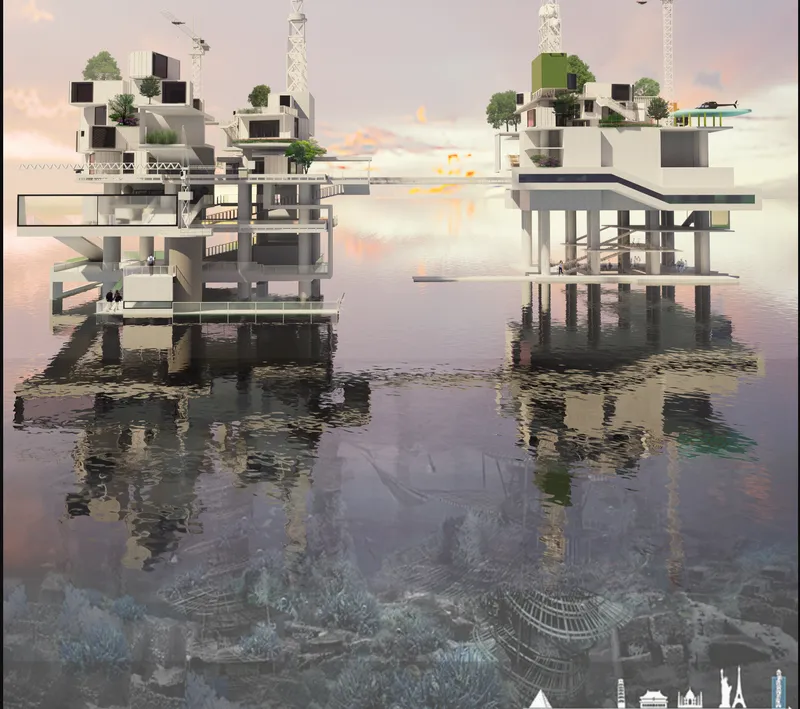
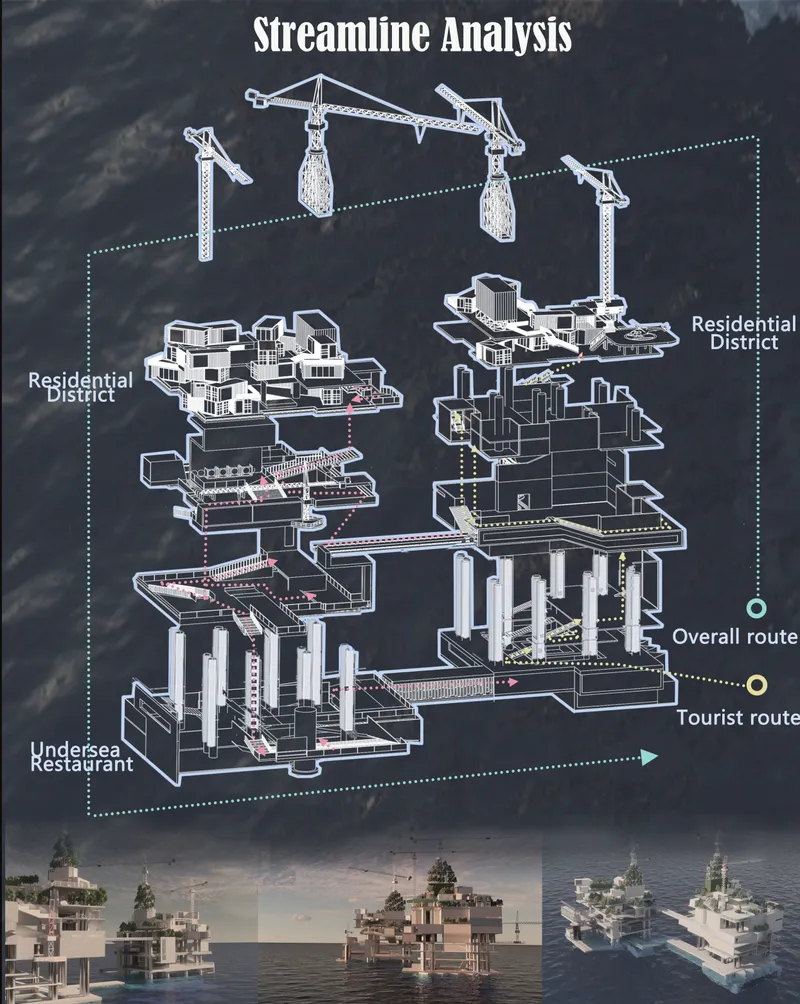
The rendering at sunset reveals how new modular housing and exhibition units stack on top of the rig's original concrete piers, their reflections doubling in the calm Adriatic water. The silhouette is deliberately industrial: cranes remain visible, structural columns are exposed, and no attempt is made to disguise the platform's origins. The exploded axonometric clarifies the logic underneath this composition. Layered platforms are connected by circulation routes that twist between residential levels, exhibition galleries, and open decks. These twisted architectural elements do double duty, functioning simultaneously as staircases, galleries, and connective tissue between programmatic zones. The design blurs the boundary between vertical walls and horizontal floors, producing a continuous, flowing spatial experience rather than a stack of discrete floors.
Above and Below the Waterline


The section drawing is the project's most revealing document. Above the waterline, housing modules and public platforms fan outward from the rig's structural core. Below it, submerged levels descend along vertical columns into the sea. The contrast is intentional and central to the narrative: underwater spaces are tight, somber, and reflective, forcing visitors into confrontation with the fragility of marine ecosystems, while above-water zones open to sunlight, wind, and the vibrant life of the Mediterranean surface. This juxtaposition is not just atmospheric; it structures the entire visitor circuit from darkness into hope.
The view through the cylindrical steel columns reinforces the sense of occupying an inherited industrial framework. The elevated platform hovers above a water pool, and the structural grid reads as both shelter and cage. Retaining elements like drilling structures and platform decks honors the site's memory while converting them into the bones of something genuinely new.
A Closed-Loop Energy and Food System at Sea

Sustainability here goes well beyond solar panels. The team proposes an integrated, multi-source energy recycling system that combines solar, wind, tidal, biomass, and geothermal inputs into a closed-loop ecological habitat. Ocean thermal energy is optimized through a combined cooling-electricity generation cycle, with solar serving as an auxiliary heat source. The platform also supports marine farming, waste recycling, and sustainable food production, positioning the rig not as an isolated museum piece but as a prototype for self-sufficient offshore living. The deck view at dusk, with its suspended ring seats overlooking the water and distant crane structures, captures the atmosphere of a place where leisure, education, and ecological infrastructure coexist without hierarchy.
Material Honesty: Concrete, Timber, and Steel
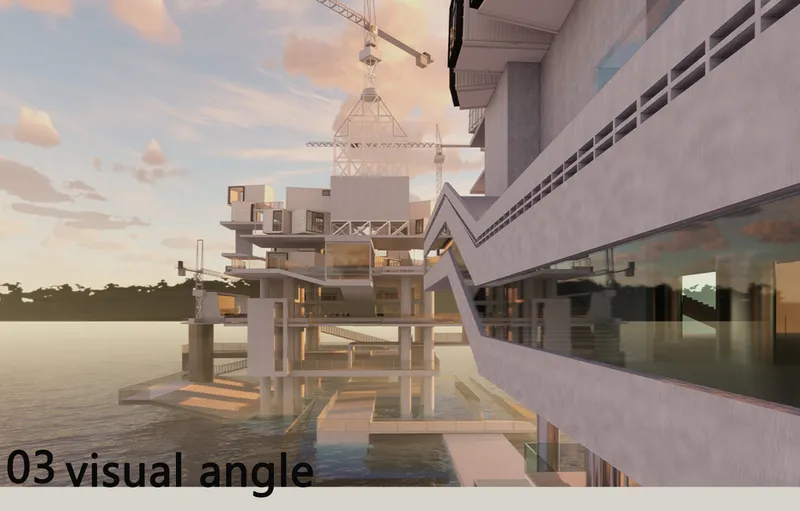
The final image shows the material palette in its clearest terms: raw concrete volumes, timber walkways, and the looming steel of a crane tower. The choice to pair new timber elements with the rig's existing concrete and steel creates a legible distinction between what was here before and what has been added. Elevated platforms connected by timber boardwalks introduce a tactile warmth that softens the industrial character without erasing it. The crane remains as an orienting landmark, a vertical marker visible from the water that signals the platform's past function even as its present purpose has fundamentally shifted.
Why This Project Matters
The default approach to decommissioned oil infrastructure is removal or neglect, both of which erase the evidence of environmental exploitation. "Ecological Salvation" argues for a third option: keep the structures, transform their purpose, and use them as spatial instruments for public education and ecological research. The three-color narrative, from white through gray to black and back again, is more than a graphic device. It organizes architecture into an emotional sequence that makes the consequences of industrialization legible to anyone willing to walk through the space.
What elevates this proposal beyond provocation is its operational ambition. The closed-loop energy and food systems, the integration of underwater and above-water ecosystems, and the combination of museum, habitat, and research station into a single offshore platform suggest that adaptive reuse at this scale is not merely symbolic. Chen, Liu, Li, and Yue have outlined a framework where industrial relics become genuinely productive ecological assets, and where confronting the past is inseparable from building a viable future.
View the Full Project
About the Designers
Designers: Zhiwei Chen, Hui Liu, Wanqing Li, Su Yue
Enter a Design Competition on uni.xyz
uni.xyz runs architecture and design competitions year-round that reward proposals with spatial conviction and real site intelligence.
Project credits: Ecological Salvation by Zhiwei Chen, Hui Liu, Wanqing Li, Su Yue Proximity Island (uni.xyz).


Popular Articles
Popular articles from the community


Extended Shell: Retrofitting Kolkata's Balconies as Living Urban Thresholds
A modular retrofit system recovers the social and environmental intelligence of Kolkata's historic verandas for contemporary Park Street residents.

The Amber Palace Opera: A Geological Fiction Surfaces on Tallinn's Baltic Waterfront
Pierre Brillard reimagines a Baltic legend as a public landscape, opera house, and waterfront promenade rooted in Tallinn's coastal identity.
Opera by the Sea Estonia: Three Shells Dissolving Architecture into Tallinn's Coastline
A winning opera house proposal replaces monumental form with interconnected shells that blur the boundary between building, park and Baltic Sea.

Opera on the Sea: Driftwood Logic Shapes a Timber Opera House on Estonia's Coast
Trevor Orgill's opera house translates the entangled drift of floating timber into a civic building where wood, water, and music converge.

Similar Reads
You might also enjoy these articles

Day and Night Park: A Time-Based Urban Newsstand in Beijing
A temporary urban newsstand in Beijing blending travel, light, and reading through poetic colors, compact form, and community-focused design.

Modernist Patio Renovation in El Masnou, Barcelona by Oliver Segura Arquitectura + Cebrià Arquitectura
Modernist patio renovation blending tradition and innovation with a movable pool, leveled floors, and Catalan materials in El Masnou.

Alto Residencial Coop: Cooperative Housing Development in Santiago de Compostela by Carbajo Barrios Arquitectos
A linear cooperative housing complex blending white volumes and perforated metal façades, enhancing community living, natural light, privacy, and urban integration.

Vil Genis School by BPA ARCHITECTURE – Massy, France
Vil Genis School in Massy, France, features sustainable design, south-facing classrooms, community integration, accessible spaces, and modern educational architecture.


Comments (0)
Please login or sign up to add comments
No comments yet. Be the first to comment!