

Play = Learn Better: Modular School Architecture That Grows with Its Students
A play-driven educational landscape replaces rigid classrooms with adaptive, vertically expandable zones shaped by children's developmental needs.


What if the most effective classroom had no walls at all? "Play = Learn Better" starts from a provocation that most school architects avoid: conventional educational spaces actively work against the way children learn. Rigid rows of desks, sealed-off corridors, and uniform rooms produce passive recipients of knowledge rather than active, curious learners. The project dismantles that model entirely, proposing a school whose architecture is inseparable from its pedagogy, where play is not a reward for finishing work but the primary mechanism through which cognitive, emotional, and physical development occurs.
Designed by 翔 S.H, 哩 川, 彥份 郭, and 航航 葉, the project received an Honorable Mention in the Learn Better competition. Sited within a landscape of rivers, forests, and parks, the scheme transforms an entire educational campus into an interconnected playground, one that evolves vertically and horizontally as its student body grows from early childhood through adolescence.
A Child's Eye View of Spatial Organization
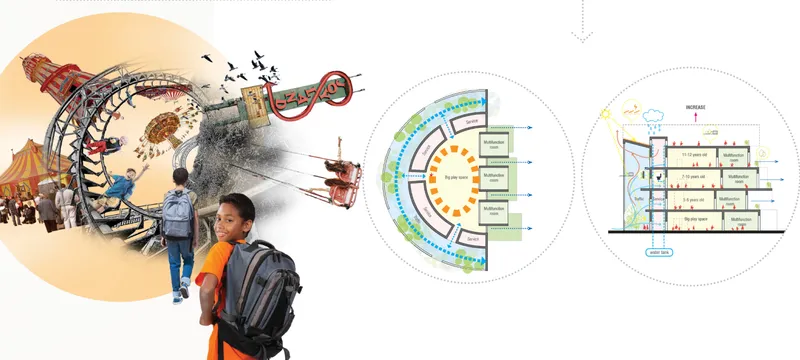
The opening conceptual rendering places a child at the center of the design logic, quite literally. Circular and sectional diagrams radiate outward from the figure, annotating how spatial organization responds to developmental stages rather than administrative convenience. The move is significant: instead of fitting children into predetermined room types, the designers derive spatial configurations from research on how different age groups play, socialize, and absorb information. It is architecture designed from the inside out, starting with the body of the learner.
Color-Coded Zones for Teaching, Playing, and Growing
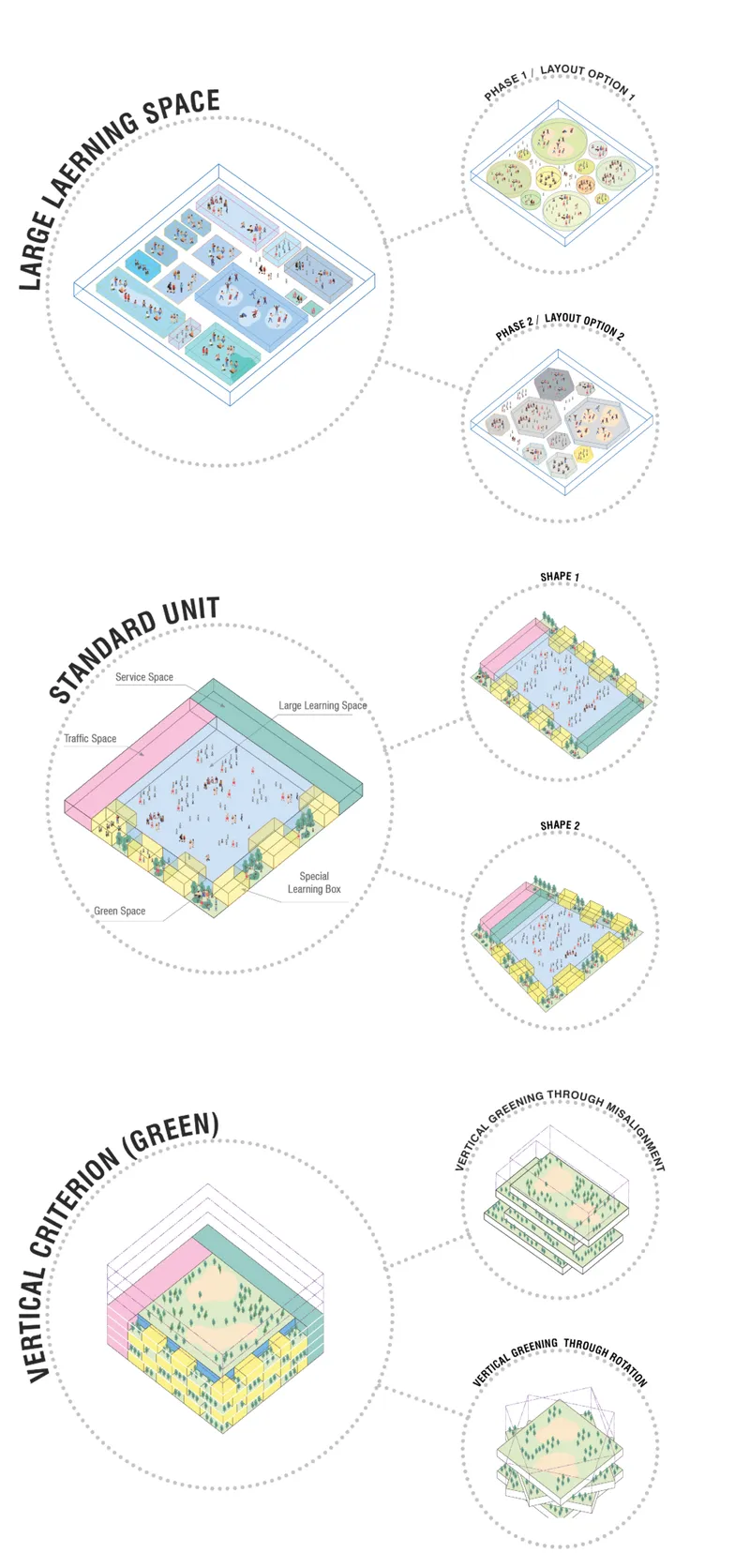
The axonometric drawings break the school into three distinct programmatic zones, each rendered in a different color to clarify function. These zones accommodate large interactive learning areas, indoor and outdoor playgrounds, and multipurpose community spaces. What stands out is the variation in spatial configuration across the three schemes: the layouts shift in density, openness, and connectivity depending on the age group and activity type they serve. The modular logic means the school is never a finished object. It can expand, contract, or reconfigure as enrollment shifts or pedagogical priorities change.
Vertical expandability is a core structural principle here. Rather than sprawling outward across the site, the design stacks and layers programmatic elements, freeing ground-level space for the physical movement and outdoor exploration that younger children need most. Upper levels host quieter, more focused learning environments for older students. The result is a vertical gradient of activity, from high-energy play at the base to concentrated study above.
The Site as Educational Landscape


The site plan reveals just how thoroughly the designers have integrated the school into its surrounding ecology. Outdoor playgrounds, sports courts, and garden areas nestle between forest edges and water bodies. There is no hard line between campus and nature; instead, the landscape becomes a teaching tool. Activity trails thread through green roofs and vertical gardens, turning circulation into exercise and environmental observation. Orientation has been carefully studied to optimize sunlight and natural ventilation, reducing energy loads while keeping interior spaces bright and comfortable.
The aerial perspective is striking. A curving roofscape, punctuated by colored play surfaces and basketball courts, sits within an autumn canopy of orange and gold. The roof itself becomes usable terrain, blurring the boundary between building and ground plane. Sports fields are not exiled to a distant corner of the campus but woven directly into the architectural massing, reinforcing the project's thesis that physical activity and learning are inseparable.
Building Beside the Wetlands

The site elevation drawing offers a quieter, more grounded view of the project's relationship to its immediate ecology. The building volume sits beside a wetland, with a detail inset showing riverbank planting strategies that manage stormwater while creating habitats for local species. The futuristic glass facade, visible in this elevation, is not merely aesthetic; it mediates between interior learning zones and the natural systems outside, promoting environmental awareness through daily visual contact with weather, water, and vegetation. Students do not just learn about ecology. They live within it.
Why This Project Matters
"Play = Learn Better" takes a position that most educational architecture projects gesture toward but rarely commit to fully: that the built environment should be an active participant in learning, not a neutral container for it. By grounding every design decision in research on childhood development and play-based pedagogy, the team produces a proposal that is both speculative and rigorous. The modular, vertically expandable structure offers a genuinely scalable model, one that could adapt to different sites, cultures, and educational philosophies without losing its core logic.
For architects and educators alike, the project presents a compelling challenge: stop designing schools as institutions and start designing them as landscapes of possibility. The merging of built form with rivers, forests, and parks, the color-coded programmatic clarity, and the insistence on physical movement as a learning tool all point toward a school typology that treats children not as future adults to be trained but as present beings whose curiosity, energy, and playfulness are assets to be amplified. That reframing alone makes the project worth serious attention.
View the Full Project
About the Designers
Designers: 翔 S.H, 哩 川, 彥份 郭, 航航 葉
Enter a Design Competition on uni.xyz
uni.xyz runs architecture and design competitions year-round that reward proposals with spatial conviction and real site intelligence.
Project credits: Play = Learn Better by 翔 S.H, 哩 川, 彥份 郭, 航航 葉 Learn Better (uni.xyz).


Popular Articles
Popular articles from the community


ETEH Reworks the Shared Spaces of São Domingos School in Brazil Around Timber, Color and Hanging Plants
At São Domingos School in Brazil, 436 m² of hall, refectory and library are recast with timber joinery, a yellow and blue code and trailing greenery.


Singing Woman: An Opera House That Performs Before the Curtain Rises
Ovidiu Cristian Pavel's conceptual opera house translates Estonia's choral identity into a sculpted waterfront landmark facing the Baltic Sea.

Manzana Morphosis: Stretching Barcelona's Grid into a Living Landscape for 2050
A radical reworking of the Eixample manzana turns density into a tool for generous public space, vertical ecology, and environmental performance.

FCC Arquitectura Expands a Portuguese Granite House with a Board-Marked Concrete Wing
In Portugal, JV House pairs a cleaned-up whitewashed and granite dwelling with a timber-shuttered concrete extension, courtyards and a garden pool.

Similar Reads
You might also enjoy these articles

Cube Design Draws an Ecological Corridor Between Two Shenzhen Hills with the Nankai Building
Beside Shenzhen's container docks, the Nankai Building pairs stacked balconies with a climbing green screen to connect two hillsides across its height.

Praksis A and Studio Sted Bend a Red Timber Cabin Across the Granite of Norway's Southern Coast
On the southern Norwegian coast, a 105 m² cabin follows the rock on slender posts, pairing red cladding outside with pine, brick and plywood within.

David Ortega Stacks a Two-Story Mexico City Penthouse Around a Steel Stair and a Pergola-Shaded Roof Terrace
In Colonia Roma, a 300 m² penthouse uses oak joinery, a planted steel stair and a slatted roof pergola to make a new-build apartment feel like a house.

PARALELA and LB2 Thread a Public Walkway Through the Base of a Las Condes Residential Tower
In Las Condes, Santiago, the Hamlet Building gives its fenceless ground floor to a 70-metre wooded passage linking two streets and the metro.


Comments (0)
Please login or sign up to add comments
No comments yet. Be the first to comment!