
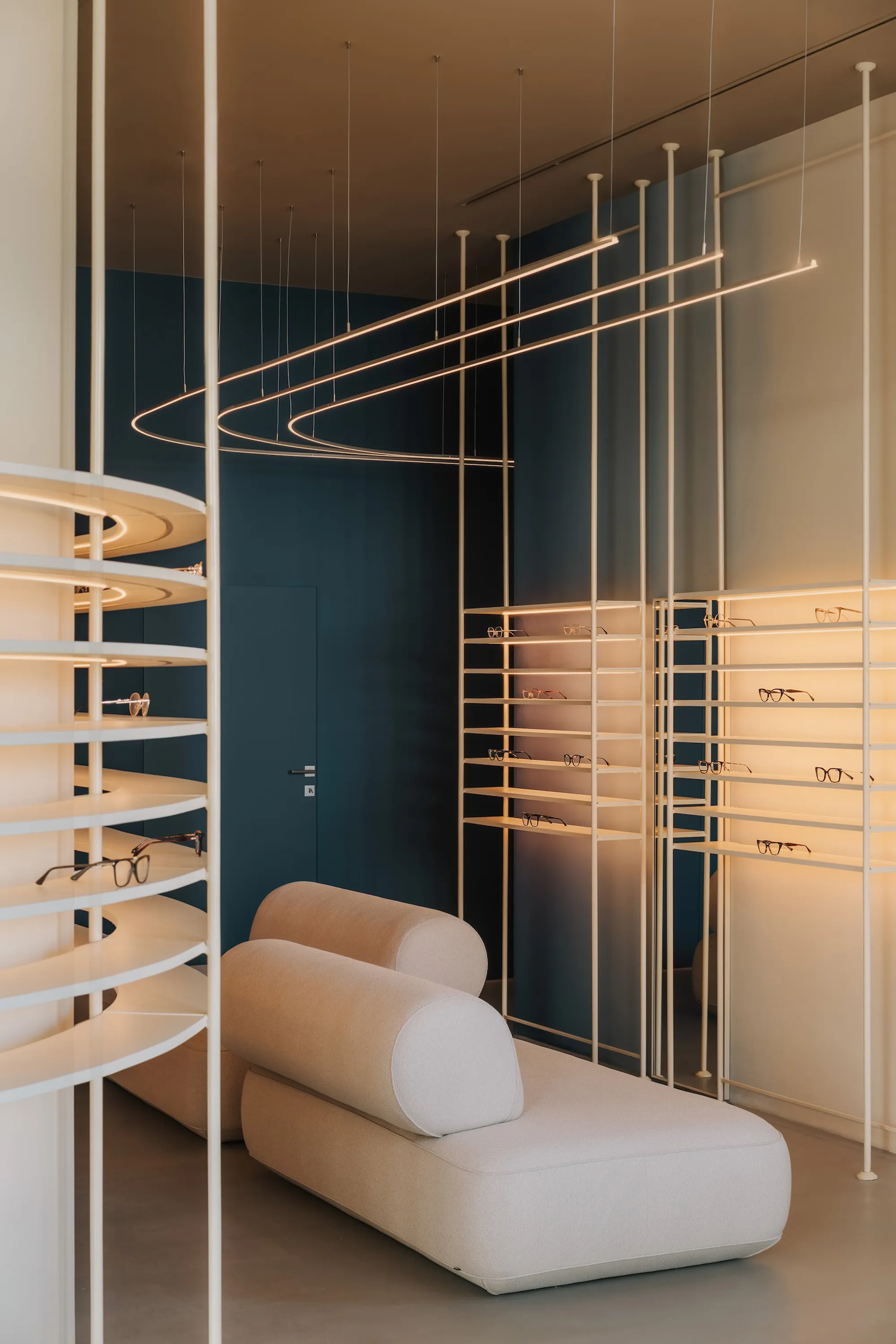
Znamy się Designs an Optical Salon in Wrocław as a Spatial Map of the Human Eye
Auga Optical Salon translates the biology of vision into material, light, and spatial sequence across 191 square meters in Wrocław, Poland.


Most retail interiors for eyewear brands default to one of two modes: clinical minimalism or fashion-house theatrics. Znamy się refused both when they were asked to design Auga, a 191 square meter optical salon and specialist clinic in Wrocław, Poland. Instead, the studio chose an organizing metaphor that is both deeply literal and surprisingly productive: the anatomy of the human eye itself, with the salon's plan, materials, and lighting choreographed to mirror the path of light as it travels from cornea through lens to retina.
What makes the concept land is not cleverness alone but the rigor with which it is executed. The entrance zone corresponds to the cornea, the central retail floor to the lens, and the specialist consulting rooms at the rear to the retina, where neural signals are finally processed. A deep blue gradient that intensifies from front to back references rod photoreceptors and the Purkinje effect, the phenomenon by which color perception shifts under low light. The result is a store that feels genuinely different to move through, not because it announces its concept at every turn but because its spatial qualities, from brightness to enclosure, keep subtly changing.
Entering Through the Cornea

Steel-framed glass doors mark the threshold, functioning as the cornea in the biological analogy: the point where light first enters. The transition from street to interior is immediate but not abrupt. Backlit display shelves line both flanks, drawing you forward, while a sinuous ceiling fixture establishes the curving geometry that will recur throughout the salon. There is no lobby, no decompression zone. You are already inside the eye.
The Lens: A Burl Wood Counter and Biconvex Glass


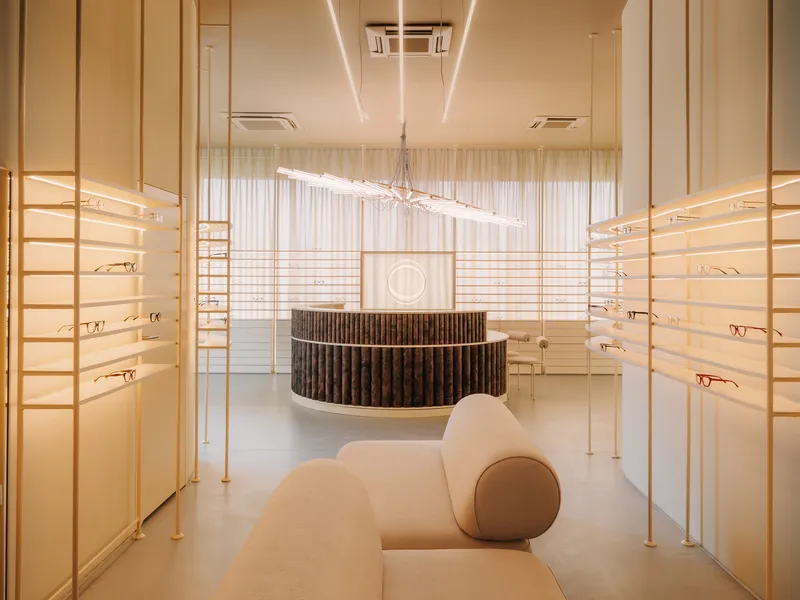
At the heart of the salon sits a round counter clad in fluted burl wood, directly beneath a radiating LED chandelier. In Znamy się's schema, this is the macula, the point of sharpest focus. The counter's dark timber panels, vertically ribbed, contrast with the lighter horizontal shelving surrounding it, making it read as a gravitational center even in an open plan.
Nearby, a biconvex glass screen with a grooved, ridged surface acts as the salon's most direct material homage to the eye's lens. It refracts daylight entering from the street, casting shifting patterns of shadow and highlight across adjacent surfaces. The effect is not static. As the sun moves, the interior transforms, an optical phenomenon playing out in real time inside an optical store.
Display Systems: Brass Rods and Backlit Shelving


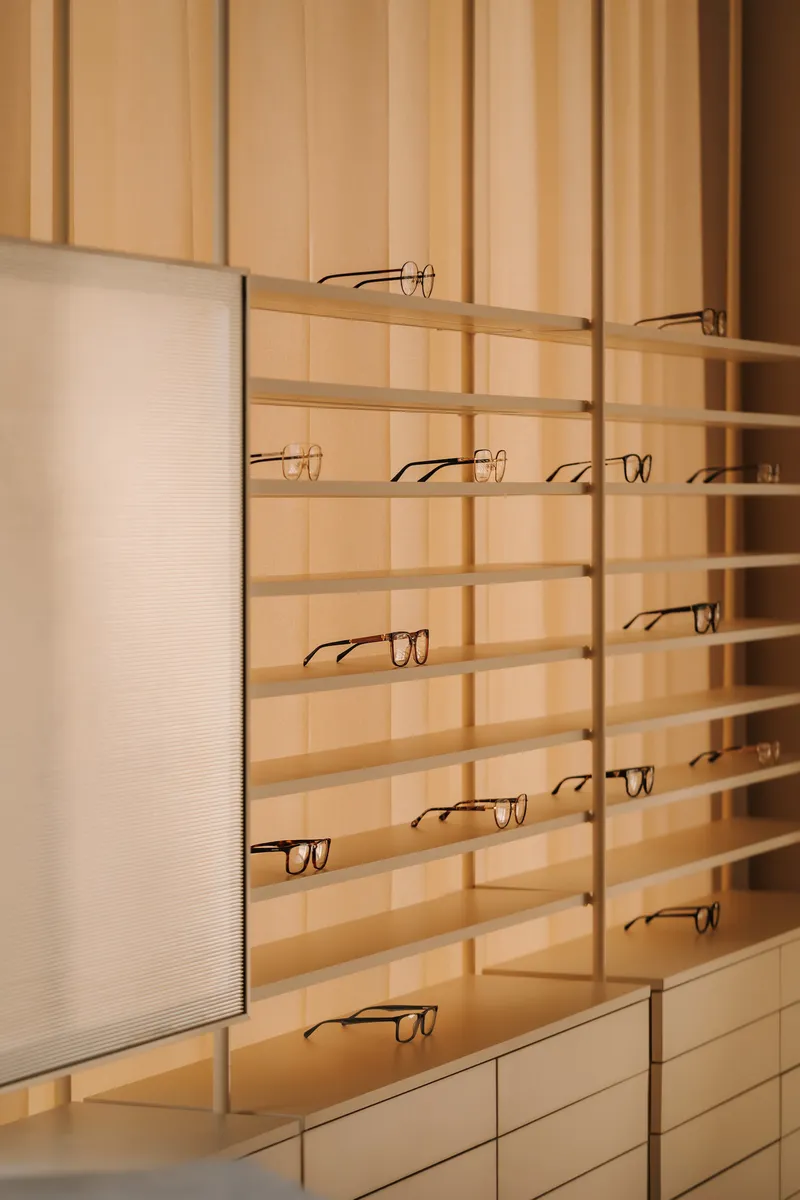
Eyewear is presented on horizontal brass rods mounted against translucent backlit panels and deep teal walls. The shelving system avoids the usual grid logic of retail display. Instead, the rods run at rhythmic but not perfectly regular intervals, giving each frame its own pocket of light while maintaining a visual continuity that reads almost textile-like from a distance. The brass catches warm tones during daylight hours and turns cooler under the LED system at night.
Floor-to-ceiling sheer curtains soften the boundary between display wall and window, filtering afternoon light into the kind of diffuse wash that flatters both product and customer. It is a simple move, but one that reduces glare on lenses and eliminates the harsh reflections that plague many eyewear stores.
Light as Nerve Impulse


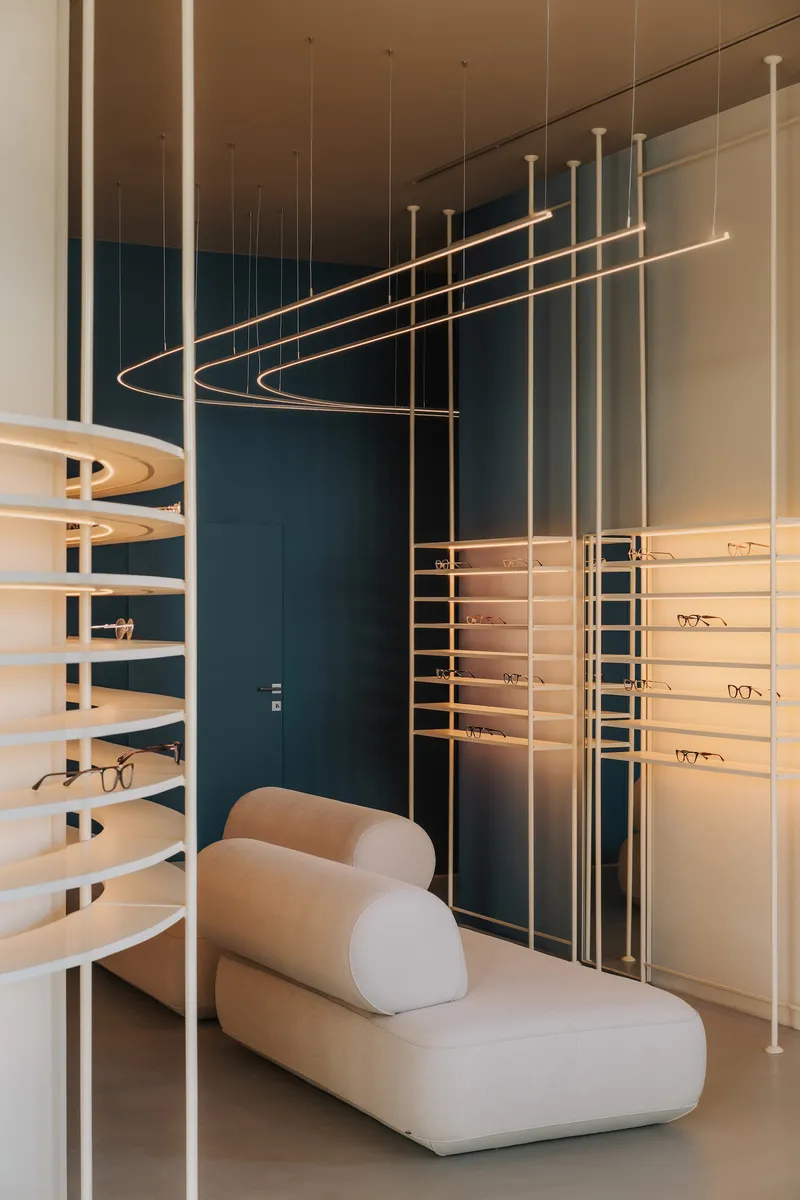
Suspended LED light guides curve through the salon and extend into the consulting rooms at the rear, tracing continuous lines overhead that the studio describes as nerve impulses. The metaphor is apt: these fixtures carry energy, quite literally, from the public retail zone into the private clinical spaces, establishing a visual thread that makes the two programmatic halves feel like parts of one organism.
At night, the fixtures become the dominant architectural element, their tubular forms reading against the dark ceiling like luminous capillaries. The effect is dramatic without being theatrical, a restrained calibration of brightness that keeps the focus on product and patient rather than spectacle.
The Retina: Consulting Rooms and the Blue Gradient


The specialist consulting rooms at the rear of the salon correspond to the retina, the zone where visual information is processed and interpreted. Here, the palette shifts decisively. Deep teal ceilings press down, creating a more intimate enclosure, while pale cabinetry and filtered daylight through horizontal blinds maintain clinical clarity. The blue gradient that has been building from the entrance reaches its deepest navy here, referencing rod photoreceptors and the Purkinje effect.
Functionally, these rooms need to be quiet, controlled, and well-lit for diagnostic work. Znamy się achieves all three without making the spaces feel severed from the retail environment. The LED light guides continue overhead, and the material palette, brass, timber, teal, remains consistent. The result is a clinic that belongs to its store.
Material Encounters at Close Range


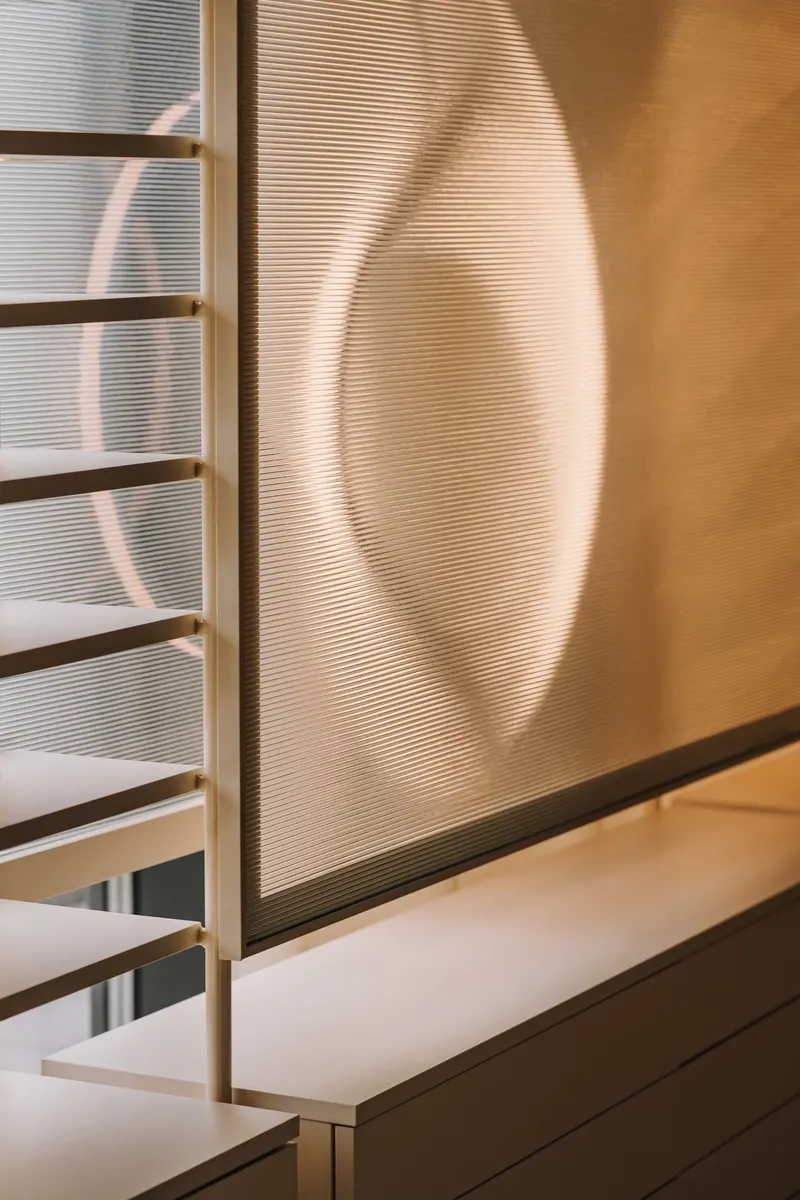
Several details reward closer inspection. Corner alcoves use vertical brass rods as display armatures, framing each pair of glasses as a discrete object rather than inventory. The ribbed translucent wall panels cast precise shadow lines when struck by daylight, turning a partition into a sundial. Sheer curtains pool at the floor, their softness a deliberate counterpoint to the metallic precision of the shelving.
These moments are not incidental. In a salon built around the metaphor of seeing, the details have to perform. If the concept invites you to look more carefully, the surfaces need to reward that attention. They do.
Structural Texture and Thresholds


Vertical metal frames punctuate the interior, serving as both spatial dividers and visual frames. Looking through them, you catch layered views of shelving, teal walls, and curved lighting, a series of framed perspectives that reinforce the salon's optical theme without belaboring it. Weathered steel tubes intersecting horizontal bars and yellow wall planes suggest an industrial materiality that grounds what could otherwise become too precious.
Plans and Drawings
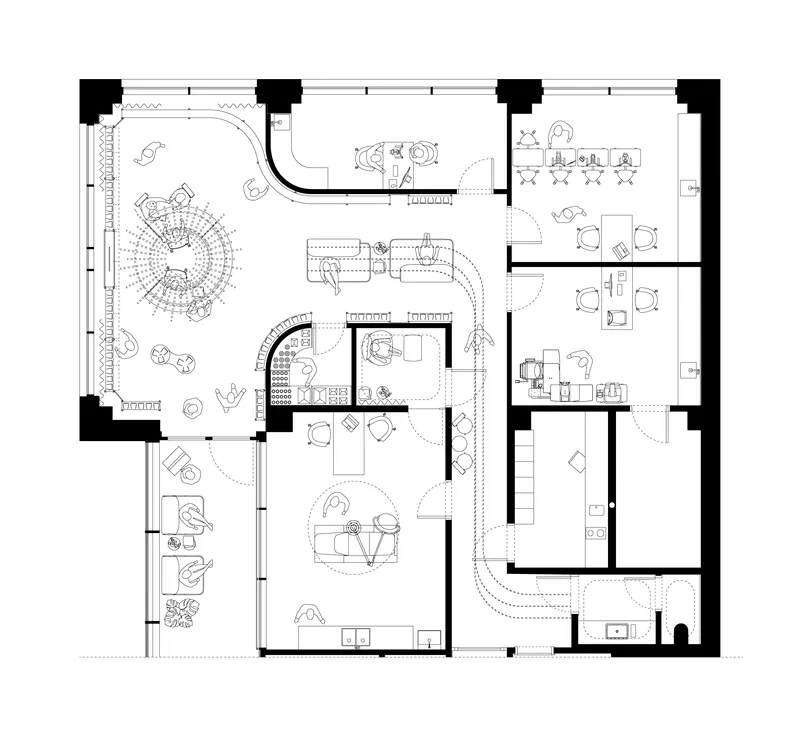
The floor plan confirms the conceptual logic. A central circular seating area occupies the middle of the open workspace, anchoring the retail zone, while private meeting and consulting rooms line the rear. The progression from open to enclosed is clear and unforced, with the round counter acting as the pivot point between public browsing and clinical consultation. The 191 square meters are organized with an economy that belies the richness of the spatial experience.
Why This Project Matters
Concept-driven retail interiors are common enough, but few commit to their premise with this level of consistency. Znamy się did not simply name-check the eye and move on. They mapped an entire biological system onto plan, section, material, and light, then calibrated each element so that the metaphor operates at every scale, from the overall gradient to the grain of the burl wood. The risk with such an approach is always didacticism, and Auga sidesteps it because the spatial experience precedes any explanation. You feel the shift from bright to deep, from open to enclosed, before anyone tells you why.
More practically, the project demonstrates that a specialist optical clinic and a retail showroom do not need to feel like separate programs stapled together. By using a single organizing metaphor, continuous material palette, and the LED light guides as a literal connective thread, Znamy się produced a unified environment where browsing and diagnosis occupy the same conceptual space. For a business built around the act of seeing, that coherence is not just appropriate. It is essential.
Auga Optical Salon by Znamy się (design team: Wojtek Nowak, Bogna Kawa-Nowak, Monika Jokiel, Ula Dachnij-Seredyńska, Anna Petryszyn). Wrocław, Poland. 191 m². Completed 2025. Photography by Migdal Studio.
About the Studio
Share Your Own Work on uni.xyz
If projects like this are the kind of work you want to make, uni.xyz is a place to publish your own, find collaborators, and enter design competitions.



Popular Articles
Popular articles from the community


The Ocean Hive: Sustainable Architecture for a Self-Sufficient Civilization at Sea
The Ocean Hive imagines sustainable architecture at sea, where modular habitats, algae, wave power and ocean waste sustain a growing colony.

EW PARK: Sustainable Architecture Reimagines the Future of Urban Parking
EW PARK reimagines city parking as a modular wooden tower combining automation, solar energy, electric mobility, and adaptable urban design.

Co-Life: Senior Housing Design That Reconnects Older Adults With the City
Co-Life reimagines senior housing design through healing gardens, shared streets, workshops, and a sustainable community across generations.

Riyadh For All: Intergenerational Urban Design for Active Aging in Rabat
Riyadh For All reimagines urban design in Rabat with intergenerational co-living, adaptive courtyards, and Moroccan cultural exchange today.


Similar Reads
You might also enjoy these articles

Bao Huynh Watercolor Atelier: A Serene Art Retreat in Hội An
Bao Huynh Watercolor Atelier in Hội An blends multifunctional art spaces, sustainable design, local materials, and family-friendly living in a serene environment.

Atelier Macri Concept Store Interior Design by CASE-REAL
Atelier Macri store features a "ko" counter, walnut wood details, cork displays, blending retail, gallery, and seamless customer experiences.

Manuel Vargas Izquierdo Stadium and High-Performance Sports Center: Architectural Excellence in Jalpa de Méndez
The Manuel Vargas Izquierdo Stadium blends sustainable design, inclusive sports facilities, and cultural-inspired architecture, revitalizing Jalpa de Méndez’s public spaces.

KAKR Buluh Awar Hall: Revitalizing Community and Ecology Through Bamboo Architecture
Community built bamboo hall revitalizes Buluh Awar village, empowering youth, restoring ecology, celebrating vernacular craftsmanship through sustainable architecture and culture.

Explore Public Building Competitions
Discover active competitions in this discipline



Challenge to design locus for the upliftment of human rights


Design challenge to reuse E-waste
Comments (0)
Please login or sign up to add comments
No comments yet. Be the first to comment!