
B2Ai Converts a 1970s Brussels Brewery into a School for 860 Students
A former Vandenheuvel bottling plant in Sint-Jans-Molenbeek becomes a circular, community-facing educational hub for three learning tracks.


Until the mid-1970s, the building at West Station in Sint-Jans-Molenbeek bottled Ekla pilsner for the Vandenheuvel brewery. After that it stored wine. Then it sat empty. Now, after a thorough circular renovation by B2Ai, it houses 860 secondary school students across academic, technical, and vocational streams in 11,860 square meters of repurposed and newly built space. The Egied Van Broeckhoven School, which opened in September 2024 as the first completed project under the Flemish Government's DBFM school construction initiative, treats heritage preservation and energy performance not as competing agendas but as the same agenda.
What makes the project genuinely interesting is the way it refuses to separate the school from its neighborhood. A semi-underground sports hall is visible from the street. Playgrounds stack on multiple levels above it. After hours, the gymnasium and fields open to local sports clubs, boxing academies, and youth initiatives. In a dense, multicultural district where Dutch-language education is in high demand, B2Ai has designed a building that earns its relevance by staying permeable rather than retreating behind walls.
A Facade That Bridges Two Centuries of Construction
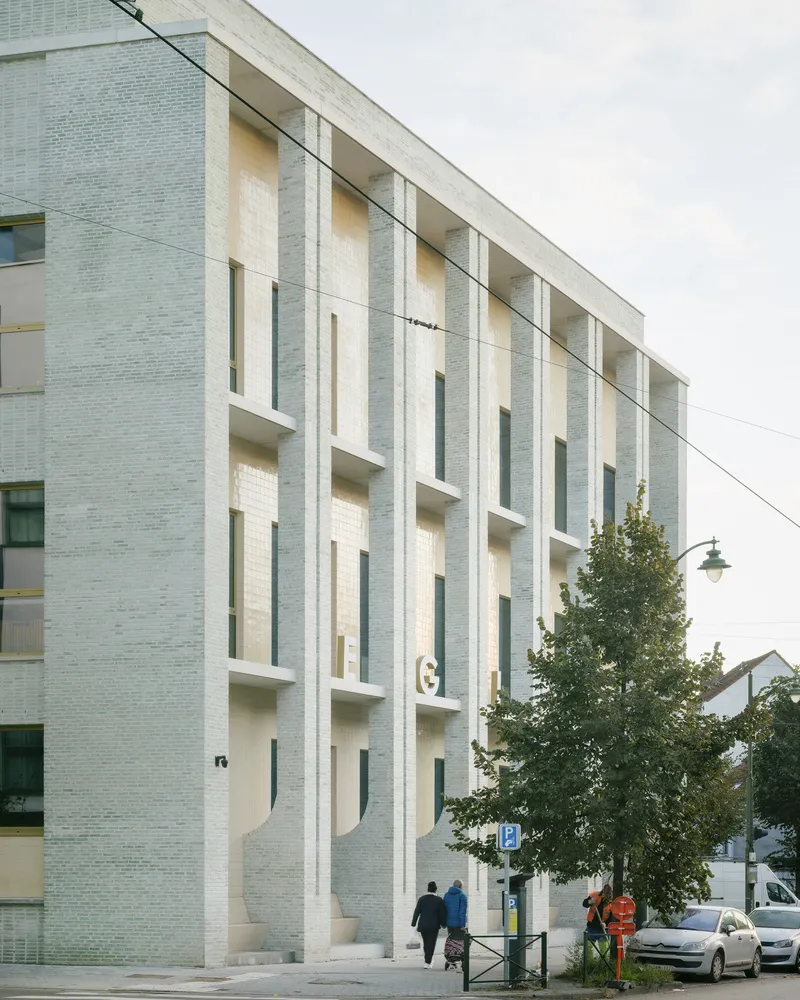
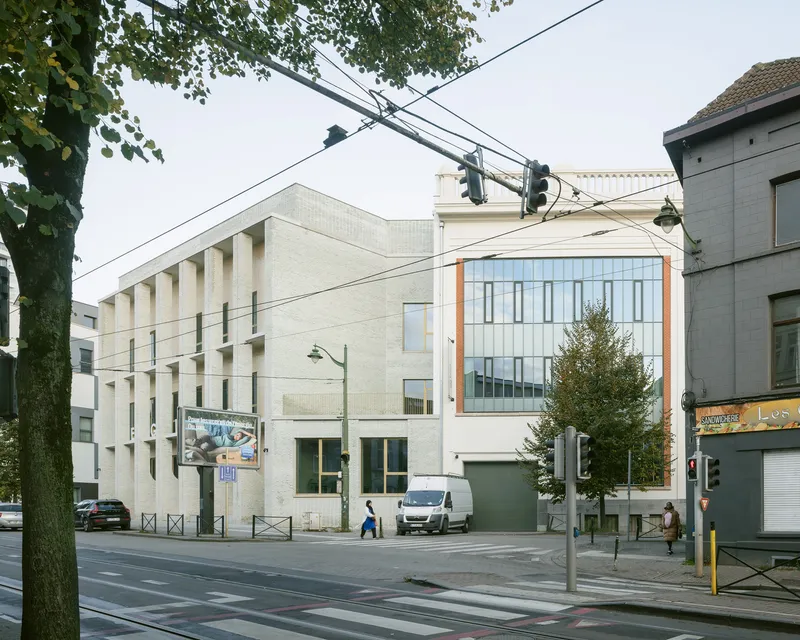
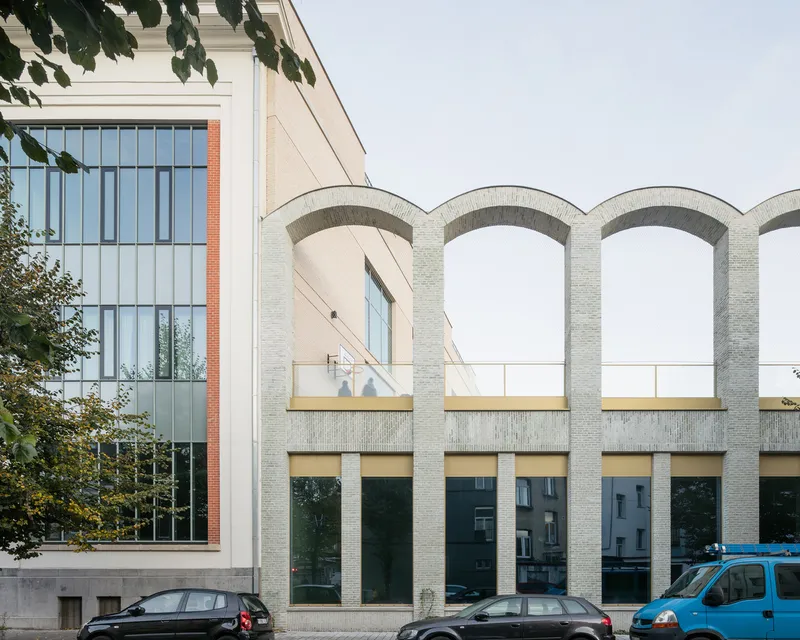
The original Art Deco street facades were cleaned, insulated to meet current energy performance standards, and left to speak for themselves. B2Ai's new volumes pick up the language of the existing structure: arched openings, vertical articulation, a pronounced cornice line. The pale brick and grey-green facade stone of the additions read as a continuation rather than a contrast, with ochre-colored joinery providing a warm chromatic thread across old and new.
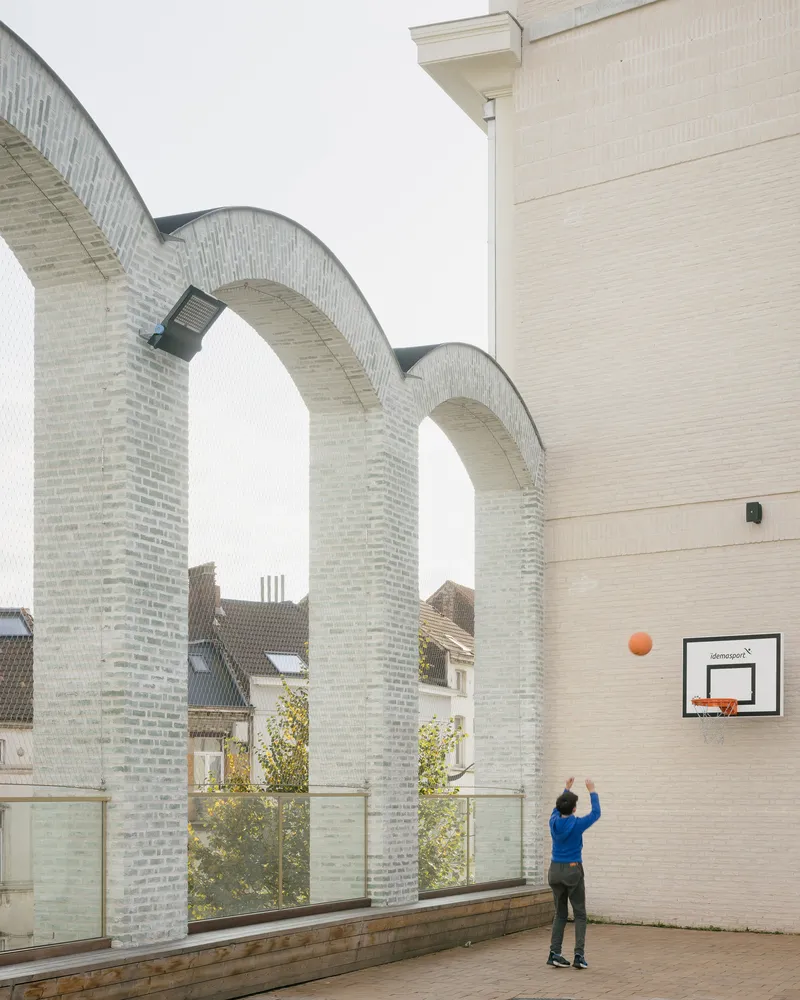
The street-level arched colonnade along one elevation does double duty: it gives the building civic presence while sheltering arrival zones and the connection between indoor and outdoor sports spaces. Parked cars and overhead power lines are a reminder that this is not a pristine campus. It is a working school embedded in a working neighborhood, and the architecture makes no attempt to sanitize that context.
The Courtyard as Social Engine
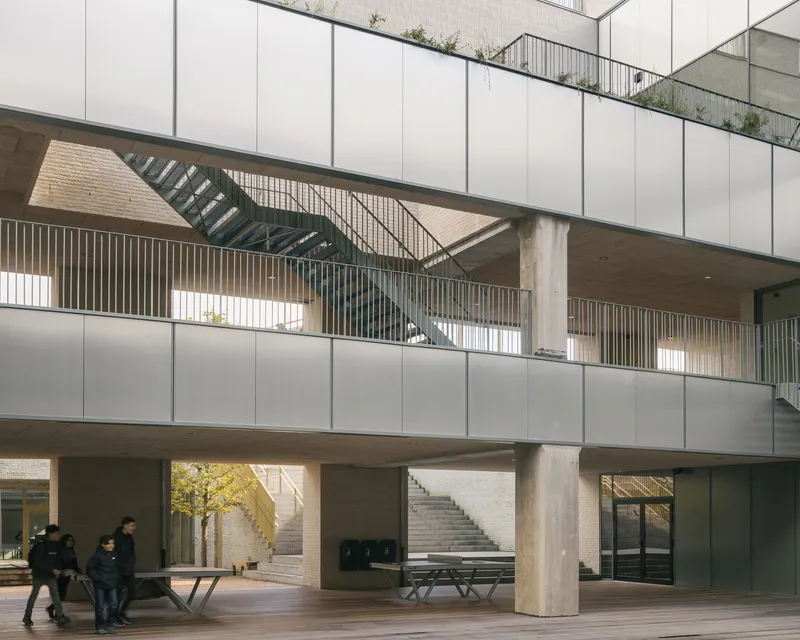
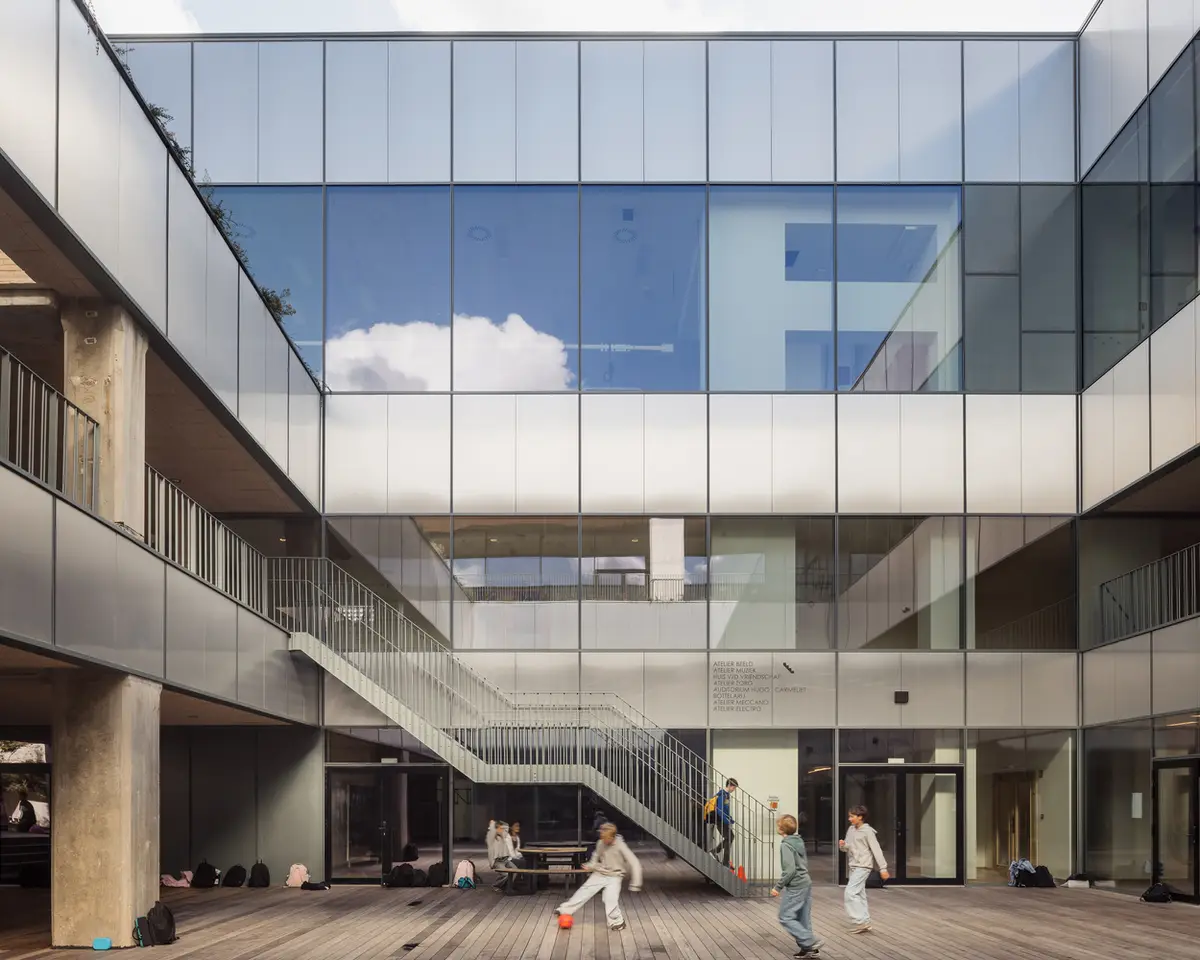
A central patio, introduced into the deep floor plate inherited from the brewery's concrete grid, solves two problems at once. It pulls daylight into interiors that the original industrial layout would have left dim, and it creates a social heart where circulation, play, and informal learning overlap. The covered entrance courtyard, with its exposed concrete columns and suspended terrace, operates as a kind of urban living room: open enough to feel public, defined enough to feel safe.
The basketball court tucked beneath brick arches captures the spirit of the whole project. Play happens in leftover spaces, on rooftops, between structural bays. Playground area is distributed across multiple levels rather than spread across a single ground-floor footprint, a smart response to the dense site and the need to serve nearly 900 students without swallowing the block.
Industrial Bones, Pedagogical Flexibility
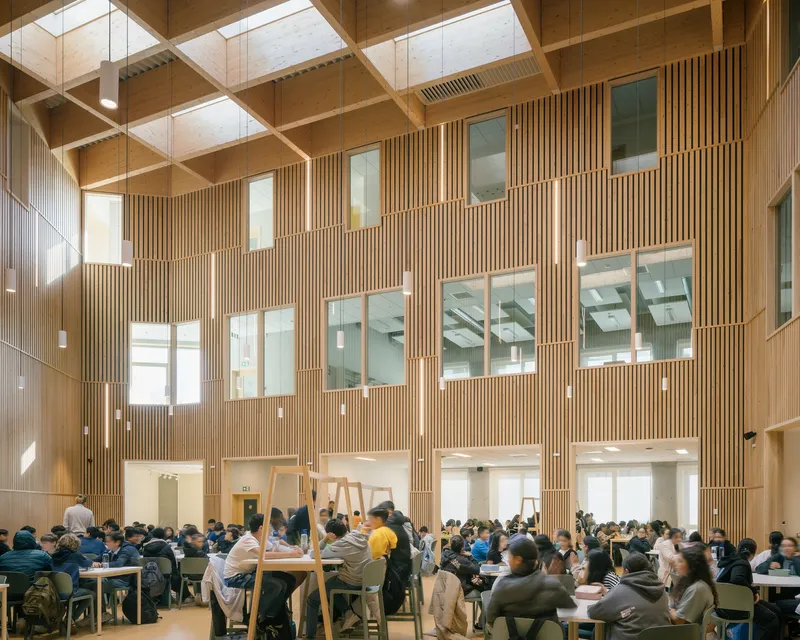
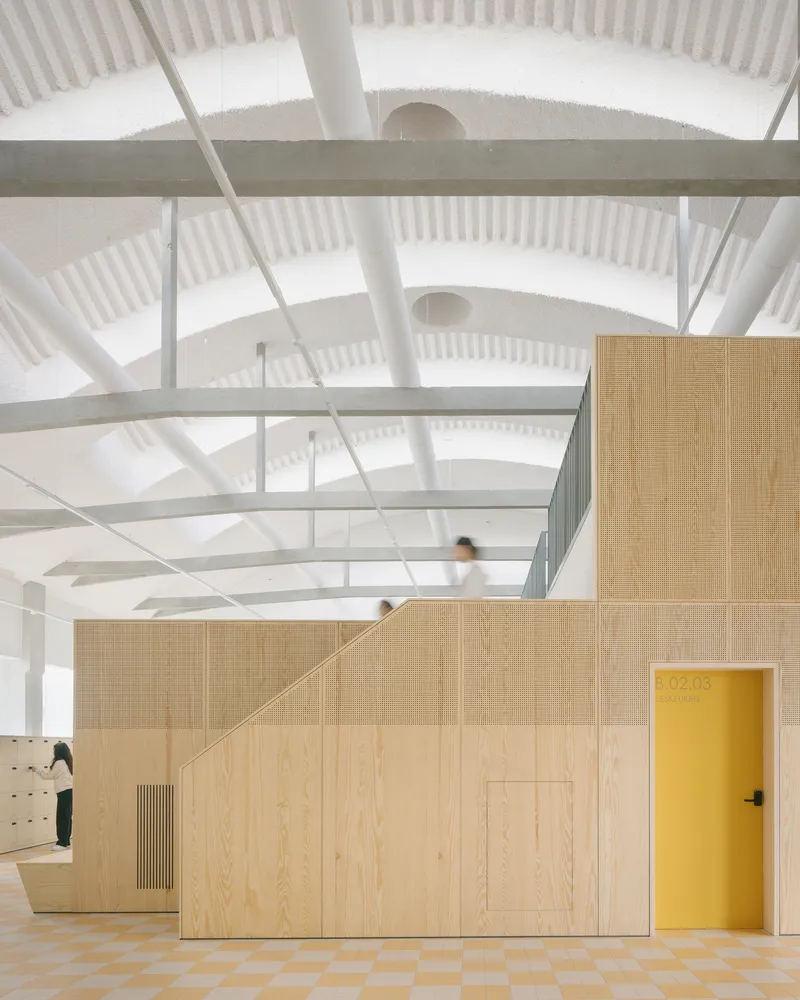
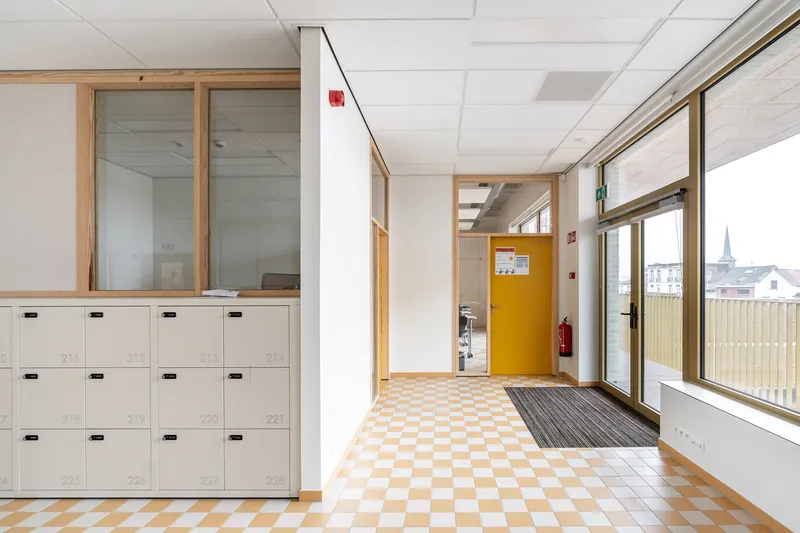
Inside, the brewery's concrete skeleton is left exposed. High ceilings in the former bottling hall, complete with its arched roof, have been converted into open learning environments, workshops, and an auditorium. B2Ai made a deliberate decision to treat the existing structure as the interior finish rather than concealing it behind plasterboard, letting the industrial character anchor the school's identity.
The material palette is restrained and legible. Pine wood lines walls and ceilings in gathering spaces like the double-height dining hall, where coffered skylights wash surfaces with even light. Elsewhere, demountable plywood partitions and ochre-grey checkered floor tiles, some of them reclaimed, keep the interiors adaptable. First-through-fourth-year students occupy familiar classroom clusters with adjoining project spaces for collaborative work. In the final two years, the emphasis shifts to self-directed learning, and the architecture accommodates that transition without requiring renovation, just reconfiguration.
Yellow doors punctuate the corridors like way-finding markers, and white locker banks provide necessary storage without crowding the generous ceiling heights. The exposed steel trusses above the partitioned zones are a constant reminder that these rooms were once part of something much larger, and could be again.
Arrival and Identity
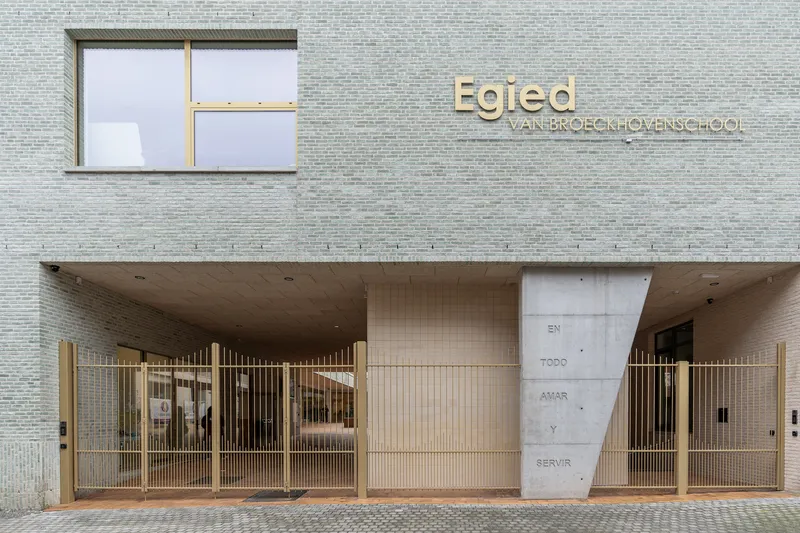
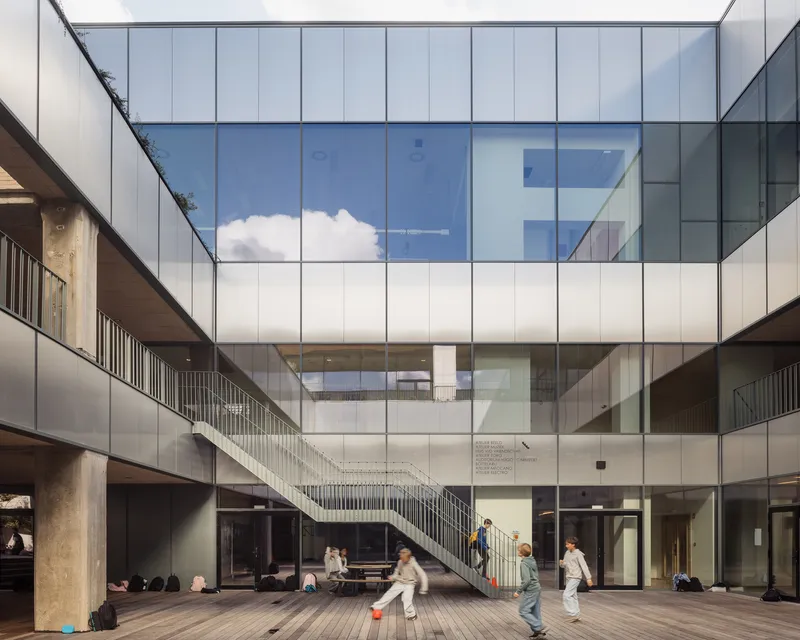
The main entry, marked by brass lettering and a recessed loggia with vertical metal gates, establishes the school's civic presence without resorting to grand gestures. An inscribed concrete panel grounds the institution's name in the materiality of the building itself. It is a restrained move, but an effective one: the school announces itself as permanent, serious, and rooted in its place.
Behind this threshold, the glass curtain wall facing the interior courtyard reverses the experience. Timber decking, a diagonal staircase, and children at play become visible almost immediately. The shift from stone compression to transparent openness happens within a few steps, encoding the pedagogical idea that the school is simultaneously protective and liberating.
Energy Performance Without the Sermon
B2Ai pushed the building's energy consumption 30 percent below prescribed EPB regulations for new construction. An Aquifer Thermal Energy Storage system, paired with a geothermal heat pump, meets 90 percent of the heating load and provides passive cooling in summer. Solar panels on the roof supply green electricity. A D-system ventilation strategy with heat recovery manages indoor air quality year-round. These are not showpiece technologies; they are pragmatic choices made legible by the building's performance rather than by signage.
The insulation of the Art Deco facades is perhaps the most telling detail. Rather than demolish and rebuild, the architects found a way to bring century-old walls up to current thermal standards while preserving their ornamental integrity. That balance, between conservation and performance, defines the entire project's ethos.
Why This Project Matters
The Egied Van Broeckhoven School matters because it proves that adaptive reuse at an institutional scale can be rigorous, not just romantic. Converting a brewery into a school for 860 students is not a weekend salvage project. It requires structural audacity, energy engineering, and a spatial strategy that serves pedagogical goals over architectural ego. B2Ai delivered all three, and did so as the first completed project in a pipeline of roughly 40 DBFM school commissions across Flanders. The precedent is now set.
More importantly, the building rejects the gated-campus model that has defined school design for decades. By making its sports facilities available to the community, keeping its ground floor visually open to the street, and partnering with local organizations from boxing clubs to debate societies, the school treats architecture as social infrastructure. In a neighborhood that has too often been discussed in terms of its problems, this building is a concrete, literal argument for investment, inclusion, and long-term optimism.
Egied Van Broeckhoven School by B2Ai. Sint-Jans-Molenbeek, Brussels, Belgium. 11,860 m². Completed 2024. Photography by Stijn Bollaert and Matthias Vanhoutteghem.
About the Studio
Share Your Own Work on uni.xyz
If projects like this are the kind of work you want to make, uni.xyz is a place to publish your own, find collaborators, and enter design competitions.


Popular Articles
Popular articles from the community


David Ortega Stacks a Two-Story Mexico City Penthouse Around a Steel Stair and a Pergola-Shaded Roof Terrace
In Colonia Roma, a 300 m² penthouse uses oak joinery, a planted steel stair and a slatted roof pergola to make a new-build apartment feel like a house.

Cube Design Draws an Ecological Corridor Between Two Shenzhen Hills with the Nankai Building
Beside Shenzhen's container docks, the Nankai Building pairs stacked balconies with a climbing green screen to connect two hillsides across its height.


Opera on the Sea: Driftwood Logic Shapes a Timber Opera House on Estonia's Coast
Trevor Orgill's opera house translates the entangled drift of floating timber into a civic building where wood, water, and music converge.

The Amber Palace Opera: A Geological Fiction Surfaces on Tallinn's Baltic Waterfront
Pierre Brillard reimagines a Baltic legend as a public landscape, opera house, and waterfront promenade rooted in Tallinn's coastal identity.

Similar Reads
You might also enjoy these articles


Hodi-Mandai Geram
Project Function: Preservation and revitalization of the Intangible heritage and socio-spatial identity of the Hodi by Housing, Cultural Memory Center, Sacred Grove, landscape, local tourism economy


Olio Towers: A Mid-Rise for Performers That Fuses Housing, Rehearsal, and Stage
Located blocks from Houston's Theater District, this modular tower stacks living units around a central performance atrium.

Oasis: Modular Green Housing Carved into Dhaka's Urban Fabric
A shortlisted Plugin Housing entry reclaims unauthorized settlements in Dhaka with stepped concrete volumes, green roofs, and ventilation-driven design.

Black Hole: A Floating Megastructure for the Post-Physical Era
Emiliano Mazzarotto envisions a spherical, self-scaling arena where e-sports, digital hotels, and holographic stadiums replace traditional public space.

Explore Educational Building Competitions
Discover active competitions in this discipline

Challenge to design public laboratory

Challenge to reimagine the Iron Throne

Photograph architecture without architects

Illustrate the lost glory of Angkor Wat - Render Challenge
Comments (0)
Please login or sign up to add comments
No comments yet. Be the first to comment!