

El fabricante de espheras Weaves a Market Pavilion from Tote Bags and Fruit Crates in València
A cylindrical textile installation on Plaza del Ayuntamiento recovers the shade, scent, and spirit of a 16th-century market tradition.


Markets generate cities. In València, the square between Mercado Central and La Lonja has hosted market stalls since the sixteenth century, and its identity is still tied to the rituals of exchange: the overhead awning, the wooden crate, the rope that holds everything together. La Valentina, an ephemeral installation by El fabricante de espheras, takes those elemental materials and reassembles them into a concave gathering space, a small agora that argues for a different kind of public life in the city center.
Originally commissioned for València's urban planning week in 2020 and postponed by the pandemic, La Valentina finally materialized in May 2021. The site shifted too: refurbishment works on Plaza del Mercado pushed the pavilion to Plaza del Ayuntamiento. What could have been a compromise became an opportunity. The installation landed among the grand civic facades and clock tower of the city's ceremonial square, injecting something intimate, handmade, and deliberately temporary into a setting designed for permanence. Its circular steel ring suspended tote bags in a curtain that created shade, framed views, and, when the week was over, was dismantled and given away to neighbors.
A Ring of Fabric Against the City

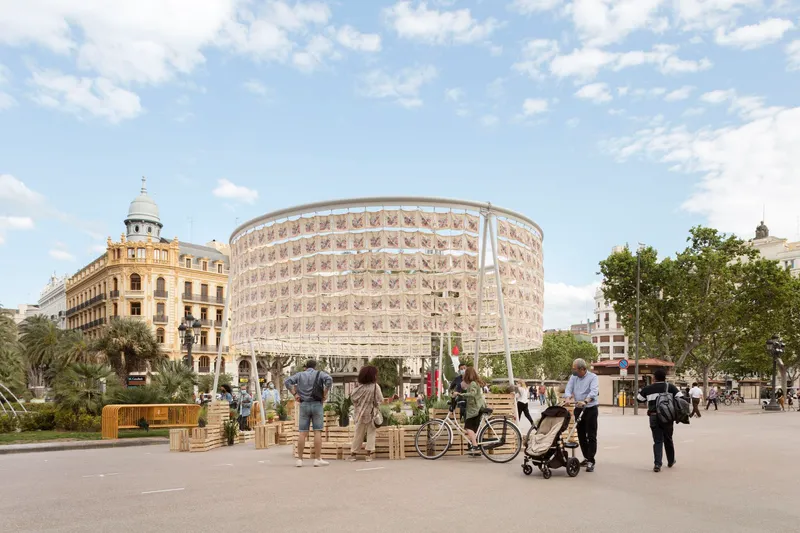
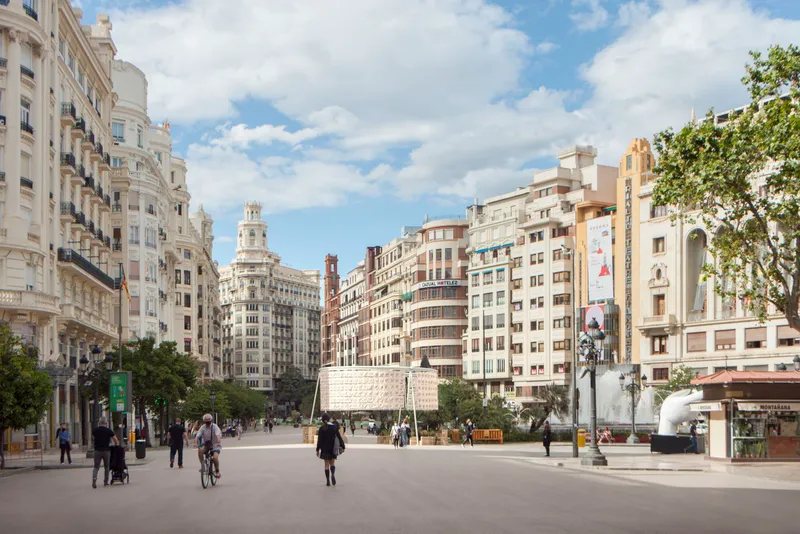
The installation reads as a soft cylinder dropped into hard ground. A white tubular steel ring, fabricated by Hierros y Estructuras Segorbe, defines the perimeter. From it, printed tote bags hang on ropes to form a continuous screen that is porous enough to let breeze and bodies through yet dense enough to establish enclosure. The effect is something between a curtain and a wall, and the ambiguity is the point: La Valentina is neither building nor furniture, but it behaves enough like both to anchor activity in the plaza.
Seen from outside, the pavilion holds its own against the surrounding apartment blocks and civic monuments. Its cylindrical form is simple, almost generic, but the printed textiles give it a graphic presence that shifts with light and viewing angle. The decision to use tote bags, the ubiquitous accessory of ethical consumerism, is slyly on the nose for a project rooted in market culture.
Shade as a Social Act
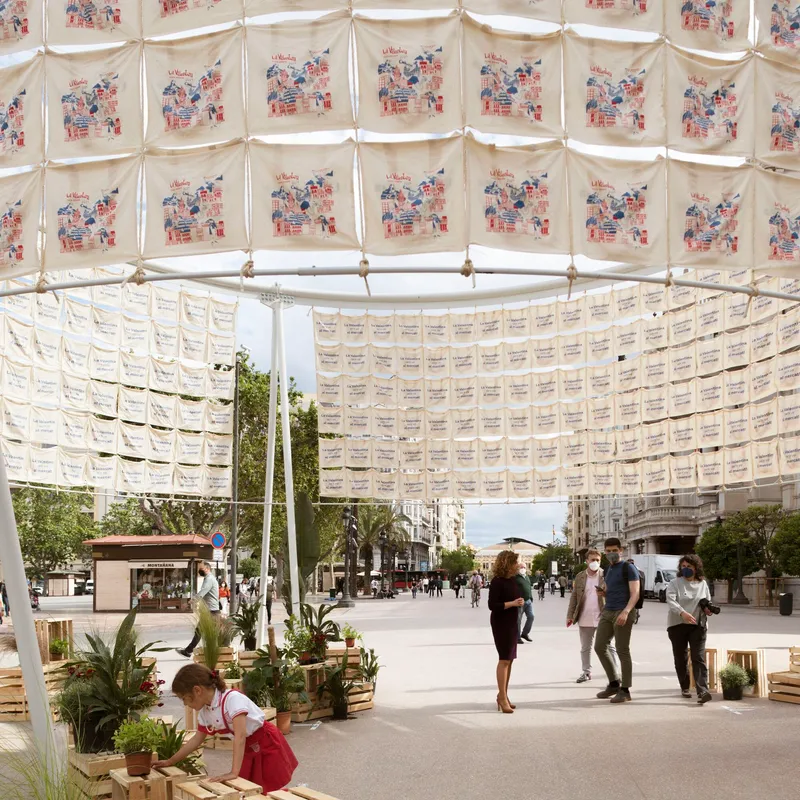
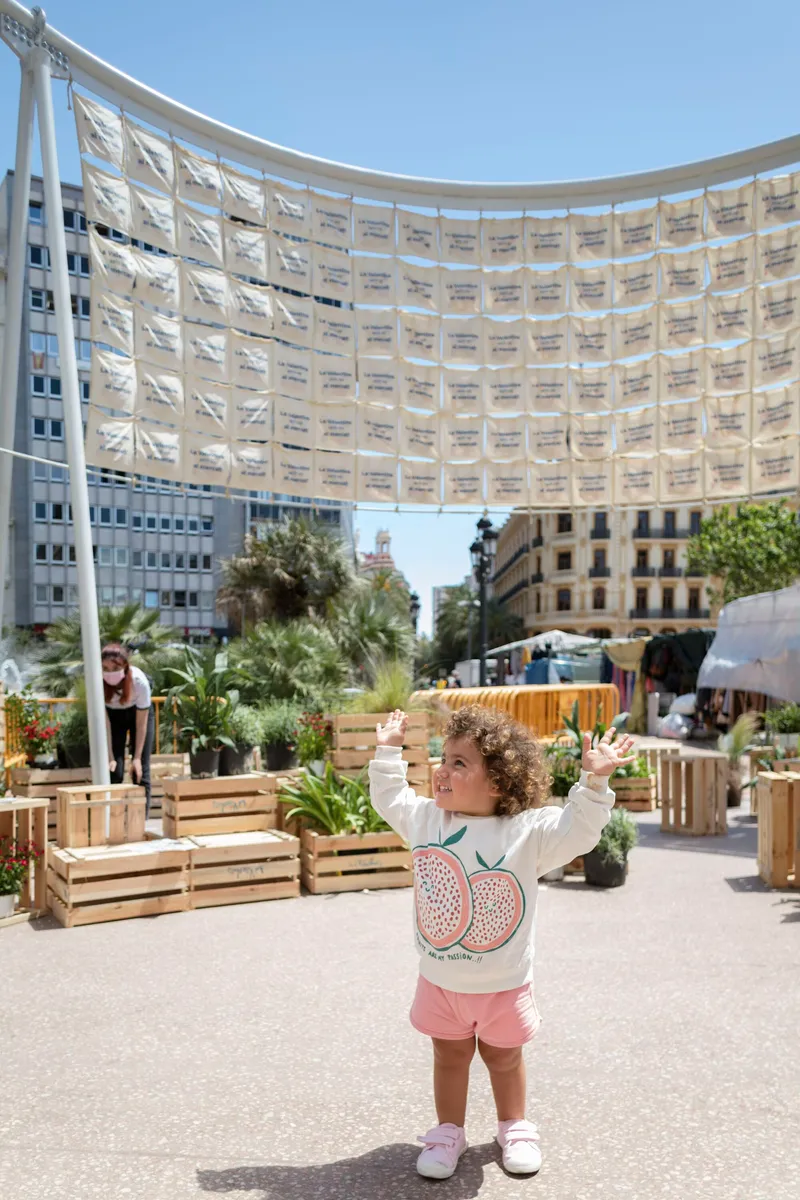
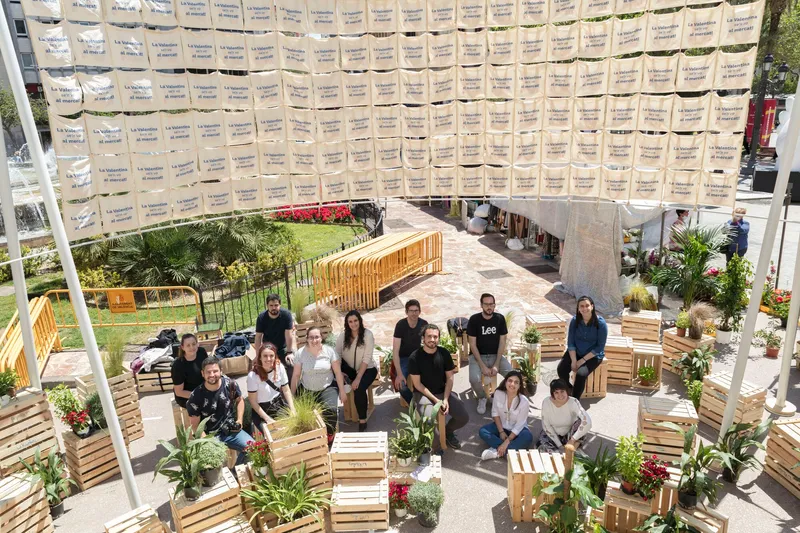
The interior tells a different story than the exterior. Step through the textile screen and the scale collapses to something domestic: timber fruit crates serve as benches and tables, planted containers bring greenery to the paving, and the overhead canopy filters sun into a soft, dappled condition. Children sit among the planters. Adults linger. The concave geometry encourages people to face each other rather than drift apart, and the shade overhead does what market awnings have done for centuries: it converts exposed pavement into habitable ground.
This is the installation's central claim, stated as a physical manifesto for gender-responsive urban planning. Public space that provides comfort, not just passage, changes who uses it and for how long. The shade here is not decorative. It is infrastructure, even if it only lasts a week.
Assembly by Hand
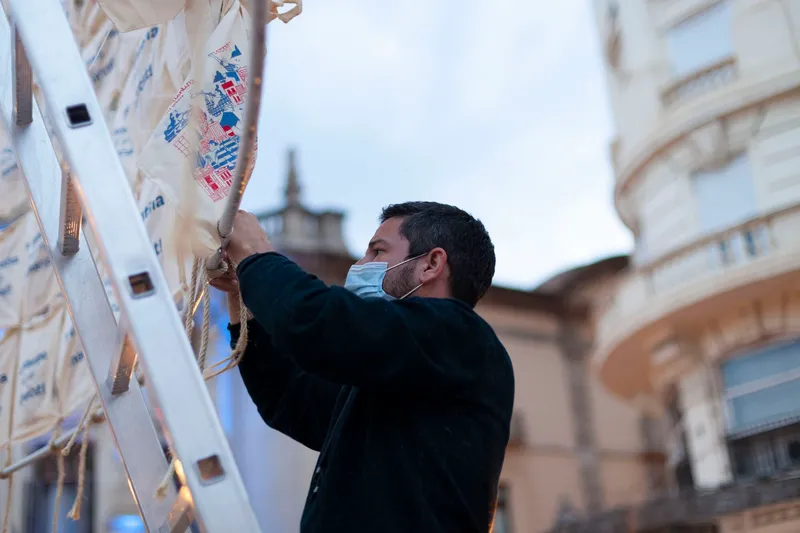
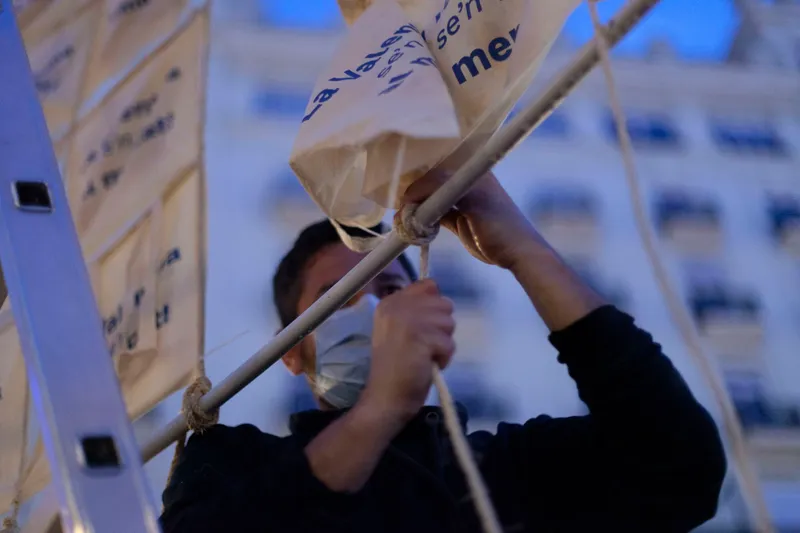
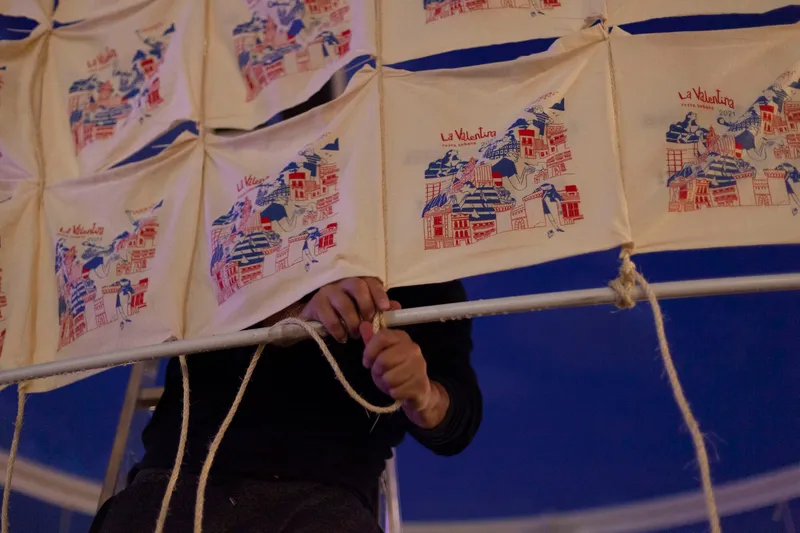
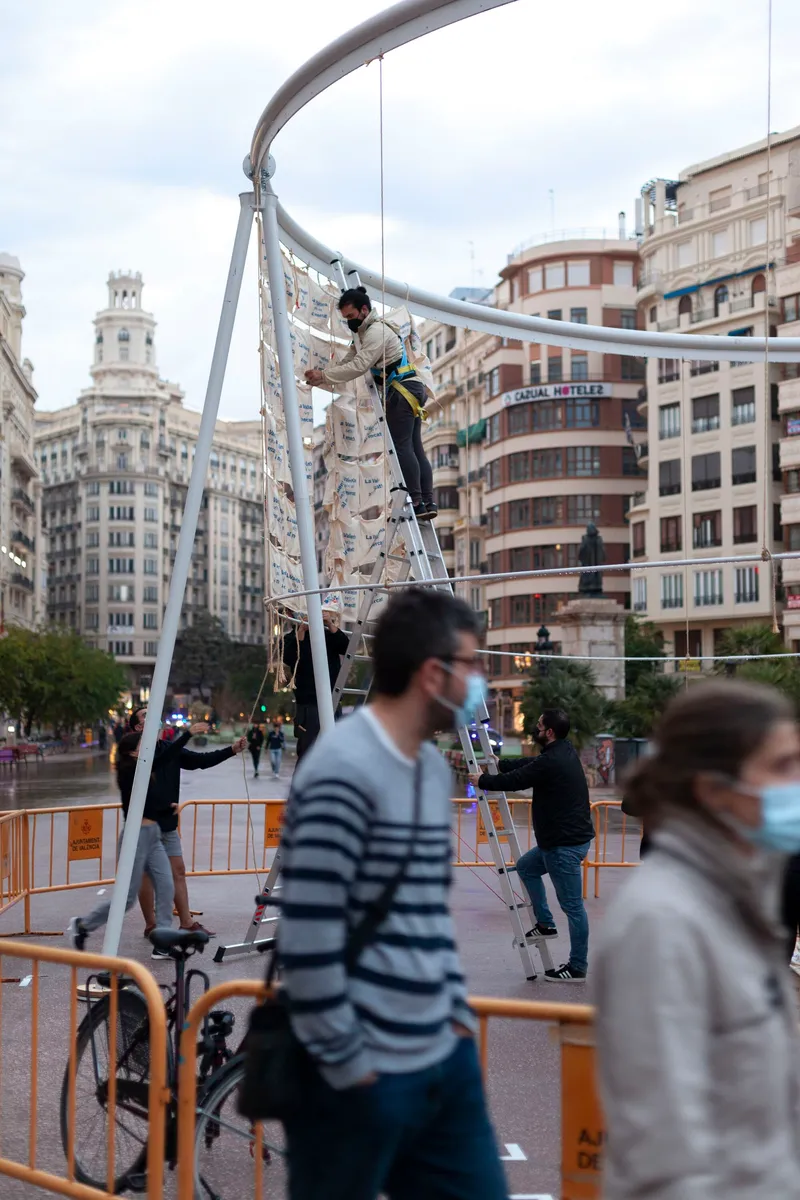
The construction sequence reveals a project that depends on labor more than technology. After cranes set the steel ring in place, the rest was hand work: tote bags lashed to rope, rope tied to the frame, timber poles crossed and bound. The images of hands knotting fabric to structure at dusk feel closer to a fishing village than a design festival, and that is what makes them convincing. Every joint is legible, every connection reversible.
Reversibility was always part of the plan. The entire installation was disassembled with help from neighbours and market users. Bags, crates, ropes, and plants were distributed to attendees, turning deconstruction into a closing ceremony. Only the steel ring was stored, waiting for a future site in a city park or square. The architecture circulated back into the community that made it possible.
Lifting the Ring
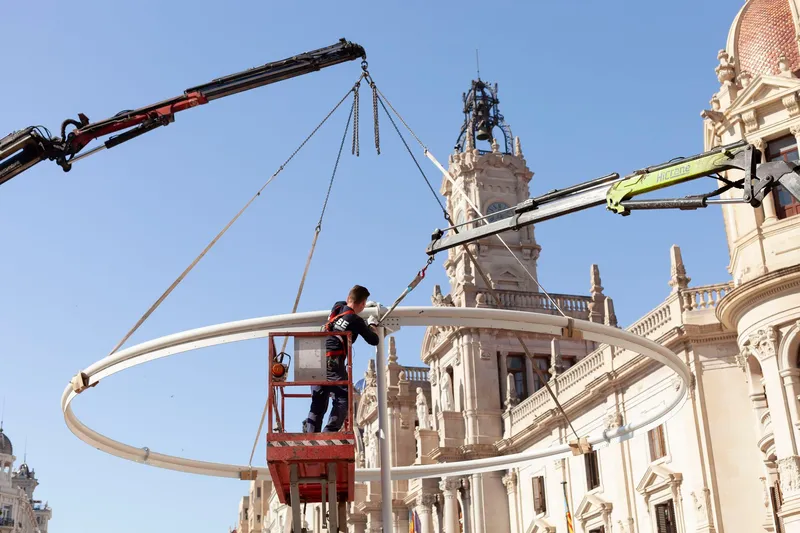


The crane sequence is worth pausing on because it exposes the one moment of industrial intervention in an otherwise artisanal process. The curved white ring rises above historic cornices, a clean geometric form momentarily set against ornamental facades. Workers below mark positions on the paving stones with the precision of a stage crew blocking a performance. The contrast between the crane's reach and the hand-tied knots that will follow collapses the distance between heavy engineering and craft, which is ultimately what market architecture has always done: light structures supported by serious logistics.
Market Echoes


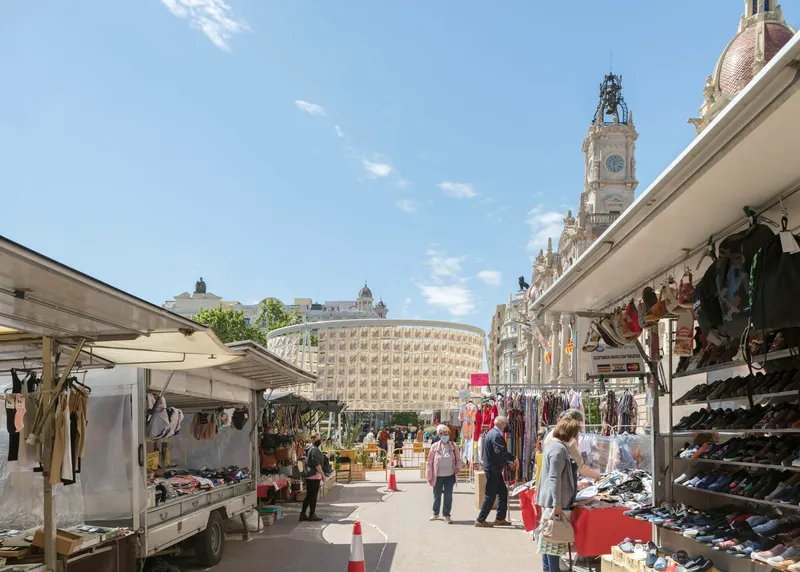
Seen alongside the actual market stalls that ring the plaza, La Valentina clarifies its lineage. The white canopies of the temporary vendors echo the white bags of the pavilion. Both are lightweight, demountable, and oriented toward exchange. The installation does not imitate the market; it abstracts it, distilling the awning and the crate into a formal language that can carry additional meanings about public space, gender equity, and the politics of gathering.
Placing clothing racks and other vendor goods beside the textile screen collapses any remaining boundary between art object and commercial setting. The pavilion becomes part of the market, not a commentary on it viewed from a safe distance.
Detail and Texture Up Close

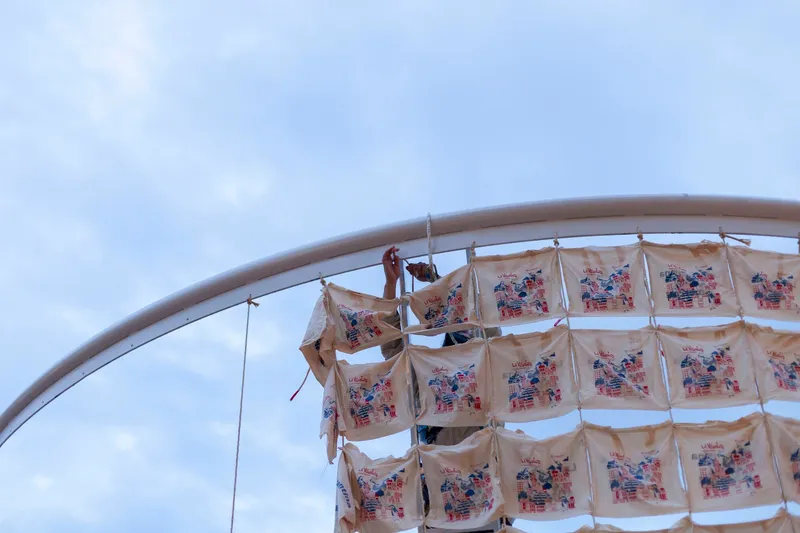

At close range, the printed graphics on the bags become legible, and the roughness of the rope connections takes on an almost decorative quality. The curved steel armature reads as a slender white line against overcast sky, barely there. Timber and fabric occupy the foreground. This hierarchy is deliberate: the structural system disappears so that the sensory materials can dominate. El fabricante de espheras understands that texture, not form, is what people remember about a space they touched.
Plans and Drawings
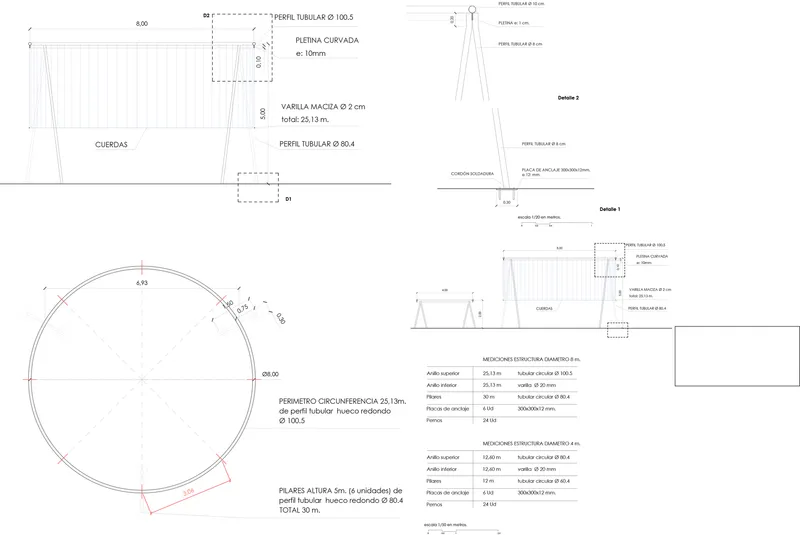
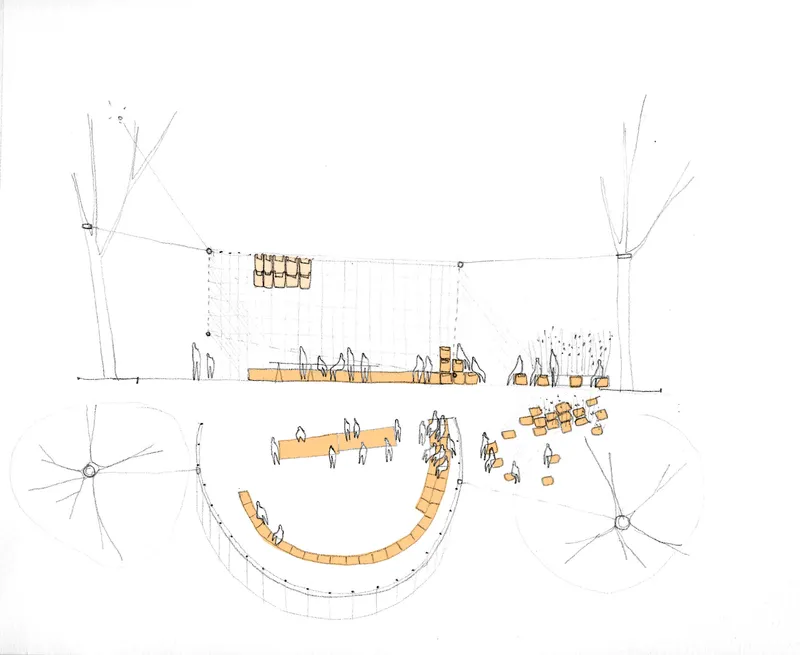
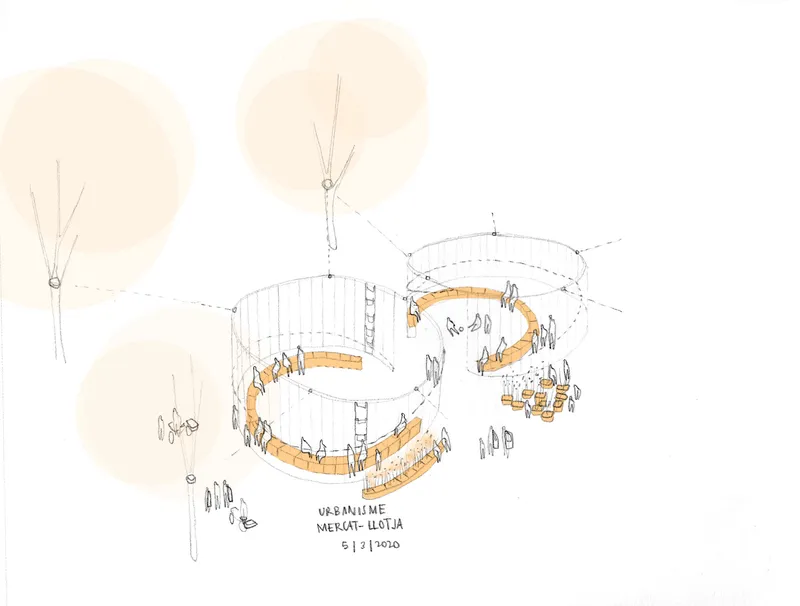

The technical drawing of the circular timber assembly lays out structural dimensions and connection details with the economy of a construction manual. The sketches are looser: watercolor isometrics of spiraling timber platforms, section views of the canopy with hanging planters, plan diagrams of curved seating. Read together, they trace the project from concept to calculation. The gap between the loose watercolor figures and the measured plan is where design happens, and El fabricante de espheras leaves that gap visible rather than papering over it with polished renders.
Why This Project Matters
Ephemeral architecture is easy to dismiss. It goes up, it comes down, and what remains is photographs and goodwill. La Valentina challenges that reading by building circularity into its core logic. The steel ring persists, ready for reuse. The materials disperse into the hands of the community. The argument for shade, comfort, and inclusion in public space persists long after the ropes are untied. In a city where market culture is centuries deep, the installation does not need to last forever to make its point.
What we find compelling is the refusal to separate politics from pleasure. La Valentina is a manifesto for gender-responsive urban planning, but it is also a place where a child stands in dappled light and a neighbor sits on a fruit crate to talk. The best public spaces hold both registers at once. This one did, even if only for a week.
La Valentina Installation by El fabricante de espheras. València, Spain. Completed 2021. Photography by Milena Villalba.
About the Studio
Share Your Own Work on uni.xyz
If projects like this are the kind of work you want to make, uni.xyz is a place to publish your own, find collaborators, and enter design competitions.


Popular Articles
Popular articles from the community


Extended Shell: Retrofitting Kolkata's Balconies as Living Urban Thresholds
A modular retrofit system recovers the social and environmental intelligence of Kolkata's historic verandas for contemporary Park Street residents.

Tsunami Convergenics: Turning Catastrophic Ocean Forces into Underwater Housing Infrastructure
A speculative underwater settlement off the coast of Onagawa, Japan, treats tsunamis and typhoons as energy sources rather than threats.

Temporary Home for Dogs: A Reversed Zoo Rethinks Animal Shelter Architecture
In Bucharest, a sinuous corridor and freed landscape flip the logic of containment, designing a shelter that works to make itself unnecessary.

Faces of the Soviet Avant-Garde: Turning Moscow's Street Names into an Open-Air Museum
A network of sculptural installations across a Moscow residential district transforms forgotten architect names into spatial encounters with cultural memor

Similar Reads
You might also enjoy these articles

Pixel Gardens: One Repeated Module Stacked Into a Terraced Social Housing Tower for Famagusta
Salem Bader's shortlisted housing tower builds a vertical neighbourhood from one repeated module, offsetting units to carve terraces, light and air.

Bao Huynh Watercolor Atelier: A Serene Art Retreat in Hội An
Bao Huynh Watercolor Atelier in Hội An blends multifunctional art spaces, sustainable design, local materials, and family-friendly living in a serene environment.

Atelier Macri Concept Store Interior Design by CASE-REAL
Atelier Macri store features a "ko" counter, walnut wood details, cork displays, blending retail, gallery, and seamless customer experiences.

Manuel Vargas Izquierdo Stadium and High-Performance Sports Center: Architectural Excellence in Jalpa de Méndez
The Manuel Vargas Izquierdo Stadium blends sustainable design, inclusive sports facilities, and cultural-inspired architecture, revitalizing Jalpa de Méndez’s public spaces.

Explore Plaza Competitions
Discover active competitions in this discipline

Challenge to design a portable theatre

Challenge to design a portable music platform

Challenge to design an open learning module for the elderly

Challenge to design luxury tourism on rails
Comments (0)
Please login or sign up to add comments
No comments yet. Be the first to comment!