
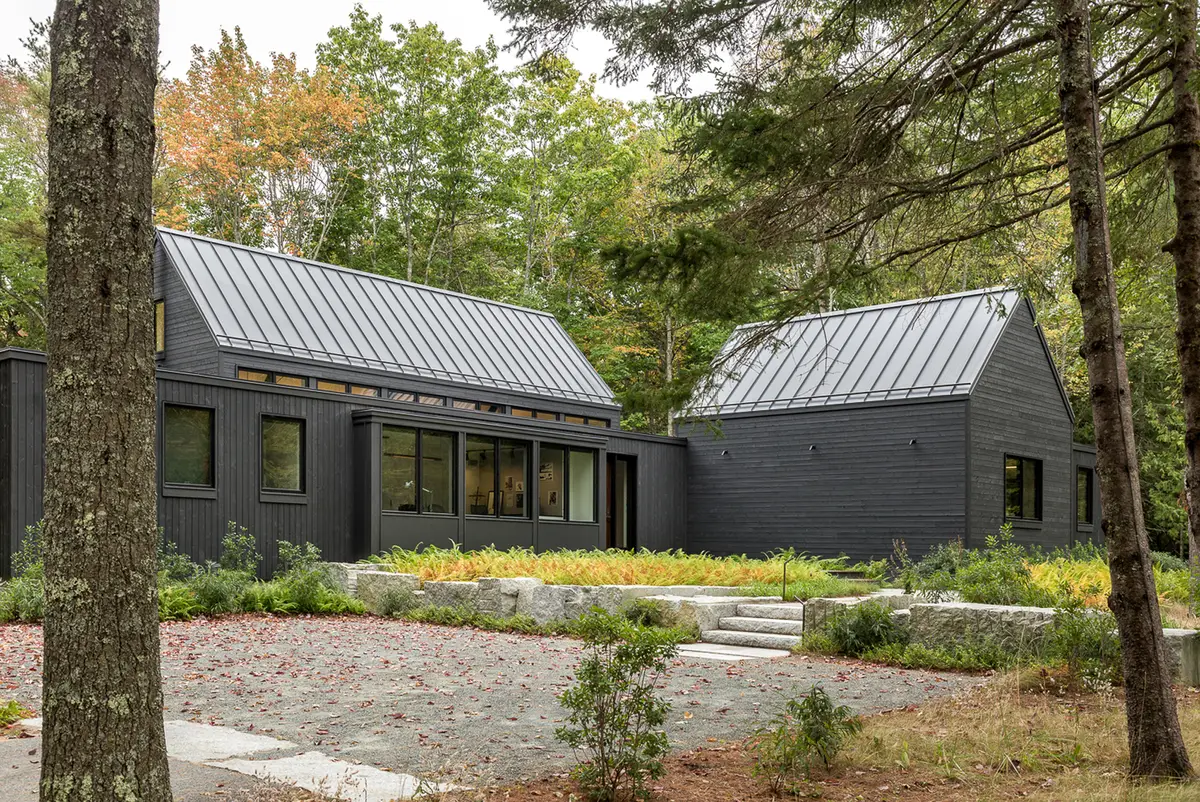
ElliottArchitects Builds a Dark Gabled House on a Century-Old Foundation in Blue Hill, Maine
A black-stained residence replaces a 19th century Cape Cod, bridging a walkable town center and the Maine woods on one compact site.


For over a hundred years, a Cape Cod residence sat on this spot in Blue Hill, Maine, five minutes on foot from the center of town and backed up against deep woods. When ElliottArchitects took on the project, lead architect Matt Elliott chose to build on the existing foundation rather than start from scratch, anchoring a new house to the memory of the old one while pursuing a radically different spatial expression. The result is a house that holds two identities at once: familiar gabled massing that respects the scale of its neighbors, and a stripped-back material palette that lets the building nearly vanish into its wooded setting.
What makes the project genuinely interesting is the way it treats the threshold between town and wilderness not as a boundary but as a gradient. The front door faces civic life; the back door opens onto ferns, pines, and silence. Rather than choosing a side, the house occupies the seam, using dark-stained wood cladding and a dark metal roof to read as shadow among the trees while maintaining a civic presence through its familiar roofline. Two gabled volumes, one for living and one for a woodworking shop, are linked by a glazed connector, and a rift of granite blocks organizes the ground plane around them.
A Dark Shell in the Trees
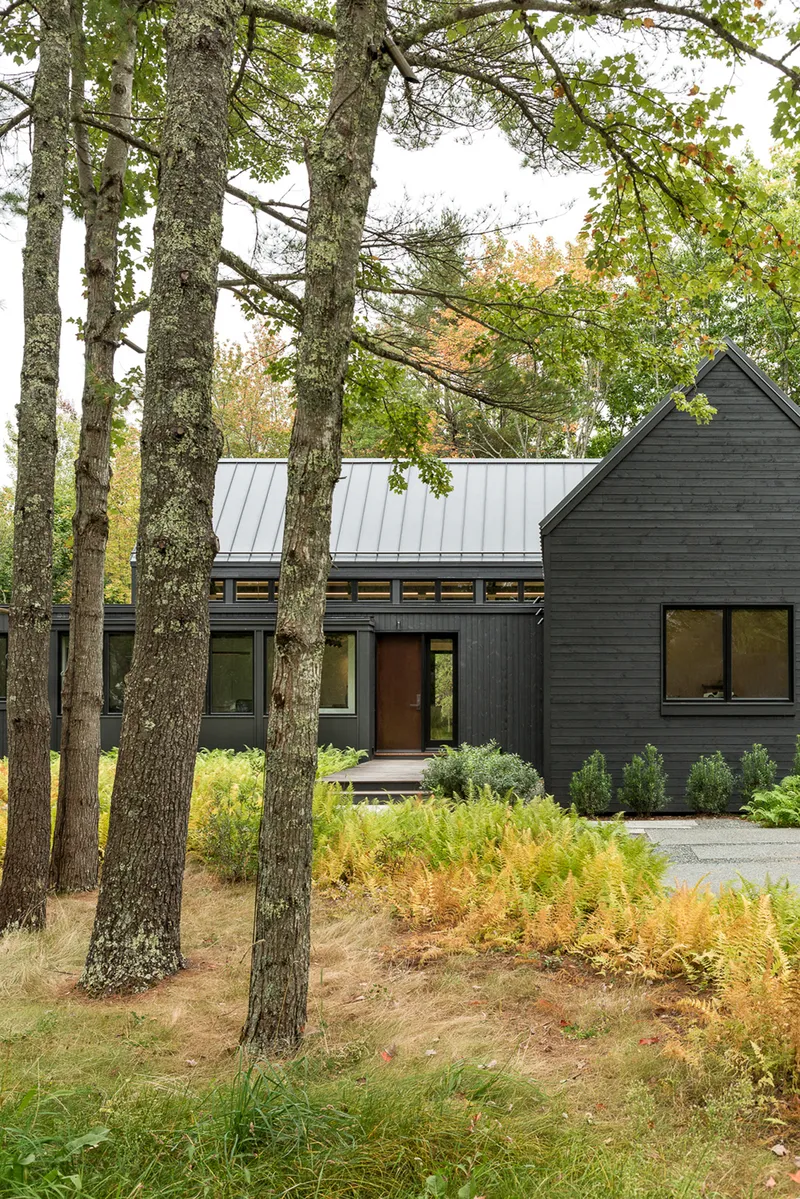
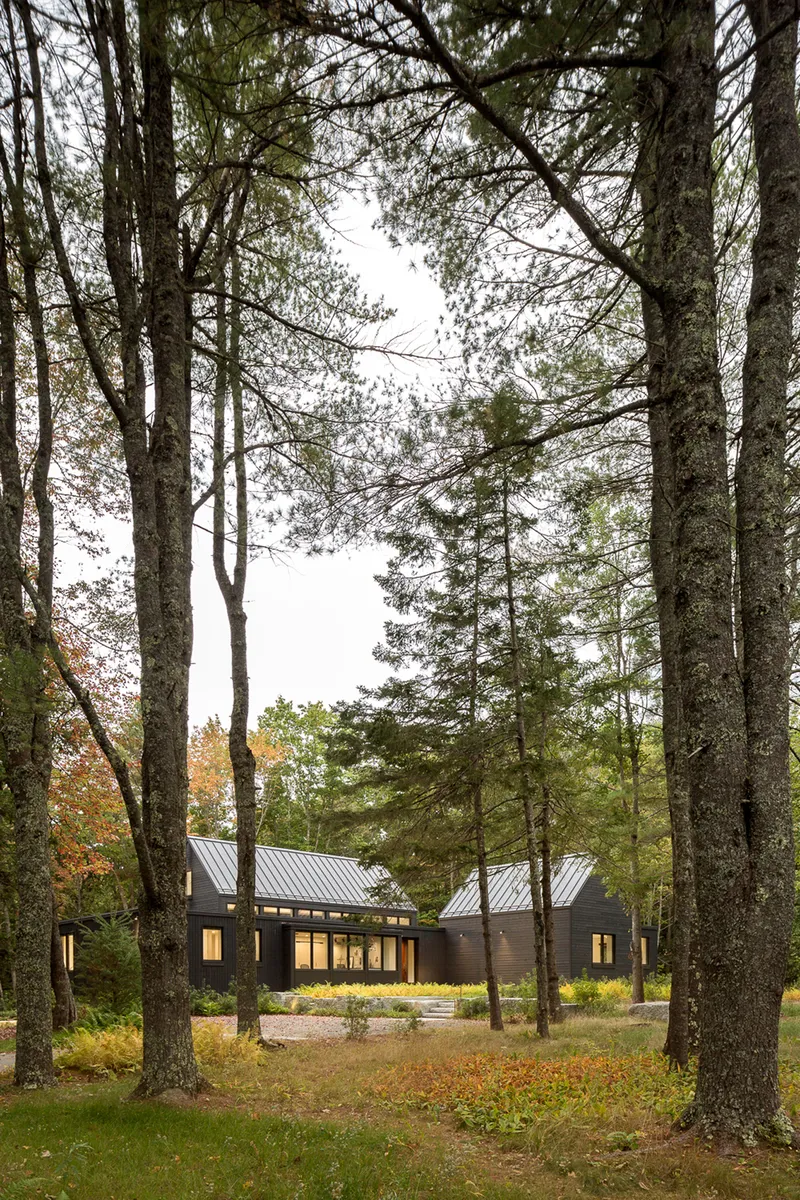
The charred timber cladding and standing seam metal roof work together as a single dark envelope. From a distance, particularly at dusk, the house reads less as an object and more as a gap in the canopy. The vertical grain of the siding picks up the rhythm of the surrounding tree trunks, an alignment that feels deliberate without being fussy. There is nothing precious about the darkness here; it is functional camouflage, letting the landscape stay the dominant element.
The gable massing is the critical social gesture. Blue Hill is a small coastal town with a tight-knit architectural vernacular, and a flat-roofed modernist box would have been an intrusion. By holding the roofline and scale of surrounding structures, ElliottArchitects earned the right to do everything else differently: the materials, the openings, the interior spatial logic.
Granite as Threshold
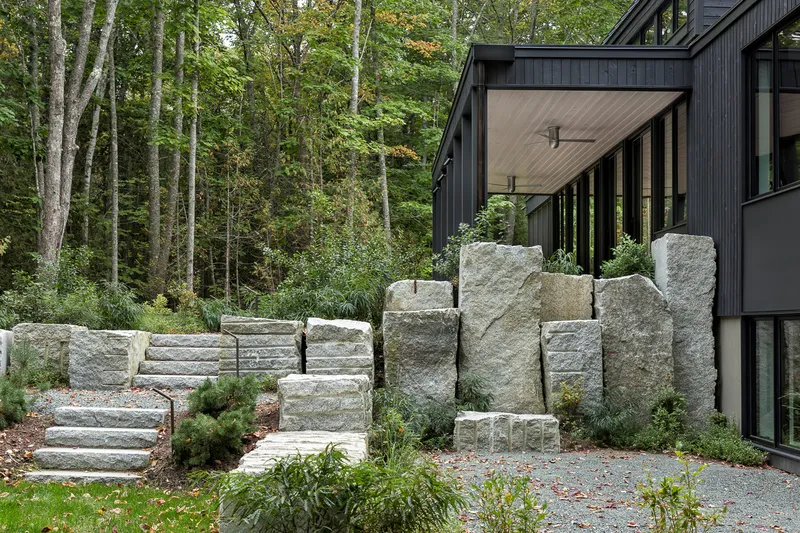
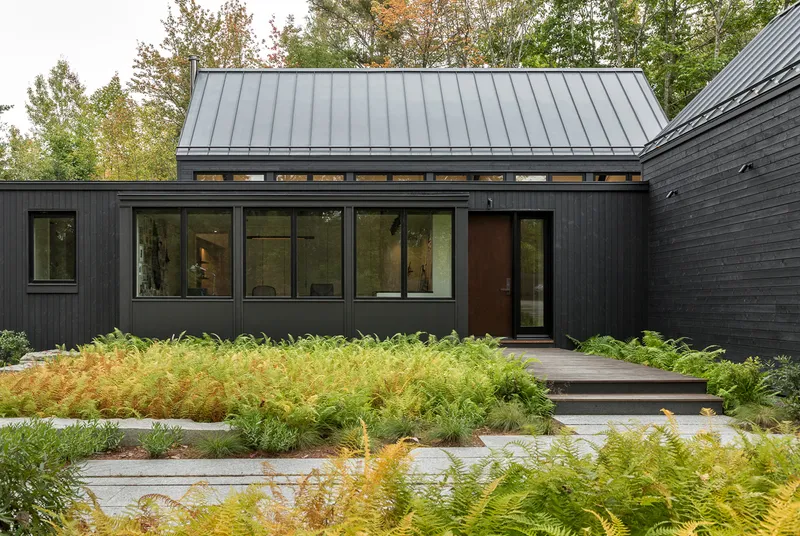
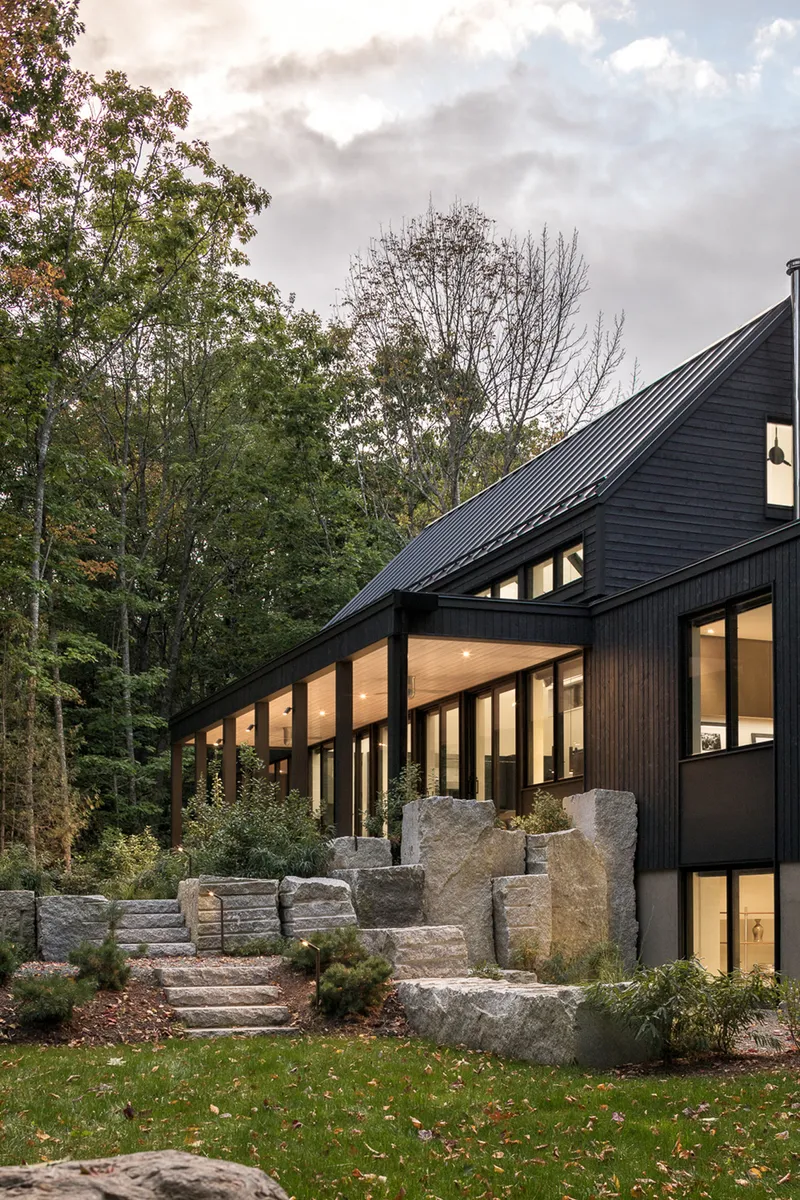
A rift of stacked granite blocks does the heavy organizational work on the exterior. These are not decorative; they define the parking area, carve out the entry sequence, create retaining walls, and build the terraced steps that lead to the covered porch. The granite is local and rough, left unpolished, and its mass provides a counterweight to the lightweight cladding above.
Inside, the same stone reappears as a bench beside the woodstove, pulling the landscape material through the building envelope. It is a simple move, but it prevents the interior from feeling hermetically sealed from the site. The ferns and native grasses planted tight against the stone base blur the line further, softening the hard edge where building meets ground.
Two Volumes, One Compound
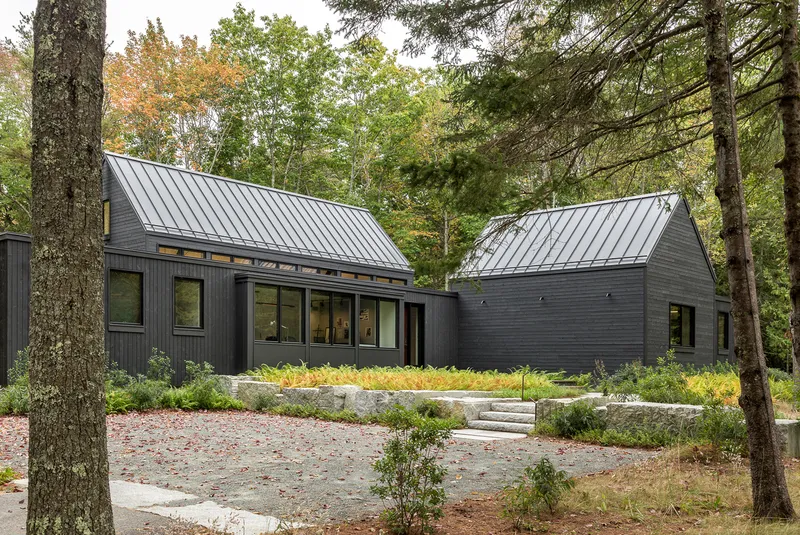
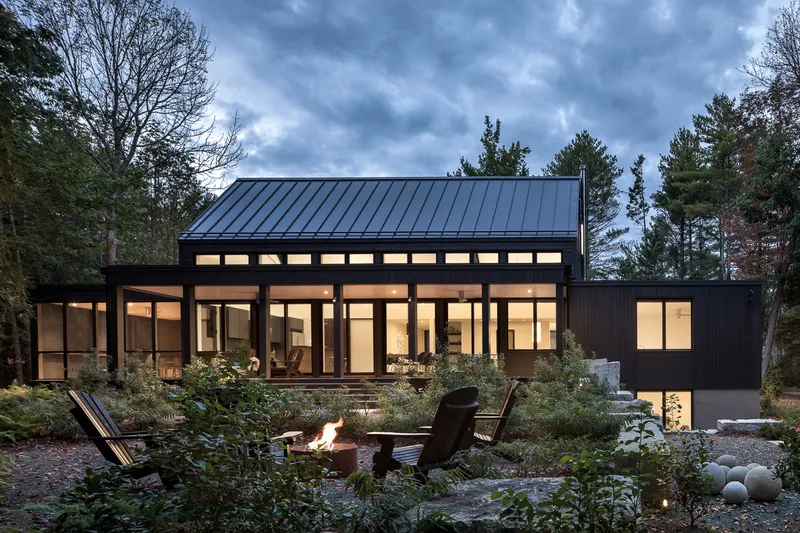
The house is organized as two gabled volumes connected by a glazed link. The primary volume contains the cathedral living space with cooking, dining, and sitting arranged along a single open axis. The second volume houses a dedicated woodworking shop, a program choice that says a lot about the client and the region. Blue Hill has a long tradition of craft, and giving the workshop its own building, not just a garage bay, elevates it to equal architectural standing.
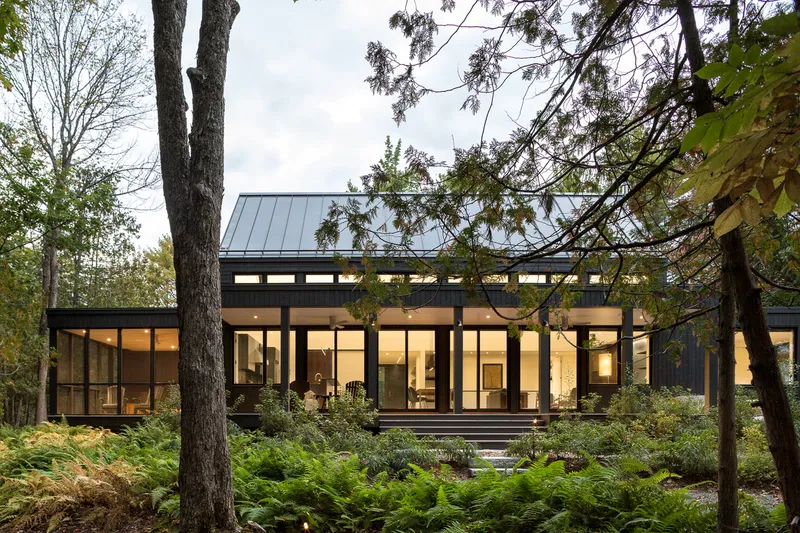
Between the two volumes, terraced granite steps and planted beds create an outdoor room that is neither front yard nor backyard but something in between. The twilight view from the rear shows a fire pit set into this interstitial space, turning what could have been leftover circulation into a social zone with its own atmosphere.
The Cathedral Interior
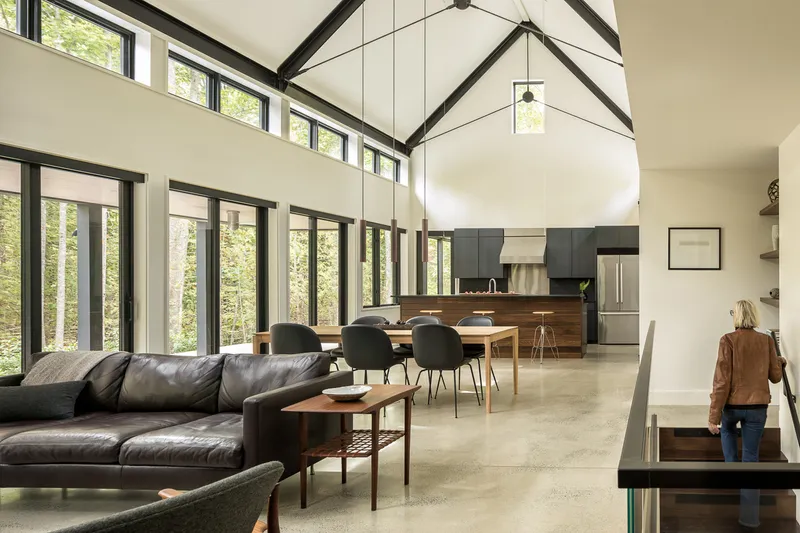
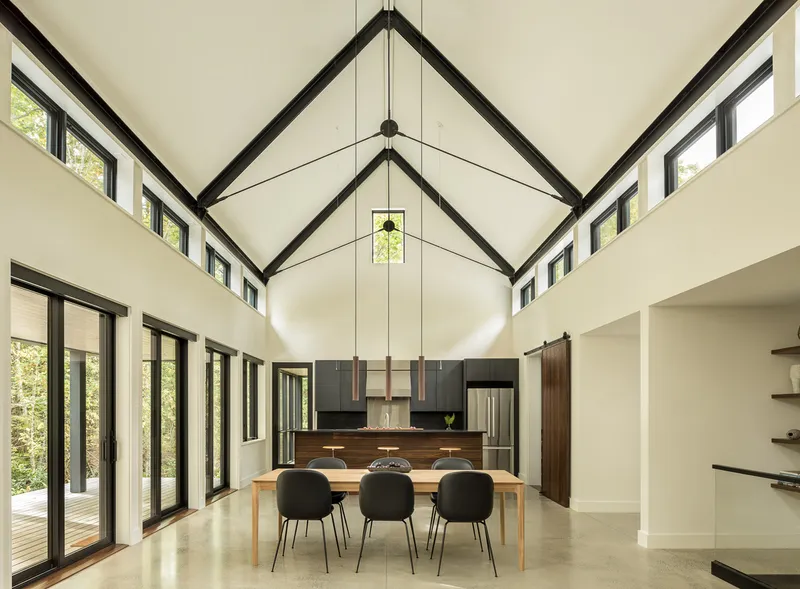
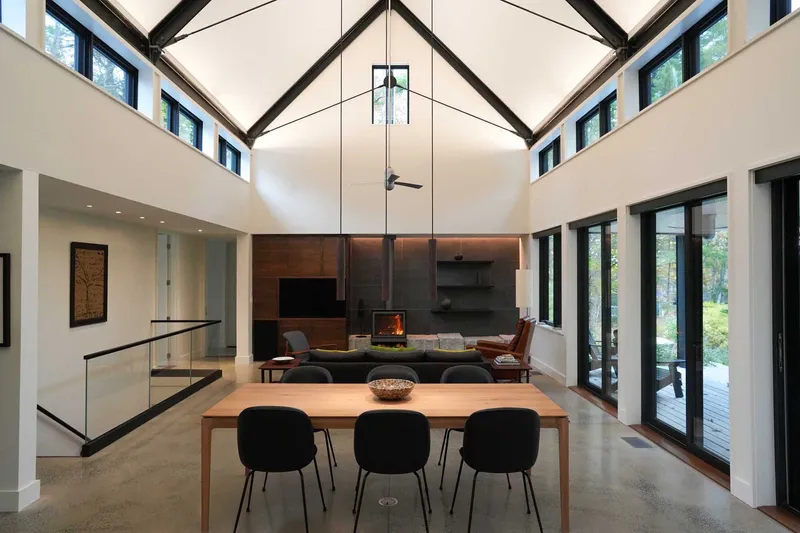
Inside the main volume, the ceiling vaults upward beneath exposed timber trusses braced with black steel connectors. The structure is honest and legible: you can trace the load path from ridge to wall without guessing. High clerestory windows draw light in above the lower roof plane of the connecting link, creating a band of sky-glow at the top of the space that keeps the room luminous without exposing it to direct solar gain on every wall.
The polished concrete floor anchors the room with thermal mass and gives the space a workshop honesty that complements the exposed structure above. Floor-to-ceiling glazing on the forest side dissolves the rear wall entirely, pulling the pine canopy into the room as a living mural. The effect is that the most civic-facing side of the house is solid and protective, while the woodland side is almost entirely transparent.
Material Details: Walnut, Steel, Stone
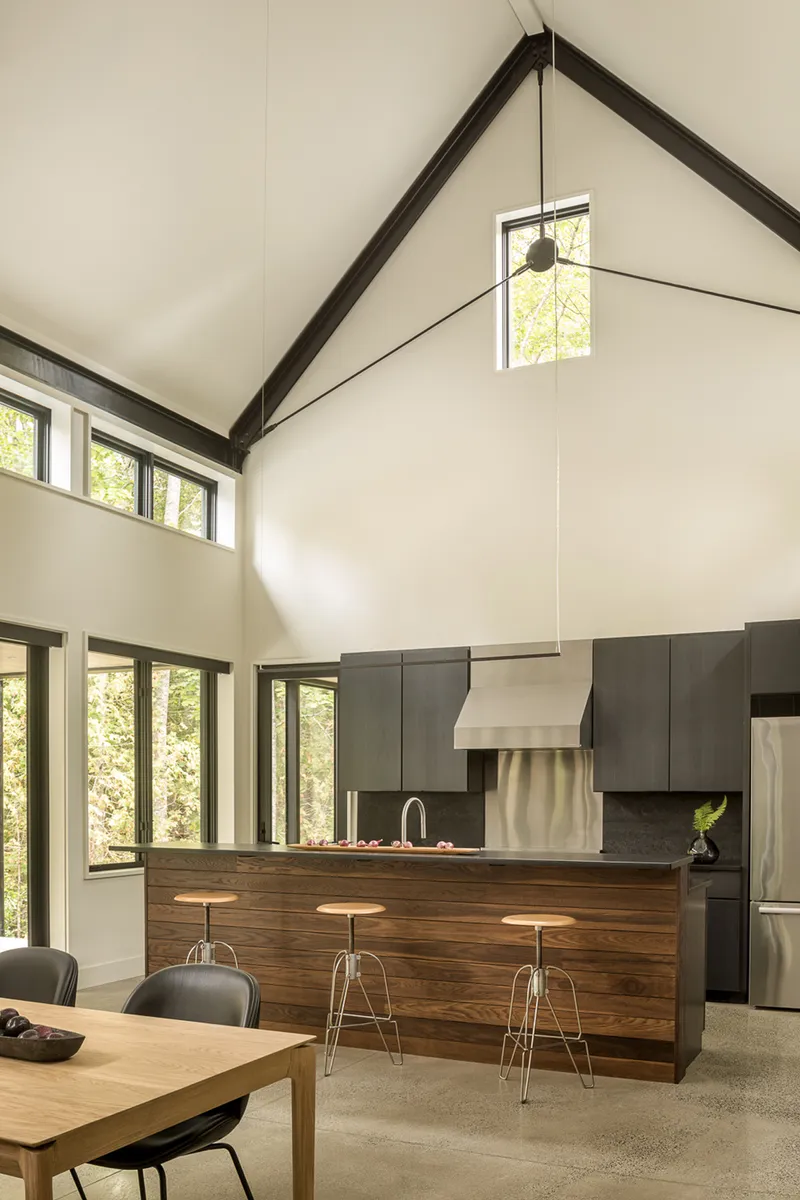
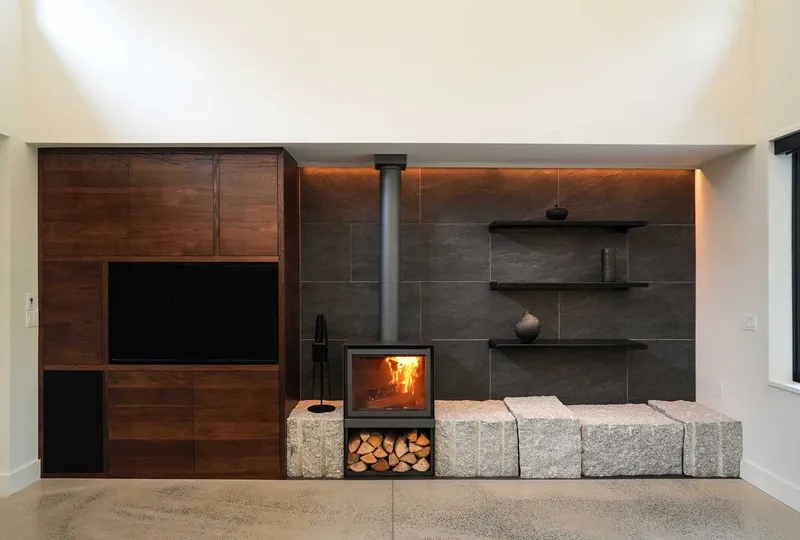
The interior material palette is restrained to three main players. Walnut appears on the kitchen island face, cabinetry, and shelving, warm but not saccharine. Steel shows up in the trusses, stools, and hardware, always painted black to read as line work against the lighter wood and concrete. And the granite blocks return at the woodstove alcove, forming a rough bench that stores firewood below, a detail that is both sculptural and utterly practical.
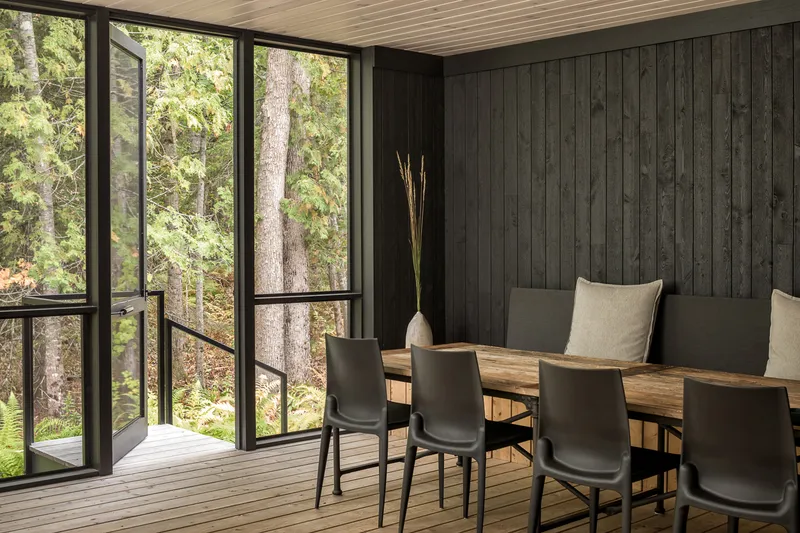
The charcoal-stained vertical planks lining the dining wall deserve attention. They bring the exterior cladding language inside, reinforcing the idea that this house does not draw hard distinctions between out and in. Against these dark walls, the forest visible through the adjacent glazing reads brighter and more vivid, a contrast that lighting designer Greg Day likely calibrated carefully.
Workshop and Passage
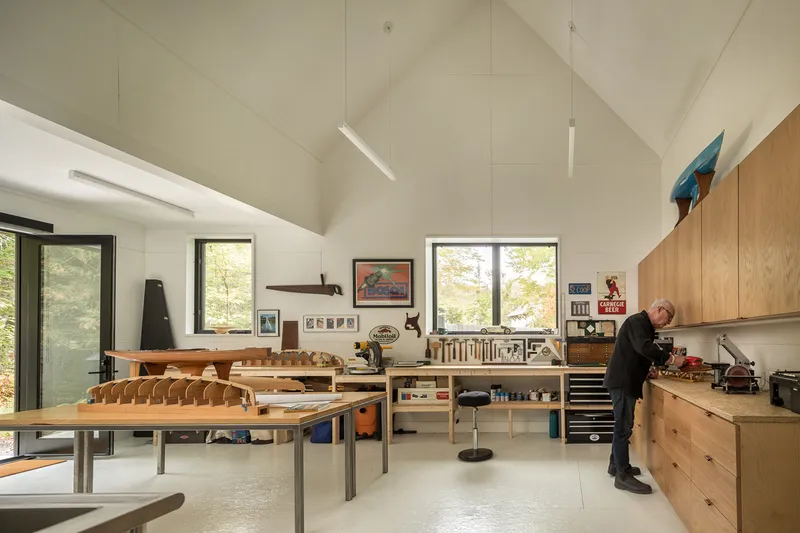
The woodworking shop occupies its own gabled volume with the same vaulted ceiling and clerestory windows as the main house. A boat hull sits on the workbench in the photographs, a detail that locates this house culturally as much as the granite and the ferns do. The shop is not an afterthought; it has the same spatial generosity and daylight quality as the living room, which suggests the client spends as much life here as at the dining table.
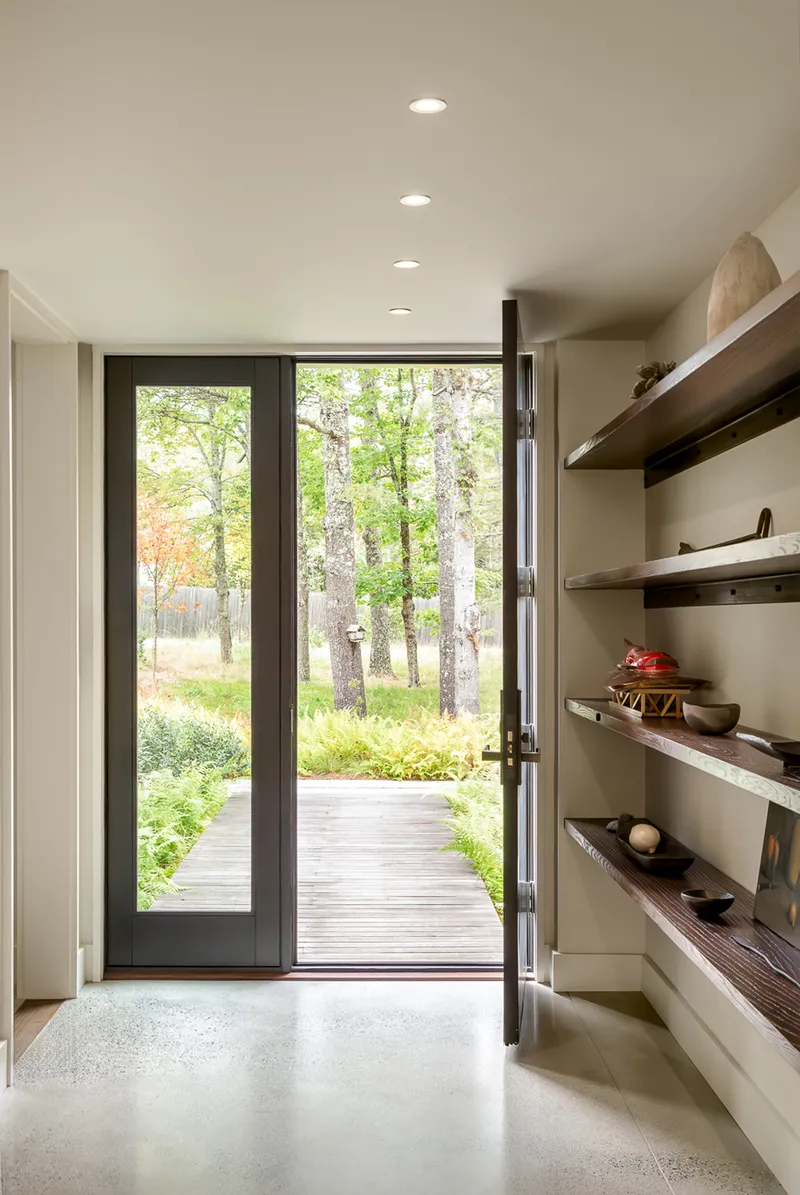
The entry hall functions as a decompression chamber between exterior and interior. Timber shelving lines one wall, and a glazed door at the far end opens onto a boardwalk that threads into the forest. It is a secondary exit that reframes the house's relationship to its site: you do not just look at the woods through glass, you walk into them.
Back Patio and the Forest Edge

The rear elevation is where the house drops its guard entirely. Floor-to-ceiling glazing opens onto a patio furnished with Adirondack chairs, and the naturalized plantings of ferns and native shrubs make it difficult to say precisely where the garden ends and the forest begins. Landscape architect David Maynes Studio designed a planting scheme that avoids the typical suburban lawn, instead using species already present in the surrounding woodland to stitch the house into its context.
Plans and Drawings
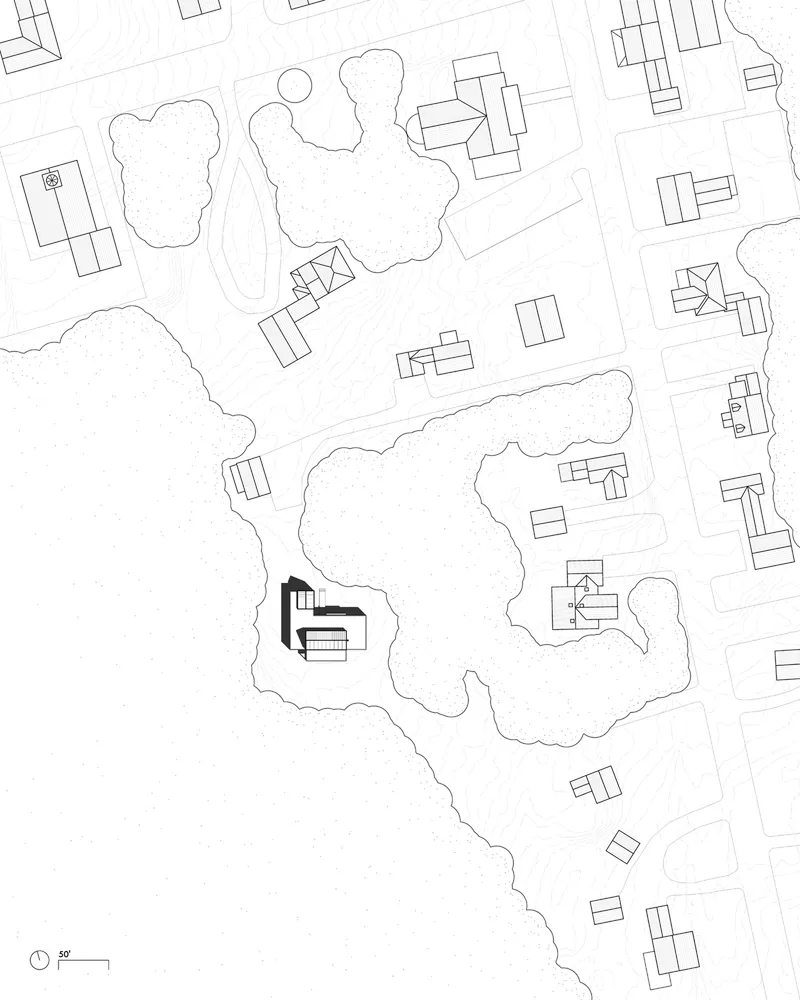
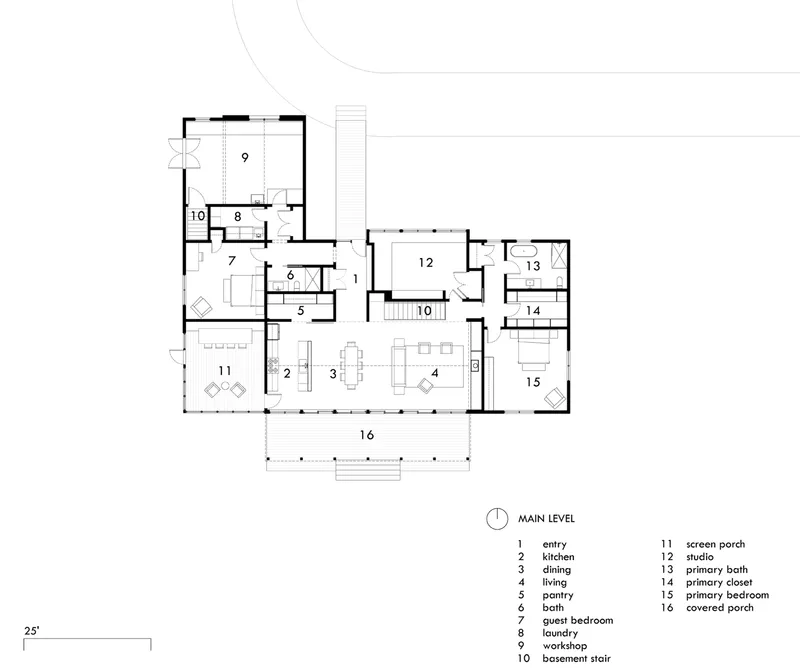
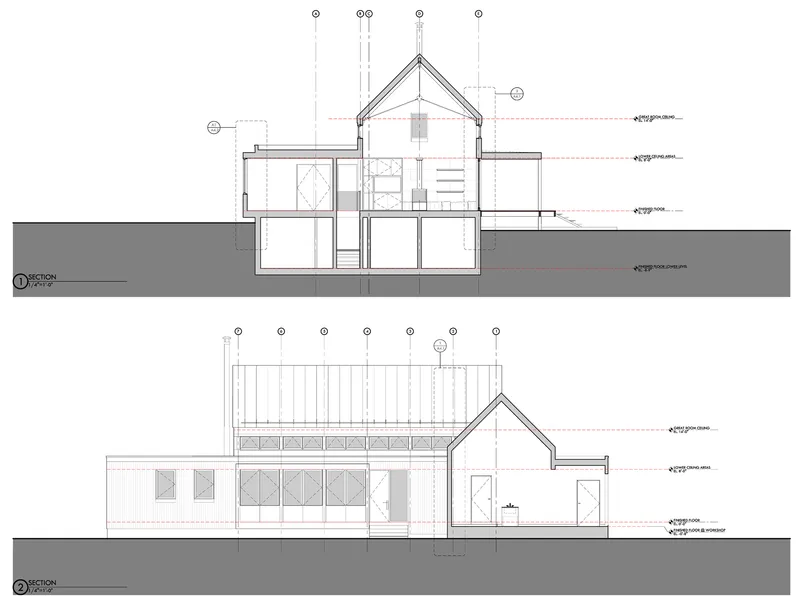
The site plan reveals just how tightly the house is threaded among existing trees. The two gabled volumes are rotated slightly relative to each other, responding to the tree positions and the geometry of the original foundation rather than an abstract grid. The floor plan shows the spread arrangement of rooms around the central kitchen, dining, and living spine, with the workshop clearly separated but linked. The section drawings clarify the clerestory strategy: the connecting link sits lower than the main gable, and the gap between its roof plane and the main wall becomes a continuous light slot. It is a simple sectional move that drives most of the interior atmosphere.
Why This Project Matters
There is a version of this brief that produces a generic dark cabin in the woods, all Instagram angles and no ideas. What ElliottArchitects delivered instead is a house that takes its cues from the specific conditions of its site: the existing foundation, the proximity of town, the density of the canopy, the local tradition of handcraft. The decision to build on the old foundation is not just sustainable pragmatism; it is an act of continuity, acknowledging that a Cape Cod house stood here for a century and that the new building inherits its relationship to the street and the land.
The project also demonstrates that dark, minimal architecture does not have to be alienating. The gable form, the granite, the walnut, the workshop with a boat in progress: these are all signals of belonging to a specific place and a specific culture. The house recedes visually but participates socially, and that balance is harder to achieve than it looks. For a small residential project in a small Maine town, it carries more ideas per square foot than many buildings ten times its size.
House at Town's Edge by ElliottArchitects (lead architect Matt Elliott, AIA), Blue Hill, Maine, United States. Completed 2024. Photography by Jeff Roberts.
About the Studio
Share Your Own Work on uni.xyz
If projects like this are the kind of work you want to make, uni.xyz is a place to publish your own, find collaborators, and enter design competitions.


Popular Articles
Popular articles from the community


The Amber Palace Opera: A Geological Fiction Surfaces on Tallinn's Baltic Waterfront
Pierre Brillard reimagines a Baltic legend as a public landscape, opera house, and waterfront promenade rooted in Tallinn's coastal identity.

Opera on the Sea: Driftwood Logic Shapes a Timber Opera House on Estonia's Coast
Trevor Orgill's opera house translates the entangled drift of floating timber into a civic building where wood, water, and music converge.
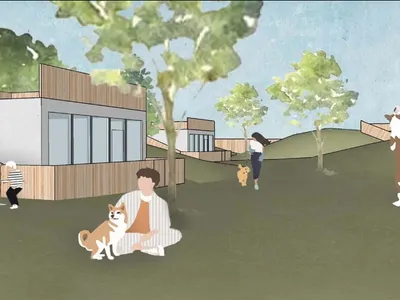
Temporary Home for Dogs: A Reversed Zoo Rethinks Animal Shelter Architecture
In Bucharest, a sinuous corridor and freed landscape flip the logic of containment, designing a shelter that works to make itself unnecessary.

Singing Woman: An Opera House That Performs Before the Curtain Rises
Ovidiu Cristian Pavel's conceptual opera house translates Estonia's choral identity into a sculpted waterfront landmark facing the Baltic Sea.

Similar Reads
You might also enjoy these articles

Pixel Gardens: One Repeated Module Stacked Into a Terraced Social Housing Tower for Famagusta
Salem Bader's shortlisted housing tower builds a vertical neighbourhood from one repeated module, offsetting units to carve terraces, light and air.

Bao Huynh Watercolor Atelier: A Serene Art Retreat in Hội An
Bao Huynh Watercolor Atelier in Hội An blends multifunctional art spaces, sustainable design, local materials, and family-friendly living in a serene environment.

Atelier Macri Concept Store Interior Design by CASE-REAL
Atelier Macri store features a "ko" counter, walnut wood details, cork displays, blending retail, gallery, and seamless customer experiences.

Manuel Vargas Izquierdo Stadium and High-Performance Sports Center: Architectural Excellence in Jalpa de Méndez
The Manuel Vargas Izquierdo Stadium blends sustainable design, inclusive sports facilities, and cultural-inspired architecture, revitalizing Jalpa de Méndez’s public spaces.

Explore Tree House Competitions
Discover active competitions in this discipline

Challenge to design mud housing for contemporary communities

Challenge to reimagine the Iron Throne

Photograph architecture without architects

Illustrate the lost glory of Angkor Wat - Render Challenge
Comments (0)
Please login or sign up to add comments
No comments yet. Be the first to comment!