
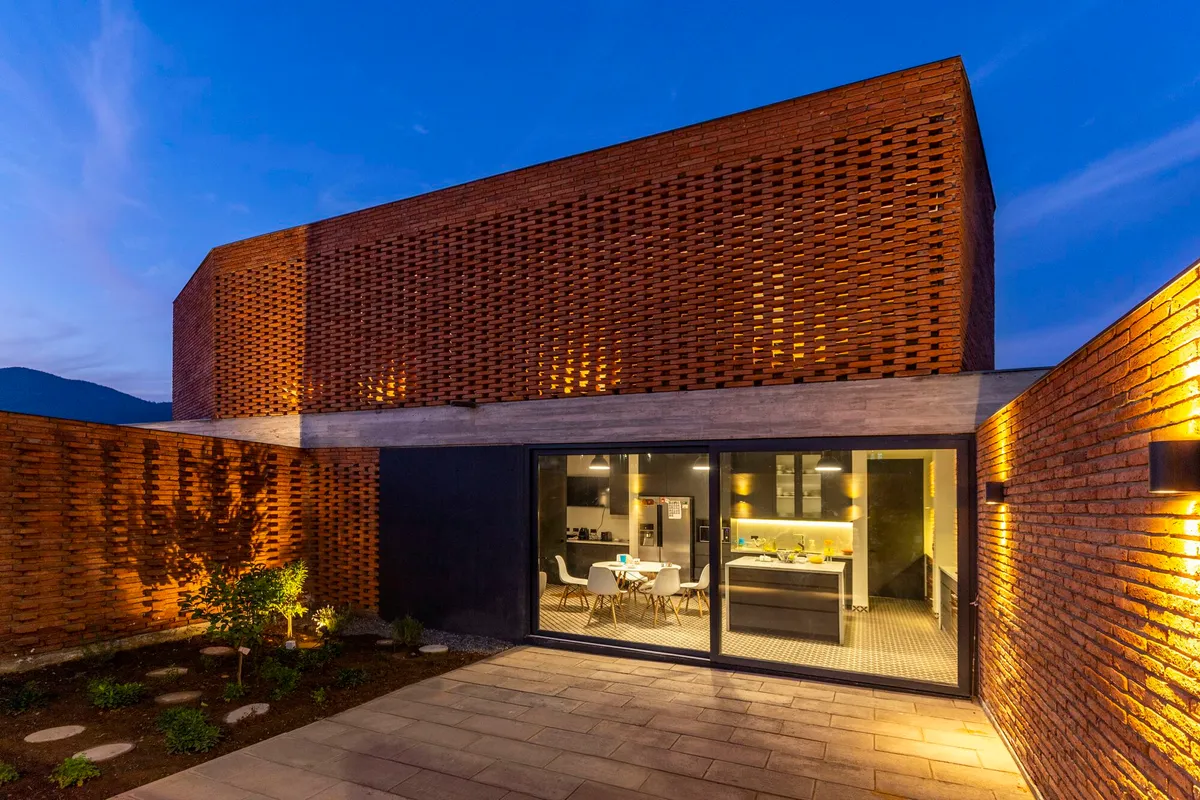
elton_léniz Wraps a Lo Barnechea House in Handmade Brick Latticework
A 302-square-meter family home in the Chilean foothills uses perforated brickwork to filter light, frame views, and honor adobe tradition.


Brick is rarely the protagonist of a contemporary Chilean house. In a country where timber, concrete, and steel dominate the residential conversation, the decision by Santiago-based elton_léniz to build almost entirely in handmade brick feels deliberate and loaded with meaning. The Ibañez-Concha House, completed in 2019 in the foothills commune of Lo Barnechea, treats brick not as infill or veneer but as the primary architectural language: structure, screen, ornament, and climate mediator all at once.
What makes the project compelling is its refusal to be nostalgic about its chosen material. The brick here is not pastoral. It is geometric, sharp-edged, and precisely choreographed into latticework screens that transform across the day. The house sits within a private condominium carved from 17 plots developed by two extended family groups, a suburban condition that could easily produce banal results. Instead, elton_léniz used the constraints of the site to build a house that is simultaneously open and opaque, grounded and hovering.
A Material Language Rooted in Craft
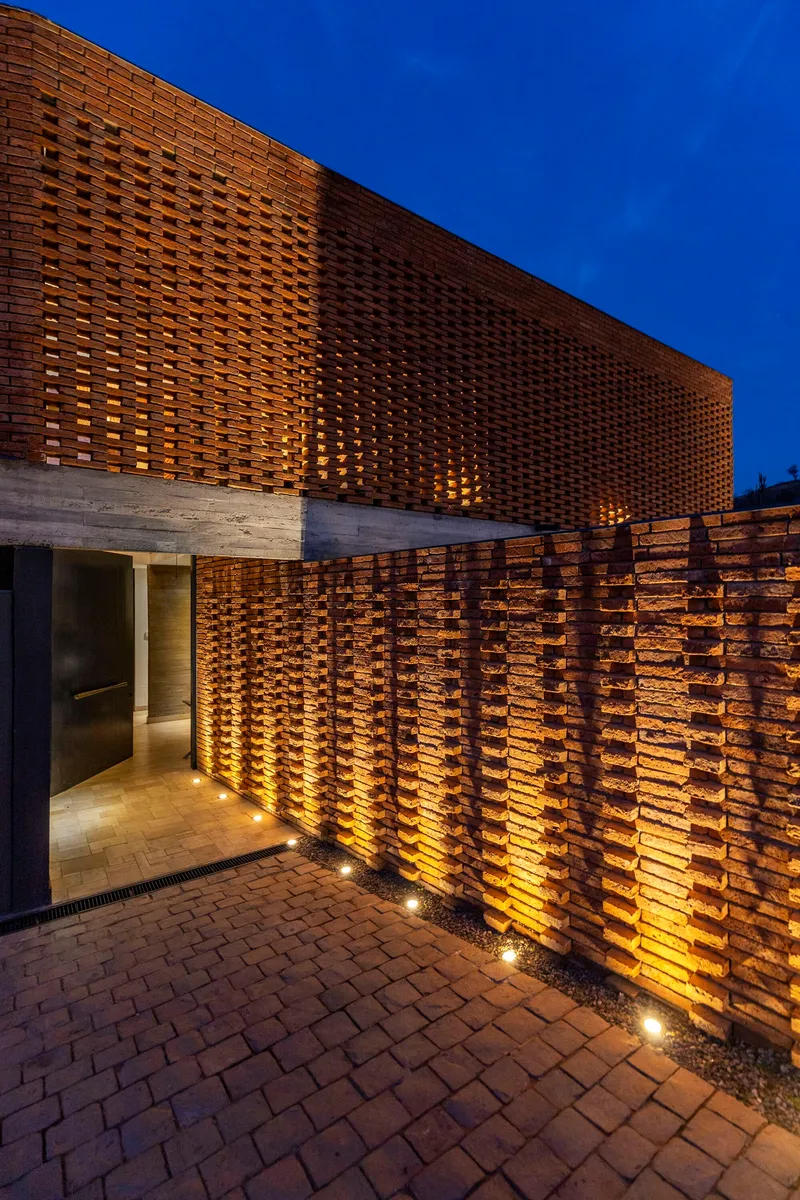
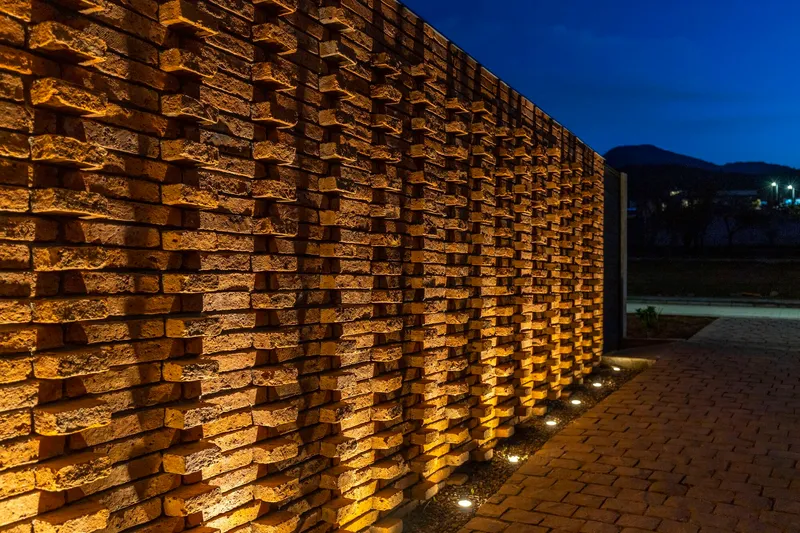

The handmade bricks carry the fingerprint of their making. Close inspection reveals slight variations in color and texture, the kind of irregularity that machine-pressed units cannot deliver. elton_léniz exploits this by deploying the bricks in staggered, protruding patterns that create geometric reliefs across the building's skin. The effect is somewhere between textile and masonry: a woven surface that catches light differently with every passing hour.
Ground-level uplighting transforms the reliefs at dusk into something almost topographic, the wall reading as a landscape of ridges and valleys. This is not decorative indulgence. The protruding bricks are calibrated to filter sunlight and manage privacy, functioning as both screen wall and expressive facade. The technique draws on a constructive tradition inherited from adobe, repositioned for a suburban house that needs to negotiate between exposure and enclosure.
The Cantilever and the Ground
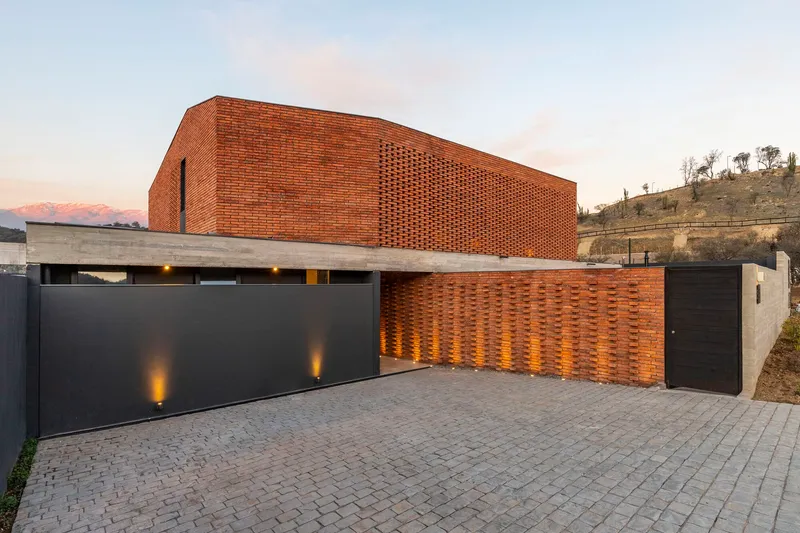
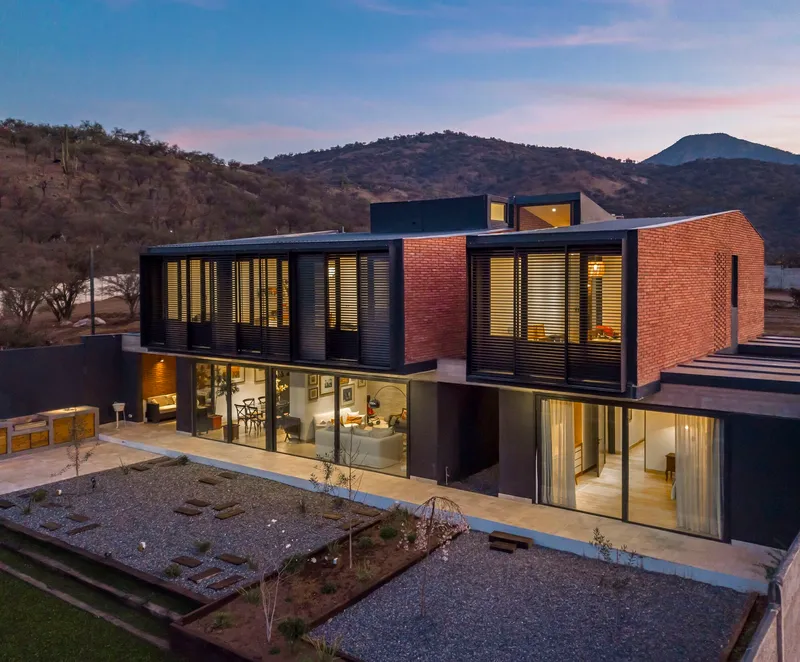
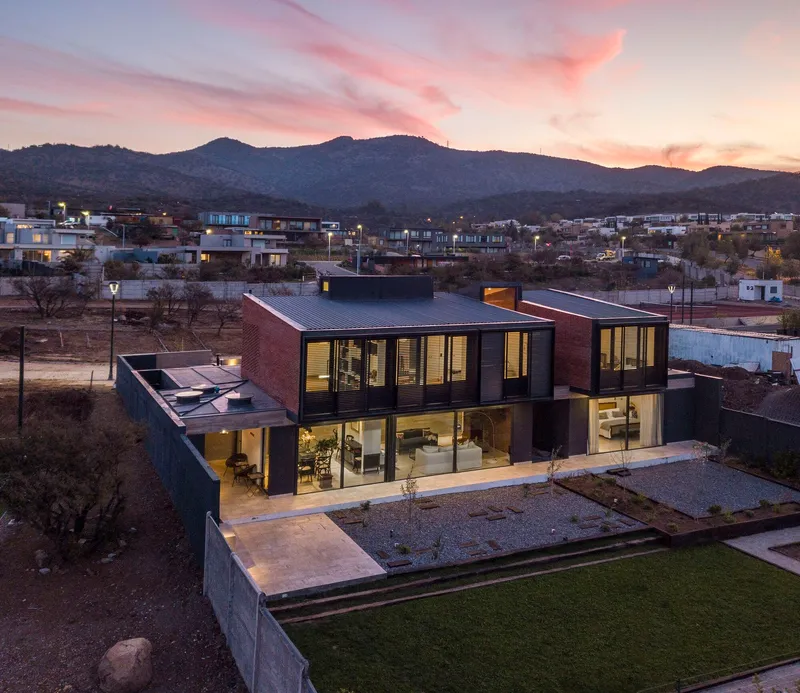
From the street, the house presents a bold sectional move: a heavy brick volume cantilevered over a recessed ground floor of dark metal gates and glazing. The upper level reads as a solid, enigmatic mass; the base, by contrast, is porous and shadowed. It is a classic inversion, placing the visual weight at the top, that gives the house a sense of tension and levitation despite its earthy materiality.
Seen from a distance at dusk, with the Andes foothills rising behind, the red brick upper volume glows warmly against the darkening sky. The horizontal louvers and perforated screens break the mass into registers, preventing it from becoming monolithic. The proportions are considered: the cantilever is generous enough to shelter the ground floor entries beneath it, creating covered thresholds that mediate between the condominium's roadways and the domestic interior.
Courtyards and Thresholds
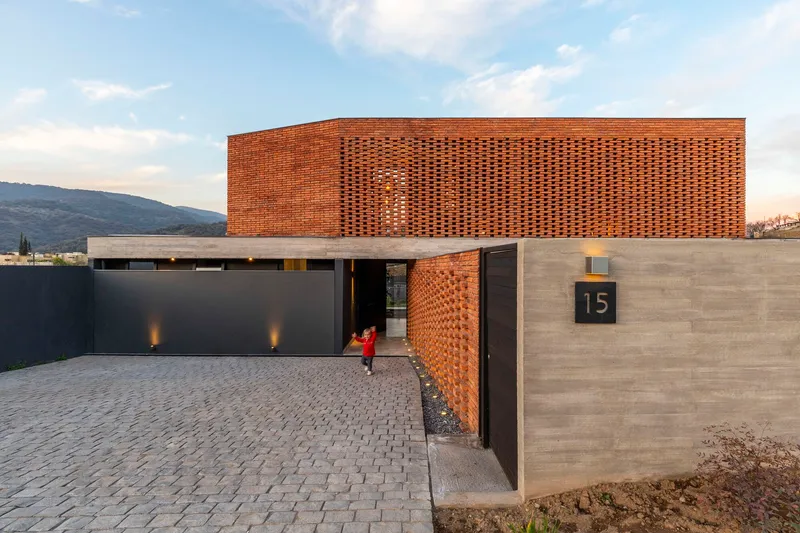
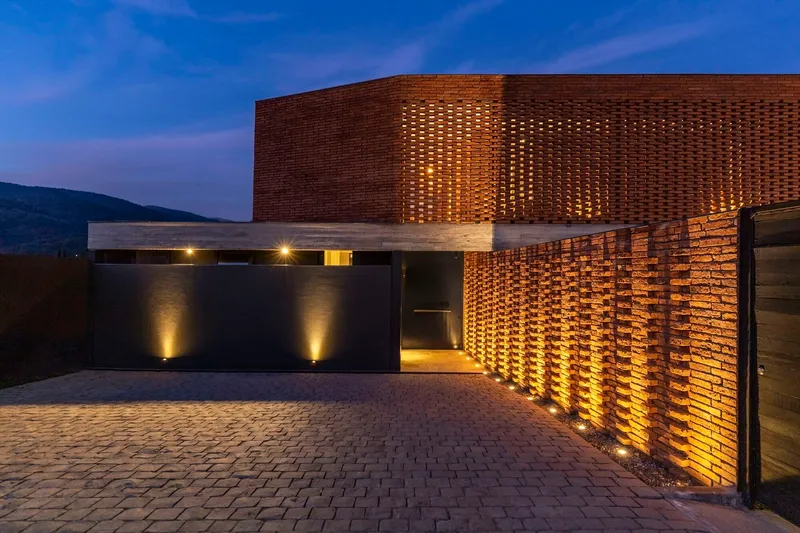
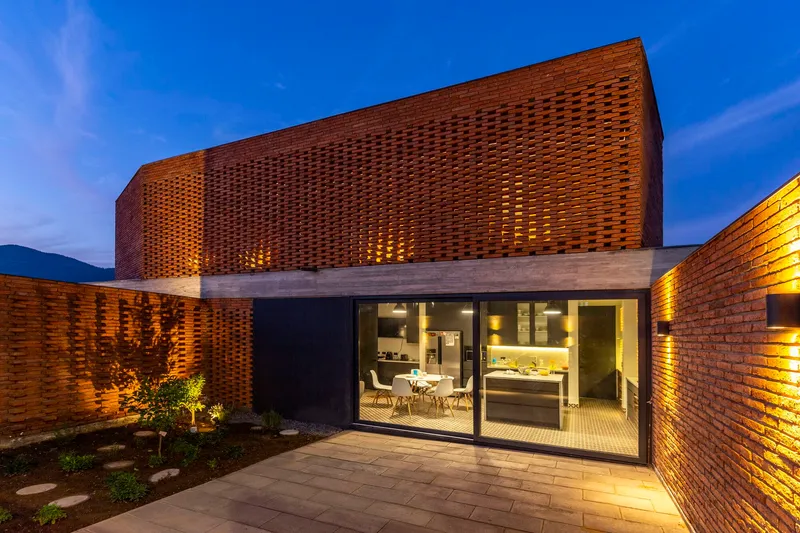
Entry into the house is orchestrated through a sequence of courtyards and paved thresholds that slow the visitor down. A child in red crossing the entry paving in one photograph captures the scale perfectly: these are generous outdoor rooms, not corridors. The perforated brick volume overhead provides a canopy that filters light into dappled patterns on the ground, turning an otherwise straightforward approach into a spatial event.
The courtyard visible from the dining room shows how elton_léniz uses the curved perforated brick volume to create intimacy at the heart of the house. A planted bed softens the junction between glass and masonry, while the brick screen above frames the sky without fully exposing the interior. The courtyards serve as thermal buffers and light wells simultaneously, a strategy well suited to Lo Barnechea's warm, dry summers and cool mountain-influenced winters.
Living Between Glass and Brick
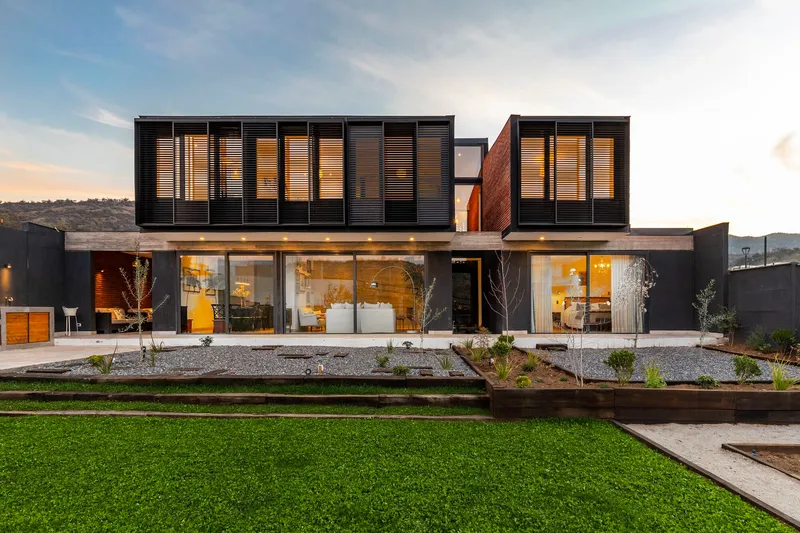
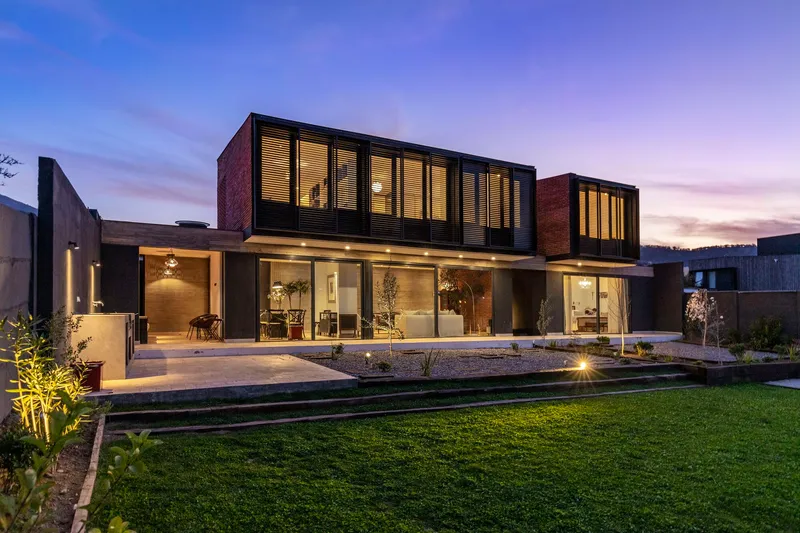
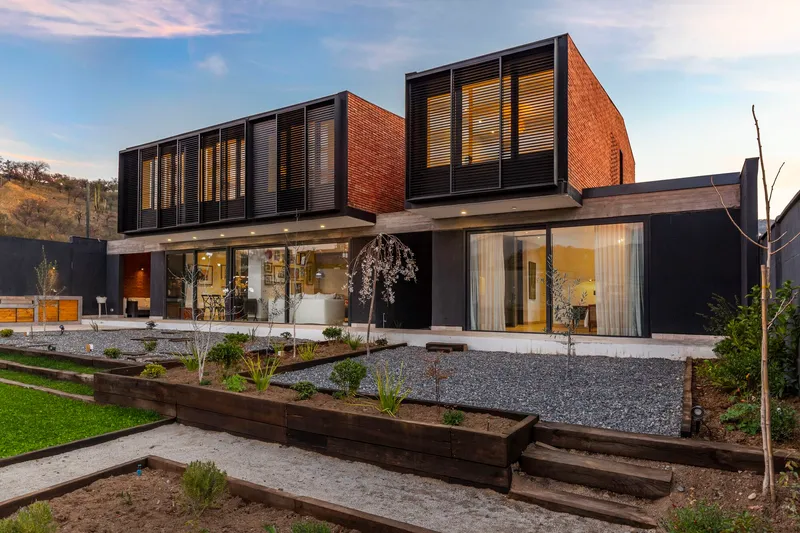
The garden facades reveal the house's dual personality. At ground level, floor-to-ceiling glazing opens the living spaces entirely to the landscape, dissolving the boundary between inside and out. Above, the brick and slatted metal volumes reassert enclosure, creating a layered section where privacy increases with height. The bedrooms, sheltered behind the latticework, enjoy filtered light and screened views; the common areas below embrace the garden directly.
At twilight, the illuminated ground floor glows beneath the cantilevered upper volumes like a lantern set into the hillside. Terraced planted beds and gravel courtyards step down the slope, integrating the house into the terrain rather than sitting it on top. The relationship between the opaque upper register and the transparent lower one generates a productive contradiction: the house feels both protective and generous, solid and open.
Vertical Circulation as Material Event
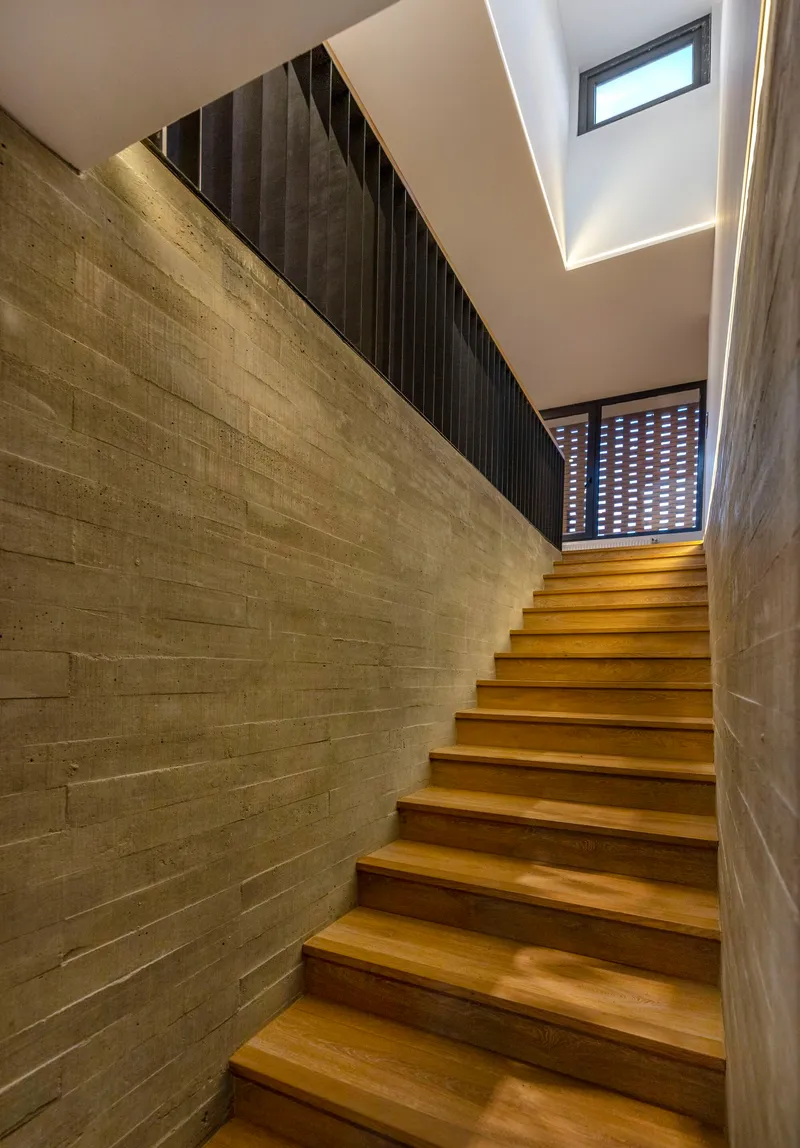
The staircase is where the house's material vocabulary converges most intensely. Board-formed concrete walls channel the ascent, their rough texture a deliberate counterpoint to the refined brickwork. A skylight washes the concrete with natural light from above, while a perforated brick screen appears at the upper landing, signaling the transition from the open ground floor to the more private upper level. Timber treads warm the palette and add a tactile quality underfoot.
This is not an incidental circulation space. It is the spine of the house, the vertical hinge that connects the transparent social rooms below with the brick-wrapped bedrooms above. The shift in materials as you climb, from concrete to timber to brick, narrates the journey from public to private without the need for closed doors or narrow hallways.
Plans and Drawings
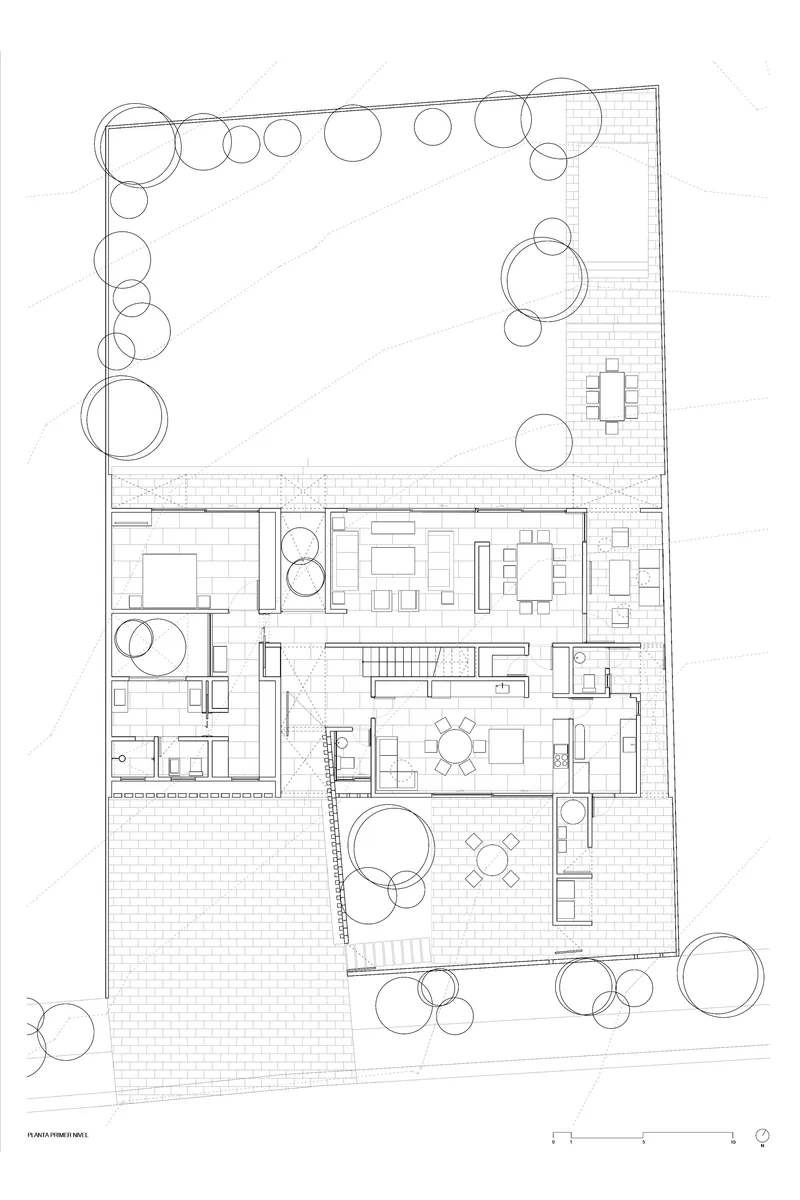
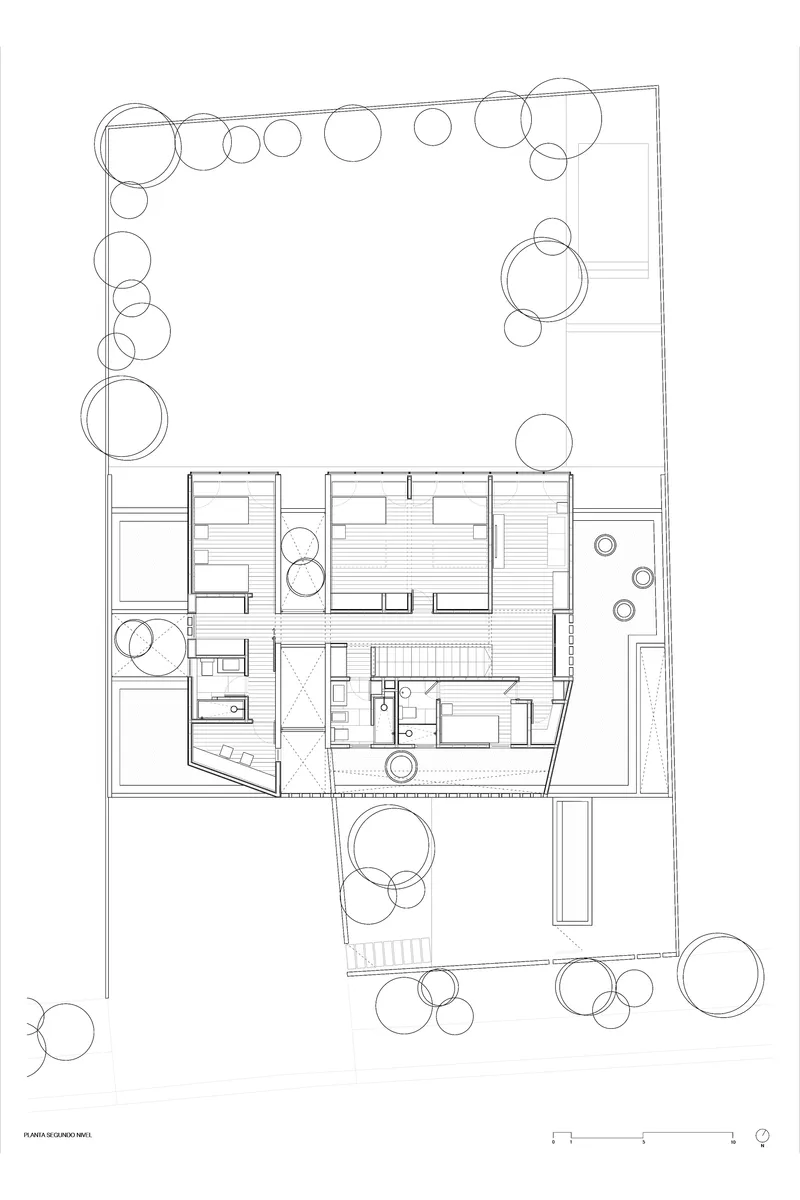
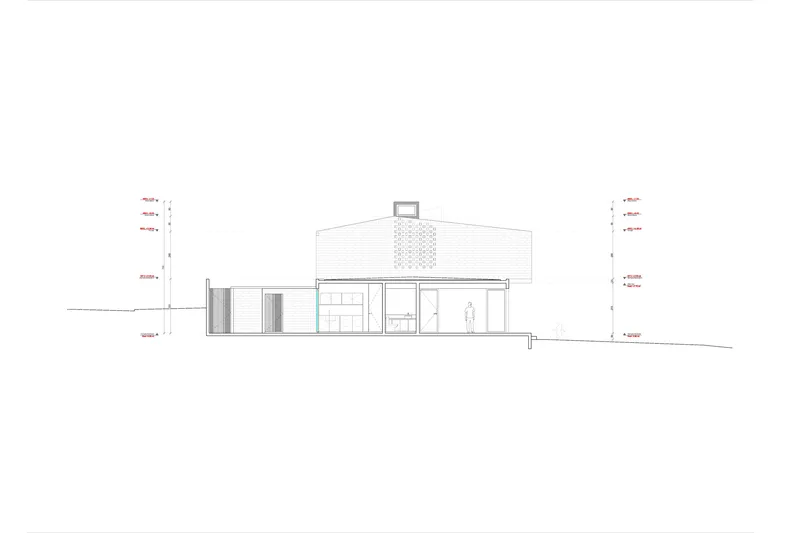
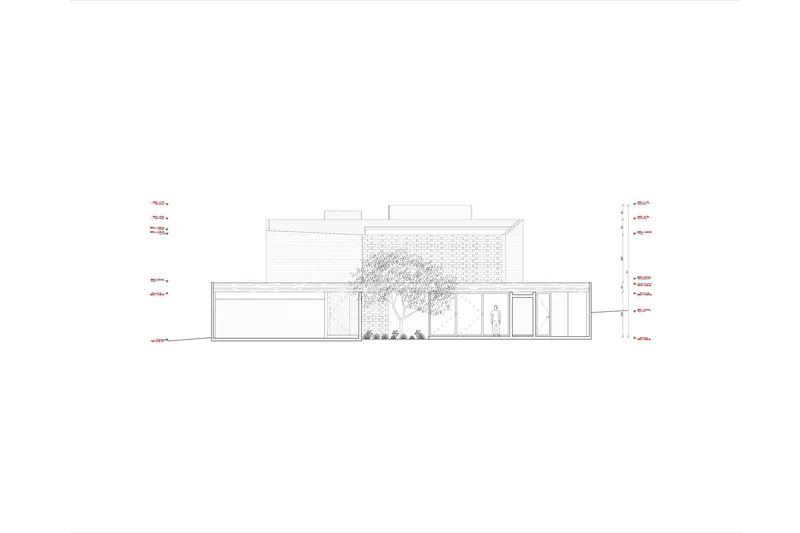
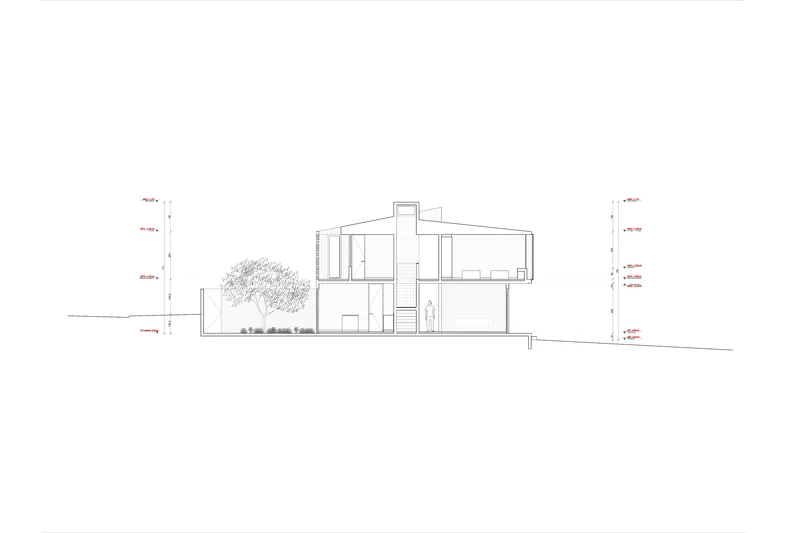
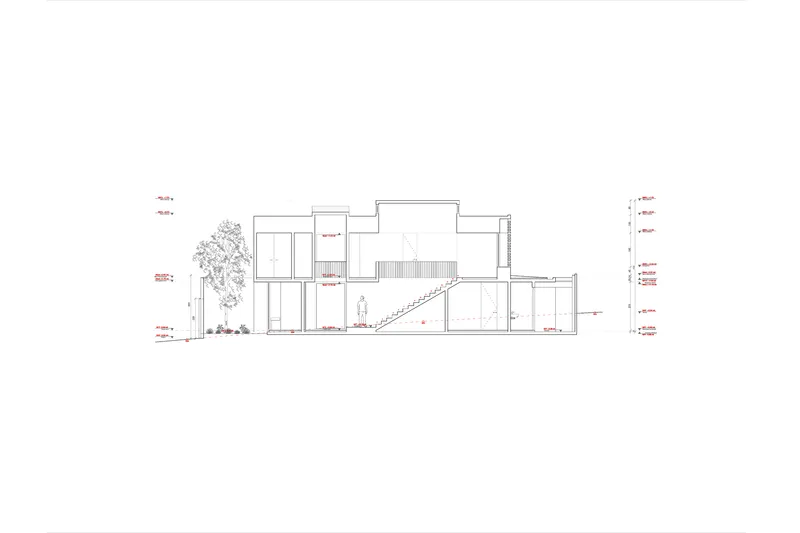
The ground floor plan reveals a loose, L-shaped arrangement of living spaces organized around a central courtyard with a tree. Terraces extend outward in multiple directions, blurring the footprint of the house into the landscape. The upper floor is more compact and inward-looking, with bedrooms arranged around a central stairwell and oriented toward the perforated brick screens rather than unobstructed glass.
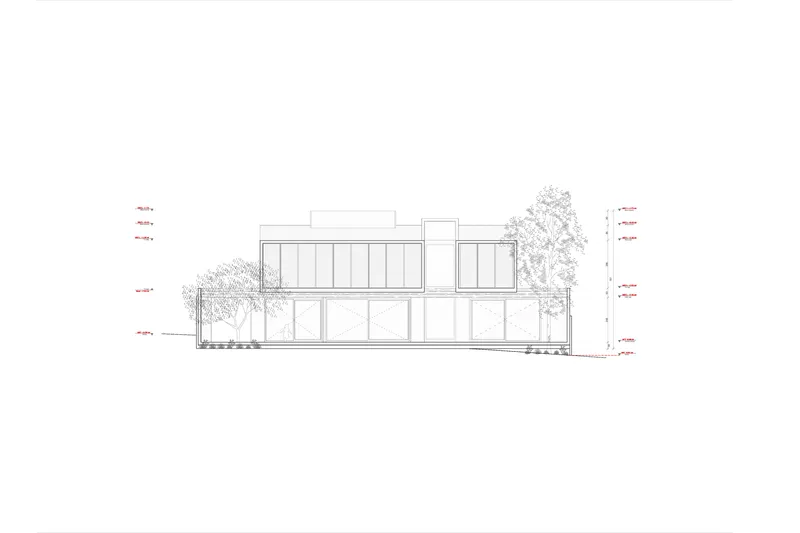
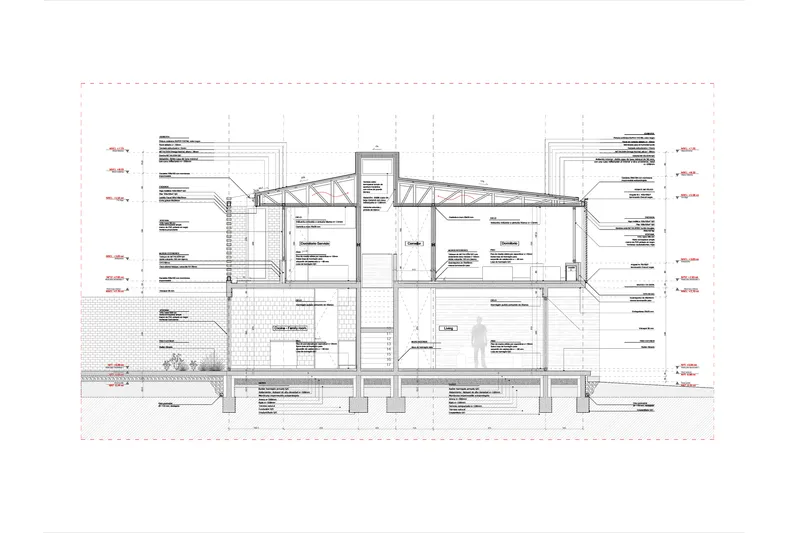
The sections are the most revealing drawings. They show how the courtyard tree anchors the spatial composition, with the perforated brick screen rising above it to create an internal facade. The sloped site is handled with half-level shifts that keep the house close to the ground while accommodating a garage at the lower elevation. A detailed construction section exposes the structural system and material assemblies, confirming that the brick is not merely cladding: it participates in the building's tectonic logic from foundation to parapet.
Why This Project Matters
The Ibañez-Concha House is a quiet argument for material commitment. In an era when residential architecture often defaults to neutral white volumes or exposed concrete slabs, elton_léniz chose a material with deep local roots and pushed it far beyond its expected register. The handmade brick here is not retro or regional-nostalgic; it is treated with the precision and conceptual rigor usually reserved for more fashionable materials. The latticework screens alone represent a significant investment in craft and detail, and they pay dividends in the quality of light and atmosphere they produce.
More broadly, the project demonstrates that suburban condominium housing does not have to be generic. Within the modest footprint of 302 square meters, elton_léniz created a house with genuine spatial complexity: courtyards that mediate climate, a section that modulates privacy, and a material language that rewards close attention. It is the kind of house that gets better the longer you spend in it, which is ultimately the only test that matters.
Ibañez-Concha House by elton_léniz, Lo Barnechea, Chile. 302 m², completed 2019. Photography by Marcos Mendizábal.
About the Studio
Share Your Own Work on uni.xyz
If projects like this are the kind of work you want to make, uni.xyz is a place to publish your own, find collaborators, and enter design competitions.


Popular Articles
Popular articles from the community


The Ocean Hive: Sustainable Architecture for a Self-Sufficient Civilization at Sea
The Ocean Hive imagines sustainable architecture at sea, where modular habitats, algae, wave power and ocean waste sustain a growing colony.

Play: Fragments of Their World
Familiar architecture becomes modular playground design, creating safe spaces where displaced children can learn, connect, imagine and play.

Co-life: Sustainable Architecture for Age-Friendly Community Living
Co-life reimagines sustainable architecture for seniors through courtyards, rammed earth, shared gardens, and spaces designed for belonging.

Hill & Cross Opera: Sculptural Opera House Architecture Shaped by Tallinn’s Landscape and Identity
Hill & Cross Opera reimagines opera house architecture in Tallinn through its sculptural hill, civic plaza, glass wave and a luminous cross.

Similar Reads
You might also enjoy these articles

Bao Huynh Watercolor Atelier: A Serene Art Retreat in Hội An
Bao Huynh Watercolor Atelier in Hội An blends multifunctional art spaces, sustainable design, local materials, and family-friendly living in a serene environment.

Atelier Macri Concept Store Interior Design by CASE-REAL
Atelier Macri store features a "ko" counter, walnut wood details, cork displays, blending retail, gallery, and seamless customer experiences.

Manuel Vargas Izquierdo Stadium and High-Performance Sports Center: Architectural Excellence in Jalpa de Méndez
The Manuel Vargas Izquierdo Stadium blends sustainable design, inclusive sports facilities, and cultural-inspired architecture, revitalizing Jalpa de Méndez’s public spaces.

KAKR Buluh Awar Hall: Revitalizing Community and Ecology Through Bamboo Architecture
Community built bamboo hall revitalizes Buluh Awar village, empowering youth, restoring ecology, celebrating vernacular craftsmanship through sustainable architecture and culture.


Comments (0)
Please login or sign up to add comments
No comments yet. Be the first to comment!