

Ignacio Prego Architectures Builds a 461-Room Garden City for a French Prison Academy in Under a Year
A prefabricated wood-and-concrete campus in Agen, France, reimagines high-density student housing as a walkable village inside a 15-hectare park.


Housing a thousand people is one thing. Housing a thousand people in a way that feels like a village rather than a barracks is something else entirely, especially when the brief calls for 461 standardized rooms on a narrow infill plot inside a 15-hectare park. That was the problem facing Ignacio Prego Architectures at the campus of the National School of the Penitentiary Administration (ENAP) in Agen, France. The answer they arrived at borrows its name and its logic from the Garden City: break the mass into smaller blocks, thread intimate pathways between them, and let landscape do the work of making density feel generous.
What makes the project worth studying is less the concept, which has obvious historical precedent, and more the execution. A mixed wood-and-concrete 2D prefabrication system allowed the entire 9,700 square meter complex to be assembled on site in just 11 months once foundations were in place. Prefabricated bathroom pods, standardized room modules, and a disciplined material palette of brickwork, corrugated metal, and powder-coated steel kept costs and timelines controlled without producing the visual flatness that usually accompanies fast-tracked housing. The facades shift in material, color, and rhythm from block to block, and the result reads more like a compact neighborhood than a single building.
A Colonnade as Common Ground
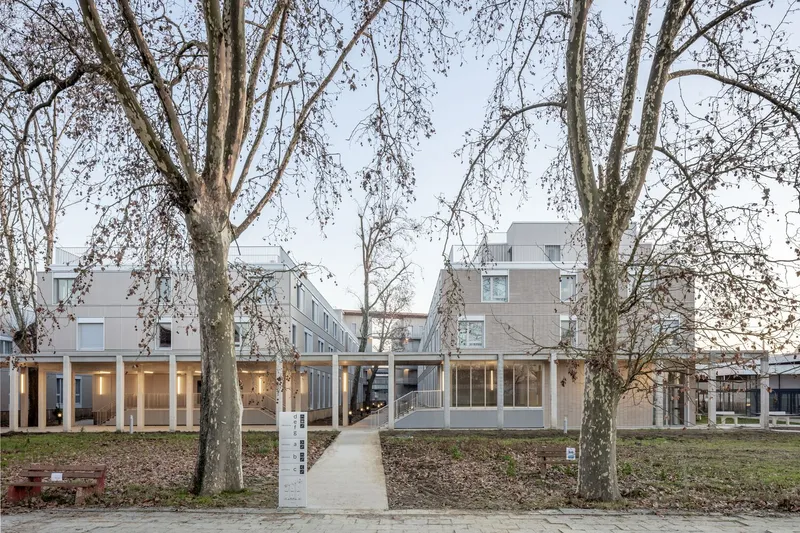
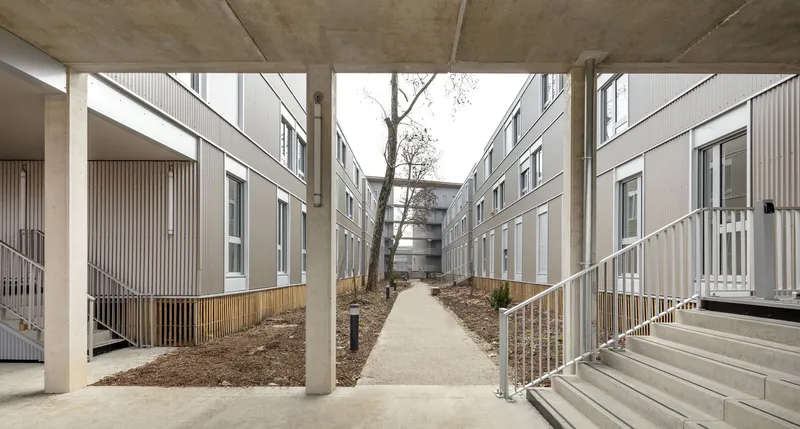
The ground floor across much of the complex is given over to a concrete colonnade: exposed columns supporting the residential mass above and creating a continuous, covered public layer. It is a simple move with a significant social payoff. Residents walking between blocks stay sheltered. The ground plane remains visually open, connecting the buildings to the surrounding park rather than walling it off. The glazed bays set back behind the columns house communal functions, drawing activity to street level.
Raising the residential volume off the ground also solves an awkward site condition. The plot sits between existing buildings of very different scales. By lifting the living quarters and keeping the base transparent, the architects avoid the fortress effect that a continuous plinth would have created. Light passes through, sightlines extend, and the colonnade reads as a continuation of the park's open space rather than its boundary.
Facades That Refuse to Repeat
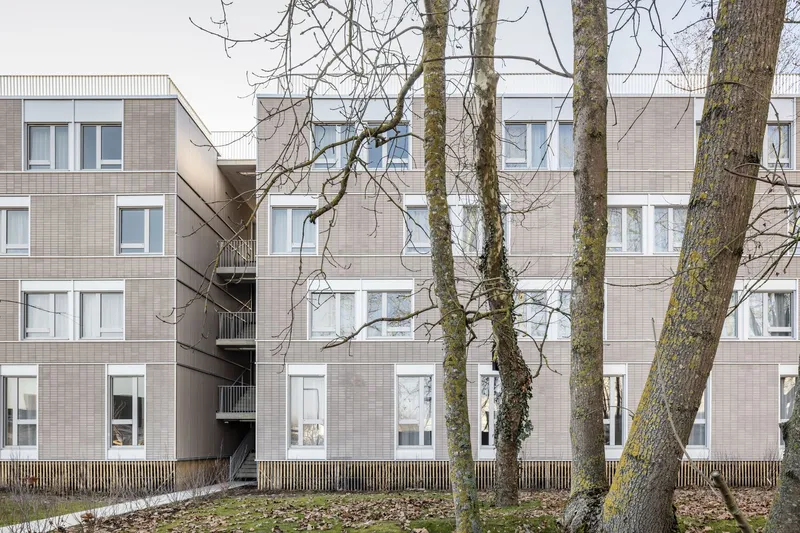
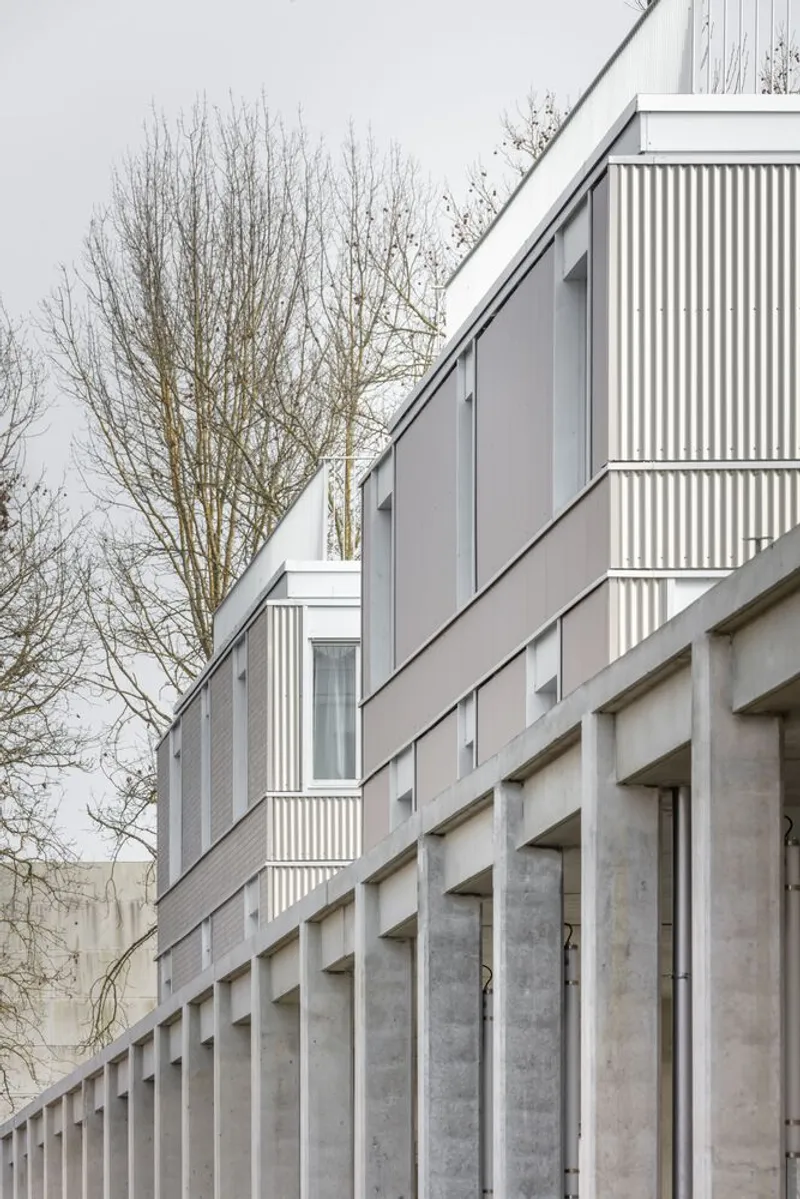
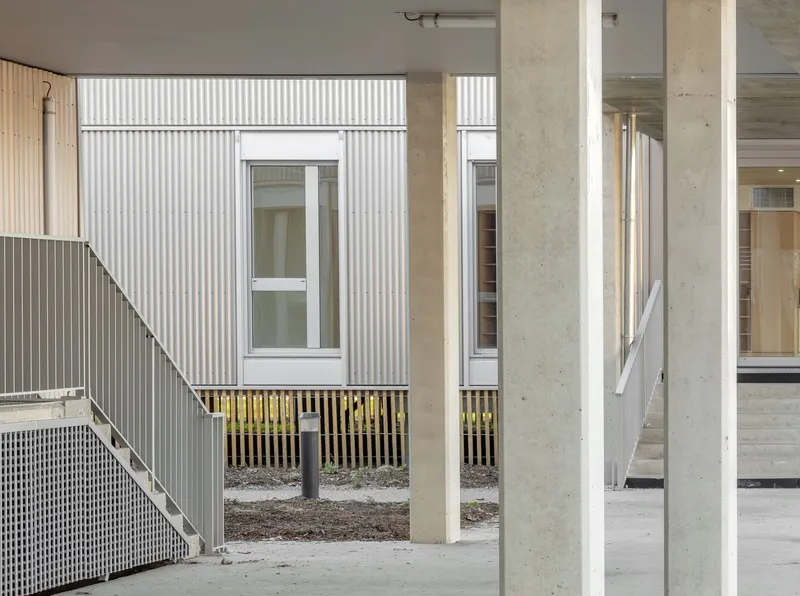
The most persistent criticism of prefabricated housing is that it looks prefabricated: endless identical panels marching along a facade, each window a photocopy of the last. Prego's team tackled this head-on by cycling through materials, from grey panel cladding to corrugated metal to timber slat screens, and varying the depth and rhythm of balconies from one block to another. The corrugated metal panels on the upper floors catch light differently throughout the day, while the timber slatted fencing and balcony screens at ground level introduce a warmer, more domestic register.
The color and texture choices are not arbitrary. Terracotta paving around the plot references the warm tones of the regional built landscape, grounding the new construction in its southwestern French context. Powder-coated steel in the alleyways adds a sharper, more industrial note that honestly signals the prefabricated construction method rather than trying to disguise it. The effect is a campus that owns its modular DNA while refusing to let it dictate the visual experience.
Village Scale at Dusk
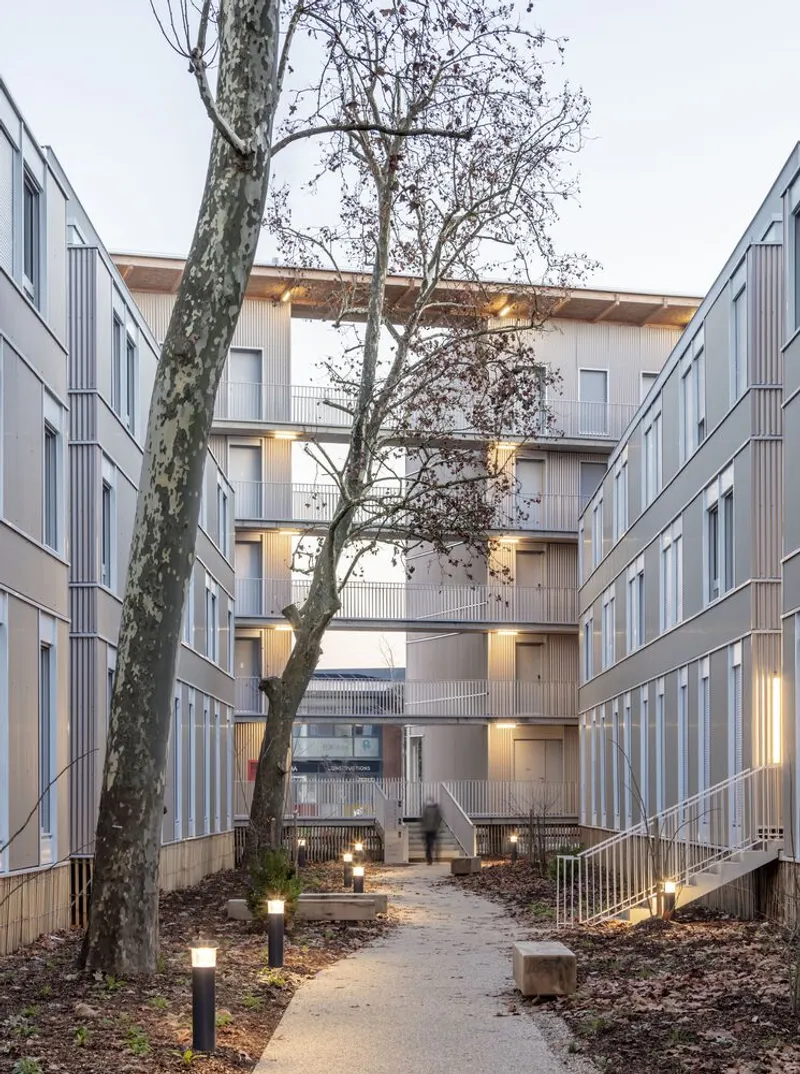
The garden city concept lives or dies in the spaces between buildings, and the courtyard pathways here are where the design proves itself. Narrow enough to feel intimate, wide enough to let a mature tree establish itself at center, these passages function as the social spine of the project. At dusk, when interior lighting spills out through the curtained windows, the walkways take on the quality of a residential lane in a small town. It is the opposite of the anonymous corridor that typically connects dormitory blocks.
This is the real achievement of the project: not that it was built fast, though it was, but that the spaces it creates between its prefabricated walls have genuine character. The bare winter trees, the warm lighting, and the human-scaled proportions combine to produce an environment that invites walking and lingering rather than just transiting.
The Room: Compact but Not Cramped
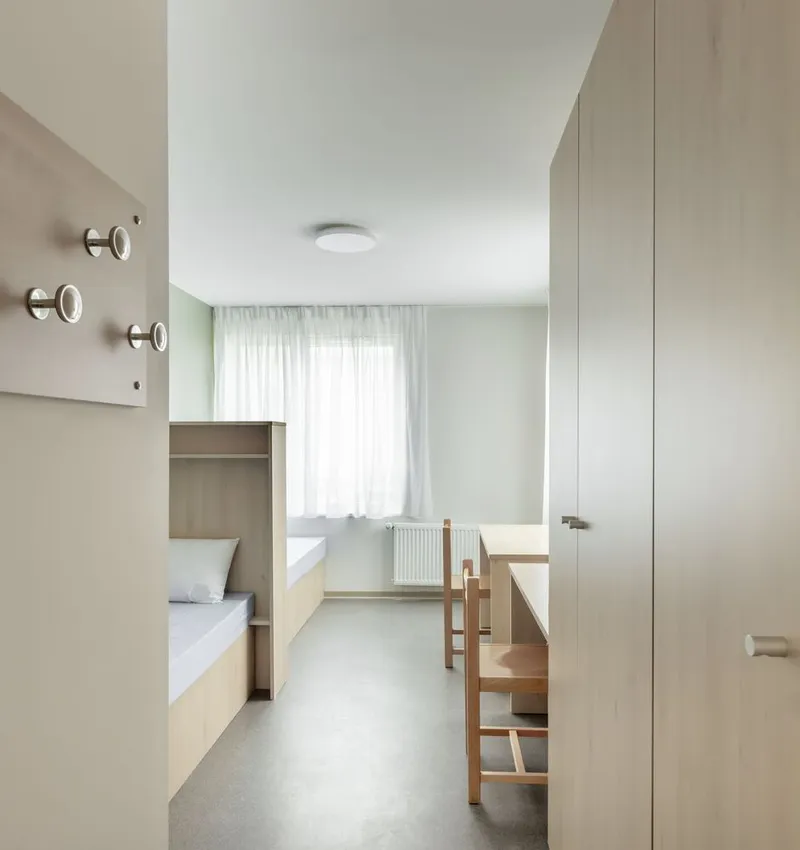
Inside the 461 rooms, a standardized layout accommodates bunk beds, a built-in desk, and a wardrobe within a tight footprint. Pale-wood carpentry lines the bedroom interiors, softening a space that could easily feel institutional. Soft daylight filters through sheer curtains, and the proportions, though compact, avoid the claustrophobia that plagues many dormitory designs. Prefabricated bathroom pods slot in behind the sleeping area, a detail that was critical to the 11-month assembly schedule.
The room design reflects a pragmatic honesty about what mass housing can and should deliver. There is no attempt to make each unit feel like a boutique hotel. Instead, the focus is on material quality, natural light, and intelligent storage. For trainees spending months at the ENAP campus, this is the difference between a room that functions and a room that feels like a place to live.
Why This Project Matters
The ENAP Garden City is a proof of concept for something the architecture profession has long promised but rarely delivered: high-density prefabricated housing that does not sacrifice place-making for speed. An 11-month assembly window, 461 rooms, and a thousand residents are numbers that belong to industrial construction. The intimate courtyard paths, the shifting facades, and the warm material palette belong to architecture. Prego's team managed to hold both in the same project, and that is instructive.
It also matters because it refuses the false binary between efficiency and identity. The building is unapologetically modular, and it is unapologetically specific to its site in Agen, from the terracotta paving to the way the colonnade opens the complex to the surrounding park. As housing pressures intensify across Europe, projects like this one demonstrate that prefabrication does not have to mean generic. It just requires architects who care enough to make the seams interesting.
ENAP Garden City by Ignacio Prego Architectures (lead architects: Ignacio Prego, Rémi Souleau), Agen, France. 9,700 m². Completed 2022. Photography by Luc Boegly.
About the Studio
Share Your Own Work on uni.xyz
If projects like this are the kind of work you want to make, uni.xyz is a place to publish your own, find collaborators, and enter design competitions.


Popular Articles
Popular articles from the community


Tsunami Convergenics: Turning Catastrophic Ocean Forces into Underwater Housing Infrastructure
A speculative underwater settlement off the coast of Onagawa, Japan, treats tsunamis and typhoons as energy sources rather than threats.

Cloaked Colonization: A Mobile Underwater Habitat That Moves Like a Fish
Micah Abaya's shortlisted EHC Pacific entry reimagines ocean settlement as a dispersed network of self-sustaining architectural organisms.

Singing Woman: Contemporary Architecture Inspired by Estonia’s Voice and the Sea
Singing Woman turns Estonia’s song culture into flowing opera house architecture, blending public life, landscape, sea, and national memory.

Opera by the Sea Estonia: Three Shells Dissolving Architecture into Tallinn's Coastline
A winning opera house proposal replaces monumental form with interconnected shells that blur the boundary between building, park and Baltic Sea.

Similar Reads
You might also enjoy these articles


Hodi-Mandai Geram
Project Function: Preservation and revitalization of the Intangible heritage and socio-spatial identity of the Hodi by Housing, Cultural Memory Center, Sacred Grove, landscape, local tourism economy


Olio Towers: A Mid-Rise for Performers That Fuses Housing, Rehearsal, and Stage
Located blocks from Houston's Theater District, this modular tower stacks living units around a central performance atrium.

Oasis: Modular Green Housing Carved into Dhaka's Urban Fabric
A shortlisted Plugin Housing entry reclaims unauthorized settlements in Dhaka with stepped concrete volumes, green roofs, and ventilation-driven design.

Black Hole: A Floating Megastructure for the Post-Physical Era
Emiliano Mazzarotto envisions a spherical, self-scaling arena where e-sports, digital hotels, and holographic stadiums replace traditional public space.

Explore Planned City Competitions
Discover active competitions in this discipline

Challenge to reimagine the Iron Throne

Photograph architecture without architects

Illustrate the lost glory of Angkor Wat - Render Challenge

Design challenge to reuse E-waste
Comments (0)
Please login or sign up to add comments
No comments yet. Be the first to comment!