
Encasa Archstudio Shapes a Kerala Home Around Barrel Vaults and a Central Courtyard Pool
Vault House pairs board-formed concrete arches with tropical planting and timber warmth on a dense residential plot in Kerala, India.


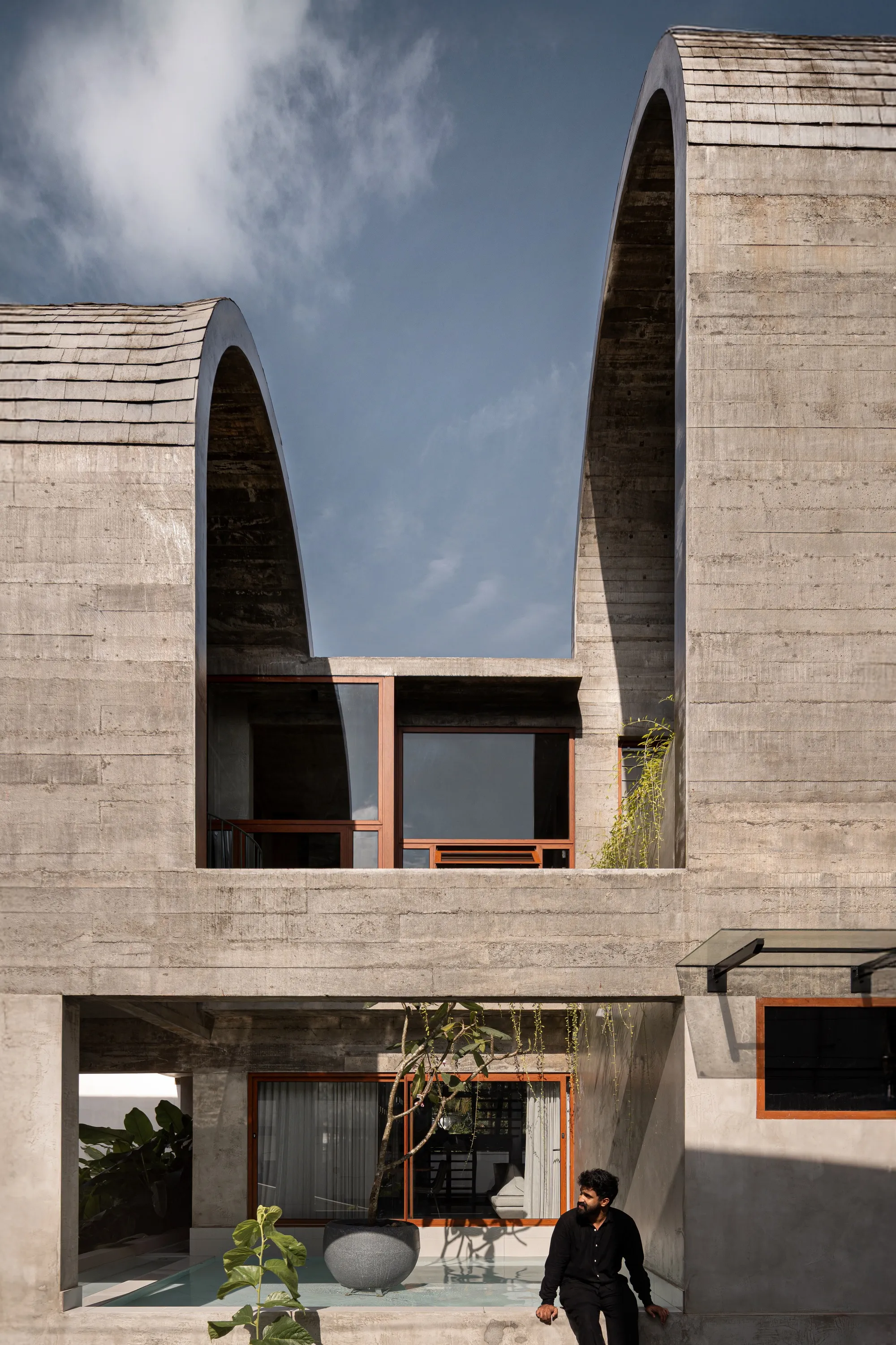
Concrete barrel vaults are nothing new in tropical residential architecture, but they rarely carry a house this confidently. Encasa Archstudio's Vault House in Kerala treats the vault not as a decorative ceiling motif but as the governing structural and spatial logic of the entire dwelling. Two parallel barrel-vaulted volumes, clad in tile and left largely exposed in board-formed concrete inside, organize everything from sleeping quarters to the courtyard pool below.
What makes the project worth studying is the discipline with which a small palette of materials, concrete, timber, steel rod railings, and white render, gets stretched across every scale. The same formwork texture that marks the double-height living wall also lines the shower enclosure. The same arched opening that punctuates the street facade reappears at bedroom windows looking out over palm canopies. The result is a house that reads as a single, coherent object from the street while offering genuinely varied spatial experiences inside.
Street Presence: Concrete and Curves Against the Neighborhood Grain


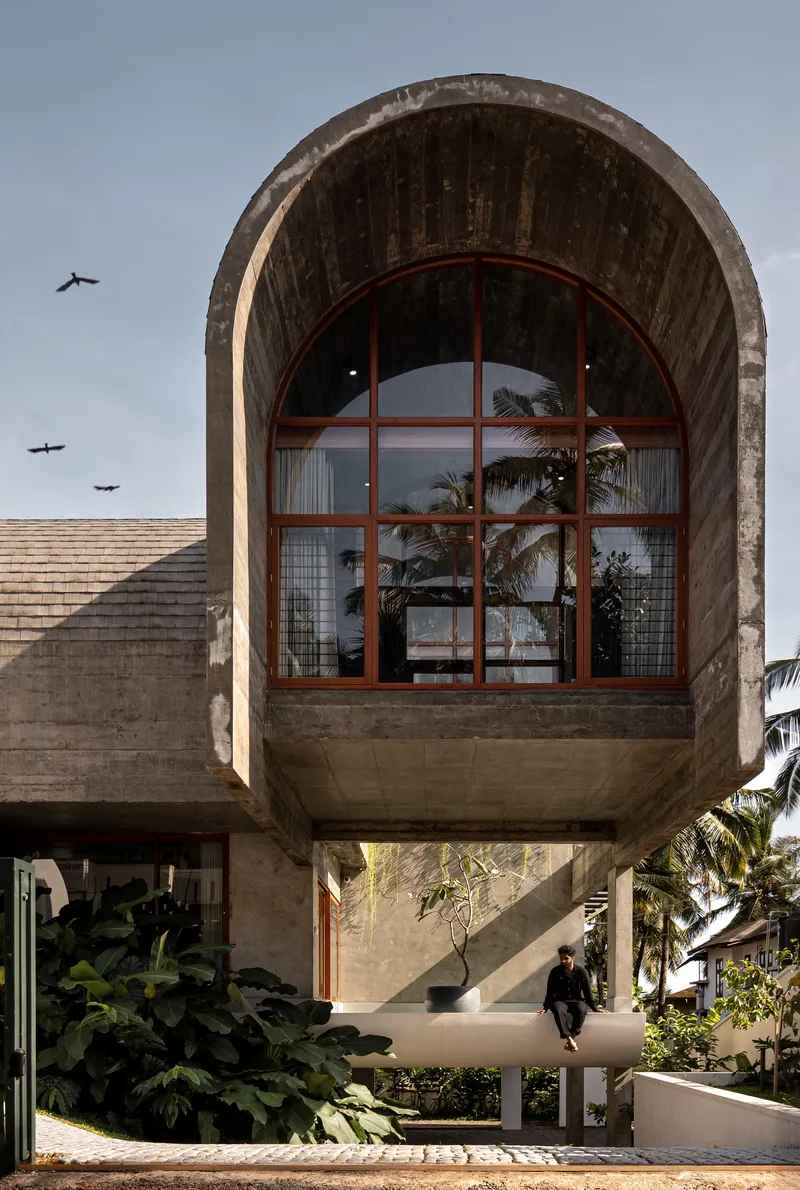
From the road, Vault House registers as an almost civic gesture: paired concrete barrel vaults cresting above coconut palms, with deep arched openings punched through the mass. The board-formed texture of the concrete gives the facade a handmade grain that softens its monolithic bulk. A metal fence and a modest forecourt keep the house close to the street edge, a common condition in Kerala's dense residential plots that forces the architecture to work hard in section rather than spread across the site.
The tiled roof surfaces visible from above and across the street add a subtle domesticity, linking the contemporary form language back to Kerala's tradition of clay-tiled roofs. It is a smart move: the house stands out without shouting.
The Entry Sequence and Courtyard Logic
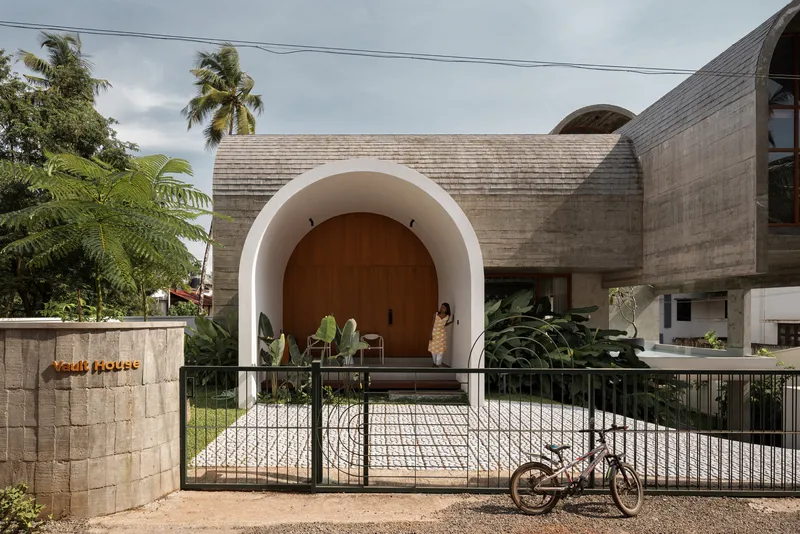

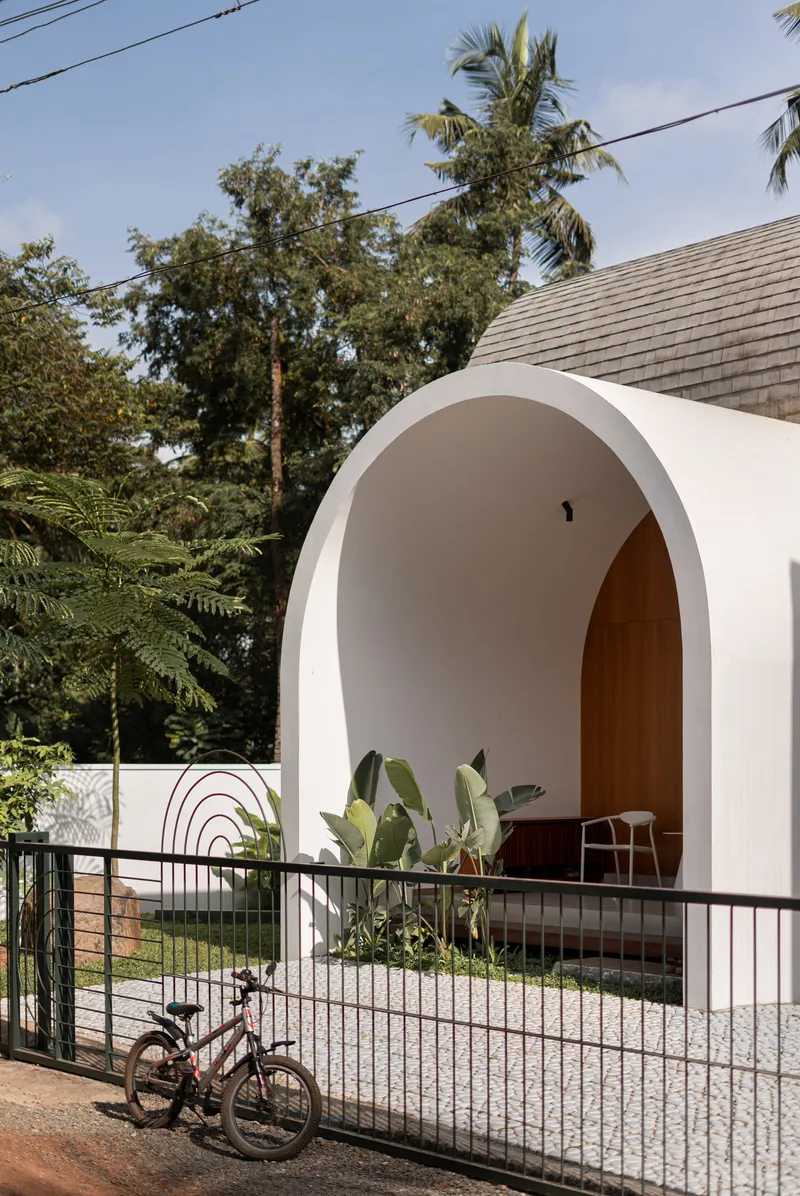
Arriving at Vault House means passing through a compressed arched portal set in white stucco before stepping into a board-formed concrete foyer. The transition from bright tropical light to the muted, textured interior is immediate. From the foyer, the house opens laterally into a central courtyard that functions as the organizational heart of the plan. This is where daylight, ventilation, and visual connection between rooms are negotiated.
The courtyard is not ornamental. It houses the lap pool, a timber deck, and planted beds that bring greenery into the section at every level. A white barrel-vaulted pavilion flanks one edge, creating a secondary outdoor room that mediates between the more closed private zones and the open pool terrace.
The Pool Courtyard as Spatial Engine


The courtyard pool is more than a luxury amenity; it is the device that pulls light and air deep into the plan. Overhead, a perforated metal trellis filters sunlight into diagonal shadow patterns across the timber deck and white walls. From the aerial view, the curved concrete water feature and tile surround read as a direct extension of the vaulted roof geometry, as if the arches have been inverted and laid flat on the ground.
Glass walls along the living spaces open directly onto this pool court, collapsing the boundary between inside and out. A person seated on the interior stair can look through the full depth of the house to the planted beds beyond. That kind of visual permeability is essential in a Kerala climate where cross-ventilation and shade determine whether a house is livable or merely photogenic.
Living Spaces Under the Vault


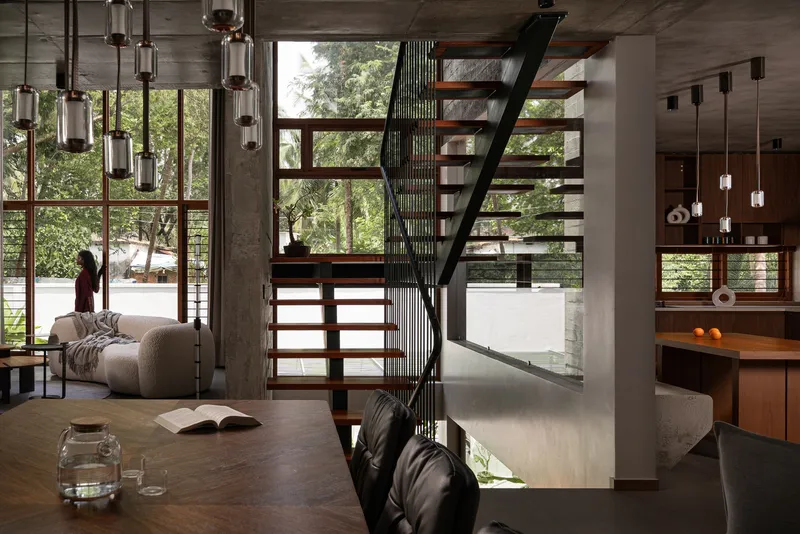
The double-height living space is the most dramatic room in the house. Board-formed concrete wraps the walls and ceiling continuously, giving the vault its full structural expression. A steel staircase threads through the volume, its open treads and slender rod balustrade reading as line drawings against the heavy concrete. Pendant lights drop in clusters from the apex, scaled to the room's considerable height.
Full-height glazing on the garden side floods the room with diffused light, and the decision to keep furniture minimal and low lets the volume speak. The armchair in the corner is almost comically small against the towering wall, but that disproportion is precisely the point. The vault makes ordinary domestic activities feel slightly ceremonial.
Timber, Steel, and the Craft of Circulation


Staircases in Vault House do real architectural work. The primary open-tread timber stair descends past concrete walls with pendant light clusters marking the landing, creating a vertical room in its own right. Elsewhere, a curved staircase with timber treads and steel rod railings leads to an exterior terrace, its geometry echoing the arched forms that dominate the rest of the project.
The vertical rod balustrades deserve mention. They appear at every stair and balcony, thin enough to remain transparent but dense enough to create a rhythmic screen when seen in perspective. Against the rough concrete, the precision of the steel rods creates a productive tension between the handmade and the machined.
Bedrooms and Private Quarters


The bedrooms continue the material language but shift the mood. Board-marked concrete walls are paired with sheer curtains and soft daylight filtered through tall arched windows. In the upper bedroom, timber-framed arches overlook the palm canopy, and the vaulted ceiling drops low enough to feel intimate rather than monumental. A curved timber wall beneath one arch introduces a warm counterpoint to the concrete, creating a reading nook or dressing area that benefits from the vault's natural acoustics.
The shower enclosure is a standout detail: a concrete-lined room with a planted bed beneath a skylight slot, where tropical foliage grows inside the section. It is a small move, but it confirms that the architects were thinking about the experience of every room, not just the ones visitors see first.
Dusk and Night: The House as Lantern


At dusk, the arched openings become illuminated frames, and the house transforms from a weighty concrete mass into a series of warm lanterns set among tropical plantings. The courtyard view with its lit arched windows against the darkening sky is the most evocative image of the project. The timber ceiling inside the arched window alcove glows amber, revealing the layering of materials that daytime photographs flatten.
The night shot under a starry sky pushes into slightly cinematic territory, but it reveals something important about the entry courtyard's proportions: the potted tree, the vault overhead, and the concrete walls create a room without a roof that feels complete. It is the kind of space that only works when every surface has been considered, and here, they have been.
Plans and Drawings
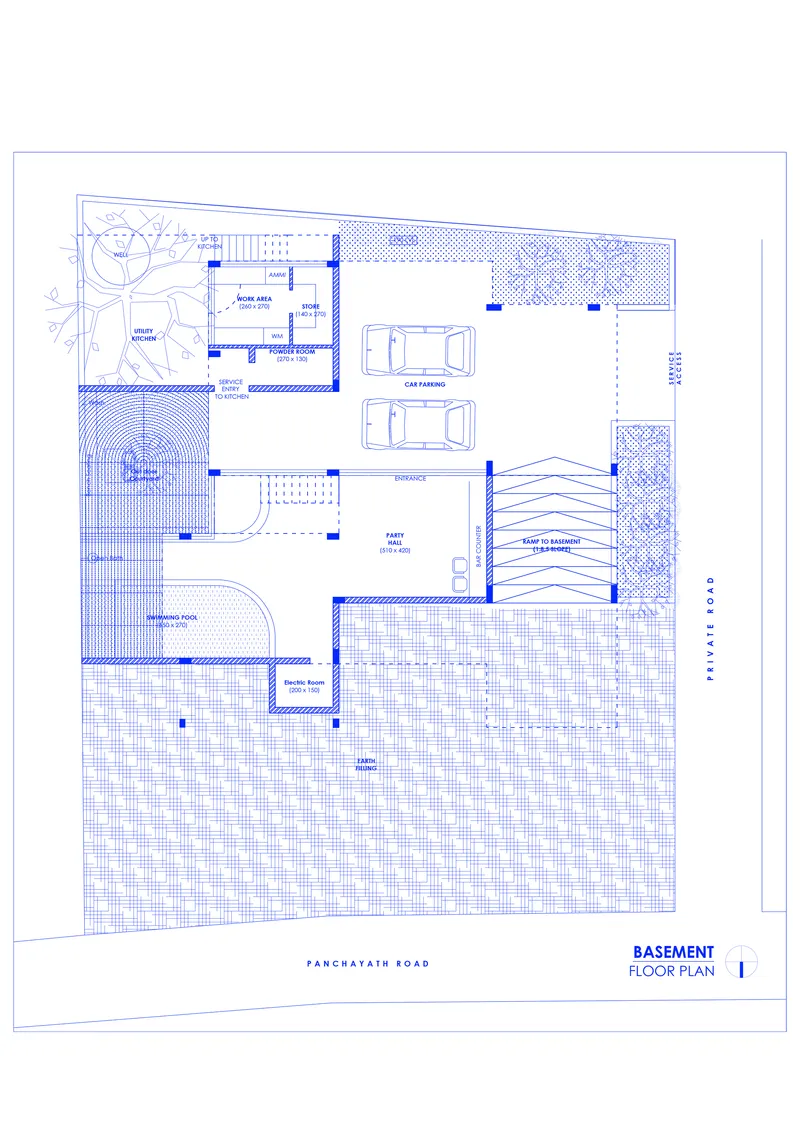


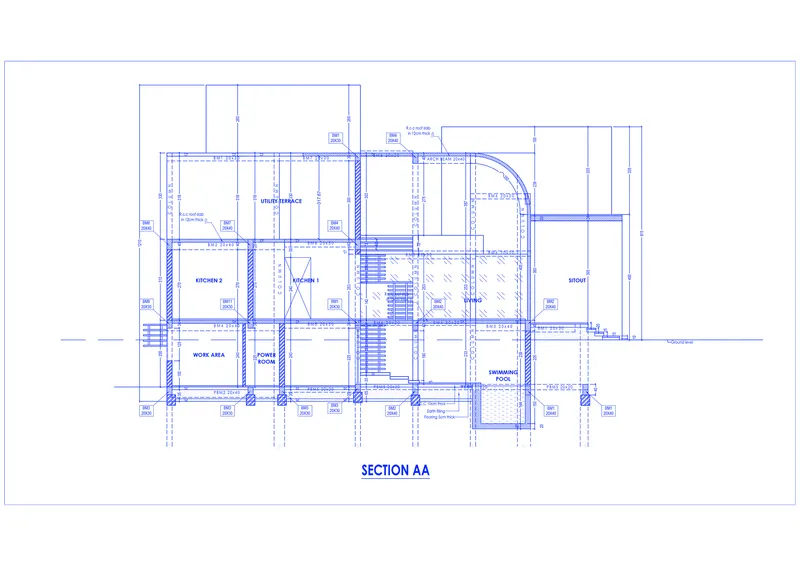

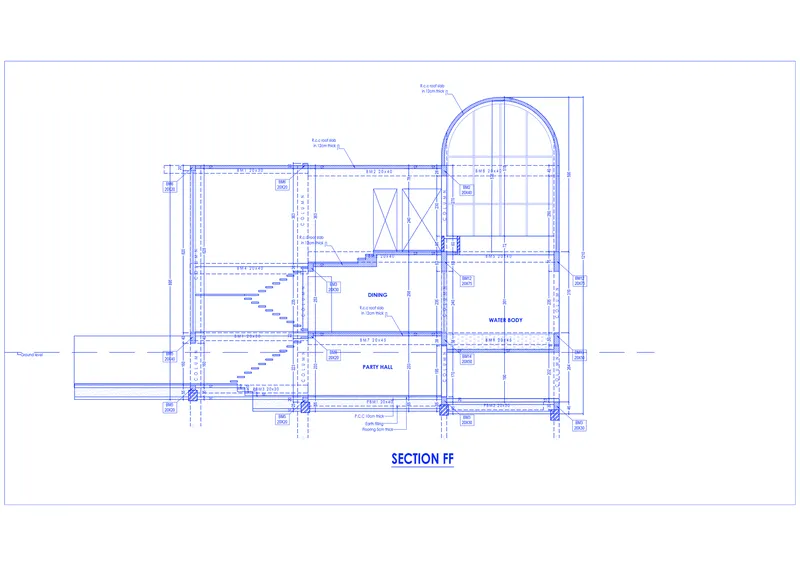

The floor plans reveal the courtyard's role as the organizational spine: living spaces wrap one side, bedrooms and service areas the other, with circulation threading between them at multiple levels. The basement accommodates car parking and services, freeing the ground floor for the open living, dining, and courtyard sequence. The first floor pushes bedrooms to the perimeter, giving each room access to a balcony or roof terrace.
The four section drawings are where the project's ambition becomes clearest. They show how the barrel vaults span the full width of each wing, how the double-height living space and the pool court carve vertical voids through the mass, and how the arched openings are tuned to admit light without exposing interiors to direct sun. The party hall and work areas tuck into the lower levels, taking advantage of the cooler, shaded zones at the base of the section.
Why This Project Matters
Kerala's residential architecture has been in a sustained period of formal experimentation, with exposed concrete, courtyard plans, and tropical modernism now standard vocabulary for a generation of young studios. Vault House earns its place in that conversation by committing fully to a single structural idea and letting it organize everything: the roofline, the window openings, the ceiling surfaces, even the water feature in the courtyard. That kind of consistency is harder than it looks, because it demands that every junction, every threshold, every piece of furniture negotiate with the curve overhead.
Encasa Archstudio has delivered a house that is legible from the street, spatially rich inside, and environmentally responsive without resorting to gimmicks. The board-formed concrete will age well in Kerala's humid climate, picking up moss and patina in ways that only deepen the texture. And the courtyard pool, far from being an afterthought, is the mechanism that makes the entire plan breathe. If you are going to build with barrel vaults in the tropics, this is the level of integration to aim for.
Vault House by Encasa Archstudio, Kerala, India. Completed 2024. Photography by Turtle Arts Photography.
About the Studio
Share Your Own Work on uni.xyz
If projects like this are the kind of work you want to make, uni.xyz is a place to publish your own, find collaborators, and enter design competitions.




Popular Articles
Popular articles from the community


Riyadh For All: Intergenerational Urban Design for Active Aging in Rabat
Riyadh For All reimagines urban design in Rabat with intergenerational co-living, adaptive courtyards, and Moroccan cultural exchange today.

Hill & Cross Opera: Sculptural Opera House Architecture Shaped by Tallinn’s Landscape and Identity
Hill & Cross Opera reimagines opera house architecture in Tallinn through its sculptural hill, civic plaza, glass wave and a luminous cross.
EW PARK: Sustainable Architecture Reimagines the Future of Urban Parking
EW PARK reimagines city parking as a modular wooden tower combining automation, solar energy, electric mobility, and adaptable urban design.

The Ocean Hive: Sustainable Architecture for a Self-Sufficient Civilization at Sea
The Ocean Hive imagines sustainable architecture at sea, where modular habitats, algae, wave power and ocean waste sustain a growing colony.


Similar Reads
You might also enjoy these articles

Bao Huynh Watercolor Atelier: A Serene Art Retreat in Hội An
Bao Huynh Watercolor Atelier in Hội An blends multifunctional art spaces, sustainable design, local materials, and family-friendly living in a serene environment.

Atelier Macri Concept Store Interior Design by CASE-REAL
Atelier Macri store features a "ko" counter, walnut wood details, cork displays, blending retail, gallery, and seamless customer experiences.

Manuel Vargas Izquierdo Stadium and High-Performance Sports Center: Architectural Excellence in Jalpa de Méndez
The Manuel Vargas Izquierdo Stadium blends sustainable design, inclusive sports facilities, and cultural-inspired architecture, revitalizing Jalpa de Méndez’s public spaces.
KAKR Buluh Awar Hall: Revitalizing Community and Ecology Through Bamboo Architecture
Community built bamboo hall revitalizes Buluh Awar village, empowering youth, restoring ecology, celebrating vernacular craftsmanship through sustainable architecture and culture.




Comments (0)
Please login or sign up to add comments
No comments yet. Be the first to comment!