

Eraclis Papachristou Architects Channels Byzantine Churches into a Mountainside Wine Distillery in Cyprus
Perched on a promontory above Kalopanagiotis, three concrete cylinders reinterpret sacred geometry for the stages of winemaking.


Cyprus has been making wine for more than five millennia, long enough for the craft to feel inseparable from the island's terrain. When Eraclis Papachristou Architects took on the Lampadistis Wine Distillery, set on a promontory above the remote mountain village of Kalopanagiotis, the studio chose not to invent an aesthetic from scratch. Instead they looked downhill, to the UNESCO-listed monastery of St. John the Baptist, known locally as Lambadistis: three churches arranged in a row, their tiled roofs appearing to hover above rough stone walls. That ecclesiastical sequence became the skeleton of a 4,700-square-meter production complex brought to life over five years and recognized with Cyprus' 2022 architecture state prize.
What makes the project genuinely compelling is its refusal to separate spectacle from process. Three massive concrete cylinders house the sequential stages of winemaking: fermentation, ageing, and bottling. The volumes protrude from rough stone walls like apses shoved forward into the landscape, their weight made visually ambiguous by a hovering béton brut exoskeleton. A linear path leads visitors from the mountainside into the heart of production, narrowing to a bridge that hangs above a considerable drop before turning sharply into the building. Architecture and viticulture share the same circulation; one does not merely decorate the other.
A Promontory and Three Drums


From a distance the building reads as a series of stacked horizontal planes cantilevered out over the forested hillside, anchored by concrete piers that disappear into vegetation. At dusk, the illuminated glass facades glow against the Paphos Forest ridgeline, turning the production facility into something closer to a lantern. The drama is structural: cantilevered roof overhangs, board-formed concrete walls, and a deliberate exposure of the load paths that carry the building's weight sideways into the slope.
The three cylindrical drums, visible in plan as punctures in the main floor, organize everything. Each drum corresponds to a phase of production, from raw grape to finished bottle, and each generates a distinct spatial condition above and below grade. Stainless steel fermentation tanks sit within wells sunk beneath the main level, keeping the production cool while presenting a spectacle of industry to visitors walking overhead.
The Mosaic Screens and Shading Layers
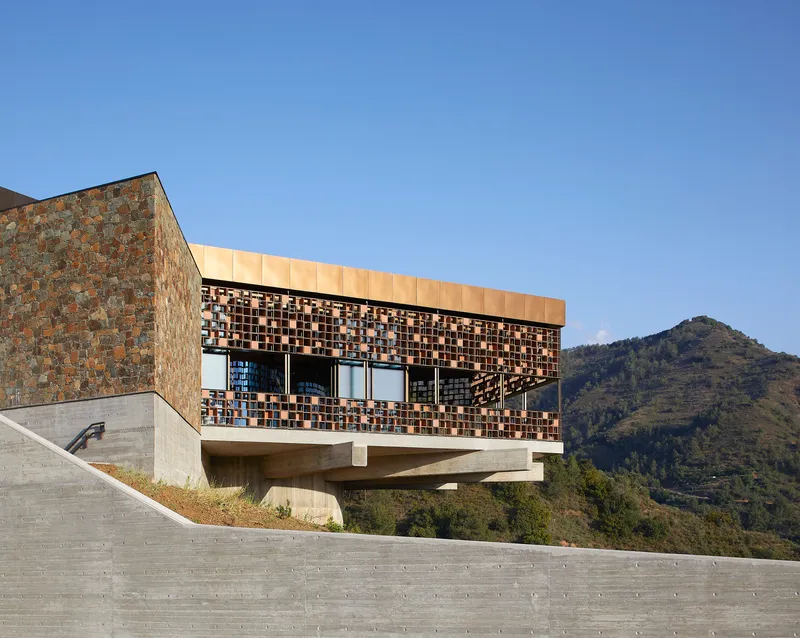
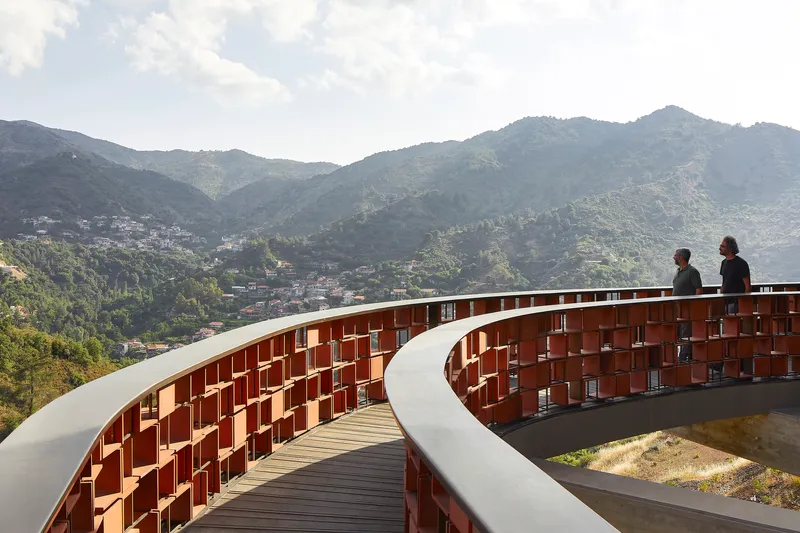

The most visually arresting surface on the building is its perforated screen facade. Constructed from 3,450 L-shaped Ductal concrete modules finished in polished red-earth coloring, the screen wraps the upper volume like a balustrade scaled up to architecture. The open geometry of the modules follows an interweaving pattern set within an open metal framework, a reinvention of the tile wedges traditionally placed between granite stones in the village below. The effect is a translucent veil that filters afternoon light, frames mountain ridges, and provides passive shading without sealing the interior off from the landscape.
From inside, the screens dissolve the boundary between building and terrain. Figures silhouetted against them become part of the pattern, and the distant ridges of Cyprus' interior mountains appear through thousands of apertures. It is a detail that could easily have tipped into decoration, but its grounding in local stonework traditions gives it a material logic that holds.
Reclaimed Timber and the Radial Ceiling
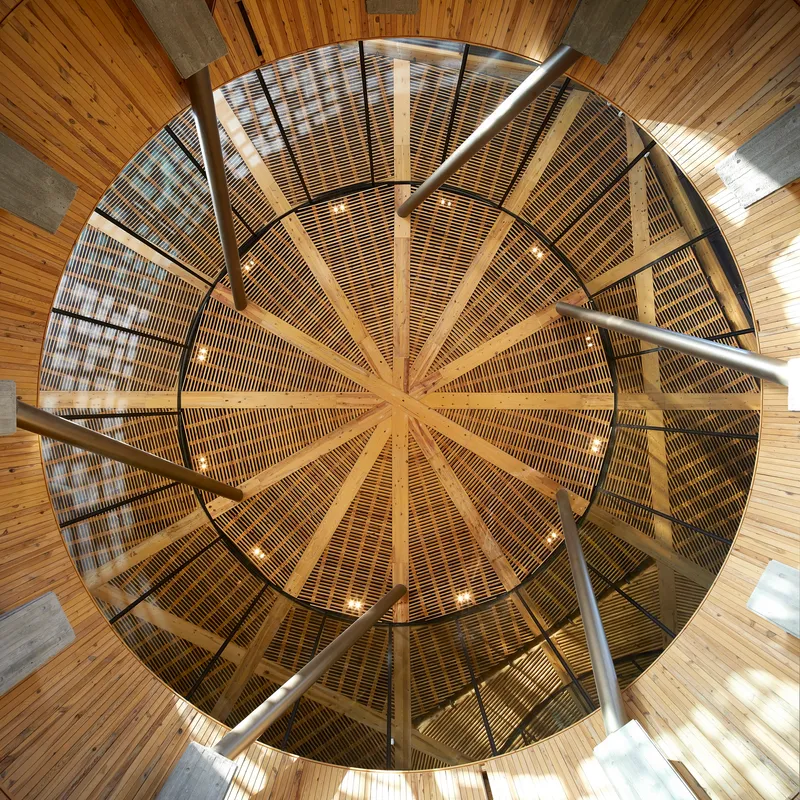
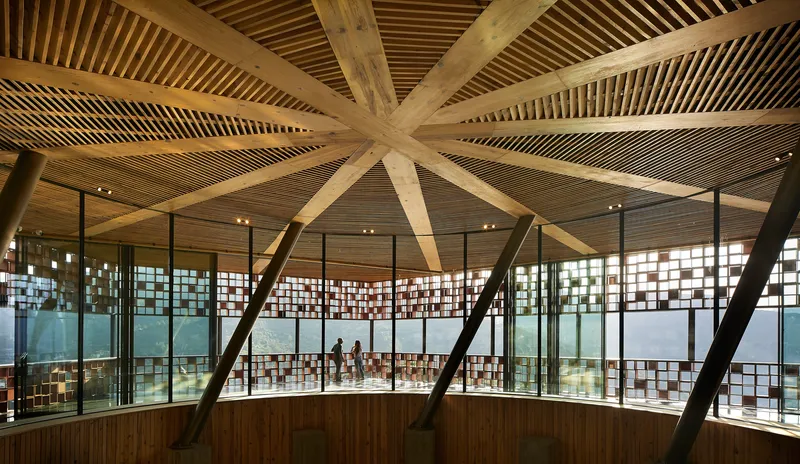

The interior ceilings are built from reclaimed timber salvaged from a forest fire that struck Cyprus several years before construction began. That biographical detail transforms what might otherwise be a handsome structural decision into something with genuine resonance: wood that survived catastrophe now shelters wine production. Arranged as radial beams converging at central oculi above each cylindrical volume, the timber ceiling rotates with strong geometries around the three core drums. The effect when looking upward is almost centrifugal, with slatted panels fanning out like spokes.
The soffit extends beyond the building envelope as a deep overhang, its timber slats visible from below alongside the concrete support columns. This continuity of material between inside and out erases the threshold and extends the atmospheric warmth of the interior into shaded outdoor terraces overlooking the valley.
Production Floor as Spectacle


A glass viewing box cantilevered above the production floor lets visitors look directly down at stainless steel fermentation tanks set against board-formed concrete walls. The decision to make production visible rather than hidden is the building's strongest curatorial move. Wine is not presented as a finished luxury but as an ongoing physical process, one with heat, moisture, steel, and gravity. The dark, reflective main floor amplifies this by mirroring the equipment and the architecture overhead, doubling the sense of depth.
Beyond production, the program extends to a gourmet restaurant and a conference center for wine tastings and private events. These public spaces occupy the upper levels behind the mosaic screens, their polished floors catching mountain views through ribbon windows and perforated copper panels. The spatial sequence from arrival to tasting follows the same linear path as the wine itself, from raw material to refined product.
Concrete, Copper, and Stone
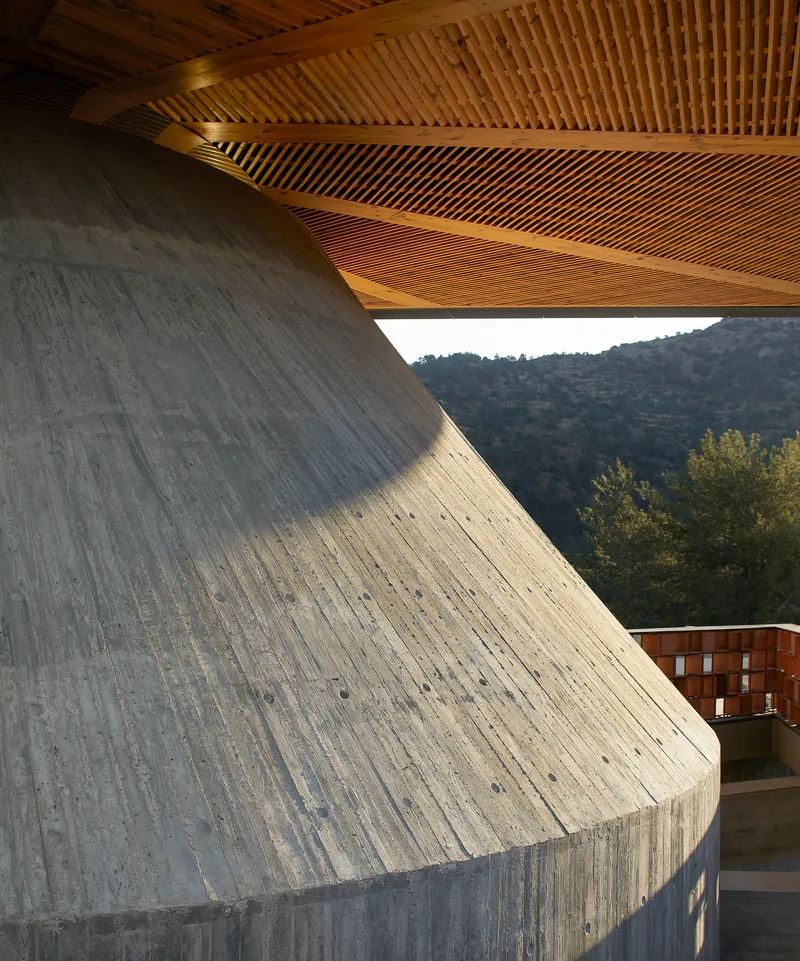
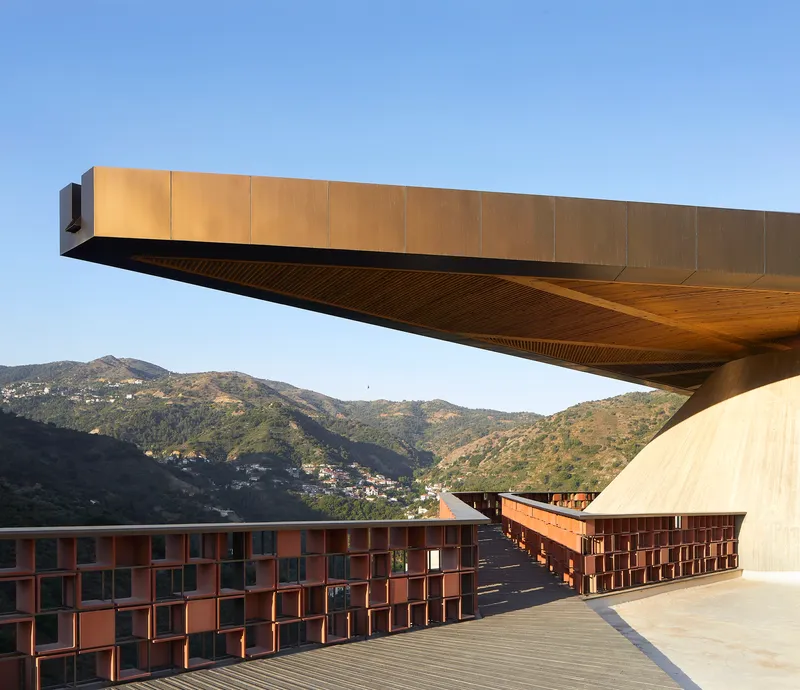
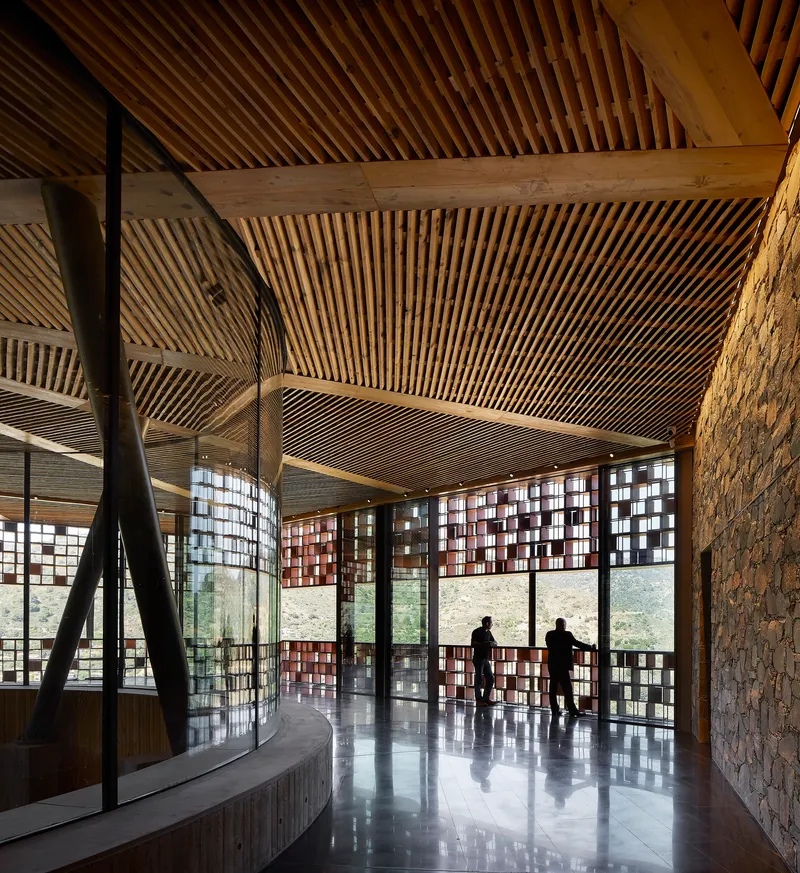
The material palette is deliberately limited but rich in texture. Curved concrete walls meet the cantilevered roof overhang with geometric precision, while copper-clad volumes age against the mountain air. The entry foyer grounds everything with a polished stone floor and diagonal steel bracing beneath the slatted timber ceiling, exposing the structural logic rather than concealing it. Angled posts carry the ceiling weight visibly, turning load-bearing into ornament.
Granite stones with reinvented tile wedges between them recall the masonry of Kalopanagiotis without copying it. The building sits on the border between raw and refined, between the béton brut of its exoskeleton and the polished red-earth Ductal modules of its screens. That tension, between weight and apparent weightlessness, runs through every joint.
Terraces and the Valley Below
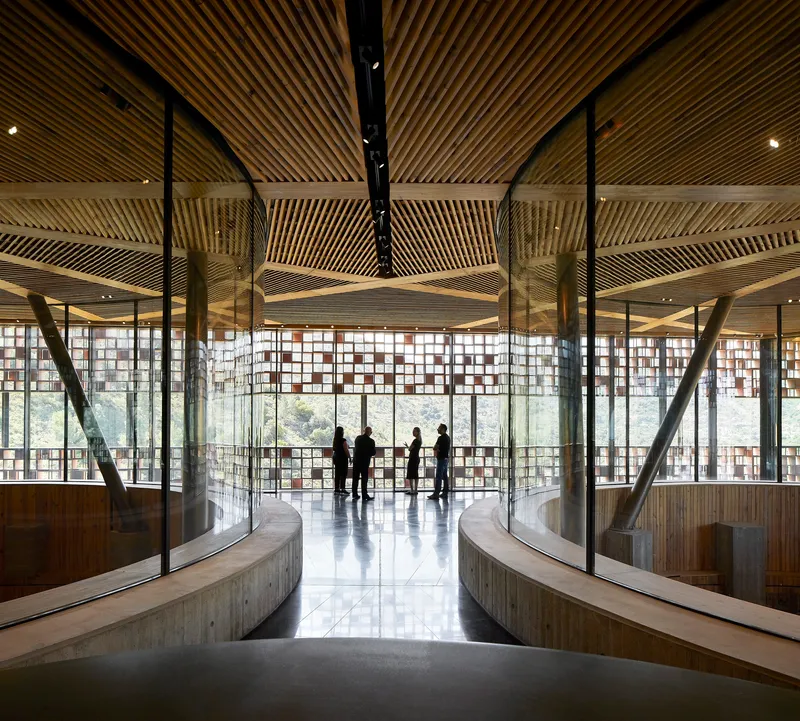
Curved balconies within the central hall let visitors lean out toward the perforated screens and look through them to the valley below. An observation walkway provides panoramic views of the surrounding countryside, making the landscape integral to the tasting experience. The building's relationship with its promontory is not incidental; it is the primary design gesture. You arrive by traversing the mountainside, cross a vertiginous bridge, and then the architecture slowly opens outward to return your gaze to the terrain you just left.
Plans and Drawings


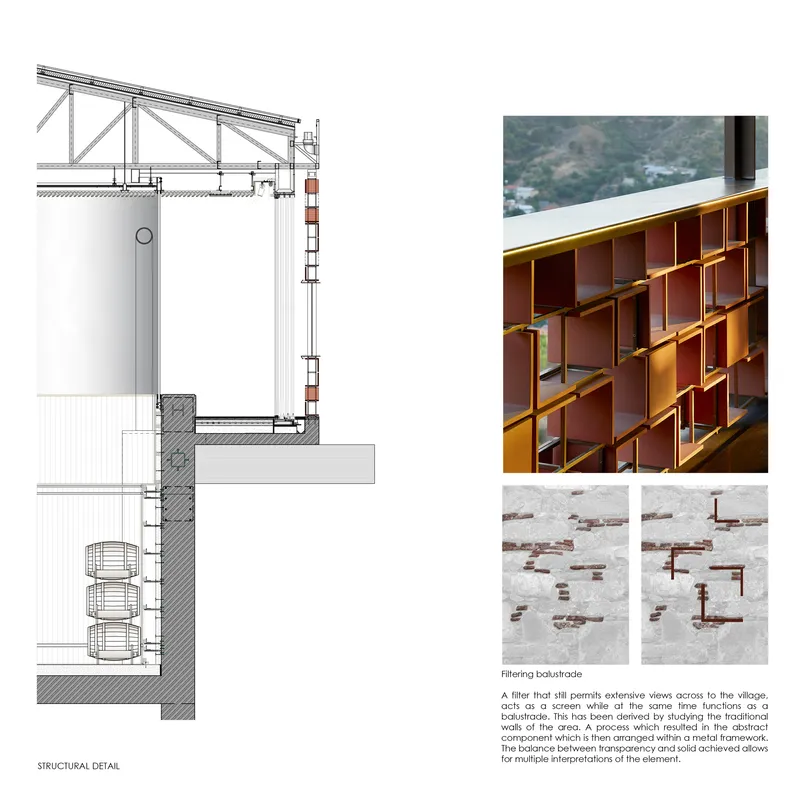
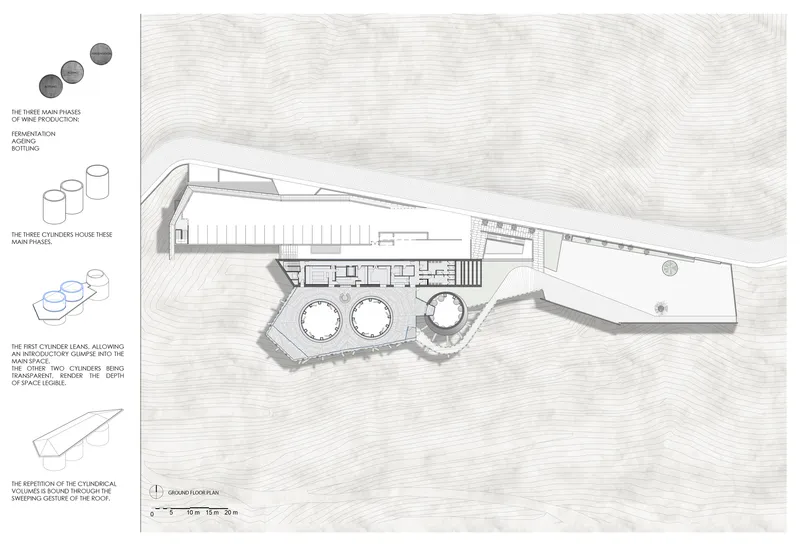
The plans reveal what photographs only imply. Three circular volumes, clearly legible in all floor plans, are connected to a linear service wing that extends like a triangular wedge across the contoured terrain. The section drawing shows underground fermentation tanks sunk below the main floor, confirming that the building's drama works vertically as much as horizontally. Structural detail drawings of the wall assembly illustrate how the filtering balustrade integrates with the fermentation vessels below grade, tying the decorative screen to the production logic beneath it.
The upper-level plan shows the three circular chambers linked by gallery spaces, while the ground floor reveals the entrance plaza and its relationship to the mountainside approach. What the drawings make explicit is the project's debt to its ecclesiastical source: three drums in a row, each distinct in program, unified by a hovering roof. The geometry is disciplined enough that the plan reads almost as a diagram of the winemaking process itself.
Why This Project Matters
Winery architecture has become a genre unto itself, often privileging sculptural gesture over programmatic clarity. The Lampadistis Wine Distillery succeeds because it refuses that split. Its three cylinders are simultaneously a typological reference to the Lambadistis monastery, a diagram of the production sequence, and the primary structural event. The building does not need to explain itself through signage or guided tours; walk through it and you understand fermentation, ageing, and bottling spatially, by moving from one drum to the next. That is architecture doing the work of narrative.
Equally significant is the project's relationship to its materials and context. Reclaimed fire-damaged timber, reinvented stone wedges, Ductal modules colored with local red earth: these are not token gestures toward sustainability but real material decisions that bind the building to the island. At a construction cost of €6,000,000 for 4,700 square meters, the budget is substantial but not extravagant, and the result is a building that earns its presence on the promontory. Cyprus' 5,000-year winemaking tradition finally has an architectural counterpart that takes the long view seriously.
Lampadistis Wine Distillery by Eraclis Papachristou Architects. Kalopanagiotis, Cyprus. 4,700 m². Completed 2022. Photography by Hufton+Crow.
About the Studio
Share Your Own Work on uni.xyz
If projects like this are the kind of work you want to make, uni.xyz is a place to publish your own, find collaborators, and enter design competitions.


Popular Articles
Popular articles from the community

Faces of the Soviet Avant-Garde: Turning Moscow's Street Names into an Open-Air Museum
A network of sculptural installations across a Moscow residential district transforms forgotten architect names into spatial encounters with cultural memor
Opera by the Sea Estonia: Three Shells Dissolving Architecture into Tallinn's Coastline
A winning opera house proposal replaces monumental form with interconnected shells that blur the boundary between building, park and Baltic Sea.

Manzana Morphosis: Stretching Barcelona's Grid into a Living Landscape for 2050
A radical reworking of the Eixample manzana turns density into a tool for generous public space, vertical ecology, and environmental performance.

Singing Woman: An Opera House That Performs Before the Curtain Rises
Ovidiu Cristian Pavel's conceptual opera house translates Estonia's choral identity into a sculpted waterfront landmark facing the Baltic Sea.

Similar Reads
You might also enjoy these articles

Pixel Gardens: One Repeated Module Stacked Into a Terraced Social Housing Tower for Famagusta
Salem Bader's shortlisted housing tower builds a vertical neighbourhood from one repeated module, offsetting units to carve terraces, light and air.

Bao Huynh Watercolor Atelier: A Serene Art Retreat in Hội An
Bao Huynh Watercolor Atelier in Hội An blends multifunctional art spaces, sustainable design, local materials, and family-friendly living in a serene environment.

Atelier Macri Concept Store Interior Design by CASE-REAL
Atelier Macri store features a "ko" counter, walnut wood details, cork displays, blending retail, gallery, and seamless customer experiences.

Manuel Vargas Izquierdo Stadium and High-Performance Sports Center: Architectural Excellence in Jalpa de Méndez
The Manuel Vargas Izquierdo Stadium blends sustainable design, inclusive sports facilities, and cultural-inspired architecture, revitalizing Jalpa de Méndez’s public spaces.


Comments (0)
Please login or sign up to add comments
No comments yet. Be the first to comment!