
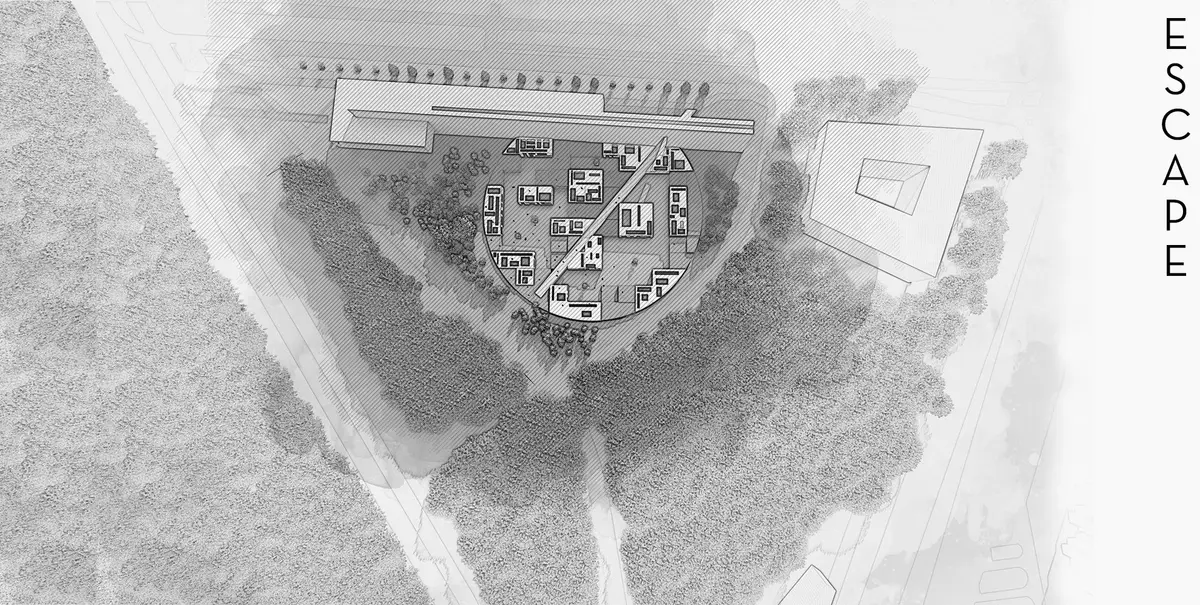
ESCAPE: A Public Library Dissolved into a Field of Courtyards and Capillary Paths
A fragmented public library sunk three metres into the ground, where capillary paths link informal learning below to a formal volume at +7.50.


Most libraries still behave like institutions of supervision: a front desk, a reading hall, rows of fixed seats and an unspoken rule of silence. ESCAPE starts from the opposite premise. It treats the library as a tool for leaving those conditions behind, a place where knowledge carries no inspection, no ban and no imposed hierarchy, and where reading philosophy, rehearsing music, attending a talk or arguing with a stranger all count as legitimate forms of learning.
Designed by Batu Özenalp and Yusef Kimyon, the proposal replaces the monolithic library block with a constellation of small, interconnected volumes set inside a circular boundary on a triangular urban site. The designers organise the programme across three key levels: an informal library embedded in the landscape at -3.00, a ground plane at +0.00, and a formal learning zone lifted to +7.50. The result reads less like a building and more like a terrain that people move through, linger in and claim.
A Circle of Courtyards Instead of a Reading Hall
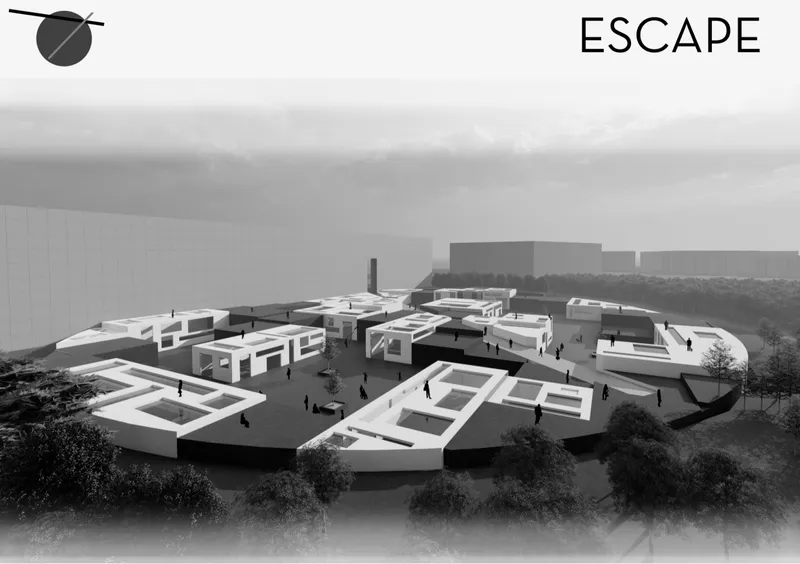
The aerial view makes the central argument immediately legible. White courtyard blocks, each punctured by rooftop openings, gather in a ring rather than stacking into a single mass. Trees occupy the foreground and the gaps between volumes, so the library never presents one continuous façade to the city. A tall gridded wall rises behind the cluster, giving the composition a backdrop against which the low, porous field of rooms can register.
This fragmentation is a deliberate attack on institutional intimidation. Smaller units mean smaller thresholds, and smaller thresholds lower the psychological cost of walking in. The circle, which the designers frame as a figure of inclusivity and collective gathering, works here as a soft perimeter: it defines a common ground without walling it off.
Fitting a Round Idea into a Triangular City Block
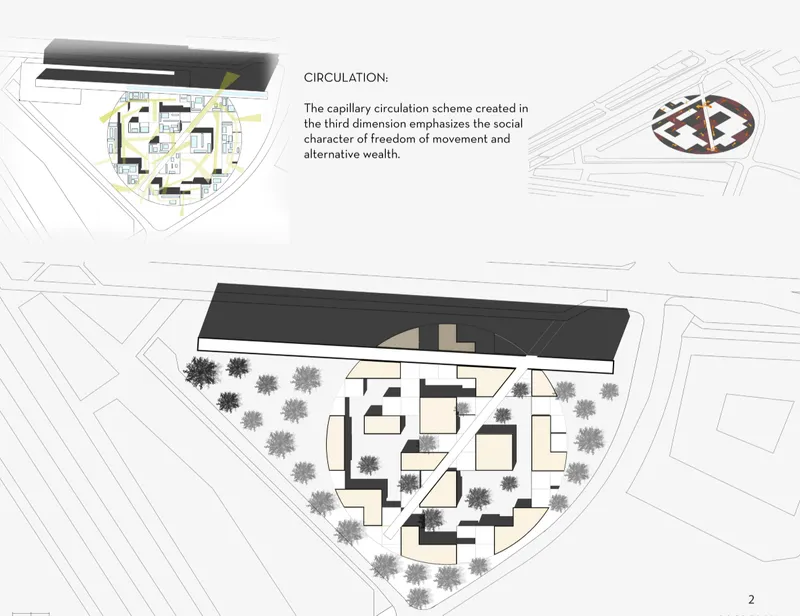
The site plan shows how the circular plot sits inside its triangular urban context, with scattered volumes distributed across the disc and a diagonal path slicing through beside a long dark block. That diagonal matters. It suggests the scheme is not a sealed campus but a piece of the city's walking network, letting people cross the site as a shortcut and, ideally, get distracted along the way.
Between the built pieces, the plan leaves room for trees, courtyards and open platforms. This is where the designers' notion of capillary circulation takes shape: routes branch, split and rejoin rather than funnelling users down a single corridor. With multiple ways to arrive at any room, no single journey through the library is privileged, which mirrors the project's claim that learning is not linear.
Roofs That Become Seats, Courtyards That Become Rooms
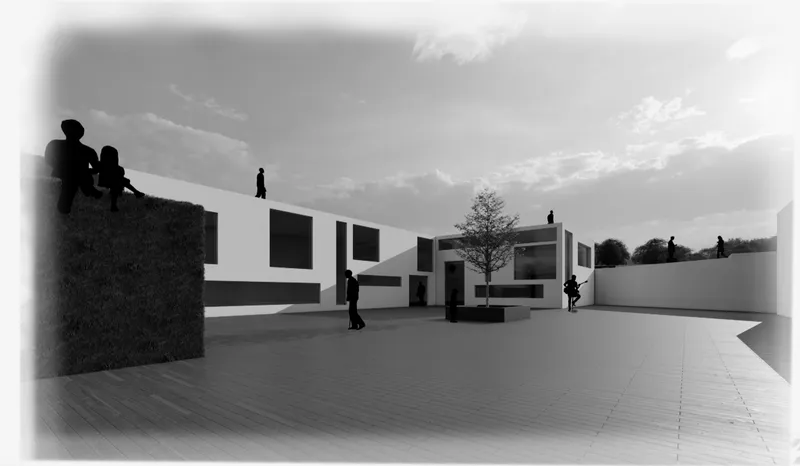
At ground level the courtyard is paved, anchored by a single tree in a planter, with a grass-topped mass on the left and figures sitting on the rooftops above. It is a useful image because it shows the project's layered ground condition in use. The roof of one space becomes the bench or lookout of another, and the distinction between inside and outside, programme and leftover space, starts to blur.
This is the spatial translation of what the designers describe as alternative wealth: not material richness but social and intellectual exchange. By making every surface potentially occupiable, the scheme multiplies the places where unplanned encounters can happen, which is precisely what a conventional library, with its controlled seating plan, tends to suppress.
A Gridded Wall and a Red Box as Civic Signals
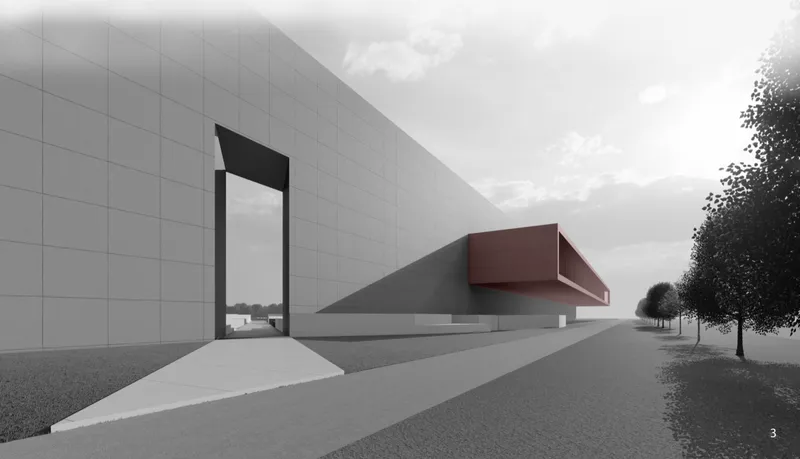
Against the low, fragmented field, the long gridded panel wall offers a strong counterpoint. A tall framed opening breaks its rhythm, and a red cantilevered box projects from the surface, catching the low sun beside a row of trees. These are the moments where the project chooses to be visible, giving the otherwise dispersed library a recognisable face from the street.
That visibility connects to the vertical logic of the scheme. The designers place formal learning at +7.50, describing the upper volume as a landmark that symbolises knowledge while remaining accessible. The tension between a quiet, embedded ground and an assertive elevated presence is one of the more interesting choices here: the project accepts that a public institution needs some legibility, but it refuses to let that legibility dictate how the rest of the site behaves.
The Sunken Level as a Protected Commons
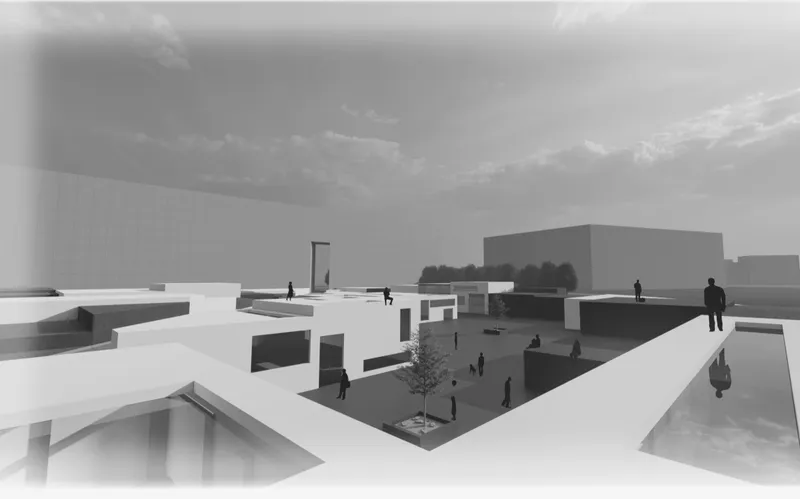
The rooftop view looks down over the white volumes into a sunken courtyard with a tree, small figures and a reflecting pool under heavy cloud. This is the informal library at -3.00, set into the landscape so that it feels sheltered without being closed. Dropping the level three metres below grade gives it a degree of acoustic and visual calm, while the open courtyard keeps it connected to sky and street.
Placing the informal zone at the lowest point is a telling inversion. Traditional libraries often reserve their most protected spaces for formal study. ESCAPE gives that protection to experimentation, conversation and community use instead, and with accessibility guaranteed at both -3.00 and +0.00, the sunken commons is not a basement but a second ground floor.
Why This Project Matters
Public libraries are being asked to do more than store books, yet many new ones still default to the same diagram of halls, desks and controlled entrances. ESCAPE offers a clear alternative: break the institution into human-scaled pieces, thread them with capillary paths, and let the section, from -3.00 to +7.50, carry the difference between informal and formal learning. The approach is legible in plan and convincing in the renderings, where people sit on roofs and gather in courtyards rather than queue at a counter.
The open question is how such a porous field would handle the practical demands of collections, climate and security, issues the proposal leaves largely implicit. But as a position, the project is valuable. Batu Özenalp and Yusef Kimyon argue that freedom of movement is itself a form of access to knowledge, and they give that argument a spatial form worth testing.
View the Full Project
About the Designers
Designers: Batu Özenalp, Yusef Kimyon
Enter a Design Competition on uni.xyz
uni.xyz runs architecture and design competitions year-round that reward proposals with spatial conviction and real site intelligence.
Project credits: ESCAPE by Batu Özenalp, Yusef Kimyon.


Popular Articles
Popular articles from the community


GROUP A Strips a 1969 Rotterdam Harbor Headquarters to Its Frame and Wraps It in Timber Louvers
In Rotterdam's M4H harbor district, Ferro Offices reuses a 1969 frame, adds one timber storey and reaches BREEAM-NL Outstanding.

Juan García Correa, John González and Claudia Rueda Sink a Circular Amphitheater into a Manizales Engineering Building
On the La Nubia campus in Manizales, Colombia, the S1 Building folds labs and offices into a hillside of ramped lawns that double as a campus route.

David Macias Steps a Doorless Stone and Plaster House Down a Tropical Colombian Hillside
In the humid hills of Colombia, Threshold House replaces the front door with an open void and terraces its 850 m² down the slope instead of fighting it.

Architekt Andreas Gruber Scatters 23 Dark Timber Chalets Across a South Tyrolean Forest Edge
In Molini di Tures, Amonti Chalets breaks a resort into a hamlet of gabled timber houses, with parking, storage and services pushed into the slope.

Similar Reads
You might also enjoy these articles
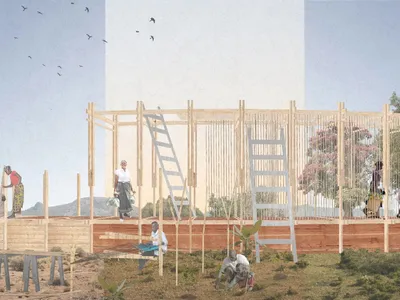
Healing Façade: A Modular Chapel System That Restores Ethiopia's Sacred Forests
Winner of the Eco-Chapel competition, this circular timber façade collects water from air to rebuild soil and reforest degraded Ethiopian landscapes.
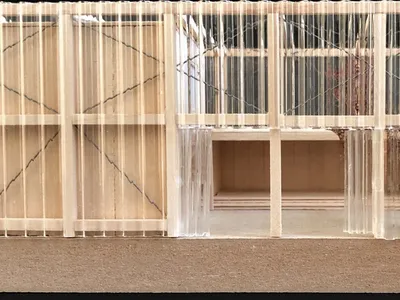
Kaffeebühnen: Where Coffee Shop Architecture Becomes a Civic Stage in Vienna
A linear sequence of timber boxes, transparent shells, and open yards turns the Viennese café tradition into a public performance space.
Eco Chapel: A Modular Forest Pavilion That Grows Like the Landscape It Protects
Hexagonal timber modules weave through existing trees, turning a chapel into a living system for prayer, education, and reforestation.


Urban Forest: A Vertical Ecosystem for 5,000 Workers in Singapore's Changi Business Park
Radially stacked pods and layered green decks turn a 7-acre plot into 47 acres of ecological workspace projected for 2040.

Comments (0)
Please login or sign up to add comments
No comments yet. Be the first to comment!